
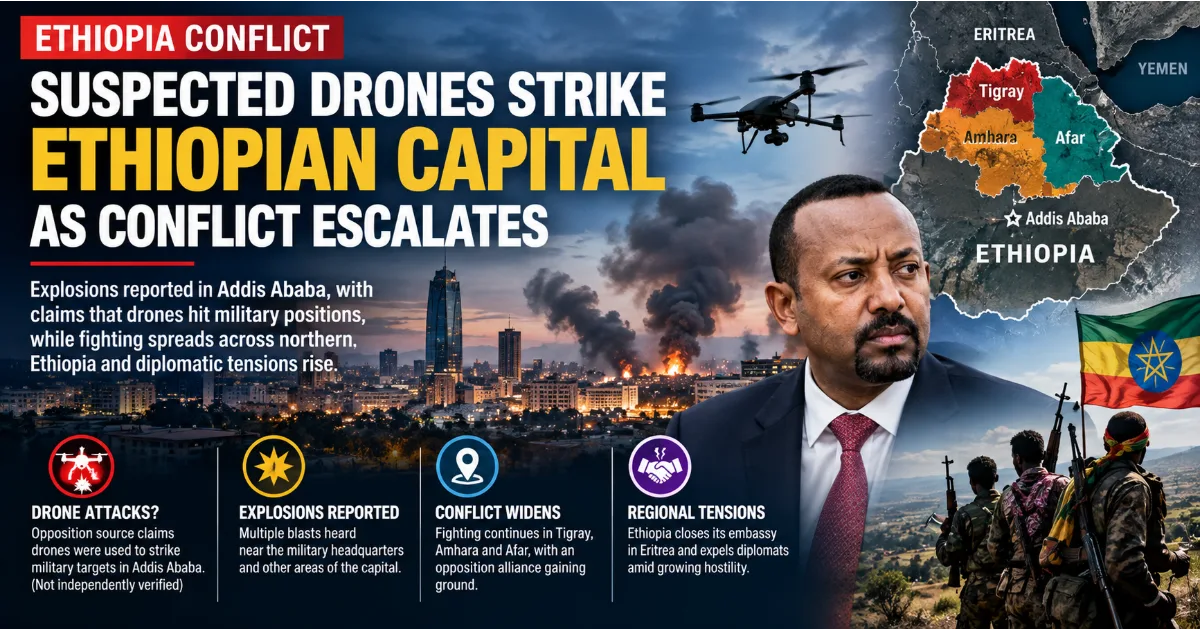
Explosions in Ethiopia’s capital, Addis Ababa, have raised the stakes in a rapidly worsening conflict that had already spread across the northern regions of Tigray, Amhara and Afar. Multiple blasts were reported overnight on September 30 and October 1, including in the vicinity of Ethiopia’s military headquarters, while a source linked to an opposition alliance claimed that drones had been used to attack military positions in the capital. The claim has not been independently verified, and Ethiopian authorities have not publicly confirmed that drones caused the explosions. But the combination of the reported blasts, a government ban on drone flights over Addis Ababa and the intensifying fighting in northern Ethiopia has created a new level of concern about the geographical reach of the conflict.
If the reported drone operation is eventually confirmed, it would represent a major development in Ethiopia’s renewed conflict. Addis Ababa is hundreds of kilometres from the principal battlefronts in the north and is the country’s political, administrative and military centre. A successful or attempted drone strike against military facilities there would demonstrate that armed opposition groups have developed or acquired the ability to conduct attacks deep inside territory controlled by the federal government. At present, however, it is important to distinguish what is established from what remains a claim. Reuters reported that three diplomatic sources confirmed that explosions were heard in the capital, while a source linked to the opposition alliance claimed responsibility for several drone strikes, including an alleged attack on the military headquarters. Reuters said it could not independently verify that claim.
The reported explosions came at a particularly dangerous moment for Ethiopia. Fighting that began in northern Ethiopia in late September has shattered the relative calm established by the November 2022 Pretoria agreement, which ended the devastating 2020 to 2022 Tigray war. The latest conflict is no longer limited to a confrontation between the federal government and the Tigray People's Liberation Front, or TPLF. The TPLF has joined a wider coalition of armed groups from different parts of Ethiopia, while federal forces and allied militias have been fighting on multiple fronts. The United Nations has warned that the situation is deteriorating rapidly and that the expansion of hostilities is putting civilians and humanitarian operations at increasing risk.
The significance of Addis Ababa lies partly in what the capital represents. Ethiopia is one of Africa’s largest and most strategically important countries, and Addis Ababa is home to the federal government, the national military leadership, diplomatic missions and the headquarters of the African Union. The city has largely been removed from the direct battlefield dynamics that have characterised the northern conflict. Reports of explosions close to military installations therefore carry a significance beyond the immediate physical incident. They suggest that the conflict may be developing a capability to threaten institutions at the centre of the Ethiopian state, even though the available evidence does not yet establish the scale or effectiveness of any such capability.
The reported incidents also occurred shortly after Ethiopia’s National Intelligence and Security Service announced an indefinite ban on drone flights over Addis Ababa and surrounding areas. The authorities said the restriction was intended to protect national leaders, critical infrastructure and major public events, and warned that legal action could be taken against unauthorised drone operators. The timing of that decision, followed by reports of explosions and an opposition claim of drone attacks, has naturally intensified scrutiny of the security situation in the capital. But the existence of the drone ban does not itself prove that the subsequent explosions were caused by hostile drones.
According to reporting from Mada Masr, an Ethiopian security source said defence systems had detected what the source described as an attempted attack involving suicide drones against vital facilities in Addis Ababa, including the military command headquarters in the Tor Hailoch area and the vicinity of the 24th Infantry Division headquarters in the Kirkos district. A resident near the military headquarters reported hearing two explosions. These claims provide additional detail, but they remain dependent on sources rather than independent verification of the full sequence of events.
That uncertainty is particularly important in a conflict where information is already heavily contested. Ethiopia's federal government and its opponents have issued competing accounts of who initiated the latest fighting, what territories have changed hands and what role neighbouring states may be playing. Communications disruptions in Tigray have made independent verification even more difficult. Reuters reported that internet and telephone connectivity in parts of Tigray had been severely disrupted, while humanitarian organisations have warned that restrictions on communication and movement are making it harder to assess conditions on the ground.
The renewed conflict began against the background of unresolved tensions left by the previous Tigray war. The 2022 Pretoria agreement halted large-scale fighting, but it did not eliminate the political, territorial and security disputes that had contributed to the earlier conflict. The relationship between the federal government and Tigrayan political forces remained strained, while disputes over territory, political authority and the implementation of the peace agreement continued. The United Nations warned as early as January 2026 that renewed tensions in Tigray were creating a worsening security environment and raising the possibility of a wider conflict.
By September, those tensions had developed into open fighting. The United Nations said on September 23 that it was gravely concerned by the rapidly deteriorating situation in northern Ethiopia, including the seizure and occupation of airports in Mekelle, Axum and Shire and the spread of hostilities into neighbouring areas. The organisation called on all parties to exercise maximum restraint, protect civilians and allow humanitarian organisations to reach people in need.
The battlefield subsequently expanded across Tigray, Amhara and Afar. Pro-government forces reported advances, while opposition forces captured or contested strategic locations. One of the most important developments was the reported capture of Alamata, a strategically located town south of Mekelle. Reuters reported that video evidence verified the presence of pro-government forces in the town, while diplomatic sources also said it had fallen. The town is significant because of its position near the boundary between Tigray and Amhara and its role as a supply route for troops, fuel and food.
Government forces have also been moving toward Mekelle, the capital of Tigray. Al Jazeera reported that federal forces had advanced to positions roughly 40 kilometres from Mekelle, while the TPLF was reportedly repositioning fighters and some leaders had left the city. The military situation remains fluid, and information from the front is difficult to verify independently.
The possibility of drone warfare is particularly significant because drones have already played an important role in the conflict. The Ethiopian military has used imported and domestically produced drones against targets in Tigray, according to conflict monitoring cited by Reuters. The use of drones gives military forces the ability to conduct surveillance and strikes without exposing aircraft and pilots to the same risks associated with conventional air operations.
For years, Ethiopia's federal forces have maintained a substantial advantage in aerial surveillance and strike capability. That advantage has been one of the factors shaping the battlefield in the north. Reuters reported that telecommunications disruptions in Tigray may have been connected to efforts to reduce the government's ability to use battlefield drones, although the TPLF denied responsibility for the shutdowns. The same reporting noted that Ethiopian forces had large stocks of imported and domestically manufactured drones.
If opposition groups have now developed the ability to use drones for deep strikes against federal military infrastructure, the balance becomes more complicated. A drone does not need to destroy a major installation to have an operational effect. The mere possibility of attack can force a military to disperse equipment, increase air-defence coverage, restrict aviation, protect command centres and devote additional resources to detecting small aerial threats. In that sense, even limited drone operations can impose costs on a much larger military organisation.
There is also a psychological dimension. Addis Ababa is not simply another Ethiopian city. It is the seat of national power and the location of institutions that represent the authority of the federal government. Reports of explosions near military headquarters could therefore have a significance disproportionate to the physical damage involved. They can affect public confidence, raise concerns about the security of government installations and demonstrate to supporters and opponents that the conflict is no longer confined to remote regions.
Yet it would be premature to conclude that Addis Ababa has become a new conventional battlefield. Available reporting does not establish sustained attacks against the capital, nor does it demonstrate that opposition forces can repeatedly penetrate the city's airspace. The reported incidents could represent an isolated attempt, a limited series of attacks or something different altogether. Independent verification of the weapons involved, targets hit and damage caused remains incomplete.
The broader political consequences are already more visible. On October 1, Ethiopia announced that it was closing its embassy in Eritrea and expelling 10 Eritrean diplomats, accusing Eritrea of direct and indirect hostile actions against Ethiopia. Eritrea rejected allegations that it was supporting the armed opposition alliance. The diplomatic rupture represents a serious escalation in relations between two countries whose relationship has repeatedly shifted between cooperation and confrontation.
Eritrea's role is particularly sensitive because of its history with the Tigray conflict. During the 2020 to 2022 war, Eritrean forces fought alongside Ethiopian federal forces against the TPLF. That relationship helped the federal government defeat the Tigrayan forces militarily, but it also produced allegations of serious abuses and became one of the most controversial aspects of the war. The Pretoria peace agreement did not include Eritrea as a party in the same way it included the Ethiopian federal government and the TPLF.
Relations between Addis Ababa and Asmara have subsequently deteriorated. One source of tension has been Ethiopia's desire for secure access to the Red Sea. Ethiopia became landlocked after Eritrea's independence in 1993, and Prime Minister Abiy Ahmed has repeatedly emphasised the strategic and economic importance of maritime access. Eritrea, meanwhile, has strongly resisted Ethiopian ambitions involving its territory and ports. The issue has become an important part of the wider strategic environment surrounding the current conflict.
The latest diplomatic confrontation therefore cannot be separated entirely from the military crisis in Tigray. Ethiopia has accused Eritrea, Sudan and Egypt of supporting opposition forces, while those countries have rejected various accusations made against them. The involvement of neighbouring states remains one of the most sensitive questions surrounding the renewed conflict because Ethiopia's internal war could become connected to wider regional rivalries involving the Red Sea, Sudan and the Nile basin.
The possibility of regional escalation is one reason the United Nations has repeatedly called for restraint. Ethiopia sits at the centre of a strategically important part of Africa. Its borders connect it to Eritrea, Sudan, South Sudan, Kenya, Somalia and Djibouti, while the country itself hosts the headquarters of the African Union. A major internal war would therefore have consequences extending well beyond Ethiopia's borders.
The humanitarian consequences are another major concern. The previous Tigray war produced enormous civilian suffering. Estimates of deaths vary according to methodology, but the African Union has cited around 600,000 deaths from combat, famine and the collapse of healthcare during the 2020 to 2022 conflict. The renewed fighting is occurring in communities that have not fully recovered from that catastrophe.
The United Nations has warned that people displaced by the previous conflict face additional protection risks while new displacement is already taking place. The UN Resident and Humanitarian Coordinator in Ethiopia said on September 30 that the situation was creating serious concerns for civilians, including those who had already been displaced during the earlier war. Humanitarian organisations have also reported incidents affecting aid personnel, vehicles and facilities.
The problem is not simply the number of people forced to flee. Conflict also disrupts food distribution, medical treatment, telecommunications, transport and local markets. In Tigray, restrictions on access have already brought humanitarian operations close to a standstill in some areas. The UN said on October 1 that escalating drone activity and airstrikes across northern Ethiopia were putting civilians, critical infrastructure and humanitarian operations at growing risk.
One particularly serious incident reported by the UN involved a drone strike in northwestern Tigray that hit a truck carrying food assistance for internally displaced people. The UN had already warned that humanitarian access was becoming increasingly difficult and that aid organisations needed safe and unhindered access to affected communities.
This illustrates why the spread of drone warfare is not merely a military issue. Modern drones can be used against military positions, but they can also threaten roads, warehouses, electricity infrastructure and humanitarian convoys. Even when strikes do not directly hit civilians, the perception that an area is under aerial threat can make humanitarian workers less able to move and can encourage authorities to restrict access.
The communications blackout adds another layer of difficulty. When telephone and internet networks are disrupted, journalists and humanitarian organisations lose important channels for verifying information. Families can lose contact with relatives, businesses cannot operate normally and emergency responders may struggle to coordinate. In a conflict where both sides accuse the other of initiating attacks and where territorial claims change rapidly, the lack of independent information becomes especially consequential.
The reported Addis Ababa explosions therefore arrive at the intersection of several crises. There is a military crisis in northern Ethiopia, a political confrontation between the federal government and an increasingly broad opposition coalition, a humanitarian emergency, a diplomatic rupture with Eritrea and an emerging concern about the ability of armed groups to project force far beyond the traditional front lines.
The opposition alliance itself represents a significant change from the earlier Tigray conflict. Seven armed groups have reportedly joined the Ethiopian Peoples' Forces Alliance for Survival, including the TPLF and organisations associated with Amhara, Afar, Somali and Benishangul-Gumuz regions. The alliance has declared an objective of removing Prime Minister Abiy Ahmed's government.
Such an alliance is complicated because its members do not necessarily share identical political objectives. Ethiopia's armed conflicts have historically involved overlapping ethnic, territorial and political disputes. Groups that cooperate against the federal government may still have competing interests regarding territory, regional autonomy and political power. The durability of the alliance therefore remains an open question.
For the federal government, the emergence of a coordinated opposition coalition presents a different challenge from confronting a single regional force. Multiple fronts can stretch military resources and complicate logistics. If armed groups can operate simultaneously in Tigray, Amhara, Afar and other areas, federal forces must divide their attention across a much larger geographic area.
Drone technology could potentially amplify that challenge. A relatively small number of operators can use drones to threaten fixed installations, surveillance sites, airfields or military concentrations. The actual effectiveness depends on the type of drone, its range, guidance system, payload, operator training and ability to evade air defences. But the technology allows armed groups to extend the reach of their operations without having to physically occupy territory near the target.
That is why reports of possible drone attacks in Addis Ababa are being watched closely. The capital is far from the northern battlefields, meaning any ability to reach it would represent a significant expansion in the geographical scope of the conflict. However, the available evidence currently supports describing the incidents as reported or suspected drone attacks rather than as an established sustained campaign.
The distinction is especially important because Ethiopia's information environment is highly contested. The government has its own account of the war, opposition groups have their own narratives, and outside observers often lack direct access to conflict zones. Satellite imagery, diplomatic sources, local witnesses and humanitarian organisations can provide pieces of information, but none necessarily provides a complete picture.
That makes independent verification critical. If further evidence emerges showing that drones struck military facilities in Addis Ababa, investigators will need to establish the type of weapons used, where they originated, which targets were intended and what damage was caused. Such evidence could clarify whether the incidents represent a new operational capability or an isolated attempt.
The regional implications could be even more serious if the conflict continues to expand. Ethiopia's relationship with Eritrea is already deteriorating sharply. Ethiopia has closed its embassy in Asmara and expelled Eritrean diplomats, while Eritrea has responded by severing diplomatic relations. The two countries previously fought a major border war from 1998 to 2000, and their rivalry has remained an important factor in Horn of Africa security.
A direct confrontation between Ethiopia and Eritrea would transform the current crisis. It could create another military front, place additional pressure on already vulnerable communities and complicate international efforts to restore the Pretoria peace framework. It could also interact with conflicts in Sudan and Somalia, creating a wider regional security problem.
For now, however, the central story remains Ethiopia's internal conflict and the breakdown of the fragile post-2022 peace. The United Nations continues to support efforts by the African Union and regional organisations to return the parties to dialogue. The UN Secretary-General has urged all sides to exercise maximum restraint, protect civilians and avoid actions that could produce a broader and more devastating conflict.
The coming days will be important. Developments around Mekelle will determine whether federal forces can consolidate their advance into Tigray. The ability of opposition forces to maintain positions across multiple regions will determine whether the conflict becomes a prolonged multi-front war. The government's response to alleged drone operations will show whether Addis Ababa believes the capital faces a continuing aerial threat. And the diplomatic confrontation with Eritrea could determine whether the current crisis remains primarily an Ethiopian civil conflict or develops into something wider.
The reported explosions in Addis Ababa should therefore be viewed in that broader context. The immediate question is what happened during the night of September 30 and October 1. Were drones responsible? Were military facilities actually damaged? Who launched the weapons? How many were involved? Those questions remain incompletely answered.
The larger question is what the incident tells us about the direction of the war. Ethiopia's conflict is no longer simply a dispute over political control in Tigray. Armed groups from different regions have formed an alliance, fighting has spread across several parts of the country, drones and airstrikes are increasingly part of the battlefield, humanitarian operations are being disrupted and relations with Eritrea have deteriorated to the point of a diplomatic break.
If the Addis Ababa drone allegations are confirmed, the incident would mark an important new stage in that escalation. It would show that the conflict has acquired a long-range dimension capable of reaching the country's political centre. But even without confirmation, the fact that the capital has imposed an indefinite drone ban and that explosions have been reported near military facilities demonstrates how quickly the security environment has changed.
For civilians, the immediate concern is not the symbolism of a new military capability but the possibility of another prolonged war. Tigray is still recovering from the devastation of the previous conflict. Families displaced during the earlier war face the possibility of being displaced again. Humanitarian organisations are already struggling to maintain access. Communication networks are disrupted in parts of the north. Medical facilities are under pressure. Food security remains vulnerable.
The experience of the 2020 to 2022 war demonstrates how quickly a political confrontation can develop into a humanitarian catastrophe when fighting becomes entrenched. The international community is therefore watching the current escalation with particular concern. The UN has repeatedly stressed that the Pretoria framework remains relevant and that dialogue is the preferred route for preventing a return to full-scale war.
The events in Addis Ababa are a warning that the geographic boundaries of the current conflict may be changing. Whether the suspected drone attacks prove to be an isolated incident or the beginning of a sustained campaign remains unknown. What is clear is that Ethiopia is entering a period of heightened uncertainty in which military developments in the north, political struggles in Addis Ababa and tensions with neighbouring Eritrea are becoming increasingly interconnected.
The immediate task for all sides is therefore not only to control territory but to prevent the conflict from expanding beyond the point where political dialogue becomes even more difficult. Every new battlefield, every disruption to humanitarian access and every escalation between Ethiopia and its neighbours increases the potential cost.
The suspected drone strikes, if confirmed, would be another sign that the conflict is changing. They would demonstrate that the technologies of modern warfare are reaching deeper into Ethiopia's political heartland. But the deeper story is not simply about drones. It is about the collapse of a fragile peace, the re-emergence of unresolved political and territorial disputes, the formation of new armed alliances and the growing risk that a national conflict could acquire regional consequences.
For now, the evidence supports caution. Explosions in Addis Ababa have been confirmed by multiple sources, and an opposition-linked source has claimed that drones were responsible. Ethiopian authorities have imposed a drone ban over the capital. But independent verification of the alleged attacks and their effects remains limited. As fighting continues in Tigray, Amhara and Afar and Ethiopia's relations with Eritrea deteriorate, the most important question is whether the latest escalation can still be contained before another devastating cycle of war takes hold.
#BeyondHeadlines #Ethiopia #AddisAbaba #EthiopiaConflict #Tigray #DroneStrike #DroneWarfare #Eritrea #HornOfAfrica #TPLF #EthiopianArmy #AfricaNews #AfricanPolitics #Geopolitics #CivilWar #Conflict #HumanitarianCrisis #EthiopiaNews #TigrayConflict #PeaceProcess #Africa #InternationalRelations #WorldAffairs #Security #DroneTechnology