
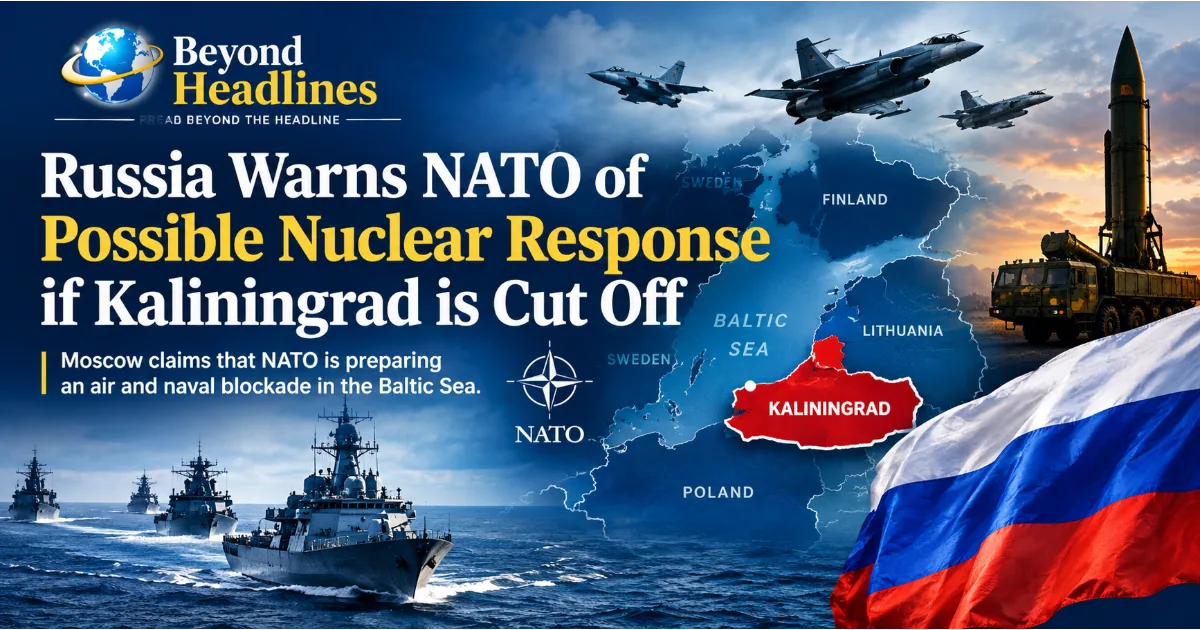
A new warning from Moscow has placed the small Russian exclave of Kaliningrad at the centre of one of the most sensitive security questions in Europe, with Russia telling NATO that any attempt to isolate the territory from the rest of the country could trigger a response involving its entire military arsenal, including nuclear weapons. The warning, delivered through a diplomatic communication to NATO and echoed publicly by Russian diplomatic missions, comes as military activity and strategic competition have intensified around the Baltic Sea. At the same time, NATO has rejected the suggestion that it is preparing to blockade Kaliningrad, with Secretary General Mark Rutte describing the alliance as defensive and saying there is no imminent threat of Russian nuclear use against the Baltic states.
That distinction is essential to understanding what has actually happened. Moscow has made a serious nuclear warning, and the warning itself is documented. But the assertion that NATO is preparing an air and naval blockade of Kaliningrad remains a Russian claim rather than an independently established fact. Reporting from Reuters says the Russian diplomatic note accused NATO of following what Moscow described as a dangerous course with a high risk of direct armed conflict. Russia said it would be prepared to use its full range of capabilities, including nuclear weapons, if NATO countries attempted to isolate Kaliningrad from the rest of Russia. NATO, meanwhile, has rejected the premise that its exercises or activities constitute a threat to Russian territory.
For Europe, the significance of the warning lies not only in the nuclear language but in the geography behind it. Kaliningrad is unlike most Russian territory. It is an exclave, separated from mainland Russia and surrounded on its landward sides by NATO members Poland and Lithuania. It sits on the Baltic Sea and has become one of Russia's most heavily militarised territories. Its location gives Moscow an important military position in the Baltic region, while its separation from the Russian mainland creates a strategic vulnerability that has been a source of concern for planners on both sides for years. The result is a piece of territory where geography, military infrastructure and competing security doctrines intersect unusually sharply.
The latest warning therefore cannot be understood simply as another exchange of hostile rhetoric. It reflects a deeper problem surrounding the Baltic Sea. Since Russia's full-scale invasion of Ukraine, NATO and Russia have increasingly viewed military activity in the region through the lens of potential confrontation. Finland and Sweden's accession to NATO transformed the alliance's geographical position around the Baltic. NATO has increased its presence and surveillance in the region, while Russia has continued to emphasise the military importance of Kaliningrad and its other Baltic assets. Every exercise, aircraft patrol, naval deployment or discussion about critical infrastructure can now be interpreted through a much more dangerous strategic framework than existed before the war in Ukraine.
Why Kaliningrad Matters So Much
Kaliningrad's importance begins with its location. The territory lies between Poland and Lithuania, both members of NATO, while its coastline opens onto the Baltic Sea. From Moscow's perspective, it is a forward military position that places Russian capabilities close to several NATO countries. From NATO's perspective, its location creates a heavily militarised Russian territory inside a region where the alliance has responsibility for the defence of multiple member states.
Reuters has described Kaliningrad as a potential flashpoint because of this combination of geography and military infrastructure. The territory hosts Russia's Baltic Fleet and nuclear-capable Iskander missile systems. Its air-defence, missile and naval capabilities give Russia the ability to project military power across parts of the Baltic region and beyond. At the same time, its physical separation from mainland Russia means that any serious military confrontation involving the territory would raise immediate questions about reinforcement, resupply and access.
This is where the concept of isolation becomes particularly important. Kaliningrad is connected to the rest of Russia through air and sea links and through routes that cross or approach NATO territory. That does not mean that the territory is currently under blockade, nor does it establish that NATO is preparing one. It does mean that military planners on both sides have long considered the possibility of how access to the exclave could be affected during a major conflict.
The issue is therefore not simply about a piece of territory on a map. It is about whether Russia could maintain military and civilian connections with an isolated region during a confrontation with NATO. Any attempt to deliberately cut those connections would carry enormous escalation risks because NATO members would be directly involved in controlling or contesting routes around a Russian territory that Moscow regards as sovereign.
That is why the Russian diplomatic warning is so significant. Moscow has explicitly connected the possibility of Kaliningrad being isolated with the potential use of its full military arsenal. Reuters reported that the Russian note also warned of the possibility of strikes against decision-making centres in NATO member states from the outset of a conflict. Such language moves the discussion beyond conventional military competition and into the realm of strategic deterrence and nuclear signalling.
Russia's Nuclear Warning
The central message from Moscow is that Kaliningrad should not be treated as an isolated military problem that could be contained without consequences for the wider Russian state. Russia's diplomatic communication stated that it would be ready to use its entire arsenal, including nuclear weapons, to defend its territory if NATO countries attempted to isolate the Kaliningrad region from the rest of Russia.
That does not mean that nuclear weapons are about to be used. The distinction between nuclear signalling and actual nuclear employment is crucial. Nuclear-armed states frequently communicate their willingness to escalate under particular circumstances as part of deterrence. Such statements are designed to communicate consequences and influence the calculations of an adversary. Whether they represent an imminent operational decision is a separate question.
NATO Secretary General Mark Rutte addressed that distinction directly on September 30. Asked whether the Russian warning represented a real risk of nuclear weapons being used against the Baltic states, Rutte said it did not. He said NATO had responded to Russia by emphasising that it is a defensive alliance and by urging Moscow to stop making nuclear threats. He also said NATO's assessment of the Russian threat had not changed compared with assessments from weeks and months earlier.
Rutte's comments provide the other half of the story. Moscow is describing a potential attempt to isolate Kaliningrad as a threat serious enough to justify the possibility of nuclear escalation. NATO is saying that its activities are defensive and that there is no imminent nuclear threat to the Baltic states. These positions are sharply different, but they are not evidence that a blockade is already underway.
That is why the language surrounding the story matters. Saying that Russia has threatened nuclear escalation if Kaliningrad is cut off is supported by the available reporting. Saying that NATO is currently blockading Kaliningrad would go beyond the evidence. Saying that NATO is preparing such a blockade would require evidence that has not been independently established in the reporting available so far.
The Baltic Sea Has Become a Strategic Front
The wider Baltic Sea environment has changed dramatically since Russia launched its full-scale invasion of Ukraine in 2022. Finland and Sweden subsequently joined NATO, strengthening the alliance's position around the Baltic and altering the region's strategic geography. Reuters reported that NATO has increased activity partly because of concerns about threats to undersea energy and communications infrastructure.
The Baltic is now a region where military and civilian infrastructure overlap. Commercial shipping moves through the sea. Undersea cables carry communications and energy connections. Pipelines and other critical infrastructure cross the seabed. Naval forces operate alongside civilian vessels. Aircraft from multiple countries patrol the airspace. The density of activity creates opportunities for surveillance and deterrence, but it also creates opportunities for accidents and misinterpretation.
NATO's response has included increased monitoring and protective activity. The alliance launched Operation Baltic Sentry in 2025 to help protect critical undersea infrastructure. Military exercises have also continued in the region, with additional activity planned during 2026. From NATO's perspective, these measures are connected to regional security and the protection of allied infrastructure. From Moscow's perspective, however, the accumulation of NATO military capabilities around the Baltic can be interpreted as evidence of increasing pressure on Russian positions.
That difference in interpretation is itself a security problem. A military exercise intended by one side as defensive preparation can be viewed by the other side as rehearsal for offensive action. Increased surveillance intended to prevent surprise can be interpreted as preparation for a strike. More naval patrols intended to protect infrastructure can appear to the other side as the beginning of an effort to control maritime access.
This does not mean that the two interpretations are equally supported by evidence. It means that strategic competition becomes more dangerous when each side increasingly interprets the other's defensive preparations through the possibility of offensive action.
The Kaliningrad Question and the Baltic States
Kaliningrad's location also brings the Baltic states into the centre of the discussion. Lithuania, Latvia and Estonia are NATO members, and their geography has long been considered strategically sensitive because of their proximity to Russia and Belarus.
For NATO, the security of these countries is covered by the alliance's collective defence commitments. For Russia, NATO's expansion into the Baltic region has been repeatedly presented as evidence of an increasingly hostile military environment near Russian territory. The competing positions have been part of the broader European security confrontation for years, but the war in Ukraine has made the consequences more immediate.
Kaliningrad sits directly within this strategic environment. Its military infrastructure can influence NATO's calculations around the Baltic, while NATO's presence around the territory can influence Russian calculations about its own security.
The result is a geographic paradox. Kaliningrad provides Russia with a forward military position, but the same geography that gives it strategic value also makes it vulnerable to isolation in a major conflict. The territory's location between NATO members means that Russia cannot treat its military security there in the same way it would treat the security of a region connected directly to the Russian mainland.
That vulnerability is part of the reason why Moscow has reacted so strongly to suggestions that Kaliningrad could be isolated.
What Does "Blockade" Actually Mean?
The word "blockade" carries considerable military and legal significance. It is not synonymous with military exercises, surveillance or increased naval activity. A genuine blockade would involve deliberate efforts to prevent maritime or other forms of access to a territory. Such an action would represent a major escalation, particularly if carried out against territory belonging to a nuclear-armed state.
The Russian claim that NATO is preparing an air and naval blockade therefore represents a serious allegation. But the available reporting does not establish that such a blockade is currently being prepared. Reuters reported that a Western military source described an unannounced NATO aircraft operation around Kaliningrad in August that demonstrated the ability to disrupt Russian radar, communications and air-defence capabilities in a conflict scenario. That is significant from a military planning perspective, but it is not evidence by itself of an operational plan to blockade the territory.
This distinction matters because military forces routinely conduct exercises and simulations designed to demonstrate capabilities without indicating that those capabilities are about to be used. A force may practise disabling radar without intending to disable that radar tomorrow. A navy may train for maritime control without intending to impose a blockade. Aircraft may practise operating in contested airspace without a decision having been made to conduct combat operations.
For observers trying to understand the present situation, separating capability from intent is therefore essential.
Nuclear Signalling in a Conventional Crisis
The most dangerous aspect of the Kaliningrad dispute is the possibility that a conventional confrontation could become entangled with nuclear signalling. Russia and NATO possess large nuclear arsenals, and both sides understand that direct military conflict could carry consequences far beyond the immediate battlefield.
Russia's warning appears designed, at least in part, to establish a deterrent boundary around Kaliningrad. Moscow is communicating that it considers the territory an integral part of Russia and that attempts to isolate it could have consequences far beyond conventional military operations. Whether that message changes NATO planning is impossible to determine from the public information currently available.
NATO, for its part, has sought to prevent the Russian warning from being interpreted as evidence of an imminent nuclear crisis. Rutte said there was no imminent threat to NATO territory and rejected the idea that the warning indicated a real and immediate risk of Russian nuclear use against the Baltic states.
The exchange illustrates an uncomfortable feature of nuclear deterrence. The objective of nuclear signalling is often to prevent war by convincing an opponent that escalation would be too costly. Yet repeated nuclear threats can also create instability if they become normalised or if the other side becomes uncertain about where the actual thresholds lie.
That is particularly dangerous when the two sides disagree about the meaning of a particular action. If one side considers a maritime restriction to be an act of war while the other regards it as a lawful security measure, the possibility of miscalculation increases.
The Danger of Miscalculation
A major conflict does not necessarily begin with a deliberate decision by both sides to enter a war. History contains numerous examples of crises in which accidents, misunderstandings and incorrect assumptions contributed to escalation. The Baltic environment has several characteristics that make this concern relevant today.
Military aircraft operate close to national borders. Naval vessels operate near busy commercial routes. Drones and surveillance systems are active across the region. Electronic warfare can interfere with communications and navigation. Undersea infrastructure is vulnerable to damage. Each of these factors creates situations in which an incident could be interpreted differently by different governments.
The problem becomes particularly acute when political relations are already deteriorating. A radar incident that might otherwise be treated as a technical problem could be interpreted as deliberate interference. A naval encounter that might normally end with diplomatic complaints could become a military confrontation if one side believes the other was testing its response.
Kaliningrad amplifies these risks because of its military importance. A confrontation near the territory could rapidly involve air-defence systems, naval forces, missiles and electronic warfare capabilities.
The result would not necessarily be a nuclear conflict. But the existence of nuclear weapons changes the stakes of every conventional confrontation between Russia and NATO.
The Suwałki Corridor and the Geography of Access
Any discussion of Kaliningrad inevitably leads to the geography between Poland and Lithuania. The area around the Polish-Lithuanian border has received significant attention from military planners because it connects the Baltic states to the rest of NATO's territory while also lying between Kaliningrad and Belarus.
This geography creates competing strategic concerns. NATO wants to ensure that the Baltic states can be reinforced and defended. Russia wants to ensure that Kaliningrad cannot be isolated and that its military position in the region remains viable. Belarus, Russia's close military partner, adds another geographical factor to the equation.
The importance of this corridor does not mean that a military conflict is inevitable. It means that geography has made the region one of the most closely watched areas of Europe's security architecture.
The Russian nuclear warning should therefore be understood within this larger geographical context. Moscow is not talking about an arbitrary piece of territory. It is talking about a heavily militarised exclave that occupies a strategically important position in the Baltic region.
Why NATO's Response Matters
NATO's response has been deliberately different in tone from Moscow's warning. Rutte has stressed that NATO is a defensive alliance and urged Russia to stop making nuclear threats. He also said that NATO's assessment of the Russian threat had not changed.
That response serves several purposes. First, it rejects the Russian suggestion that NATO's current activities constitute preparation for a blockade. Second, it seeks to prevent public perceptions of an immediate nuclear crisis. Third, it reinforces NATO's stated position that its military posture is intended to protect member states.
Rutte also said NATO was prepared to defend NATO territory. That is consistent with the alliance's basic collective-defence role, but it also underscores the potential consequences if a confrontation around Kaliningrad were to involve Poland, Lithuania or another NATO member.
The alliance therefore has to maintain two messages simultaneously: deterrence must be credible, but escalation must remain controlled.
Why This Story Is Bigger Than Kaliningrad
The immediate story concerns a Russian warning over one territory. The larger story concerns the future security architecture of Europe.
The Baltic Sea has become a region where Russia and NATO increasingly operate in close proximity. The accession of Finland and Sweden has changed the alliance's geographical position. Russia's war against Ukraine has transformed European defence planning. Critical infrastructure has become a strategic security concern. Military exercises have become more frequent and more closely watched. Nuclear language has returned to European security debates with greater prominence.
Kaliningrad sits at the intersection of all these developments.
It is a military outpost, a Russian territory, a Baltic port region and an exclave surrounded by NATO countries. Its strategic value is precisely what makes it vulnerable to pressure. That contradiction is likely to remain central to European security discussions regardless of whether the current dispute develops into something more serious.
The Difference Between Deterrence and Escalation
There is another important question behind the current exchange: when does deterrence become escalation?
Russia's warning is clearly intended to communicate a red line. The message is that Moscow considers isolation of Kaliningrad unacceptable and potentially serious enough to justify extreme military responses. Such warnings can be intended to prevent an adversary from taking a particular action.
But deterrence depends on credibility and restraint. If threats become too broad or too frequent, they can lose some of their ability to distinguish genuinely dangerous situations from routine political messaging. At the same time, an adversary may begin to assume that a threatened response will not actually occur.
NATO faces the opposite challenge. The alliance needs to communicate that it can defend its members without creating the impression that it intends to attack Russian territory. This is particularly difficult around Kaliningrad because the territory's military capabilities are directly relevant to NATO's regional defence planning.
The balance between those two objectives is one of the central strategic challenges in the Baltic.
What Is Known and What Remains Unclear
Several facts are established by the current reporting. Russia has sent a diplomatic warning to NATO. The warning included a reference to the possible use of nuclear weapons if NATO attempted to isolate Kaliningrad. Russian diplomatic missions have publicly described what Moscow says is information about preparations for an air and naval blockade. NATO has responded that it is a defensive alliance and has rejected the Russian characterisation of its activities. NATO Secretary General Mark Rutte has said there is no imminent threat of Russian nuclear use against the Baltic states.
What remains unclear is whether there is any actual NATO plan to blockade Kaliningrad. The public evidence cited in current reporting does not establish that. Military exercises and operations demonstrating the ability to disrupt communications, radar or air defences show that certain capabilities exist, but capability is not the same thing as a decision to conduct an operation.
The intentions of governments are also difficult to establish from public statements alone. Russia's warning may be intended primarily as deterrence. NATO's response may be intended to reassure member states while avoiding unnecessary escalation. Neither interpretation can be confirmed as the sole motivation without additional evidence.
This uncertainty is precisely why careful reporting matters.
A Dangerous Moment, But Not Proof of Imminent Nuclear War
The presence of nuclear language in the latest Russian warning is serious. It should not be dismissed simply because NATO has rejected the threat as unhelpful or because Rutte has said there is no imminent danger. At the same time, the warning should not automatically be presented as evidence that nuclear war is approaching.
The available information points instead to a highly tense strategic confrontation in which both sides are communicating boundaries, demonstrating military capabilities and attempting to influence the calculations of the other.
That is dangerous enough without exaggeration.
The central risk is miscalculation. If military activity around Kaliningrad intensifies, if maritime access becomes contested, or if an incident involving aircraft or ships produces casualties, political leaders could face pressure to respond quickly. In such an environment, the distinction between signalling and action becomes increasingly important.
For that reason, the most consequential developments to watch are not simply the next dramatic statement from Moscow or Brussels. They are concrete changes in military posture, confirmed restrictions on shipping or airspace, new deployments, official changes to rules of engagement, or diplomatic measures that materially alter access to Kaliningrad.
Those developments would provide a stronger indication of whether the current dispute is remaining at the level of deterrence and political signalling or moving toward a direct confrontation.
The Kaliningrad Question Is a Test of European Security
Kaliningrad has existed as a strategic challenge for decades, but the circumstances surrounding it have changed. NATO's enlargement, Russia's war in Ukraine, the accession of Finland and Sweden, growing concern about Baltic infrastructure and increased military activity have all made the region more strategically important.
The latest Russian warning is therefore part of a much wider contest over the security architecture of northern Europe.
For Moscow, Kaliningrad is Russian territory whose security is tied to the country's wider military posture. For NATO, the region sits within a defensive environment involving Poland, Lithuania and other alliance members. Both sides have reasons to take the territory seriously, and both sides have incentives to prevent a direct military confrontation.
That is what makes the current situation so delicate.
The headline may be about nuclear weapons, but the deeper story is about geography, deterrence, military signalling and the difficulty of managing confrontation between nuclear-armed powers.
Kaliningrad is small compared with Russia as a whole, but its strategic importance is much larger than its size. It sits at a point where Russian military power meets NATO's eastern flank, where commercial shipping crosses strategic waters and where the boundaries between conventional deterrence, military planning and nuclear signalling can become blurred.
The latest warning should therefore be read carefully. Russia has explicitly threatened the possibility of using nuclear weapons if NATO attempts to isolate Kaliningrad. NATO has rejected the claim that it is preparing such a blockade and says its activities are defensive. There is currently no confirmed evidence establishing that NATO is preparing an actual air and naval blockade of the Russian exclave.
Beyond the headline, the real concern is not simply whether one side is threatening the other. It is whether the increasingly militarised Baltic environment leaves enough room for both sides to recognise the difference between deterrence and provocation, between an exercise and an attack, and between a warning intended to prevent war and a warning that could unintentionally contribute to it.
For Europe, that distinction has become increasingly important. Kaliningrad is not merely a Russian enclave on the Baltic map. It is a pressure point in a wider confrontation whose consequences could extend far beyond the territory itself. As long as Russia and NATO remain locked in strategic competition, the challenge will be to maintain credible defence while preventing military signalling from becoming a pathway to direct conflict.
The immediate crisis may pass without any blockade or military confrontation. But the underlying strategic problem will remain. Kaliningrad will continue to sit between Russia's mainland and NATO's Baltic members, heavily armed and strategically exposed. The Baltic Sea will continue to carry both commercial traffic and military significance. And nuclear weapons will remain part of the background calculation whenever Russia and NATO confront each other directly.
That is why the latest warning deserves attention, but also precision. The facts are serious enough on their own. Russia has issued the warning. NATO has responded. The alleged blockade remains unconfirmed. The military geography is real. The nuclear arsenals are real. And the possibility of miscalculation is a genuine concern identified in reporting around the crisis.
The story of Kaliningrad is ultimately a story about how geography can turn a relatively small territory into a major strategic flashpoint. It is about how military exercises can be interpreted as signals, how signals can become threats, and how threats can alter the calculations of nuclear-armed governments. It is also a reminder that in a region crowded with military forces, the most dangerous moment may not necessarily be the moment when leaders decide to fight. It can be the moment when one side believes the other has already decided to do so.
For now, the available evidence shows a serious diplomatic and strategic confrontation, not a confirmed NATO blockade and not evidence of imminent nuclear war. What happens next will depend on whether Moscow and NATO can keep their competing military preparations within the boundaries of deterrence and prevent the Baltic from becoming the site of a confrontation neither side intended to begin.
#BeyondHeadlines #Russia #NATO #Kaliningrad #BalticSea #NuclearWeapons #Geopolitics #EuropeanSecurity #RussiaNATO #BalticStates #Poland #Lithuania #MilitaryNews #GlobalSecurity #NuclearDeterrence #WorldAffairs #InternationalRelations #Defence #Security #Europe