
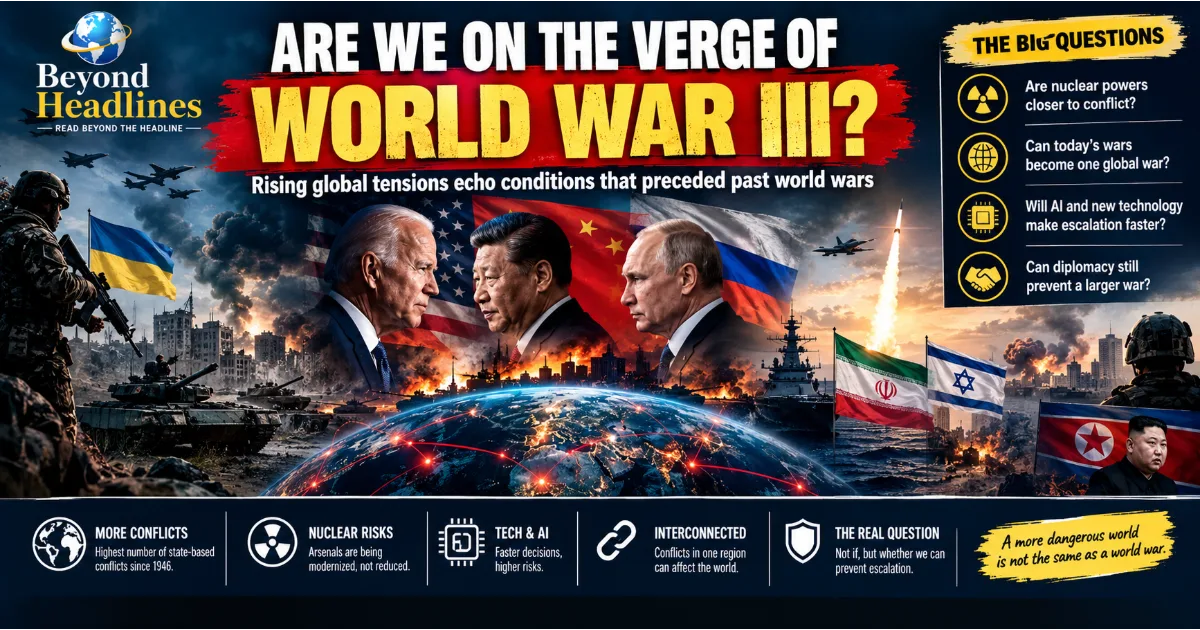
The phrase “World War III” has moved from the vocabulary of science fiction and strategic speculation into everyday geopolitical discussion. Wars are being fought simultaneously in several regions. Nuclear powers are directly involved in some of them. The United States and China are competing over technology, trade, military power and influence. Russia's war against Ukraine has entered its fifth year. The Middle East has experienced direct military confrontation involving Israel, Iran and the United States. India and Pakistan have experienced renewed conflict. North Korea is expanding its military capabilities while deepening its relationship with Russia. Taiwan remains one of the world's most closely watched potential flashpoints.
Against that backdrop, a question raised by a recent Japan Times commentary by Brad Glosserman is understandable: are today's tensions beginning to resemble the conditions that preceded the two world wars? Glosserman's August 12 analysis noted that historians are quick to identify parallels with the period before 1914, while also examining the limits of that comparison. (The Japan Times)
The answer is not a simple yes or no.
There are genuine reasons for concern. The number of armed conflicts is extraordinarily high. Competition among major powers is becoming sharper. Nuclear arsenals are being modernized rather than steadily dismantled. Military technologies are changing rapidly. International institutions are under pressure. Several regional conflicts involve overlapping alliances and outside powers.
At the same time, the world of 2026 is not the world of 1914 or 1939. Nuclear deterrence fundamentally changes the calculations of major powers. Economic interdependence remains substantial. Governments possess communication mechanisms that did not exist before the First World War. International organizations, although weakened in some areas, continue to provide diplomatic channels. And today's conflicts, despite their connections, do not yet constitute a single war involving the world's major powers in direct, sustained combat against one another.
That distinction is essential.
The world can become considerably more dangerous without becoming a world war.
In fact, one of the most important questions for understanding the current moment is not whether a Third World War has already begun. It is whether the mechanisms that historically prevented regional conflicts from becoming global ones are becoming weaker, while the mechanisms that could connect separate conflicts are becoming stronger.
That is where the real warning signs lie.
The World Is Experiencing an Extraordinary Concentration of Conflict
There is little dispute about the deterioration in the global security environment.
Research published by the Peace Research Institute Oslo and based on Uppsala Conflict Data Program data found that 2025 recorded 65 state-based conflicts across 35 countries, the highest number since records began in 1946. Eight of those were interstate conflicts, twice the number recorded the previous year and the highest level since 1946. Battle-related violence killed approximately 245,000 people in 2025, according to the latest UCDP assessment. (Peace Research Institute Oslo)
Those figures do not mean that the world is automatically heading toward another world war.
They do, however, demonstrate that the international security environment is unusually violent.
The geographical concentration is also important. Ukraine remains the centre of the largest conventional war in Europe in generations. The Middle East has become a complex network of conflicts involving states and armed groups. Sudan remains one of the world's most devastating wars. Yemen and the Red Sea continue to have international consequences. Myanmar remains embroiled in prolonged armed conflict. The India-Pakistan relationship remains vulnerable to escalation. North Korea's military posture continues to create risks in Northeast Asia.
These conflicts have different causes.
That point is often lost when the phrase “World War III” is used.
Russia's war against Ukraine is fundamentally different from the Israel-Iran conflict. The security confrontation on the Korean Peninsula has a different history from the Taiwan question. Sudan's civil war is not simply another front in the competition between Washington and Beijing.
Treating all these conflicts as pieces of one giant war can obscure rather than clarify what is happening.
The Lowy Institute made this point in a September analysis arguing that today's conflicts overlap and interact without necessarily converging into a single global war. It compared the current situation more closely with historical periods such as the Seven Years' War, when major powers fought across multiple theatres for different reasons, rather than with the two twentieth-century world wars. (The Lowy Institute)
That distinction is useful because it separates geographical interconnectedness from political unity.
A world can experience many simultaneous conflicts without those conflicts becoming one war.
The danger emerges when the objectives, alliances and military operations of major powers begin to converge.
Why 1914 Still Haunts Strategic Thinking
The comparison with 1914 persists because the First World War did not begin as an obvious global catastrophe.
Before the assassination of Archduke Franz Ferdinand, Europe had experienced years of strategic competition, military planning, alliance-building and political tension.
The great powers had competing interests. Germany, France, Britain, Russia and Austria-Hungary were deeply concerned with their relative positions. Nationalism was powerful. Military establishments had become increasingly influential. Arms races were underway. Alliances created commitments that could transform a local confrontation into a wider conflict.
Yet many leaders did not expect the crisis that followed to produce four years of industrialized slaughter.
That is one of the most important lessons from the First World War.
The danger is not necessarily that governments deliberately choose a global war.
The danger can be that governments take actions they consider limited, rational or defensive, only to discover that their opponents interpret those actions differently.
One country mobilizes because it fears attack.
Another interprets the mobilization as preparation for invasion.
A third activates an alliance commitment.
A fourth believes it must strike before its strategic position deteriorates.
The resulting chain can move faster than diplomacy.
That is why historians remain interested in 1914.
The relevance is not that 2026 is secretly identical to 1914.
It is that complex international systems can produce outcomes that no individual government originally intended.
Today's Alliances Are Different
There is, however, a major difference between the international system of 1914 and the present.
Today's great powers possess nuclear weapons.
The United States, Russia, China, France, the United Kingdom, India, Pakistan, North Korea and Israel are all nuclear-armed states, according to the Stockholm International Peace Research Institute.
SIPRI estimated that the world contained approximately 12,187 nuclear warheads in January 2026, including around 9,745 in military stockpiles potentially available for use. Approximately 4,012 were deployed with missiles and aircraft, while between 2,100 and 2,200 deployed warheads were maintained at high operational alert, overwhelmingly by Russia and the United States. (SIPRI)
That makes the prospect of direct war between major nuclear powers fundamentally different from the conflicts of 1914 and 1939.
The consequences of escalation are potentially existential.
This creates a powerful incentive for governments to avoid direct confrontation.
But nuclear weapons create another problem.
They do not eliminate conflict.
Instead, they can encourage states to compete below the threshold of direct war.
Cyber operations, proxy forces, economic coercion, sanctions, information operations, covert activity, drone warfare and limited military interventions can all become attractive because they allow governments to pursue objectives while attempting to avoid triggering a catastrophic confrontation.
The result can be a paradox.
Nuclear weapons may make direct great-power war less likely while making indirect competition more persistent.
The Nuclear Danger Is Not Disappearing
The nuclear balance itself is changing.
SIPRI's 2026 assessment warned that nuclear-armed states are increasingly relying on nuclear weapons as instruments of national power and that decades of progress toward reducing nuclear arsenals are being reversed. All nine nuclear-armed states continued to modernize their arsenals in 2025. (SIPRI)
Russia and the United States continue to possess the overwhelming majority of the world's nuclear weapons.
But China's arsenal is expanding rapidly.
SIPRI estimates that China had approximately 620 nuclear warheads as of January 2026 and is expanding its nuclear forces faster than any other nuclear-armed state. Hundreds of missiles had been deployed into new silo fields, according to SIPRI's assessment. (SIPRI)
The strategic significance is larger than the number itself.
For decades, the nuclear relationship was dominated by the United States and Soviet Union, and later the United States and Russia.
A more complex nuclear system is emerging.
China is expanding its arsenal.
India and Pakistan remain nuclear rivals.
North Korea continues to develop nuclear weapons and delivery systems.
Israel maintains a nuclear capability without publicly acknowledging it in the same way as the recognized nuclear-weapon states.
More nuclear actors mean more potential interactions.
More interactions mean more opportunities for misunderstanding.
And as artificial intelligence, cyber capabilities, missile defenses and space-based systems become increasingly important to military operations, nuclear command and control itself is entering a technologically more complicated environment.
SIPRI has specifically identified the interaction between AI, international security and nuclear risk as an emerging issue. (SIPRI)
Ukraine Is Already a War With International Dimensions
Russia's war against Ukraine is the clearest example of how a regional conflict can acquire global strategic consequences without becoming a world war.
Russia and Ukraine are the primary combatants, but the conflict has drawn substantial involvement from NATO countries and other governments through military assistance, intelligence, sanctions, financial support and diplomatic backing.
North Korea has also become directly relevant to the conflict.
The Lowy Institute noted that North Korean troops and ammunition are supporting Russia's war effort in Europe while Pyongyang gains military experience, technology and leverage. (The Lowy Institute)
This creates an unusual situation.
A conflict geographically centred in Europe is influencing security calculations in East Asia.
Lessons from drone warfare, missile defense, electronic warfare and battlefield logistics are spreading between theatres.
Weapons and military technologies developed for one conflict can be adapted elsewhere.
That does not make Ukraine the beginning of a world war.
But it does demonstrate how modern conflicts can become interconnected.
A military development in Europe can alter calculations in Asia.
A weapons transfer involving one country can change the capabilities of another.
A conflict can therefore have consequences far beyond its immediate battlefield.
The Middle East Has Become Another Major Strategic Hub
The Middle East represents another major source of concern.
The United States, Israel and Iran have become directly involved in military confrontation, while Gaza, Lebanon and Yemen remain part of a wider regional security crisis.
The implications extend well beyond the region.
The Middle East is central to global energy markets. Major shipping routes pass through the region. The security of the Red Sea, Persian Gulf and surrounding waterways affects international trade.
A prolonged conflict can therefore influence oil prices, inflation, shipping costs, financial markets and military deployments across the world.
It can also force governments to make difficult strategic choices.
A country supporting one side in a regional conflict may find itself drawn into another confrontation.
Military resources deployed in one theatre may become unavailable elsewhere.
The United States' involvement in the Middle East, for example, inevitably affects perceptions in Europe and the Indo-Pacific.
That is one reason strategic analysts increasingly examine conflicts as interconnected systems rather than isolated events.
Taiwan Is Perhaps the Most Important Potential Flashpoint
If there is one location where a regional crisis could most clearly develop into direct confrontation between major powers, Taiwan occupies a special position.
China claims Taiwan as part of its territory and has not ruled out the use of force to achieve unification.
The United States maintains longstanding security commitments and extensive unofficial relations with Taiwan while deliberately preserving ambiguity about precisely how it would respond to an attack.
Japan also has a direct interest in the stability of the Taiwan Strait because of its geography, alliance relationship with the United States and dependence on regional trade.
The issue has become particularly sensitive in recent months.
Reuters reported that US allies in Asia have expressed concern about how President Donald Trump might approach Taiwan during his September meeting with Chinese President Xi Jinping. The uncertainty has been amplified by Trump's characterization of US arms sales to Taiwan as a negotiating tool and his reluctance to specify how Washington would respond to a conflict. (Reuters)
Taiwan itself has been strengthening its defenses.
The Associated Press reported that Taiwan recently conducted significant military exercises combining attack drones with conventional weapons, including anti-air, anti-ship and anti-landing missiles. The exercises came shortly before the Trump-Xi summit. (AP News)
This does not mean an invasion is imminent.
It means the parties involved are preparing for the possibility of conflict.
That distinction is crucial.
Military preparation can serve both offensive and defensive purposes.
A government may increase its military capabilities because it intends to attack, or because it wants to convince an adversary that an attack would be too costly.
This is one of the central dilemmas of deterrence.
Actions intended to prevent war can sometimes make the opposing side feel more threatened.
North Korea Adds Another Nuclear Flashpoint
The Korean Peninsula is another potential pathway through which a regional conflict could involve major powers.
North Korea possesses nuclear weapons and ballistic missiles and has deepened its relationship with Russia.
The Institute for the Study of War reported in September that North Korea had conducted a major missile and drone exercise involving multiple types of systems and that its uranium-enrichment infrastructure appeared to be expanding. The International Atomic Energy Agency had assessed that a newly constructed facility at Yongbyon could accommodate up to 28 centrifuge cascades, although the IAEA could not determine precisely how much highly enriched uranium it could produce. (Institute for the Study of War)
North Korea's military development therefore has implications beyond the Korean Peninsula.
South Korea and Japan are both US allies.
Any major conflict involving North Korea could rapidly become an alliance crisis.
And because North Korea has strengthened its relationship with Russia, developments on the Korean Peninsula are increasingly connected to broader strategic competition.
The Council on Foreign Relations describes the North Korean confrontation as a developing interstate conflict and notes the country's nuclear and ballistic-missile capabilities as a major security concern for South Korea and Japan. (Council on Foreign Relations)
Again, this does not mean a world war is inevitable.
It means there are more than one or two locations where miscalculation could have consequences for multiple major powers.
The China-Russia-Iran-North Korea Relationship Is Complicated
It is tempting to describe Russia, China, Iran and North Korea as a new unified military bloc.
The reality is more complicated.
The four governments cooperate in some areas, but they do not share identical strategic interests.
Russia has its own objectives in Ukraine and Europe.
China's central strategic concerns include Taiwan, the Indo-Pacific, economic development and competition with the United States.
Iran's security priorities are concentrated heavily on the Middle East and its regional relationships.
North Korea's central concern remains regime survival and security on the Korean Peninsula.
Their interests sometimes overlap, but overlap is not the same as a formal alliance.
This distinction matters because world wars historically involve organized coalitions capable of coordinating sustained military operations across theatres.
The current international system has partnerships, alignments and transactional relationships, but it does not reproduce the exact alliance structures of 1914 or 1939.
That may make a single coordinated global war less likely.
But it also creates uncertainty because relationships can change rapidly during crises.
The World Is Also More Economically Interdependent
Another difference from the early twentieth century is economic interdependence.
The global economy is deeply integrated.
China is a major trading partner for much of the world.
The United States remains central to global finance.
Europe depends on international energy and supply chains.
Asian economies are interconnected through manufacturing networks.
India is deeply integrated into global services, energy and trade systems.
A major war between the world's largest economies would therefore impose enormous costs on the countries fighting it and on countries attempting to remain neutral.
This creates an economic deterrent that did not operate in the same way before 1914.
But economic interdependence is not an absolute guarantee of peace.
The First World War itself occurred in an era of substantial international trade and financial integration.
The lesson is therefore not that trade prevents war.
It is that economic integration creates both incentives for cooperation and potential vulnerabilities.
Modern economic warfare can also become part of strategic competition.
Sanctions, export controls, restrictions on technology and critical minerals and financial measures increasingly function as instruments of geopolitical power.
Competition does not need to begin with tanks crossing a border.
It can begin with restrictions on chips, energy, currencies or supply chains.
Artificial Intelligence Could Change the Speed of Escalation
Technology is adding another layer of uncertainty.
Artificial intelligence is increasingly being integrated into intelligence analysis, cyber operations, surveillance, logistics, autonomous systems and decision support.
The potential benefit is obvious.
AI can process enormous quantities of information and identify patterns more rapidly than humans.
The risk is equally important.
If governments begin relying on automated systems during crises, decisions may be made faster than traditional diplomatic channels can respond.
An algorithm might identify an apparent attack before human analysts fully understand what happened.
A cyber-defense system might respond automatically.
An adversary might interpret that response as deliberate escalation.
The result could be a feedback loop.
This is particularly concerning when nuclear weapons are involved.
The international community has therefore begun discussing how AI should interact with nuclear command and control, autonomous weapons and cyber operations.
The emerging US-China dialogue on AI safety is an example of this broader concern. The two countries have discussed mechanisms for communicating about serious AI incidents precisely because increasingly capable systems could create risks that cross national boundaries.
That conversation illustrates a wider point.
Technology does not necessarily make war more likely.
But it can make the consequences of miscalculation faster and harder to control.
Space Is Becoming Another Strategic Domain
Modern military competition is also moving into space.
Satellites support communications, navigation, intelligence, missile warning and battlefield operations.
A conflict involving major powers could therefore involve attacks on satellites or space-based infrastructure even if the primary fighting occurred on Earth.
That creates another escalation problem.
A government might consider an attack on an adversary's satellite network a conventional military operation.
The targeted government might view it as a strategic attack because the same satellites support early warning or nuclear command systems.
The distinction between conventional and strategic attacks can therefore become blurred.
The more military systems depend on interconnected technology, the greater the importance of clearly understood rules and communication channels.
Why a World War Is Still Not the Same Thing as Many Wars
This is perhaps the most important point in the entire debate.
The existence of many wars does not automatically constitute a world war.
The Lowy Institute argues that today's conflicts have different causes and objectives and that their interaction should not automatically be interpreted as convergence into one global conflict. (The Lowy Institute)
A world war requires something more.
Historically, the First and Second World Wars involved sustained mobilization by major powers across multiple theatres.
Their economies were reorganized around warfare.
Mass armies were mobilized.
Industrial production was redirected.
Military alliances became directly involved.
Civilian populations became part of the war effort.
The entire structure of society changed around the conflict.
Today's international system has not reached that point.
There are multiple major wars and crises, but there is not currently a single global military mobilization involving the major powers against one another.
That distinction should prevent both complacency and sensationalism.
The world can be dangerously unstable without technically being in a world war.
The More Immediate Risk Is Escalation
Rather than asking whether World War III has already begun, a more useful question is whether existing conflicts have mechanisms capable of preventing escalation.
Consider the possible pathways.
A confrontation in Ukraine could escalate into direct Russia-NATO conflict.
A Taiwan crisis could lead to US-China military confrontation.
A North Korean attack could trigger US and South Korean intervention.
An incident involving Iran could draw additional regional and external powers into the conflict.
A conflict between India and Pakistan could escalate under the shadow of nuclear weapons.
These are different scenarios.
But they share a common feature.
Each could transform a regional conflict into a confrontation involving a major power.
That is why diplomatic communication matters so much.
Hotlines, military-to-military channels, crisis negotiations, ceasefire mechanisms and international institutions may appear bureaucratic when compared with military hardware.
In a crisis, however, they can be critical.
History Offers Warnings, Not Predictions
Historical comparisons are valuable when they reveal patterns.
They become dangerous when they are treated as forecasts.
The world of 1914 cannot simply be mapped onto 2026.
The world of 1939 cannot simply be reproduced.
Technology is different.
Economies are different.
Nuclear weapons fundamentally change strategic calculations.
International organizations exist.
Mass communication is instantaneous.
Governments have decades of experience with deterrence and crisis management.
At the same time, history can remind policymakers that stable systems can deteriorate faster than expected.
The First World War is a particularly powerful example because many leaders believed they could control the escalation.
They could not.
That is why historian Margaret MacMillan has recently warned that the present contains troubling parallels with the periods before both world wars, while also stressing that a world war is not inevitable. Her assessment has been cited in recent discussions about the present global security environment. (Legion Magazine)
That is a useful distinction.
Concern does not equal prediction.
Warning signs do not prove an outcome.
The Most Dangerous Combination Would Be Convergence
If there is one scenario that deserves particular attention, it is not the existence of multiple independent wars.
It is the convergence of those wars.
Imagine a situation in which the European conflict intensifies at the same time that tensions rise sharply around Taiwan and the Korean Peninsula.
Now add a major Middle Eastern crisis that requires significant US military resources.
The result would be a strategic environment in which governments have to divide attention, ammunition, intelligence assets and diplomatic resources across several theatres.
That is when miscalculation becomes particularly dangerous.
An adversary might interpret military redeployment from one region as weakness.
An ally might fear abandonment and take unilateral action.
A rival might decide that the moment provides an opportunity.
A local conflict could then become connected to another.
This is the kind of chain reaction that historians worry about when they examine the origins of global wars.
The important point is that such an outcome is possible without being inevitable.
India Has a Particular Interest in Avoiding a Global Confrontation
For India, the global security environment presents a complex set of challenges.
India has direct security interests in South Asia, particularly in its relationship with Pakistan and along its northern borders.
It is also a major participant in the Indo-Pacific, with growing strategic relationships involving the United States, Japan, Australia and other countries.
At the same time, India maintains important relationships with Russia and has significant economic ties with countries across the Middle East.
That gives New Delhi a strong interest in maintaining strategic flexibility.
A genuinely global conflict would have consequences far beyond military security.
India's energy imports could be affected by disruptions in the Middle East.
Global trade could suffer.
Shipping insurance costs could rise.
Supply chains could be interrupted.
Food and commodity prices could become more volatile.
Financial markets could experience major stress.
Technology access could become more restricted.
The experience of recent conflicts has already demonstrated how quickly distant wars can influence Indian inflation, fuel prices, currency markets and exports.
A world war would magnify those effects enormously.
What Would Actually Indicate That the Situation Had Crossed a Threshold?
There is no universally accepted checklist for declaring that the world has entered a Third World War.
But historically, several developments would be far more significant than another regional crisis.
Direct and sustained combat between major nuclear powers would be one such threshold.
Large-scale mobilization of national economies would be another.
Formal activation of major military alliances for sustained combat against another great power would be highly significant.
Simultaneous major-power warfare across several theatres would represent another fundamental change.
The use of nuclear weapons would obviously mark an extraordinary escalation, although a nuclear exchange is not a prerequisite for historians eventually classifying a conflict as a world war.
At present, those conditions do not collectively describe the international system.
That does not mean the current environment is safe.
It means the distinction between high global tension and world war remains important.
The Real Warning May Be the Weakening of Restraint
Perhaps the most concerning development is not any single conflict.
It is the gradual weakening of assumptions that once helped stabilize international relations.
Arms-control agreements have weakened.
Nuclear arsenals are being modernized.
International institutions face political and financial pressure.
Military technology is advancing rapidly.
Great-power competition is intensifying.
Regional conflicts are becoming more interconnected.
And political leaders increasingly speak in terms of strategic rivalry rather than shared international systems.
SIPRI's warning about the deterioration of nuclear arms control is particularly relevant here. Its 2026 assessment noted that the expiration of the US-Russia New START treaty in February 2026 has increased uncertainty about the future direction of strategic nuclear forces. (SIPRI)
This does not mean nuclear war is approaching.
It means one of the mechanisms that historically constrained nuclear competition has weakened.
That is precisely the kind of development that deserves sustained attention.
So, Are We on the Verge of World War III?
The evidence supports a more nuanced answer than either panic or reassurance.
The world is experiencing an unusually dangerous concentration of armed conflicts.
The number of state-based conflicts is at its highest level in decades.
Major powers are competing more intensely.
Nuclear arsenals are being modernized.
The United States, China and Russia are involved in increasingly serious strategic competition.
The Middle East remains unstable.
Ukraine remains a major war.
Taiwan remains a critical potential flashpoint.
North Korea continues to expand its military and nuclear capabilities.
New technologies are changing the speed and character of warfare.
These are genuine warning signs.
But there is still a crucial difference between a dangerous international system and an actual world war.
Today's conflicts remain largely distinct.
The major powers are not currently engaged in sustained direct warfare against one another across multiple theatres.
Nuclear deterrence continues to impose extraordinary costs on direct confrontation.
Economic interdependence creates incentives to avoid catastrophic escalation.
Diplomatic channels remain available.
And governments continue to make choices that can either increase or reduce the possibility of wider war.
The most responsible conclusion is therefore neither “World War III is coming” nor “there is nothing to worry about.”
It is that the margin for error appears narrower than it was during much of the post-Cold War period.
Beyond the Headline
The phrase “World War III” is powerful because it captures a genuine fear: that several apparently separate crises could eventually become one interconnected catastrophe.
But history teaches that global wars are not created simply by having many conflicts at the same time.
They emerge when political objectives, alliances, mobilization and military operations converge.
That convergence has not happened today.
The international system, however, is under considerable strain.
The data on global conflict are unmistakable. The number of armed conflicts is extraordinarily high. Nuclear arsenals are being modernized. The strategic relationships among the United States, China, Russia, Iran and North Korea are becoming more complicated. Taiwan and the Korean Peninsula remain dangerous flashpoints. Ukraine and the Middle East continue to generate consequences far beyond their borders. (Peace Research Institute Oslo)
That makes the present moment one that deserves serious attention.
But seriousness should not be confused with certainty.
The future of international security will depend on decisions that governments have not yet made.
A crisis can escalate.
It can also be contained.
An alliance can become a mechanism for deterrence.
It can also become a pathway for escalation.
Technology can make warfare more dangerous.
It can also improve warning systems and communication.
Diplomacy can fail.
It can also prevent conflicts from becoming larger.
The most important lesson from 1914 may therefore not be that another world war is inevitable.
It may be that leaders should never assume they have complete control over an escalating crisis.
That is why communication between rivals matters.
It is why nuclear safeguards matter.
It is why military hotlines matter.
It is why diplomacy matters even between governments that fundamentally disagree.
And it is why the question facing the world in 2026 is perhaps less dramatic, but more useful, than asking whether World War III has already begun.
The more important question is whether the international community can prevent today's separate crises from becoming one.
That remains an open question.
And unlike a historical event, it is one whose outcome is still being shaped now.
#BeyondHeadlines #WorldWarIII #WorldWar3 #GlobalConflict #Geopolitics #InternationalRelations #GlobalSecurity #WorldPolitics #Russia #Ukraine #China #Taiwan #UnitedStates #Iran #MiddleEast #NorthKorea #India #Pakistan #NuclearWeapons #NuclearRisk #NuclearDeterrence #MilitaryConflict #GlobalTensions #WorldNews #InternationalSecurity #WarAndPeace #GeopoliticalRisk #AIandWar #FutureOfWarfare #GlobalGovernance #Diplomacy #UN #IndoPacific #Europe #BeyondTheHeadline