
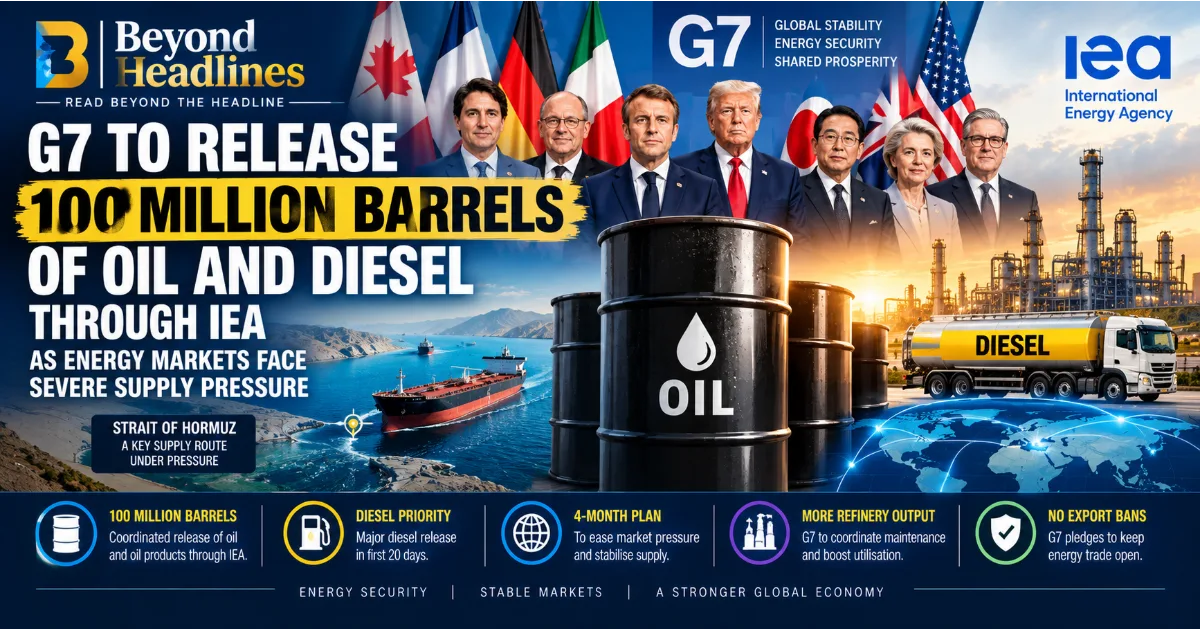
The Group of Seven has agreed to coordinate the release of 100 million barrels of oil and refined petroleum products through the International Energy Agency in an attempt to ease severe pressure on global energy markets, with a substantial quantity of diesel to be released within the first 20 days. The decision comes as governments confront exceptionally tight fuel supplies, elevated diesel prices and disruptions to international energy flows linked to conflicts in the Middle East and Eastern Europe. (Reuters)
The agreement was announced after a virtual meeting of G7 leaders on October 2, chaired by French President Emmanuel Macron, whose country holds the G7 presidency this year. The United States, Canada, France, Germany, Italy, Japan and the United Kingdom agreed to implement the release over four months and asked the IEA to monitor its implementation and assess its effect on energy security and market stability. The European Commission also participated in the meeting. (IEA)
The announcement is significant because the current energy squeeze is not simply a conventional crude-oil shortage. One of the most serious problems is the availability of refined products, particularly diesel. Crude oil can remain available while consumers still face fuel shortages if refineries, shipping routes, storage facilities or distribution networks are disrupted. The G7's decision therefore places unusual emphasis on diesel rather than treating the crisis solely as a crude-oil problem.
At the same time, the 100 million barrels should not be understood as 100 million barrels of diesel alone. The G7 statement refers to a coordinated release of 100 million barrels of oil and oil products, with a substantial diesel release brought forward during the first 20 days. The precise division between crude oil and refined products has not been publicly specified. (G7 Information Centre)
The distinction matters because crude released from strategic reserves does not immediately become diesel at filling stations. It must first be transported, processed by refineries and distributed through fuel markets. The effectiveness of the measure will therefore depend not only on the quantity released but also on refinery capacity, logistics, regional demand and the condition of international shipping routes.
Why the G7 Is Releasing Emergency Stocks
The immediate concern is the extraordinary pressure on global fuel markets.
The IEA said after the G7 meeting that the energy-market effects of the crisis around the Strait of Hormuz remained acute, particularly for diesel. IEA Executive Director Fatih Birol told G7 leaders that although crude-oil exports from the Middle East had recovered significantly, refined-product flows remained severely constrained. He also pointed to Ukrainian attacks on Russian refineries as another factor worsening diesel-market tightness. (IEA)
The Strait of Hormuz is particularly important because it is one of the world's most significant energy chokepoints. Large volumes of crude oil and petroleum products normally pass through the waterway connecting the Persian Gulf with the Gulf of Oman and the wider Indian Ocean.
Disruption to that route can affect not only the physical availability of oil but also insurance costs, shipping rates, delivery schedules and market expectations. Even when some cargoes continue moving, uncertainty about future shipments can push prices higher because traders and refiners begin competing for supplies.
The current crisis has been intensified by the broader conflict involving Iran, Israel and the United States, as well as continuing disruption connected with the war between Russia and Ukraine. The G7 statement explicitly linked its energy-security action to disruption around the Strait of Hormuz and called for restoration of navigational rights and freedom of commerce through the waterway. (G7 Information Centre)
For consumers, the consequences are most visible at fuel stations and in transport costs. Diesel is particularly important because it powers much of the global freight system, heavy industry, agriculture, construction equipment and commercial transportation.
A sustained diesel shortage can therefore spread through an economy even when petrol or gasoline supplies remain relatively more comfortable.
The IEA Is Central to the Response
The International Energy Agency is coordinating the broader strategic-stock response.
The IEA was established in the aftermath of the 1970s oil crisis and has a central role in coordinating emergency responses among its member countries. Its collective-security system requires member countries to maintain oil stocks equivalent to at least 90 days of net imports, subject to the agency's rules.
All seven G7 countries are members of the IEA.
The agency announced in March that member countries would collectively release 400 million barrels of oil from emergency reserves. By October 3, approximately 325 million barrels had already been released, representing more than 80% of the original commitment. (IEA)
That creates an important question surrounding the latest G7 announcement.
Is the new 100 million barrels an entirely additional release, or does it include the remaining portion of the March commitment?
The public statements do not provide a completely clear answer. The G7 statement says the 100 million barrels will be released “taking into account commitments that have already been fulfilled.” The IEA reported that approximately 325 million of the earlier 400 million-barrel commitment had already been released, leaving roughly 75 million barrels from that earlier programme. (G7 Information Centre)
This means the headline figure should be interpreted carefully. It would be misleading to automatically add the full 100 million barrels to the 325 million barrels already released without knowing precisely how the new commitment overlaps with the previous programme.
What is clear is that the G7 has asked for another coordinated mobilisation of strategic stocks, with diesel supplies frontloaded because refined-product markets are under particularly heavy pressure.
Diesel Is the Immediate Priority
The decision to frontload a substantial amount of diesel during the first 20 days is perhaps the most important operational detail in the G7 announcement.
Diesel is a critical industrial fuel. It is used by trucks, ships, construction machinery, agricultural equipment, generators and many forms of public and commercial transportation.
A shortage can therefore affect the cost of moving almost everything.
When diesel prices rise, transport companies face higher operating costs. Those costs can eventually be passed on to consumers through higher prices for food, manufactured goods and services. Farmers can also face higher costs for tractors, harvesting machinery and transportation. Construction companies can see expenses increase because heavy machinery generally relies heavily on diesel.
This makes diesel shortages economically sensitive in a way that goes beyond the price displayed on a fuel-pump sign.
The G7's decision therefore seeks to address a potential chain reaction.
If strategic reserves can increase the availability of diesel quickly enough, governments hope that they can reduce competition for limited supplies and moderate prices before shortages become more widespread.
But the timing is important.
The G7 has announced the release over four months, while the diesel component is supposed to be brought forward substantially within the first 20 days. That suggests policymakers are trying to address the immediate market shock while giving refineries, traders and governments more time to adjust to the wider supply situation.
Why Crude Oil Alone Cannot Solve the Diesel Problem
One of the easiest mistakes in understanding the announcement is to assume that releasing crude oil automatically solves a diesel shortage.
It does not.
Crude oil must be refined into products such as diesel, gasoline, jet fuel and other petroleum products. If refineries are operating close to maximum capacity, releasing more crude may not immediately increase the quantity of diesel available.
That is why the G7 statement also calls for coordination of refinery maintenance schedules and temporarily higher refinery utilisation where feasible. The objective is to reduce the possibility that several refineries will be offline simultaneously and to make better use of existing capacity. (G7 Information Centre)
This is an important part of the response because the current crisis involves a bottleneck in refined products as well as crude oil.
The IEA has highlighted the difference between crude flows and refined-product flows. Even though some Middle Eastern crude exports have recovered, refined products remain constrained. That imbalance is one reason diesel prices have become particularly sensitive. (IEA)
In practical terms, the world needs not only oil in the ground or crude sitting in storage tanks. It needs functioning refineries, available ships, open shipping routes, sufficient storage and reliable distribution networks.
A strategic reserve can help with one part of that chain.
It cannot repair every part of it.
The Four-Month Release Plan
Under the G7 agreement, the coordinated release will take place over four months.
The leaders instructed the IEA to monitor the immediate and full implementation of the March commitments and to coordinate the new release. They also agreed that a substantial diesel release should be brought forward into the first 20 days. (G7 Information Centre)
The four-month period is designed to provide a bridge through a period of unusually tight markets rather than permanently replace disrupted supplies.
That distinction is critical.
Emergency reserves are designed for emergencies. They are not an unlimited source of new oil.
Every barrel released from a strategic stockpile is a barrel that is no longer available for a future emergency unless it is subsequently replaced.
The G7 therefore also asked for a follow-up report within 20 days containing recommendations for future responses and stock replenishment.
That requirement recognises the basic dilemma facing policymakers.
They need to release enough fuel to prevent a damaging supply shock today, but they also need to retain sufficient reserves to protect against another crisis tomorrow.
The US Pressure Behind the Agreement
The G7 decision followed significant pressure from Washington over diesel supplies.
The Trump administration had considered restricting US diesel exports as domestic fuel prices climbed. The concern was that American consumers could face increasingly expensive diesel while US producers continued sending fuel to overseas markets.
A US export restriction, however, could have created problems elsewhere, particularly in Europe, which relies significantly on imported diesel.
The G7 agreement includes a commitment by members not to impose energy export restrictions on one another. The leaders also called on energy-producing countries to avoid export bans that could worsen market tensions. (G7 Information Centre)
That commitment is almost as important as the reserve release itself.
Energy markets are highly interconnected.
If one major supplier blocks exports, another country may attempt to compensate by importing more from a third country. That can raise prices across regions and create shortages elsewhere.
The G7 therefore appears to be trying to avoid a situation in which countries respond individually to a global supply problem and unintentionally make the overall shortage worse.
Europe Faces a Particularly Difficult Diesel Situation
Europe is especially exposed to diesel-market disruption.
The continent has historically relied heavily on imported refined products, and disruptions affecting Russia, the Middle East and maritime shipping can create significant pressure.
The situation becomes more sensitive as winter approaches because energy demand changes seasonally.
European governments therefore face a difficult balancing act.
They need to release enough fuel to reduce immediate price pressure while retaining adequate stocks for the colder months.
S&P Global reported that European diesel inventories had fallen to five-year lows, although it also noted that the precise nature of strategic inventories varies and that commercial stocks play an important role in the European system. (S&P Global)
This makes the G7 decision particularly important for Europe.
The reserve release may provide additional breathing room, but it does not eliminate the structural dependence on global fuel markets.
If international shipping remains disrupted or refinery outages continue, European governments could face renewed pressure after the emergency stocks have been used.
The US Strategic Petroleum Reserve Has Its Own Constraints
The United States also faces a strategic-reserve dilemma.
The US Strategic Petroleum Reserve is one of the world's largest emergency oil stockpiles, but it has already been drawn down substantially in recent years.
S&P Global reported that the US reserve was approaching a multi-decade low, creating a question about how much additional emergency capacity Washington can comfortably deploy without weakening its own buffer against future disruptions. (S&P Global)
That makes coordinated action more attractive.
Rather than relying entirely on the US reserve, the G7 approach spreads responsibility across several major economies.
The collective system also allows countries with different types and locations of petroleum stocks to contribute to the global response.
However, coordination does not eliminate national constraints.
Every government must consider its own energy security.
Will 100 Million Barrels Bring Prices Down?
The answer depends on several factors.
On paper, 100 million barrels is a substantial quantity.
If released evenly over four months, it would amount to roughly 830,000 barrels per day. But the actual release will not necessarily be even, and the diesel component will be frontloaded during the first 20 days. (euronews)
The market impact therefore depends on timing and composition.
If a large quantity of diesel reaches consumers quickly, the effect could be stronger in the short term.
If much of the release consists of crude, the impact on diesel prices will depend on refinery capacity.
If shipping through the Strait of Hormuz remains severely disrupted, additional stock releases may compensate for some lost supply but may not fully replace normal market flows.
And if Russian refinery disruptions continue, diesel markets could remain tight even after strategic stocks are released.
This is why analysts have cautioned that reserve releases can provide short-term relief without solving the underlying supply problem. S&P Global described the measure as potentially a temporary solution to a deeper global tightness in refined products. (S&P Global)
The Strait of Hormuz Remains the Central Risk
The G7 statement specifically called for the restoration of navigational rights and freedom of commerce through the Strait of Hormuz.
That reveals the central problem facing the global oil market.
Strategic stock releases can provide temporary supplies, but the long-term solution depends on restoring normal trade flows.
If tankers cannot move freely through major shipping corridors, the global market has to compensate through longer routes, alternative suppliers and emergency inventories.
All of those alternatives carry additional costs.
Shipping companies may face higher insurance premiums. Cargoes may take longer to reach their destinations. Refiners may pay more for suitable crude. Fuel distributors may need to find alternative suppliers.
Those costs eventually feed into consumer prices.
The G7 therefore regards the energy crisis not simply as an inventory problem but as a broader security and trade problem.
Russia's Refineries Add Another Layer of Pressure
The war between Russia and Ukraine is another important factor in the diesel market.
Ukraine has carried out attacks against Russian energy infrastructure, including refineries. The IEA said these attacks have exacerbated diesel-market tightness. (IEA)
Russia remains one of the world's major oil producers and refiners.
Disruptions to its refining system can therefore have international consequences even when global crude production remains relatively high.
A refinery outage is different from an oil-well shutdown.
If crude production falls, the market loses raw material.
If refining capacity falls, crude may remain available while supplies of diesel, gasoline and other products become tighter.
That distinction helps explain why the present crisis has been particularly severe for diesel.
The G7 Is Also Trying to Keep Refineries Running
The reserve release is only one part of the package.
The G7 has agreed to coordinate refinery maintenance schedules across member countries to reduce the possibility of simultaneous shutdowns. It also wants to temporarily increase utilisation rates where feasible. (G7 Information Centre)
This is a relatively technical measure, but it could have an important effect.
Refineries periodically need to shut down for maintenance. Those shutdowns are necessary for safety and reliability, but if multiple facilities undergo maintenance at the same time, available refining capacity can fall sharply.
Coordinating maintenance schedules can reduce that risk.
The G7 also called for cooperation with countries that possess significant refining capacity to increase global production of refined products, especially diesel.
This reflects an understanding that the crisis cannot be solved by G7 inventories alone.
Why Export Restrictions Could Make the Problem Worse
Another key element of the G7 agreement is the decision to avoid energy export restrictions among G7 countries.
At first glance, export restrictions may seem logical during a shortage. A government could attempt to keep more fuel at home by preventing companies from selling it abroad.
But international energy markets are interconnected.
Europe, for example, depends on fuel imports from outside the region. If a major supplier restricts exports, European buyers may need to compete for alternative supplies.
That can push global prices higher.
The G7 therefore chose cooperation over restrictions among its members. The leaders also called on oil producers to avoid bans that could intensify market tensions. (G7 Information Centre)
This does not guarantee that all countries outside the G7 will follow the same approach.
But it establishes a common position among some of the world's most important industrial economies.
What It Means for Consumers
For ordinary consumers, the G7 decision will ultimately be judged through prices and availability.
The most immediate potential benefit would be lower diesel prices or at least a reduction in the pace at which prices are rising.
Transport companies could benefit from lower fuel costs. Farmers could see some relief in operating expenses. Airlines, manufacturers and logistics companies could also benefit indirectly if broader energy-market pressure decreases.
But the effect will not be identical in every country.
Fuel prices depend on taxation, refining capacity, exchange rates, local inventories, transport costs and government subsidies as well as international crude prices.
A fall in the international oil price therefore does not necessarily translate one-for-one into lower retail prices.
The same applies to diesel.
The G7 can increase the amount of petroleum available to international markets, but individual governments determine many of the conditions under which consumers ultimately buy that fuel.
The Impact on Emerging Markets
The consequences extend well beyond the G7.
Emerging markets are often highly sensitive to oil and diesel prices because transportation and agriculture can represent large portions of household and business expenses.
Higher fuel prices can feed into food inflation, transport fares, electricity-generation costs and manufacturing expenses.
Countries that import most of their petroleum products are particularly exposed.
A coordinated release by the G7 could therefore have indirect benefits for developing economies if it succeeds in reducing global price pressure.
However, the distribution of benefits will depend on market conditions.
If fuel remains physically unavailable in certain regions because shipping routes are disrupted, a global inventory release may not immediately solve local shortages.
This is why the G7's emphasis on maintaining open trade is significant.
Global inventories only help countries that can access international markets.
A Temporary Fix for a Structural Problem
The G7's decision represents an emergency response rather than a permanent solution.
Strategic reserves exist precisely because governments cannot predict every future crisis.
But reserves cannot replace investment in refining capacity, diversified energy supply chains, alternative shipping routes and long-term energy resilience.
The current crisis demonstrates the vulnerability created when several disruptions occur simultaneously.
Middle Eastern shipping is under pressure.
Russian refining has been disrupted.
Diesel inventories are tight.
Refinery maintenance is becoming more sensitive.
And governments are considering restrictions on energy exports.
Each problem increases the pressure created by the others.
The G7 therefore needs to think beyond the immediate release.
That is why the group's statement asks for recommendations on future responses and replenishment of stocks. (G7 Information Centre)
Once emergency barrels are released, governments eventually have to replace them.
If they replenish reserves while prices remain high, the process could be expensive.
If they wait for prices to fall, they risk remaining underprepared for another supply disruption.
The Question of What Comes After Four Months
Perhaps the most important question is what happens when the four-month release period ends.
If global oil and diesel markets have returned to normal, the emergency measure could be judged successful.
If the Strait of Hormuz remains disrupted, Russian refining capacity remains constrained and global demand stays strong, governments could face another difficult decision.
They could release additional reserves.
But repeated emergency releases would gradually reduce the safety cushion.
Alternatively, governments could allow prices to remain elevated and rely on markets to encourage additional production and reduce consumption.
That approach would protect reserves but could impose significant costs on consumers and businesses.
The G7 has left open the possibility of additional diesel releases. Its statement says members will meet through the IEA in the coming days to discuss further action if necessary. (G7 Information Centre)
That means the 100 million barrels may not necessarily be the final intervention.
Markets React Before the Fuel Arrives
Energy markets often respond to announcements before physical supplies actually reach consumers.
The announcement itself can influence traders because it changes expectations about future availability.
If traders believe strategic releases will prevent a severe shortage, oil and diesel futures can decline even before the physical barrels are delivered.
But expectations can also reverse.
If shipping remains disrupted or another refinery outage occurs, traders may conclude that the emergency stocks are insufficient.
This makes communication by the G7 and IEA extremely important.
Markets need to know how much fuel will be released, when it will arrive, what types of petroleum products are involved and whether additional releases are possible.
Uncertainty itself can contribute to price volatility.
A Test of International Energy Cooperation
The current crisis is also testing whether major economies can coordinate their responses when national interests diverge.
The United States wants affordable fuel for American consumers.
European countries need secure diesel supplies.
Japan depends heavily on imported energy.
Canada is an important energy producer but also participates in global markets.
France, Germany, Italy and the United Kingdom face their own economic and energy-security pressures.
These interests do not always point in exactly the same direction.
Yet the G7 has agreed that coordinated action is preferable to competing national responses.
The IEA provides the institutional framework for that cooperation.
Its role is not simply to release oil. It also provides data, market analysis and a mechanism through which major consuming countries can coordinate emergency responses.
The current crisis is therefore a test of the broader international energy-security architecture.
What the IEA Has Already Done
The scale of the IEA's earlier response provides important context.
The agency said approximately 325 million barrels had already been released from strategic reserves since the March collective action, representing more than 80% of the original 400 million-barrel commitment. (IEA)
That is an unusually large intervention.
It demonstrates the seriousness with which governments view the current supply disruption.
It also means that strategic reserves are already being used extensively before the latest G7 announcement.
The challenge is to prevent the market from becoming dependent on emergency releases.
Strategic reserves are a buffer.
They are not production.
Once released, those barrels have to be replaced.
That is why the G7's commitment to stock replenishment planning will be important over the coming months.
What to Watch Next
Several developments will determine whether the G7 strategy succeeds.
The first is the speed of the diesel release. The group has promised a substantial amount during the first 20 days, making this the earliest test of the plan.
The second is the physical condition of the Strait of Hormuz. A sustained return to normal shipping would reduce pressure on emergency stocks considerably.
The third is Russian refinery output. Continued attacks or prolonged outages could keep refined-product markets tight.
The fourth is refinery utilisation in Europe, North America and Asia.
The fifth is winter demand. Colder weather can increase demand for heating fuels and place additional pressure on distillate markets.
The sixth is whether countries outside the G7 impose new export restrictions.
And the seventh is whether the IEA recommends another collective release.
These factors will determine whether the current emergency intervention becomes a temporary stabilising measure or the beginning of a much larger international response.
Beyond the Headline: The World Has Oil, but Getting It to Consumers Is the Problem
The headline figure of 100 million barrels is enormous, but the deeper story is more complicated.
The world is not simply running out of oil.
The current crisis is about the ability to move, refine and distribute energy at the scale required by a global economy.
Crude may exist underground.
Oil may exist in strategic storage.
But if ships cannot move safely through major waterways, if refineries are damaged or offline, if diesel inventories fall too low and if governments restrict exports, consumers can still experience severe shortages.
That is why the G7 has combined the reserve release with measures designed to keep energy trade open and refinery capacity available.
The strategy is essentially based on buying time.
Emergency stocks can fill part of the immediate gap.
Refineries can increase output.
Shipping routes can potentially reopen.
Markets can adjust.
And governments can work toward restoring normal supply.
But if the underlying geopolitical disruptions continue, emergency reserves will eventually face limits.
A Delicate Balance Between Relief and Resilience
The G7's 100 million-barrel decision is therefore both an economic intervention and a test of energy security.
The immediate objective is clear: reduce pressure on global energy markets, with particular attention to diesel.
The longer-term challenge is more difficult.
Governments must ensure that the emergency release does not leave their reserves dangerously depleted. They must also rebuild inventories, protect refining capacity and diversify supply routes.
The IEA will be central to that process.
The agency's data and coordination mechanisms provide governments with a framework for responding collectively rather than individually.
For consumers, the hope is that additional supplies will reduce the extraordinary pressure that has pushed fuel prices higher.
For governments, the priority is to prevent an energy-price shock from spreading into broader inflation, transport disruption and economic instability.
For markets, the crucial question is whether the physical supply situation improves fast enough to match the scale of the intervention.
The answer will depend on events far beyond the G7's control.
The Strait of Hormuz remains critical.
The Middle East conflict remains unresolved.
The war involving Russia and Ukraine continues to affect refining infrastructure.
And global energy demand remains substantial.
The 100 million-barrel release can provide breathing space, but it cannot by itself restore a normal global energy system.
The most important message from the G7 decision is therefore not simply that another 100 million barrels are coming onto the market.
It is that the world's major industrial economies now see the energy situation as serious enough to require coordinated emergency action.
The next few weeks will reveal whether that coordination is sufficient to ease the diesel squeeze.
The next few months will show whether markets can return to balance.
And the longer-term test will be whether governments can rebuild the reserves they are now drawing down while making the global energy system less vulnerable to the next geopolitical shock.
For now, the G7 has chosen to open the emergency stocks.
The bigger question is whether the world can restore the supply chains that made those emergency stocks necessary in the first place.
#BeyondHeadlines #G7 #IEA #OilPrices #Diesel #EnergyCrisis #EnergySecurity #OilReserves #StrategicReserves #GlobalEnergy #CrudeOil #FuelPrices #DieselPrices #StraitOfHormuz #Iran #Russia #Ukraine #UnitedStates #Europe #Japan #Canada #France #Germany #Italy #UnitedKingdom #GlobalMarkets #Geopolitics #EnergyMarkets #OilMarket #GlobalEconomy #Inflation #EnergyNews #WorldNews #InternationalNews #ReadBeyondTheHeadline