Britain Joins Historic French Nuclear Exercise as Paris Works With 10 European Nations to Strengthen Deterrence Against Russia
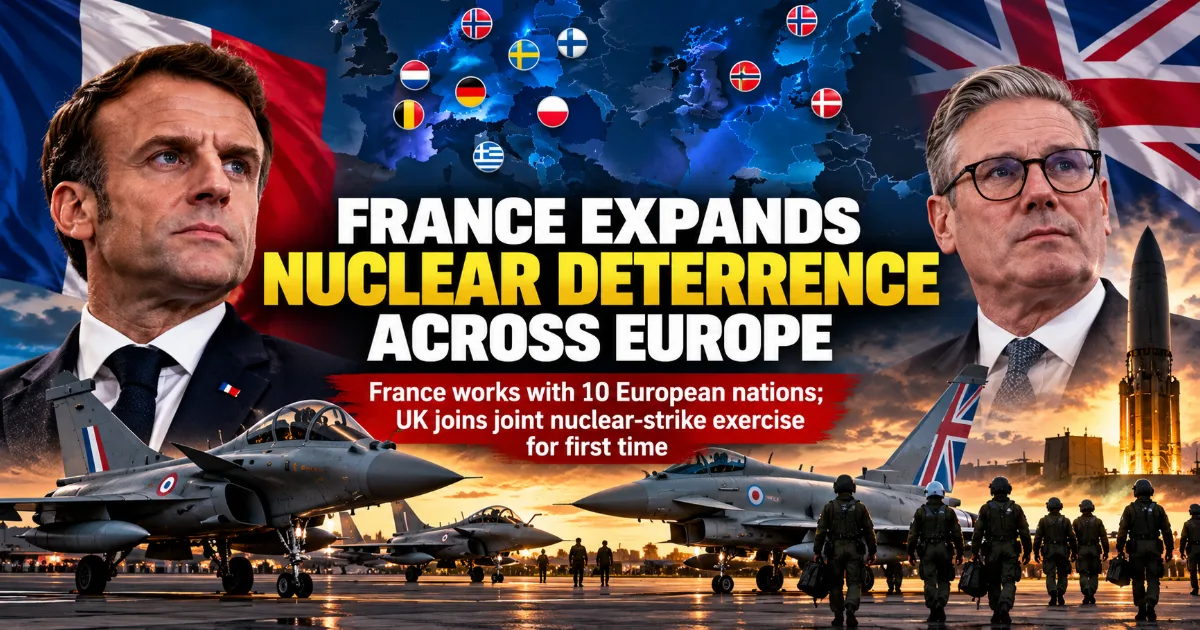
Europe is entering a new phase of defence cooperation as France seeks to expand the role of its independent nuclear arsenal and build closer security relationships with countries concerned about Russia's military power and the future reliability of American protection. The shift has become increasingly visible following a historic joint exercise in which British fighter jets escorted French nuclear-capable aircraft on a simulated nuclear strike mission for the first time. At the same time, France is working with 10 European countries on a broader initiative intended to strengthen deterrence through closer military coordination, intelligence sharing, early-warning systems and improved defence infrastructure.
The developments represent a significant change in how European governments are approaching their long-term security. For decades, the continent's defence strategy has depended heavily on the United States, whose nuclear arsenal and military presence form the central pillar of the North Atlantic Treaty Organization's deterrence against Russia. France and Britain also maintain independent nuclear forces, but their capabilities have historically operated within distinct national frameworks. Paris is now exploring ways to make its nuclear deterrent more relevant to the security concerns of neighbouring countries without surrendering French control over decisions involving nuclear weapons.
The immediate catalyst is a growing sense of uncertainty about the future of European security. Russia's war against Ukraine has demonstrated that large-scale conventional conflict remains a serious possibility on the continent. European governments are increasing defence spending, expanding military production and reassessing their ability to respond if a crisis escalates beyond conventional warfare. At the same time, uncertainty surrounding Washington's long-term commitments has encouraged European capitals to consider how much additional responsibility they may need to assume for their own protection.
The French initiative, described as a form of forward deterrence, could create new ways for European allies to participate in activities connected with France's nuclear capabilities. However, it does not mean that France has agreed to transfer nuclear weapons to its partners, nor does it establish an automatic guarantee that Paris would use nuclear weapons if another European country were attacked. France retains sovereign authority over its arsenal and the decision to employ it.
The distinction is crucial. Europe is not creating a single nuclear command under French leadership. Instead, it is exploring how an independent French deterrent could contribute to a broader European security architecture while remaining under national control. The initiative may strengthen political coordination and complicate the calculations of a potential aggressor, but it also raises difficult questions about credibility, responsibility and the limits of European strategic autonomy.
The Historic Exercise That Signals a New Era in European Nuclear Cooperation
The most visible demonstration of the changing strategy came on October 20 and 21, when British and French fighter aircraft participated in Exercise Rummy over the Mediterranean. The exercise brought together Britain's Royal Air Force Typhoon fighters and French Rafale aircraft associated with the country's airborne nuclear deterrent. The British jets escorted French aircraft during a simulated nuclear strike mission, marking the first time British fighters had participated in a French nuclear air exercise.
The operation began from Saint-Dizier Air Base in northeastern France, a significant location for French military aviation. The exercise was designed to test coordination between the two countries' forces and demonstrate that they could operate together during a mission connected with France's nuclear deterrence capabilities.
The distinction between a simulated mission and an actual nuclear operation is essential. No nuclear weapons were used during the exercise. The aircraft practised coordination and operational procedures, demonstrating how conventional military assets from two independent nuclear powers could work together in a scenario involving France's strategic forces.
For Britain and France, the exercise was a practical test of a political commitment made in July 2025, when the two governments agreed to deepen cooperation between their nuclear deterrents. That agreement created a framework for closer coordination while preserving the independence of both countries' nuclear forces and their respective national decision-making processes.
The exercise also carries symbolic significance. For decades, Britain and France have maintained distinct nuclear doctrines, delivery systems and command arrangements. Both countries are NATO members, but their nuclear forces have different historical foundations and operate under separate national authority. The participation of British aircraft in a French nuclear exercise indicates that this separation does not prevent closer operational cooperation.
Military coordination can strengthen deterrence in several ways. It can improve familiarity between crews, test communication procedures and help military planners understand how allied forces might operate together during a crisis. It can also send a political signal that a potential adversary would have to consider the combined capabilities and intentions of more than one European country.
Nevertheless, one exercise does not establish a unified European nuclear force. The operation demonstrates that cooperation is possible, but it does not mean that British forces have gained authority over French nuclear weapons or that France has transferred responsibility for its deterrent to London.
The long-term importance of Exercise Rummy will depend on whether the two countries build on the experience through additional training, planning and institutional cooperation. If they do, the exercise could become an early milestone in a broader transformation of European defence.
What Is France's Forward Deterrence Strategy?
French President Emmanuel Macron announced the broader initiative in March 2026, presenting a new approach to the relationship between France's nuclear capabilities and European security. The strategy, described as forward deterrence, is intended to make France's nuclear forces more relevant to the defence of European allies while preserving French sovereignty over their use.
The concept involves several interconnected elements. France is working with European partners on new communication arrangements, intelligence sharing, early-warning capabilities and supporting military infrastructure. The initiative also envisages deployments of French nuclear-capable Rafale aircraft across Europe under appropriate arrangements.
The purpose is not simply to move aircraft from one air base to another. It is to create additional options for the dispersal and operation of French forces, improve coordination with partners and make an adversary's military planning more complicated.
Nuclear deterrence relies partly on uncertainty. A potential aggressor must consider the possible consequences of an attack and assess whether the target country or its allies might respond with overwhelming force. If an adversary believes that an attack can be carried out without triggering a serious response, deterrence may weaken. If the potential consequences are uncertain and potentially catastrophic, the calculation becomes more difficult.
Forward deterrence seeks to increase that uncertainty by making France's nuclear capabilities more closely connected to the wider European security environment. If French aircraft can operate from a broader range of locations and cooperate more closely with allied forces, an adversary may have to consider additional military scenarios when planning an attack.
However, the strategy remains under French control. The countries participating in the initiative do not automatically gain a role in authorising the use of French nuclear weapons. France has not announced a general nuclear guarantee for every country involved, and the initiative does not replace existing NATO arrangements.
This limitation reflects a central tension in European nuclear policy. Allies want greater reassurance that France would consider their security interests during a major crisis, but Paris is unwilling to surrender the sovereign decision-making authority that defines its nuclear deterrent.
The initiative therefore occupies a space between a purely national nuclear posture and a collective nuclear alliance. It offers opportunities for consultation, coordination and military cooperation without establishing a shared European nuclear command.
Whether that arrangement proves sufficient will depend on the expectations of participating countries and the credibility of the political commitments behind it.
Which 10 European Countries Are Working With France?
The initiative has attracted interest from 10 European countries beyond France. They are the United Kingdom, Germany, Poland, the Netherlands, Belgium, Finland, Norway, Sweden, Denmark and Greece. Their participation is not identical, and the programme should not be understood as a single formal nuclear alliance in which every country has accepted the same responsibilities.
The countries involved have different geographical positions, military capabilities and relationships with Russia. Some are close to Russia's borders, while others are more geographically distant. Their security concerns also vary, reflecting differences in history, military planning and domestic politics.
Poland and the Nordic countries have particularly strong reasons to focus on the consequences of Russian military pressure. Finland shares a long border with Russia, while Sweden and Denmark occupy important positions in northern European and Baltic security. Norway is a NATO member with direct experience of managing security in the High North.
Germany, the Netherlands and Belgium occupy central positions within European defence planning and have long-standing military relationships with France and Britain. Greece brings a different geographical perspective, given its location in southeastern Europe and its role within NATO.
The United Kingdom has a distinctive position because it is itself a nuclear-armed state. Its participation is not simply that of a non-nuclear ally seeking reassurance from France. Britain maintains an independent nuclear deterrent based on submarine-launched ballistic missiles, and the two countries are seeking closer coordination between their separate capabilities.
The initiative's structure is also important. Rather than immediately bringing all participating countries into one large decision-making body, France has pursued bilateral discussions and separate arrangements with partners. This allows cooperation to develop according to the interests and sensitivities of individual governments.
The approach may make progress easier because each country can determine which activities it is willing to support. It also creates a challenge: if information and commitments remain distributed across multiple bilateral relationships, partners may not always have a complete understanding of what others have been offered.
That uncertainty makes regular communication essential. Governments will need to establish clear expectations about the programme's purpose, the limits of participation and the circumstances in which cooperation might expand.
For now, the 10 countries should be understood as partners in an evolving deterrence initiative, not as members of a new nuclear alliance with shared control over French weapons.
Why European Governments Are Reconsidering Their Dependence on the United States
The renewed focus on French nuclear deterrence cannot be separated from questions about the future of American security commitments. Since the Second World War, the United States has played a central role in European defence, providing conventional forces, intelligence, military infrastructure and the nuclear capabilities that underpin NATO's collective deterrence.
American protection has helped reassure European allies that a major attack would carry consequences extending beyond the country directly targeted. The possibility that a conflict could involve the United States has been a central part of NATO's deterrent effect.
However, the credibility of that commitment has become a more prominent subject of debate. European governments are increasingly concerned about whether Washington's strategic priorities will remain aligned with Europe's security needs over the coming decades. Political differences, changing American foreign policy priorities and uncertainty surrounding future commitments have encouraged European leaders to consider additional arrangements.
These concerns do not necessarily mean that European governments believe the United States will abandon NATO. Many continue to regard the American military presence as indispensable. Their concern is that strategic planning cannot depend entirely on assumptions about what a future US administration will decide during a crisis.
Nuclear deterrence involves particularly difficult questions because the consequences of escalation would be enormous. A European government facing a severe military threat would want confidence that its allies would be willing to accept significant risks to defend it. Yet even the closest allies cannot eliminate uncertainty about how leaders would respond under extreme circumstances.
Would Washington risk a nuclear confrontation with Russia over an attack on a European ally? Would American priorities change if the United States faced a simultaneous crisis in another region? How would a future administration balance domestic political pressure against its international obligations?
These questions have long existed within alliance politics. What has changed is the degree of attention they receive in European capitals and the urgency with which governments are examining alternative arrangements.
France's initiative offers one possible response. It cannot reproduce the full scale of American military power, but it could create another layer of deterrence under European control. The intention is to reduce the possibility that a potential adversary might believe European countries can be isolated from their strongest allies.
Norwegian officials have emphasised that the French initiative is intended to supplement, rather than replace, existing American nuclear guarantees. This distinction reflects a broad recognition that European security would remain vulnerable if governments treated French capabilities as a complete substitute for American protection.
The likely objective is therefore greater resilience. Europe wants more options if American support becomes uncertain, while preserving the advantages of continued cooperation with Washington.
France's Independent Nuclear Arsenal Gives the Initiative Its Strategic Weight
France occupies a unique position in European defence because it maintains an independent nuclear deterrent outside the American nuclear-sharing framework. Its nuclear forces were developed to ensure that the country could protect its vital interests without relying entirely on another power's decisions.
France's nuclear doctrine has historically emphasised national sovereignty and the ability to impose unacceptable costs on an aggressor. The underlying idea is that an adversary should not assume that an attack against France could be conducted without risking a devastating response.
The French arsenal includes submarine-launched ballistic missiles and air-launched nuclear weapons carried by specially configured Rafale aircraft. These capabilities provide different options for maintaining a credible deterrent. Submarines offer survivability because they can operate at sea and are difficult to locate with certainty, while aircraft provide a different form of flexibility and visible signalling.
France's nuclear force is smaller than those of the United States and Russia, but it is designed around a different strategic purpose. Its role is not to match the entire Russian arsenal weapon for weapon. Rather, it is intended to convince a potential adversary that an attack threatening France's vital interests would carry unacceptable consequences.
The country's nuclear posture also reflects a longstanding preference for independent decision-making. France does not participate in NATO's Nuclear Planning Group in the same way as other alliance members, and its president retains authority over the decision to use French nuclear weapons.
That independence is central to the forward deterrence initiative. France can offer closer cooperation to allies precisely because it retains control of its own forces. But this same principle limits what it can promise. Partner countries may participate in exercises, improve communications and help develop supporting infrastructure, yet they cannot assume that they will have a vote in the French president's decision.
The French government has also announced plans to expand its nuclear arsenal and resume production of nuclear devices after a long period without such production. Macron has indicated that France will no longer publicly disclose the precise size of its stockpile, changing a previous practice of providing a declared figure.
These decisions suggest that Paris sees the strategic environment as requiring a stronger and more adaptable deterrent. However, expanding a nuclear arsenal involves long-term financial and industrial commitments, as well as questions about arms control and the broader European security balance.
The initiative's credibility will depend not only on the number of weapons France possesses but also on the readiness of its forces, the reliability of its delivery systems and the political clarity of its doctrine.
Britain and France: Two Nuclear Powers With Different Systems
The United Kingdom and France are Europe's two nuclear-armed powers, but their deterrents are structured differently. Understanding those differences helps explain why the recent joint exercise is important and why it does not amount to a merger of their nuclear capabilities.
Britain's nuclear deterrent is based on submarine-launched ballistic missiles. Its continuous at-sea deterrence system is designed to ensure that at least one nuclear-armed submarine remains on patrol, preserving the ability to respond even if the country were subjected to a devastating first strike.
The British system depends on American-made missile technology and a close defence relationship with the United States, even though the decision to use British nuclear weapons remains a sovereign British responsibility. London has also committed to significant investment in the next generation of submarines and related nuclear infrastructure.
France operates both submarine-based and airborne nuclear forces. Its Rafale aircraft can carry air-launched nuclear missiles, giving Paris an option for signalling resolve and conducting a nuclear mission through a different delivery platform.
The airborne component is particularly relevant to forward deterrence because aircraft can operate from bases and conduct missions in coordination with conventional air forces. This creates opportunities for allied participation in exercises and operational planning without requiring France to hand over control of nuclear weapons.
The British Typhoons that participated in Exercise Rummy did not become nuclear delivery platforms as a result of the mission. Their role was to escort French Rafale aircraft during the simulated strike exercise. That distinction is important because it prevents the exercise from being misinterpreted as a transfer of France's nuclear capability to the Royal Air Force.
The operation instead demonstrated that British conventional aircraft can support a mission associated with French nuclear deterrence. This is a meaningful form of cooperation because nuclear missions do not occur in isolation from the broader military environment. Aircraft may need protection, communications support, intelligence and coordination with other forces.
For the two governments, the exercise provides a foundation for developing more sophisticated cooperation. It also sends a message that their national deterrents can contribute to a shared European security objective while remaining under separate political control.
How Forward Deterrence Could Work in Practice
The practical elements of the French initiative are likely to be as important as its political message. A nuclear deterrent is credible only if it is supported by functioning military systems, trained personnel, reliable communications and clear procedures.
One element is the possible deployment of French nuclear-capable Rafale aircraft to locations beyond their usual bases. Dispersal can make an air force more difficult to neutralise because an adversary cannot assume that all relevant aircraft are concentrated in a small number of known locations.
However, deployments require extensive preparation. Aircraft need suitable runways, maintenance facilities, fuel supplies, communications equipment and trained support personnel. Security arrangements must protect sensitive systems and prevent unauthorised access to nuclear-related operations.
Host countries may be able to provide conventional infrastructure and logistical support without hosting nuclear weapons. The political and legal implications of each arrangement would depend on its specific terms, and it would be inaccurate to assume that participation in the initiative automatically means nuclear weapons would be stationed on a partner's territory.
Another element involves intelligence sharing and early warning. Governments need reliable information about potential threats to understand whether an incident is a routine military activity, a serious escalation or a possible precursor to an attack. Better communication can reduce the risk that different countries interpret the same event in incompatible ways.
Coordination also matters during a crisis. If French and allied forces have already practised operating together, they may be better prepared to communicate under pressure. Familiarity with procedures can reduce confusion and improve the ability to respond quickly.
Yet these arrangements must be developed carefully. Sharing sensitive intelligence creates security risks, and nuclear-related information is particularly protected. Governments will need to determine what can be shared, with whom and under what conditions.
The initiative is therefore a long-term institutional project rather than a quick deployment programme. It involves not only aircraft and equipment but also political consultation, military planning, legal agreements and public communication.
Russia's Strategic Calculations Could Become More Complicated
The central strategic objective of France's initiative is to make a potential Russian attack on European countries more difficult to plan and less attractive. Moscow possesses one of the world's largest nuclear arsenals and has repeatedly used nuclear rhetoric during its confrontation with Western countries over Ukraine.
Russian leaders have sought to warn NATO members against becoming directly involved in the conflict, while Western governments have attempted to support Ukraine without triggering a direct war between NATO and Russia. This balance has required careful management of military assistance, deployments and political messaging.
Forward deterrence could add another layer to that calculation. If French nuclear-capable aircraft can operate from a broader range of locations and coordinate more closely with allied forces, Russian planners would have to consider more potential scenarios involving French capabilities.
The effect would not necessarily depend on France deploying nuclear weapons to every participating country. The possibility that French aircraft could operate from different locations, supported by allied infrastructure, could itself complicate an adversary's planning.
Deterrence is partly about shaping expectations. A potential aggressor must decide whether the anticipated gains of an attack outweigh the risks. If an attack could trigger a response from France in addition to the consequences already associated with NATO, the calculation may become more difficult.
However, the effect should not be exaggerated. Russia has extensive military capabilities and its own deterrence strategy. It is unlikely to interpret every new European defence initiative as fundamentally changing the overall strategic balance. Moscow may respond with additional military deployments, exercises or political pressure.
The result could be a cycle in which European governments strengthen their defences, Russia responds with additional measures, and both sides adjust their planning. Such a cycle can reinforce deterrence, but it can also increase mistrust and the risk of miscalculation.
The most important question is whether the initiative reduces the likelihood of aggression without creating new incentives for escalation. That outcome will depend on how clearly France and its partners communicate their intentions, how they manage military deployments and whether diplomatic channels remain open during periods of tension.
Can France Really Replace the American Nuclear Umbrella?
France's initiative has attracted attention partly because it addresses concerns about American reliability. Yet replacing the United States as Europe's principal nuclear guarantor would be an enormous undertaking, and the French programme is not designed to achieve that objective on its own.
The American nuclear arsenal is vastly larger than France's, and the United States maintains extensive global military infrastructure, intelligence capabilities and conventional forces. Its commitments to Europe are embedded in NATO's collective defence arrangements, which include dozens of countries with different military roles and responsibilities.
France cannot reproduce that entire system. Its nuclear forces are intended to deter attacks against its vital interests, not to provide a complete substitute for every element of American extended deterrence.
The challenge is also political. France has not offered an unconditional guarantee that it would use nuclear weapons to defend every participating country. Its doctrine is based on French national interests, and the French president retains the final decision.
That leaves allies with an important unanswered question: under what circumstances would an attack against another European country threaten France's vital interests strongly enough to trigger a nuclear response?
Macron has suggested that the survival of close partners could affect France's own vital interests. This provides a basis for strategic consultation, but it does not establish a precise threshold or automatic commitment.
The ambiguity is partly deliberate. Nuclear deterrence depends on an adversary being unable to calculate with certainty how a country would respond to an extreme crisis. However, ambiguity can also create anxiety among allies who want clearer assurances.
The initiative may therefore be best understood as an additional layer of security rather than a replacement for American protection. It can strengthen cooperation and give European governments more options, but it cannot eliminate the need for NATO or resolve every concern about Washington's future role.
The Political and Legal Limits of Sharing Nuclear Deterrence
Nuclear cooperation is more politically sensitive than conventional defence collaboration because the consequences of nuclear use would be catastrophic. Governments must therefore balance military effectiveness with national sovereignty, democratic accountability and international obligations.
France has made clear that its nuclear forces will remain under French control. This protects the principle that decisions involving the country's most destructive weapons cannot be delegated to another government. It also means that partner countries cannot assume they will control or direct the French arsenal.
The arrangement differs from NATO's existing nuclear-sharing system, in which the United States maintains nuclear weapons in several European countries and has established arrangements for allied participation in nuclear missions. The precise command, custody and authorisation rules are governed by existing national and alliance procedures.
France's initiative does not simply reproduce that system under a different flag. It is designed around the independent French deterrent and the possibility of closer cooperation with European partners. The level of involvement will vary, and the programme's exact legal and operational arrangements will need to be clarified as it develops.
Domestic politics will matter. Some governments may support deeper cooperation because their populations are concerned about Russia, while others may face resistance from voters who oppose nuclear weapons or fear that closer involvement could make their countries targets during a crisis.
There are also questions about transparency. Governments may wish to keep certain military arrangements confidential for security reasons, but citizens still need a clear understanding of the political commitments being made in their name.
The long-term success of the initiative will depend on whether it can build durable political support across different governments and electoral cycles. A programme based on national sovereignty must be designed to withstand changes in leadership and public opinion.
Could the Initiative Increase the Risk of Escalation?
Supporters of stronger deterrence argue that credible military capabilities reduce the likelihood of war by convincing an adversary that aggression would be too costly. Critics warn that expanding nuclear cooperation can also increase the risk of misinterpretation, arms competition and escalation during a crisis.
Both concerns deserve consideration. Deterrence can contribute to stability when governments understand each other's capabilities, intentions and limits. However, a deterrence strategy can become less predictable if military movements are misunderstood or if political leaders make threats that their opponents interpret as preparation for an attack.
Forward deployments may be intended as defensive measures, but Russia could view them as an attempt to bring nuclear capabilities closer to its territory. That interpretation could lead Moscow to adjust its own posture, conduct additional exercises or increase pressure on countries participating in the initiative.
European governments would need to communicate the purpose of their activities carefully. Military readiness and deterrence messaging can be strengthened without presenting every exercise as a preparation for imminent conflict.
The risk of escalation also highlights the importance of crisis communication. Even when countries disagree sharply, they need channels through which military incidents can be clarified and political intentions communicated. Without those channels, a misunderstanding could trigger responses that neither side originally intended.
Nuclear deterrence is most effective when it prevents conflict without making nuclear use appear inevitable. The objective should be to convince a potential aggressor that an attack would fail, not to normalise the idea that nuclear weapons are an ordinary instrument of battlefield competition.
France and its partners will therefore need to ensure that forward deterrence is accompanied by clear doctrine, disciplined political communication and continued diplomatic engagement. The success of the initiative should be measured not simply by how many exercises are conducted, but by whether it contributes to a more stable security environment.
What the Initiative Means for NATO
NATO remains central to European defence, and France's forward deterrence initiative is not formally a replacement for the alliance's collective defence system. Instead, it could provide an additional European capability that operates alongside existing arrangements.
The alliance's nuclear deterrence has historically depended heavily on the United States, with Britain contributing its own nuclear force and France maintaining an independent deterrent. The French initiative introduces new possibilities for connecting national capabilities with the security needs of other European allies.
This could help address concerns that Europe has insufficient strategic autonomy. It could also encourage governments to invest more seriously in conventional military capabilities, infrastructure, intelligence and defence production.
However, additional European arrangements could create coordination challenges if they are not aligned with NATO planning. Governments will need to clarify how the French initiative relates to the alliance's existing command structures, contingency planning and political consultation.
The objective should be to strengthen collective security rather than create competing systems that confuse responsibilities. European countries need to understand which arrangements apply in different circumstances and how their participation contributes to the wider defence posture.
The initiative could also influence the transatlantic relationship. Some American policymakers may welcome greater European responsibility for defence, particularly if it reduces pressure on US military resources. Others may worry that parallel arrangements could complicate alliance planning or encourage European governments to pursue a more independent strategic direction.
For European governments, the challenge is to increase their own capabilities while maintaining the benefits of cooperation with the United States. Strategic autonomy does not necessarily require strategic separation. A stronger European contribution could make NATO more resilient if it is developed in coordination with the alliance.
The Financial and Industrial Cost of a Stronger Deterrent
Building a credible nuclear deterrence network requires substantial long-term investment. France already spends billions of euros each year maintaining its nuclear arsenal, including submarines, missiles, aircraft, warheads, command systems and supporting infrastructure.
The French government has signalled its intention to expand the arsenal and strengthen the industrial base that supports it. Such plans require sustained funding, specialised engineering expertise and complex production processes. Nuclear forces cannot be expanded quickly simply by purchasing additional aircraft.
The forward deterrence initiative may also require investment in allied infrastructure, communications networks, early-warning systems and facilities that can support French aircraft during deployments. Partner countries will need to determine how much of that infrastructure they are willing to fund and which responsibilities they are prepared to accept.
These costs will arise at a time when European governments are under pressure to increase conventional defence spending. They must also fund healthcare, education, pensions, transport and other public services. Defence investment therefore involves difficult political choices.
Supporters argue that the cost of deterrence must be weighed against the potentially catastrophic consequences of a major war. Critics may question whether additional nuclear spending produces greater security than investment in conventional forces, diplomacy, resilience and civil protection.
The debate is unlikely to be resolved by a single financial calculation. Nuclear deterrence serves a different strategic purpose from conventional military readiness, and governments generally treat it as part of a wider defence posture rather than an isolated programme.
The key issue is whether the initiative's costs are matched by clear strategic benefits. If the programme improves coordination, strengthens resilience and reassures allies, governments may consider the investment justified. If its commitments remain vague or its military benefits are limited, political support could weaken.
What Happens Next?
The initiative is expected to develop over years rather than months. The immediate priority will be to translate political commitments into practical arrangements with participating governments. That process will involve discussions about infrastructure, communications, intelligence, exercises and the conditions under which French aircraft might operate from allied locations.
The joint exercise with Britain provides a concrete example of how cooperation can progress. Further training could test how aircraft and support units from different countries work together and help identify weaknesses that need to be addressed.
France will also need to clarify how its expanded nuclear posture relates to its national doctrine. Its partners will want to understand what participation means for their security and what kinds of consultation they can expect during a crisis.
The United Kingdom's role will be particularly important because it maintains its own nuclear deterrent. Closer cooperation between London and Paris could become a central pillar of European nuclear coordination, although neither government has indicated that it intends to merge its national command arrangements.
Germany and Poland will also be important participants because of their economic and military weight within Europe. The Nordic countries bring distinctive geographical concerns and experience in managing security risks close to Russia. The Netherlands, Belgium and Greece contribute additional perspectives and military relationships.
The programme's progress will depend on political continuity. Governments may change, and future leaders may hold different views about nuclear weapons, European integration and the relationship with Washington. A durable initiative will need arrangements that can survive those changes.
It will also need to coexist with diplomatic efforts to reduce the risk of conflict. Stronger deterrence and diplomacy are not mutually exclusive. Military capabilities can support negotiations by reducing the incentives for aggression, while diplomatic channels can help prevent a crisis from escalating beyond control.
The next decade will show whether France's initiative becomes a lasting component of European security or remains a limited collection of bilateral arrangements. Its significance will depend on the commitments governments are prepared to make and the credibility of the capabilities supporting them.
Conclusion: Europe Is Building More Options, Not Abandoning NATO
France's effort to strengthen its nuclear deterrent and cooperate more closely with 10 European nations reflects a broader reassessment of the continent's security. Russia's military actions, the continuing war in Ukraine and uncertainty about future American commitments have encouraged European governments to seek additional ways to protect themselves.
The participation of British Typhoon fighters in a French nuclear exercise marks an important step in that process. It demonstrates that two independent nuclear powers can coordinate their military activities in support of a shared security objective without merging their arsenals or surrendering national control.
The forward deterrence initiative could create new opportunities for French aircraft deployments, intelligence sharing, early warning and improved military infrastructure. It may make European defence planning more resilient and introduce additional uncertainty into the calculations of a potential aggressor.
However, the initiative has clear limits. France has not offered an automatic nuclear guarantee to all participating countries, and its president retains sole national authority over the use of French nuclear weapons. The programme is not a substitute for the full range of American military capabilities, nor does it eliminate the importance of NATO.
Its long-term effectiveness will depend on political credibility, practical military cooperation and the ability to prevent deterrence from becoming a source of uncontrolled escalation. European governments must be clear about what the initiative promises, what it does not promise and how it fits into the wider security architecture.
The most important development is not simply that France is strengthening its nuclear posture. It is that European governments are increasingly willing to discuss how national military capabilities can contribute to a more independent and coordinated continental defence.
Europe is not abandoning its transatlantic alliance. It is attempting to build more options within an uncertain strategic environment. Whether those options make the continent safer will depend on how carefully they are developed, how credibly they are supported and whether military strength remains connected to diplomacy and political restraint.
#France #NuclearDeterrence #EuropeanSecurity #NATO #UnitedKingdom #EmmanuelMacron #Russia #DefenceNews #Geopolitics #MilitaryCooperation #BeyondHeadlines