
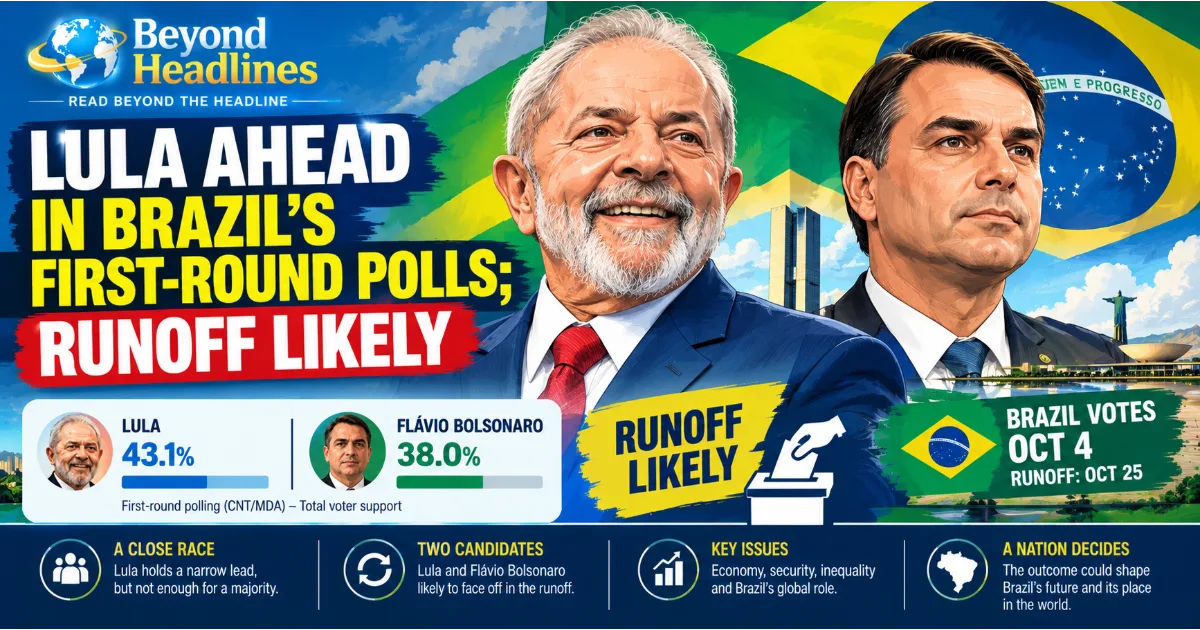
Brazil heads to the polls in one of the most closely watched presidential elections in Latin America, with President Luiz Inácio Lula da Silva holding a narrow advantage over Senator Flávio Bolsonaro in the final surveys before the first round. The numbers point toward a competitive contest rather than a decisive victory, however, and the most consistent message emerging from the latest polling is that Brazil is likely to return to the ballot box for a second-round confrontation on October 25. (Reuters)
The election has brought together two powerful political currents that have shaped Brazil for much of the past decade. On one side is Lula, the veteran leftist leader seeking a fourth non-consecutive presidential term and campaigning on social welfare, economic gains, democratic institutions and Brazil's independent role in the world. On the other is Flávio Bolsonaro, senator and son of former President Jair Bolsonaro, who is seeking to revive the political movement associated with his father and channel voter concerns about crime, public security, government spending and conservative values.
The latest polls give Lula an advantage in the first round, but not one large enough to suggest that he is on course to cross the 50% threshold required to avoid a runoff. More importantly, the surveys indicate that the gap between Lula and Flávio Bolsonaro has narrowed considerably compared with earlier stages of the campaign. That means the first round may establish the two leading candidates without determining the eventual winner. (Reuters)
For Beyond Headlines, the important story is therefore not simply that Lula is ahead. The larger question is what the polling tells us about the structure of Brazilian politics, why a runoff is likely, how the second-round battle could change the electoral map and why the contest matters far beyond the borders of Brazil.
A First Round That May Only Be the Beginning
Brazil's presidential election system requires a candidate to secure more than half of the valid votes to win outright in the first round. Blank and null ballots are not included when determining whether a candidate has crossed that threshold. If no candidate achieves a majority, the two candidates receiving the most valid votes advance to a second round. This year's potential runoff is scheduled for October 25. (Reuters)
That mathematical reality is crucial to understanding the latest polling.
Lula may be leading, but the available surveys do not place him close enough to the required majority to make a first-round victory the central expectation. The latest CNT/MDA poll, for example, put Lula at 43.1% in total voter support and Flávio Bolsonaro at 38%. When only projected valid votes are considered, Lula reached 47.8% and Flávio Bolsonaro 42.1%. The survey was conducted from September 30 to October 2 among 2,007 people and had a margin of error of 2.2 percentage points. (Investing.com)
Datafolha's latest survey presented an even tighter picture. Among valid votes, Lula stood at 45% while Flávio Bolsonaro was at 42%, within the poll's two-point margin of error. The survey interviewed 4,006 people between October 2 and 3. (Folha de S.Paulo)
Quaest was tighter still, showing Lula at 46% and Flávio Bolsonaro at 45% among valid votes. AtlasIntel and Bloomberg showed Lula at 47% and Flávio Bolsonaro at 44.1%. In other words, although Lula generally appeared ahead, the size of his advantage varied considerably from one pollster to another. (bdnews24.com)
This variation is one of the most important features of the election. A candidate leading by several points in one survey can be almost tied in another without either poll necessarily being wrong. Margins of error, sampling methods, turnout assumptions and the timing of interviews can all affect the final numbers. The appropriate conclusion is not that one candidate has already secured victory, but that the first round is extremely competitive and that the identity of the two finalists appears increasingly clear.
Lula's Lead Is Real, but It Is Not Comfortable
Lula enters election day with an advantage that has persisted across much of the final polling period, but the trajectory matters as much as the headline number.
Earlier in the campaign, Lula had enjoyed a more substantial lead. The gap narrowed as Flávio Bolsonaro consolidated support among conservative voters and the campaign became increasingly focused on issues that have created difficulties for the incumbent, particularly crime, household finances, the cost of living and concerns about government spending.
The CNT/MDA numbers illustrate that movement. On September 15, Lula had been measured at 40.5% in total voter support against 30.4% for Flávio Bolsonaro. By the final poll before the vote, the figures were 43.1% and 38%, respectively. The Bolsonaro campaign therefore entered the final stretch having substantially reduced the distance separating the two principal candidates. (Investing.com)
That narrowing is politically significant because Brazil's electoral system does not reward a candidate simply for finishing first in the first round. If Lula wins the largest share of votes but remains below 50%, the political contest effectively resets.
A runoff is not merely a second version of the first round. It creates a fundamentally different political environment.
Candidates eliminated in the first round become potential kingmakers. Their voters must decide whether to support Lula, back Flávio Bolsonaro, abstain, cast blank or null ballots, or simply stay away from the second round. Political parties that spent the first phase competing against both leading candidates must decide which side offers them the greater strategic advantage.
The geography of voting also becomes more important. Lula's support has traditionally been particularly strong among poorer voters and in Brazil's Northeast, while Bolsonaro's political movement has had strong support among wealthier voters and sections of the South and Southeast. The final result depends not simply on national percentages but on whether either candidate can expand beyond the coalition that carried them through the first round.
Flávio Bolsonaro's Rise Has Changed the Race
Flávio Bolsonaro's performance is one of the defining developments of the 2026 election.
The senator has inherited a political brand built by his father, Jair Bolsonaro, whose presidency transformed Brazil's conservative movement into one of the country's most powerful political forces. Jair Bolsonaro remains a deeply polarising figure, but his influence over conservative voters has not disappeared.
Flávio has made that legacy central to his campaign. In the final days of the race, he appeared at events invoking his father's political identity, including carrying an image of the former president during a campaign appearance. He also used a motorcycle caravan and rallies to mobilise supporters in São Paulo state and Rio de Janeiro. (Reuters)
His campaign has sought to translate the Bolsonaro family's existing political base into a new presidential coalition. That is not necessarily an easy task. Jair Bolsonaro himself was a unique political figure with a highly personalised following, and Flávio must convince voters that he can reproduce that political energy while also dealing with controversies and allegations surrounding his campaign.
Nevertheless, the polling demonstrates that the Bolsonaro name remains electorally powerful.
The latest Datafolha survey found Flávio performing strongly among voters with higher education and middle-class voters, while Lula retained an advantage among poorer voters, voters with lower levels of education and voters in the Northeast. In the Southeast, however, Flávio moved ahead of Lula in the latest Datafolha measurement. (Folha de S.Paulo)
That regional and socioeconomic divide could become decisive in a runoff.
Why a Runoff Is Now the Central Story
The simplest reason for the likely runoff is arithmetic.
Even Lula's strongest recent first-round polling numbers remain below the majority needed for an outright victory. The combined support for the other candidates remains large enough to prevent either Lula or Flávio Bolsonaro from reaching 50% of valid votes.
The CNT/MDA poll placed Augusto Cury at 3.6%, Ronaldo Caiado at 3.4%, Renan Santos at 1.7% and Romeu Zema at 0.9% among valid votes. Datafolha produced broadly similar results, with smaller candidates occupying the remaining portion of the electorate. (bdnews24.com)
These voters become extraordinarily important after the first round.
A candidate who finishes third may have no realistic path to the presidency, but the voters who supported that candidate suddenly become a large pool that Lula and Flávio Bolsonaro must court. Political negotiations can intensify, endorsements can shift, campaign rhetoric can moderate or harden, and policy promises can be adjusted.
This is why the October 4 vote should not be interpreted simply as a choice between Lula and Flávio Bolsonaro. It is also a process through which Brazil's electorate determines which political coalitions will survive into the final stage.
The first round establishes the battlefield.
The second round decides who controls the country.
The Runoff Polls Are Much More Uncertain
If the first round establishes Lula and Flávio Bolsonaro as the finalists, the available runoff polling suggests that neither has a decisive advantage.
The latest CNT/MDA survey showed Lula leading Flávio Bolsonaro 47.3% to 43.1% in a second-round scenario. That represents an advantage for Lula, but it is far from overwhelming. (Investing.com)
Datafolha showed an even narrower result, with Lula at 47% and Flávio Bolsonaro at 46% in its latest figures as reported by Reuters. The poll's own earlier version had also shown the contest within a narrow range. (bdnews24.com)
AtlasIntel and Bloomberg produced another extremely close result, with Lula at 47.6% and Flávio Bolsonaro at 47.4%. Quaest went in the opposite direction, showing Flávio Bolsonaro at 44% and Lula at 42% in a hypothetical second round. (bdnews24.com)
The implication is straightforward. Lula may be the first-round favourite to finish first, but the polling does not establish him as a clear favourite to win the presidency.
That distinction is essential.
A first-place finish and a second-round victory are two different political achievements. Lula appears better positioned for the first. The second remains genuinely uncertain.
The Economy Could Decide the Final Battle
Economic sentiment is one of the major forces shaping the election.
Lula's administration can point to improvements in inequality and unemployment as part of its record, but the government's broader economic message has encountered a more difficult electoral environment. Many voters continue to feel pressure from the cost of living, household debt and everyday expenses even when macroeconomic indicators show improvement.
The opposition has used these frustrations to argue that economic gains have not been sufficiently felt by ordinary Brazilians.
At the same time, the election campaign has exposed a contradiction across the political spectrum. Candidates have acknowledged the need to address Brazil's fiscal position, but detailed explanations of how they would control spending, reduce debt pressures or restructure government finances have been less prominent than campaign rhetoric. (Folha de S.Paulo)
Recent reporting in Brazil indicates that public debt had reached 82.9% of GDP in August, increasing pressure on whoever takes office. Lula has defended maintaining the existing fiscal framework with adjustments, while Flávio Bolsonaro and other opposition candidates have proposed tighter rules or alternative approaches to controlling public spending. (Folha de S.Paulo)
This debate could become considerably more important after the first round.
During the final days of a campaign, candidates have strong incentives to emphasise immediate voter concerns and emotionally powerful issues. Once only two candidates remain, however, financial markets, businesses, investors and voters may demand greater clarity about taxation, spending, debt management, infrastructure, social programmes and the future of Brazil's fiscal framework.
The winner will inherit not only a political mandate but also the challenge of managing those competing demands.
Crime and Public Security Are Major Voter Concerns
Crime has emerged as another central issue.
Brazil has long struggled with organised criminal networks, drug trafficking and violence, and public security has become an important area where the political approaches of Lula and Flávio Bolsonaro differ.
Flávio Bolsonaro has campaigned on a more aggressive security agenda, including tougher measures against criminal organisations and proposals involving large prison complexes. His political movement presents public security as one of the areas where a conservative government would adopt a fundamentally harder approach.
Lula's political coalition has generally placed greater emphasis on social policy, state institutions and broader economic and social programmes while also promising action against criminal networks.
The political challenge for Lula is that voters do not necessarily judge security policy through abstract statistics. They judge it through whether they feel safe in their neighbourhoods, whether businesses can operate without intimidation and whether police and state institutions can confront organised crime effectively.
For Flávio Bolsonaro, the challenge is different. A promise of tougher policing and punishment may attract voters concerned about violence, but voters also expect a government to explain how such policies would work within Brazil's legal and institutional system.
The second round is therefore likely to produce a sharper debate over security.
The Legacy of Jair Bolsonaro
It is impossible to understand Flávio Bolsonaro's campaign without understanding his father's political legacy.
Jair Bolsonaro remains one of the most consequential figures in modern Brazilian politics. His presidency helped establish a durable conservative movement, while his confrontation with Lula transformed the country's politics into an unusually intense ideological struggle.
But his political legacy is also inseparable from the controversies surrounding the end of his presidency.
Jair Bolsonaro was convicted over an attempt to overturn the 2022 election result and remains under house arrest, according to recent reporting. His supporters continue to regard him as a symbol of conservative resistance, while his opponents see his political legacy as associated with threats to democratic institutions. (Reuters)
Flávio's campaign therefore faces a delicate balancing act.
The Bolsonaro name provides him with an existing political identity, a loyal base and national recognition. But it also carries the controversies that surround the former president.
For Flávio, the election is consequently both a presidential campaign and a referendum of sorts on whether the Bolsonaro political movement can survive beyond Jair Bolsonaro himself.
Lula's Own Political Legacy Is Also on the Ballot
The election is equally significant for Lula.
At 80, he is seeking a fourth non-consecutive term as president. His political career stretches across decades and has made him one of the best-known political leaders in the developing world.
His supporters see him as a defender of democracy, social welfare and economic inclusion. His government has highlighted falling inequality and unemployment and has promoted programmes intended to support lower-income households.
His critics, meanwhile, argue that Brazil continues to struggle with crime, high living costs, government spending and political polarisation.
The current election therefore represents more than an ordinary contest for another presidential term. It is a judgment on whether Lula's political model remains capable of commanding a national majority at a moment when conservative movements are gaining ground in several parts of Latin America.
A Lula victory would represent continuity for Brazil's current political direction.
A Flávio Bolsonaro victory would represent a major return of the Bolsonaro movement to the presidency.
The Trump Factor Adds an International Dimension
Brazil's election also has an international component.
Relations between Brazil and the United States have become more complicated during the campaign, particularly as Lula has emphasised Brazilian sovereignty and maintained close economic ties with China while facing tensions with the administration of US President Donald Trump.
Trump has publicly indicated that he is watching Brazil's election closely. The relationship has also been influenced by US trade policy and tariffs affecting Brazilian goods. (Reuters)
The Bolsonaro family has generally cultivated a closer relationship with Trump's political movement. Flávio Bolsonaro has sought to use that connection as part of his broader international positioning.
Lula, by contrast, has emphasised Brazil's ability to maintain strategic independence and diversify its international relationships.
That difference could matter after the election.
Brazil is the largest economy in Latin America and one of the world's most important agricultural and commodity exporters. It is also a major player in the BRICS grouping and an important diplomatic actor on climate, trade, food security and global governance.
The outcome will therefore affect not only Brazilian domestic politics but also the country's relationships with Washington, Beijing and other major powers.
The Amazon and Brazil's Global Role
Environmental policy is another area in which Lula's political identity has international significance.
Lula has sought to position Brazil as a leader in protecting the Amazon and combating deforestation, while also presenting the country as a major voice for developing nations in international climate negotiations.
Brazil's stewardship of the Amazon matters far beyond its borders because of the rainforest's role in the global climate system.
A change of government could therefore alter Brazil's approach to environmental regulation, agricultural expansion, indigenous rights, infrastructure development and international climate diplomacy.
For international investors and governments, the presidential election is consequently not simply a domestic political event. It could influence Brazil's approach to trade, energy, agriculture, climate policy and strategic partnerships for years.
The Final Days Have Been Intensely Polarised
The closing stage of the campaign reflected the broader political divisions.
Lula ended his campaign in São Paulo with a large rally that organizers said drew approximately 150,000 supporters. He presented the election as a contest involving democracy and the country's political direction. Flávio Bolsonaro, meanwhile, concluded his campaign with a motorcycle caravan and rallies, projecting confidence that he could win in the first round. (Reuters)
Both campaigns therefore entered election day projecting confidence even as the polls pointed toward a runoff.
The final televised debate was also cancelled, depriving voters of a last major opportunity to see the principal candidates confront each other directly. The cancellation generated political accusations from both sides and became another illustration of the unusually contentious nature of the campaign. (Al Jazeera)
The result is an election in which the final campaign days have been shaped as much by political identity and controversy as by detailed policy discussion.
What the Polls Can and Cannot Tell Us
Opinion polls are useful indicators, but they are not election results.
The latest surveys show Lula ahead in several first-round scenarios, yet the size of his advantage varies. Datafolha places the race at 45% to 42% among valid votes. CNT/MDA gives Lula a larger 47.8% to 42.1% advantage. AtlasIntel has Lula at 47% and Flávio Bolsonaro at 44.1%, while Quaest shows only a one-point gap between them. (bdnews24.com)
The difference between these numbers is a reminder that the final result can still move.
The margin of error is only one factor. Turnout, late decisions, undecided voters, methodological differences and the ability of campaigns to mobilise supporters all matter.
The second-round polling is even more uncertain because it depends on how voters who supported eliminated candidates behave.
That is why declaring a winner before the ballots are counted would be premature.
The strongest defensible conclusion is that Lula enters the first round with a narrow polling advantage and that a second round between Lula and Flávio Bolsonaro is the most likely outcome.
What Happens After the First Round
If Lula and Flávio Bolsonaro advance, the political landscape will change almost immediately.
The candidates will have roughly three weeks before the scheduled October 25 runoff. That period will be crucial.
Lula will need to retain his support among lower-income and northeastern voters while expanding his appeal among middle-class voters and voters concerned about crime and economic management.
Flávio Bolsonaro will need to transform the Bolsonaro family's strong conservative base into a broader national coalition. He will need voters who may support other centre-right or independent candidates in the first round, while also persuading undecided voters that he represents a credible alternative to Lula.
The candidates will also have to compete for voters who dislike both major political camps.
That group could become decisive.
Brazil's election may therefore move from a thirteen-candidate first-round contest into a highly concentrated two-person battle in which every percentage point matters.
A Contest That Extends Beyond Lula and Bolsonaro
The political significance of the election goes beyond the personalities of the two leading candidates.
Brazil is facing difficult questions about public finances, security, social inequality, economic growth, international relations and the role of the state. Whoever wins will have to address these problems while dealing with a deeply polarised electorate and a Congress that may not automatically provide easy legislative support.
The election will also test whether Brazil's political system can move beyond the intense Lula-Bolsonaro confrontation that has dominated national politics for years.
For Lula, victory would reinforce the durability of the Brazilian left and demonstrate that his political coalition can survive the emergence of a new Bolsonaro generation.
For Flávio Bolsonaro, victory would prove that his family's political movement can survive Jair Bolsonaro's exclusion from the presidential race and return to power through another member of the family.
For Brazil itself, the stakes are broader.
The next government will inherit one of the world's most important emerging economies at a time of geopolitical uncertainty, economic pressure and changing political alliances across Latin America.
The Most Important Number May Be 50
The headline number in the polls is Lula's lead.
But the number that matters most on election day is 50.
If Lula crosses the majority threshold in valid votes, the election ends immediately and he secures another presidential term.
If he does not, the contest continues.
And virtually all of the latest polling indicates that crossing that threshold in the first round is unlikely. (Reuters)
That is why Sunday's vote should be viewed as the opening chapter of the decisive contest rather than its conclusion.
Lula enters with the advantage of incumbency and a persistent first-round polling lead. Flávio Bolsonaro enters with a rapidly consolidated conservative base and the political legacy of one of Brazil's most influential recent presidents.
The first round will determine who survives.
The runoff could determine which political vision dominates Brazil for the next presidential term.
For now, the evidence from the final polls points in one direction: Lula is ahead, but not far enough ahead to make the election his. Flávio Bolsonaro remains close enough to turn the second round into a genuine contest, and the eventual outcome could depend on voters who today support neither of the two leading candidates.
That makes Brazil's October election one of the most consequential political contests in the Americas this year. The country is not simply choosing between two candidates. It is deciding whether to continue Lula's left-leaning governing project or reopen the door to the political movement built by Jair Bolsonaro and now carried forward by his son.
The polls can identify the frontrunner.
Only the voters can decide the president.
#BeyondHeadlines #BrazilElection #Brazil2026 #Lula #LuizInacioLulaDaSilva #FlavioBolsonaro #JairBolsonaro #BrazilPolitics #BrazilPresidentialElection #LatinAmerica #BrazilNews #Election2026 #RunoffElection #LulaDaSilva #Bolsonaro #GlobalPolitics #WorldNews #PoliticalNews #Democracy #BrazilEconomy #BrazilSecurity #Amazon #Geopolitics #InternationalRelations #ElectionPolls #ReadBeyondTheHeadline