
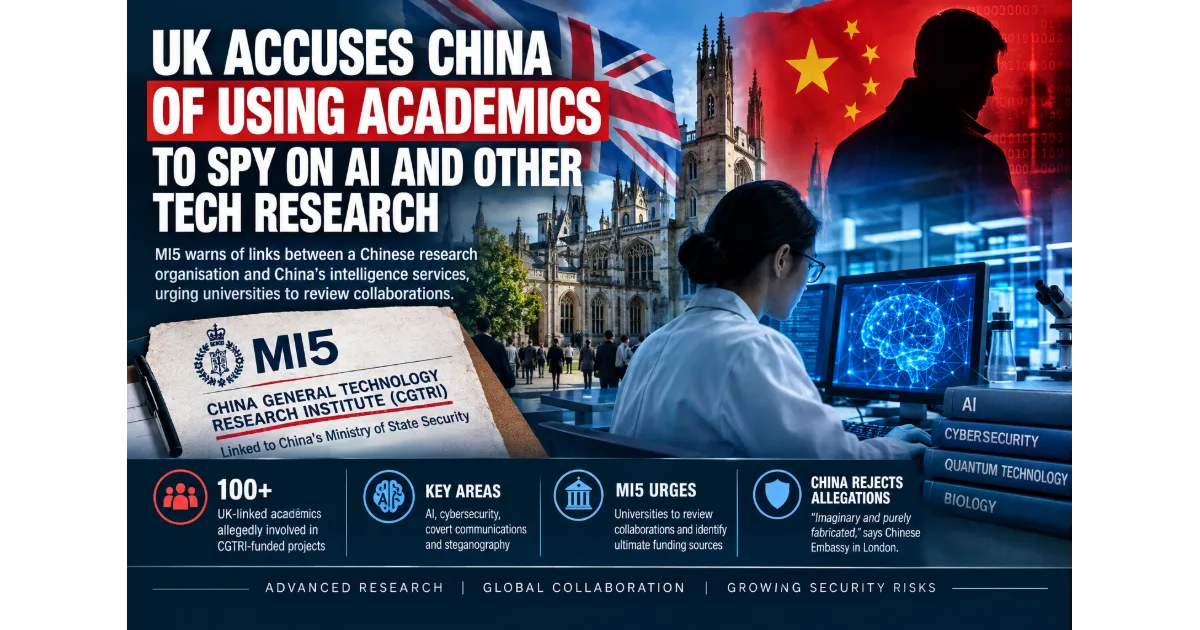
Britain has issued one of its strongest public warnings yet about the security risks surrounding Chinese involvement in British academic research, accusing a Chinese research organisation of funding projects that ultimately strengthen Beijing’s intelligence capabilities. The warning, issued by MI5 on September 30, 2026, focuses on the China General Technology Research Institute, or CGTRI, and alleges that the organisation has very strong links to China’s Ministry of State Security, the country’s civilian intelligence service. MI5 says more than 100 UK-linked academics have contributed to projects funded through CGTRI, including work involving artificial intelligence, cybersecurity, covert communications and steganography.
The allegation is significant because it shifts part of Britain's counter-espionage focus from conventional intelligence gathering toward the research environment itself. Universities are built around international collaboration, open scientific exchange and the movement of researchers across borders. Modern research, particularly in fields such as AI, computing, advanced materials and cybersecurity, can also have commercial, military and intelligence applications. That creates a difficult line for governments and universities to draw. The same research that can improve civilian technology can sometimes also be adapted for surveillance, cyber operations, communications security or other state-security purposes. MI5's warning places that dual-use problem at the centre of Britain's latest confrontation with China.
MI5's central allegation is unusually direct. It says it has identified CGTRI's primary purpose as funding academic research that directly improves the technical capabilities of China's Ministry of State Security for espionage. The agency says the organisation funds research in China and has been connected to projects involving UK academics. MI5 is advising universities to immediately review existing or planned collaboration with CGTRI and is urging researchers involved in partnerships with Chinese institutions to establish the ultimate source of funding.
The British government has reinforced that warning. Security Minister Dan Jarvis said he had written to university leaders across Britain asking them to ensure that staff ended relationships with CGTRI. He said the alert demonstrated attempts by Chinese intelligence to benefit covertly from British academic expertise and research. At the same time, Jarvis acknowledged that international partnerships remain important to universities and research institutions, framing the government's position as an effort to protect sensitive research while allowing legitimate international cooperation to continue.
China has rejected the allegations. A spokesperson for the Chinese Embassy in London described the accusations as “imaginary and purely fabricated” and said Beijing opposed what it called baseless allegations. The embassy also argued that academic exchanges and cooperation between British and Chinese universities have been conducted voluntarily and in accordance with laws and regulations. The Chinese response means that the central intelligence allegations remain a contested matter between the British security authorities and Beijing, rather than an independently adjudicated finding.
That distinction is important. MI5 is Britain's domestic security and counter-intelligence service, and its warning represents an official British security assessment. But an intelligence assessment is not the same thing as a court judgment establishing criminal responsibility for every researcher or institution involved. Indeed, MI5 itself says that some academics may not have known that CGTRI was involved in funding the Chinese research projects to which they contributed. The agency is therefore warning universities and researchers to examine funding chains and institutional relationships rather than claiming that every academic involved knowingly assisted Chinese intelligence.
Why Artificial Intelligence Is at the Centre of the Concern
Artificial intelligence is particularly sensitive because AI research is increasingly relevant to civilian industry, cybersecurity, military systems and intelligence operations. Algorithms developed for one purpose can sometimes be adapted for another. Machine learning can be used to analyse large datasets, identify patterns, automate surveillance, improve cybersecurity tools, translate communications, process images and assist decision-making. The same underlying technologies can therefore have both commercial and security applications.
MI5 specifically identified AI among the research areas connected to CGTRI-funded projects. It also mentioned cybersecurity, covert communications systems and steganography. Steganography refers to methods of concealing information within apparently ordinary files, images, messages or other forms of digital content. Research into such technologies can have legitimate civilian applications, including privacy and secure communications, but it can also be relevant to intelligence operations.
The concern is therefore not that AI research itself is inherently suspicious. Britain has one of the world's major academic and commercial AI ecosystems, and international cooperation is an ordinary part of scientific research. The security question is who ultimately funds particular projects, who receives the resulting research, what restrictions exist on its use, and whether a seemingly civilian research relationship is connected to an intelligence or military organisation.
That distinction is becoming increasingly important as the boundaries between civilian technology and national security become less clear. A research paper on machine learning may appear entirely academic, while the underlying techniques could potentially be incorporated into surveillance or intelligence systems. A communications project could have applications in civilian telecommunications while also being relevant to secure military communications. Cybersecurity research can strengthen the defence of computer networks while some of the same knowledge can also be applied offensively.
This is why British authorities have increasingly focused on what they describe as “dual-use” research. The UK government already maintains guidance for academics working in areas where technology could potentially be used for military purposes. Official export-control guidance identifies fields including telecommunications, information technology, sensors, engineering, biotechnology, materials technology and other STEM disciplines as areas in which certain research can have security implications.
The China General Technology Research Institute
At the centre of the latest warning is CGTRI, also known in some translations as the China Academy of General Technology, or CAGT. MI5 says the organisation has very strong ties to the Chinese Ministry of State Security. According to the agency, those connections were not sufficiently transparent to many British researchers before the new alert.
MI5 says more than 100 UK-linked academics have contributed to projects funded by MSS through CGTRI. Importantly, the agency says that in some cases researchers may not have been aware that CGTRI was funding the Chinese research project in which they were participating. That element of the warning is particularly important because it changes the issue from one of deliberate espionage by academics to one involving the transparency of international research funding.
Universities frequently work with external research institutions, corporations and government-linked organisations. Funding can pass through several layers before reaching an individual researcher or laboratory. A researcher may know the immediate organisation providing a grant without necessarily knowing every organisation that ultimately supports that organisation.
MI5 is now explicitly telling British academics to establish the ultimate funding source when entering research collaborations with Chinese institutions. The agency wants universities to determine whether CGTRI is involved anywhere in the funding chain.
That approach reflects a broader shift in how national-security authorities view research partnerships. Previously, due diligence might have focused primarily on the direct partner. Increasingly, governments are asking institutions to examine ownership structures, funding sources, institutional affiliations and possible links to state security organisations further down the chain.
The challenge is that such investigations can be complicated. Universities may collaborate with large organisations containing multiple research institutes, companies and government-linked bodies. Chinese state-owned enterprises and research institutions can have complex relationships with government ministries. Determining whether a research partner is commercially oriented, military-linked or connected to an intelligence organisation may require information that is not readily available to an academic researcher.
MI5's alert is therefore as much about research due diligence as it is about espionage.
More Than 100 Academics, But Not More Than 100 Spies
One of the most important points to understand is that MI5's figure of more than 100 academics does not mean that Britain has identified more than 100 people as Chinese spies.
The security agency says more than 100 UK-linked academics contributed to CGTRI-funded projects. It also explicitly states that some academics may not have known about CGTRI's role in funding the research. The agency's concern is therefore about the transfer of knowledge and expertise through a research network that it says ultimately benefits Chinese intelligence.
That distinction matters because academic collaboration and espionage are not synonymous. A British scientist can collaborate with a Chinese institution on legitimate research without intending to provide information to an intelligence service. The security concern arises if the research is ultimately directed toward an intelligence purpose without the researcher's knowledge, or if sensitive information is transferred in circumstances that violate British law or national-security safeguards.
MI5's warning consequently does not establish that every project involving the organisation was classified, secret or illegal. Instead, it tells universities to review relationships and identify whether the funding chain connects to CGTRI.
The agency's language also suggests that it sees the risk as systemic rather than limited to a small number of individual researchers. If the underlying mechanism is legitimate-looking academic funding that can ultimately provide useful technical knowledge to an intelligence organisation, then the problem becomes one of institutional vulnerability.
That is a fundamentally different challenge from identifying a traditional spy.
Britain's National Security Act Raises the Stakes
The warning also carries a legal dimension. MI5 reminded universities, researchers and institutions about Britain's National Security Act 2023, legislation that created or expanded offences relating to foreign intelligence activity and assistance to foreign intelligence services.
MI5 says individuals or institutions that continue research ultimately funded by CGTRI should obtain independent legal advice. The agency warns that continued involvement could have criminal consequences depending on the circumstances.
This does not mean that every future collaboration involving a Chinese institution would automatically constitute an offence. The legal consequences depend on the facts and the requirements of the legislation. But the warning changes the environment for academics who might previously have treated research funding as an ordinary administrative matter.
A researcher who receives an international grant generally focuses on the scientific question, funding terms, publication rights and project objectives. Under the security framework now being emphasized by MI5, researchers may also need to ask who ultimately funds the project, what organisations are connected to the funder and whether the research could contribute to a foreign intelligence service.
This is a major change in the compliance burden placed on universities.
It also raises a difficult question for academic institutions. Universities are not intelligence agencies, and researchers are not trained investigators. Expecting individual scientists to determine the ultimate ownership or intelligence relationships of foreign institutions can be difficult. That is why the UK government has established dedicated research-security structures to provide guidance.
The Research Collaboration Advice Team, or RCAT, provides advice to research institutions on national-security risks linked to international research. The government says RCAT works across government and academia to help institutions identify risks while maintaining international collaboration.
The Wider British Concern About Chinese Technology Access
The MI5 warning does not appear in isolation. British authorities have been increasingly concerned about the possibility that foreign states could obtain commercially or strategically valuable information through legitimate-looking business, academic and professional relationships.
MI5's broader guidance says foreign intelligence services can seek business information and research in order to accelerate technological development or gain military advantages. It specifically identifies artificial intelligence, advanced materials and biotechnology among areas that may attract foreign intelligence interest.
The United Kingdom's National Cyber Security Centre and other government agencies have also issued warnings about foreign-state cyber activity. Academic institutions have become part of this wider security discussion because universities hold large amounts of intellectual property and employ researchers working at the technological frontier.
Universities also possess characteristics that can make them attractive targets. Research environments are designed to share knowledge rather than restrict it. International conferences, visiting researchers, joint publications and collaborative projects are fundamental to scientific progress. Laboratories often work with multiple institutions simultaneously, and researchers frequently exchange data and technical information across borders.
That openness is one of the strengths of the academic system. It can also create security vulnerabilities when sensitive research is involved.
The challenge for governments is therefore not simply to prevent foreign collaboration. It is to distinguish legitimate collaboration from relationships that could expose strategically important technology or research to hostile state actors.
China Rejects the Allegations
Beijing's response has been categorical. The Chinese Embassy in London rejected the MI5 allegations and described them as fabricated. It argued that cooperation between Chinese and British universities is voluntary and conducted according to law.
China has previously rejected British and allied allegations concerning espionage and foreign interference. The latest dispute therefore fits into a larger pattern of disagreement between Beijing and Western governments over how Chinese international engagement should be interpreted.
From China's perspective, extensive academic cooperation is part of international scientific exchange. Chinese universities and research institutions collaborate with institutions around the world, while Chinese students and researchers make major contributions to international science and technology.
From the British security perspective, however, the issue is not whether international academic exchange is legitimate in general. It is whether particular organisations may be used as channels through which sensitive expertise is transferred to an intelligence service.
Those two positions are not necessarily mutually exclusive at the level of individual research projects. Legitimate scientific collaboration can exist alongside attempts by states to obtain sensitive information. The policy challenge is determining where one ends and the other begins.
Universities Are Caught in the Middle
British universities now face a difficult balancing act. International partnerships are an important source of research funding, expertise and scientific exchange. China is a major global research power, and completely separating British universities from Chinese researchers would have consequences for scientific collaboration.
At the same time, universities have a responsibility to protect sensitive research and intellectual property. The British government has explicitly acknowledged this tension. Its guidance on protecting higher education from foreign interference says international research can involve risks to data, know-how and equipment, while emphasizing that the objective is to enable institutions to collaborate in trusted environments.
This means the immediate effect of the MI5 alert may be less about ending all UK-China academic cooperation and more about increasing scrutiny of individual relationships.
Universities are likely to examine funding sources, contractual arrangements, data-sharing provisions and the ownership of research outputs. Researchers working in sensitive areas may face additional due-diligence requirements. Institutions could also need to determine whether apparently independent Chinese research bodies have links to government agencies or state security organisations.
That process could become especially complicated for smaller universities and laboratories that depend heavily on external funding.
The Risk of Chilling Scientific Cooperation
There is another side to the debate. If security concerns become too broad, researchers may become reluctant to collaborate internationally even when projects are entirely legitimate.
Scientific progress often depends on researchers working across borders. AI development, climate science, medicine, quantum computing, telecommunications and many other fields are international by nature. Cutting researchers off from colleagues because of nationality or institutional affiliation could reduce scientific exchange without necessarily eliminating espionage risks.
The British government therefore faces a difficult policy problem. It must protect strategically important research without creating a system in which ordinary international collaboration becomes so complicated that researchers avoid it.
MI5's own wording reflects this distinction. The agency is not telling British universities to end all research with Chinese institutions. Its warning specifically identifies CGTRI and urges institutions to establish ultimate funding sources when collaborating with Chinese organisations.
That is narrower than a general prohibition on China-related research.
The question now is how universities interpret the warning and how far they extend their due-diligence procedures beyond CGTRI.
AI Makes the Security Problem More Difficult
Artificial intelligence makes the debate particularly complicated because the technology is advancing rapidly and research can move from the laboratory to commercial and security applications relatively quickly.
An AI model developed for image recognition, language processing or pattern analysis can potentially be adapted for surveillance or intelligence analysis. Cybersecurity research can be used to defend networks but can also provide knowledge about vulnerabilities. Advances in automated data processing can have applications across healthcare, finance, transportation and national security.
The value of AI research is also increasingly tied to the quality and scale of data. Access to specialised datasets, technical expertise and algorithms can accelerate development. That means intellectual property and research knowledge have become strategic assets in their own right.
For governments competing technologically, gaining access to advanced research can potentially be much faster than independently developing every capability from scratch.
This is why MI5 views academic research as part of the national-security environment rather than as a completely separate sphere. The agency's broader guidance explicitly states that foreign intelligence services may seek academic research, particularly in STEM, dual-use technologies, emerging technology and commercially sensitive areas, to improve their technological or military capabilities.
The CGTRI warning is therefore part of a larger transformation in how governments think about technology competition.
From Traditional Espionage to Knowledge Acquisition
Traditional espionage is often imagined as an intelligence officer stealing a classified document or recruiting a government insider. Modern technology competition can operate through more complicated channels.
A research grant can produce knowledge. A joint project can produce intellectual property. A consultancy can provide technical expertise. A visiting researcher can develop relationships with scientists. A company can acquire a smaller technology firm. A cyberattack can obtain research data. None of these activities necessarily looks like traditional espionage when viewed individually.
The security question is what happens when these activities form part of a coordinated effort to acquire strategic knowledge.
MI5's warning suggests that British intelligence believes CGTRI provided such a channel. The agency says the organisation's purpose is connected to improving the technical capabilities of China's Ministry of State Security.
That is the core allegation and the reason the alert has generated such concern in British universities.
But the public information released so far does not provide a complete account of every project, every academic involved or every piece of research allegedly transferred to Chinese intelligence. That means the broader public cannot independently assess every individual case from the available information.
The distinction between what MI5 has assessed and what has been independently established will remain important as universities investigate the relationships.
A New Test for UK-China Relations
The timing of the warning also matters because Britain has simultaneously been seeking to manage a complicated relationship with China involving trade, investment, diplomacy and economic interests.
China is an important global economic power, while Britain wants to protect its national-security interests and maintain access to international markets. That creates competing priorities.
The academic sector sits directly inside that tension. British universities benefit from international students, research partnerships and global scientific networks. China is a major source of researchers and scientific collaboration. At the same time, British authorities increasingly regard some Chinese state-linked organisations as potential security risks.
The CGTRI case therefore raises a question that goes beyond a single research organisation: how can Britain distinguish between legitimate engagement with China and relationships that could expose sensitive national capabilities?
There is no simple answer.
A blanket approach could damage legitimate scientific collaboration. A completely open approach could leave sensitive research vulnerable. The middle ground requires detailed due diligence, institutional safeguards, clear legal rules and the ability to identify the ultimate destination of research funding and intellectual property.
That is precisely the direction indicated by MI5's warning to universities.
What Happens Next?
The immediate task for British universities is to review their relationships with CGTRI. MI5 has advised institutions to examine ongoing and planned collaborations and to ensure that the organisation is not involved. Researchers working with Chinese institutions have also been urged to establish the ultimate source of funding.
The legal implications will depend on individual circumstances. MI5 has specifically advised institutions and individuals continuing research ultimately funded by CGTRI to seek independent legal advice. That means the warning should not be interpreted as an automatic declaration that every past collaboration was unlawful.
The government's broader research-security framework will likely become more important as universities respond. RCAT and other government bodies already provide advice on international research security, while official guidance covers foreign interference and export controls.
Universities will also have to determine how to communicate the new requirements to researchers. Scientists who believed they were participating in ordinary research may now discover that the organisation financing a project has a much more complicated institutional background than they understood.
That is one of the most consequential aspects of the MI5 announcement. The agency itself acknowledges that some researchers may not have known CGTRI was involved.
The Bigger Issue: Who Owns the Future of Technology?
The controversy ultimately goes beyond Britain and China. It reflects a global struggle over who controls advanced technology and how scientific knowledge moves across borders.
AI, quantum computing, advanced communications, cybersecurity, biotechnology and other emerging technologies are increasingly treated as strategic assets. Governments want their universities and companies to remain open enough to innovate but protected enough to prevent sensitive knowledge from being transferred to strategic competitors without safeguards.
That tension will become more pronounced as the technological gap between research and application continues to narrow.
The academic world was built around the idea that knowledge advances through openness. National security is built around the idea that certain knowledge must be protected. Artificial intelligence and other dual-use technologies increasingly occupy the space between those two principles.
Britain's latest MI5 alert brings that conflict directly into university laboratories.
The most significant factual point is that MI5 has not accused more than 100 academics of being spies. It says more than 100 UK-linked academics contributed to projects funded through an organisation that MI5 alleges has very strong links to China's Ministry of State Security. Some researchers, according to the agency, may not have known about those links.
The second important point is that China rejects the allegations. Beijing's embassy in London has described them as fabricated and opposed what it sees as an attempt to undermine academic cooperation.
The third is that Britain is not moving toward an outright ban on academic cooperation with China. Instead, the immediate focus is on identifying hidden funding relationships, protecting sensitive research and ensuring that universities understand their obligations under national-security law.
That distinction will be crucial.
The future of British universities will still depend heavily on international research. But the rules governing that internationalism are changing. Researchers may increasingly be expected to understand not only what they are researching and who their immediate partner is, but also who ultimately pays for the work, who can access the results and whether the technology could have security applications.
For China, the controversy adds another layer to an already complicated relationship with Britain. For the UK, it demonstrates why AI and advanced technology are now treated as national-security issues as much as economic or scientific ones. And for universities, it creates a new responsibility to examine research partnerships with a level of scrutiny that was previously associated more with government agencies and defence contractors.
The central question is no longer simply whether British scientists should collaborate internationally. It is whether universities can remain open centres of global research while ensuring that sensitive knowledge is not quietly redirected toward intelligence or military purposes.
MI5 has now made clear that it believes such a risk exists in the case of CGTRI. China rejects that assessment. The next stage will depend on what British universities discover when they examine the funding relationships, what evidence emerges concerning specific projects and how Britain balances research openness with national-security safeguards.
That is the story beyond the headline. The issue is not simply about China, Britain or espionage. It is about the increasingly blurred boundary between academic research and strategic power in an era when a breakthrough developed in a university laboratory can become an economic, military or intelligence capability with global consequences.
#BeyondHeadlines #UK #China #MI5 #ChinaUK #Espionage #AI #ArtificialIntelligence #Cybersecurity #AcademicResearch #Universities #Technology #NationalSecurity #ResearchSecurity #ChinaSpying #UKUniversities #TechWar #Geopolitics #InternationalRelations #ScienceAndTechnology #DualUseTechnology #CyberSecurity #GlobalTechnology #WorldAffairs