
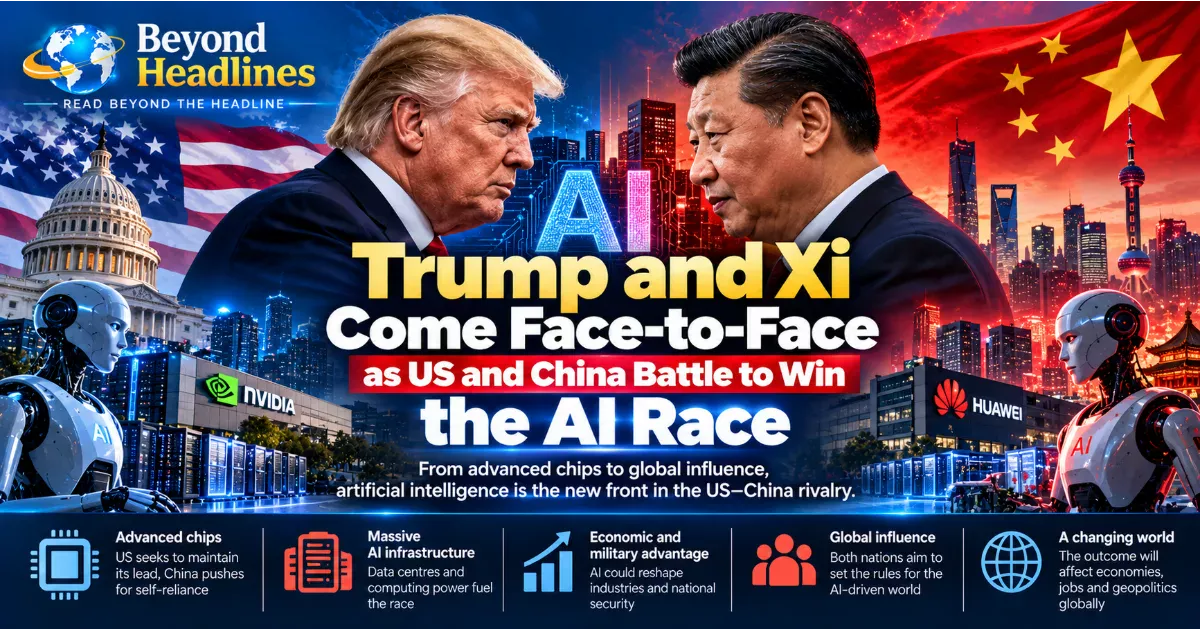
Artificial Intelligence Becomes a Global Power Struggle
Artificial intelligence has become one of the most important battlegrounds in the relationship between the United States and China. What began as a competition among technology companies to build smarter software has developed into a broader contest involving national security, economic growth, scientific research, semiconductor manufacturing, military capabilities and international influence.
Donald Trump and Xi Jinping represent two powerful political systems seeking to shape the future of this technology. The United States has a strong position in advanced AI research, semiconductor design, cloud computing and the development of commercial AI systems. China, meanwhile, has demonstrated its ability to compete through large-scale manufacturing, engineering talent, government-supported research, expanding digital infrastructure and increasingly capable AI models.
The stakes extend far beyond which country produces the most advanced chatbot. Artificial intelligence could transform manufacturing, healthcare, education, transportation, financial services, scientific discovery and military planning. Countries that develop these capabilities may gain significant economic advantages, while those that depend heavily on foreign technology could face strategic vulnerabilities.
The competition is also complicated by the close economic connections between the two countries. American companies depend on international supply chains, while Chinese businesses need access to global markets, advanced equipment and essential components. Both countries have reasons to compete aggressively, but both also have reasons to avoid a complete technological separation.
The emerging AI race therefore presents a difficult question for Washington and Beijing. Can either country secure a lasting technological advantage without damaging the global economic system that helps make innovation possible?
Why Artificial Intelligence Matters to Trump and Xi
Artificial intelligence is increasingly viewed as a foundational technology, comparable in strategic importance to electricity, the internet and advanced computing. Its influence comes from its ability to improve the performance of many other industries rather than serving only one specific market.
A manufacturing company can use AI to identify production defects, predict equipment failures and improve inventory management. Hospitals can use AI-assisted systems to help analyse medical images, organise patient information and support research. Financial institutions can apply machine learning to identify unusual transactions, assess risk and automate routine operations.
Governments can also use AI to analyse large volumes of information, improve public services and strengthen cybersecurity. Military organisations are exploring applications involving intelligence analysis, logistics, autonomous systems and decision support. These possibilities explain why AI has become a central concern for national leaders.
For Trump, maintaining American leadership in artificial intelligence fits into a broader economic and strategic agenda focused on technological competitiveness, domestic investment and national security. The administration's approach has emphasised innovation, access to computing infrastructure and competition with China, alongside restrictions intended to limit the transfer of certain sensitive technologies.
For Xi, artificial intelligence supports China's ambitions to modernise its economy, strengthen domestic technological capabilities and reduce dependence on foreign suppliers. Beijing has spent years promoting advanced manufacturing, semiconductor development, robotics and digital infrastructure as important components of national development.
Both leaders understand that technological leadership can create advantages across multiple sectors. A country with stronger AI capabilities may attract investment, establish influential technical standards, develop new industries and strengthen its position in international negotiations.
However, neither country can assume that today's advantages will automatically guarantee tomorrow's leadership. AI technology changes rapidly, and breakthroughs can come from unexpected companies, research teams and approaches.
The United States: Strong Research, Powerful Companies and Advanced Chips
The United States enters the AI competition with several significant advantages. Its technology ecosystem includes leading AI laboratories, major cloud computing providers, advanced chip designers, universities, venture capital firms and a large market for commercial software.
Companies such as OpenAI, Google, Microsoft, Anthropic, Amazon and Meta have invested heavily in AI research and infrastructure. Their work spans large language models, image generation, coding assistants, scientific applications, enterprise software and AI systems designed to operate across different types of information.
The strength of this ecosystem is not simply the presence of individual companies. It is the interaction between researchers, investors, universities, semiconductor designers, software developers and businesses that can rapidly test new technologies.
A research breakthrough can attract investment. That investment can fund computing infrastructure and engineering teams. Those resources can help turn a research result into a commercial product, which can then generate revenue to finance further development.
American cloud providers also play an important role. Training and operating advanced AI systems require enormous computing capacity, reliable electricity, specialised equipment and sophisticated software. Large cloud companies can offer these resources to businesses that would otherwise struggle to build their own infrastructure.
Another important advantage is the United States' influence over parts of the advanced semiconductor supply chain. American firms design many of the processors used in AI infrastructure, while specialised companies and manufacturing partners across several countries produce the equipment and components required to make advanced chips.
This influence gives Washington strategic leverage, although it does not mean that the United States controls every stage of semiconductor production.
The country also benefits from an extensive network of research institutions and international technology partnerships. Researchers, engineers and entrepreneurs from many countries contribute to American AI development, helping businesses recruit specialised talent and exchange ideas.
Yet the American position is not without weaknesses. Advanced AI infrastructure is expensive, electricity demand is increasing, and access to computing resources remains uneven. There are also questions about employment disruption, data privacy, market concentration and the ability of governments to respond to rapidly changing technology.
The United States must therefore address two challenges simultaneously: maintaining technological leadership and ensuring that the benefits of AI reach businesses, workers and the wider economy.
China: Manufacturing Strength and Rapid AI Development
China approaches the AI race from a different position. It has a vast domestic market, extensive manufacturing capacity, strong engineering capabilities and a government that treats technological self-reliance as a strategic priority.
Chinese technology companies have developed AI models, cloud services, robotics systems and digital platforms for domestic and international markets. Companies including Alibaba, Baidu, Tencent, Huawei and ByteDance operate across different parts of the technology ecosystem.
China's manufacturing base is particularly important. AI systems do not exist only as software. They depend on data centres, networking equipment, power systems, cooling technology, circuit boards, servers and other physical infrastructure.
China's experience in large-scale manufacturing can help it expand certain parts of this infrastructure efficiently. Its industrial ecosystem also creates opportunities to integrate AI into factories, logistics networks, consumer electronics and automated production systems.
Another important factor is the development of AI models that can compete on capability, efficiency and cost. Chinese research teams have demonstrated that alternative technical approaches, model optimisation and efficient use of computing resources can challenge assumptions about the resources required to build useful AI systems.
This matters because AI leadership is not determined solely by which organisation trains the largest model. A system that performs well at a lower operating cost may be attractive to businesses, developers and governments.
Open-weight models are especially relevant to this competition. They allow developers to obtain model parameters and adapt systems to particular applications, subject to the applicable licence and technical restrictions. This can make it easier for companies to deploy AI on their own infrastructure, customise models and reduce dependence on a small number of commercial providers.
Chinese companies have increasingly explored this approach, contributing to a competitive environment in which models can spread rapidly across developer communities.
However, China also faces significant obstacles. Restrictions on access to some advanced semiconductor technologies complicate efforts to develop and operate the most demanding AI systems. Domestic chip development can reduce dependence over time, but building a complete semiconductor ecosystem requires substantial research, investment, manufacturing expertise and specialised equipment.
China must also manage the relationship between technological experimentation and regulatory oversight. Its domestic rules governing data, online information and AI services shape how products are developed and deployed.
The country's ability to turn research progress into widely adopted, internationally competitive products will be an important test of its ambitions.
The Semiconductor Battle Behind the AI Race
Behind the competition between American and Chinese AI models lies a less visible contest over semiconductors.
Advanced AI systems require processors capable of performing enormous numbers of calculations. Graphics processing units and specialised accelerators are particularly important for training large models and operating them at scale.
Designing these chips is only one part of the challenge. Manufacturing advanced semiconductors requires highly sophisticated fabrication facilities, precision equipment, specialised materials and complex supply chains involving companies across several countries.
The ecosystem includes chip designers, semiconductor foundries, equipment manufacturers, electronic design software providers, packaging specialists and memory producers. No single country independently controls every critical component.
The United States has substantial influence through chip design, computing software and certain semiconductor technologies. Taiwan plays a central role in advanced chip manufacturing, while South Korea is important in memory and semiconductor production. Japan and several European countries contribute essential equipment and materials.
China has worked to strengthen its domestic semiconductor industry and reduce exposure to foreign restrictions. Its efforts include investments in chip design, manufacturing equipment, domestic production and alternative computing architectures.
However, semiconductor independence is not achieved simply by announcing an investment programme. Advanced chip production involves years of engineering development, demanding manufacturing processes and continuous improvements in performance and reliability.
Washington's export controls seek to restrict Chinese access to certain advanced computing chips and semiconductor manufacturing capabilities. The stated strategic concern is that these technologies could contribute to military modernisation or other sensitive capabilities.
Beijing views restrictions as a challenge to its development and technological sovereignty. They also create an incentive for Chinese companies to invest more heavily in domestic alternatives.
This produces a complicated outcome. Export controls may slow access to some foreign technologies, but they can also encourage the targeted country to accelerate efforts to develop substitutes.
For American policymakers, the central question is whether restrictions can preserve a meaningful strategic advantage without unnecessarily damaging commercial innovation or international partnerships. For China, the challenge is whether domestic innovation can overcome the technical and economic difficulties associated with building advanced semiconductor capabilities.
The result will influence not only AI but also telecommunications, supercomputing, consumer electronics, industrial automation and defence technology.
AI Models: Is Bigger Always Better?
For much of the recent AI boom, attention focused on building increasingly large models trained on enormous datasets and supported by vast computing resources. Scale remains important, but the competition is becoming more complex.
AI performance depends on several factors, including model architecture, training data, computing power, training techniques, inference efficiency and the quality of post-training improvements. The ability to use a model effectively also depends on how well it integrates with software, tools and real-world workflows.
American laboratories have invested heavily in frontier models designed to perform complex reasoning, coding, scientific tasks and multimodal analysis. Their systems can support applications ranging from everyday productivity to specialised business processes.
Chinese developers have challenged the idea that technological leadership requires an unlimited increase in computing expenditure. Research into efficient training, model distillation and other optimisation techniques can make capable systems less expensive to develop or operate.
Efficiency is strategically important because the cost of using AI affects adoption. A model may demonstrate impressive performance in a laboratory but struggle to achieve widespread use if its operating costs are too high.
Businesses often care about reliability, speed, security and integration more than a model's position on a single benchmark. A smaller model that performs a specific task accurately and cheaply may be more valuable to a company than a much larger system.
This creates multiple paths to success. One country may lead in certain frontier models, another may offer compelling low-cost systems, and other competitors may specialise in robotics, industrial AI or scientific applications.
The competitive landscape is therefore unlikely to be decided by a single announcement or model release. Sustained progress will depend on research quality, computing access, commercial execution and the ability to turn technical achievements into dependable products.
Open-Weight AI and the Fight for Developers
The distinction between closed commercial AI systems and open-weight models has become an important part of the global competition.
Closed systems typically provide access through a company's product or application programming interface. The provider retains control over the underlying model and determines how it is updated, priced and distributed.
Open-weight systems make model parameters available for developers to download and use under specified terms. Depending on the model and licence, developers may be able to adapt the system, run it on their own infrastructure or incorporate it into specialised applications.
Open-weight does not necessarily mean completely open source. Training data, development processes and other components may remain unavailable, while licence conditions can limit certain uses.
Nevertheless, open-weight models can broaden participation. Universities, startups and established businesses can experiment with systems without depending entirely on a single provider's hosted service.
They can also improve data control for organisations that need to keep sensitive information within their own systems. For companies operating in heavily regulated industries, this flexibility may be commercially significant.
Chinese companies have used open-weight releases to attract developers and expand the reach of their technology. American companies also participate in this ecosystem, and the distinction between national approaches is not absolute.
The strategic significance lies in the communities that form around these systems. Developers who build applications using a particular model may create documentation, integrations and specialised tools that make the technology more useful over time.
A country or company that builds a large and active developer ecosystem can gain influence even when its products are not the most expensive or technically advanced.
For Washington and Beijing, the competition is therefore about more than producing models. It is also about establishing the platforms, tools and communities that other countries will use to build their own AI applications.
Data Centres and Energy: The Physical Limits of AI Growth
The expansion of artificial intelligence requires a major increase in computing infrastructure. Behind every advanced AI service are servers, networking equipment, storage systems, cooling technologies and facilities that consume electricity.
Training a frontier model can require substantial computing resources, while serving millions of users creates continuing demand for power and infrastructure. As AI adoption expands, the economics of electricity, land, cooling and grid connections become increasingly important.
The United States has attracted large investments in data centres and cloud infrastructure. However, new facilities can face delays because of electricity availability, transmission constraints, permitting requirements and the time needed to manufacture and install equipment.
China's industrial capacity and infrastructure development offer advantages in some areas, but its AI expansion also depends on reliable energy, advanced equipment and efficient data-centre operations.
The energy question may become one of the defining issues in the next phase of AI competition. Countries that can provide affordable and dependable electricity while building computing infrastructure efficiently may gain an important advantage.
This does not mean that simply constructing more data centres guarantees leadership. Facilities must have access to suitable chips, skilled engineers, reliable networks and customers willing to pay for computing services.
Energy efficiency will also matter. Better chips, improved cooling, optimised software and more efficient AI models can reduce the cost of operating large systems.
There is a broader environmental question as well. Electricity demand, water consumption, hardware manufacturing and electronic waste all deserve attention as AI infrastructure expands.
The countries that manage these pressures successfully may be better positioned to sustain long-term growth.
AI and National Security
Artificial intelligence is increasingly relevant to national security because it can improve information processing, cybersecurity, intelligence analysis and the coordination of complex operations.
Military organisations are exploring AI-assisted tools for interpreting surveillance information, planning logistics, identifying potential threats and supporting decisions. AI can also contribute to autonomous systems, although these applications raise difficult questions about human control, reliability and accountability.
The same underlying technologies can have civilian and military uses. This dual-use character makes it difficult to draw a clear boundary between ordinary commercial innovation and capabilities with national security implications.
American officials are concerned that advanced computing systems and AI models could contribute to military applications or accelerate sensitive research. Chinese officials similarly view AI as relevant to national defence and long-term strategic competition.
Cybersecurity creates another area of concern. AI can help defenders identify vulnerabilities, detect suspicious activity and respond to incidents. It can also help malicious actors generate convincing phishing messages, automate parts of cyberattacks or produce misleading content at scale.
Governments must therefore consider both the defensive benefits and the risks associated with wider access to powerful AI systems.
There is also a danger that intense competition could create pressure to deploy systems before they have been adequately tested. In national security environments, errors may have serious consequences, particularly when systems operate with limited human supervision.
Responsible deployment requires clear accountability, rigorous testing and procedures for human intervention. Technical progress alone cannot resolve every question about the appropriate use of AI in military and security settings.
The challenge for both Washington and Beijing is to pursue technological advantages without increasing the risk of miscalculation or uncontrolled escalation.
The Global Economy and the Future of Work
The economic implications of the AI race extend well beyond the United States and China. AI could improve productivity, create new industries and reduce the cost of certain services. It could also disrupt occupations, intensify competition and concentrate economic power.
Businesses are experimenting with AI tools to automate repetitive tasks, analyse information, support software development and improve customer service. In some cases, AI can help workers complete tasks faster. In others, it may reduce demand for particular forms of labour.
The overall impact will depend on how companies redesign jobs, how quickly workers acquire new skills and whether productivity gains generate broader economic opportunities.
The United States has a large technology sector and a strong venture capital ecosystem, which may help it commercialise new AI applications. China has a large manufacturing base and extensive experience integrating digital technologies into industrial operations.
These strengths create different opportunities. American companies may be particularly influential in some software, cloud and research markets, while Chinese firms may have advantages in certain manufacturing and deployment environments.
However, these are not fixed national boundaries. Both countries operate across many sectors, and their capabilities will continue to overlap.
For developing economies, the competition could create opportunities to attract investment, develop specialised services and adopt AI to improve public administration, agriculture, education and healthcare.
It could also increase dependence on foreign platforms. Countries that rely on a small number of external providers may face challenges involving pricing, data governance, technical standards and continuity of service.
The ability to develop local expertise will therefore be important. Governments do not necessarily need to build every layer of the AI ecosystem themselves, but they can invest in education, research, digital infrastructure and policies that encourage responsible adoption.
What the AI Race Means for India
India occupies an important position in the global AI landscape because of its large technology workforce, expanding digital economy, domestic market and growing interest in advanced computing.
The competition between the United States and China creates both opportunities and risks for Indian businesses, policymakers and researchers.
India has strengths in software development, IT services, engineering talent and digital public infrastructure. These capabilities can support the development of AI applications for businesses, government services, healthcare, education and agriculture.
Indian companies can also benefit from demand for AI integration. Many organisations need assistance adapting models to existing software, securing data, automating workflows and measuring the commercial value of AI projects.
Another opportunity lies in building systems that address local needs. AI tools designed for Indian languages, regional contexts and public-service challenges could improve access to digital services for people who are not well served by English-language products.
Agriculture offers potential applications in crop monitoring, pest detection, weather analysis and agricultural advice. Healthcare systems may benefit from tools that assist with medical administration and support trained professionals. Education platforms can use AI to provide learning support adapted to different levels of ability.
These opportunities require careful implementation. AI systems must be evaluated for accuracy, privacy, bias and suitability for local conditions. In healthcare and other high-impact fields, technology should support qualified professionals rather than replace appropriate human oversight.
India also faces challenges involving computing infrastructure, access to advanced chips, research investment and the retention of highly skilled workers. Developing a sustainable AI ecosystem will require coordination among universities, industry, government and research institutions.
The country does not need to reproduce every aspect of the American or Chinese technology model. It can build on its own strengths, develop partnerships with international companies and focus on applications where it can create distinctive value.
The most important goal is to ensure that AI adoption improves productivity and public welfare while strengthening India's ability to participate in the global technology economy.
Regulation: Innovation Versus Control
The AI competition has intensified disagreements about how governments should regulate the technology.
One approach places strong emphasis on enabling innovation, encouraging investment and avoiding rules that could prevent companies from developing new products. Another gives greater priority to managing risks involving privacy, misinformation, discrimination, safety and accountability.
In practice, both countries contain competing views about the appropriate balance. Businesses often seek predictable rules and room to experiment, while governments face pressure to address risks associated with increasingly capable systems.
Regulation can influence where companies establish research facilities, how they collect and use data, which products they release and how much money they must spend on compliance.
Rules that are too restrictive may discourage experimentation or favour the largest companies, which can afford extensive legal and technical teams. Rules that are too weak may leave individuals and organisations exposed to preventable harms.
The difficulty is that AI systems differ widely. A model used to recommend entertainment content presents different risks from a system used in medical diagnosis, financial decision-making or critical infrastructure.
Effective governance therefore needs to consider the context in which a system is deployed, the consequences of errors and the safeguards available.
International cooperation could help establish common expectations around testing, security and the responsible use of advanced AI. However, geopolitical rivalry makes agreement difficult, particularly when governments disagree about national security, data access and the role of the state.
The United States and China may continue to develop different regulatory approaches, but their decisions will affect businesses and users across the world.
Can the United States and China Cooperate?
Competition does not eliminate every incentive for cooperation. Both countries have an interest in avoiding serious accidents, reducing the risks associated with dangerous AI applications and maintaining economic stability.
AI safety is one area where technical dialogue could provide mutual benefits. Researchers and policymakers may be able to exchange information about evaluation methods, security vulnerabilities and approaches to testing powerful systems without disclosing sensitive commercial or national security information.
Other areas could include standards for measuring performance, reducing certain forms of misuse and improving the reliability of systems deployed in critical environments.
However, cooperation faces substantial obstacles. Each government may worry that sharing information could help the other country improve its capabilities. Commercial companies may also be reluctant to disclose proprietary information, while national security agencies may classify relevant research.
Political tensions can further complicate scientific collaboration. Restrictions on investment, research partnerships and technology transfers may limit exchanges that previously supported innovation.
Despite these challenges, a complete breakdown in communication would create risks. When two countries are competing to develop powerful technologies, misunderstandings about capabilities and intentions can contribute to unnecessary escalation.
A limited framework for dialogue could help reduce those risks without requiring either country to abandon its strategic objectives.
The question is not whether Washington and Beijing will stop competing. That outcome appears unlikely. The more practical question is whether they can establish boundaries that allow competition to continue without making the world less secure.
Who Is Winning the AI Race?
There is no single answer because AI leadership consists of several interconnected dimensions.
The United States has important strengths in advanced AI research, major commercial platforms, semiconductor design, cloud computing and access to investment capital. These capabilities provide a strong foundation for developing and commercialising advanced systems.
China has demonstrated substantial strengths in manufacturing, engineering, large-scale technology deployment and the development of competitive AI models. Its efforts to strengthen domestic supply chains may also improve its long-term position.
Neither country has a guaranteed path to dominance. American companies must continue innovating while managing infrastructure costs, competition and public concerns about AI. Chinese companies must overcome semiconductor constraints, sustain research progress and demonstrate that their technologies can compete across international markets.
Other countries and companies will also influence the outcome. European researchers, Asian semiconductor manufacturers, international universities and technology firms around the world contribute to the broader ecosystem.
The definition of success may change as the technology matures. Early leadership in model training may not translate directly into leadership in robotics, industrial automation or scientific applications. Likewise, a country that develops highly capable models may still struggle to commercialise them efficiently.
AI leadership is better understood as a continuous process than as a race with a single finish line.
Conclusion: The Future Will Be Shaped by More Than Technology
Donald Trump and Xi Jinping face a competition that will influence the economic and strategic balance of power for years to come. Their countries are investing in AI because the technology could transform industries, strengthen national capabilities and influence the rules governing the digital economy.
The United States brings powerful research institutions, established technology companies, advanced chip design and a strong commercial ecosystem. China brings manufacturing scale, engineering resources, a large domestic market and a determined effort to build technological independence.
Both sides have advantages, and both face significant constraints. Semiconductor access, electricity supply, computing costs, research talent, regulation and international partnerships will all influence their progress.
The outcome will not be determined only by which country develops the most impressive AI model. It will also depend on who can make the technology affordable, reliable and useful across real-world applications.
For businesses, the immediate challenge is to understand how AI can improve productivity without creating unnecessary risks. For governments, it is to support innovation while protecting public interests and maintaining strategic stability. For workers, the challenge is to develop skills that complement increasingly capable machines.
For countries such as India, the competition offers an opportunity to build expertise, attract investment and create applications that address local needs.
The larger lesson is that technological leadership requires more than money or political ambition. It depends on scientific progress, skilled people, dependable infrastructure, open channels for useful collaboration and the ability to turn innovation into broad economic value.
The United States and China may continue competing for years, but the consequences will extend far beyond their borders. The most consequential question is not simply which country wins the AI race. It is whether the global community can use this powerful technology to expand opportunity, strengthen human capabilities and create a more secure and productive future.
#BeyondHeadlines #DonaldTrump #XiJinping #USChinaRelations #ArtificialIntelligence #AIRace #AICompetition #China #UnitedStates #Technology #AIInnovation #Semiconductors #AIChips #OpenSourceAI #OpenWeightModels #TechnologyPolicy #ExportControls #NationalSecurity #DigitalEconomy #GlobalTechnology #AIRegulation #AISafety #DataCentres #CloudComputing #Manufacturing #FutureOfWork #GlobalEconomy #TechGeopolitics #Innovation #DigitalTransformation #BeyondTheHeadline

