
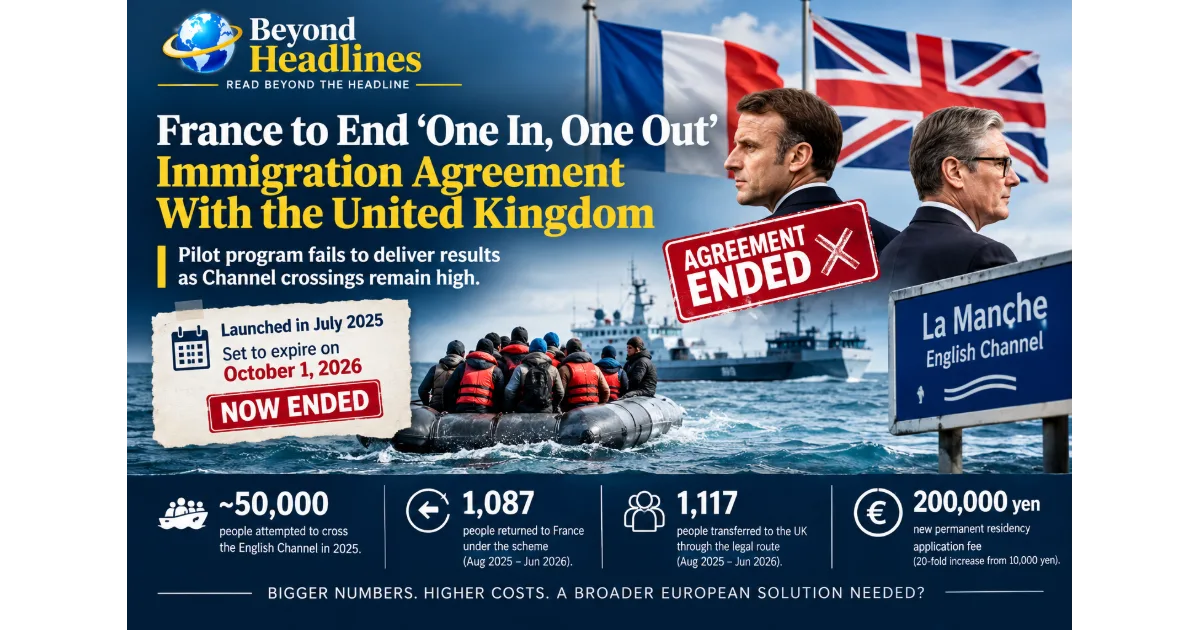
France has decided to end the controversial “one in, one out” immigration agreement with the United Kingdom, bringing to a close a pilot scheme that was designed to discourage migrants from making dangerous small-boat journeys across the English Channel. The arrangement, launched in 2025 and operational from August that year, was built around a reciprocal exchange. Britain could return certain migrants who had reached the UK by small boat to France, while accepting an equivalent number of asylum seekers from France through a legal route. The agreement was intended to create a new deterrent to irregular Channel crossings while also providing a controlled legal pathway for some people seeking protection in Britain.
The scheme formally reached its scheduled end on October 1, 2026, after France decided not to renew it. The British Home Office has confirmed that the pilot is no longer processing new cases, although arrangements for people already detained under the scheme and previously scheduled returns can continue for a limited period. The decision follows months of disagreement over the scale, cost and structure of the programme, as well as France’s preference for a broader European arrangement involving the European Union rather than continuing to carry the principal responsibility through a bilateral agreement with Britain.
The central question surrounding the agreement is whether it achieved what its architects wanted it to achieve. Paris has concluded that the results did not meet its expectations. French Interior Minister Laurent Nuñez acknowledged in June that he was not claiming the system was completely ineffective as a deterrent, but argued that France should not be expected to carry the mechanism alone. He said a broader arrangement between the European Union and the United Kingdom would be preferable. That position is important because it reveals the fundamental disagreement between London and Paris. Britain has viewed the bilateral arrangement as a practical tool for reducing dangerous crossings, while France has increasingly argued that migration across the Channel is part of a wider European issue that requires a wider European response.
The scale of the Channel migration challenge helps explain why the pilot was created in the first place. In 2025, nearly 50,000 people attempted to cross the English Channel from France to Britain in small boats, according to reporting by Le Monde. Nearly 17,000 more attempts were recorded during the first seven months of 2026. These figures illustrate the scale of movement that the bilateral arrangement was intended to influence. They also demonstrate the difficulty of expecting a mechanism that processed only a relatively small number of people to transform a migration route involving tens of thousands of attempted crossings.
It is important, however, to distinguish between attempts, arrivals and completed returns. British government statistics define small-boat arrival figures as people detected arriving in the UK, including people intercepted in the Channel by British authorities and brought ashore. Those figures do not include people prevented from leaving France, people intercepted by French authorities and returned to France, or people who cross without being detected. The UK government therefore treats the different categories separately, and comparisons between attempted crossings and completed returns need to take those definitions into account.
How the “One In, One Out” System Worked
The agreement was formally established through the UK-France Agreement on the Prevention of Dangerous Journeys. It entered into force on August 6, 2025 and provided the legal framework for the pilot. Under the arrangement, people who arrived in the United Kingdom through small-boat crossings and met the criteria for return could be transferred back to France. In exchange, Britain agreed to admit an equivalent number of people from France through a legal route, subject to identity, documentation, security and eligibility checks.
The principle was deliberately simple. For every eligible person returned to France, another person would be admitted legally to Britain. The British government presented the mechanism as a way to change the calculation facing people considering a dangerous Channel journey. Instead of assuming that reaching British territory by small boat would provide a route into the UK asylum system without the possibility of return, the policy was intended to establish that some arrivals could be transferred back to France. At the same time, the legal component was supposed to demonstrate that there were safer alternatives for eligible people with connections to Britain.
The arrangement represented a significant development in post-Brexit migration cooperation. Britain had left the European Union and subsequently lost the previous framework through which migration and asylum matters were handled within the broader European system. The new bilateral agreement therefore attempted to create a specific mechanism between London and Paris for a problem that had become particularly visible along the Channel.
The treaty also reflected a practical reality of geography. France is a major staging point for people attempting to reach Britain by sea, while Britain is the intended destination for many of those making the journey. French authorities can prevent departures from beaches and disrupt smuggling networks, but once people reach British territory, the legal responsibility shifts largely to British authorities. The “one in, one out” arrangement attempted to connect those two stages by creating a mechanism through which Britain could return certain people to France after they arrived.
The Numbers Reveal the Limits of the Pilot
The most revealing feature of the programme may be the relatively small number of people processed compared with the overall scale of Channel migration. According to official UK data covering the period from August 2025 through June 2026, 1,087 people had been returned to France while 1,117 people had been transferred into Britain through the reciprocal legal route. The figures were described by the British government as operational statistics and were subject to later revision.
The monthly figures show that the programme expanded gradually. In September 2025, 17 people were returned to France and three were transferred into Britain. By June 2026, the monthly figures had reached 264 returns and 314 transfers. Across the period covered by the official release, however, the total remained in the low thousands.
That limited scale became one of the principal criticisms of the scheme. British Home Secretary Shabana Mahmood told Parliament in September that approximately 1,400 people had been returned to France under the programme. She also described implementation as difficult and pointed to the relatively small number of people returned. Le Monde reported the same figure and said the average cost of each return had reached approximately £56,000, or around €65,323 at the exchange rate cited in the report.
The cost question is particularly significant because immigration enforcement programmes are not judged only by the number of people removed. Governments also have to consider detention capacity, transportation, legal procedures, administrative processing, security checks and arrangements in the receiving country. If the number of returns remains small while the administrative cost per case is high, the financial efficiency of the system becomes a central policy issue.
At the same time, cost alone cannot determine whether such a programme has an effect. Governments can pursue expensive enforcement measures if they believe those measures prevent larger numbers of attempted journeys, disrupt smuggling organizations or reduce deaths at sea. The British government has argued that the programme contributed to deterrence, even though the scale of the return mechanism remained limited. French officials have acknowledged that the scheme may have had some deterrent effect but have nevertheless concluded that it did not produce the results Paris wanted.
This distinction matters because the available figures do not establish that the programme itself caused the broader decline in Channel crossings reported in 2026. A reduction in crossings can be influenced by weather, French enforcement activity, changes in smuggling networks, British immigration policy, international migration patterns and other factors. The existence of the agreement and the decline in crossings occurred during the same period, but that does not by itself establish how much of the decline was caused by the exchange mechanism.
Crossings Have Fallen, But the Problem Has Not Disappeared
The end of the agreement comes at a time when Channel crossings have actually declined compared with the previous year. Le Monde reported that the number of people crossing by small boat had fallen by around 40 percent during 2026 compared with the corresponding period of the previous year. British government statistics also show continued arrivals during September, demonstrating that the route remains active.
The UK government's weekly statistics recorded 199 migrants arriving in three boats during the week ending September 20, 2026, while 40 migrants were prevented from crossing and five crossing events were prevented. The government stresses that these figures are provisional operational data and can differ from the final figures published through the official immigration statistics system.
This creates an important complication in the debate over the “one in, one out” agreement. The programme is ending even though the number of crossings has declined. That does not necessarily mean that the agreement succeeded or failed. It means that the relationship between the agreement and the overall movement of people across the Channel is difficult to isolate from other measures being implemented at the same time.
France and Britain have also been cooperating on efforts to prevent boats from leaving French shores. In August, the British government said French police units funded through a newer UK-France arrangement had prevented 185 small-boat crossing events between April 27 and August 2, involving an estimated 4,300 people. The British government said this represented a prevention rate of 61 percent during that period.
That activity is separate from the “one in, one out” mechanism and is important when assessing the wider bilateral relationship. Ending the exchange scheme does not mean that France and Britain have ended all cooperation on Channel migration. The two governments continue to have an interest in preventing dangerous crossings, disrupting people-smuggling organizations and managing people who arrive in Britain after crossing from France.
Why France Wanted Out
France's objections increasingly focused on the structure of the agreement rather than simply its existence. French officials argued that France should not be left with a disproportionate responsibility for receiving people returned from Britain. Laurent Nuñez said in Parliament that France should not have to carry the system alone and argued that an agreement involving the European Union and the United Kingdom would be more appropriate.
That position reflects the broader consequences of Brexit. Britain is outside the European Union, while France remains part of the EU and the Schengen area. Migration routes across Europe do not stop at the French coast, and people arriving in France may have travelled through several countries before reaching the Channel. A bilateral arrangement places a particular burden on the country closest to the British coast, even though the migration routes and asylum systems involved extend well beyond France.
From Paris's perspective, the preferred solution is therefore not necessarily the abandonment of cooperation with Britain. Instead, France has sought to move from a narrow bilateral mechanism toward a broader European framework. Such an arrangement could potentially distribute responsibilities among more countries, although negotiations over exactly how that would work remain complicated.
The difficulty is that Britain wants practical mechanisms that allow it to return people who have arrived through irregular routes, while EU countries have their own legal obligations, political pressures and concerns about accepting responsibility for people who ultimately seek to live in Britain.
The post-Brexit relationship makes the issue particularly sensitive. The EU-UK Trade and Cooperation Agreement governs many aspects of the relationship between Britain and the bloc, but it does not provide a comprehensive framework for asylum and immigration comparable to the arrangements that existed when Britain was an EU member.
Britain’s Argument for Continuing the Scheme
London had sought to keep the agreement alive. British officials argued that returning people who had crossed the Channel could contribute to deterrence, particularly if migrants and smugglers believed that arriving in Britain by small boat did not necessarily mean being able to remain there.
The British government also continued to describe the wider policy as part of an effort to dismantle organized people-smuggling networks and reduce dangerous journeys. The original treaty explicitly stated that the purpose of the arrangement was to deter small-boat crossings, disrupt organized immigration crime and save lives by demonstrating that irregular maritime journeys were not a reliable route to remaining in Britain.
There is also a humanitarian argument embedded in the British position. The Channel is a busy shipping route with strong currents, unpredictable weather and heavy commercial traffic. Small inflatable boats carrying large numbers of people can be dangerously overcrowded and poorly equipped. British and French authorities have repeatedly emphasized the dangers involved in the journeys.
From that perspective, a policy that discourages people from making the crossing could potentially have a humanitarian objective as well as an immigration-control objective. The difficulty is determining whether the particular mechanism used by the “one in, one out” programme was sufficient to change behavior on a large scale.
The Legal Route Was an Important Part of the Deal
The agreement was not solely about returns. Its other half created a legal route into Britain for a limited number of people from France who met the required conditions.
The UK government stated when the treaty came into force that the people transferred into Britain would undergo documentation, security and eligibility checks. The individuals would have to qualify under the relevant immigration rules, and the route was designed to prioritize people with appropriate links to Britain.
By the end of June 2026, 1,117 people had entered Britain through the programme compared with 1,087 returns to France. Later reporting put the total number returned at more than 1,400 as the scheme moved toward its end. The precise figures differ depending on the date and statistical cut-off used, but all available figures point to a programme operating at a relatively small scale compared with the overall Channel migration challenge.
The end of the programme therefore removes one of the few legal pathways that was directly connected to the Channel migration relationship between Britain and France. That aspect has received less attention than the returns themselves, but it is significant. The original concept was partly based on replacing at least some irregular movement with controlled legal movement.
Whether another arrangement will create a similar legal pathway remains uncertain.
Human Rights and Legal Concerns
The agreement has also faced criticism from refugee and migrant-rights organizations. A group of non-governmental organizations challenged the mechanism in court, arguing that the system raised serious concerns about access to international protection and the treatment of people subject to removal.
According to Le Monde, around 15 organizations challenged the agreement without success, arguing that the exchange mechanism risked treating individuals as interchangeable units rather than people with individual protection claims.
Those concerns illustrate the tension inherent in migration agreements based on numerical exchanges. Governments naturally seek measurable mechanisms because immigration systems depend on identifiable rules and procedures. Humanitarian organizations, by contrast, emphasize that each asylum claim has to be assessed according to the individual's circumstances and applicable international protection standards.
The existence of an exchange mechanism does not remove those legal obligations. People returned to France still have an administrative and legal status that must be dealt with under French law, while people transferred to Britain must meet the requirements of the relevant British immigration system. The treaty itself specifies that people readmitted to France have their administrative situation examined under domestic law.
The Risk of Repeat Crossings
Another difficulty emerged when some people returned to France subsequently attempted to cross the Channel again. Le Monde, citing reporting by The Guardian, said that around 50 people returned under the scheme later reached Britain again by small boat.
Repeat crossings are significant because the deterrent logic of the programme depends partly on the assumption that return to France will alter the incentives of people considering the journey. If people who are returned simply try again, the mechanism becomes more complicated. It may still demonstrate that irregular entry can lead to removal, but the practical effect is reduced if the same individuals repeatedly attempt the journey.
Repeat attempts also raise questions about the conditions facing migrants in France. The broader migration debate includes issues of accommodation, legal status, employment opportunities and access to asylum procedures. These factors can influence decisions to attempt the Channel crossing, making it difficult for any single enforcement policy to determine behavior.
The Economics of the Channel Route
Behind the political debate is an extensive criminal economy involving people smugglers. The British government has repeatedly described the small-boat trade as organized immigration crime. Smugglers charge migrants substantial sums for journeys that can take place in overcrowded inflatable boats with inadequate safety equipment.
The policy challenge therefore has two interconnected sides. One concerns people already attempting to cross, while the other concerns the organizations arranging the crossings.
Returning migrants after arrival addresses the first problem but may not necessarily dismantle the organizations arranging departures. Preventing boats from launching, seizing equipment, arresting suspected facilitators and disrupting financial networks address the second. This is why French policing activity along the northern coast and British investigations into organized immigration crime have continued independently of the exchange scheme.
The British government's August announcement that French units had prevented 185 small-boat events during a three-month period illustrates this broader approach. Such operations seek to stop journeys before they begin rather than relying on returns after people reach Britain.
What Happens After October 1?
The end of the pilot does not mean the Channel migration issue disappears. Britain remains responsible for people arriving on its territory, while France remains one of the principal countries through which migrants travel before attempting to reach Britain.
The immediate administrative transition is also not instantaneous. The British Home Office has indicated that the programme is no longer accepting new cases, while people already detained under the system can continue to be dealt with under existing arrangements. Earlier reporting indicated that return flights for people already detained could continue for several weeks while the governments completed the withdrawal process.
The larger question is what replaces the scheme. France has been calling for an EU-UK arrangement, but establishing such a framework would require agreement among Britain and multiple European governments and institutions. Each country has different migration pressures and different political considerations.
For Britain, the end of the bilateral scheme creates a need to maintain cooperation with France while looking for other mechanisms to reduce Channel crossings. For France, the challenge is balancing cooperation with Britain against the broader responsibility of managing migration through European territory.
Neither side can address the problem entirely through unilateral action because the geography of the Channel route creates shared responsibilities.
A Policy Experiment With a Larger Legacy
The “one in, one out” agreement will therefore be remembered as more than a short-lived bilateral immigration arrangement. It represented an attempt to create a new model for post-Brexit migration cooperation between Britain and France. Its basic premise was that returns and legal admissions could be combined into a reciprocal mechanism capable of changing incentives.
The experiment produced actual returns and legal transfers. It also created a formal process that had not previously existed at this scale between the two countries. But the number of people processed remained small compared with the tens of thousands involved in Channel crossings, while the cost per return became a significant issue. French officials concluded that the results were insufficient to justify continuing the model in its existing form.
At the same time, the decline in Channel crossings during 2026 complicates any simple assessment of the programme. Crossings fell substantially compared with the previous year, while French and British authorities were simultaneously implementing other enforcement measures. The available evidence does not allow the decline to be attributed solely to the “one in, one out” mechanism.
That distinction will matter in the years ahead. Immigration policy is rarely the result of a single measure. Border enforcement, asylum processing, international agreements, police operations, employment opportunities, housing, migration routes and conditions in countries of origin can all influence movement.
The end of the agreement also highlights the unresolved consequences of Brexit for migration management. Britain wants greater control over its borders, while France and other European countries have an interest in preventing Britain-bound migration from creating additional pressure on their own systems. Without a broader framework, each side remains dependent on cooperation from the other.
What the End of the Deal Says About Europe’s Migration Challenge
The most important development may therefore be what happens next rather than the termination itself. France is signaling that bilateral cooperation alone is not sufficient. Britain is signaling that it still needs operational cooperation with France to address small-boat crossings. The European Union occupies a central position in the background because most of the migration routes leading toward the Channel pass through European territory.
The issue also illustrates the limits of numerical solutions to complex migration problems. The phrase “one in, one out” is easy to understand, but the actual system involved eligibility rules, legal assessments, detention, transportation, identity checks and administrative decisions. Every individual case remained subject to national and international legal requirements.
The numbers also tell only part of the story. More than 1,000 people were returned under the agreement, and more than 1,000 were legally transferred to Britain. Yet tens of thousands of people continued to attempt Channel crossings over the broader period. The difference between those numbers is central to understanding why Paris decided not to continue the pilot in its existing form.
For Britain, the challenge remains preventing dangerous journeys while dealing with people who reach its territory. For France, the challenge is preventing departures and managing migrants on its territory without becoming the default destination for people whom Britain wants to return. For the European Union, the issue touches on the wider question of how responsibility for migration should be distributed between member states and a neighboring country that is no longer part of the bloc.
The end of the “one in, one out” arrangement does not resolve any of those questions. It simply closes one chapter in an increasingly complicated effort to manage migration across the English Channel.
What began in 2025 as an attempt to create a clear reciprocal deterrent has ended after roughly a year of operational activity, with France arguing that the results were insufficient and that the responsibility should be shared more broadly. Britain, meanwhile, continues to pursue measures aimed at reducing dangerous crossings and disrupting smuggling networks.
The Channel remains one of Europe's most visible migration routes, and the human stakes remain high. The British government says the small-boat journeys are dangerous and wants to prevent them. French authorities face pressure to stop departures from its coastline. Migrants continue to make decisions shaped by conditions far beyond the beaches of northern France. Smuggling organizations continue to adapt to enforcement measures. And both governments remain under domestic political pressure to demonstrate that they can manage the situation.
The termination of the agreement therefore should not be interpreted simply as the end of cooperation between Britain and France. Rather, it marks the end of one particular experiment in that cooperation. The next phase will depend on whether London and Paris can build a system that addresses both sides of the problem: preventing dangerous and irregular journeys while establishing clear, lawful mechanisms for asylum, returns and responsibility-sharing.
For now, the record of the pilot provides a measurable but limited result. Official UK data recorded 1,087 completed returns to France and 1,117 transfers into Britain through June 2026, while later figures put total returns at more than 1,400. Against the backdrop of tens of thousands of Channel crossings and attempts, the programme remained relatively small. France has decided that its future lies elsewhere, particularly in a broader European framework.
The deeper lesson is that migration cannot easily be reduced to a single number or a single agreement. The “one in, one out” formula offered a simple political description of a complicated legal and operational system. Its ending leaves Britain and France facing the same geography, the same Channel, the same smuggling networks and the same difficult questions about asylum and responsibility.
The next agreement, if one emerges, will have to confront those realities rather than simply changing the terminology. The central challenge for both countries remains how to reduce dangerous journeys, maintain lawful access to protection, prevent organized smuggling and distribute responsibility in a way that is workable across the post-Brexit European landscape.
For Beyond Headlines, that is the larger story behind the decision. France is not simply walking away from Britain on migration. Paris is ending a specific bilateral experiment that it says did not deliver the results it wanted and is pressing for a wider European approach. Britain, meanwhile, still faces the practical problem that the agreement was created to address. The end of “one in, one out” therefore closes a policy experiment, but it does not close the Channel migration question.
#BeyondHeadlines #France #UnitedKingdom #UKFrance #Immigration #Migration #ChannelCrossings #EnglishChannel #OneInOneOut #AsylumSeekers #Refugees #BorderSecurity #Brexit #EuropeanUnion #MigrationPolicy #FranceNews #UKNews #Europe #BorderControl #GlobalMigration #WorldAffairs #InternationalRelations