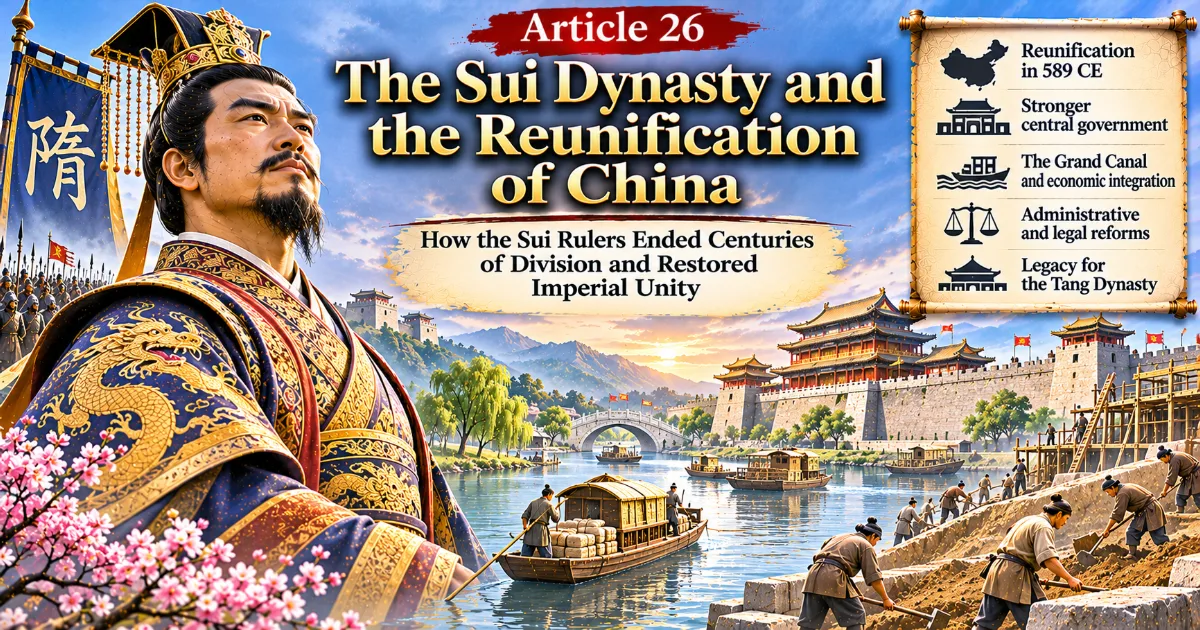
How the Sui rulers ended centuries of political division, restored imperial unity, and laid the foundations for the prosperity of the Tang Dynasty.
For nearly three centuries after the collapse of the Western Jin Dynasty in 316 CE, China experienced political fragmentation, competing kingdoms, population movements, and profound cultural transformation. Northern and southern regimes developed different political systems and social environments, while warfare repeatedly changed the boundaries of kingdoms. Despite this division, economic exchange, religious development, and cultural connections continued across the country.
The reunification of China under the Sui Dynasty in 589 CE marked one of the most important turning points in Chinese history. The Sui rulers established a centralised imperial government, strengthened administrative institutions, reorganised taxation and military systems, and connected distant regions through major infrastructure projects. Their achievements created the political and economic foundations upon which the Tang Dynasty would later build one of the most celebrated periods in Chinese civilization.
The Sui Dynasty was short-lived, lasting only from 581 to 618 CE. Yet its historical importance was far greater than its brief existence suggests. Its rise demonstrated how a divided country could be reunited, while its collapse revealed the dangers of excessive military ambition, forced labour, heavy taxation, and political mismanagement.
Continue Reading
The Sui Dynasty and the Reunification of China
How the Sui rulers ended centuries of political division, restored imperial unity, and laid the foundations for the prosperity of the Tang Dynasty1. China Before the Sui Dynasty: Centuries of Division
For nearly three centuries after the collapse of the Western Jin Dynasty in 316 CE, China experienced political fragmentation, competing kingdoms, population movements, and profound cultural transformation. Northern and southern regimes developed different political systems and social environments, while warfare repeatedly changed the boundaries of kingdoms. Despite this division, economic exchange, religious development, and cultural connections continued across the country.
The Northern and Southern Dynasties period was not simply an age of destruction. It witnessed significant developments in Buddhism, literature, agriculture, military organisation, and artistic expression. Northern rulers introduced administrative and cultural reforms, while southern courts preserved important traditions of Chinese scholarship and aristocratic culture. Population movements also brought new agricultural techniques and commercial activity to different regions.
However, political division created serious challenges. There was no single government capable of exercising authority over the entire Chinese heartland. Different kingdoms maintained their own armies, taxation systems, officials, and political priorities. Competition for territory and resources repeatedly produced military conflict.
The reunification of China under the Sui Dynasty in 589 CE marked one of the most important turning points in Chinese history. The Sui rulers established a centralised imperial government, strengthened administrative institutions, reorganised taxation and military systems, and connected distant regions through major infrastructure projects. Their achievements created the political and economic foundations upon which the Tang Dynasty would later build one of the most celebrated periods in Chinese civilization.
The Sui Dynasty was short-lived, lasting only from 581 to 618 CE. Yet its historical importance was far greater than its brief existence suggests. Its rise demonstrated how a divided country could be reunited, while its collapse revealed the dangers of excessive military ambition, forced labour, heavy taxation, and political mismanagement.
2. The Rise of the Northern Zhou Dynasty
The political background to Sui reunification began in northern China. Following the division of the Northern Wei Dynasty in 534 CE, northern territories were controlled by competing successor states. These political divisions eventually produced the Northern Qi and Northern Zhou dynasties.
The Northern Zhou Dynasty emerged as a powerful state under rulers who developed strong military institutions and sought to consolidate control over northern China. Its ruling elite had connections with the military and political traditions of the northwestern frontier, where Chinese and non-Chinese communities had interacted for generations.
Northern Zhou rulers strengthened their armies, reorganised government institutions, and pursued territorial expansion. Their military establishment was particularly important because the northern states had to defend themselves against rival kingdoms and maintain control over a politically diverse population.
In 577 CE, Northern Zhou conquered Northern Qi. This victory brought much of northern China under a single government and removed one of the major obstacles to wider reunification.
The conquest significantly strengthened Northern Zhou's position. It gained control over additional agricultural lands, population centres, military resources, and important routes. The northern political landscape was now more consolidated than it had been for generations.
Yet the Northern Zhou court would soon experience another political transformation. A powerful official and military leader named Yang Jian was positioned to take control of the imperial government.
3. Yang Jian and the Foundations of the Sui Dynasty
Yang Jian came from an influential family with strong military and political connections. His daughter had married the Northern Zhou crown prince, giving him a close relationship with the imperial family. Over time, Yang Jian became one of the most powerful figures at court.
When Emperor Xuan of Northern Zhou died in 580 CE, Yang Jian became regent for the young emperor Jing. The young ruler's position was politically weak, and powerful officials competed for influence. Yang Jian used this opportunity to strengthen his authority and secure the support of important military commanders and government officials.
His rise was not uncontested. Several military leaders resisted his growing influence, leading to political and military confrontations. Yang Jian eventually defeated his opponents and consolidated control over the Northern Zhou government.
In 581 CE, he took the throne and established a new dynasty, adopting the name Sui. He became known historically as Emperor Wen of Sui.
The transition marked the end of Northern Zhou imperial rule and the beginning of a new political project. Yang Jian's ambition extended beyond controlling the northern territories. He sought to reunite the entire Chinese empire under a centralised government.
The Sui Dynasty inherited a strong northern military and administrative structure. Emperor Wen used these resources to prepare for the conquest of the remaining southern kingdom.
4. Emperor Wen: The Architect of Reunification
Emperor Wen's reign was one of the most important periods in the formation of the Sui state. He understood that military victory alone would not guarantee lasting unity. A successful empire needed stable institutions, reliable taxation, an organised bureaucracy, and the cooperation of regional elites.
His government worked to restore central authority and reduce the influence of competing aristocratic and military interests. Officials were appointed to administer territories, supervise taxation, maintain public order, and implement imperial decisions.
Emperor Wen also promoted policies intended to improve agricultural production and strengthen the economic foundations of the state. Agriculture remained the principal source of wealth and government revenue, making the organisation of rural society essential to imperial stability.
The emperor sought to reduce unnecessary expenditure and maintain a disciplined administration. His reputation for personal restraint and attention to government affairs became an important part of his historical image.
The Sui government also inherited political ideas and administrative practices from earlier Chinese dynasties. It did not create a completely new imperial system. Instead, it reorganised and strengthened institutions developed during the Han, Wei, Jin, and Northern Dynasties periods.
The success of Emperor Wen's government depended on combining military power with administrative reform. This approach would become central to the reunification campaign.
5. The Southern Chen Dynasty: The Last Independent Kingdom
By the late sixth century, the principal remaining obstacle to reunification was the Chen Dynasty in southern China. Established in 557 CE, Chen controlled territories around the lower Yangtze River and important southern urban centres.
The south had developed a distinct political and cultural environment during the centuries of division. Its courts were associated with aristocratic families, literary culture, Buddhist institutions, and commercial activity. The Yangtze River system provided important transportation routes and supported agricultural and economic development.
However, Chen faced internal difficulties. Its political and military resources were weaker than those of the expanding Sui state. Court rivalries, administrative problems, and limited military coordination reduced its ability to resist a large northern invasion.
Emperor Wen recognised that conquering Chen would require careful preparation. A direct campaign across the Yangtze would involve complex military operations, including the movement of troops, supplies, and equipment across major waterways.
The Sui government therefore strengthened its forces, gathered intelligence, prepared transportation networks, and developed a coordinated strategy.
The campaign would test whether the new dynasty possessed the military and administrative capacity to transform its northern power into control over the entire country.
6. The Sui Campaign Against Chen in 589 CE
In 588 CE, the Sui government began preparing a major military campaign against the Chen Dynasty. The operation involved forces advancing through several routes, supported by naval and logistical preparations.
The Yangtze River was a major geographical barrier. Controlling crossings and securing supply lines were essential to the success of the campaign. The Sui forces used coordinated military operations to attack Chen's defensive positions and disrupt its ability to organise resistance.
The Chen court was unable to respond effectively. Its military organisation was weaker, and its leadership struggled to coordinate a defence against the large Sui invasion.
In 589 CE, Sui forces captured the Chen capital of Jiankang, near present-day Nanjing. The last Chen ruler, Chen Shubao, was captured, and the dynasty came to an end.
The conquest completed the political reunification of China under the Sui Dynasty. For the first time since the collapse of the Western Jin in 316 CE, a single imperial government exercised authority over both northern and southern China.
The achievement was historically significant. It ended generations of political division and restored the possibility of large-scale national administration, economic coordination, and cultural exchange.
7. The Challenges of Governing a Reunified Empire
Reunification was a military achievement, but governing the newly unified empire was a much more complicated task.
Northern and southern regions had experienced different political developments for centuries. Their administrative systems, social structures, elite families, and cultural practices were not identical. The Sui government had to integrate these territories without allowing regional resistance to undermine imperial authority.
The south contained powerful local families and established political networks. Some of these groups had previously enjoyed considerable influence under the Chen and earlier southern dynasties. They could not simply be ignored or removed without risking instability.
The Sui government therefore sought to extend its administrative institutions throughout the empire. Officials were appointed to supervise local government, taxation, law enforcement, and public works.
The central government also had to restore economic connections between regions. Northern China possessed important agricultural and military resources, while the south was becoming increasingly important for rice production, trade, and population growth.
The Yangtze River and its tributaries offered natural transportation routes, but efficient communication between northern and southern administrative centres required additional infrastructure.
The Sui rulers recognised that political unity needed economic integration. Their infrastructure projects would become among the most important legacies of the dynasty.
8. Administrative Reforms and the Centralised Imperial State
One of the Sui Dynasty's most important contributions was the strengthening of central government institutions.
The imperial administration was organised to separate major responsibilities and create clearer channels of authority. The Three Departments and Six Ministries system became an important feature of this development, with different departments responsible for drafting, reviewing, and implementing government decisions.
The Six Ministries dealt with major administrative areas, including personnel, revenue, rites, military affairs, justice, and public works. These institutions provided an organised framework for governing a large territory.
The Sui rulers also strengthened the role of the emperor as the highest political authority. Regional officials were expected to carry out imperial policies rather than establish independent power bases.
Administrative reform was necessary because the empire contained large populations, diverse local conditions, and extensive agricultural territories. A central government required accurate records, trained officials, and dependable communication systems.
The Sui administrative structure influenced later dynasties, particularly the Tang. Although institutions changed over time, the broad organisational framework developed during the Sui period became an important foundation of imperial government.
9. The Legal Reforms of the Sui Dynasty
The Sui rulers also reorganised the legal system. Law was essential to maintaining political stability, defining official responsibilities, regulating social behaviour, and establishing consistent government authority.
The Sui legal code drew on earlier legal traditions while introducing reforms intended to create a more systematic framework. It helped clarify punishments and administrative procedures and influenced the legal development of the Tang Dynasty.
The Sui legal reforms were part of a wider effort to establish uniform government institutions throughout the reunified empire. Different regions had experienced different political systems, and the central government wanted a more consistent approach to law and administration.
Legal standardisation did not mean that all local differences disappeared. Regional customs and social conditions continued to influence everyday life. However, the imperial government increasingly sought to establish common legal principles across its territories.
The later Tang legal system would build upon this foundation and become one of the most influential legal traditions in East Asian history.
10. Taxation, Land, and Agricultural Reform
Agriculture was the foundation of the Sui economy. Most people lived in rural settlements and depended on farming for their livelihood. Government revenue, food supplies, and military resources all depended heavily on agricultural production.
The Sui government continued and strengthened land and taxation policies associated with earlier northern dynasties, particularly the equal-field system. Under this system, eligible households received allocations of land according to state regulations, while certain categories of land remained hereditary or otherwise restricted.
The system was intended to connect agricultural households more directly with the state. Land records helped officials determine taxation obligations and organise labour services.
The government also sought to identify households, register populations, and establish clearer relationships between landholding and taxation. Such measures were important for preventing powerful families from concealing land and population resources from the central government.
However, these reforms required administrative supervision. Accurate records were difficult to maintain across a large empire, and local officials could misuse their authority.
When implemented effectively, agricultural and taxation reforms strengthened government revenue and encouraged productive settlement. When combined with excessive demands, however, they could become burdensome for rural households.
11. The Revival of Luoyang
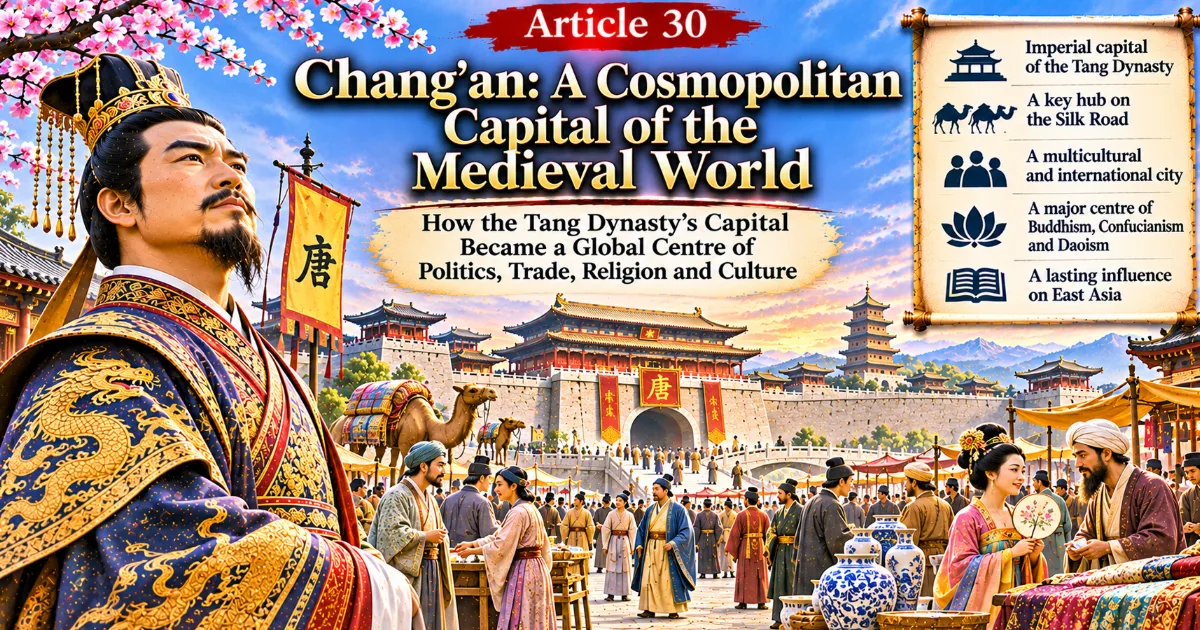
The Sui rulers recognised the importance of strategically located capitals. Chang'an, in the northwest, had long served as a major political centre. Its location provided advantages for controlling western and northwestern territories, but transporting supplies from the increasingly productive south could be difficult.
Luoyang, located in the central plains, offered another important political and geographical advantage. It stood closer to the major agricultural regions of the east and the transportation routes connecting northern and southern China.
Emperor Wen strengthened the role of the capital at Chang'an, while Emperor Yang later undertook a major programme of construction at Luoyang.
The new eastern capital became an important administrative and logistical centre. Its location was closely connected with the development of the Grand Canal and the movement of grain and other resources.
Capital construction was not simply a matter of building palaces and government offices. It involved roads, warehouses, defensive structures, residential districts, markets, and facilities for transporting supplies.
These projects demonstrated the scale of the Sui government's ambitions. They also required enormous labour and resources, creating pressures that would contribute to public dissatisfaction.
12. Emperor Yang of Sui and the Second Phase of Imperial Expansion
Emperor Wen was succeeded by his son Yang Guang, who became Emperor Yang of Sui in 604 CE. His reign was marked by major infrastructure projects, military campaigns, and ambitious plans to strengthen imperial power.
Emperor Yang possessed considerable political and administrative ambition. He sought to expand the prestige of the dynasty, improve transportation across the empire, and strengthen the authority of the central government.
His reign included the construction and expansion of Luoyang, the development of the Grand Canal, and military campaigns against neighbouring powers.
Some of these projects had lasting economic and strategic value. The Grand Canal became a vital transportation network, while the reorganisation of major cities strengthened imperial administration.
However, Emperor Yang's government demanded enormous quantities of labour and resources. Large construction projects required workers from different regions, and military campaigns placed additional pressure on taxation and supplies.
The gap between imperial ambition and the capacity of ordinary households to support it became increasingly dangerous.
13. The Grand Canal: Connecting North and South China
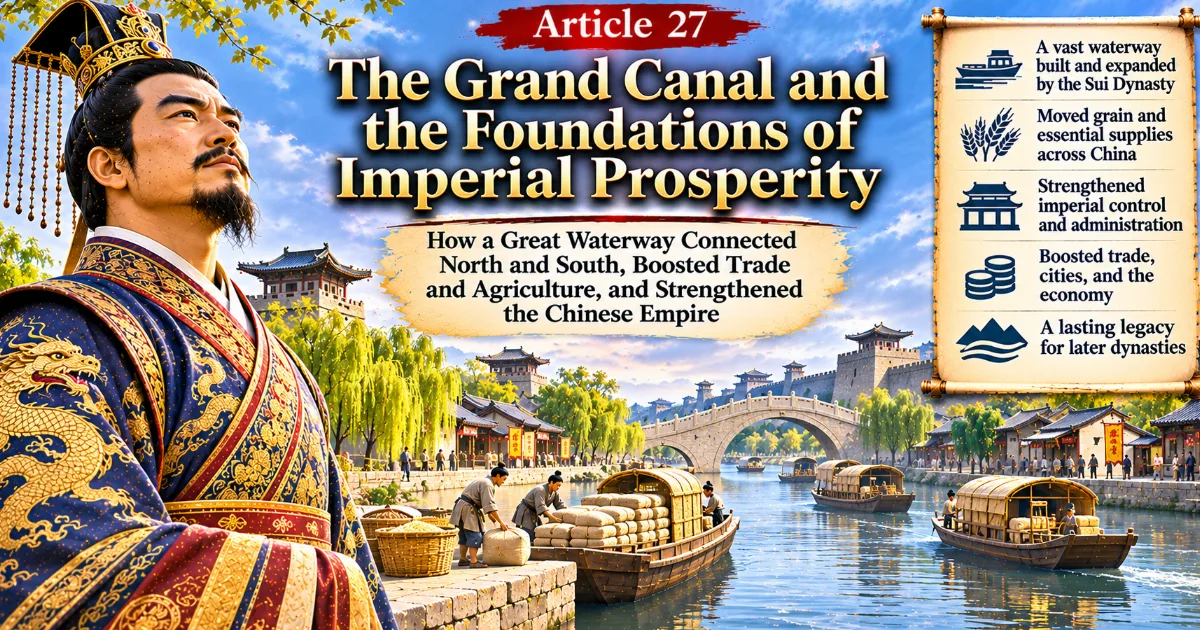
The Grand Canal became one of the greatest infrastructure achievements associated with the Sui Dynasty. It connected major waterways and transportation routes, linking important regions of northern and southern China.
Water transport had long been essential to Chinese economic life. Rivers and canals carried grain, timber, textiles, construction materials, and other goods. However, the country's major river systems did not always provide convenient connections between important political and economic centres.
The Sui government developed and connected canal sections into a more extensive transportation system. The network linked the region around the Yellow River with the Huai River, the Yangtze River, and areas further south.
The canal was especially important for transporting agricultural produce from the south towards northern political and military centres. Southern regions were increasingly productive, and the central government needed reliable methods of moving grain to support cities, officials, soldiers, and construction projects.
The Grand Canal also improved communication and commercial exchange. Boats could carry goods across long distances, reducing dependence on difficult overland transportation.
Its development required enormous labour. Workers had to excavate waterways, deepen existing channels, construct embankments, build locks and bridges, and maintain the system.
The canal's economic importance extended far beyond the Sui period. Later dynasties continued to use and improve it, making it one of the most enduring elements of China's transportation history.
14. The Economic Importance of the Grand Canal
The Grand Canal helped strengthen the economic integration of northern and southern China. It connected agricultural production centres with political capitals and commercial markets, creating a more closely linked imperial economy.
The south became increasingly important as a source of rice and other agricultural products. Its waterways supported transportation, while its growing population contributed to the development of towns and commercial centres.
Northern political centres depended on reliable supplies. Moving grain by land over long distances was expensive and difficult, especially when large quantities were needed to support government institutions and military forces.
Water transportation offered a more efficient alternative. The canal helped move agricultural produce towards major cities and administrative centres.
It also encouraged commercial activity. Traders could transport goods between regions, while urban markets benefited from a wider supply of products.
The canal therefore became more than an engineering achievement. It was an instrument of economic integration and imperial administration.
Its long-term importance was demonstrated during the Tang and later dynasties, when the transportation network continued to support large populations and the operation of the central government.
15. Military Expansion and the Korean Peninsula
While Emperor Yang invested in infrastructure, he also pursued an ambitious foreign policy. One of his principal military objectives was the conquest of Goguryeo, a powerful kingdom located in parts of the Korean Peninsula and neighbouring northeastern territories.
Goguryeo possessed a strong military tradition and had developed extensive defensive systems. Its territory included difficult landscapes, fortified settlements, and strategically important routes.
The Sui court viewed Goguryeo as a major regional power whose independence challenged Chinese influence in the northeast. Diplomatic tensions and competition over border territories contributed to the conflict.
Emperor Yang organised large military expeditions against Goguryeo. These campaigns required the mobilisation of enormous armies, supplies, horses, ships, and transport resources.
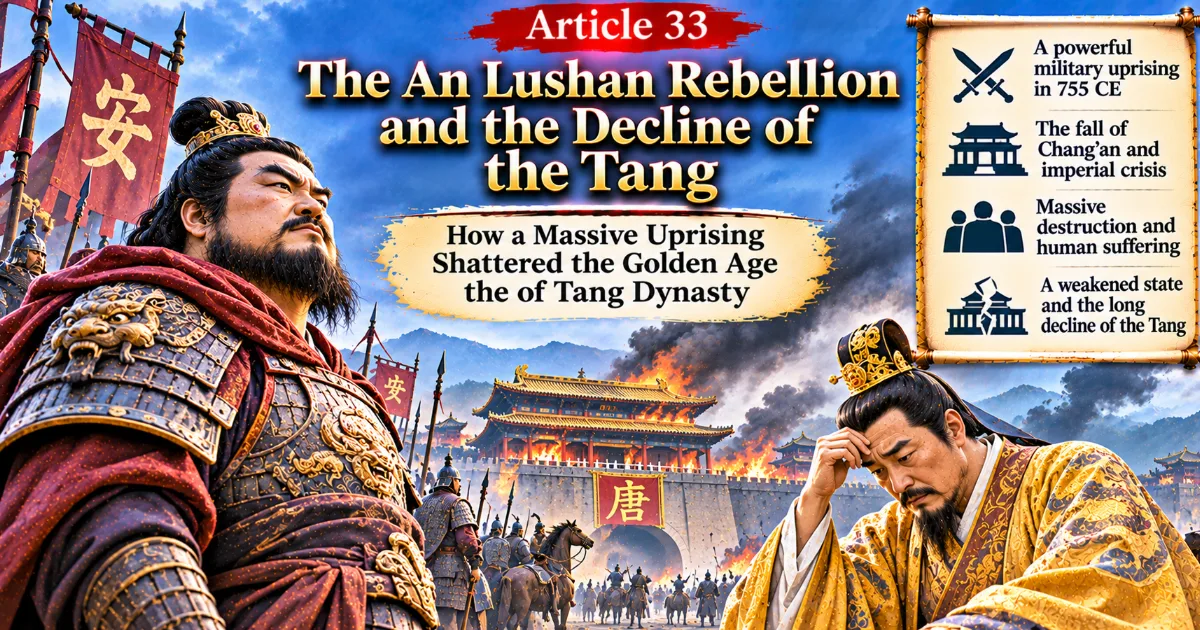
The first major invasion in 612 CE ended disastrously for the Sui forces. The campaign encountered logistical difficulties, strong resistance, and severe military setbacks.
The Sui army suffered enormous losses, damaging the prestige of the emperor and placing additional pressure on the empire's economy.
Further campaigns followed, but the Sui government failed to achieve its objective. The repeated wars became one of the most important factors contributing to the dynasty's collapse.
16. The Human Cost of Imperial Ambition
The Sui Dynasty's achievements were accompanied by a heavy human cost. Infrastructure construction, military mobilisation, and capital development required large numbers of workers.
Many people were compelled to participate in public works or provide labour and supplies. Agricultural households had to balance their own farming responsibilities with obligations imposed by the state.
When workers were taken away during important agricultural seasons, families could lose opportunities to plant or harvest crops. This could reduce household income and create food shortages.
Military campaigns also placed pressure on rural communities. Governments needed grain, animals, weapons, clothing, transport equipment, and soldiers. These demands could become especially difficult when campaigns continued for years.
The suffering was not distributed equally. Wealthier families sometimes possessed greater resources and influence to manage their obligations, while poorer households were more vulnerable to taxation, labour demands, and local abuses.
The growing distance between imperial projects and ordinary people's needs weakened public confidence in the government.
17. Rebellions and the Beginning of the Sui Collapse
By the second decade of the seventh century, dissatisfaction with the Sui government had become increasingly widespread. Military failures, heavy taxation, forced labour, and administrative abuses contributed to growing unrest.
Rebellions emerged in different parts of the empire. Some were led by local military figures, while others developed from social and economic grievances.
The central government struggled to respond effectively. The army was weakened by foreign campaigns, and the administration faced the challenge of dealing with unrest across a vast territory.
Regional commanders and ambitious officials began building independent power bases. As imperial authority weakened, these leaders competed for control of territory, resources, and political legitimacy.
The rebellion movement was not a single coordinated uprising. It consisted of different groups with varying goals and leadership. Some wanted to overthrow the Sui government, while others sought to protect their local interests or establish new political authority.
The growing fragmentation showed that the dynasty had lost much of its ability to command loyalty and maintain order.
18. Li Yuan and the Rise of the Tang Dynasty
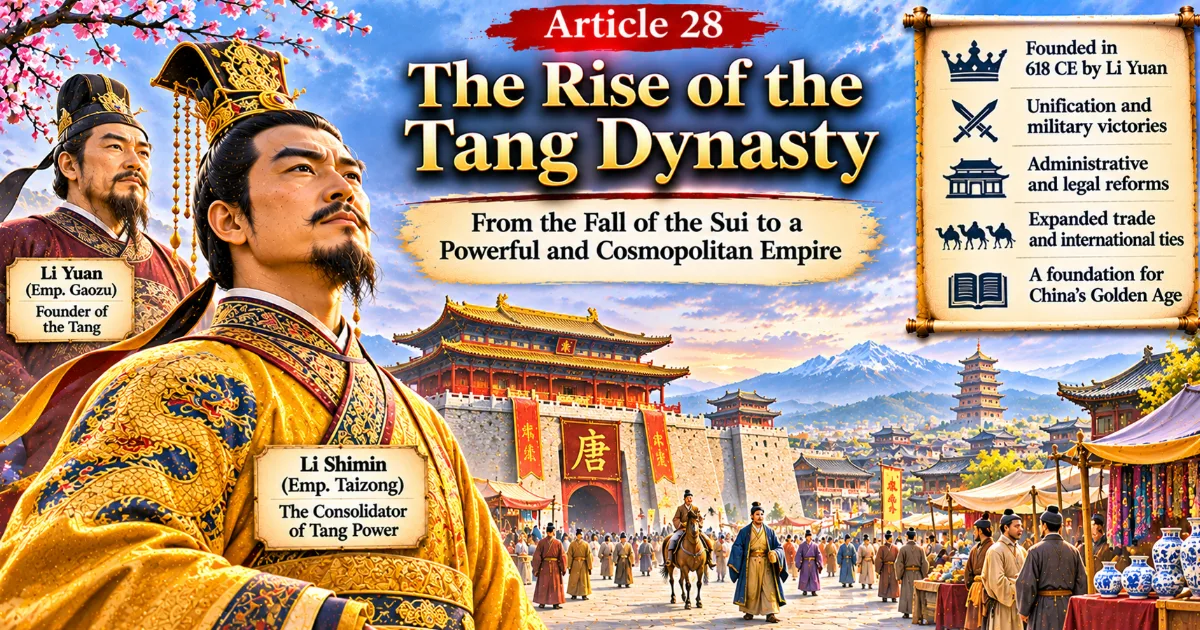
One of the most important figures to emerge during the collapse of the Sui Dynasty was Li Yuan, a powerful military commander with aristocratic connections.
Li Yuan had served the Sui government and possessed considerable military experience. As the political situation deteriorated, he recognised that the imperial regime was becoming increasingly vulnerable.
In 617 CE, he raised forces against the Sui government and advanced towards Chang'an. His campaign succeeded, and he gained control of the capital region.
Li Yuan initially presented himself as a defender of the imperial order, but the collapse of Sui authority created an opportunity for him to establish a new dynasty.
In 618 CE, after Emperor Yang was killed during political turmoil, Li Yuan formally founded the Tang Dynasty and became Emperor Gaozu.
The transition did not immediately bring peace to the entire country. Rival military leaders and regional governments continued to compete for power. The Tang rulers had to spend several years defeating their opponents and consolidating control.
Nevertheless, the establishment of the Tang Dynasty marked the end of Sui imperial rule and the beginning of a new phase in Chinese history.
19. Why the Sui Dynasty Collapsed So Quickly
The collapse of the Sui Dynasty resulted from several connected problems rather than a single event.
First, Emperor Yang's military campaigns placed enormous pressure on the empire. The repeated invasions of Goguryeo consumed soldiers, supplies, and financial resources without achieving the intended victories.
Second, large construction projects required extensive labour and taxation. Although many projects had long-term value, their immediate costs were extremely high. The burden fell heavily on ordinary households.
Third, administrative problems weakened the relationship between the central government and local communities. Corruption, excessive demands, and the inability to respond effectively to regional grievances contributed to growing dissatisfaction.
Fourth, the imperial leadership failed to maintain sufficient political support. Military commanders and regional officials increasingly pursued their own interests as the central government lost authority.
Finally, the dynasty had not existed long enough to establish the same depth of political legitimacy and institutional stability associated with earlier imperial houses. Its achievements were significant, but its government became vulnerable when its resources were stretched beyond their limits.
The Sui collapse illustrates a recurring problem in imperial history: a powerful government may possess the ability to undertake extraordinary projects, but those achievements cannot be sustained if the population and administrative system are pushed beyond their capacity.
20. The Sui Dynasty's Lasting Legacy
Although the Sui Dynasty lasted only a few decades, its achievements shaped the development of China for centuries.
Its reunification of the country restored a central imperial government after generations of division. The administrative institutions developed during the Sui period provided important foundations for the Tang Dynasty and later imperial governments.
The legal reforms of the Sui influenced the Tang legal code, while its administrative organisation helped establish durable patterns of government.
The Grand Canal became one of the most important transportation networks in Chinese history. It strengthened economic connections between northern and southern regions and supported the movement of grain, trade goods, officials, and military supplies.
The Sui also contributed to the development of major urban centres, particularly through the expansion of Luoyang and the strengthening of Chang'an as an imperial capital.
Its political experience offered important lessons about the relationship between state power, economic resources, military ambition, and public welfare.
The Tang Dynasty inherited a reunified empire, administrative institutions, transportation networks, and an increasingly integrated economic system. These foundations helped the Tang government build a powerful and prosperous state.
21. From Sui Reunification to Tang Prosperity
The transition from Sui to Tang demonstrates the importance of institutional continuity in Chinese history.
The Tang rulers did not begin with an entirely new political system. They inherited much of the administrative structure, legal organisation, and infrastructure developed under the Sui.
However, the Tang government learned from the failures of its predecessor. Its early rulers sought to strengthen political stability, maintain a more sustainable relationship with the population, and consolidate authority without repeating the most damaging aspects of Sui rule.
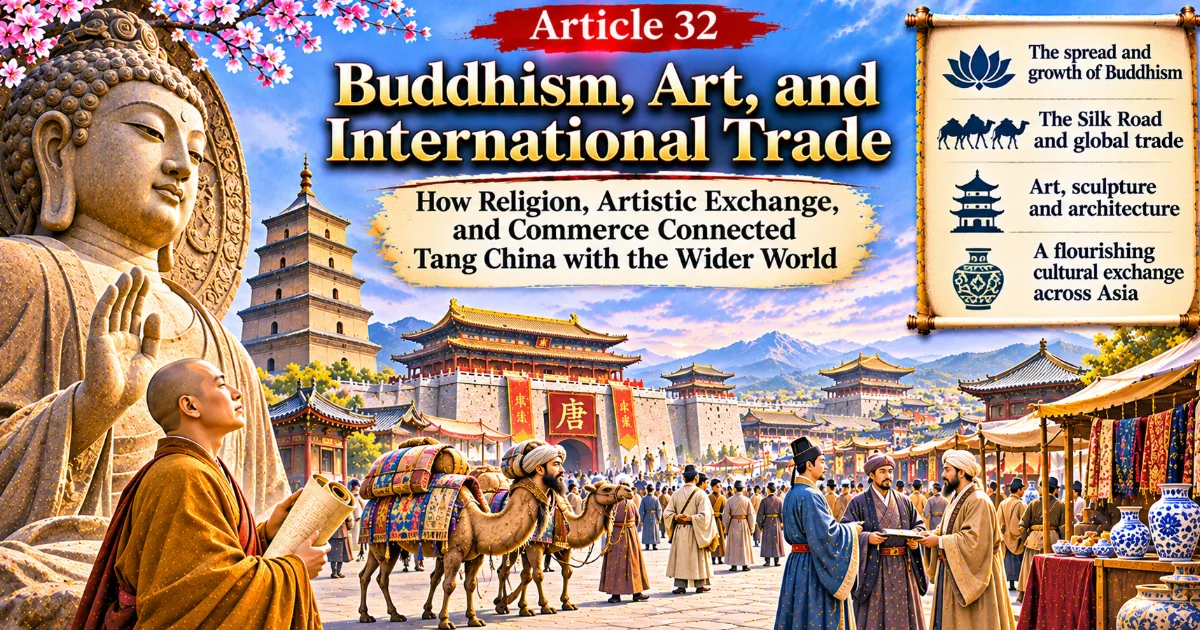
The Tang Dynasty would eventually become one of the most influential periods in Chinese history. Its capital cities attracted merchants, diplomats, scholars, monks, and travellers from different parts of Asia.
Buddhism continued to develop, literature and poetry flourished, and international trade expanded. The Silk Road connected China with Central Asia and regions further west, while maritime commerce became increasingly important.
These developments were made possible in part by the political unity restored under the Sui.
Conclusion: A Short Dynasty That Reunited an Empire
The Sui Dynasty occupies a special place in Chinese history because its political achievements were much greater than its short duration might suggest.
Emperor Wen established a new imperial government, strengthened central administration, and completed the reunification of China in 589 CE. His reforms helped create a more integrated political and economic system after centuries of division.
Emperor Yang continued the programme of imperial development through major construction projects, the expansion of Luoyang, and the development of the Grand Canal. These achievements strengthened transportation and economic connections between northern and southern China.
However, excessive military campaigns, particularly against Goguryeo, combined with heavy taxation and forced labour, placed enormous pressure on the population. Rebellions weakened the central government, and the dynasty collapsed in 618 CE.
The Tang Dynasty inherited the political unity and administrative foundations created by the Sui. It would transform these foundations into a period of remarkable cultural, economic, and international influence.
The Sui Dynasty therefore teaches an important lesson about the relationship between ambition and stability. Reunifying a country requires military strength, but maintaining unity requires effective administration, economic balance, public confidence, and responsible leadership.
The Sui Dynasty was brief, but its achievement changed the direction of Chinese history. It reunited an empire, connected distant regions, and prepared the ground for the rise of the Tang Dynasty.
#HistoryOfChina #SuiDynasty #ChineseHistory #GrandCanal #TangDynasty