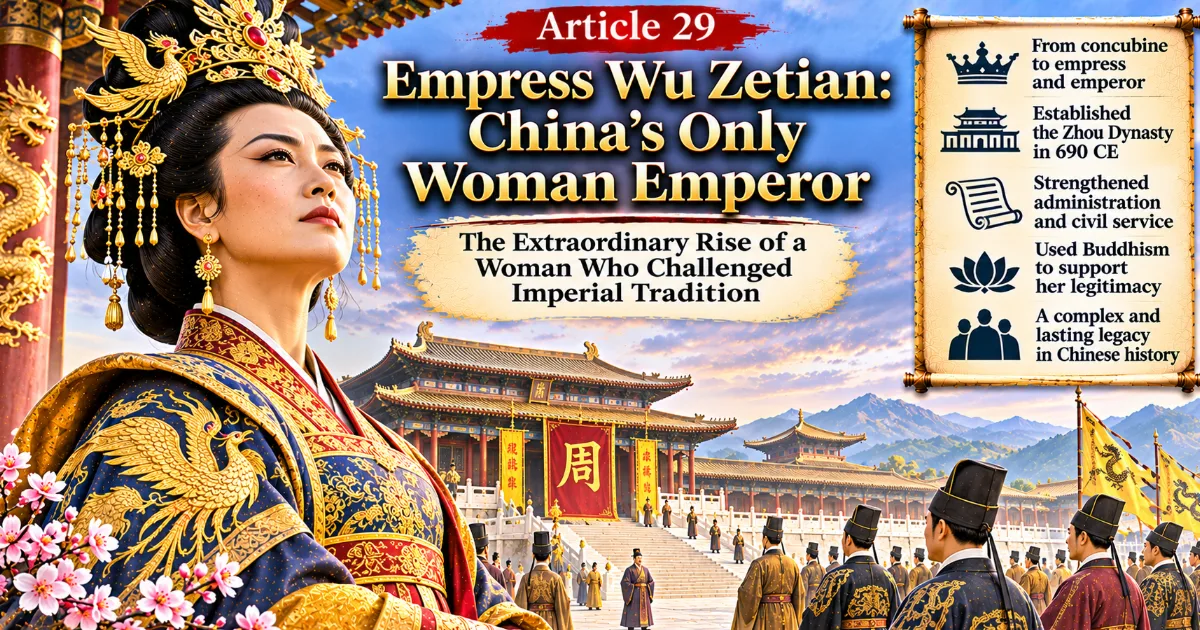
The Extraordinary Rise of a Woman Who Challenged Imperial Tradition
For more than two thousand years, China's imperial system was dominated by men. Emperors inherited the throne through established dynastic traditions, senior officials controlled the machinery of government, and Confucian political thought generally placed women in subordinate positions within the family and state. Although imperial women could exercise considerable influence as empresses, regents, and advisers, the formal position of emperor was understood as a male office.
Wu Zetian challenged this political order in one of the most remarkable episodes in Chinese history. Rising from a relatively modest aristocratic background, she entered the imperial palace as a concubine, became an influential empress, gradually established control over the government, and eventually declared herself emperor in 690 CE. She founded her own dynasty, known as the Zhou, and ruled in her own name until 705 CE.
Her achievement was extraordinary not simply because she was a woman who occupied the highest position in the empire. She also demonstrated considerable political intelligence, administrative ability, and an understanding of how imperial authority could be strengthened through institutions, ideology, appointments, and carefully managed public legitimacy.
Wu Zetian's reign remains controversial. Traditional historical accounts often portrayed her as ruthless, ambitious, and manipulative. Some accusations against her became part of a broader tradition of criticism directed at women who exercised political power. At the same time, her government employed coercive methods, including political investigations, executions, and purges. A balanced understanding of her reign must therefore recognise both her achievements and the human cost of her political methods.
Continue Reading
Her story is an essential chapter in the history of the Tang Dynasty and in the wider history of Chinese political institutions.
1. China Before Wu Zetian: The Political World of the Tang Dynasty
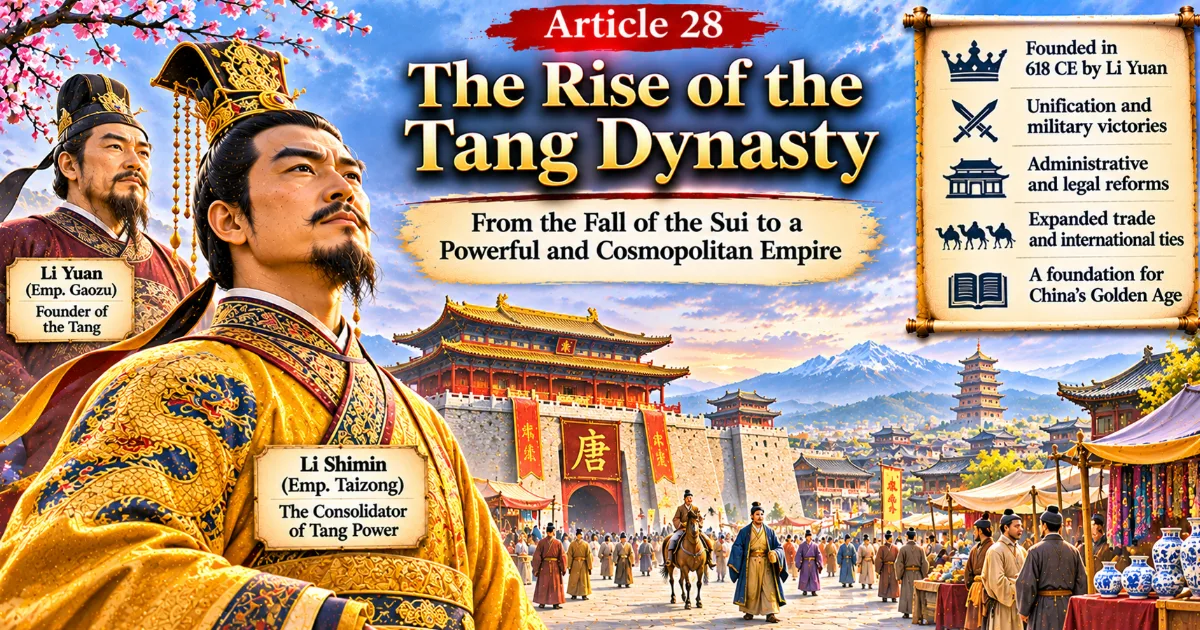
The Tang Dynasty began in 618 CE, when Li Yuan established a new imperial government after the collapse of the Sui Dynasty. His son, Emperor Taizong, later became one of the most celebrated rulers in Chinese history. Under Taizong, the empire strengthened its administrative institutions, expanded its influence across Central Asia, developed diplomatic relationships, and established a reputation for political stability.
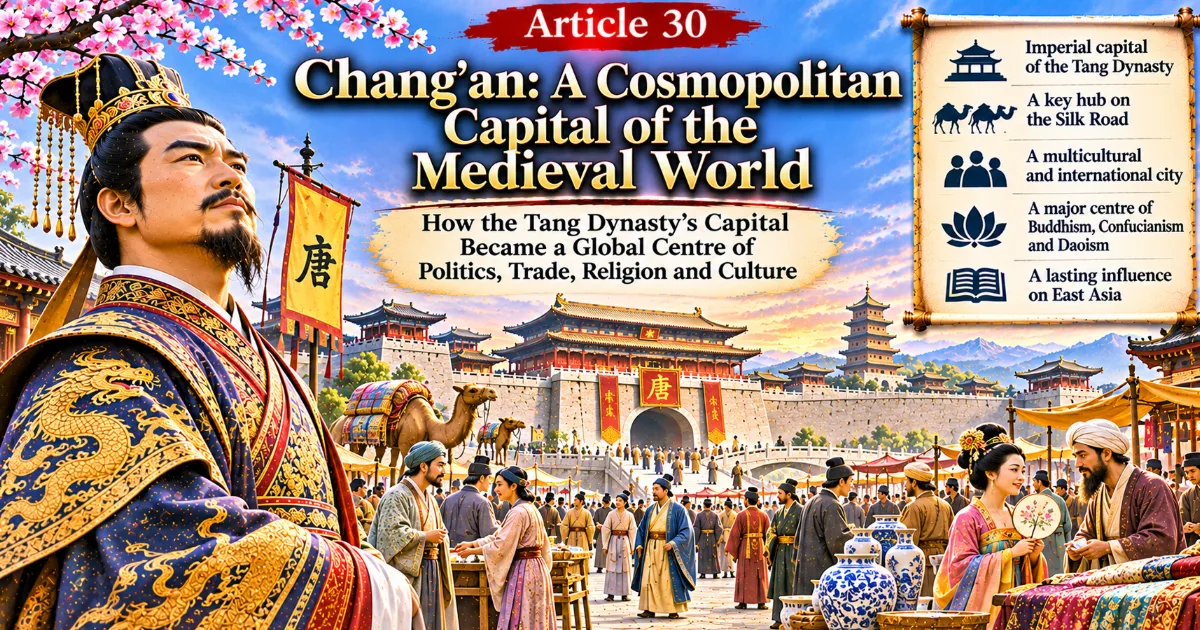
The Tang imperial court was centred in Chang'an, one of the largest and most internationally connected cities of the medieval world. Merchants, diplomats, religious teachers, scholars, and travellers arrived from different regions of Asia. The capital reflected the wealth and cultural diversity of the empire.
However, political power remained concentrated among the imperial family and influential aristocratic families. These families had established connections through marriage, official appointments, military service, and inherited status. Gaining influence at court required navigating a complicated network of personal relationships and political interests.
Women could become powerful within this environment, particularly through their relationships with emperors and their sons. Empresses could influence succession decisions, advise rulers, protect their families, and sometimes govern during periods when an emperor was young or incapacitated.
Yet the political system did not normally recognise women as independent sovereign rulers. The emperor was expected to embody the authority of Heaven and maintain the relationship between the celestial order and the earthly state. Wu Zetian would eventually challenge the assumption that this authority could only be exercised by a man.
2. Wu Zetian's Early Life and Family Background
Wu Zetian was born in 624 CE during the early Tang period. Her family belonged to the wealthy and influential class of the empire, although it did not possess the same deeply established aristocratic standing as some of the most powerful families at court.
Her father, Wu Shihuo, had built his position through government service and commercial activity. He supported the establishment of the Tang Dynasty and received important official appointments. His wealth and political connections gave his daughter access to an environment that would have been difficult for women from ordinary families to enter.
Wu Zetian received an education that included literature, writing, and the cultural traditions associated with elite society. Such education was not unusual among wealthy families, but it provided her with abilities that later became valuable in imperial politics.
Her early experiences also exposed her to the political significance of family relationships. In imperial China, marriage was not merely a personal arrangement. It could strengthen alliances, create access to influential networks, and connect families to the ruling house.
After her father's death, the family's position became less secure. Nevertheless, Wu Zetian's social background and personal circumstances eventually brought her into the imperial palace.
3. Entering the Palace of Emperor Taizong
During the reign of Emperor Taizong, Wu Zetian entered the imperial palace as a concubine. She received the title of Cairen, a position within the hierarchy of imperial consorts.
The imperial palace was a highly structured political and social environment. It contained the emperor's household, officials, servants, attendants, and women whose positions depended on their rank and relationship with the ruler.
For a young woman entering this system, advancement depended on a combination of imperial favour, family connections, personal ability, and the complicated rivalries within the palace.
Wu Zetian did not become one of Taizong's most influential consorts. Her position during his reign remained relatively limited. Nevertheless, her time at court exposed her to the workings of imperial government and the behaviour of senior officials.
She also became familiar with the ceremonies, traditions, and political expectations that surrounded the emperor.
When Taizong died in 649 CE, Wu Zetian's position changed dramatically. According to the religious and court customs of the period, women who had been consorts of a deceased emperor could be sent to Buddhist institutions. Wu Zetian was therefore placed in a Buddhist convent.
This might have appeared to mark the end of her political prospects. However, her connection with the next emperor would bring her back into the imperial court.
4. Her Return to Court Under Emperor Gaozong
After Taizong's death, his son Li Zhi became Emperor Gaozong. Historical accounts describe Wu Zetian and the new emperor as having developed a relationship before or during her time in the palace, although the precise details of their early connection are difficult to establish.
Gaozong eventually brought Wu Zetian back from the Buddhist convent and made her one of his consorts.
Her return created a new political situation. The emperor's existing household already contained women with established positions, particularly Empress Wang and Consort Xiao. Both had relationships with powerful court networks.
Wu Zetian's growing influence placed her in competition with these women. The struggle was not simply a personal rivalry. The position of empress carried political importance because the empress could influence appointments, succession, family alliances, and access to the emperor.
The emperor's preference for Wu Zetian gradually weakened the position of Empress Wang and Consort Xiao.
Wu Zetian became increasingly important within the palace and eventually gave birth to children who strengthened her position in the imperial family.
The political struggle surrounding her elevation remains one of the most debated aspects of her life. Later historical accounts contain dramatic allegations about the methods she used against her rivals. Some accusations may reflect real political violence, while others may have been exaggerated or shaped by later hostility toward her rule.
What is clear is that Wu Zetian successfully transformed her position from that of a relatively minor consort into that of the emperor's most influential partner.
5. Becoming Empress: The Struggle for the Imperial Household
In 655 CE, Wu Zetian became empress after Empress Wang was removed from her position. Consort Xiao also lost her influence.
This was a major political victory. Wu Zetian now occupied the highest female position in the imperial household and gained access to the centre of government.
The role of empress was more than ceremonial. The empress represented the senior female authority of the imperial family and played an important role in palace administration, family rituals, and succession politics.
Wu Zetian's position was strengthened by the fact that Emperor Gaozong increasingly relied on her advice. Gaozong suffered from serious health problems, including episodes that affected his ability to govern effectively. As his condition worsened, Wu Zetian became more involved in state affairs.
She attended discussions, communicated with officials, reviewed documents, and participated in decisions that traditionally belonged to the emperor.
Her political influence grew beyond the palace. Senior officials began to recognise that decisions could not always be understood without considering her role.
For Wu Zetian, becoming empress was not the final stage of her ambition. It provided the institutional position from which she could move toward direct control of the state.
6. The Emergence of a Political Partnership With Emperor Gaozong
During the later years of Gaozong's reign, Wu Zetian became an increasingly important participant in imperial government.
The emperor's health problems created practical difficulties in managing the empire. The Tang government was large, and its administration required constant attention to military reports, provincial matters, taxation, appointments, diplomatic relations, and legal decisions.
Wu Zetian increasingly helped manage these responsibilities.
The relationship between Gaozong and Wu Zetian has sometimes been described as one in which she gradually replaced him. However, the political reality was more complicated. Gaozong remained emperor, and formal authority continued to be exercised in his name. Wu Zetian's influence developed within an arrangement in which both rulers were involved, although her role became progressively stronger.
The imperial court sometimes referred to them together as the Two Saints. This expression reflected the unusual political partnership that had developed at the centre of the Tang state.
The arrangement was significant because it demonstrated that Wu Zetian could exercise authority through the established imperial system before attempting to claim the throne herself.
She learned how government decisions were made, how officials were appointed, how court factions operated, and how imperial legitimacy could be presented to the population.
Her growing involvement also created opposition. Some officials believed that her influence threatened the traditional relationship between the emperor and the bureaucracy. Others feared that her political ambitions could affect the succession and weaken the position of Gaozong's sons.
These disagreements would become central to the next stage of her rise.
7. Political Rivalries and the Decline of Aristocratic Opposition
One of Wu Zetian's major political challenges was the power of established aristocratic families.
Many senior officials belonged to influential lineages that had maintained political connections for generations. These families often regarded themselves as natural participants in imperial government and could resist changes that threatened their influence.
Wu Zetian needed officials who depended on imperial appointment rather than inherited aristocratic prestige. She therefore supported a broader system of recruitment and advancement that could provide opportunities to talented individuals from outside the most powerful families.
Her government made significant use of the civil service examination system. The examinations were not invented during her reign, and their importance had already been growing under earlier rulers. However, she supported their expansion and used them as one means of identifying officials who could strengthen her administration.
This approach had political advantages. Officials whose careers depended on imperial favour could become loyal supporters of the ruler. It also helped reduce the exclusive influence of certain established families.
Wu Zetian's political methods were not limited to administrative reform. She also relied on investigations, punishments, and the removal of opponents.
Some officials were accused of conspiracy and executed or exiled. The court became an environment in which political suspicion could have serious consequences.
Her methods helped weaken organised opposition, but they also created fear and resentment. The political stability of her government was therefore supported by both institutional change and coercive power.
8. Wu Zetian as Regent and the Consolidation of Power
Emperor Gaozong died in 683 CE. His death created a major constitutional and political transition.
Wu Zetian's son Li Xian became Emperor Zhongzong. However, the new emperor's authority was limited by his mother's influence.
Zhongzong attempted to promote members of his wife's family into important positions. Wu Zetian regarded this as a threat to her control of the government. Within a short period, she removed him from the throne and replaced him with another son, Li Dan, who became Emperor Ruizong.
Ruizong remained emperor in name, but Wu Zetian controlled the central administration.
She held court, issued orders, appointed officials, and managed major decisions. The young emperor did not exercise independent political authority.
This period demonstrated that Wu Zetian had become the effective ruler of the Tang state without formally claiming the imperial title.
Her control depended on several foundations. She had the authority of the imperial mother, the support of important officials, influence over the palace, and the ability to manage military and administrative institutions.
However, remaining a powerful regent was not the same as becoming emperor in her own name. The distinction was important because the imperial title represented a claim to supreme political and symbolic authority.
Wu Zetian would soon take the final step.
9. Declaring the Zhou Dynasty in 690 CE
In 690 CE, Wu Zetian formally removed Emperor Ruizong and declared herself emperor. She established a new dynasty called Zhou, drawing on the historical prestige of the ancient Zhou Dynasty.
She adopted the imperial title Shengshen Huangdi, commonly translated as Emperor or Divine Emperor. Her decision was unprecedented in Chinese imperial history.
She was not merely acting as regent for a male ruler. She claimed the same sovereign status traditionally held by male emperors.
The declaration of the Zhou Dynasty required a carefully constructed explanation of political legitimacy. Chinese political thought associated the emperor with the Mandate of Heaven. A ruler was expected to possess the moral and political authority necessary to govern.
Wu Zetian therefore needed to demonstrate that Heaven supported her rule.
She used religious symbolism, political declarations, official ceremonies, and carefully managed public messages to establish this claim.
Buddhist traditions were particularly useful in this effort. Certain Buddhist texts and interpretations could be presented as supporting the appearance of an exceptional female ruler. Religious authorities and court supporters helped connect her reign with a larger cosmic order.
She also changed official titles, ceremonial practices, and aspects of the imperial political structure to reflect the establishment of her new dynasty.
The transition represented one of the most dramatic political transformations of the Tang period. The Tang imperial family had not disappeared, but the dynasty's name and formal ruling authority had been replaced by Wu Zetian's Zhou regime.
10. Buddhism and the Religious Foundations of Her Legitimacy
Buddhism played an important role in Wu Zetian's political strategy.
By the seventh century, Buddhism had become a major religious and cultural force in China. It had spread from India through Central Asia and developed deep connections with Chinese society.
Monasteries, temples, translators, religious scholars, and Buddhist communities were present throughout the empire. Buddhist ideas influenced art, literature, philosophy, charitable activity, and political thought.
Wu Zetian supported Buddhist institutions and used Buddhist symbolism to reinforce her claim to rule.
One important element was the association of her authority with Maitreya, the future Buddha. Some religious interpretations presented the coming of Maitreya as an event that would bring a new era of moral and spiritual renewal. Such ideas could be used to portray Wu Zetian as a ruler whose appearance had been anticipated by religious prophecy.
She also supported Buddhist texts and institutions that strengthened the symbolic foundations of her government.
This did not mean that Buddhism alone created her legitimacy. Imperial authority in China continued to depend on political control, military support, administrative effectiveness, and the acceptance of influential officials.
Nevertheless, religion provided a language through which an unprecedented political arrangement could be explained.
Wu Zetian's use of Buddhism also illustrates the close relationship between religious institutions and state power in medieval China. Rulers supported religious traditions, while religious authorities could contribute to the public image and legitimacy of the state.
11. Administrative Reforms and the Civil Service
Wu Zetian's government continued and developed several administrative practices that had been important under earlier Tang rulers.
The Tang state relied on a sophisticated bureaucracy. Government officials were responsible for taxation, law, public works, agriculture, military administration, education, and provincial management.
The emperor depended on these institutions to govern a vast territory.
Wu Zetian recognised that effective administration was essential to maintaining power. She supported the examination system as a way to identify and recruit officials.
Candidates were tested on classical learning, writing, and their ability to interpret important texts. Success could open a path into government service, although family connections and recommendations continued to influence careers.
The examination system was not yet the fully developed meritocratic structure that it would become in later centuries. Wealth, education, social position, and access to preparation remained important advantages.
Even so, the expansion of examination-based recruitment helped create opportunities for officials outside the most established aristocratic families.
Wu Zetian also encouraged the submission of reports and recommendations from officials across the empire. Such methods helped the court identify administrative problems and potential political threats.
Her government demonstrated that the bureaucracy could serve as an instrument for centralising imperial authority.
12. Political Intelligence, Secret Police, and the Cost of Control
Wu Zetian's rise and reign were accompanied by extensive political investigations.
She relied on officials who gathered information about suspected conspiracies, monitored court opponents, and reported possible challenges to her authority.
Some investigators became powerful because of their access to the ruler and their ability to influence political accusations.
The use of secret investigations helped Wu Zetian weaken groups that might have organised resistance. However, it also created an atmosphere of fear.
Officials could be accused of disloyalty, imprisoned, tortured, exiled, or executed. Families could suffer because of the political actions of one member.
These methods should not be overlooked when assessing her reign. Political control was not achieved solely through administrative reform or personal intelligence. Coercion played an important role.
At the same time, later accounts of Wu Zetian's cruelty must be examined critically. Traditional historians often wrote from perspectives shaped by Confucian political expectations and the restoration of the Tang Dynasty. Their descriptions could emphasise her alleged immorality and ambition while giving less attention to the political violence committed by male rulers.
A balanced historical assessment recognises that Wu Zetian used severe methods to secure her position while also questioning claims that may have been exaggerated or shaped by gender-based hostility.
Her government was both capable and coercive.
13. Economic Administration and the Rural Population
The Tang Dynasty depended heavily on agriculture. Most people lived in rural communities and worked as farmers, labourers, artisans, or traders.
The government needed agricultural production to maintain tax revenue, supply the army, support urban populations, and finance public administration.
Wu Zetian's government continued the agricultural and taxation systems inherited from earlier Tang rulers. These included arrangements for land allocation, household registration, and the collection of taxes and labour obligations.
The equal-field system had been designed to regulate the distribution and use of agricultural land, although its actual operation varied across regions and periods. Over time, population growth, land concentration, migration, and administrative difficulties placed increasing pressure on the system.
Wu Zetian's reign did not eliminate these structural problems, but the government continued to rely on agricultural administration as the foundation of imperial revenue.
She also supported public works and local administrative measures that could strengthen production and improve the state's ability to govern.
The period did not represent a complete transformation of the economic structure. Instead, it continued the broader development of Tang institutions that had begun under earlier rulers.
The prosperity of the empire depended on the relationship between central authority and local society. Effective taxation, agricultural stability, transportation, and regional administration were essential to maintaining the imperial system.
14. Military Campaigns and the Defence of the Empire
The Tang Dynasty was a major military power in East Asia and Central Asia. Its influence depended partly on its ability to defend its borders, maintain relationships with neighbouring states, and protect important trade routes.
Wu Zetian's government inherited military commitments across a wide geographical area.
The empire faced challenges involving Tibetan power, Turkic groups, and other political communities along its western and northern frontiers. These regions were important for security and trade, but maintaining control over them required significant resources.
During her reign, the Tang state experienced both military successes and setbacks.
The government continued to conduct campaigns and manage diplomatic relationships with neighbouring powers. However, frontier conditions were complicated by shifting alliances, local resistance, and the difficulty of maintaining military control across distant territories.
Wu Zetian's military policy should not be understood simply as expansion or retreat. It involved managing a large imperial frontier while preserving the resources necessary to govern the central regions.
Her reign also demonstrated that political authority in China depended on more than control of the capital. The emperor had to maintain the confidence of military commanders and ensure that provincial forces did not become independent political powers.
15. Culture, Literature, and the Intellectual Life of the Court
The Tang period was one of the most culturally dynamic eras in Chinese history. Its achievements included poetry, painting, sculpture, religious literature, architecture, music, and international cultural exchange.
Wu Zetian's court participated in this broader cultural environment.
She supported scholars, literary figures, religious institutions, and official intellectual activity. Court literature played an important role in presenting imperial authority and celebrating the achievements of the government.
Her administration also used writing and official records to communicate political messages across the empire.
The Tang period was particularly important for the development of Chinese poetry. Although the greatest flowering of Tang poetry is often associated with later rulers and poets, the cultural institutions of the dynasty had already established a strong foundation.
Wu Zetian's court was part of this wider intellectual world. Her political rise also attracted literary attention because it challenged established assumptions about authority, gender, and the imperial order.
The cultural significance of her reign therefore lies not only in specific works produced during her rule but also in the way she used literature, religion, ceremony, and historical symbolism to construct a new political identity.
16. The Role of Women During Wu Zetian's Reign
Wu Zetian's political career raises important questions about the position of women in imperial China.
Traditional Chinese society was strongly influenced by Confucian family structures. These traditions generally emphasised male authority in the household and public life. Women could exercise influence through marriage, motherhood, family management, and relationships with powerful men, but formal political authority was restricted.
Wu Zetian's rise challenged these expectations.
Her success demonstrated that a woman could occupy the highest political office and govern through the institutions of the imperial state.
However, her reign did not produce a general transformation in the legal and social position of women throughout China. Most women continued to live within established family structures and had limited access to formal government positions.
Her personal achievement should therefore be distinguished from broader social change.
She did not establish a political system based on equality between men and women. Instead, she demonstrated that exceptional political circumstances, personal ability, family position, and control of institutions could allow a woman to reach the highest level of power.
Her example remained unusual precisely because the structures of imperial society did not generally provide women with such opportunities.
17. Opposition to the Zhou Dynasty
Although Wu Zetian controlled the imperial government, her rule was never free from opposition.
Many officials remained loyal to the Tang imperial family. The Zhou Dynasty depended heavily on Wu Zetian's personal authority, and some members of the court viewed it as an interruption of the legitimate Tang succession.
The continued existence of the Tang imperial family created a potential alternative source of political legitimacy.
Some members of the royal house and their supporters resisted Wu Zetian's rule. Rebellions and political conspiracies demonstrated that the establishment of the Zhou Dynasty had not completely resolved the question of succession.
Wu Zetian responded by strengthening her control over the court and maintaining close supervision of political officials.
Her government also faced the practical challenge of deciding who would succeed her. The Zhou Dynasty had been founded through her personal authority, but a lasting dynasty required an accepted successor.
Her sons belonged to the Tang imperial family. Selecting one of them would effectively restore the Tang line. Choosing another successor could create uncertainty and resistance.
This problem became increasingly important as Wu Zetian grew older.
18. The Succession Question and the Future of the Empire
The question of succession was one of the greatest weaknesses of Wu Zetian's political system.
She had established a new dynasty and ruled as emperor, but she had not created a widely accepted alternative ruling family capable of continuing the Zhou line independently.
Her sons remained connected to the Tang imperial house. Her nephews and other relatives could potentially benefit from the continuation of the Zhou Dynasty, but their claims were not universally accepted.
The court was divided over what should happen after her death.
Some officials believed that the Tang Dynasty should be restored because the imperial family represented the established political order. Others supported the possibility of continuing Wu Zetian's dynasty through her relatives.
The disagreement was not merely about family loyalty. It involved the legitimacy of the imperial state, the future of government appointments, and the political interests of powerful officials.
In the end, the Tang restoration faction gained the advantage.
The decision would determine the final years of Wu Zetian's reign and the future of the imperial house.
19. The End of Wu Zetian's Rule in 705 CE
By the beginning of the eighth century, Wu Zetian was elderly and increasingly dependent on a small group of court favourites.
Two brothers, Zhang Yizhi and Zhang Changzong, had become especially influential. Their position created resentment among senior officials and members of the imperial family.
In 705 CE, a group of officials and military figures organised a political coup. They entered the palace, killed the Zhang brothers, and demanded that Wu Zetian surrender power.
She was forced to abdicate.
Her son Li Xian, who had previously ruled as Emperor Zhongzong, was restored to the throne. The Tang Dynasty officially returned, bringing the Zhou Dynasty to an end.
Wu Zetian retained the title of empress regnant in retirement for a short period before dying later in 705 CE.
Her reign as emperor had lasted approximately fifteen years, from 690 to 705 CE. Her wider political influence had extended over several decades.
The restoration of the Tang Dynasty did not erase her historical significance. She had demonstrated that the imperial system could be controlled and reshaped by a woman who possessed sufficient political authority.
20. Wu Zetian's Historical Reputation
Wu Zetian's reputation has changed considerably across different periods of Chinese history.
Traditional accounts frequently portrayed her as a dangerous and immoral ruler. Her rise was described through stories of palace intrigue, manipulation, sexual ambition, and cruelty.
Some accounts accused her of eliminating rivals and using extraordinary violence to secure the throne. These descriptions became part of the historical memory of her reign.
However, historians must consider the political context in which these accounts were produced.
After Wu Zetian's death, the Tang Dynasty was restored. The new government had an interest in presenting the return of the Tang imperial family as a restoration of legitimate authority.
Writers influenced by Confucian political values also viewed the rule of a woman emperor as a challenge to established social and political principles.
Consequently, descriptions of Wu Zetian often combined factual events with moral judgement.
Modern historical analysis attempts to separate the evidence from the political and cultural assumptions that shaped later accounts.
This does not require presenting her as an ideal ruler. Her government used coercion, and political opponents suffered severely. But it does require examining her administrative achievements, strategic decisions, and ability to govern an extensive empire.
Wu Zetian was neither simply a villain nor an uncomplicated symbol of female empowerment. She was a powerful political figure whose rule combined institutional innovation, political intelligence, religious symbolism, ambition, and repression.
21. Wu Zetian's Administrative and Political Legacy
Wu Zetian left an important legacy in the development of imperial Chinese government.
Her support for examination-based recruitment contributed to the growing importance of the civil service as a route into government. Although the examination system remained limited and unequal, it became increasingly significant in later centuries.
Her government also demonstrated the value of maintaining a strong central administration. She understood that imperial authority depended on appointments, communication, political information, and the ability to manage powerful officials.
Her reign revealed the importance of ideology in Chinese political life. She used Buddhism, imperial ceremonies, historical symbolism, and official language to establish the legitimacy of her rule.
She also exposed the difficulties of succession when political authority became concentrated in one individual.
The restoration of the Tang Dynasty after her abdication showed that personal power, however extensive, could not automatically create a lasting dynasty.
Her political career therefore provides valuable insight into both the strengths and limitations of imperial government.
22. Was Wu Zetian a Successful Emperor?
Judging Wu Zetian requires considering several different aspects of leadership.
From the perspective of political survival, she was extraordinarily successful. She moved from the position of a minor palace consort to the throne of China, defeated powerful rivals, managed competing factions, and governed for decades.
From an administrative perspective, she maintained the machinery of the Tang state and supported the recruitment and advancement of officials. Her government continued the development of institutions that would remain important in later imperial history.
From a military perspective, her reign involved both successful operations and difficult frontier challenges. The empire remained a major regional power, but maintaining control over distant territories was costly.
From a moral and political perspective, her use of investigations, executions, and coercive measures remains a serious part of her record.
Her reign also failed to establish a lasting Zhou Dynasty. The restoration of the Tang family demonstrated that the political order she created depended heavily on her individual authority.
A fair assessment must therefore recognise her as an effective and historically important ruler while acknowledging the violence and instability associated with her methods.
23. Why Wu Zetian Remains Important in World History
Wu Zetian occupies a unique position in the history of political leadership.
At a time when most major states were governed by male monarchs, she ruled one of the world's largest and most sophisticated empires in her own name.
Her rise challenges simplistic assumptions about political power in traditional societies. It demonstrates that even strongly patriarchal institutions could contain opportunities for exceptional individuals to reshape the political order.
Her reign also provides an important case study in the relationship between personal authority and institutional government. She did not rule through personal influence alone. She controlled an established bureaucracy, worked with military institutions, used religious legitimacy, and developed political networks capable of supporting her decisions.
Her story also shows the limitations of individual political achievement. Despite ruling as emperor, she could not permanently transform the succession system or eliminate the political strength of the Tang imperial family.
The significance of Wu Zetian therefore extends beyond the fact that she was China's only woman emperor. Her reign reveals how political legitimacy was constructed, how imperial institutions could be manipulated and strengthened, and how historical memory could be shaped by the interests of later governments.
Conclusion: A Woman Who Reached the Highest Seat of Imperial Power
Wu Zetian's life was one of the most extraordinary political journeys in Chinese history. Born into a wealthy family, she entered the imperial palace as a concubine, survived the transition between emperors, became empress, and gradually gained control over the Tang government.
In 690 CE, she took the unprecedented step of declaring herself emperor and establishing the Zhou Dynasty. For fifteen years, she ruled China in her own name, exercising authority over its bureaucracy, military institutions, religious establishments, and political elite.
Her government supported administrative development, expanded opportunities for examination-based recruitment, and used Buddhist symbolism to establish a new form of imperial legitimacy. At the same time, political investigations and harsh punishments created an atmosphere of fear and contributed to the suffering of her opponents.
Her abdication in 705 CE restored the Tang Dynasty, but it did not erase her achievements or the extraordinary nature of her political career.
Wu Zetian's legacy remains complex. She was an ambitious ruler, a skilled political strategist, an administrator of considerable ability, and a monarch who relied on coercion to preserve her authority. Her reign was neither a simple triumph nor an uncomplicated tragedy.
She demonstrated that the highest office in imperial China could be occupied by a woman, even when the political and cultural traditions of the empire strongly favoured male rulers.
Her story remains one of the most significant chapters in the history of the Tang Dynasty and a powerful reminder that history is often shaped by individuals who challenge the boundaries of their own age.
#HistoryOfChina #WuZetian #TangDynasty #ChineseHistory #WomenInHistory