How Li Yuan founded a new imperial house, how his son Li Shimin consolidated its power, and how the Tang transformed the reunified empire into one of the most influential civilizations of the medieval world
1. The End of the Sui Dynasty and the Beginning of a New Era
The fall of the Sui Dynasty in 618 CE brought an end to a short but consequential period of imperial rule. Its achievements had reunited China, strengthened central administration, and connected distant regions through major transportation networks. Yet ambitious military campaigns, heavy taxation, forced labour, and political instability had weakened the dynasty. Rebellions spread across the empire, and regional commanders competed to establish their own authority.
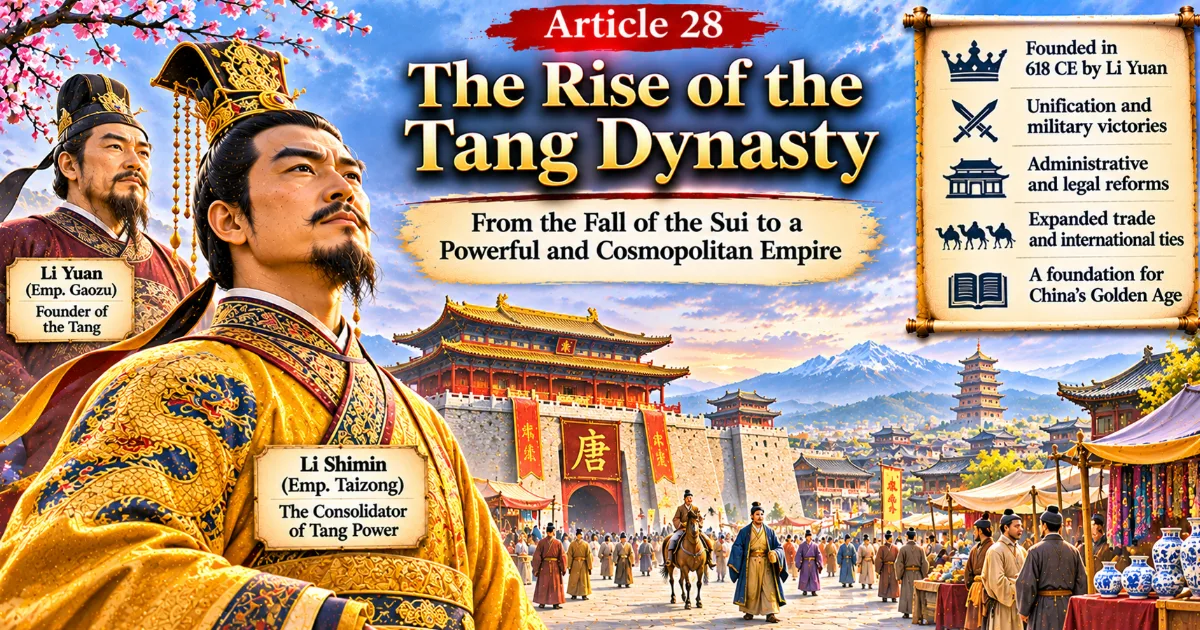
Out of this turmoil emerged the Tang Dynasty, founded by Li Yuan in 618 CE. The new dynasty inherited the political unity and administrative foundations created by the Sui, but it also faced the difficult task of restoring order and winning the loyalty of a divided population. Through military consolidation, administrative reform, diplomatic relationships, and economic recovery, the early Tang rulers established a powerful imperial state.
The rise of the Tang was not the achievement of one emperor alone. It involved the strategic decisions of Li Yuan, the military leadership of his son Li Shimin, the work of officials and commanders, and the cooperation of regional elites. Their combined efforts created the foundations for a dynasty that would become famous for its cosmopolitan cities, international trade, religious diversity, poetry, art, and political influence across Asia.
Continue Reading
The Tang Dynasty ruled from 618 to 907 CE, although its authority experienced a major interruption during the reign of Empress Wu Zetian, who established the Zhou Dynasty between 690 and 705. Despite political crises and regional rebellions, the Tang period became one of the most influential chapters in Chinese history. Its early rise explains how a dynasty emerging from civil war eventually established an empire whose influence reached far beyond China's borders.
2. China After the Collapse of the Sui
When the Sui government began to collapse, China entered another period of political uncertainty. The empire that Emperor Wen had reunited in 589 CE was no longer governed effectively from the centre. Military commanders, regional officials, aristocratic families, and rebel leaders competed for control of territories and resources.
Emperor Yang's military campaigns against Goguryeo had consumed enormous resources without achieving their objectives. The government had also undertaken extensive construction projects, including the expansion of Luoyang and the development of the Grand Canal. Although these projects had long-term value, the immediate demands placed on the population were severe.
Rural households faced taxation and labour obligations, while military mobilisation disrupted agricultural activity. Rebellions spread as communities lost confidence in the government's ability to protect them and manage the empire responsibly.
The political situation became particularly unstable after Emperor Yang moved away from the principal centres of power and struggled to maintain control. In 618 CE, he was killed during a political upheaval at Jiangdu, in present-day Yangzhou.
The emperor's death effectively ended Sui imperial authority, although different political leaders continued fighting for control. The country was not immediately unified under the Tang. Instead, the new dynasty had to defeat rival powers, establish administrative control, and persuade regional elites to accept its authority.
3. Li Yuan: The Founder of the Tang Dynasty
Li Yuan came from an influential aristocratic and military family. He had served the Sui government and possessed connections with powerful political and military networks in northern China.
His family background gave him important advantages during the collapse of the Sui. He had access to military resources, experienced commanders, and influential supporters who could help him organise a political challenge.
Li Yuan held an important command in the northern region of Taiyuan, an area of strategic value because of its military position and connections with frontier territories. As the Sui government weakened, he recognised that the imperial administration was losing its ability to control events.
In 617 CE, Li Yuan raised an army against the Sui government. He moved towards Chang'an, the major western capital, and successfully captured the city. Rather than immediately declaring himself emperor, he initially presented his actions as an effort to restore order and protect the imperial house.
He placed a young Sui ruler on the throne as a nominal emperor while consolidating his own authority. This approach helped him gain political support and avoid presenting his campaign as an openly self-serving rebellion from the beginning.
In 618 CE, after the death of Emperor Yang and the collapse of the remaining Sui political structure, Li Yuan formally established the Tang Dynasty. He took the imperial title Emperor Gaozu.
The founding of the Tang marked the beginning of a new political order. However, its survival depended on defeating rival powers and creating a government capable of exercising authority across the former Sui empire.
4. Why Chang'an Became the Capital of the Tang
Li Yuan established Chang'an as the capital of the Tang Dynasty. The city had a long history as an important political and cultural centre and had served as the western capital of the Sui.
Its geographical location offered significant strategic advantages. Chang'an stood in the Guanzhong region, which was surrounded by natural barriers and connected with important routes leading towards the northwest, central plains, and other parts of the empire.
The region possessed agricultural resources and could be defended through strategically important passes. These advantages had made it an attractive location for earlier imperial governments.
Chang'an was also closely connected with the political traditions of earlier dynasties. By governing from this city, the Tang rulers could present themselves as successors to the imperial order established by the Sui and earlier Chinese states.
The city would eventually become one of the greatest urban centres of the medieval world. Its organised layout, administrative districts, markets, religious institutions, and international population reflected the growing influence of the Tang Empire.
However, when Li Yuan first established his government, Chang'an was not yet the cosmopolitan capital for which it would later become famous. The dynasty first had to secure the territories surrounding the city and establish control over the wider empire.
5. The Struggle to Reunify China Once Again
Although Li Yuan founded the Tang Dynasty in 618 CE, several rival political powers continued to control important territories. The empire was divided among regional rulers, military commanders, and rebel leaders.
Some rivals had established independent governments and claimed imperial authority. Others controlled strategic territories and possessed armies capable of resisting the Tang.
The new dynasty therefore faced a series of military campaigns. Its leaders needed to defeat opponents, secure major cities, control transportation routes, and establish reliable administrative arrangements in conquered territories.
One of the most important figures in these campaigns was Li Yuan's son, Li Shimin. He became known for his military ability, strategic thinking, and capacity to organise armies.
Li Shimin played a decisive role in defeating several major rivals. His campaigns helped extend Tang authority across the central plains and other important regions.
The reunification process was not achieved through military force alone. The Tang government also used negotiations, political appointments, marriage alliances, and the incorporation of defeated officials into the imperial administration.
These methods helped reduce resistance and made it easier to govern territories after their conquest. By combining military strength with political integration, the Tang rulers gradually transformed a fragile new dynasty into a powerful empire.
6. Li Shimin: The Military Architect of Tang Power
Li Shimin was one of the most important figures in the early history of the Tang Dynasty. He was born in 598 CE and grew up in a family closely connected with the military and political establishment.
From an early age, he developed experience in military organisation and leadership. During the rebellion against the Sui, he helped his father organise forces and advance towards Chang'an.
After the establishment of the Tang, Li Shimin became central to the dynasty's military campaigns. He demonstrated an ability to understand terrain, assess opposing forces, coordinate commanders, and use opportunities created by political instability.
His military successes were essential to the expansion of Tang authority. He defeated powerful rivals and helped bring large areas under imperial control.
Li Shimin also understood the importance of securing the loyalty of capable individuals. He worked with experienced generals, advisers, and officials, many of whom later became important figures in the Tang government.
His reputation grew considerably through these achievements. Although his father remained emperor, Li Shimin increasingly became the central figure in the dynasty's military and political development.
The contrast between Li Yuan's role as founder and Li Shimin's role as military consolidator would eventually become one of the most important issues in the early Tang succession.
7. The Battle of Hulao and the Defeat of Wang Shichong
One of Li Shimin's most important military achievements was his campaign against Wang Shichong and his ally Dou Jiande.
Wang Shichong controlled Luoyang, a major political and economic centre in the central plains. He had established himself as a powerful regional ruler and possessed important military resources.
Dou Jiande controlled territories further east and represented another serious threat to the Tang expansion. The possibility of cooperation between these two rulers created a major strategic challenge.
Li Shimin led Tang forces against Wang Shichong and positioned his army near the Hulao Pass, a strategically important location east of Luoyang.
The campaign required careful coordination. Li Shimin had to prevent the opposing forces from joining together while maintaining pressure on Wang Shichong's position.
In 621 CE, the Tang army defeated Dou Jiande at the Battle of Hulao. Dou Jiande was captured, and Wang Shichong soon surrendered.
The victory removed two major rivals and brought Luoyang under Tang control. It also strengthened Li Shimin's reputation as one of the most capable commanders of his generation.
The capture of Luoyang was especially important because the city had long been a major political centre. Its incorporation into the Tang Empire helped strengthen control over the central plains and the transportation routes connecting northern and southern China.
8. The Defeat of Other Rival Powers
The Tang government's expansion continued after the victory at Hulao. Several other regional rulers and military leaders remained in control of territories across China.
Some of these powers were defeated through military campaigns, while others accepted Tang authority through negotiation or political submission.
The process required the new dynasty to establish control over cities, agricultural regions, border territories, and important transportation networks.
The Yangtze River basin was particularly significant because it contained productive agricultural regions and major commercial centres. Securing southern territories helped strengthen the economic foundations of the empire.
Tang forces also worked to establish authority in areas where local rulers had developed independent political systems during the collapse of the Sui.
The gradual expansion of Tang control demonstrated that reunification required sustained political and military effort. A victory over one rival did not automatically secure the entire country. The government had to establish administrative institutions, collect taxes, maintain roads and waterways, and prevent new rebellions.
By the middle of the 620s, the Tang Dynasty had become the dominant political power in China. Its authority was considerably stronger than it had been at the time of its foundation.
9. Emperor Gaozu and the Organisation of the New Empire
As founder of the Tang Dynasty, Emperor Gaozu faced the task of transforming a successful rebellion into a stable imperial government.
He inherited many administrative institutions from the Sui Dynasty. Rather than abandoning them, the Tang government retained and refined important elements of the existing system.
This approach provided administrative continuity. Officials already familiar with imperial government could continue working within the new political structure, while the dynasty gradually introduced its own appointments and reforms.
The government was organised around central departments and ministries responsible for different aspects of administration. Officials managed taxation, law, military affairs, ceremonies, personnel, and public works.
Provincial and local administrations were also essential. The central government needed officials who could implement imperial decisions, supervise agricultural production, collect revenue, and maintain public order.
Emperor Gaozu's government sought to restore stability after years of civil conflict. Reducing unnecessary burdens, rebuilding administrative capacity, and establishing political loyalty were important priorities.
The Tang government also needed to create a clear succession system. The rivalry between Li Shimin and his brothers would soon reveal that the dynasty's internal political structure remained vulnerable.
10. The Xuanwu Gate Incident of 626 CE
The growing power of Li Shimin created serious tensions within the imperial family. Although he had played a decisive role in the military victories that established the Tang, he was not the designated crown prince.
The crown prince was his elder brother Li Jiancheng. Another brother, Li Yuanji, was also influential at court and supported the existing succession arrangement.
The rivalry between the brothers involved political alliances, military influence, court appointments, and competition over the future leadership of the dynasty.
Li Shimin had a powerful network of military supporters and advisers. His brothers also possessed influential allies, creating an increasingly unstable political situation.
On 2 July 626 CE, Li Shimin carried out a decisive operation at the Xuanwu Gate, an important entrance to the imperial palace complex in Chang'an.
His forces killed Li Jiancheng and Li Yuanji during the confrontation. The incident removed his principal rivals and transformed the balance of power within the imperial family.
The event became known as the Xuanwu Gate Incident. It was one of the most consequential political episodes in early Tang history because it determined the succession and enabled Li Shimin to become emperor.
Soon afterwards, Emperor Gaozu abdicated, and Li Shimin took the throne as Emperor Taizong.
11. Emperor Taizong and the Consolidation of Tang Rule
Emperor Taizong, who ruled from 626 to 649 CE, became one of the most celebrated emperors in Chinese history.
His reign is frequently associated with effective administration, military expansion, diplomatic success, and economic recovery. Later generations remembered his government as an example of responsible imperial leadership.
Taizong understood that military conquest alone could not sustain an empire. A strong government required capable officials, predictable laws, stable taxation, and an administration that could respond to practical problems.
He encouraged officials to offer criticism and advice, even when their opinions challenged his own decisions. This approach helped create a political culture in which discussion and administrative assessment played important roles.
Taizong also recognised the value of learning from the failures of earlier rulers. The collapse of the Sui had demonstrated the dangers of excessive taxation, forced labour, and military campaigns that exceeded the state's resources.
His government therefore placed considerable emphasis on restoring agricultural production, maintaining administrative order, and strengthening the relationship between the imperial court and the population.
Although Taizong's reign was not free from warfare or political controversy, it established a powerful model of early Tang governance.
12. The Zhenguan Era and the Reputation of Good Government
The period associated with Emperor Taizong's reign is often known as the Zhenguan era, named after the reign period beginning in 627 CE.
Later Chinese historians frequently presented this era as an example of effective government. It became associated with political discipline, capable ministers, military strength, and economic recovery.
One reason for this reputation was Taizong's relationship with his advisers. He valued officials who could identify administrative problems and challenge decisions when necessary.
Among his most famous advisers was Wei Zheng, who became known for his willingness to criticise the emperor. Their exchanges were later remembered as examples of the importance of honest advice in imperial government.
Taizong also benefited from the experience of officials who had served previous regimes. Their knowledge of administration, taxation, law, and military organisation helped strengthen the Tang state.
The government worked to improve the management of land and taxation and reduce some of the pressures that had contributed to the collapse of the Sui.
The Zhenguan era later became an important reference point in Chinese political thought. Scholars and officials used it as an example when discussing the qualities of a successful ruler and the responsibilities of government.
13. The Tang Administrative System
The Tang Dynasty developed one of the most influential administrative systems in Chinese history.
At the centre of government stood the emperor, supported by senior officials and central administrative institutions. The Three Departments and Six Ministries structure provided an organised framework for government decision-making.
The Three Departments were responsible for drafting, reviewing, and implementing major government policies. Their division of responsibilities helped create a more systematic administrative process.
The Six Ministries managed important areas of government. These included personnel administration, revenue, ritual affairs, military matters, justice, and public works.
The system enabled the government to supervise a large empire through specialised institutions and appointed officials.
The Tang also developed provincial and local administrative structures. Territories were divided into units governed by officials responsible for implementing imperial policies.
Although regional administration remained complex, the central government sought to ensure that local officials were accountable to the imperial system.
The Tang administrative model influenced later dynasties and became an important part of the wider East Asian political tradition.
14. The Tang Legal Code and the Rule of Law
The Tang Dynasty developed an influential legal system that built upon reforms introduced during the Sui period.
The Tang Code established a detailed framework of laws and punishments. It covered criminal offences, administrative responsibilities, family relations, property matters, and other areas of social life.
The legal system reflected the political and moral values of the imperial state. It emphasised social hierarchy, family responsibility, official discipline, and the maintenance of public order.
Punishments varied according to the nature of the offence and the status and circumstances of the individuals involved. The code also established procedures for investigating cases and determining legal responsibility.
The Tang legal system became influential beyond China. Its principles and institutional structure affected legal traditions in neighbouring East Asian societies, including Korea and Japan.
The development of a detailed legal code strengthened the ability of the government to administer a large empire. It also reflected the Tang rulers' desire to establish a stable political order after decades of warfare.
15. The Civil Service Examination System
The Tang Dynasty continued to develop the system of examinations used to recruit officials into imperial government.
The examination system had earlier origins, but it became increasingly important as dynasties sought to identify educated individuals capable of serving the state.
Candidates studied classical texts, literature, government principles, and other subjects considered important for administrative service.
The examinations were not the only route into government. Aristocratic families continued to exercise considerable influence, and family background remained important in securing appointments.
Nevertheless, the system provided an additional method through which educated individuals could seek official positions based on demonstrated learning.
The examinations also encouraged the spread of classical education. Families invested in the study of Confucian texts because success in examinations could bring prestige, income, and political influence.
During the Tang period, the system was still developing and did not yet possess the full institutional importance it would achieve under later dynasties. However, it contributed to the formation of a more structured relationship between education and government service.
16. Economic Recovery and Agricultural Development
The Tang rulers understood that the stability of the empire depended heavily on agriculture.
The wars that accompanied the collapse of the Sui had damaged settlements, disrupted farming, and displaced populations. Restoring agricultural production was therefore an important priority.
The government continued land and taxation arrangements associated with earlier dynasties, including elements of the equal-field system. Land allocations and household registration helped officials organise taxation and labour obligations.
Agricultural households formed the foundation of the imperial economy. They produced food, paid taxes, and supplied labour and other resources required by the state.
The government also worked to improve the administration of irrigation and agricultural land. Water control was essential in many regions, particularly where rice cultivation depended on carefully managed supplies.
As political stability improved, population movements and economic activity gradually recovered. Markets expanded, towns developed, and commercial exchange increased.
The Tang economy would become increasingly diverse, combining agriculture with manufacturing, trade, transportation, and urban services.
17. The Grand Canal and the Economic Strength of the Tang
The Tang Dynasty inherited the transportation network developed and expanded under the Sui. The Grand Canal was particularly important because it connected northern political centres with the productive agricultural regions of the south.
Large cities required enormous quantities of food and other supplies. The canal allowed grain to be transported over long distances more efficiently than many overland alternatives.
The government depended on reliable transportation to support officials, soldiers, construction projects, and urban populations.
The canal also encouraged commercial activity. Merchants used waterways to move agricultural products, textiles, ceramics, timber, and other goods between regional markets.
Its importance increased as southern China became a major source of agricultural production and commercial wealth.
The Tang government continued to maintain and use the canal network, although its condition and effectiveness varied across different periods.
The transportation system helped make the empire more economically integrated. It connected regions that had developed different agricultural and commercial strengths and allowed the central government to draw upon a wider economic base.
18. The Tang Empire and the Northern Frontier
The early Tang rulers also focused on strengthening the empire's northern and northwestern frontiers.
These regions were strategically important because they connected China with the steppe societies of Central Asia and Inner Asia. Relations between agricultural empires and nomadic or semi-nomadic powers had long influenced Chinese military and diplomatic history.
The Tang rulers inherited both opportunities and challenges from the Sui period. The collapse of the Sui had altered regional relationships, while powerful steppe confederations remained influential.
One of the most important powers was the Eastern Turkic Khaganate. It controlled extensive territories north of China and possessed significant military strength.
During the early years of the Tang, the Turks exerted pressure on the new dynasty. In 626 CE, shortly before or around the time of Taizong's accession, Turkic forces reached the vicinity of the Wei River bridge outside Chang'an.
The confrontation demonstrated the vulnerability of the new dynasty. Taizong had to manage the immediate threat while strengthening his military and diplomatic position.
The Tang government gradually improved its frontier defences and built relationships with different steppe groups.
19. Emperor Taizong and the Defeat of the Eastern Turkic Khaganate
Emperor Taizong pursued a combination of diplomacy, military preparation, and strategic alliances in dealing with the Eastern Turkic Khaganate.
The Turkic political structure faced internal difficulties, and the Tang court sought to exploit divisions while strengthening its own military capacity.
In 630 CE, Tang forces defeated the Eastern Turkic Khaganate and captured its ruler, Jiali Khan, known in Chinese records as Illig Qaghan.
The victory was a major achievement for the early Tang state. It removed a significant threat to northern China and expanded Tang influence across parts of Inner Asia.
The Tang court also incorporated some Turkic leaders and communities into its political and military system. This approach allowed the empire to use the experience of frontier peoples while strengthening its influence over newly controlled territories.
Taizong's success contributed to his reputation as a powerful ruler with authority extending beyond the traditional Chinese heartland.
His relationship with steppe leaders and frontier communities also demonstrated the cosmopolitan character of the Tang political world. The empire was not defined solely by the population and territories of the central plains. It increasingly interacted with diverse societies across Asia.
20. The Tang and the Wider World
The Tang Dynasty developed extensive diplomatic and commercial relationships with other regions.
Central Asia was especially important because it connected China with Persia, India, and territories further west. Merchants and travellers moved along the Silk Road, carrying goods and ideas between distant societies.
The Tang capital of Chang'an became an important destination for foreign visitors. Traders, religious teachers, diplomats, students, and travellers arrived from many regions.
The city contained communities with different languages, customs, and religious traditions. This diversity contributed to its reputation as one of the most cosmopolitan urban centres of the medieval world.
The Tang government also maintained diplomatic relationships with neighbouring kingdoms and states. Envoys travelled between courts, exchanging gifts, negotiating political arrangements, and establishing cultural connections.
These relationships strengthened China's influence across East Asia and Central Asia.
The Tang Dynasty's international position was supported by military power, economic strength, diplomatic activity, and cultural prestige. Its capital became a symbol of an empire connected to a wider world.
21. Buddhism and the Tang State
Buddhism had already become an important religious and intellectual force in China before the establishment of the Tang Dynasty. The new rulers inherited monasteries, translated scriptures, established schools, and a population with diverse Buddhist traditions.
The Tang emperors generally supported Buddhist institutions during important parts of the dynasty's history, although the relationship between Buddhism and the state changed over time.
Monasteries continued to serve as centres of religious practice, scholarship, education, and charitable activity. Monks and nuns studied scriptures, practised meditation, copied manuscripts, and participated in ceremonies.
The Tang period also witnessed major developments in Buddhist scholarship. Chinese monks travelled to India to study Buddhist teachings and obtain scriptures. Their journeys strengthened intellectual connections between China and the Indian subcontinent.
One of the most famous of these travellers was Xuanzang, whose journey to India during the seventh century became one of the most celebrated episodes in Chinese Buddhist history.
Buddhism became deeply connected with Tang literature, visual art, philosophy, and international relations. It was one of the major traditions contributing to the dynasty's cultural achievements.
22. Confucianism and the Ideals of Imperial Government
Although Buddhism became influential during the Tang period, Confucianism remained central to the political ideology of the imperial state.
Confucian teachings emphasised moral responsibility, proper conduct, family relationships, education, and the duties of rulers and officials.
The Tang government relied on classical learning to educate officials and establish standards of administrative behaviour. Confucian texts formed an important part of the examination system and the broader intellectual culture of the court.
The ideal ruler was expected to govern through moral example, wise administration, and concern for the welfare of the population.
The relationship between Confucianism, Buddhism, and Daoism was complex. These traditions sometimes competed for political support and intellectual influence, but they also coexisted and shaped different aspects of Chinese society.
The Tang period became especially important for the development of this religious and philosophical diversity.
23. The Early Tang and the Foundations of Chang'an's Golden Age
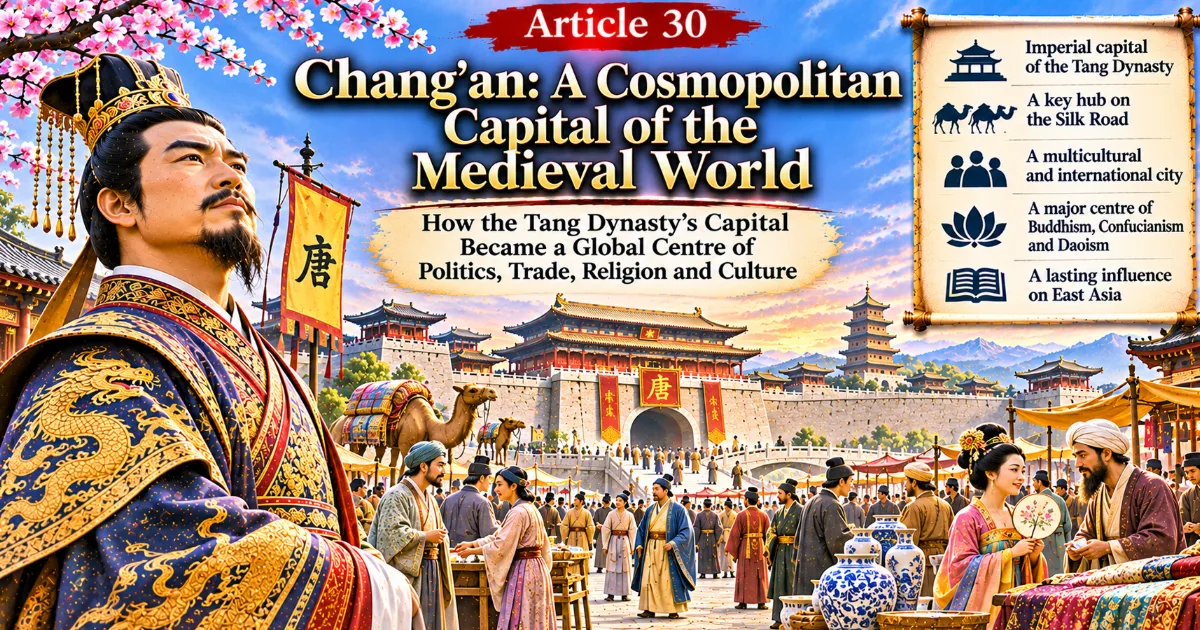
Chang'an developed into one of the most remarkable cities of the medieval world during the Tang Dynasty.
Its urban planning reflected the political ambitions of the imperial court. The city contained palace complexes, administrative offices, residential districts, temples, markets, and carefully organised streets.
The population included officials, scholars, soldiers, craftsmen, merchants, monks, entertainers, and foreign visitors.
The eastern and western markets were important centres of commercial activity. Goods arrived from different regions of China and from international trading networks.
Foreign merchants brought horses, precious stones, textiles, spices, and other products. Cultural influences from Central Asia and beyond became visible in clothing, music, food, art, and religious practices.
The city was also an important centre of education and literature. Scholars gathered to study classical texts, write poetry, pursue official careers, and participate in intellectual discussions.
Chang'an's development reflected the wider prosperity of the Tang state. Its international character was made possible by political stability, transportation networks, military security, and commercial exchange.
24. The Rise of Tang Literature and Poetry
The Tang Dynasty became famous for its literary achievements, particularly its poetry.
Poetry occupied an important place in educated society. Officials, scholars, monks, and members of the aristocracy composed poems on nature, friendship, travel, politics, love, historical memory, and personal experience.
The literary culture of the Tang was supported by education, classical scholarship, court patronage, and the growth of urban intellectual communities.
Some of the greatest Chinese poets in history lived during the Tang period, including Li Bai and Du Fu. Their most influential works belong to later phases of the dynasty, but the early Tang provided the political and cultural environment in which this extraordinary literary tradition developed.
Poetry became a means of expressing personal emotions and observing social change. It also served as an important part of official culture and intellectual communication.
The Tang literary tradition would influence Chinese writing for centuries and become one of the most celebrated legacies of the dynasty.
25. The Tang Dynasty and Its Long-Term Historical Importance
The rise of the Tang Dynasty marked the beginning of a period of exceptional political and cultural influence.
Its founders restored imperial unity after the collapse of the Sui, while Emperor Taizong strengthened the government and expanded the empire's regional influence.
The Tang inherited administrative institutions, legal arrangements, and infrastructure developed by earlier dynasties. It improved these systems and created a powerful model of imperial government.
The dynasty also benefited from the economic integration of northern and southern China. Agricultural production, commercial transportation, and the Grand Canal helped support major cities and military establishments.
Its diplomatic and commercial connections brought China into close contact with Central Asia, India, Korea, Japan, and other regions.
Buddhism, Confucianism, and Daoism influenced intellectual life, while literature, poetry, painting, sculpture, and architecture developed remarkable traditions.
The Tang Dynasty's rise also demonstrates that a successful imperial government depended on more than conquest. Military victories created the opportunity for reunification, but effective administration, economic recovery, diplomatic relationships, and cultural development helped transform that opportunity into lasting influence.
Conclusion: The Foundation of China's Golden Age
The Tang Dynasty emerged from the political collapse of the Sui and the military struggles that followed. Li Yuan founded the dynasty in 618 CE, using his military connections and political judgement to establish a new imperial government at Chang'an.
His son Li Shimin played a decisive role in defeating rival powers and consolidating Tang authority. The Battle of Hulao in 621 CE was among the most important victories of the reunification campaigns, while the Xuanwu Gate Incident of 626 CE changed the imperial succession and brought Li Shimin to the throne as Emperor Taizong.
Taizong's reign strengthened the political and administrative foundations of the dynasty. His government developed a reputation for effective administration, encouraged capable officials, expanded military influence, and restored confidence in imperial rule.
The Tang also inherited and developed the economic and transportation systems established under the Sui. The Grand Canal helped connect northern political centres with southern agricultural regions, while international trade and diplomacy expanded China's relationships with the wider Asian world.
These achievements created the conditions for the Tang Golden Age. In the centuries that followed, Chang'an would become a major centre of international exchange, Tang poetry would reach extraordinary heights, and Chinese art, religion, and scholarship would influence neighbouring civilizations.
The rise of the Tang Dynasty was therefore more than the replacement of one imperial family by another. It marked the transformation of a country recovering from civil war into a powerful and internationally connected empire.
The Tang Dynasty rose from the ashes of the Sui, but its influence extended far beyond the political achievements of its founders. It established the foundations for one of the most remarkable cultural and economic periods in Chinese history.
#HistoryOfChina #TangDynasty #ChineseHistory #EmperorTaizong #AncientChina