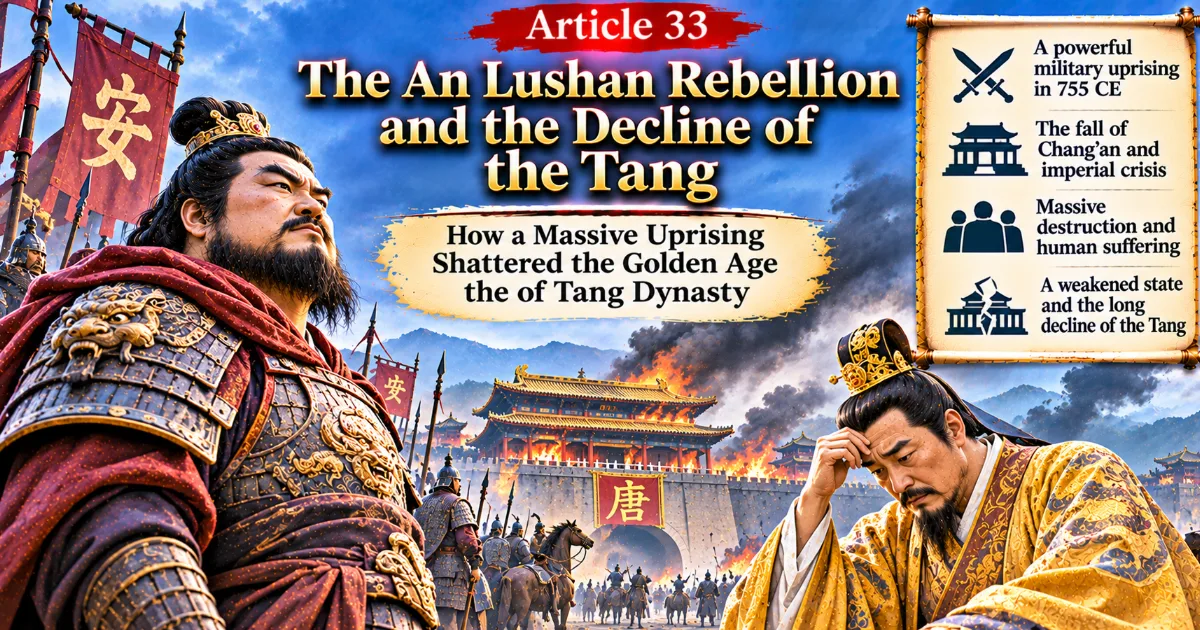
How a Massive Uprising Shattered the Golden Age of the Tang Dynasty
The Tang Dynasty, which ruled China from 618 to 907 CE, is widely remembered as one of the greatest periods in Chinese history. Its achievements in poetry, painting, sculpture, architecture, technology, administration, and international trade established a cultural legacy that influenced East Asia for centuries. During its strongest years, the Tang Empire possessed a powerful government, prosperous cities, extensive commercial networks, and considerable influence across Central Asia.
However, the dynasty's prosperity concealed serious political and military weaknesses. As the empire expanded, the government increasingly depended on powerful regional military commanders to defend its frontiers. These commanders controlled large armies, collected resources, and gradually developed political influence independent of the central court. At the same time, competition within the imperial administration, financial pressures, and weaknesses in the military system created conditions for a major political crisis.
The turning point came in 755 CE, when An Lushan, a powerful frontier commander, launched a rebellion against the Tang government. His uprising developed into one of the most destructive conflicts in Chinese history. It devastated important cities, disrupted agricultural production, displaced millions of people, weakened the imperial government, and permanently transformed the political structure of the dynasty.
The rebellion lasted for years and continued to affect the empire long after its main military phase ended. Although the Tang court eventually recovered its capital and restored a degree of political stability, it never fully regained the authority it had possessed during the early Tang period. Regional military governors became increasingly independent, government revenues declined, and the imperial court struggled to control distant territories.
Continue Reading
The An Lushan Rebellion did not immediately destroy the Tang Dynasty. The dynasty survived for another century and a half. Nevertheless, it marked the beginning of a long period of political decline that eventually contributed to the dynasty's collapse in 907 CE.
Understanding this rebellion is essential for understanding how the Tang Golden Age weakened, why imperial authority became fragmented, and how one of China's most successful dynasties gradually lost control of its empire.
1. The Tang Dynasty Before the Rebellion
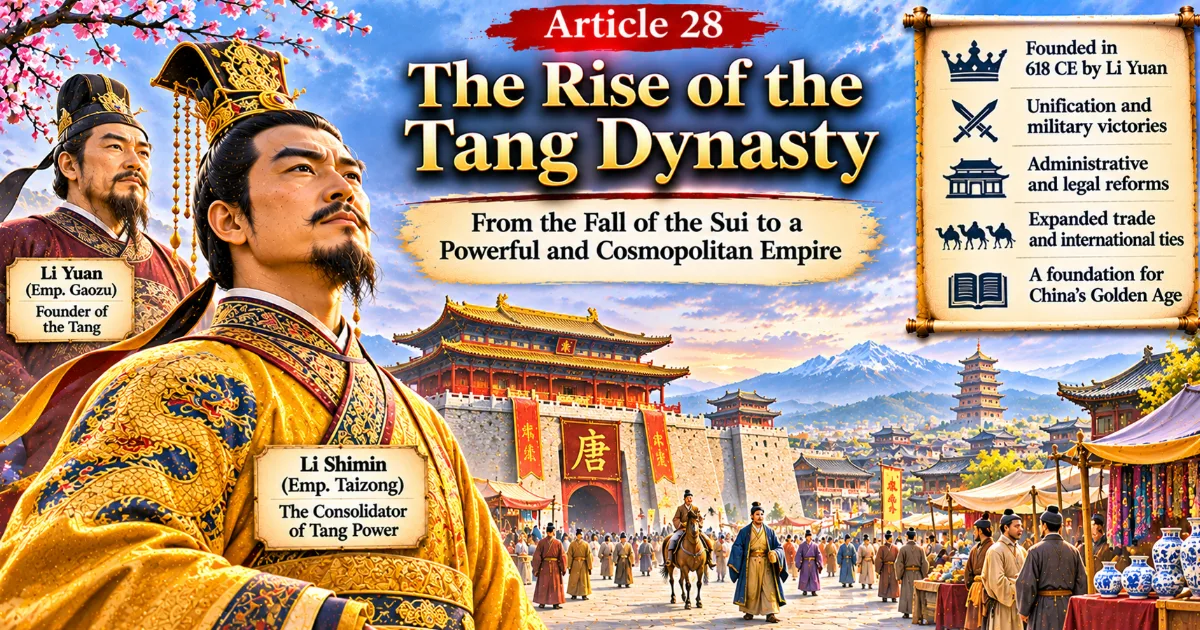
The Tang Dynasty was established in 618 CE after the collapse of the Sui Dynasty. Its founders inherited a reunified empire with established administrative institutions, transportation networks, and agricultural systems.
Under early Tang rulers, particularly Emperor Taizong, the government strengthened central administration, developed legal institutions, improved military organisation, and expanded China's influence beyond its traditional frontiers.
The reign of Emperor Taizong became associated with effective government and political stability. His administration encouraged capable officials, strengthened imperial authority, and established a reputation for responsible leadership.
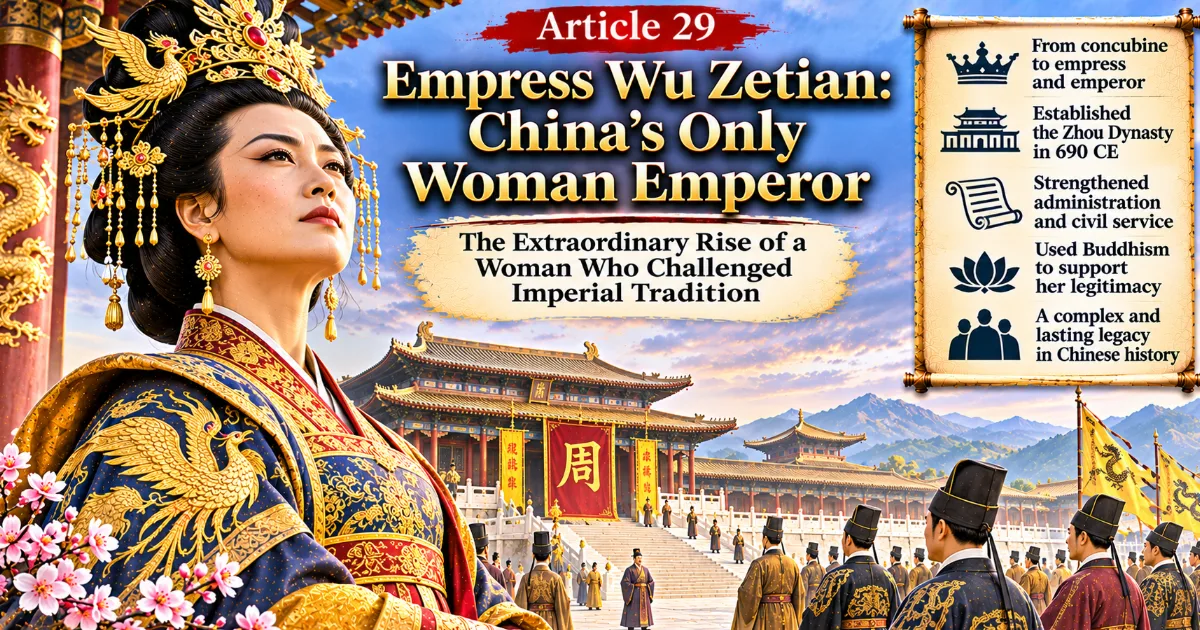
Later rulers continued many of these policies, although the political environment gradually changed. Under Emperor Gaozong and Empress Wu Zetian, the imperial court expanded its influence and experienced important administrative and cultural developments.
The eighth century initially brought another period of prosperity under Emperor Xuanzong, who ascended the throne in 712 CE. His early reign became associated with the Kaiyuan era, which lasted until 741 CE and is often remembered as a high point of Tang political and cultural achievement.
Agriculture expanded in many regions, commercial cities flourished, and international trade connected China with Central Asia, India, Southeast Asia, and the wider world.
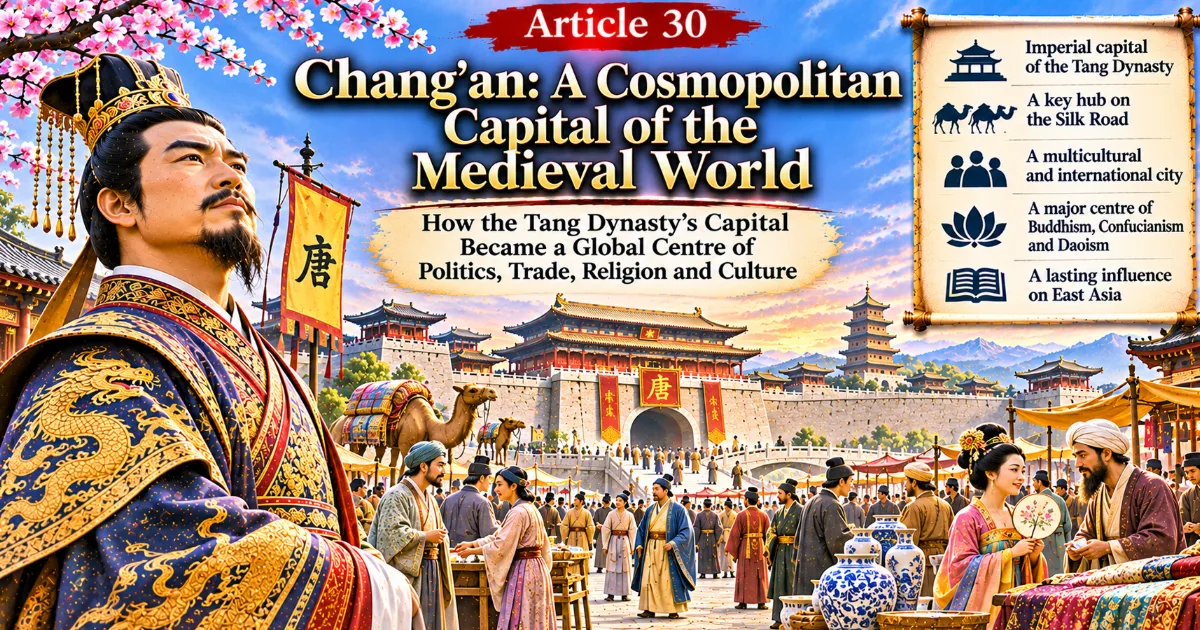
Chang'an, the imperial capital, became one of the largest and most cosmopolitan cities of its time. Its markets, religious institutions, educational centres, and diplomatic communities reflected the international character of Tang civilisation.
However, the empire's increasing size created administrative and military challenges. Defending distant frontiers required large standing armies, while the central government struggled to maintain direct control over every region.
The same military system that helped protect the Tang Empire would eventually contribute to its greatest internal crisis.
2. Emperor Xuanzong and the Changing Political Environment
Emperor Xuanzong, also known as Li Longji, ruled from 712 to 756 CE. His reign is often divided into two broad phases.
During the first phase, he worked to strengthen administration and improve the financial condition of the empire. He relied on experienced officials, promoted administrative reforms, and supported cultural development.
The court became a centre of artistic activity. Poets such as Li Bai and Du Fu produced some of the most celebrated works in Chinese literature, while painting, music, and decorative arts flourished.
However, the later years of Xuanzong's reign were marked by political difficulties.
The emperor increasingly relied on a smaller circle of influential advisers and court favourites. Political competition intensified, and the administration became less effective in responding to growing military and financial challenges.
One important figure in this environment was Li Linfu, who served as chief minister for many years. He was a powerful political operator who sought to preserve his influence by limiting the advancement of potential rivals.
His policies contributed to the growing importance of military commanders who were not deeply integrated into the traditional civil official system.
After Li Linfu's death in 752 CE, Yang Guozhong became increasingly influential at court. His political rivalry with An Lushan contributed to the tensions that eventually erupted into rebellion.
The emperor's declining political judgement, court rivalries, and reliance on powerful individuals weakened the government's ability to recognise and respond to the danger developing along its northern frontiers.
3. Who Was An Lushan?
An Lushan was a military commander of mixed Central Asian and Sogdian background who rose to prominence within the Tang military system.
He was born around 703 CE in a region associated with the multicultural frontier world of northeastern China. His background gave him connections with several cultural and linguistic communities that participated in the military and commercial life of the empire.
An Lushan became a capable military officer and developed a reputation for energy, ambition, and personal influence.
He served in frontier defence and gradually gained command over important military forces. His experience and connections helped him establish relationships with soldiers, officers, and political figures.
The Tang government valued commanders who could defend distant borders, particularly in regions where military pressure from neighbouring powers required permanent forces.
An Lushan benefited from this system. He eventually controlled three major frontier commands, known as jiedushi, giving him authority over large numbers of soldiers and substantial regional resources.
His military position made him one of the most powerful individuals outside the imperial court.
An Lushan also cultivated a personal relationship with Emperor Xuanzong and gained the emperor's confidence. This relationship helped him strengthen his position despite concerns among some officials about his growing power.
His rise illustrates how the Tang military system could create commanders whose influence became difficult for the central government to control.
4. The Frontier Military System and the Rise of Regional Commanders
The Tang Empire faced extensive military responsibilities. Its frontiers stretched across regions that required constant defence against competing states, nomadic confederations, and other political powers.
To manage these responsibilities, the government developed a system of regional military commands.
Commanders known as jiedushi were responsible for defending specific frontier areas. They could supervise troops, organise supplies, manage military administration, and respond to external threats.
This system helped the empire defend its borders without requiring the central government to direct every military operation.
However, the responsibilities of some commanders expanded over time. Certain jiedushi controlled multiple military districts and gained influence over local administration and economic resources.
The government increasingly depended on professional soldiers stationed in frontier regions. These troops often developed stronger personal relationships with their commanders than with officials at the imperial court.
The military system therefore began to create regional centres of power.
An Lushan's authority over several important commands gave him a particularly strong position. He possessed the soldiers, resources, and administrative influence necessary to challenge the central government.
The problem was not simply that one commander became ambitious. It was that the imperial system had created military institutions that could become powerful enough to threaten the state they were supposed to defend.
5. The Rivalry Between An Lushan and Yang Guozhong
Political rivalry at the Tang court played an important role in the outbreak of the rebellion.
Yang Guozhong was a relative of Consort Yang, one of Emperor Xuanzong's most influential companions. He gradually became the leading political figure at court after Li Linfu's death.
Yang Guozhong regarded An Lushan as a threat to his own authority. An Lushan, meanwhile, viewed Yang as an obstacle to his political ambitions.
Their rivalry became increasingly intense.
Yang Guozhong reportedly warned the emperor that An Lushan was preparing to rebel. However, Xuanzong did not take decisive action to remove the commander or substantially reduce his military power.
Some officials may have underestimated the seriousness of the threat. Others may have feared that taking action against An Lushan would provoke the very uprising they hoped to prevent.
An Lushan also had reasons to fear political removal. If he lost his commands, he could become vulnerable to his enemies at court.
These tensions created a dangerous political environment in which rebellion became increasingly likely.
The imperial government failed to establish a reliable solution to the conflict between its powerful regional commander and influential court officials.
6. The Beginning of the An Lushan Rebellion in 755 CE
In December 755 CE, An Lushan launched his rebellion from the northeastern frontier.
He declared that he was acting against corrupt officials and claimed that his actions were intended to protect the emperor. His forces moved southwards, beginning a major military campaign against the Tang government.
The rebellion was initially known as the An-Shi Rebellion because Shi Siming later became one of its principal leaders.
An Lushan's forces advanced rapidly through important northern regions. The Tang government was unprepared for the scale and speed of the uprising.
Some frontier troops joined the rebels, while others were unable to resist their advance.
The rebellion exposed weaknesses in the imperial military system. The central government possessed substantial resources, but its forces were not organised effectively enough to prevent the rebels from gaining early victories.
An Lushan's army also benefited from surprise, political discontent, and the loyalty of soldiers who had served under his command.
The conflict soon threatened the political heart of the Tang Empire.
7. The Fall of Luoyang
One of the most important early victories for the rebels was the capture of Luoyang.
Luoyang was a major imperial city with considerable political, economic, and cultural importance. It had served as an important capital during earlier dynasties and remained a significant centre during the Tang period.
The rebels captured the city in early 756 CE.
After taking Luoyang, An Lushan established his own political authority and declared the establishment of a new state called Yan.
The capture of Luoyang demonstrated that the rebellion was not merely a temporary military disturbance. It was an attempt to replace the existing imperial government.
The loss of the city also weakened the Tang government's control over important northern transportation and administrative networks.
The imperial court now faced a rebellion that had captured major urban centres and threatened the security of the capital itself.
8. The Crisis of Chang'an
Chang'an was the political and cultural centre of the Tang Empire.
Its enormous population, imperial palaces, administrative institutions, markets, religious establishments, and international communities made it one of the most important cities in the medieval world.
The advancing rebel forces created an immediate threat to the capital.
The imperial government struggled to organise an effective defence. Military commanders disagreed over strategy, while political rivalries weakened coordination.
The emperor and his advisers faced a difficult decision about whether to defend the capital or withdraw to a safer location.
The situation deteriorated rapidly during 756 CE.
Chang'an was eventually abandoned by the imperial court as Xuanzong and his entourage fled westward.
The loss of the capital was a devastating blow to the prestige of the Tang government. It demonstrated that the emperor could no longer guarantee the security of the empire's most important political centre.
For a dynasty that had once projected extraordinary power across Asia, the fall of Chang'an represented a profound crisis of legitimacy.
9. The Flight to Sichuan and the Mutiny at Mawei
As the imperial court fled from Chang'an, the emperor and his entourage travelled towards Sichuan.
During the journey, tensions within the imperial retinue became increasingly serious.
The soldiers accompanying the emperor blamed Yang Guozhong for the military disaster. They believed that his political influence and rivalry with An Lushan had contributed to the crisis.
At Mawei, near present-day Xingping in Shaanxi, the troops mutinied in July 756 CE.
Yang Guozhong was killed. The soldiers also demanded the death of Consort Yang, whom they associated with the political failures of the court.
Xuanzong was unable to protect her, and she was executed.
The event became one of the most tragic episodes in the history of the Tang imperial court.
Consort Yang's death later inspired literature, poetry, opera, and artistic interpretations. Her story became closely associated with the decline of Emperor Xuanzong and the loss of the Tang Golden Age.
The flight and mutiny exposed the collapse of confidence in the emperor's leadership. The imperial court had lost not only its capital but also the loyalty of the soldiers responsible for protecting it.
10. Emperor Suzong and the Struggle to Restore Imperial Authority
After Xuanzong fled towards Sichuan, his son Li Heng took a different route and established a new imperial court in the northwest.
He ascended the throne as Emperor Suzong in 756 CE.
Suzong faced an extremely difficult situation. The rebels controlled major cities, the capital had fallen, and the imperial military system had been severely damaged.
His government needed to rebuild military strength and establish alliances with forces capable of defeating the rebellion.
The Tang court received support from regional commanders and foreign allies.
One particularly important development was the cooperation with Uyghur forces. The Uyghur Khaganate had become a major power in Central Asia, and its military assistance helped the Tang government regain important territories.
However, this support came with political and economic costs. The Tang government had to provide substantial payments and other benefits to secure Uyghur military assistance.
Suzong's government gradually organised counterattacks against the rebels.
The recovery of the empire would require years of military campaigns, changing alliances, and enormous financial expenditure.
11. The Role of Foreign Allies in the Tang Recovery
The Tang government depended on foreign assistance during the struggle to recover its territories.
The Uyghur Khaganate was particularly important. Uyghur forces helped the Tang army during campaigns to retake major cities, including Luoyang and Chang'an.
These alliances demonstrate that the Tang Empire remained connected to the wider political world even during its greatest internal crisis.
The relationship was not entirely one-sided. The Uyghurs received payments, gifts, and opportunities for trade in return for military support.
The Tang government also benefited from the participation of other regional forces and commanders who opposed An Lushan and his successors.
However, reliance on outside military assistance revealed the weakness of the central government.
A dynasty that had once possessed enormous military resources now needed foreign support to recover its own capital.
This dependence also contributed to financial pressures and gave external powers greater influence over Tang political affairs.
12. The Death of An Lushan
An Lushan's rebellion was weakened by internal conflict.
Although he had successfully captured major cities and established the Yan state, his position became increasingly unstable.
He suffered from serious health problems and reportedly became increasingly suspicious of those around him.
In January 757 CE, An Lushan was assassinated by his own son, An Qingxu.
The assassination created further instability within the rebel leadership.
An Qingxu became the new leader, but he lacked the same authority and military influence that An Lushan had possessed.
The rebel forces continued to fight, and the Tang government still faced a difficult military challenge.
An Lushan's death did not end the rebellion. Instead, it began another phase of conflict involving rival leaders, shifting alliances, and repeated military campaigns.
13. The Tang Recapture of Chang'an and Luoyang
With the help of allied forces, the Tang government gradually regained control of important cities.
In 757 CE, imperial forces recaptured Chang'an.
The recovery of the capital was a major symbolic victory. It restored the imperial court's presence in the political centre of the empire and strengthened the legitimacy of Emperor Suzong.
Later that year, Tang forces and their allies also recovered Luoyang.
However, these victories did not completely eliminate the rebellion.
The rebel leadership continued to operate in northern China, and the conflict entered another prolonged phase.
The recovery of major cities also revealed the enormous damage caused by the war. Infrastructure had been destroyed, populations had been displaced, and agricultural production had been disrupted.
The Tang government could reclaim its capital, but rebuilding the political and economic foundations of the empire would prove far more difficult.
14. Shi Siming and the Continuation of the Rebellion
After the death of An Lushan, Shi Siming emerged as a major rebel leader.
He had originally served as a military commander under An Lushan and possessed considerable experience in frontier warfare.
Shi Siming eventually turned against An Qingxu and established his own authority over the remaining rebel forces.
In 759 CE, he killed An Qingxu and took control of the rebel state.
He continued the conflict against the Tang government and achieved several military successes.
Shi Siming's leadership demonstrated that the rebellion had developed beyond the personal ambitions of An Lushan. It had become a broader struggle involving military commanders, regional interests, and political opposition to the imperial government.
Shi Siming was eventually assassinated in 761 CE by his own son, Shi Chaoyi.
The rebel forces continued to resist, but their political and military organisation gradually weakened.
The Tang government eventually defeated the remaining rebellion in 763 CE.
Although the major conflict had ended, the consequences would continue to shape Chinese politics for generations.
15. The Human Cost of the Rebellion
The An Lushan Rebellion caused enormous suffering across northern China.
Cities were captured and recaptured, villages were destroyed, agricultural land was abandoned, and transportation networks were disrupted.
Civilians experienced violence, displacement, hunger, and economic insecurity.
The conflict also affected families and communities far beyond the immediate battlefields.
Farmers lost access to land and irrigation systems. Merchants faced dangerous routes and reduced commercial activity. Craftsmen and labourers lost customers, workshops, and sources of income.
Religious institutions and cultural centres also experienced disruption.
Historical population records indicate a dramatic decline in registered households during and after the rebellion. However, these figures should not be interpreted as a direct count of deaths.
War, migration, administrative collapse, tax avoidance, and changes in census registration all affected the recorded population.
The exact number of people who died remains uncertain. Nevertheless, the rebellion clearly produced a major demographic and economic catastrophe.
Its impact was particularly severe in regions that had previously supported the prosperity of the Tang Empire.
16. The Economic Destruction of Northern China
Before the rebellion, northern China contained important agricultural regions, commercial centres, and transportation routes.
The war disrupted these foundations.
Agricultural production declined in many affected areas because farmers abandoned their fields, irrigation systems were damaged, and military forces consumed or destroyed local resources.
Trade routes became less secure, while the movement of goods and people was interrupted.
Cities that had once supported large populations and active markets experienced severe disruption.
The government also faced declining tax revenues.
The Tang administrative system depended heavily on agricultural taxation and the collection of resources from registered households. When populations moved or land became unproductive, the state lost important sources of income.
The rebellion therefore weakened the government in two ways. It consumed enormous military resources while simultaneously reducing the revenue needed to maintain the state.
This financial problem continued long after the military conflict ended.
17. The Transformation of the Tang Military System
One of the most important long-term consequences of the rebellion was the transformation of Tang military organisation.
Before the rebellion, the central government had relied on a combination of imperial forces, frontier armies, and regional commands.
After the conflict, the court increasingly depended on powerful military governors to maintain order in different regions.
Many commanders controlled their own troops and developed strong local political networks.
Some regional governments became hereditary or semi-independent in practice. Their commanders could resist imperial orders, retain tax revenues, and negotiate with the central government from positions of strength.
These regions became known as fanzhen, or military governorships.
The growth of these regional powers weakened the traditional structure of imperial government.
The Tang emperor remained the formal ruler of the empire, but his practical authority varied considerably from region to region.
This fragmentation became one of the central problems of late Tang politics.
18. The Rise of the Fanzhen and Regional Independence
The military governorships became increasingly powerful after the rebellion.
Some commanders continued to recognise the Tang emperor while exercising substantial independence over their territories.
They controlled local military forces, managed taxation, appointed officials, and maintained political relationships with neighbouring regions.
The central government sometimes accepted these arrangements because it lacked the resources to defeat every powerful commander.
This created a difficult political compromise.
The imperial court retained symbolic authority, but its ability to enforce decisions depended on negotiations with regional military leaders.
Some governorships became especially powerful in northern China, where the rebellion had created long-lasting military and administrative instability.
The fanzhen system made it difficult for the Tang government to rebuild a fully centralised empire.
It also created conditions for future rebellions and political struggles.
19. Changes in the Tang Taxation System
The rebellion exposed serious weaknesses in the Tang taxation system.
Before the conflict, the government relied on systems that connected taxation to registered households and agricultural land.
However, war and population movement made traditional registration increasingly difficult.
Many people had fled their homes, while local officials struggled to maintain accurate records.
The government needed a more reliable way to collect revenue from a changing population and economy.
In 780 CE, during the reign of Emperor Dezong, the Tang government introduced the Two-Tax System.
Under this system, taxation was reorganised around property and economic capacity rather than relying entirely on older household categories.
Payments were generally collected twice a year, giving the system its name.
The reform represented an important change in Chinese fiscal administration.
It reflected the reality that the Tang state could no longer depend on the same administrative and economic conditions that had existed before the rebellion.
The Two-Tax System helped provide the government with a more practical method of raising revenue, although financial pressures continued.
20. The Decline of the Equal-Field System
The equal-field system had been an important part of early Tang economic administration.
It was designed to allocate agricultural land according to established rules and support taxation and military obligations.
However, the system had faced difficulties even before the rebellion.
Land concentration, population growth, private ownership, and administrative weaknesses reduced the government's ability to distribute and monitor land effectively.
The An Lushan Rebellion accelerated these problems.
Displacement and destruction disrupted land records, while powerful families and regional authorities gained greater control over resources.
The central government found it increasingly difficult to regulate agricultural land according to the original principles of the system.
The weakening of the equal-field system reflected a broader transformation in Chinese society.
The economic structure of the empire was changing, and the government needed new methods to manage taxation, landholding, and rural production.
21. The Cultural Impact of the Rebellion
The An Lushan Rebellion deeply affected Tang cultural life.
The early Tang period had been associated with confidence, artistic achievement, and international openness. The rebellion introduced a much darker atmosphere of uncertainty and loss.
Poetry became an especially important medium for expressing the human consequences of political instability.
Du Fu, one of China's greatest poets, experienced the turmoil of the rebellion and wrote about the suffering of ordinary people, the destruction of cities, the separation of families, and the failures of political leadership.
His poetry provides a powerful literary record of the period.
The rebellion also influenced historical writing and political thought. Later generations examined the conflict as a warning about excessive military power, poor imperial judgement, and the dangers of political factionalism.
The Tang Golden Age did not disappear immediately after 755 CE, but its character changed.
The confidence of the earlier period gave way to a more complicated cultural environment shaped by war, political uncertainty, and social transformation.
22. Buddhism and Religious Institutions After the Rebellion
Buddhist institutions were affected by the rebellion in different ways.
Some monasteries suffered from warfare, while others continued to provide religious services, education, and assistance to local communities.
The economic disruption also affected donations and the resources available to religious institutions.
At the same time, the religious landscape remained diverse. Buddhism continued to influence Chinese philosophy, literature, art, and spiritual practice.
The Tang government maintained a complicated relationship with Buddhist institutions, balancing political support with financial regulation.
The rebellion itself did not bring about the major persecution of Buddhism. That occurred later, particularly during Emperor Wuzong's campaign in 845 CE.
Nevertheless, the political and economic pressures created by the rebellion contributed to a changing relationship between the state and religious organisations.
23. The Reign of Emperor Dezong and Continued Political Problems
Emperor Dezong ruled from 779 to 805 CE.
His reign demonstrated that the Tang government still faced serious problems more than a decade after the rebellion had ended.
Dezong attempted to strengthen central authority and reduce the independence of regional military governors.
However, these efforts produced new conflicts.
Military commanders resisted attempts to limit their authority, and rebellions broke out in several regions.
The emperor's government struggled to coordinate military operations and maintain stable relationships with powerful commanders.
The Two-Tax System was an important administrative reform, but fiscal improvements alone could not solve the political problem of regional military independence.
The Tang court continued to depend on negotiations and military campaigns to maintain control.
The dynasty survived, but the balance of power had changed permanently.
24. The Long-Term Decline of Imperial Authority
The An Lushan Rebellion weakened the Tang Dynasty in several interconnected ways.
It destroyed important economic resources, reduced the population recorded under imperial administration, weakened the military system, and encouraged the rise of powerful regional governments.
The central court also became more dependent on military commanders, financial intermediaries, and influential court officials.
In later Tang history, eunuchs gained considerable influence within the imperial palace and sometimes played decisive roles in selecting or removing emperors.
Court politics became increasingly unstable, while regional commanders continued to challenge imperial authority.
The Tang Dynasty remained culturally influential, and some regions continued to experience economic development.
However, the political unity and administrative effectiveness of the early Tang period were never fully restored.
The rebellion had changed the foundations of the empire.
25. From the An Lushan Rebellion to the Fall of the Tang Dynasty
The Tang Dynasty survived the rebellion of 755 to 763 CE, but its later history was marked by repeated political and military crises.
Regional military governors remained powerful. Imperial finances continued to face pressure, and court rivalries weakened the government.
During the ninth century, social and economic tensions increased.
Corruption, taxation pressures, local insecurity, and administrative problems contributed to widespread dissatisfaction.
The Huang Chao Rebellion, which began in 874 CE, became another major crisis for the dynasty.
Huang Chao's forces captured Chang'an in 880 CE, creating another devastating blow to imperial authority.
Although the Tang government eventually recovered the capital, its political strength had been severely weakened.
In the final years of the dynasty, regional military commanders became increasingly powerful.
In 907 CE, Zhu Wen, a former military commander who had risen to prominence during the late Tang crisis, forced the last Tang emperor to abdicate and established the Later Liang Dynasty.
The Tang Dynasty came to an end after nearly three centuries of rule.
The fall of the dynasty marked the beginning of the Five Dynasties and Ten Kingdoms period, another era of political division in Chinese history.
Conclusion: The Rebellion That Ended the Tang Golden Age
The An Lushan Rebellion was one of the most important turning points in Chinese history.
It began as a challenge to the Tang imperial government by a powerful frontier commander, but it developed into a conflict that transformed the political, economic, military, and cultural foundations of the empire.
The rebellion exposed the dangers of allowing regional commanders to accumulate excessive military power. It also revealed the consequences of court rivalries, weak political judgement, and an administrative system that struggled to control an expanding empire.
The loss of Chang'an and Luoyang demonstrated the vulnerability of the Tang government. Although the imperial court eventually recovered these cities, it could not restore the political order that had existed before the conflict.
The rebellion devastated northern China, disrupted agriculture and trade, displaced populations, and weakened government finances. It also encouraged the growth of powerful military governorships that gradually reduced the authority of the central state.
The Tang Dynasty continued to produce important cultural and economic achievements after the rebellion. Its literature, art, religious traditions, and commercial connections remained influential. However, the political confidence and centralised strength of the early Tang period had been permanently damaged.
The rebellion did not directly end the dynasty, but it began a long process of decline that eventually culminated in the fall of the Tang in 907 CE.
The story of the An Lushan Rebellion offers an important lesson about the relationship between prosperity and political stability. A civilisation may achieve extraordinary success in art, commerce, technology, and culture, but those achievements cannot guarantee the survival of its political institutions.
The Tang Dynasty reached remarkable heights, yet its internal weaknesses gradually undermined the foundations of its power. The An Lushan Rebellion revealed those weaknesses and changed the course of Chinese history.
#HistoryOfChina #TangDynasty #AnLushanRebellion #ChineseHistory #AncientChina