How the Capital of the Tang Dynasty Became One of the Greatest Cities in Human History
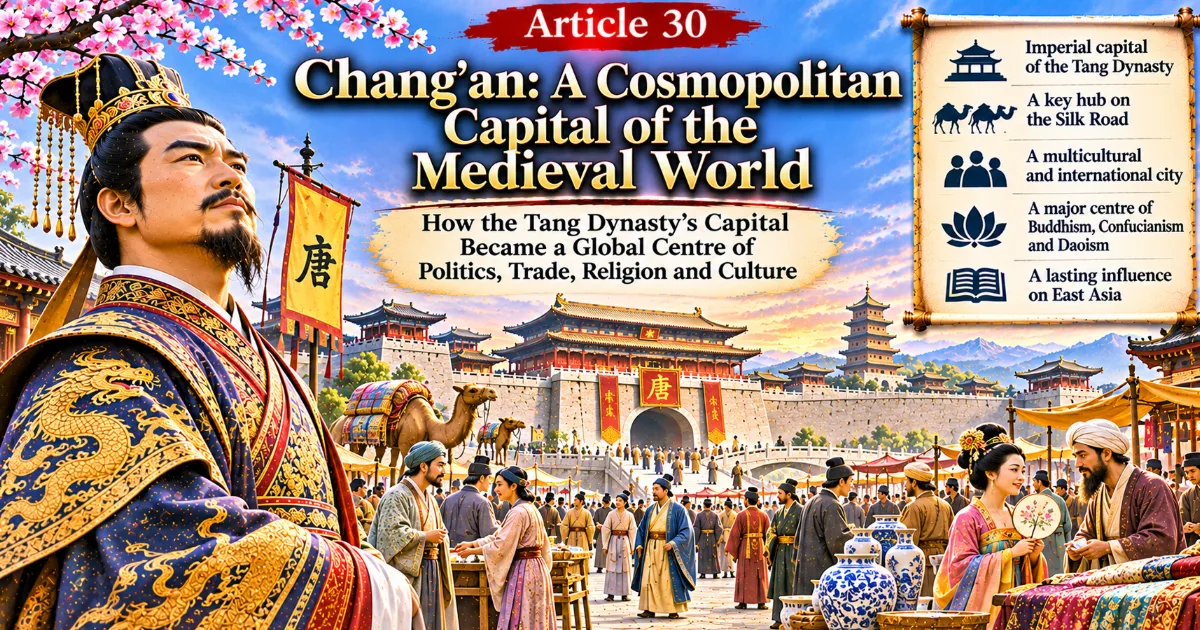
During the Tang Dynasty, one city stood above all others as a symbol of China's political authority, economic prosperity, cultural achievement, and international influence. That city was Chang'an, the imperial capital of the Tang Empire. Located in present-day Xi'an in Shaanxi Province, Chang'an became one of the largest and most sophisticated urban centres of the medieval world. Its enormous population, carefully planned streets, magnificent palaces, thriving markets, religious institutions, and international communities made it a remarkable example of urban civilisation.
At the height of the Tang Dynasty, Chang'an attracted merchants from Central Asia, diplomats from neighbouring kingdoms, Buddhist monks from India, scholars from Korea and Japan, musicians from Persia, and travellers from distant regions connected through the Silk Road. The city was not simply the administrative centre of a Chinese empire. It was a meeting place where languages, religions, commercial traditions, artistic styles, and intellectual ideas came into contact.
The city's greatness was closely connected with the political strength of the Tang Dynasty. Established in 618 CE, the dynasty restored unity after the collapse of the Sui Empire and developed an extensive system of government. Its rulers supported international trade, maintained diplomatic relations with neighbouring states, and presided over a period of extraordinary cultural activity. Chang'an became the physical expression of this imperial confidence.
The city also influenced the development of other Asian capitals. Its planning principles, ceremonial architecture, administrative districts, and urban organisation provided important models for cities such as Nara and Heian-kyo in Japan. Its influence extended far beyond China's borders.
Continue Reading
However, Chang'an's history was not one of uninterrupted prosperity. Political rebellions, military conflicts, economic changes, and the weakening of central authority eventually reduced its importance. The An Lushan Rebellion of the eighth century was particularly destructive, exposing the vulnerabilities of the Tang political system and damaging the foundations of the city's prosperity.
Understanding Chang'an is essential to understanding the Tang Dynasty. Its history reveals how an imperial capital could become a centre of global exchange, how urban planning could express political ideology, and how international connections helped shape one of the most influential civilisations of the medieval period.
1. The Historical Origins of Chang'an
Chang'an's importance began before the Tang Dynasty. The region surrounding present-day Xi'an had served as a centre of political power for several ancient Chinese states and dynasties.
The city became especially important during the Western Han Dynasty, when it served as the imperial capital from 202 BCE. Under the Han rulers, Chang'an developed into a major administrative and commercial centre. It was connected with important roads, agricultural regions, military installations, and trade routes.
The name Chang'an means enduring peace or lasting peace. It expressed the political ambition of rulers who hoped to establish a stable capital from which they could govern a unified empire.
After the fall of the Han Dynasty, China experienced centuries of division and political instability. Northern and southern regimes competed for power, and several dynasties established their own capitals. Chang'an continued to hold symbolic importance, although its political role changed during these periods.
In 581 CE, Yang Jian established the Sui Dynasty and reunified much of China. He selected the region of Chang'an for his new capital, but rather than simply rebuilding the old Han city, the Sui government created a new planned capital known as Daxing. The construction of this city began in 582 CE.
The new capital was designed on an enormous scale. Its layout reflected the political and philosophical ideas of the period, including the importance of symmetry, hierarchy, orientation, and the relationship between the ruler and the wider universe.
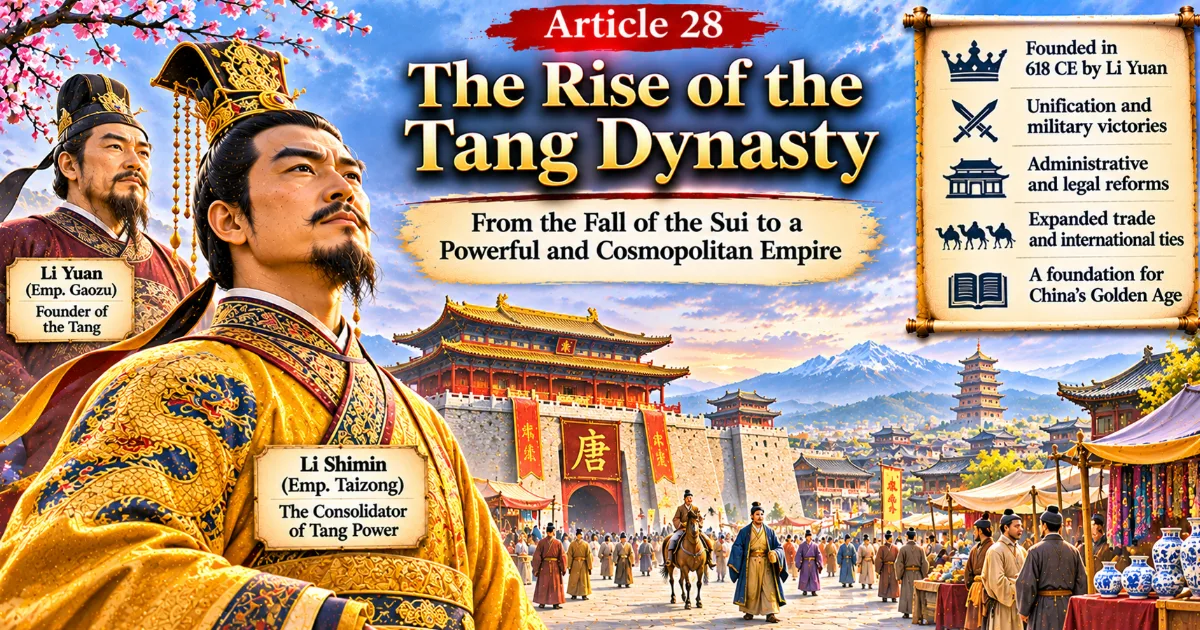
When the Tang Dynasty replaced the Sui in 618 CE, the new rulers retained the capital and restored the historic name Chang'an. The city then entered its most famous period of development.
2. The Tang Dynasty and the Rise of a Great Capital
The Tang Dynasty was founded by Li Yuan, who became Emperor Gaozu in 618 CE. His son Li Shimin played a decisive role in establishing the new regime and later became Emperor Taizong.
The early Tang rulers inherited a reunified empire but also faced the challenge of maintaining political stability. The Sui Dynasty had collapsed after expensive military campaigns, forced labour projects, and widespread rebellion. The Tang government needed to restore confidence in imperial institutions while rebuilding the economy.
Chang'an became central to this project.
The city housed the emperor, the imperial family, senior government officials, military commanders, foreign ambassadors, and administrative institutions. Major decisions concerning taxation, military campaigns, diplomacy, legal affairs, and public works were made there.
Its location in the Guanzhong region provided strategic advantages. The surrounding area had agricultural resources and access to important routes connecting northern China with the east, west, and southwest. The region was also protected by natural geographical features, including mountain ranges and river systems.
However, the capital's location created logistical challenges. Feeding a large population required the movement of enormous quantities of grain from other parts of the empire. The Grand Canal and the transport networks developed during the Sui and Tang periods helped address this challenge.
As the Tang state became more prosperous, Chang'an grew into a centre of imperial administration and international activity.
3. The Extraordinary Urban Planning of Chang'an
One of the most remarkable features of Tang Chang'an was its carefully organised urban layout.
The city was planned according to a broad rectangular design, with walls enclosing an extensive area. Its streets followed a grid pattern, creating a structured arrangement of districts, residential areas, markets, administrative buildings, religious institutions, and imperial spaces.
The city was divided into numerous residential wards. These neighbourhoods were enclosed by walls and separated by broad streets. Gates controlled movement between different areas, while local authorities supervised residential life.
The grid system made the city easier to administer. Officials could organise neighbourhoods, monitor commercial activity, maintain security, and regulate access to important areas.
The main avenues were unusually wide by the standards of the medieval world. They allowed ceremonial processions, military movements, official transport, and large gatherings.
The city's layout also reflected political hierarchy. The imperial palace occupied a dominant position, while government institutions and other important buildings were arranged according to their relationship with the ruler.
The urban design was not simply practical. It expressed the belief that the capital should embody order, stability, and the authority of the emperor.
The symmetry of the city and the organisation of its major avenues reflected broader Chinese ideas about cosmic balance and political harmony. The capital was intended to represent an ordered world governed by a legitimate ruler.
4. The Imperial Palaces and the Centre of Political Power
Chang'an contained several major palace complexes that reflected the power and wealth of the Tang imperial family.
The Taiji Palace served as an important centre of imperial government during the early Tang period. It contained ceremonial spaces, administrative facilities, residential areas, and locations where the emperor conducted official business.
As the Tang Dynasty developed, the Daming Palace became one of the most important imperial complexes. Construction began during the reign of Emperor Taizong and was expanded under later rulers. It became a major centre of imperial residence and administration.
The Daming Palace was an enormous architectural complex with halls, courtyards, gates, gardens, and administrative buildings. Its scale communicated the authority of the emperor to officials, foreign envoys, and visitors.
One of its most significant structures was the Hanyuan Hall, which served as a major ceremonial space. Important state occasions, diplomatic receptions, and imperial ceremonies could take place within this environment.
The palace complex also reflected the separation between public and private aspects of imperial life. Formal government activities took place in designated halls, while residential areas provided accommodation for the emperor, imperial family, attendants, and palace personnel.
The palaces of Chang'an were more than luxurious residences. They were political theatres in which imperial authority was displayed through architecture, ceremony, clothing, ritual, and controlled access.
5. The Two Great Markets of Chang'an
Commercial activity was concentrated in two major markets known as the Eastern Market and the Western Market.
The Eastern Market served important commercial and residential districts within the city. It attracted merchants, craftsmen, wholesalers, retailers, and customers from different social backgrounds.
The Western Market became particularly famous for its international connections. It was associated with foreign merchants and traders arriving through routes from Central Asia, Persia, and other regions.
Goods sold in Chang'an included silk, spices, precious metals, jewellery, ceramics, textiles, medicines, horses, glassware, and luxury products. Some items came from distant regions through several stages of exchange.
The markets were not simply places where goods changed hands. They were also spaces where people exchanged information, negotiated commercial agreements, learned foreign languages, and encountered unfamiliar customs.
The presence of foreign merchants reflected the international character of Tang society. Commercial life brought people from different regions into regular contact, creating opportunities for cultural exchange.
The government regulated markets through official rules, trading schedules, taxation, and administrative supervision. Commercial activity was therefore connected with the wider system of imperial government.
Chang'an's markets demonstrate that the Tang economy was not isolated within China's borders. It participated in a vast network of land and maritime trade that connected East Asia with Central Asia, South Asia, West Asia, and beyond.
6. The Silk Road and Chang'an's International Importance
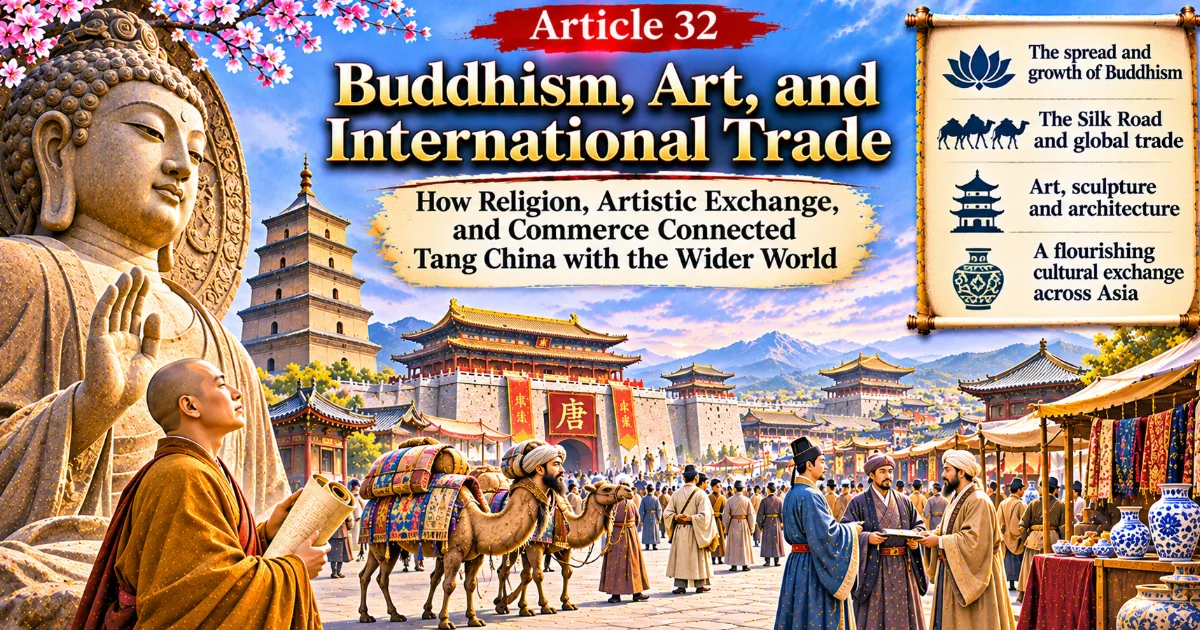
Chang'an is closely associated with the Silk Road, the network of routes that connected China with Central Asia, South Asia, the Middle East, and the Mediterranean world.
The Silk Road was not one single road. It consisted of multiple overland routes, mountain passages, desert crossings, trading settlements, and regional networks.
Merchants transported silk, horses, spices, precious stones, glass, textiles, paper, and many other products. Along with these goods travelled technologies, artistic styles, religious ideas, stories, and scientific knowledge.
The Tang Dynasty inherited and expanded China's participation in these networks. Under powerful rulers such as Emperor Taizong and Emperor Xuanzong, the empire maintained political and military relationships with several Central Asian states.
Chang'an became the destination for merchants and diplomatic missions arriving from the western regions. Some visitors came for commercial purposes, while others sought political alliances, religious opportunities, or official recognition.
The Silk Road contributed to the city's prosperity in several ways. It supported trade, increased demand for luxury goods, strengthened diplomatic connections, and encouraged the development of specialised crafts.
The movement of people was equally important. Foreign communities settled in Chang'an, bringing their languages, religious practices, musical traditions, clothing styles, and culinary customs.
The city became a place where the wider Eurasian world could be experienced within the boundaries of a Chinese imperial capital.
7. A Multicultural Population
Tang Chang'an was one of the most internationally diverse cities of its time.
Its population included Chinese residents from different regions, Central Asian merchants, Persian traders, Sogdian communities, Korean visitors, Japanese students, Indian monks, and people from several other parts of Asia.
Some foreigners came temporarily for trade or diplomacy. Others settled permanently, established businesses, married into local families, or served in government and military organisations.
The Sogdians were particularly important in the commercial networks of Central Asia. They were experienced merchants who connected trading centres across long distances. Their communities played a major role in facilitating exchanges between China and western regions.
Central Asian musicians and dancers also influenced Tang entertainment. Musical instruments, performance styles, and dance traditions from outside China became popular among sections of the elite.
Foreign military personnel served in Tang armies, and some individuals of non-Chinese origin achieved important positions within the imperial military system.
The multicultural nature of Chang'an did not mean that every community experienced identical treatment or status. Social position, legal circumstances, wealth, occupation, and political relationships influenced individual experiences.
Nevertheless, the city's international population illustrates the scale of Tang China's connections with the wider world.
8. Buddhism and the Religious Landscape of Chang'an
Buddhism was one of the most important religious traditions in Tang Chang'an.
Originally emerging in India, Buddhism had entered China through Central Asian routes over several centuries. By the Tang period, it had become deeply established across Chinese society.
Chang'an contained numerous Buddhist monasteries, temples, religious schools, libraries, and centres of translation.
Monks from different regions visited the city to study Buddhist teachings, obtain texts, translate scriptures, and participate in religious discussions.
One of the most famous figures associated with Tang Buddhism was Xuanzang, the monk who travelled from China to India in the seventh century.
Xuanzang's journey was motivated by his desire to obtain authentic Buddhist scriptures and resolve doctrinal questions. He travelled through Central Asia, visited important Buddhist centres in India, and eventually returned to China with a large collection of texts.
After returning to Chang'an in 645 CE, Xuanzang received imperial support for his translation work. He became one of the most influential Buddhist scholars in Chinese history.
His work helped strengthen the intellectual foundations of Chinese Buddhism and increased knowledge of Indian Buddhist philosophy and institutions.
Chang'an also contained monasteries associated with different Buddhist traditions. These institutions served as centres of education, religious practice, translation, charitable activity, and artistic production.
Buddhism influenced Tang architecture, sculpture, painting, literature, and political thought. It was not merely a foreign religion preserved by immigrant communities. It had become an important part of Chinese civilisation.
9. Daoism, Confucianism, and Religious Diversity
Although Buddhism was highly visible in Tang Chang'an, it was not the only major intellectual or religious tradition.
Daoism had deep historical roots in China and enjoyed imperial support during several Tang reigns. The Tang imperial family claimed a symbolic connection with Laozi, the traditional figure associated with Daoism.
Daoist temples, religious teachers, rituals, and philosophical traditions formed an important part of the city's cultural environment.
Confucianism remained central to government, education, and official ideology. Confucian classics were studied by aspiring officials, and the civil service examination system relied heavily on classical learning.
The three traditions did not always exist in complete harmony. They competed for political support, intellectual influence, property, and institutional resources.
Nevertheless, Tang society allowed substantial interaction among Buddhist, Daoist, and Confucian ideas. Scholars could study multiple traditions, and some individuals participated in different forms of religious and philosophical activity.
The religious diversity of Chang'an reflected the wider intellectual openness of the Tang period, although imperial support could change depending on the ruler and political circumstances.
10. Christian and Other Foreign Religious Communities
Tang Chang'an also became known for the presence of religious traditions that had originated outside China.
One notable example was the Church of the East, a Christian tradition that spread through parts of Asia. Its followers travelled along commercial and diplomatic routes connecting West Asia with China.
In 635 CE, a Christian missionary traditionally identified in Chinese sources as Alopen arrived in Chang'an during the reign of Emperor Taizong.
The Tang government permitted the establishment of a Christian presence, and the community received official recognition.
A famous inscription created in 781 CE, known as the Xi'an Stele or Nestorian Stele, records the history and teachings of this Christian community. It provides important evidence of the presence of Christianity in Tang China.
The city also contained communities associated with Zoroastrianism and Manichaeism, traditions that had developed in western and Central Asian regions.
These religious communities demonstrate the extraordinary geographical reach of Tang China's international connections.
Chang'an was not a city in which all religions had equal political power. Buddhist, Daoist, and Confucian traditions possessed different relationships with the imperial state. However, the presence of several foreign religions reveals that the city was connected to a much wider religious world.
11. Japanese and Korean Connections
Chang'an was particularly influential in East Asia.
Japanese diplomatic missions and students travelled to Tang China to study government, law, religion, architecture, literature, and administrative practices.
During the seventh and eighth centuries, Japan was developing a centralised state. Its rulers sought models for strengthening imperial authority and organising government institutions.
Tang Chang'an provided an important example.
Japanese visitors studied the city's urban planning and ceremonial architecture. They also examined the Tang administrative system, legal codes, Buddhist institutions, and official education.
The Japanese capital of Nara, established in 710 CE, reflected important influences from Tang urban design. Later, Heian-kyo, founded in 794 CE, also drew on Chinese planning principles.
Korean kingdoms maintained extensive diplomatic and cultural relations with Tang China. Students, monks, envoys, and officials travelled between the Korean Peninsula and the Tang capital.
These exchanges helped spread Chinese writing, Buddhist traditions, administrative practices, artistic styles, and literary culture across East Asia.
Chang'an therefore functioned as a major centre of regional influence. Its importance extended beyond the political boundaries of the Tang Empire.
12. Literature, Poetry, and Intellectual Life
Tang Chang'an was a major centre of literary and intellectual activity.
The city attracted scholars, poets, historians, officials, monks, and students who participated in a vibrant culture of writing and debate.
The civil service examination system encouraged the study of classical literature and the development of writing skills. Candidates hoping to enter government service needed to demonstrate knowledge of important texts and the ability to compose sophisticated literary works.
Poetry was particularly important in elite culture. It could express political loyalty, personal emotions, friendship, travel experiences, religious reflection, and observations of nature.
Two of the most celebrated poets of the Tang Dynasty were Li Bai and Du Fu.
Li Bai, who lived from 701 to 762 CE, became famous for his imaginative language, energetic style, and fascination with nature, friendship, wine, and Daoist themes.
Du Fu, who lived from 712 to 770 CE, developed a different literary approach. His poetry often reflected social conditions, political instability, war, poverty, and the suffering of ordinary people.
Both poets were connected with the wider cultural world of the Tang capital, although their lives and experiences differed.
The city's intellectual environment also supported historical writing, philosophical study, religious translation, and scientific activity.
Chang'an's literary culture became one of the defining achievements of the Tang period and influenced Chinese literature for centuries.
13. Music, Dance, and Entertainment
The entertainment culture of Tang Chang'an reflected its international character.
Music and dance were important features of imperial ceremonies, aristocratic gatherings, religious celebrations, and private entertainment.
Tang music incorporated instruments and performance styles from several regions. Musicians brought traditions from Central Asia, Persia, and other areas into the Chinese imperial environment.
Instruments such as the pipa became closely associated with Tang musical culture. Although the instrument's development had a longer and more complex history, its popularity reflected the influence of musical exchange across Eurasia.
Dance performances were also influenced by foreign traditions. Central Asian dance styles became particularly fashionable among sections of the Tang elite.
The imperial court supported professional musicians, dancers, and performers. Music was used in state ceremonies and celebrations, while private gatherings offered opportunities for artistic experimentation.
Chang'an's entertainment culture also included storytelling, religious performances, theatrical traditions, and public celebrations.
These activities reveal that the city was not only an administrative centre. It was also a major cultural destination where different artistic traditions interacted.
14. Clothing, Fashion, and Everyday Cultural Exchange
The clothing styles of Tang Chang'an reflected the city's wealth and international connections.
Traditional Chinese garments remained central to everyday life, but elite fashion also incorporated influences from Central Asia and other regions.
Foreign-inspired clothing, fitted garments, boots, hats, jewellery, and riding styles became popular in certain social circles.
Women in particular were associated with a range of fashionable styles that reflected changing cultural tastes. Paintings, figurines, and tomb objects provide evidence of clothing, hairstyles, cosmetics, and accessories used during the Tang period.
The popularity of foreign fashions demonstrated the prestige associated with international culture.
However, fashion varied according to class, occupation, age, region, and social circumstances. The clothing of palace elites differed considerably from the garments worn by farmers, labourers, and ordinary city residents.
Tang Chang'an's fashion culture therefore provides an important window into the interaction between social identity and international exchange.
15. Food, Markets, and the Culinary Diversity of Chang'an
The food culture of Tang Chang'an was influenced by the agricultural resources of China and the commercial networks of Eurasia.
Rice, wheat, millet, vegetables, fruits, meat, fish, and dairy products formed part of the wider food economy.
The city received agricultural supplies from surrounding regions and more distant provinces. Grain transportation was particularly important because the population of the capital was too large to depend entirely on local production.
Commercial networks brought spices, dried fruits, nuts, wine, and other products from different regions.
Some Central Asian food traditions influenced elite dining culture. Dairy products and certain forms of bread became familiar in urban environments, while noodles and other wheat-based foods were widely consumed in northern China.
Restaurants, food sellers, markets, and private kitchens served people from different economic backgrounds.
The variety of food available in Chang'an reflected the city's international connections, but it also depended on a sophisticated domestic transportation system that moved agricultural goods across the empire.
Food was therefore both a cultural and economic expression of Tang prosperity.
16. Education and the Civil Service Examination System
Chang'an was one of the most important educational centres of the Tang Empire.
The government maintained institutions for the study of classical literature, law, history, and other subjects required for official service.
The imperial university system provided education for selected students, while private teachers and local schools prepared others for examinations.
The civil service examination system played an important role in recruiting officials.
Candidates studied the Confucian classics, developed literary skills, and demonstrated their ability to interpret important texts. Success could provide access to government positions and greater social status.
The examination system did not create complete equality. Wealthy families had advantages because they could afford education and preparation. Family influence and recommendations also continued to matter.
Nevertheless, the examinations provided a structured route through which individuals could compete for official positions.
The concentration of educational institutions in Chang'an attracted students from across the empire and from foreign states.
For Japanese and Korean visitors, studying in Chang'an offered an opportunity to learn about Tang political institutions and intellectual traditions.
The city thus became a centre of education that influenced the development of government and scholarship across East Asia.
17. Chang'an and the Power of the Tang Emperor
The capital was designed to communicate the emperor's authority.
Its palace complexes, official buildings, ceremonial avenues, and administrative districts reinforced the political hierarchy of the Tang state.
Foreign ambassadors were received through carefully organised diplomatic ceremonies. Officials participated in formal audiences, and important imperial events were conducted according to established ritual procedures.
The emperor's position was represented through architecture and ceremony. The palace stood at the centre of political life, while the surrounding city reflected the organisation of imperial society.
The capital also allowed the government to monitor and manage important institutions.
Central ministries, legal offices, military authorities, and financial departments operated within a system that connected imperial decisions with provincial administration.
Chang'an therefore served as both the symbolic and practical centre of the empire.
Its urban structure helped express the Tang government's understanding of political order, while its institutions made it possible to administer an extensive territory.
18. The Grand Canal and the Challenge of Feeding the Capital
Despite its wealth, Chang'an faced a major geographical challenge. The surrounding region could not always provide sufficient grain to support its enormous population.
The capital depended on agricultural supplies transported from other parts of China.
The Grand Canal, developed significantly during the Sui Dynasty and maintained under the Tang, was essential to this system.
The canal connected major river systems and facilitated the movement of grain and other goods. Transport networks linked the eastern agricultural regions with the imperial capital.
Grain shipments were collected, stored, and transported through a combination of waterways and overland routes.
The government had to maintain warehouses, manage transport officials, protect supply routes, and coordinate distribution.
When transportation systems functioned effectively, Chang'an could sustain a large urban population and support its military and administrative institutions.
However, interruptions caused by conflict, political instability, natural disasters, or logistical difficulties could create serious problems.
The dependence of Chang'an on long-distance supply networks demonstrates that even the greatest imperial cities required complex economic systems to survive.
19. Architecture, Sculpture, and Artistic Achievement
Tang Chang'an was a centre of artistic production and architectural development.
Its palaces, temples, monasteries, pagodas, gardens, and official buildings reflected the wealth of the empire.
Wooden architecture was especially important. Large halls were constructed with carefully arranged columns, roof structures, and decorative elements.
Religious architecture displayed a mixture of Chinese and foreign influences. Buddhist temples and pagodas incorporated architectural ideas that had travelled through Central Asia and developed within China.
Sculpture was another major achievement of the Tang period. Buddhist statues, tomb figures, guardian animals, and ceramic objects provide evidence of the artistic sophistication of the age.
The famous Tang tomb figurines often depict horses, camels, musicians, attendants, foreign visitors, and animals. These objects reveal the diversity of Tang society and the importance of international exchange.
Ceramic production also reached high levels of artistic development. Tang sancai, or three-colour glazed pottery, became particularly famous for its use of green, amber, and cream tones.
Although not every object was produced in Chang'an itself, the city was a major centre for the consumption, display, and circulation of Tang artistic achievements.
20. Chang'an's Influence on the Wider World
The influence of Chang'an extended across East Asia and the wider Eurasian network.
Its urban planning principles influenced Japanese capitals. Its religious institutions helped shape Buddhist traditions across the region. Its administrative practices provided models for neighbouring governments.
The city's cultural influence also travelled through merchants, monks, diplomats, and students.
Chinese writing, literature, artistic techniques, religious texts, and philosophical ideas spread beyond the empire's borders.
Chang'an's international connections helped establish the Tang Dynasty as one of the most influential political and cultural powers of its age.
The city also became part of the historical memory of the Silk Road. Its name represented the eastern destination of a vast network of exchange that connected different civilisations.
Its achievements demonstrate that medieval globalisation was not a modern phenomenon. Long-distance commercial and cultural connections existed centuries before industrial transportation and digital communication.
21. The An Lushan Rebellion and the Decline of Chang'an
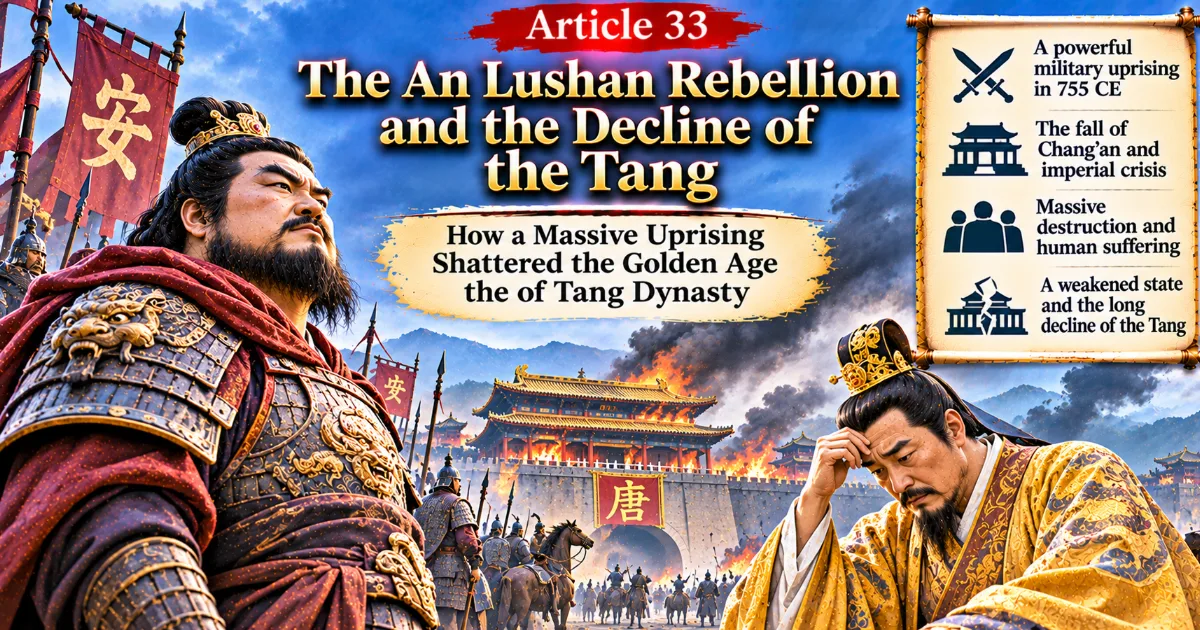
The prosperity of Chang'an suffered a major shock during the An Lushan Rebellion, which began in 755 CE.
An Lushan was a powerful military commander who controlled forces along the northeastern frontier. In 755 CE, he rebelled against the Tang government and launched a campaign that threatened the imperial capital.
The rebellion exposed weaknesses in the Tang military and administrative system. Regional commanders had accumulated considerable authority, and the central government struggled to control them.
As rebel forces advanced, Emperor Xuanzong and the imperial court fled from Chang'an in 756 CE.
The city fell into rebel hands and experienced political instability and disruption.
The rebellion continued for several years and caused enormous destruction. Population movements, agricultural disruption, military violence, and economic losses weakened the empire.
Tang forces eventually regained control of Chang'an, but the dynasty never fully recovered its earlier strength.
The rebellion changed the relationship between the central government and regional military authorities. Provincial commanders became more powerful, and the imperial court faced growing difficulties in controlling distant territories.
Chang'an remained the capital, but its position as the centre of a confident and expanding empire had been seriously weakened.
22. The Changing Character of Chang'an in the Late Tang Period
The late Tang period was marked by political instability, financial difficulties, military conflicts, and social unrest.
The central government increasingly depended on powerful regional military governors. These commanders controlled troops, taxation, and local administration, reducing the authority of the imperial court.
The capital continued to function as an important political and cultural centre, but its international character and commercial prosperity changed.
Some foreign communities became less prominent as the political environment shifted. Trade routes were affected by conflict and changes in regional power.
The government's financial difficulties also limited its ability to maintain the institutions that had supported the earlier prosperity of the capital.
Religious institutions experienced changing relationships with the state. In 845 CE, Emperor Wuzong launched a major persecution of Buddhism, ordering the closure of many monasteries and the confiscation of religious property. Although the policy was not limited to Chang'an, it had a major effect on the city's religious landscape.
The persecution demonstrated that the Tang government's relationship with religious institutions could change sharply according to political and financial priorities.
23. The Fall of the Tang Dynasty and the End of Imperial Chang'an
The Tang Dynasty formally ended in 907 CE, when the last emperor was removed by the military governor Zhu Wen, who established the Later Liang Dynasty.
The collapse followed decades of political fragmentation and rebellion.
One of the most important uprisings had been the Huang Chao Rebellion, which began in 874 CE and severely weakened the Tang state.
Rebel forces captured Chang'an in 880 CE, causing widespread destruction and disruption. The imperial government eventually regained the city, but its authority was increasingly fragile.
In the final years of the dynasty, the court became dependent on military commanders whose interests did not necessarily align with those of the imperial government.
When the Tang Dynasty ended, Chang'an lost its position as the principal capital of a unified Chinese empire.
Later dynasties established their capitals elsewhere, particularly in Luoyang, Kaifeng, and eventually Beijing.
The city continued to have regional importance, but the extraordinary international role it had enjoyed during the height of the Tang Dynasty did not return in the same form.
24. The Archaeological Legacy of Tang Chang'an
Modern archaeology has helped historians understand the scale and organisation of Tang Chang'an.
Excavations around present-day Xi'an have identified sections of city walls, palace foundations, streets, residential remains, tombs, workshops, and religious structures.
The Daming Palace archaeological site is especially important. Its remains provide evidence of the scale and organisation of the Tang imperial complex.
Archaeologists have also studied Tang tombs and their contents. Ceramic figurines, inscriptions, pottery, weapons, coins, and other objects reveal information about social life, international connections, clothing, military activity, and artistic production.
The discovery of foreign-style objects and inscriptions helps demonstrate the international character of Tang society.
Written records provide another important source of information. Official histories, literary works, religious texts, diplomatic accounts, and travel records allow researchers to reconstruct the political and cultural life of the city.
However, historical evidence must be interpreted carefully. Written accounts may reflect the interests of particular rulers or officials, while archaeological discoveries represent only part of the city's enormous historical landscape.
Combining different forms of evidence allows historians to develop a more detailed understanding of Chang'an.
25. Why Chang'an Was One of the Greatest Cities of the Medieval World
Chang'an deserves its reputation as one of the greatest cities of the medieval world because of the extraordinary combination of political, economic, cultural, and international features that defined it.
Its population was enormous by contemporary standards. Its urban layout was carefully planned, and its administrative institutions supported a sophisticated imperial government.
Its markets connected China with distant commercial networks. Its religious institutions brought together traditions from different parts of Asia. Its scholars and poets helped create one of the most celebrated literary cultures in Chinese history.
Its architecture communicated imperial authority, while its international communities demonstrated the reach of Tang diplomacy and trade.
Chang'an also influenced the development of other Asian capitals, particularly in Japan.
The city was therefore important not only because it was large or wealthy but because it helped shape political, cultural, and intellectual developments across a much wider region.
Its history demonstrates how urban centres can become powerful engines of civilisation.
Conclusion: Chang'an, the City That Connected Civilisations
Tang Chang'an was much more than an imperial capital. It was a city where the political power of China met the commercial networks of Eurasia, where Buddhist monks studied alongside Confucian scholars, where foreign merchants traded with Chinese businesses, and where artistic traditions from different regions influenced one another.
Its carefully planned streets and magnificent palaces expressed the authority of the Tang emperors. Its markets demonstrated the strength of international trade. Its temples and monasteries reflected the religious diversity of the age. Its poets, scholars, musicians, and artists contributed to a cultural legacy that continued long after the dynasty ended.
The An Lushan Rebellion and the later decline of the Tang government weakened Chang'an, while the fall of the dynasty in 907 CE ended its position as the capital of the empire. Yet its historical importance remained.
The city influenced the planning of other Asian capitals, contributed to the spread of religious and intellectual traditions, and became a lasting symbol of the Tang Dynasty's achievements.
Chang'an reminds us that the greatest cities are not defined only by their buildings, wealth, or population. They become historically significant when they connect people, ideas, economies, and cultures across geographical boundaries.
At the height of the Tang Dynasty, Chang'an was one of the clearest examples of such a city. It stood at the centre of a connected medieval world and remains one of the most remarkable urban achievements in Chinese history.
#HistoryOfChina #TangDynasty #ChangAn #SilkRoad #ChineseHistory