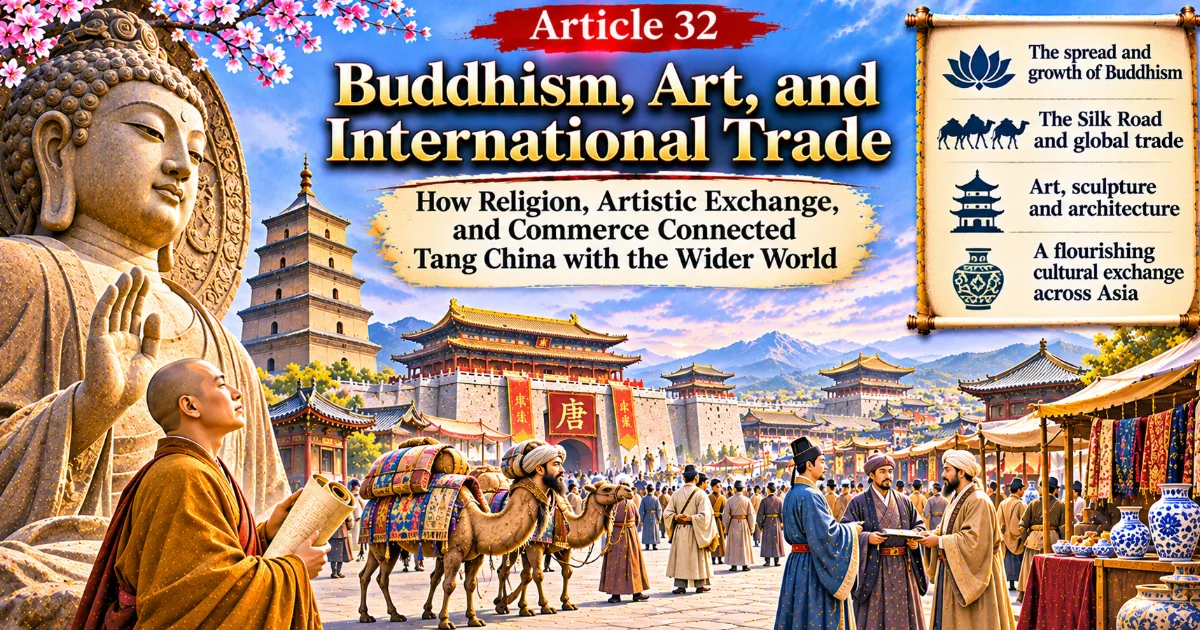
How Religion, Artistic Exchange, and Commerce Connected Tang China with the Wider World
The Tang Dynasty, which ruled China from 618 to 907 CE, witnessed an extraordinary expansion of cultural and commercial connections across Asia. Its political stability during much of the early and middle periods, powerful imperial institutions, prosperous cities, and extensive transportation networks helped transform China into one of the most influential centres of the medieval world. Among the forces that shaped this remarkable period, Buddhism, artistic exchange, and international trade played particularly important roles.
Buddhism had entered China centuries before the Tang Dynasty, travelling through Central Asian routes from the Indian subcontinent. By the seventh and eighth centuries, it had developed into a major religious and intellectual tradition. Monasteries, temples, scholars, translators, and pilgrims contributed to its growth, while imperial patronage helped establish important religious institutions. Buddhist ideas influenced philosophy, literature, sculpture, painting, architecture, education, and everyday cultural practices.
At the same time, Tang China became deeply connected with international commercial networks. The Silk Road linked Chinese cities with Central Asia, India, Persia, and regions farther west. Maritime trade connected southern Chinese ports with Southeast Asia, the Indian Ocean, and the Middle East. Merchants carried silk, ceramics, spices, horses, precious stones, textiles, and other valuable products across these routes.
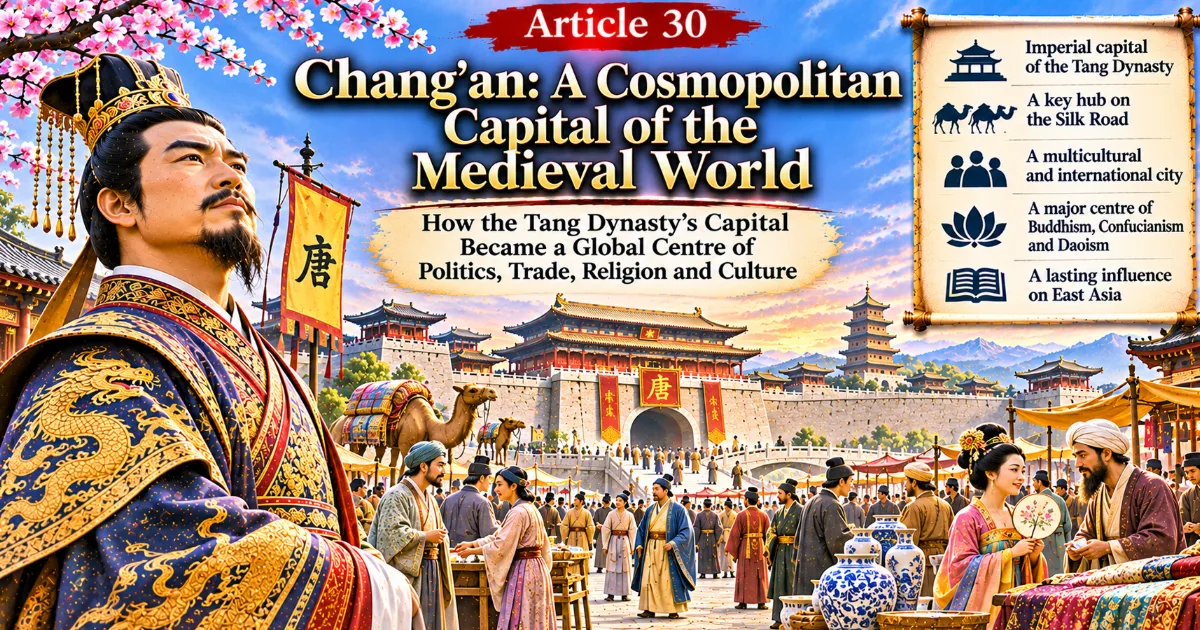
Trade did more than move goods. It brought people, technologies, artistic styles, languages, religious beliefs, and scientific knowledge into contact. Foreign merchants and religious communities established themselves in Chinese cities, while Chinese products and cultural traditions travelled abroad. Chang'an, the Tang capital, became a particularly important meeting place for these exchanges.
Continue Reading
The relationship between Buddhism, art, and international trade was especially significant. Buddhist monks travelled along commercial routes, merchants supported religious institutions, and artistic traditions moved between regions. Trade helped finance cultural activity, while religious networks created connections between communities separated by enormous distances.
This article explores how these developments shaped Tang China, how international influences transformed its artistic traditions, and why the period remains one of the most important chapters in the history of cultural exchange across Asia.
1. The Arrival of Buddhism in China
Buddhism originated in northern India during the first millennium BCE. Its teachings were based on the ideas associated with Siddhartha Gautama, known as the Buddha. These teachings addressed suffering, desire, ethical conduct, meditation, and the possibility of liberation from the cycle of rebirth.
Buddhism gradually spread beyond the Indian subcontinent through missionaries, merchants, monks, and political patrons. Central Asia became an important region through which Buddhist ideas travelled towards China.
The transmission of Buddhism into China was not a single event. It developed over several centuries through multiple routes and communities. Merchants travelling between India, Central Asia, and Chinese territories helped establish contacts, while monks carried religious texts and teachings between different centres.
Early Buddhist communities appeared in China during the first centuries CE. Translation became essential because Buddhist teachings were originally preserved in languages such as Sanskrit and various forms of Prakrit. Chinese scholars and foreign monks worked together to translate these texts into Chinese.
By the time the Tang Dynasty was established in 618 CE, Buddhism had become a deeply influential religious tradition within Chinese society. It possessed monasteries, scholars, devotional communities, artistic institutions, and established philosophical schools.
The Tang period did not introduce Buddhism to China, but it witnessed major developments in its organisation, intellectual influence, and artistic expression.
2. The Silk Road as a Route for Religious Exchange
The Silk Road was a complex network of commercial and cultural routes connecting China with Central Asia and regions farther west. It included desert passages, mountain routes, oasis settlements, trading cities, and regional transportation systems.
Buddhism benefited enormously from these connections.
Monks travelled with merchant caravans, carrying religious manuscripts and teachings. Some travelled from India towards China, while others moved between Buddhist centres in Central Asia. Merchants sometimes supported monasteries by providing donations, accommodation, or transportation.
Important Central Asian centres such as Kucha, Khotan, and Dunhuang became major locations for Buddhist activity. These places connected Chinese territories with religious communities farther west.
Dunhuang was particularly significant because of its position near routes leading towards the western regions. Its Buddhist cave temples and manuscripts provide extraordinary evidence of the movement of religious ideas and artistic traditions.
The Silk Road was therefore not simply a route for silk and luxury goods. It was also a corridor through which philosophical ideas, religious practices, artistic techniques, and written knowledge travelled.
Buddhism's expansion across Asia demonstrates how commercial networks could facilitate cultural transformation. The movement of merchants created opportunities for monks, teachers, translators, and artists to travel across political and geographical boundaries.
3. Xuanzang and the Search for Buddhist Knowledge
One of the most famous Buddhist figures of the Tang Dynasty was Xuanzang, a Chinese monk whose journey to India became an important event in the history of Asian religious exchange.
Born around 602 CE, Xuanzang became deeply interested in Buddhist philosophy. He studied existing Chinese translations but found that some important doctrines remained unclear or contradictory.
He decided to travel to India to obtain more authoritative Buddhist texts and study with respected teachers.
Around 629 CE, Xuanzang began his journey westward despite restrictions on foreign travel. He crossed difficult landscapes, passed through Central Asian territories, and eventually reached the Indian subcontinent.
During his travels, he visited major Buddhist centres and studied at Nalanda, one of the most important centres of Buddhist learning in ancient India.
Xuanzang spent years studying Buddhist philosophy, discussing religious doctrines, and collecting manuscripts. His experiences gave him a deeper understanding of the diversity of Buddhist traditions across India.
He returned to China in 645 CE with a large collection of Buddhist texts and received an important welcome from the Tang court.
The emperor supported his translation activities, and Xuanzang established a major centre for translating Buddhist scriptures in Chang'an.
His work strengthened the intellectual foundations of Chinese Buddhism and created an important historical record of the regions through which he travelled.
4. The Translation Movement and the Growth of Buddhist Scholarship
Translation was one of the most important activities supporting the development of Buddhism in Tang China.
Buddhist scriptures contained complex philosophical ideas, religious terminology, meditation practices, and descriptions of monastic discipline. Translating them into Chinese required more than replacing words from one language with another.
Translators had to explain concepts that did not always have direct equivalents in Chinese intellectual traditions. They also needed to decide how to communicate ideas in ways that Chinese readers could understand.
Xuanzang became particularly famous for his translation work. He helped introduce more precise translations of important Buddhist philosophical texts and contributed to the development of the Faxiang tradition in China.
Other translators also made major contributions. Their work helped establish different Buddhist schools and encouraged debate about the nature of consciousness, enlightenment, ethics, and the relationship between religious practice and everyday life.
Translation centres were often associated with monasteries and imperial patronage. Scholars, monks, scribes, and assistants worked together to produce manuscripts that could be studied and copied.
These activities made Chang'an an important centre of international religious scholarship.
The translation movement also demonstrates that cultural exchange required active intellectual cooperation. Foreign ideas were not simply imported unchanged. They were interpreted, debated, translated, and adapted within Chinese society.
5. Buddhist Monasteries as Centres of Learning and Society
During the Tang Dynasty, Buddhist monasteries became important institutions across China.
They served as places of worship, meditation, education, manuscript preservation, artistic production, and charitable activity.
Some monasteries possessed extensive libraries containing Buddhist scriptures and other scholarly works. Monks studied philosophy, translated texts, copied manuscripts, and taught religious doctrines.
Monasteries also provided accommodation for travelling monks and pilgrims. In some locations, they supported travellers moving through difficult routes and helped maintain connections between distant Buddhist communities.
Their influence extended beyond religious practice. Monastic institutions could own land, receive donations, employ workers, commission artworks, and participate in local economic activity.
Wealthy families and government officials sometimes donated property or money to monasteries in the hope of gaining religious merit or supporting charitable works.
Monasteries could also provide food, shelter, education, and assistance to people in need.
However, their growing economic influence sometimes created tensions with the imperial government. Religious institutions accumulated wealth and resources, while the state depended on taxation and administrative control.
These tensions became particularly important during periods when rulers sought to regulate monastic property and religious institutions.
6. The Relationship Between Buddhism and Tang Emperors
The Tang emperors had a complex relationship with Buddhism.
Some rulers supported Buddhist institutions because of their religious influence, social importance, and contribution to imperial prestige. Others were more cautious because of concerns about monastic wealth, taxation, and the growing independence of religious organisations.
Emperor Taizong supported aspects of Buddhist scholarship and welcomed Xuanzang after his return from India. Although the emperor did not simply adopt Buddhism as the exclusive state religion, his court recognised the importance of religious scholarship and international exchange.
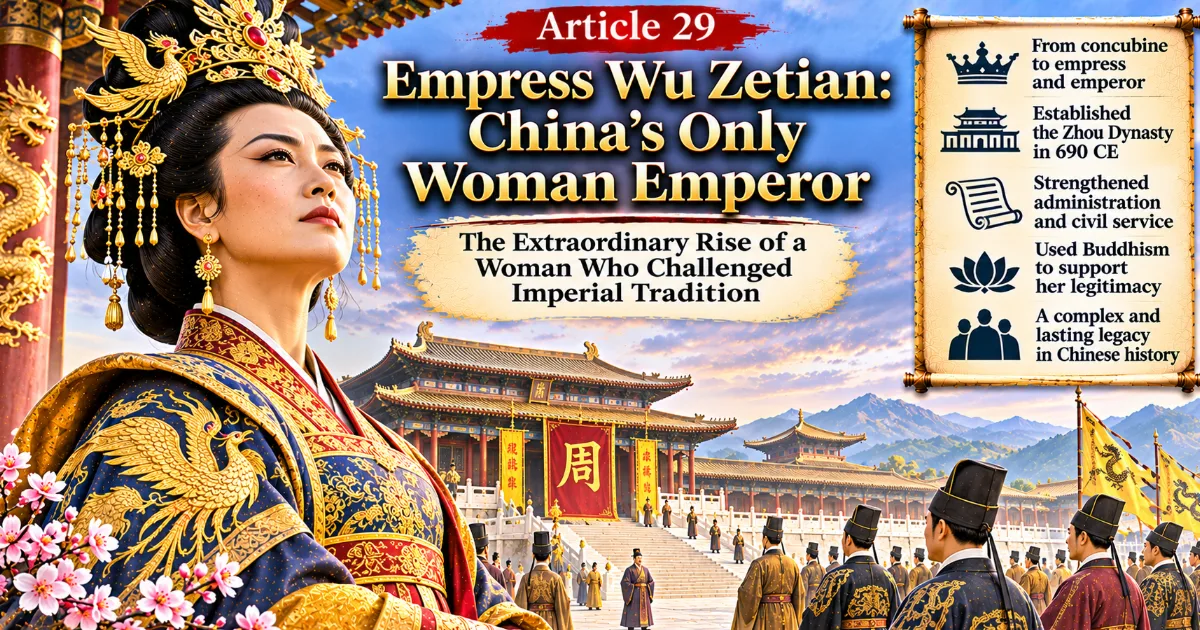
Empress Wu Zetian also used Buddhist ideas and institutions to strengthen her political legitimacy. During her reign, Buddhist texts and religious interpretations were employed to support her position as ruler.
Later Tang emperors continued to provide varying levels of support.
This relationship demonstrates that religion and politics were closely connected. Buddhist institutions could provide moral authority, educational services, and social support, while imperial patronage gave monasteries resources and protection.
However, political support was never guaranteed. When rulers believed that religious institutions threatened state interests, they could impose restrictions or take action against them.
7. Buddhist Art and the Transformation of Chinese Sculpture
Buddhism had a profound influence on Chinese sculpture during the Tang Dynasty.
Buddhist images were used in temples, monasteries, caves, shrines, and private religious spaces. Sculptors created representations of the Buddha, bodhisattvas, guardians, disciples, and other religious figures.
Earlier Chinese Buddhist sculpture had been influenced by artistic traditions from Gandhara, Central Asia, and other regions. Over time, these foreign influences were adapted to Chinese aesthetic preferences.
During the Tang period, Buddhist sculpture developed a distinctive style characterised by balanced proportions, graceful forms, expressive faces, elaborate garments, and a sense of physical presence.
The figures often appeared more naturalistic than some earlier examples. Their poses and clothing demonstrated the technical abilities of Tang sculptors.
Large-scale religious sculptures required extensive resources. Projects could involve stoneworkers, painters, architects, donors, religious officials, and government representatives.
The creation of Buddhist art was therefore a collective undertaking that connected religious belief with economic resources and artistic skill.
8. The Mogao Caves of Dunhuang
The Mogao Caves near Dunhuang represent one of the most remarkable achievements of Buddhist art in China.
The cave complex developed over many centuries, beginning long before the Tang Dynasty. However, the Tang period was particularly important in its artistic and religious history.
The caves contain Buddhist sculptures, wall paintings, inscriptions, and manuscripts. Their decoration reflects the interaction of Chinese, Central Asian, and Indian artistic traditions.
The paintings depict Buddhist stories, celestial figures, religious ceremonies, donors, landscapes, and scenes from the life of the Buddha.
They also provide evidence of everyday life and international connections. Images of merchants, travellers, clothing, musical instruments, and architectural forms reveal the cultural diversity of the Silk Road.
The caves were supported by religious communities, wealthy donors, local officials, and merchants.
Their artistic development demonstrates that Buddhist centres were not isolated from commercial life. They depended on donations, materials, skilled labour, and the movement of people.
The Mogao Caves remain one of the most important sources for understanding the artistic and cultural history of medieval Asia.
9. Buddhist Painting and the Development of Religious Imagery
Painting became an important medium for communicating Buddhist teachings.
Religious images helped people understand stories, philosophical concepts, and devotional practices. Paintings could depict the Buddha, bodhisattvas, heavenly beings, sacred landscapes, and scenes from Buddhist scriptures.
Artists used colour, composition, gesture, and symbolic objects to communicate religious meaning.
The development of Buddhist painting involved influences from different regions. Indian and Central Asian traditions contributed to the visual language of Buddhist art, while Chinese artists adapted these elements to local styles.
Tang Buddhist painting often displayed sophisticated compositions and rich decorative detail.
Large murals covered the walls of caves and temples, creating immersive religious environments. Smaller paintings and illustrated manuscripts also circulated among religious communities.
Painting helped make Buddhist ideas accessible to people who might not have been able to read complex philosophical texts.
It also created a visual record of the interaction between religious belief and artistic innovation.
10. Architecture and the Expansion of Buddhist Temples
Buddhist architecture became an important feature of Tang urban and rural landscapes.
Temples and monasteries were constructed in cities, mountain regions, pilgrimage destinations, and along important travel routes.
Their architecture combined Chinese building traditions with influences from the wider Buddhist world.
Pagodas became particularly recognisable features of Buddhist architecture. Their origins were connected with Indian stupas, structures associated with the preservation of Buddhist relics.
As Buddhism spread into China, the stupa tradition was transformed into new architectural forms, including multi-storeyed pagodas.
Tang pagodas were built using different materials and techniques. Some were constructed with brick, while others incorporated wooden structures.
The Giant Wild Goose Pagoda in Chang'an is one of the most famous surviving examples associated with the Tang period. It was originally constructed in 652 CE under the patronage of Emperor Gaozong to preserve Buddhist scriptures brought back by Xuanzang.
The pagoda became an important religious and architectural landmark.
Buddhist buildings also influenced the development of painting, sculpture, decorative arts, and urban landscapes.
11. The Spread of Buddhism to Korea and Japan
Tang China played a major role in the transmission of Buddhism across East Asia.
Korean kingdoms had established Buddhist traditions before the Tang period, but connections with China strengthened religious scholarship, artistic development, and institutional organisation.
Monks travelled between China and the Korean Peninsula, carrying scriptures and exchanging ideas. Korean Buddhist communities also contributed to the wider religious networks of East Asia.
Japan experienced particularly important exchanges with Tang China.
Japanese missions travelled to the Tang capital to study religion, government, literature, and architecture. Monks visited Chinese monasteries, studied Buddhist doctrines, and brought religious texts back to Japan.
These connections helped shape Japanese Buddhist traditions and influenced temple architecture, sculpture, painting, and monastic organisation.
The movement of Buddhist ideas across East Asia demonstrates that Tang China was not merely receiving foreign influences. It also became a major centre from which religious and cultural traditions spread to neighbouring societies.
12. The Development of Tang Painting and Artistic Innovation
Although Buddhism was a major influence, Tang artistic achievements extended far beyond religious subjects.
Painting developed in several directions, including landscape art, figure painting, court portraiture, decorative painting, and religious murals.
Court artists created portraits of emperors, officials, and members of the imperial family. These works helped communicate political authority and preserve images of important individuals.
Figure painting became particularly sophisticated. Artists developed techniques for representing clothing, movement, facial expression, and social identity.
Landscape painting also evolved, reflecting philosophical and aesthetic interests in the natural world.
Buddhist painting influenced the development of figure composition, colour use, and the representation of spiritual figures.
The artistic environment of the Tang period was also shaped by international exchange. Foreign clothing, musical instruments, animals, and decorative patterns appeared in artworks.
Tang art therefore reflects a society that combined inherited Chinese traditions with influences from across Eurasia.
13. Tang Ceramics and the International Market
Ceramics were among the most important artistic and commercial products of Tang China.
Tang potters developed a wide range of ceramic forms, including storage vessels, bowls, figurines, architectural ornaments, and burial objects.
One particularly famous tradition was sancai, meaning three-colour glazed pottery.
Sancai ceramics commonly used green, amber, and cream glazes, although other colours could also appear. These objects were often created for elite tombs and included figures of horses, camels, musicians, servants, and foreign visitors.
The figurines provide valuable evidence of Tang society and international connections.
Ceramic production also became increasingly important to commercial exchange. Chinese pottery travelled through overland and maritime trade networks, reaching markets in different parts of Asia.
Tang ceramics contributed to the development of China's international reputation for high-quality manufactured goods.
Their commercial success also encouraged the growth of specialised workshops, skilled labour, and regional production centres.
14. Silk Production and the Wealth of Tang China
Silk remained one of China's most valuable products during the Tang Dynasty.
The production of silk involved several stages, including raising silkworms, collecting cocoons, extracting silk fibres, spinning thread, weaving fabric, dyeing, and decoration.
The process required specialised knowledge and considerable labour.
Chinese silk was highly valued in international markets because of its quality, appearance, and association with prestige.
It was used for clothing, ceremonial garments, furnishings, religious objects, and diplomatic gifts.
Silk also had economic importance within the Tang Empire. It could be used in taxation, official payments, military supplies, and commercial transactions.
The Silk Road became closely associated with the movement of this valuable product, although many other goods were also traded along the same routes.
Silk production connected agriculture, craftsmanship, state administration, and international commerce.
It was therefore both an important industry and a symbol of China's economic and cultural influence.
15. The Role of Sogdian Merchants
Among the foreign communities involved in Tang trade, the Sogdians were especially important.
Sogdiana was a region of Central Asia associated with major trading centres such as Samarkand and Bukhara.
Sogdian merchants developed extensive commercial networks connecting Central Asia with China and other regions.
They traded silk, horses, textiles, precious metals, glassware, spices, and other valuable goods.
Their communities helped organise commercial exchanges across long distances. They often possessed knowledge of several languages and maintained connections with merchants in different cities.
Some Sogdians settled in Chinese territories and established commercial or military relationships with local authorities.
Their cultural influence can be seen in Tang tomb figurines, paintings, clothing styles, musical traditions, and religious practices.
Sogdian merchants also helped transmit religious traditions, including forms of Buddhism, Zoroastrianism, and Manichaeism.
Their role demonstrates how international trade depended on communities that could connect different commercial and cultural environments.
16. The Maritime Silk Road and Southern Chinese Ports
Although the overland Silk Road received considerable attention, maritime trade became increasingly important during the Tang Dynasty.
Chinese ports connected the empire with Southeast Asia, South Asia, and the wider Indian Ocean world.
Guangzhou became one of the most important international trading ports. Merchants from different regions visited the city to exchange goods and establish commercial relationships.
Ships carried Chinese silk, ceramics, metal products, and other manufactured goods. In return, traders brought spices, aromatic woods, precious stones, ivory, medicines, and other commodities.
Maritime trade depended on knowledge of monsoon winds, navigation, shipbuilding, coastal geography, and port administration.
The Indian Ocean trading system connected ports across a vast geographical area. Arab, Persian, Indian, Southeast Asian, and Chinese merchants participated in different parts of this network.
These commercial connections strengthened China's international position and helped southern port cities become important centres of economic activity.
The maritime Silk Road complemented the overland routes and expanded the geographical reach of Tang commerce.
17. Foreign Communities in Tang China
International trade encouraged the settlement of foreign communities in Chinese cities.
Chang'an and Guangzhou contained merchants, religious figures, travellers, and other residents from different regions.
These communities established commercial relationships, religious institutions, and social networks.
Foreign merchants sometimes lived in designated areas and maintained connections with people from their home regions. Their presence helped facilitate trade because they understood the languages, customs, and commercial practices of distant markets.
The cultural influence of these communities extended into food, clothing, music, religious life, and artistic production.
However, the experience of foreign residents varied. Their legal status and opportunities depended on their occupation, wealth, political circumstances, and relationships with local authorities.
The presence of international communities did not mean that all cultural differences disappeared. Instead, Tang China developed a complex environment in which exchange and adaptation occurred alongside social distinctions and political regulation.
18. Music and Dance from Central Asia
International trade also influenced Tang music and dance.
Central Asian musicians and performers introduced instruments, rhythms, and performance styles that became popular among sections of Chinese society.
The pipa, a pear-shaped string instrument, became especially important in Tang musical culture. Its history involved a long process of development and exchange across Eurasia.
Other instruments, including flutes, drums, and stringed instruments, contributed to the diversity of Tang performance traditions.
Foreign dance styles became fashionable in aristocratic circles and at the imperial court.
These performances were sometimes associated with Central Asian clothing and musical arrangements, creating artistic experiences that reflected the international character of Tang society.
Music was performed during court ceremonies, private gatherings, festivals, and religious events.
The exchange of musical traditions demonstrates that international cultural influence was not limited to written texts or religious institutions. It also transformed entertainment and everyday social life.
19. Science, Medicine, and the Movement of Knowledge
Trade and religious travel helped facilitate the movement of scientific and medical knowledge.
Merchants carried medicinal plants, minerals, and other substances used in different healing traditions.
Monks and scholars travelled with knowledge of astronomy, mathematics, medicine, and philosophy.
Chinese medicine continued to develop through its own intellectual traditions, while contact with foreign communities introduced additional substances and practices.
The Tang government supported medical institutions and the compilation of medical texts. Physicians studied herbal knowledge, diagnosis, treatment methods, and medical theory.
Buddhist monasteries also contributed to the preservation and circulation of knowledge. Their libraries contained religious and scholarly materials, while travelling monks brought texts between different regions.
Astronomical knowledge and calendar-making were particularly important to imperial government. Accurate calendars supported agriculture, administration, and religious ceremonies.
These exchanges did not always produce immediate scientific breakthroughs, but they contributed to the wider movement of knowledge across Asia.
20. The Economic Importance of International Trade
International trade contributed to the prosperity of Tang China in several ways.
It created demand for Chinese products, encouraged specialised manufacturing, supported commercial cities, and generated revenue through taxation and official regulation.
The export of silk, ceramics, metal products, and other goods strengthened China's position in regional markets.
Imports brought valuable materials and products that were not widely available within China.
Trade also encouraged improvements in transportation, storage, financial arrangements, and commercial organisation.
The growth of urban markets supported merchants, craftsmen, transport workers, warehouse operators, and other occupations.
International commerce was not the only foundation of Tang prosperity. Agriculture remained the most important economic sector, and domestic trade connected regions within the empire.
However, international trade added another dimension to the economy and helped make Tang China an important participant in a connected Eurasian world.
21. Religion, Trade, and the Exchange of Artistic Ideas
Buddhism, art, and international trade were closely connected.
Commercial routes allowed Buddhist monks and artists to travel between different regions. Merchants sometimes supported religious institutions, while monasteries provided places of accommodation and learning.
The movement of religious communities helped artistic styles circulate. Sculptors, painters, architects, and craftsmen encountered new techniques and visual traditions.
Indian Buddhist art influenced the representation of religious figures in Central Asia and China. Central Asian styles also contributed to the development of Chinese Buddhist sculpture and painting.
Chinese artists adapted these influences to local traditions, creating distinctive forms of religious expression.
The result was not simply the replacement of Chinese art by foreign styles. Instead, artistic exchange produced new combinations of techniques, materials, symbols, and aesthetic preferences.
This process demonstrates that cultural creativity often develops through contact between different traditions.
22. Religious Diversity Beyond Buddhism
Tang China was home to several religious traditions that arrived through international connections.
Zoroastrianism, Manichaeism, and Christianity associated with the Church of the East were present in some Chinese cities.
These traditions were carried by merchants, missionaries, and religious communities travelling through Central Asian and maritime networks.
The Xi'an Stele, erected in 781 CE, provides important evidence of the Christian presence in Tang China. It records the arrival and activities of Christian missionaries and describes aspects of their religious teachings.
Manichaean communities also established a presence in China, while Zoroastrian traditions were associated with some Central Asian communities.
These religions did not enjoy the same political status or social influence as established Chinese traditions. Nevertheless, their presence demonstrates the extent of Tang China's international connections.
The city of Chang'an was especially important because it brought together people from different religious backgrounds within a major imperial environment.
23. The Great Persecution of Buddhism in 845 CE
Despite centuries of growth, Buddhism experienced a major crisis during the reign of Emperor Wuzong.
In 845 CE, the emperor launched a large-scale campaign against Buddhist institutions.
The government ordered the closure of many monasteries, confiscated religious property, and forced numerous monks and nuns to return to secular life.
The campaign was motivated by several factors, including concerns about monastic wealth, the loss of taxable labour, and the financial pressures facing the imperial state.
Some officials also criticised the growing influence of religious institutions and their perceived separation from ordinary economic responsibilities.
The persecution had a major impact on Buddhism in China. Monasteries lost property, religious communities were disrupted, and many temples were damaged or closed.
Other foreign religious traditions also experienced restrictions.
The campaign did not eliminate Buddhism from China. The religion survived through established communities, regional support, and later periods of revival.
The persecution demonstrates that the relationship between religion and the state could become unstable when political and economic interests came into conflict.
24. The Decline of Tang International Influence
The Tang Dynasty experienced increasing political difficulties during the later centuries of its rule.
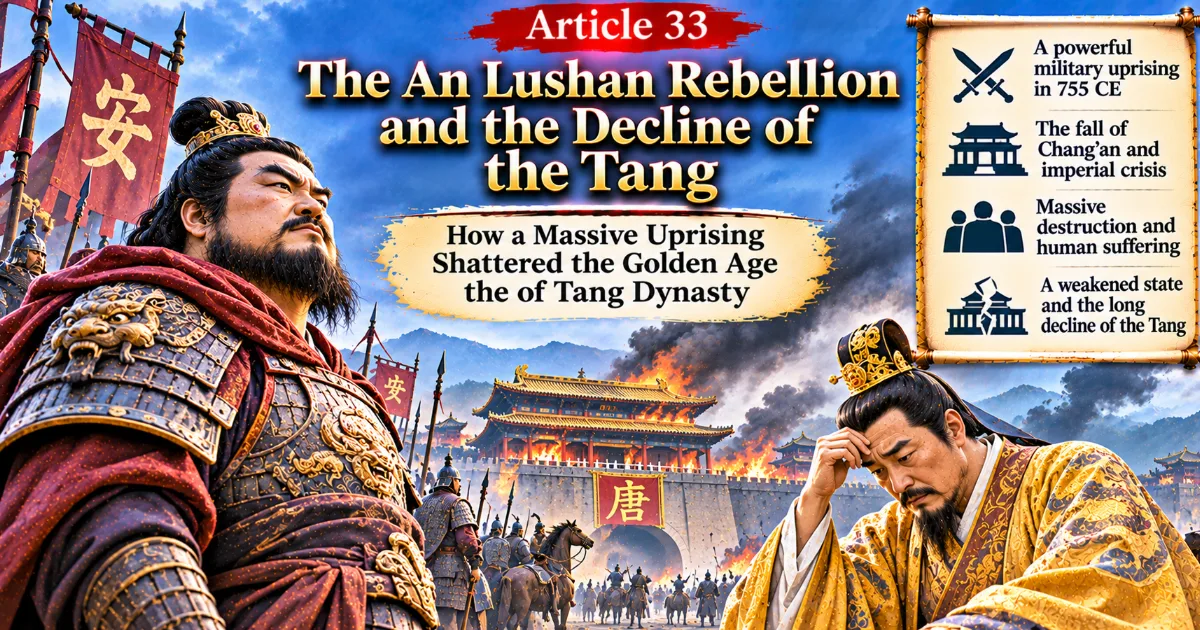
The An Lushan Rebellion, which began in 755 CE, weakened central authority and caused enormous destruction.
Military governors became more powerful, financial resources declined, and the government struggled to maintain control over distant territories.
These developments affected international trade and cultural exchange.
Political instability disrupted commercial routes, reduced the security of some trading regions, and weakened the ability of the imperial government to support international relationships.
The Tang court also faced changing conditions in Central Asia, where other political powers became increasingly influential.
The decline was gradual rather than immediate. Trade and cultural exchange continued, but the political environment that had supported the earlier prosperity of the Tang Empire became increasingly fragile.
The dynasty eventually ended in 907 CE, bringing an end to one of the most important periods in Chinese imperial history.
25. The Lasting Legacy of Tang Buddhism, Art, and Trade
The achievements of the Tang period continued to influence China and neighbouring societies long after the dynasty ended.
Buddhist institutions remained important in Chinese religious and cultural life. Temples, scriptures, philosophical traditions, and artistic works preserved the legacy of Tang religious scholarship.
Tang Buddhist sculpture and painting influenced later generations of artists. The artistic achievements of Dunhuang and other religious centres became important historical records of cultural exchange.
Chinese ceramics and silk continued to be valued in international markets. The commercial networks developed during the Tang period contributed to the long-term importance of Chinese manufactured goods.
The movement of Buddhist ideas also shaped religious traditions in Korea and Japan.
The influence of Tang culture can be seen in East Asian architecture, literature, religious institutions, government practices, and artistic traditions.
Its international importance demonstrates that the development of a civilisation depends not only on its internal achievements but also on its connections with other societies.
Conclusion: A Civilisation Connected Through Faith, Creativity, and Commerce
The Tang Dynasty became one of the most influential periods in Chinese history because it combined political strength, economic prosperity, artistic achievement, and international exchange.
Buddhism connected China with India and Central Asia, creating networks of monks, scholars, translators, and religious institutions. Figures such as Xuanzang strengthened intellectual relationships between China and the Indian subcontinent.
Buddhist art transformed sculpture, painting, architecture, and religious expression. The Mogao Caves, Giant Wild Goose Pagoda, and countless other monuments demonstrate the artistic achievements of the period.
International trade connected Chinese cities with distant markets through both overland and maritime routes. Silk, ceramics, spices, horses, precious stones, and other goods moved across Asia, while merchants and travellers carried ideas, technologies, and cultural traditions.
These developments were not separate. Religious institutions benefited from commercial networks, merchants supported artistic and religious projects, and cultural exchange helped create new forms of creativity.
The Tang Dynasty also demonstrates that international openness was not without challenges. Political instability, economic pressures, and changing imperial policies affected religious institutions and commercial activity. The persecution of Buddhism in 845 CE and the weakening of the central government reveal the complex relationship between cultural institutions and political power.
Nevertheless, the achievements of the Tang period left a lasting mark on Chinese and Asian history.
The story of Buddhism, art, and international trade during the Tang Dynasty is ultimately a story of connection. It shows how people, beliefs, objects, and ideas travelled across borders and transformed the societies they encountered.
The Tang Empire was powerful because of its institutions and military strength, but its cultural greatness also came from its ability to participate in a wider world. Through faith, creativity, and commerce, Tang China became one of the most remarkable centres of civilisation in the medieval era.
#HistoryOfChina #TangDynasty #Buddhism #SilkRoad #ChineseArt