The Poets Who Transformed Chinese Literature During the Tang Dynasty
The Tang Dynasty is widely remembered as one of the greatest periods in Chinese history. Its emperors governed an extensive empire, its capital Chang'an became an international centre of commerce and culture, and its achievements in art, architecture, religion, technology, and administration influenced societies across Asia. Yet among the dynasty's most enduring contributions, few have been as influential as its poetry.
Tang poetry represents one of the highest achievements of classical Chinese literature. It brought together philosophical reflection, personal emotion, political criticism, descriptions of nature, historical memory, friendship, love, war, and everyday experience. Poets developed sophisticated forms of expression, experimented with rhythm and imagery, and created works that continued to be studied and admired for centuries.
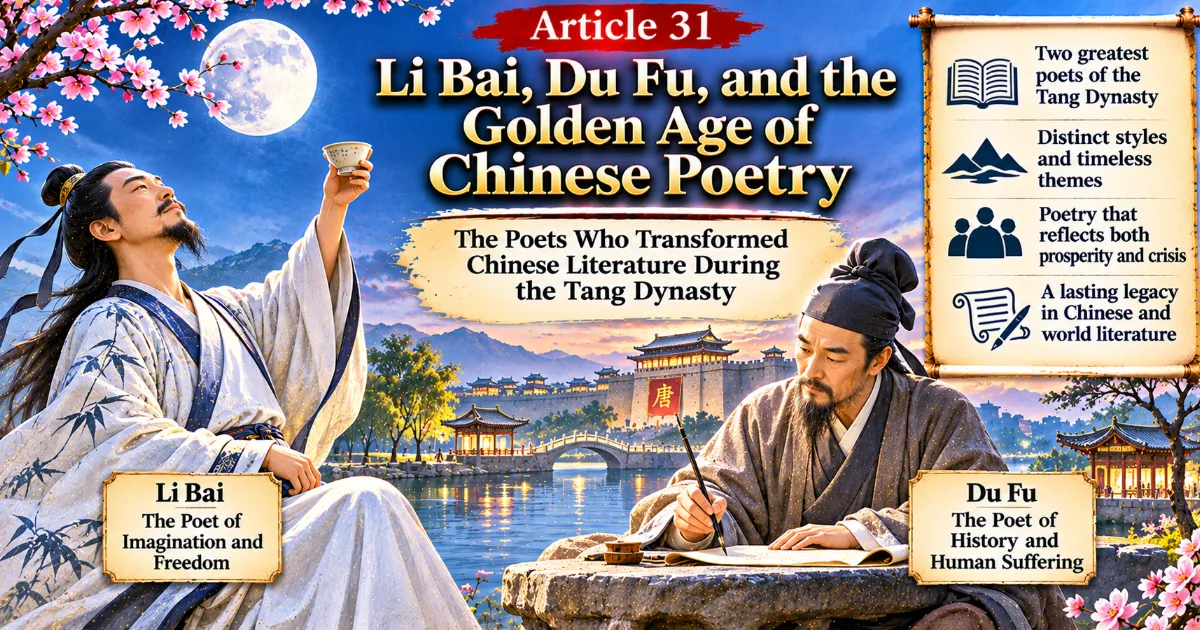
Among the hundreds of talented poets associated with the Tang period, two figures became especially celebrated: Li Bai and Du Fu. They lived during the eighth century and experienced an era of extraordinary cultural achievement as well as devastating political upheaval. Although their personalities, literary styles, and experiences were very different, both transformed Chinese poetry.
Li Bai became famous for his imagination, emotional intensity, love of nature, celebration of friendship, and fascination with wine, freedom, and Daoist thought. His poetry often appears spontaneous and expansive, creating vivid images of mountains, rivers, moonlight, and distant journeys.
Continue Reading
Du Fu developed a more reflective and socially conscious style. His poetry examined war, poverty, government failures, family separation, political responsibility, and the suffering of ordinary people. His writing combined technical sophistication with a profound awareness of human experience.
Their lives overlapped with the reign of Emperor Xuanzong, the flourishing of Chang'an, and the catastrophic An Lushan Rebellion. Their poetry therefore provides an extraordinary literary record of both the prosperity and the crisis of the Tang world.
Understanding Li Bai and Du Fu also means understanding the broader development of Chinese poetry. Their achievements were built upon centuries of literary tradition, yet they gave that tradition new depth, range, and emotional power.
1. Chinese Poetry Before the Tang Dynasty
Chinese poetry had a long and sophisticated history before the Tang Dynasty began in 618 CE.
One of the earliest major collections was the Book of Songs, traditionally known as the Shijing. It contains poems and songs associated with different regions and social settings of ancient China. Its subjects include court ceremonies, agriculture, love, marriage, political criticism, warfare, and ordinary life.
The collection became one of the foundational texts of Confucian education. Its poems were studied not only as literature but also as sources of moral reflection and social understanding.
During the Han Dynasty, poetry developed through several forms, including the yuefu, or Music Bureau tradition. These works often drew upon folk songs and explored everyday experiences, military campaigns, separation, hardship, and social conditions.
The period of division that followed the Han Dynasty also produced important literary developments. Poets experimented with landscape descriptions, personal expression, philosophical reflection, and more elaborate patterns of language.
During the Six Dynasties period, literary culture became increasingly sophisticated. Scholars developed ideas about poetic technique, parallelism, tonal patterns, and the relationship between sound and meaning.
The Sui Dynasty reunified China in 581 CE, creating the political foundations upon which the Tang literary world would later develop.
By the beginning of the Tang Dynasty, Chinese poetry already possessed a rich inheritance. Tang poets did not create the tradition from nothing. They refined existing forms, expanded literary subjects, and developed new ways of expressing personal and historical experience.
2. Why the Tang Dynasty Became the Golden Age of Poetry
Several factors contributed to the extraordinary development of poetry during the Tang Dynasty.
Political stability during much of the early and middle Tang period created favourable conditions for education, literary production, and cultural exchange. The imperial court supported scholars and poets, while government institutions encouraged the study of classical literature.
The civil service examination system also strengthened the importance of literary ability. Candidates seeking official positions needed to demonstrate knowledge of classical texts and competence in composition. Poetry became an important element of elite education and intellectual culture.
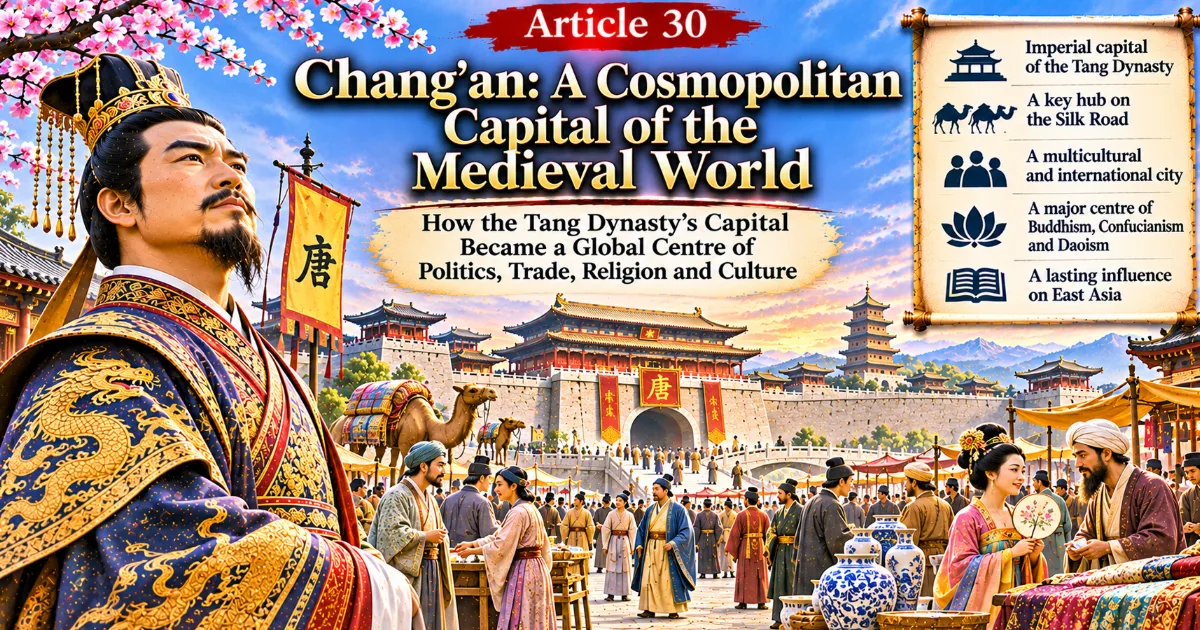
The growth of cities such as Chang'an and Luoyang brought scholars, officials, merchants, religious figures, and artists into contact. These urban centres encouraged literary exchange and created opportunities for poets to share their work.
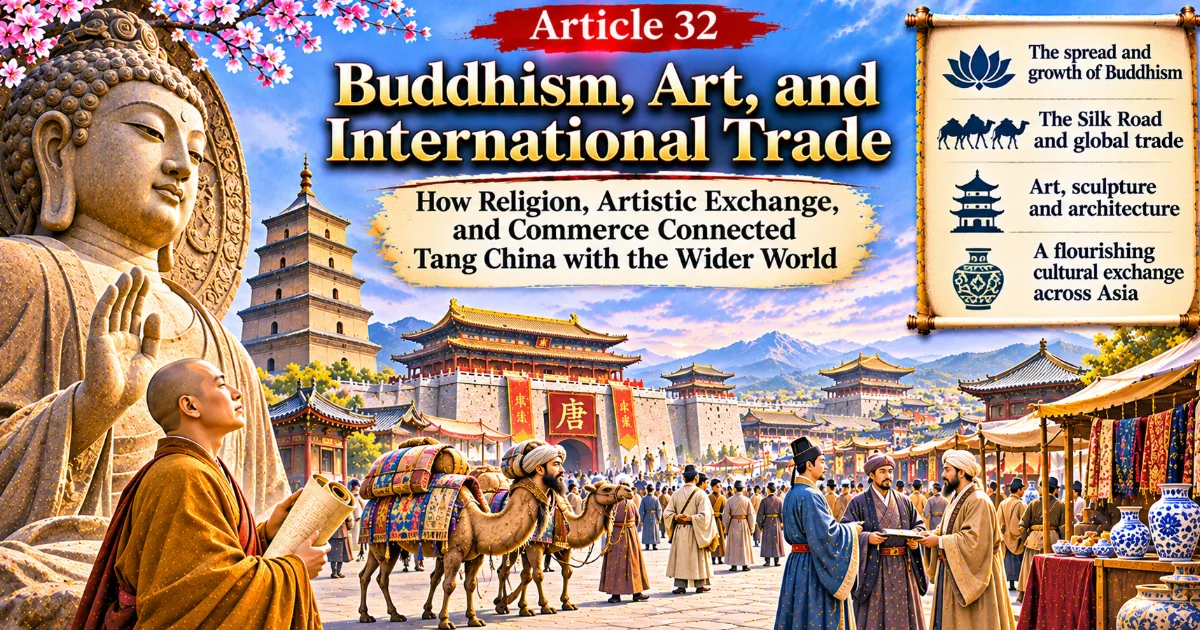
The Tang Empire's international connections also enriched its cultural environment. Central Asian music, foreign instruments, Buddhist ideas, and artistic traditions influenced the broader world of Tang literature and performance.
The development of paper production and book culture helped written works circulate. Manuscripts could be copied, collected, and preserved, allowing poetry to reach readers beyond the immediate circles of individual poets.
The imperial court also valued literary talent. Some poets received official appointments, participated in court ceremonies, or gained recognition through their writing.
However, Tang poetry was not limited to the elite. Many poems explored the lives of farmers, soldiers, travellers, servants, and ordinary families. This ability to combine sophisticated literary technique with subjects from everyday life became one of the tradition's greatest strengths.
3. The Development of Classical Tang Poetic Forms
Tang poets worked within several established literary forms, but the period became particularly famous for the refinement of regulated verse.
One important form was jueju, commonly translated as truncated verse or quatrain. It generally consisted of four lines, often with five or seven characters per line. Because of its brevity, each image and word carried considerable importance.
Another major form was lüshi, or regulated verse. It usually contained eight lines, with five or seven characters per line. Regulated verse required careful attention to tonal patterns, rhyme, and parallelism.
Parallelism was particularly important in the middle couplets. The two lines were constructed to correspond in grammatical structure and meaning, creating a balanced relationship between images and ideas.
Poets also used gushi, or ancient-style poetry. This form allowed greater flexibility in line structure, rhythm, and composition than regulated verse.
The technical requirements of Tang poetry encouraged extraordinary precision. A poet had to balance sound, meaning, imagery, rhythm, and emotional development within a carefully constructed form.
Yet great poets did not allow formal rules to restrict their imagination. They used the structures to create powerful effects, making even short poems capable of expressing complex emotions and philosophical insights.
4. Li Bai: The Poet of Imagination and Freedom
Li Bai, also known as Li Po in older English-language transliterations, was born in 701 CE. He became one of the most celebrated poets in Chinese history.
His poetry is associated with imagination, spontaneity, confidence, nature, friendship, wine, travel, and Daoist ideas.
Unlike poets whose careers were built primarily around government service, Li Bai developed an identity as a wandering intellectual and literary figure. He travelled extensively and developed connections with scholars, officials, religious figures, and other poets.
His writing often presents the natural world as a place of freedom and spiritual possibility. Mountains, rivers, clouds, waterfalls, moonlight, and distant horizons become expressions of emotional and philosophical experience.
Li Bai's reputation grew during his lifetime, and his work eventually became associated with an ideal of poetic genius.
Traditional accounts frequently describe him as energetic, unconventional, and deeply attracted to wine and companionship. Some stories about his personality may have been embellished over time, but his poetry clearly reveals an unusually imaginative literary voice.
5. Li Bai's Early Life and Education
The precise details of Li Bai's early life remain debated.
He was born in 701 CE, and historical accounts connect his family with the western regions of the Tang Empire. His family eventually settled in the region of present-day Sichuan, where he spent part of his youth.
Growing up in a period of Tang prosperity exposed him to an environment in which literature, philosophy, and travel could become important elements of an educated person's life.
Li Bai studied classical literature and developed an interest in philosophical traditions, especially Daoism.
Daoism emphasised harmony with the natural order, simplicity, spontaneity, and freedom from excessive attachment to social conventions. These ideas became important influences on his poetry.
He was also attracted to mountains, remote landscapes, religious communities, and wandering life.
Rather than following a conventional path into government service at a young age, Li Bai travelled and developed his literary reputation.
His decision to remain outside the normal structures of official advancement helped create the image of a poet who valued independence over political conformity.
6. Li Bai's Travels Across the Tang Empire
Travel was central to Li Bai's life and literary imagination.
He journeyed through different regions of China, visiting mountains, rivers, towns, monasteries, and centres of intellectual activity.
These experiences provided material for his poetry. His descriptions of landscapes often combine precise observation with imaginative transformation.
A mountain becomes a symbol of spiritual elevation. A river becomes an image of movement and freedom. The moon becomes a companion to a traveller separated from home.
Li Bai's poetry reflects the geographical diversity of the Tang Empire. His journeys connected him with different cultural environments and introduced him to a wide range of people.
Travel also influenced his understanding of personal identity. He often presented the poet as someone who could move beyond ordinary social expectations and discover a deeper relationship with nature.
His wandering life did not mean that he rejected all social relationships. Friendship, companionship, hospitality, and literary exchange were important themes in his writing.
His journeys helped establish him as a poet whose imagination extended beyond the limits of a single city or official position.
7. Li Bai and the Imperial Court
Li Bai eventually gained access to the imperial court of Emperor Xuanzong.
His literary reputation attracted attention, and he was invited to serve in a court-related capacity during the 740s.
The opportunity placed him within the cultural world of Chang'an, where poetry, ceremony, scholarship, and imperial patronage were closely connected.
Li Bai's court experience was important because it brought him into contact with influential officials and literary figures. However, he did not become a conventional career administrator.
His personality and literary independence did not always fit comfortably within the formal expectations of court life.
Accounts of his time at court often emphasise his unconventional behaviour and his preference for artistic freedom. Although some stories are difficult to verify, they contributed to the image of Li Bai as a poet who could not be easily controlled by political institutions.
His court service was relatively brief. He eventually left the imperial environment and returned to travelling.
This experience strengthened one of the central tensions in his poetry: the attraction of public recognition contrasted with the desire for personal freedom.
8. Li Bai's Love of Nature
Nature is among the most important subjects in Li Bai's poetry.
His landscapes are rarely passive backgrounds. Mountains, rivers, forests, waterfalls, clouds, and the moon become active elements in the emotional world of the poem.
His descriptions often create a sense of immense scale. A person may appear small against a mountain range or a vast river, yet this relationship can create a feeling of liberation rather than helplessness.
Li Bai was particularly skilled at presenting movement. Waterfalls descend, rivers flow, clouds drift, and travellers cross distant landscapes.
The natural world becomes an expression of the poet's inner life.
His interest in mountains also reflects Daoist influences. Remote peaks and secluded places were associated with spiritual cultivation and freedom from ordinary distractions.
Li Bai's nature poetry helped establish an enduring literary image of the poet as a traveller who seeks inspiration through direct engagement with the world.
9. The Moon, Wine, and Friendship in Li Bai's Poetry
Three recurring elements in Li Bai's poetry are the moon, wine, and friendship.
The moon appears as a symbol of distance, memory, companionship, and reflection. It is visible across different places, allowing people separated by geography to imagine a shared experience.
Wine often represents celebration, freedom, emotional release, and resistance to the limitations of ordinary life. It is also connected with friendship and literary gatherings.
Friendship was particularly important in Tang literary culture. Poets exchanged poems, visited one another, travelled together, and maintained relationships through letters and written compositions.
Li Bai's poetry captures the emotional importance of these relationships.
His famous poem often translated as Drinking Alone by Moonlight presents the poet drinking beneath the moon and imagining the moon and his shadow as companions.
The poem transforms solitude into an imaginative social experience. The poet is physically alone, but the natural world becomes part of his companionship.
This combination of loneliness and freedom is characteristic of Li Bai's literary imagination.
10. Du Fu: The Poet of History and Human Suffering
Du Fu was born in 712 CE, eleven years after Li Bai.
He became one of the most influential poets in Chinese history and is frequently described as the Poet Sage, or Shisheng.
Where Li Bai often celebrated freedom, nature, and imagination, Du Fu developed a more reflective and historically conscious approach.
His poetry examined political responsibility, social inequality, military conflict, poverty, family relationships, and the moral obligations of rulers.
Du Fu was deeply influenced by Confucian values. He believed that government should serve society and that officials had responsibilities toward the population.
His writing often reveals disappointment with political institutions and concern for the people affected by war and mismanagement.
The events of the An Lushan Rebellion transformed his life and poetry. He witnessed the breakdown of Tang authority, experienced displacement, and encountered the suffering of ordinary families.
His work became an extraordinary literary record of a society experiencing political and human crisis.
11. Du Fu's Family Background and Education
Du Fu was born into a family with a tradition of literary and official service.
His grandfather, Du Shenyan, was a recognised poet and government official. The family's cultural background gave Du Fu access to classical education and literary traditions.
From an early age, he studied the Confucian classics and developed an interest in poetry.
He also travelled during his youth, visiting different parts of the empire and meeting other scholars.
Du Fu hoped to enter government service through the established examination and recommendation systems.
His ambitions were connected with Confucian ideals of public responsibility. He believed that educated individuals should contribute to the welfare of society through ethical government.
However, his career did not develop as he had hoped.
He experienced difficulties obtaining stable official employment, and his personal circumstances became increasingly challenging as political conditions changed.
These experiences gave his poetry a strong sense of the gap between moral ideals and political reality.
12. Du Fu's Meeting With Li Bai
Li Bai and Du Fu met during the 740s, when both were developing their literary reputations.
Their meeting became one of the most famous encounters in Chinese literary history.
Although their personalities and poetic styles were very different, they shared a deep commitment to literature.
Li Bai represented a more expansive and imaginative approach to poetry, while Du Fu was associated with careful observation, moral seriousness, and technical discipline.
Their friendship included travel and literary exchange. Du Fu later wrote poems reflecting his admiration for Li Bai.
The relationship is significant because it demonstrates the diversity of Tang poetic culture. The golden age of poetry was not defined by one single style or philosophy.
Different writers could pursue different artistic goals while participating in a shared literary world.
The contrast between Li Bai and Du Fu also helps explain why both became enduring figures. Their poetry represented complementary possibilities within Chinese literature.
13. The An Lushan Rebellion and the Transformation of Tang Poetry
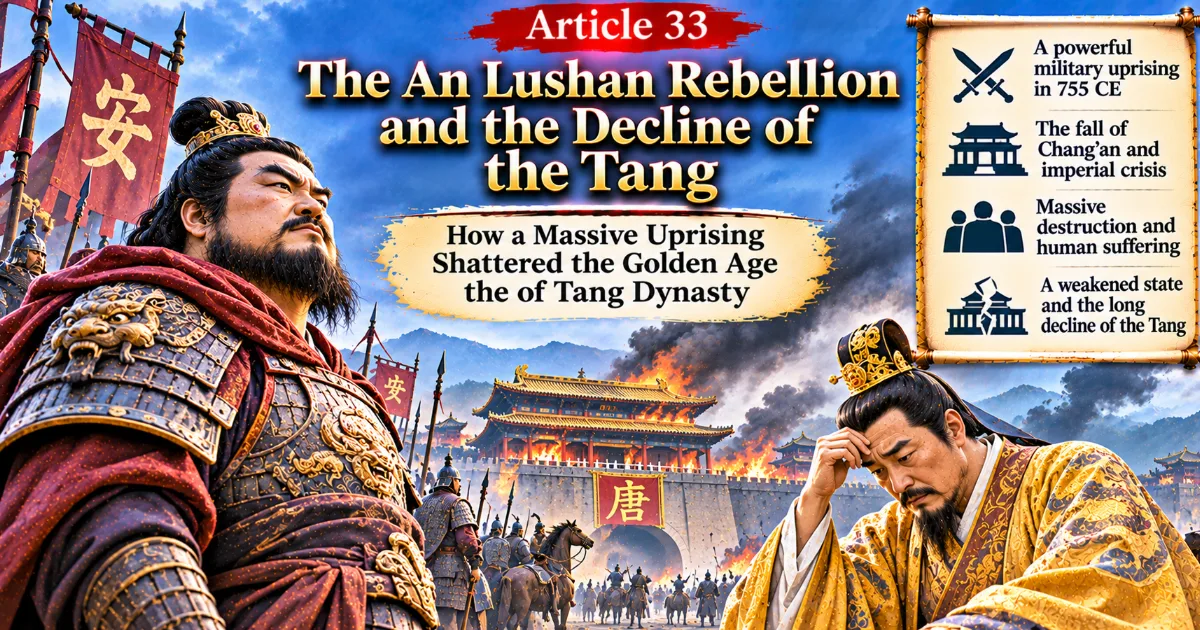
The An Lushan Rebellion began in 755 CE and became one of the most destructive conflicts in Tang history.
An Lushan was a powerful military commander who rebelled against Emperor Xuanzong's government. His forces advanced rapidly, threatening major centres of the empire.
In 756 CE, Emperor Xuanzong fled Chang'an, and the imperial government entered a period of severe crisis.
The rebellion caused enormous destruction. Cities were captured, agricultural regions were damaged, trade routes were disrupted, and millions of people experienced displacement and hardship.
The political and social effects of the conflict were reflected in the poetry of the period.
Li Bai and Du Fu experienced the crisis differently, but the rebellion affected both their lives.
Du Fu's writing became especially important as a record of the human consequences of war. His poetry described refugees, hungry families, separated relatives, soldiers, and the destruction of social stability.
The rebellion also changed the cultural atmosphere of the Tang Dynasty. The confidence of the early period gave way to a more complicated awareness of political weakness and human vulnerability.
Tang poetry did not lose its artistic quality during this crisis. Instead, it gained new emotional and historical depth.
14. Du Fu's Experience of War and Displacement
During the rebellion, Du Fu experienced the collapse of political order at close range.
He was captured by rebel forces after the fall of Chang'an and remained under difficult circumstances before escaping.
He later joined the government side and received an official appointment, although his career remained unstable.
His poetry from this period reflects the suffering caused by military conflict.
He wrote about families separated by war, people struggling to obtain food, soldiers who had been away from home for years, and communities destroyed by political violence.
His famous poem often translated as Spring View describes the condition of Chang'an after the rebellion had devastated the city.
The poem connects the beauty of spring with the pain of national crisis. Flowers and birds, normally associated with renewal and happiness, become reminders of separation and suffering.
This combination of natural imagery and political grief demonstrates Du Fu's literary skill.
He did not treat war as an abstract contest between armies. He examined its effects on individual lives.
15. Du Fu's Concern for Ordinary People
One of Du Fu's greatest achievements was his ability to represent the lives of ordinary people.
He wrote about farmers, soldiers, labourers, refugees, poor families, and individuals who rarely occupied central positions in official historical accounts.
His poem often translated as The Song of the War Chariots examines the suffering of conscripted soldiers and the families left behind.
The poem presents military mobilisation from the perspective of people who had little control over the decisions of the state.
Other works describe hunger, poverty, inadequate housing, and the effects of taxation and warfare.
Du Fu's concern for ordinary people was connected with Confucian ideas about moral government. He believed that rulers and officials had obligations toward the population.
His poetry therefore functioned as more than artistic expression. It also became a form of moral observation and historical criticism.
He demonstrated that poetry could preserve the experiences of people whose suffering might otherwise be overlooked.
16. Du Fu's Family Life and Personal Hardship
Du Fu's poetry was deeply shaped by his family relationships.
He wrote about his wife, children, relatives, and the difficulties of maintaining a household during periods of political instability.
The rebellion separated families and disrupted the economic foundations of everyday life.
Du Fu experienced financial insecurity and periods of poor health. He struggled to obtain stable housing and often depended on friends or local support.
His poems about family separation reveal the emotional consequences of political events.
For Du Fu, national crisis was never entirely separate from personal experience. The condition of the empire affected the ability of families to remain together, obtain food, and maintain ordinary routines.
His writing therefore connects large historical developments with intimate human relationships.
This ability to move between personal emotion and public responsibility became one of the defining features of his poetry.
17. The Different Literary Styles of Li Bai and Du Fu
Li Bai and Du Fu are often compared because they represent two distinct approaches to Tang poetry.
Li Bai's poetry is frequently associated with imagination, spontaneity, and emotional freedom. His images can be dramatic and expansive, and his poems often create a sense of movement beyond ordinary social boundaries.
Du Fu's poetry is more closely associated with careful structure, historical awareness, and moral reflection. His writing frequently examines the relationship between individual suffering and political responsibility.
Their differences can be understood through several themes.
In their treatment of nature, Li Bai often presents landscapes as sources of spiritual freedom, while Du Fu frequently connects the natural world with personal hardship, historical memory, or social change.
In their treatment of politics, Li Bai often expresses a desire for independence from court restrictions, while Du Fu repeatedly examines the moral duties of government.
In their treatment of friendship, Li Bai celebrates companionship and shared enjoyment, while Du Fu often explores separation, loyalty, and the emotional consequences of distance.
Neither approach is inherently superior. Together, they demonstrate the extraordinary range of Tang poetic expression.
18. Regulated Verse and Du Fu's Technical Achievement
Du Fu became particularly famous for his mastery of regulated verse.
This form required careful attention to tonal patterns, parallelism, rhyme, and structure.
Du Fu used these technical requirements to create poems with remarkable emotional complexity.
His parallel couplets could connect contrasting images, political ideas, and personal experiences. The formal balance of the poem often strengthened the tension within its subject.
His writing demonstrates that technical discipline can increase rather than restrict emotional expression.
Du Fu's influence on later Chinese poets was enormous. Generations of writers studied his use of language, structure, historical reference, and moral seriousness.
He became a model of poetic craftsmanship.
His work showed that poetry could be both formally sophisticated and deeply connected with the realities of human life.
19. Li Bai and Du Fu Beyond the An Lushan Rebellion
The rebellion did not end the literary careers of either poet.
Li Bai continued to write and travel, although he became involved in political difficulties.
During the conflict, he became associated with the court of Prince Li Lin, one of Emperor Xuanzong's sons. After Li Lin's rebellion failed, Li Bai was arrested and sentenced to exile.
He was eventually pardoned, allowing him to return from exile.
His later years were marked by continued travel, literary activity, and changing political circumstances.
Du Fu also continued writing after the major fighting had ended. He spent time in different regions, experienced continuing hardship, and eventually settled for periods in Sichuan.
He remained deeply concerned about the condition of the empire and the suffering of its population.
His later poetry continued to explore friendship, memory, nature, political change, and personal vulnerability.
Both poets therefore lived through a period in which the cultural achievements of the Tang Dynasty coexisted with the instability of a weakened empire.
20. The Deaths of Li Bai and Du Fu
Li Bai died in 762 CE, during a period when the Tang Empire was still recovering from the An Lushan Rebellion.
His death became surrounded by stories and legends, including accounts that associated him with the moon and the river. Such stories reflect the poetic image that later generations created around him, although the historical details are not all certain.
Du Fu died in 770 CE while travelling by boat. His final years were marked by illness, financial difficulties, and continuing displacement.
Neither poet died as a wealthy and secure imperial figure. Their enduring importance came from their literary achievements rather than from stable political careers.
Their deaths did not end their influence. Their works continued to circulate, be collected, studied, copied, and admired.
Over time, both became central figures in the Chinese literary canon.
21. How Tang Poetry Was Preserved
The preservation of Tang poetry depended on several institutions and cultural practices.
Poems circulated through handwritten manuscripts, personal collections, literary gatherings, correspondence, and official cultural networks.
Some works were preserved because they attracted attention from scholars and collectors. Others survived through later anthologies and historical compilations.
One of the most important collections was the Complete Tang Poems, compiled during the Qing Dynasty in the early eighteenth century.
This enormous anthology gathered tens of thousands of poems associated with the Tang period and preserved the works of a large number of poets.
Although the collection was produced centuries after the Tang Dynasty, it became an essential resource for the study of Tang literature.
The preservation of poetry also depended on education. Students learned famous poems, copied them, memorised them, and discussed their literary qualities.
The examination system and classical education helped maintain the cultural importance of poetry across generations.
22. The Influence of Li Bai and Du Fu on Later Chinese Literature
Li Bai and Du Fu became two of the most influential figures in Chinese literary history.
Their works were studied by poets during the Song, Yuan, Ming, and Qing dynasties.
Li Bai became a model of imaginative freedom and expressive power. His poetry influenced writers who valued natural imagery, spontaneity, and the relationship between literature and personal experience.
Du Fu became a model of technical excellence and moral seriousness. His work was admired for its ability to combine formal sophistication with historical awareness and social concern.
Later scholars frequently described Du Fu as the Poet Sage because of the depth of his moral and literary vision.
Li Bai was often celebrated as the Poet Immortal, a title reflecting the extraordinary imagination and almost otherworldly quality associated with his poetry.
These titles helped establish their places in the cultural memory of China.
Their influence also extended into education, painting, calligraphy, theatre, and popular culture.
23. Tang Poetry and the Development of Chinese Identity
Tang poetry became an important part of Chinese cultural identity.
Its language, imagery, and philosophical themes influenced the way later generations understood history, nature, friendship, patriotism, and personal emotion.
Famous Tang poems became part of the educational experience of children and adults. Their lines were memorised and quoted in everyday conversation, literature, public speeches, and artistic works.
The poems also provided a shared cultural vocabulary across different regions of China.
Their importance extended beyond literary appreciation. They preserved historical experiences and expressed values that continued to influence Chinese society.
The works of Li Bai and Du Fu became especially important because they represented different dimensions of the human experience.
Li Bai expressed the desire for freedom, imagination, and spiritual harmony. Du Fu expressed the responsibilities of society, the pain of historical events, and the dignity of ordinary people.
Together, they helped make Tang poetry an enduring foundation of Chinese cultural memory.
24. The International Influence of Tang Poetry
Tang poetry influenced neighbouring countries and contributed to the development of East Asian literary culture.
Japanese scholars and monks who travelled to Tang China encountered Chinese literature and brought texts and literary practices back to Japan.
Chinese poetry became an important part of education and elite culture in Japan, Korea, and Vietnam.
The classical Chinese language served as a major medium of scholarship and literary communication across parts of East Asia.
Tang poetic forms, imagery, and themes influenced writers in these societies, although each region developed its own literary traditions.
The international circulation of Tang poetry demonstrates that literature can travel across political boundaries and become part of multiple cultural histories.
Today, translations have introduced Li Bai and Du Fu to readers across the world. Their work continues to be studied in universities and appreciated by readers who may know little about the political history of the Tang Dynasty.
25. Why Li Bai and Du Fu Still Matter Today
Li Bai and Du Fu remain important because their poetry addresses experiences that continue to be meaningful.
Li Bai's poems explore the desire for freedom, the beauty of nature, the value of friendship, and the search for meaning beyond ordinary responsibilities.
Du Fu's poems examine war, poverty, political failure, family separation, and the suffering of people caught in circumstances beyond their control.
Their writing demonstrates that literature can preserve both personal emotion and collective historical experience.
Their different approaches also reveal the range of human responses to political and social change.
Li Bai often transforms uncertainty into imaginative possibility. Du Fu examines uncertainty through moral reflection and historical observation.
Modern readers can approach their poetry through translations, academic studies, literary anthologies, and historical interpretations. Although translation cannot reproduce every feature of classical Chinese language, it allows readers to appreciate the broader emotional and philosophical power of their work.
Their continued popularity demonstrates the lasting value of literature that combines artistic excellence with an understanding of human life.
Conclusion: Two Poets Who Defined an Age
The Tang Dynasty produced many remarkable poets, but Li Bai and Du Fu became its most enduring literary figures.
Li Bai represented imagination, freedom, nature, friendship, and the desire to move beyond ordinary limitations. His poetry transformed mountains, rivers, moonlight, and wine into powerful symbols of emotional and spiritual experience.
Du Fu represented reflection, social responsibility, historical awareness, and compassion for ordinary people. His poetry recorded the suffering caused by war and political instability while demonstrating the extraordinary possibilities of literary form.
Their lives overlapped with the prosperity of the Tang Empire and the destruction of the An Lushan Rebellion. Their works therefore preserve two important dimensions of the period: the cultural confidence of a great civilisation and the human consequences of its political crisis.
Tang poetry became a lasting achievement because it combined technical sophistication with emotional depth. It allowed poets to explore the natural world, public life, personal relationships, and the moral responsibilities of government.
Centuries after their deaths, Li Bai and Du Fu remain essential figures in Chinese literature. Their poetry continues to be read, studied, translated, and admired because it speaks to experiences that transcend the time and place in which it was written.
The Golden Age of Chinese poetry was not simply a period when many talented writers lived. It was an era when literature reached an extraordinary level of artistic achievement and became a lasting expression of civilisation itself.