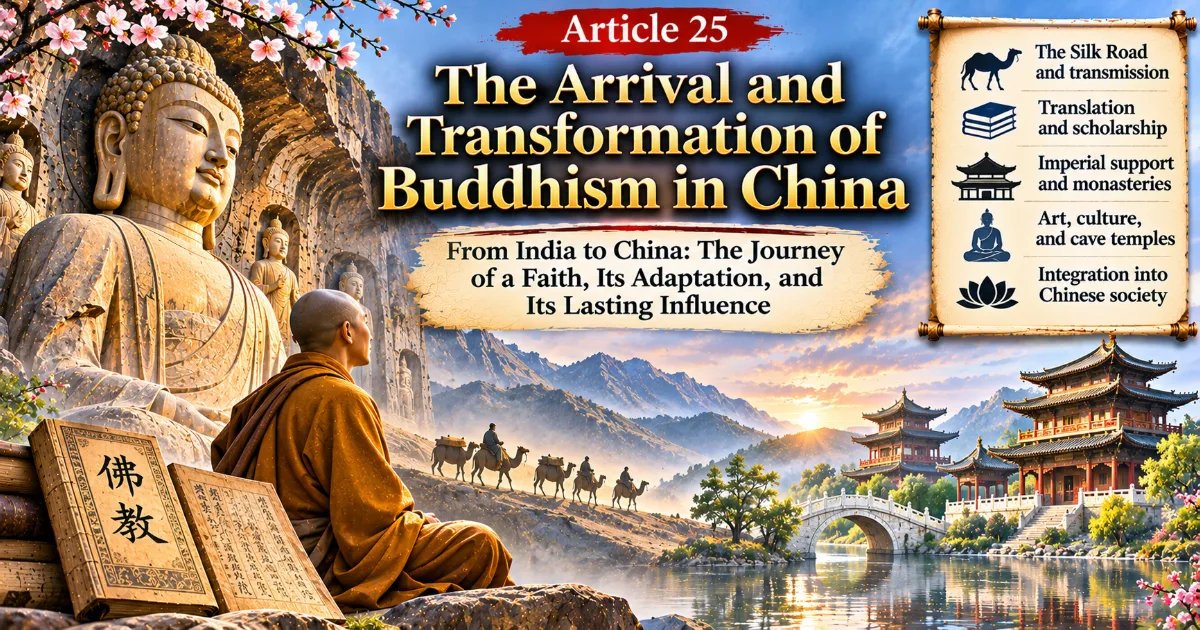
How a spiritual tradition born in India travelled across Central Asia, entered China, and gradually became one of the most influential forces in Chinese civilization.
Buddhism's journey into China was one of the most important cultural transformations in Asian history. Originating in the Indian subcontinent, the teachings of the Buddha travelled across mountains, deserts, trading settlements, and imperial territories before reaching China. What began as the movement of religious ideas along networks connecting India and Central Asia eventually developed into a major spiritual, intellectual, artistic, and institutional tradition within Chinese society.
The arrival of Buddhism did not immediately transform China. Its early presence was limited, its teachings were unfamiliar, and its concepts had to be translated into a language and intellectual environment shaped by Confucian ethics, ancestral traditions, and Daoist thought. Over several centuries, however, Buddhist monks, translators, merchants, rulers, scholars, and ordinary believers helped establish a lasting religious presence. Chinese communities gradually adapted Buddhist teachings to their own cultural circumstances, creating forms of Buddhism that were distinctively Chinese while remaining connected to the wider Buddhist world.
The transformation was especially significant during the centuries of political division following the collapse of the Han Dynasty. As northern and southern kingdoms competed for power, Buddhism offered spiritual guidance, institutions, networks of learning, and new forms of artistic expression. Monasteries became centres of religious practice and scholarship, while Buddhist sculptures, cave temples, paintings, and translated scriptures transformed the cultural landscape.
Understanding how Buddhism entered China helps explain not only the history of religion but also the development of Chinese philosophy, literature, architecture, education, international relations, and political culture. It also reveals how civilizations influence one another through exchange rather than existing in isolation.
The Arrival and Transformation of Buddhism in China
How a spiritual tradition born in India travelled across Central Asia, entered China, and gradually became one of the most influential forces in Chinese civilization
1. Buddhism and the World Beyond Ancient China
Buddhism originated in northern India during the first millennium BCE. Its founder, Siddhartha Gautama, who became known as the Buddha, taught a path towards liberation from suffering through ethical conduct, mental discipline, wisdom, and understanding the nature of existence. His teachings developed into a religious and philosophical tradition that gradually spread across the Indian subcontinent and beyond.
By the centuries surrounding the beginning of the Common Era, Buddhism had already travelled far beyond the region where it originated. Monastic communities, royal patronage, merchants, pilgrims, and teachers helped carry Buddhist ideas across different parts of Asia. The expansion of trade routes created opportunities for religious exchange, particularly along the networks that connected India, Central Asia, and China.
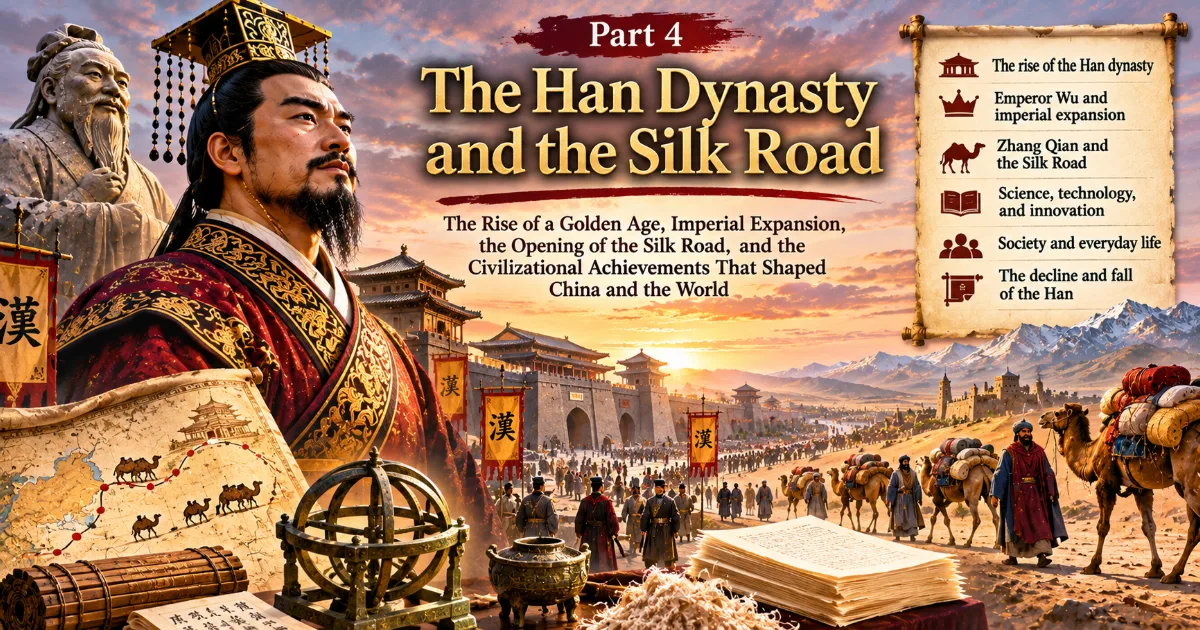
China was not isolated from these developments. During the Han Dynasty, Chinese merchants, diplomats, soldiers, and officials increasingly encountered people and cultures from Central Asia. Commercial routes connected Chinese cities with oasis settlements, mountain passes, and regions further west. These routes carried silk, horses, precious stones, textiles, artistic techniques, languages, and religious ideas.
Buddhism entered this interconnected world as one of the most significant intellectual and spiritual traditions moving eastwards. Its journey into China was not a single event. It was a gradual process involving several generations of travellers, translators, religious teachers, and local supporters.
2. The Silk Road and the Routes Through Central Asia
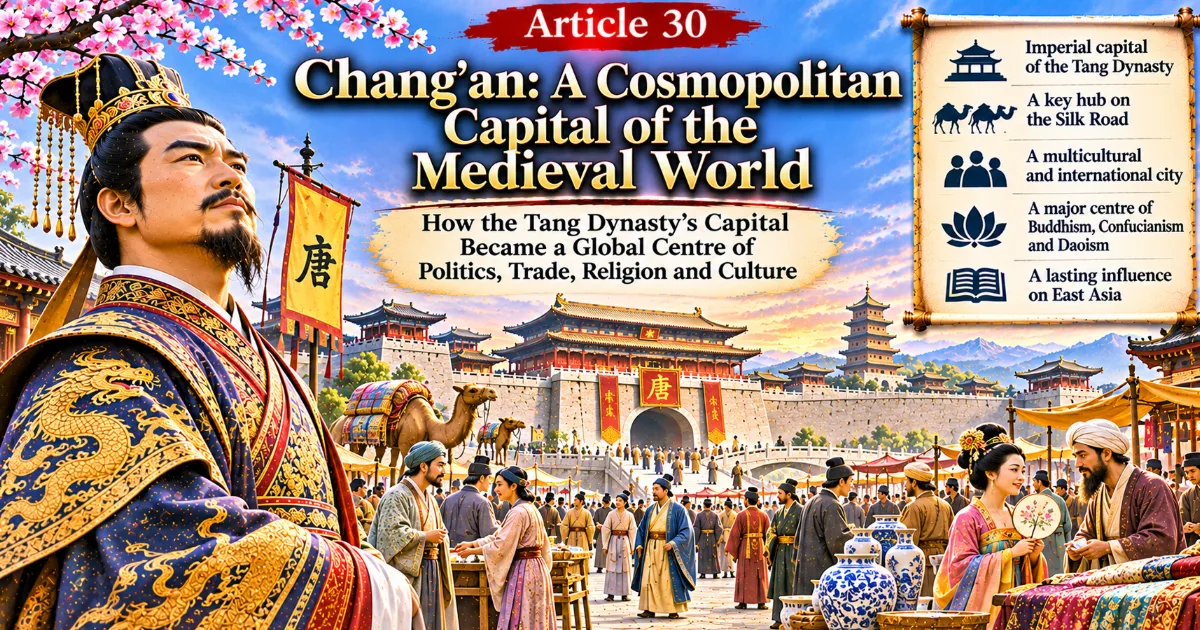
The spread of Buddhism into China was closely connected with the development of the Silk Road. This term describes a broad network of commercial and cultural routes rather than one continuous road. These routes linked the Chinese interior with Central Asia, India, Persia, and territories further west.
Merchants travelled through difficult landscapes carrying goods between distant markets. Caravan routes crossed deserts, mountain ranges, grasslands, and fertile valleys. Settlements along these routes became important centres of trade and cultural exchange. Many were also home to Buddhist communities.
The Tarim Basin, located in present-day Xinjiang, became particularly important. Its oasis settlements included places such as Kucha, Khotan, and Turfan. These centres developed strong connections with Buddhist learning and artistic traditions. Monasteries, shrines, and religious institutions served travellers as well as local populations.
Buddhist monks moved along these networks for different reasons. Some travelled to spread their teachings, while others sought religious texts, studied under established teachers, or visited important pilgrimage centres. Merchants sometimes supported monasteries, donated resources, and helped monks travel between distant regions.
The transmission of Buddhism was therefore closely connected to ordinary economic and social activity. Religious ideas often travelled with people who were primarily concerned with trade, diplomacy, migration, or education.
Central Asia also played an important role in shaping the Buddhism that reached China. Buddhist communities in the region had developed their own languages, artistic traditions, and interpretations of religious teachings. As Buddhism moved eastwards, Chinese people encountered a tradition that had already undergone centuries of adaptation outside India.
3. The Traditional Story of Buddhism's Arrival During the Han Dynasty
Chinese historical and religious traditions often associate the arrival of Buddhism with the Eastern Han Dynasty. One famous account connects Emperor Ming of Han with a dream about a golden figure. According to the traditional story, the emperor sent envoys westwards to learn about the unfamiliar spiritual figure. The envoys later returned with Buddhist monks and religious texts.
The story is associated with the establishment of the White Horse Temple at Luoyang, traditionally dated to the first century CE. The temple became an important symbol of Buddhism's early presence in China and is remembered in Chinese religious history as one of the earliest Buddhist institutions in the country.
However, historians distinguish between traditional accounts and evidence that can be independently established. The story of Emperor Ming provides an important explanation of how later generations understood Buddhism's arrival, but the precise details and chronology remain uncertain.
There is evidence that Buddhist ideas and communities were present in parts of China during the Eastern Han period. Yet the earliest stages of transmission were probably more complicated than a single imperial mission. Merchants, migrants, foreign religious teachers, and communities connected with Central Asia may have contributed to the introduction of Buddhist practices.
The distinction between arrival and acceptance is important. A religious tradition may be known in a country long before it becomes established among large sections of its population. Buddhism initially existed in a relatively limited environment, particularly among foreign communities and people connected with international trade. Its wider influence developed gradually.
4. Early Buddhist Communities in Han China
During the Eastern Han Dynasty, Buddhism began finding a place within the cultural and religious environment of Chinese society. Its early followers included people from Central Asian communities as well as Chinese individuals who became interested in unfamiliar religious teachings.
At first, Buddhist practices were not always understood in the same way that they would be in later centuries. Chinese observers sometimes interpreted Buddhist figures and teachings through concepts already familiar from Daoist and other indigenous traditions. This was partly because Buddhist philosophy introduced ideas that had no exact equivalents in classical Chinese vocabulary.
Early Buddhist communities were relatively small, and their organisation was still developing. Monks and teachers introduced religious practices, recited scriptures, explained ethical teachings, and established connections with supporters. Over time, monasteries and other religious institutions became more visible.
The growth of Buddhism also depended on the willingness of Chinese society to accommodate a tradition that had originated outside the country. Foreign religions were not necessarily rejected simply because they were foreign. However, they had to find ways to communicate their ideas within existing social and intellectual structures.
The Han period provided the initial foundations for this process. The later centuries would bring far greater institutional development, more extensive translations, and deeper philosophical debate.
5. An Shigao and the Early Translation Movement
One of the most important figures in the early history of Chinese Buddhism was An Shigao, a Buddhist monk traditionally associated with Parthian origins. He arrived in China during the second century CE and became known for translating Buddhist texts into Chinese.
An Shigao's work was significant because Buddhism could not develop widely without making its teachings accessible to people who did not understand Indian or Central Asian languages. Translation was not simply a matter of replacing words. Buddhist texts contained philosophical concepts concerning suffering, consciousness, meditation, ethical behaviour, rebirth, and liberation. These ideas required careful explanation.
An Shigao is particularly associated with texts dealing with meditation, mental discipline, and practical religious instruction. His translations helped introduce Chinese readers to methods of Buddhist contemplation and teachings concerning the mind.
Translation also created new intellectual challenges. Some Buddhist concepts did not have direct equivalents in Chinese. Translators sometimes used familiar Chinese philosophical terms to explain unfamiliar ideas. This approach made the texts easier to understand, but it could also create misunderstandings.
Nevertheless, early translators established a foundation upon which later generations could build. Their efforts helped transform Buddhism from a foreign religious presence into a tradition that Chinese scholars and believers could study directly.
6. Lokaksema and the Introduction of Mahayana Buddhism
Another important translator was Lokaksema, a monk from the Kushan cultural world of Central Asia who arrived in Luoyang during the second century CE. His work helped introduce important Mahayana Buddhist scriptures into China.
Mahayana Buddhism developed as a major movement within the wider Buddhist world. It placed particular emphasis on the bodhisattva ideal. A bodhisattva is a being who seeks enlightenment while dedicating themselves to the liberation and welfare of other living beings.
This ideal introduced a powerful devotional and ethical dimension to Buddhist practice. Rather than presenting liberation only as an individual spiritual achievement, Mahayana teachings emphasised compassion, wisdom, and the aspiration to help all beings overcome suffering.
Lokaksema translated texts that introduced Chinese readers to these ideas, including scriptures associated with profound philosophical teachings and the extraordinary spiritual qualities of bodhisattvas.
His translations helped establish the foundations of Mahayana Buddhism in China. They also demonstrated that Buddhism was not a single, unchanging body of teachings. Different schools and traditions existed across Asia, and Chinese Buddhism would develop through engagement with several of them.
7. Translation and the Challenge of Explaining Buddhist Philosophy
The translation of Buddhist scriptures became one of the most important intellectual activities in Chinese history. Translators faced the challenge of explaining a complex philosophical tradition through a language shaped by different historical experiences.
For example, Buddhist teachings discussed concepts such as karma, rebirth, emptiness, dependent origination, and nirvana. These ideas could not always be explained through existing Chinese terminology without losing important distinctions.
Early translators sometimes relied on familiar concepts from Daoist philosophy. This approach helped Chinese readers approach unfamiliar teachings, but it also encouraged interpretations that were not always identical to the original Buddhist meanings.
Over time, translators and scholars became more careful about terminology. They compared different versions of scriptures, consulted teachers familiar with Indian languages, and developed increasingly sophisticated methods of translation.
Translation gradually became a collective scholarly activity. Teams of monks, language specialists, scribes, and students worked together to produce texts. Their work helped establish a substantial Chinese Buddhist literature.
This process had consequences beyond religion. It expanded Chinese philosophical vocabulary, introduced new literary forms, encouraged international scholarship, and demonstrated the importance of cross-cultural intellectual exchange.
8. The Collapse of the Han Dynasty and Buddhism's New Opportunities
The collapse of the Han Dynasty at the end of the second century and the beginning of the third century created a period of political instability. Central authority weakened, regional powers competed for control, and the country entered an extended age of division.
The Three Kingdoms period was followed by the Western Jin and Eastern Jin dynasties, while northern China experienced the rise and fall of several competing states. Warfare, migration, political uncertainty, and social disruption transformed the lives of millions of people.
These circumstances created a new environment for Buddhism. Traditional political and intellectual structures had been weakened, and many people were searching for spiritual explanations of suffering, death, and uncertainty.
Buddhism offered teachings about impermanence, moral responsibility, compassion, and the possibility of liberation. Its monasteries could provide places for religious practice, education, charitable activity, and community support.
Buddhism did not become influential simply because China experienced political disorder. Its growth depended on the work of teachers, translators, patrons, and institutions. However, the divided political landscape allowed religious networks to develop in ways that were not always dependent on one central government.
9. Buddhism and the Northern and Southern Dynasties
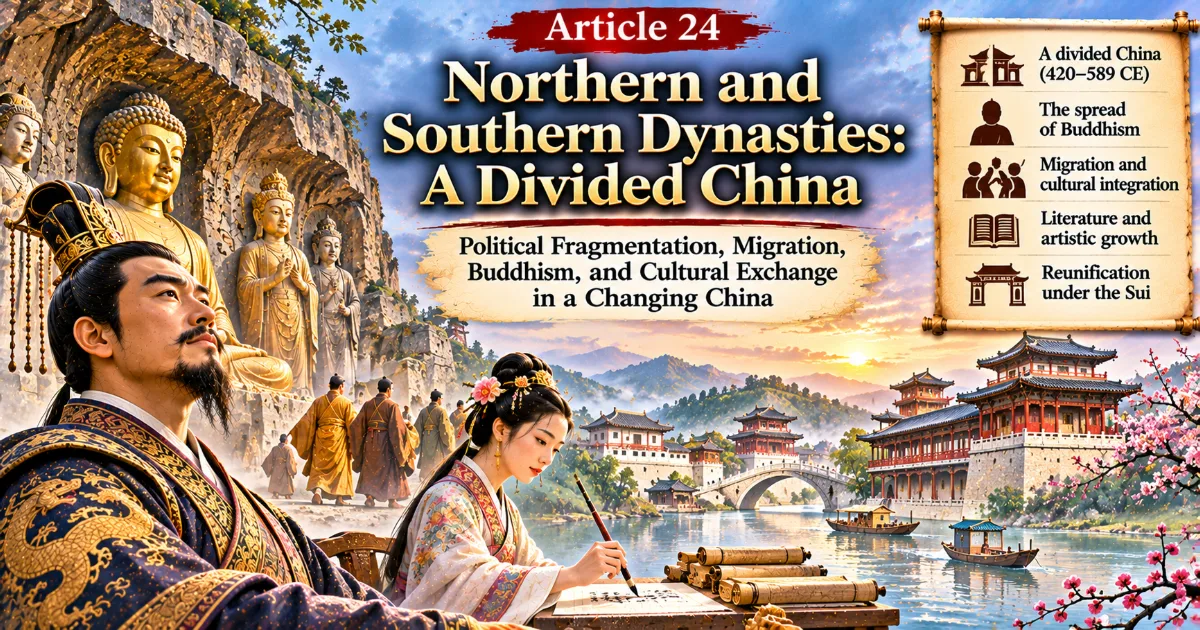
The period of division known broadly as the Northern and Southern Dynasties, conventionally dated from 420 to 589 CE, was especially important for the development of Chinese Buddhism.
During these centuries, northern and southern political regimes developed different cultural and religious environments. Buddhism expanded in both regions, although the relationship between religious institutions and political authorities varied.
In northern China, several rulers supported Buddhism as a source of legitimacy and social unity. Some rulers came from non-Han backgrounds and governed populations with different cultural traditions. Buddhism could provide a shared religious language that crossed ethnic and regional boundaries.
In southern China, Buddhist thought became increasingly influential among educated elites, aristocratic families, monks, and scholars. Monasteries developed in major cultural centres, and Buddhist discussions became part of wider debates about philosophy, literature, and ethics.
The period also witnessed the development of more organised monastic institutions. Monks and nuns lived in communities, followed disciplinary rules, studied scriptures, practised meditation, and participated in religious ceremonies.
Buddhism was no longer merely a foreign belief encountered through merchants and travellers. It had become a significant part of Chinese religious and intellectual life.
10. Kumarajiva and a New Era of Buddhist Translation
One of the greatest translators in Chinese Buddhist history was Kumarajiva, who arrived in Chang'an in 401 CE after a long and difficult political journey.
Kumarajiva was born in the region of Kucha in Central Asia. He received an extensive education in Buddhist philosophy and became highly respected for his knowledge of Mahayana teachings. His arrival in China marked a turning point in the development of Chinese Buddhist literature.
Under the support of the Later Qin court, Kumarajiva led a major translation programme. His work involved groups of scholars, monks, and assistants who collaborated to produce Chinese versions of important Buddhist scriptures.
Among the texts associated with his translation work was the Lotus Sutra, which became one of the most influential scriptures in East Asian Buddhism. His translation of the Diamond Sutra also became extremely important in later Buddhist traditions.
Kumarajiva's translations were admired for their clarity and literary quality. Earlier translations sometimes struggled with unfamiliar terminology and complex sentence structures. His work helped make Buddhist philosophy more accessible to Chinese readers.
His contribution extended beyond translating individual scriptures. The translation movement helped establish a more consistent vocabulary for Buddhist ideas and encouraged the development of Chinese Buddhist scholarship.
Kumarajiva's influence continued long after his death. Later Chinese Buddhist schools relied heavily on texts translated under his leadership.
11. Monasteries and the Growth of Buddhist Institutions
As Buddhism became more established, monasteries emerged as important institutions throughout China. They provided organised environments for religious study, meditation, worship, and community life.
Monks followed religious rules governing their behaviour, daily routines, possessions, and relationships with the wider population. Monastic life required discipline, commitment, and a willingness to place spiritual practice above many ordinary social responsibilities.
Monasteries also became centres of education. Monks studied Buddhist scriptures, discussed philosophical questions, copied manuscripts, and taught younger members of their communities. Some institutions developed extensive libraries and attracted scholars from distant regions.
Lay supporters played an essential role in sustaining monasteries. Wealthy families donated land, buildings, food, and other resources. Ordinary believers contributed offerings, participated in ceremonies, and sought religious guidance.
Monasteries sometimes provided charitable services, including food assistance and support for travellers. Their social role varied according to region and period, but they increasingly became visible institutions within Chinese communities.
The growth of monasteries also raised questions about property, taxation, labour, and political authority. As religious institutions accumulated wealth and influence, rulers had to consider how they should be regulated.
12. The Spread of Buddhism Among Ordinary People
Buddhism did not remain limited to emperors, scholars, and wealthy families. Its teachings gradually reached ordinary people through sermons, festivals, devotional practices, images, stories, and local religious communities.
Many people were attracted by the promise of spiritual protection and the possibility of improving their future through ethical conduct and religious devotion. Buddhist teachings about karma and rebirth offered explanations for suffering and moral consequences that could be understood beyond the intellectual world of scholars.
Images of the Buddha and bodhisattvas also made Buddhist ideas more accessible. People could visit temples, offer incense, make donations, recite prayers, and participate in ceremonies without requiring advanced knowledge of philosophical texts.
Buddhist festivals and devotional gatherings created opportunities for collective religious activity. Stories about the Buddha's life, previous births, miraculous events, and compassionate bodhisattvas became part of popular religious culture.
Women also participated in Buddhist religious life as donors, devotees, nuns, and supporters of monasteries. Although their opportunities were shaped by the social restrictions of their time, Buddhism provided some women with recognised paths of religious commitment beyond conventional household roles.
The expansion of Buddhism among ordinary people helped establish it as a lasting part of Chinese society rather than an intellectual movement confined to the elite.
13. Buddhism and Confucian Values
The arrival of Buddhism created important debates within Chinese intellectual life. Confucianism had long emphasised family responsibility, social harmony, respect for elders, moral education, and service to the state.
Buddhism introduced religious practices that could appear unfamiliar or even contradictory to these values. Monks traditionally renounced ordinary household life, left their families, shaved their heads, and followed monastic rules. Such behaviour raised questions about filial piety and the responsibilities of children towards parents.
Some Confucian critics argued that leaving the family was inconsistent with the duties expected of a responsible person. They also questioned whether monasteries, which received donations and sometimes enjoyed special privileges, contributed adequately to society.
Buddhist thinkers responded in different ways. They explained that religious renunciation was not necessarily a rejection of compassion or moral responsibility. Buddhist teachings about gratitude, kindness, and the liberation of living beings could also be interpreted as forms of moral service.
Over time, Chinese Buddhist thinkers developed explanations that connected Buddhist teachings with Chinese ethical traditions. They emphasised that spiritual practice could benefit families, ancestors, and society as a whole.
The relationship between Buddhism and Confucianism was therefore not simply one of conflict. It involved criticism, adaptation, intellectual debate, and eventual coexistence. Later Chinese thinkers would increasingly engage with all three major traditions: Confucianism, Daoism, and Buddhism.
14. Buddhism and Daoism
Daoism was another major intellectual and religious tradition with which Buddhism interacted. Daoist philosophy emphasised harmony with the Dao, naturalness, simplicity, and freedom from excessive interference in the natural order.
Some Buddhist ideas initially appeared similar to Daoist concepts. Both traditions discussed liberation from ordinary attachments and the limitations of conventional thinking. This encouraged early Chinese interpreters to use Daoist vocabulary when explaining Buddhist teachings.
However, the two traditions were not identical. Buddhism developed detailed teachings about karma, rebirth, suffering, dependent origination, and liberation. Daoist traditions followed different philosophical and religious paths, including practices associated with longevity, ritual, meditation, and the cultivation of spiritual power.
As Buddhism became more established, intellectual exchange continued. Buddhist scholars studied Chinese philosophical traditions, while Daoist thinkers responded to the growing influence of Buddhist institutions and ideas.
The relationship was sometimes competitive. Religious communities debated the authority of their scriptures, the nature of spiritual liberation, and their relationship with political rulers. Yet competition also encouraged the development of more sophisticated philosophical arguments.
The interaction between Buddhism and Daoism contributed to the emergence of distinctive Chinese religious practices and forms of thought.
15. Buddhist Art and the Transformation of Chinese Visual Culture
Buddhism transformed Chinese art in profound ways. The religion introduced new subjects, symbols, artistic techniques, and architectural forms.
Early Buddhist images were influenced by artistic traditions from India and Central Asia. As the religion spread into China, sculptors and painters gradually adapted these visual forms to Chinese tastes and cultural expectations.
Images of the Buddha became central to Buddhist worship. Artists represented him in different postures, including seated meditation, standing figures, teaching gestures, and depictions of his life. Bodhisattvas were represented with distinctive ornaments, expressions, and symbolic objects.
Buddhist art also developed through the decoration of temples, monasteries, caves, and pilgrimage sites. Wall paintings depicted scenes from Buddhist scriptures, stories of the Buddha, celestial beings, religious ceremonies, and images of donors.
Over time, Chinese artistic styles became increasingly visible. Facial features, clothing, gestures, decorative patterns, and architectural details reflected local artistic traditions.
Buddhist art was not simply imported from India. It evolved through continuous exchange between Indian, Central Asian, and Chinese artists. The resulting works became some of the most remarkable artistic achievements of medieval China.
16. The Great Cave Temples of Northern China
The development of cave temples was one of the most impressive expressions of Buddhist influence in China. Religious communities and rulers sponsored the creation of enormous cave complexes containing sculptures, paintings, and inscriptions.
The Yungang Grottoes near Datong became one of the most important examples. Their construction began during the Northern Wei period in the fifth century. The caves contain monumental Buddha statues, smaller religious figures, decorative carvings, and architectural details.
The Longmen Grottoes near Luoyang developed later, with major phases of construction beginning during the late fifth century and continuing for centuries. They contain thousands of Buddhist images and inscriptions carved into limestone cliffs.
These cave temples were religious spaces as well as expressions of political power and artistic achievement. Rulers who sponsored monumental Buddhist projects could present themselves as protectors of the faith and supporters of moral order.
The caves also demonstrate how Buddhism became embedded in Chinese landscapes. Sacred spaces were created in mountains, valleys, and near important political centres. Pilgrims and worshippers travelled to these locations to pray, make offerings, and experience the spiritual atmosphere of the sites.
17. Emperor Xiaowen and the Northern Wei Patronage of Buddhism
The Northern Wei Dynasty played a major role in the development of Buddhism in northern China. Its rulers supported Buddhist institutions and encouraged the creation of religious monuments.
Emperor Xiaowen, who ruled from 471 to 499 CE, is particularly associated with major cultural reforms and the strengthening of imperial authority. His reign was part of a broader transformation in which the Northern Wei court increasingly adopted Chinese administrative and cultural practices.
Buddhism benefited from this environment of political and cultural change. Royal patronage supported monasteries, religious ceremonies, translations, and artistic projects.
Buddhist institutions could also help connect diverse populations within the northern kingdoms. Religious teachings and monastic networks offered forms of cultural communication that were not entirely dependent on ethnic identity.
However, state support did not mean that Buddhism was free from political control. Rulers sometimes regulated monasteries, monitored religious activity, and intervened in disputes. The relationship between the Buddhist establishment and the state remained complex.
18. The Challenges of Buddhist Wealth and Political Control
As Buddhism expanded, monasteries accumulated land, donations, and other resources. Their growing influence created practical concerns for rulers who depended on taxation, agricultural production, and military service.
Monastic institutions sometimes received privileges or exemptions that reduced their obligations to the state. When monasteries became wealthy, officials could question whether too much land and labour were being removed from ordinary administrative control.
Religious institutions could also become politically influential because of their connections with rulers, aristocratic families, and local communities. Some rulers viewed Buddhism as a source of stability and legitimacy, while others feared that its institutions might weaken government authority.
These tensions occasionally resulted in restrictions or persecution. The history of Chinese Buddhism therefore includes periods of strong imperial support as well as episodes of state intervention.
Such developments demonstrate that Buddhism's success was not automatic. Its institutions had to negotiate their place within a political system that expected religious organisations to remain compatible with the interests of the state.
19. The Development of Chinese Buddhist Schools
As Buddhist scriptures became more widely available, Chinese scholars began organising teachings into different interpretive traditions. They studied philosophical differences between texts, compared methods of meditation, and debated the nature of enlightenment.
Different schools gradually developed distinctive approaches to Buddhist practice. Some placed particular emphasis on philosophical interpretation, while others focused on meditation, devotional worship, or specific scriptures.
The formation of recognisably Chinese Buddhist schools became more pronounced in later centuries, particularly during the Sui and Tang dynasties. Nevertheless, the foundations were established during the period of division through translation, study, debate, and institutional development.
The Tiantai tradition, associated with the Lotus Sutra, would later become one of the major Chinese Buddhist schools. Its teachers developed systematic ways of interpreting Buddhist teachings and explaining the relationship between different forms of practice.
Other traditions would also emerge with distinctive approaches to meditation, devotion, and philosophical inquiry. Chinese Buddhism was becoming a diverse intellectual and religious world rather than a single unified organisation.
20. Pure Land Devotion and the Promise of Rebirth
One of the most influential developments in East Asian Buddhism was the growth of Pure Land devotion. This tradition focused on Amitabha Buddha and the aspiration to be reborn in his Pure Land, a realm associated with favourable conditions for attaining enlightenment.
Pure Land teachings offered a form of Buddhist practice that could be followed by people who were not able to devote their entire lives to monastic study or intensive meditation.
Devotional practices included reciting the name of Amitabha Buddha, cultivating faith, developing compassion, and directing one's aspirations towards rebirth in the Pure Land.
The tradition became particularly influential because it connected Buddhist spiritual goals with accessible forms of religious devotion. It appealed to monks, scholars, and ordinary believers alike.
Pure Land ideas developed over several centuries and became especially important in later Chinese Buddhism. They also influenced Buddhist traditions in Korea, Japan, and other parts of East Asia.
21. Women and Buddhism in Chinese Society
Women played an important role in the spread and development of Buddhism in China. Some became nuns and devoted their lives to religious discipline, meditation, and the study of scriptures. Others supported monasteries as donors, organised religious activities, or participated in devotional communities.
The establishment of nunneries created opportunities for women to pursue religious lives outside the ordinary expectations of marriage and household management. These opportunities were not equal across all social groups, and women continued to face restrictions shaped by the wider social order.
Nevertheless, Buddhist institutions gave some women access to education, religious authority, and spiritual communities. Female patrons also helped finance temples, sculptures, and charitable activities.
Buddhist teachings concerning compassion and the potential for spiritual liberation provided important foundations for discussions about women's religious roles.
The participation of women contributed to the wider social reach of Buddhism and helped establish its place in different levels of Chinese society.
22. Buddhism, Literature, and Intellectual Life
The spread of Buddhist scriptures enriched Chinese literature and encouraged new forms of writing. Translations introduced unfamiliar narrative structures, philosophical vocabulary, and religious imagery.
Buddhist stories became sources of inspiration for poetry, historical writing, sermons, biographies, and popular literature. Accounts of monks travelling across dangerous regions, searching for sacred texts, and overcoming hardship became especially influential.
Buddhist ideas also influenced Chinese discussions about impermanence, human suffering, moral responsibility, and the nature of consciousness. These themes became part of wider intellectual debates.
The translation movement encouraged scholars to develop new methods of reading and interpreting texts. Monasteries preserved manuscripts and supported the copying of scriptures, contributing to the growth of literary culture.
Buddhist scholarship also strengthened China's connections with other Asian societies. Texts and interpretations moved between China, Central Asia, India, Korea, and other regions, creating an international intellectual network.
23. The Arrival of Buddhism and China's International Connections
Buddhism strengthened China's cultural connections with the wider Asian world. Monks and pilgrims travelled across borders, while Chinese scholars sought religious knowledge from teachers in Central Asia and India.
These journeys required considerable determination. Travellers faced dangerous roads, harsh climates, political instability, and the possibility of illness or death. Nevertheless, the desire to study Buddhist teachings encouraged many to undertake long journeys.
Chinese Buddhist communities also maintained connections with foreign monasteries and teachers. These relationships helped circulate scriptures, artistic styles, and philosophical interpretations.
The movement of Buddhist ideas demonstrates that ancient and medieval Asia was connected through extensive networks of exchange. Religious traditions could cross political borders even when kingdoms were divided or at war.
Buddhism became one of the strongest links connecting China with India and Central Asia. Its spread contributed to a wider cultural environment in which ideas, artistic traditions, and knowledge moved between societies.
24. Buddhism Before the Sui Reunification
By the sixth century, Buddhism had become firmly established across much of China. It possessed monasteries, respected teachers, translated scriptures, devotional communities, and monumental artistic centres.
The northern and southern kingdoms had developed different forms of Buddhist patronage and scholarship, but both regions contributed to the religion's expansion.
The political division of China had not prevented the growth of Buddhist networks. In some respects, the absence of a single unified government allowed religious communities to develop through regional courts, local patrons, and international connections.
At the same time, the existence of different political regimes created challenges for religious institutions. Their privileges, property, and relationships with rulers varied across territories.
The coming reunification under the Sui Dynasty would create new opportunities for Buddhist institutions to operate across a unified empire. The Sui rulers would use Buddhism as one of the important cultural and religious forces supporting imperial authority.
25. How Buddhism Became Chinese
The transformation of Buddhism in China was not a simple process of replacing Indian customs with Chinese ones. It involved centuries of intellectual discussion, translation, artistic adaptation, religious experimentation, and institutional development.
Chinese Buddhists continued to study teachings that originated in India, but they interpreted them through their own language and cultural experiences. They developed new forms of devotional practice, philosophical explanation, monastic organisation, and artistic expression.
Buddhist concepts became part of Chinese discussions about morality, consciousness, family responsibilities, political authority, and the meaning of human existence. Monasteries became important institutions within Chinese society, while cave temples and sculptures transformed the visual landscape.
The interaction with Confucianism and Daoism also shaped Buddhism's development. Rather than simply replacing older traditions, Buddhism entered into a long process of debate and coexistence with them.
This adaptation explains why Chinese Buddhism eventually became distinct from the Buddhist traditions of India and Central Asia. It retained its connection with the wider Buddhist world while developing its own schools, practices, and cultural identity.
Conclusion: A Spiritual Journey That Changed Chinese Civilization
The arrival of Buddhism in China was one of the most important examples of cultural exchange in Asian history. Originating in India, the teachings of the Buddha travelled through Central Asia and entered China along networks created by trade, migration, diplomacy, and pilgrimage.
Its early development depended on foreign monks and translators such as An Shigao and Lokaksema. Later scholars, especially Kumarajiva, helped make Buddhist scriptures accessible to Chinese readers through influential translation programmes.
The centuries of political division following the Han Dynasty created a new environment for Buddhist expansion. Northern and southern rulers, aristocratic families, monks, nuns, merchants, and ordinary believers supported its institutions and practices. Monasteries became centres of learning and religious life, while Buddhist art produced extraordinary monuments such as the Yungang and Longmen Grottoes.
Buddhism also transformed Chinese intellectual culture. Its relationship with Confucianism and Daoism encouraged philosophical debate and new interpretations of morality, family duty, spiritual liberation, and the nature of existence.
By the time China approached reunification under the Sui Dynasty, Buddhism was no longer a foreign tradition existing at the edges of Chinese society. It had become one of the country's major religious and cultural forces.
Its influence would continue to grow during the Sui and Tang dynasties, when Buddhist scholarship, monasteries, pilgrimage, and artistic achievement reached new heights. The next chapter in this story is closely connected with the Sui Dynasty, whose rulers reunited China after centuries of division and created the political foundations for a new age of imperial development.
The journey of Buddhism into China was not simply the movement of a religion from one country to another. It was a meeting of civilizations that reshaped the spiritual and cultural history of Asia.
#HistoryOfChina #ChineseHistory #BuddhismInChina #SilkRoad #AncientAsianHistory