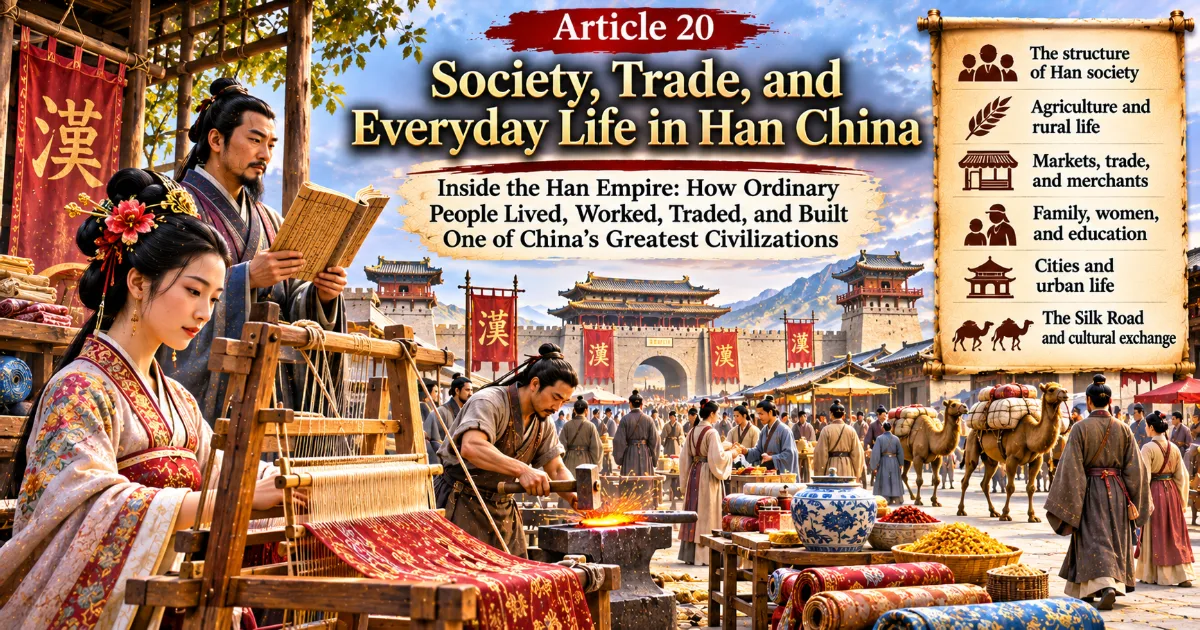
Inside the Han Empire: How Ordinary People Lived, Worked, Traded, and Built One of China's Greatest Civilizations
The Han Dynasty, which ruled China from 206 BCE to 220 CE, was one of the most influential periods in Chinese history. Its achievements are often remembered through powerful emperors, military campaigns, the expansion of the Silk Road, scientific discoveries, and the development of imperial institutions. However, the history of the Han Dynasty cannot be understood through rulers and major events alone. Its strength also depended on millions of ordinary people who cultivated fields, raised families, produced goods, operated businesses, served in the army, worked in government offices, and participated in an increasingly connected economy.
Life during the Han period was shaped by social position, wealth, occupation, gender, location, and access to land. A wealthy landowning family in the capital experienced a very different world from a farming household in a remote village. Merchants travelling along commercial routes encountered opportunities and dangers that were unfamiliar to artisans working in local workshops. Soldiers stationed at frontier garrisons faced conditions that differed greatly from those experienced by officials and scholars in major cities.
Despite these differences, people across the empire were connected through agriculture, markets, family relationships, government administration, religious practices, cultural traditions, and systems of taxation. The Han government depended on agricultural production, while rural communities relied on markets to exchange surplus goods. Cities brought together merchants, craftspeople, officials, entertainers, and travellers. Long-distance trade connected Chinese communities with Central Asia and other regions, helping ideas and products travel across vast distances.
Understanding everyday life in Han China reveals how one of the ancient world's largest and most sophisticated empires functioned. It also reminds us that history was not experienced only in imperial palaces or on battlefields. It was lived in family homes, agricultural fields, workshops, marketplaces, roads, military settlements, and villages throughout the empire.
Continue Reading
The Structure of Han Society
Han society was organized through a combination of political authority, economic position, family status, education, and occupation. Social relationships were influenced by Confucian values, inherited customs, legal regulations, and practical economic circumstances.
Traditional accounts often describe a social hierarchy that placed scholars and officials above farmers, artisans, and merchants. This arrangement reflected the belief that educated officials served the state, farmers produced essential food, artisans created useful goods, and merchants earned profits by exchanging products rather than directly producing them.
However, this hierarchy should not be interpreted as a perfect description of everyday reality. Wealth and political influence did not always correspond to formal social rankings. Successful merchants could become extremely wealthy, while poor farmers could experience severe hardship. Some landowning families accumulated enormous economic and political power, and certain officials used their positions to strengthen their family interests.
The imperial court and central government stood at the top of the political structure. Emperors claimed supreme authority, while senior officials managed administration, military affairs, finance, justice, and public works. Below them were local administrators, clerks, military officers, and other government personnel.
Local communities contained landowners, farmers, artisans, traders, labourers, servants, and people with limited or uncertain legal status. Family connections could influence opportunities, especially for those seeking education or government employment.
Confucian ideals emphasized respect for parents, loyalty within families, proper conduct, social responsibility, and respect for legitimate authority. These values influenced education, family relationships, official behaviour, and political thinking.
The actual experience of Han society was complex. Social mobility existed, but it was limited by wealth, education, family background, and access to influential networks. Some individuals rose through government service or military achievement, while many remained within the economic and social circumstances into which they were born.
The Emperor, Court, and Government Officials
At the centre of Han political life stood the emperor. The emperor was regarded as the supreme ruler and the highest authority in the imperial administration. His responsibilities included protecting the empire, maintaining order, appointing officials, overseeing major policies, and preserving the legitimacy of the dynasty.
The imperial court was a major centre of political decision-making. It included senior officials, advisors, members of the royal family, palace attendants, military commanders, scholars, and other individuals connected to imperial administration.
The emperor's power was supported by an extensive bureaucratic system. Officials were responsible for collecting taxes, managing local populations, maintaining records, administering justice, organizing public works, and implementing imperial orders.
The Han government used administrative divisions to manage its extensive territory. Commanderies and counties formed important parts of the system, although administrative arrangements changed during different periods. Local officials were expected to report information to higher authorities and carry out government responsibilities within their jurisdictions.
Government service offered prestige and opportunities for influence. Educated men who gained official appointments could improve their family's social standing and economic position. Their households might gain access to networks, education, and political connections that were unavailable to ordinary families.
However, official life also carried considerable pressure. Officials were expected to demonstrate loyalty, competence, and appropriate conduct. Failure to fulfil responsibilities could result in dismissal, punishment, or political disgrace.
The court itself was not always a place of stability. Rivalries between officials, imperial relatives, palace factions, and powerful families sometimes influenced government decisions. During the later Han period, these conflicts became increasingly damaging to the authority of the central government.
The Importance of the Family
The family was one of the most important institutions in Han society. It provided economic security, social identity, education, inheritance, emotional support, and a framework for understanding relationships between generations.
Confucian values placed strong emphasis on filial piety, commonly understood as respect and responsibility toward parents and ancestors. Children were expected to honour their parents, support them in old age, and maintain family traditions.
Family relationships also influenced political thinking. The relationship between a ruler and his subjects was sometimes explained through comparisons with relationships within a family. Just as children were expected to respect parents, officials and subjects were expected to demonstrate loyalty to legitimate authority.
Households often included several generations, although living arrangements varied according to wealth, occupation, location, and family circumstances. Extended families could share agricultural responsibilities, care for children, manage property, and support elderly relatives.
Marriage helped establish relationships between families and could strengthen economic and social connections. In wealthy households, marriage arrangements could involve considerations of property, status, and political influence. For ordinary families, marriage was also closely connected to labour, household survival, and the continuation of family lines.
The inheritance of property was important because land provided food, income, and social security. Family disputes could arise over inheritance, marriage arrangements, responsibilities, and the management of household resources.
The family was therefore more than a private social unit. It was an economic and cultural institution that helped maintain the structure of Han society.
Life in Rural Villages
Most people in Han China lived in rural communities. Agriculture supported the empire, and village life was organized around the cultivation of crops, the management of animals, household production, and seasonal labour.
A typical farming household needed to manage many responsibilities. Family members prepared fields, planted crops, removed weeds, irrigated land, harvested produce, repaired tools, stored grain, and maintained buildings. The exact work depended on regional climate, land quality, agricultural techniques, and household resources.
Some families owned their own land, while others cultivated rented fields or worked for wealthier landowners. The difference could be significant. Independent farmers might retain a larger share of their harvest, although they still faced taxation and other obligations. Tenant farmers had to surrender part of their produce or income to landowners.
Rural households often combined farming with other activities. Women might produce textiles, prepare food, raise silkworms, manage domestic work, and assist with agricultural tasks. Men might work in fields, repair equipment, transport goods, or fulfil government labour and military obligations. Children could contribute to household responsibilities as they grew older.
Village communities were connected through local markets, religious and seasonal observances, family networks, and administrative institutions. Neighbours could cooperate during planting and harvesting, exchange labour, share information, and assist one another during difficult periods.
However, rural life could be uncertain. Floods, droughts, pests, disease, heavy taxation, military recruitment, and land disputes could threaten a family's livelihood. A poor harvest might leave a household with insufficient grain for the following year.
The prosperity of the Han Empire depended on the work of these rural communities, but their lives were often vulnerable to economic and environmental pressures.
Agriculture: The Foundation of the Han Economy
Agriculture was the most important economic activity in Han China. Grain production supported households, supplied urban markets, fed soldiers, and provided revenue for the imperial government.
Millet and wheat were important crops in northern China, while rice cultivation was especially significant in southern regions. Other crops included beans, vegetables, fruits, and various plants used for food, fibre, and other purposes.
Farmers relied on seasonal knowledge to determine when to prepare fields, plant seeds, irrigate crops, and harvest produce. Local experience was essential because agricultural conditions varied considerably across the empire.
Iron tools and improved plough equipment helped increase productivity in some regions. Oxen could provide additional power for cultivation, while irrigation systems supported farming in areas where water management was necessary.
Agricultural practices also included the use of animal manure and other methods of maintaining soil fertility. Farmers developed knowledge about crop selection, planting schedules, and the management of different types of land.
The government regarded agriculture as a matter of national importance. Grain supplies were essential for maintaining public order, supporting the military, and responding to emergencies. Officials sometimes encouraged cultivation, supported irrigation projects, and maintained storage facilities.
Agricultural taxes were an important source of government revenue. The state could collect a portion of agricultural production or impose other obligations on households. Taxation policies changed over time and were influenced by political priorities and economic conditions.
Although agriculture created the wealth of the empire, farmers did not always benefit equally from economic growth. Land concentration, debt, taxation, and unequal access to resources could weaken small households and increase dependence on powerful landowners.
Food and Eating Habits in Han China
Food was central to everyday life, and eating habits varied according to region, wealth, climate, and social position.
In northern China, millet and wheat were important staples. People consumed grain in different forms, including porridges, cakes, and other prepared dishes. In southern regions, rice played a major role in daily diets.
Vegetables were common and included different varieties of leafy greens, roots, and legumes. Beans were especially useful because they provided an important source of nutrition and could be stored or processed in different ways.
Meat was available, but its consumption depended heavily on household wealth and access to animals. Pork, chicken, and other meats could be found in different settings, while wealthier families had greater opportunities to serve a wider variety of foods.
Fish was important in communities near rivers, lakes, and coastal areas. Fermented and preserved foods helped households manage supplies and extend the period during which food could be consumed.
Cooking methods included boiling, steaming, roasting, and other techniques. Pottery and metal vessels were used for food preparation and storage.
Salt was essential for preserving and seasoning food. Its economic importance was so significant that the Han state became involved in controlling its production and distribution.
Meals were also connected to family relationships and social customs. Shared eating could strengthen household bonds and provide opportunities for hospitality. Wealthy families might hold elaborate banquets, while ordinary households generally prepared simpler meals based on locally available ingredients.
Food therefore reflected both the agricultural resources of a region and the economic position of the people who lived there.
Clothing, Textiles, and Personal Appearance
Clothing in Han China reflected social status, occupation, climate, and cultural customs. Most people wore garments made from materials that were available and affordable within their communities.
Hemp and other plant fibres were important for ordinary clothing. Such materials were more accessible to many households than silk. Wealthier people could afford finer fabrics, including silk garments with elaborate patterns and decoration.
Silk production was one of China's most valuable industries. The process required the cultivation of mulberry trees, the raising of silkworms, the collection of cocoons, and the processing of fibres into thread.
Textile production was often a household activity. Women played an important role in spinning, weaving, sewing, and maintaining clothing. In some households, textile work could contribute to income or the payment of obligations.
Clothing also communicated social position. Officials and members of wealthy families could wear garments that displayed their status, while ordinary farmers and labourers generally wore practical clothing suited to physical work.
The Han period had established conventions concerning formal dress and official appearance. Clothing could indicate rank, position, and participation in ceremonies.
Footwear varied according to occupation and circumstances. People used different forms of shoes and sandals, while wealthy households could afford more carefully made footwear.
Personal appearance was also influenced by hairstyles, headwear, and grooming practices. These customs could reflect age, gender, occupation, and social position.
Women and Their Roles in Han Society
Women played essential roles in Han households and the wider economy, although their opportunities and legal circumstances were shaped by gender expectations and social hierarchy.
In farming households, women contributed to food preparation, childcare, textile production, animal care, and agricultural work. Their labour was essential to household survival.
Silk production was particularly associated with women's work. Raising silkworms and producing textiles required detailed knowledge, patience, and substantial labour. Textiles could be used within the household, exchanged in markets, or supplied for other economic purposes.
Women in wealthy families might supervise servants, manage household resources, arrange marriages, and participate in family networks. Some women in elite households received education, although access varied significantly.
Han society generally placed men in dominant formal political and family positions. Women faced restrictions in many areas of public life, property management, and official employment. However, these restrictions did not mean that women lacked influence or economic importance.
Women could exercise authority within households, particularly when managing property or representing family interests. Widows sometimes played important roles in preserving family wealth and arranging the futures of their children.
The historical record also contains examples of women who gained unusual political influence. Empresses and members of the imperial family could influence court politics, appointments, and succession disputes.
One particularly influential figure was Empress Dowager Dou, who exercised significant political influence during the early Western Han period. Later, Empress Dowager Deng also became an important political figure during the Eastern Han.
The lives of ordinary women were less frequently recorded, but their contribution to agriculture, textile production, family organization, and local economies was fundamental to the survival of Han society.
Children and Education
Children were raised within family structures that emphasized respect for parents, discipline, household responsibilities, and the continuation of family traditions.
Education varied considerably according to wealth and social background. Wealthy families could provide children with access to teachers, books, and private instruction. Some boys from educated households prepared for government service by studying classical texts.
Learning to read and write required time and resources. Written materials were not equally accessible to everyone, and many rural children received little formal education.
Children from farming families often learned practical skills through observation and participation in household activities. They helped with simple agricultural tasks, cared for animals, gathered materials, and assisted with domestic work.
Education in elite families often included classical learning, writing, ritual knowledge, and moral instruction. Confucian texts became increasingly important within the educational system.
The government supported institutions that promoted classical scholarship, particularly during the reign of Emperor Wu. The establishment of the Imperial Academy helped strengthen the relationship between education and official administration.
However, Han China did not possess a universal education system. Opportunities remained concentrated among families with sufficient resources and social connections.
Cities and Urban Life
Han China contained important urban centres that served as political, economic, cultural, and administrative hubs.
Chang'an, the capital of the Western Han Dynasty, was one of the most significant cities in the ancient world. It contained palaces, government offices, markets, residential areas, workshops, religious sites, and other institutions.
Luoyang became the principal capital of the Eastern Han Dynasty and developed into another major centre of imperial life.
Urban environments were more diverse than rural villages. Officials, soldiers, merchants, artisans, servants, entertainers, religious specialists, and travellers could all be found in major cities.
Markets provided access to food, clothing, household equipment, tools, and luxury products. Specialist workshops produced metal objects, pottery, textiles, lacquerware, and other goods.
Government buildings reflected the administrative importance of cities. Officials worked in offices, maintained records, organized taxation, and supervised public responsibilities.
Urban populations also depended on surrounding agricultural regions. Grain, vegetables, meat, fish, and other products had to be transported into cities to support residents.
The growth of cities created economic opportunities, but urban life could also be crowded and expensive. Poor households might live in modest accommodation and depend on irregular work.
Cities were centres of cultural exchange. Travellers brought information about distant places, while merchants introduced unfamiliar goods and customs. The cosmopolitan character of major urban centres became increasingly important as long-distance trade expanded.
Markets, Shops, and Local Trade
Markets were essential to the economic life of Han China. They connected agricultural producers, artisans, merchants, transport workers, and consumers.
Farmers could bring surplus grain, vegetables, livestock, and other products to local markets. Artisans sold tools, pottery, clothing, and household objects. Merchants purchased goods in one location and transported them to another where demand was greater.
Markets also supported the exchange of services. People could purchase prepared food, repair work, transportation, and other practical services.
The imperial government regulated many aspects of economic activity. Market supervision could involve rules concerning trading locations, measurements, prices, taxation, and the conduct of merchants.
Coins became important in commercial transactions. The Han state used standardized coinage, including the famous wuzhu coin introduced during the reign of Emperor Wu in 118 BCE. The wuzhu coin remained influential for a long period, although monetary conditions changed over time.
Coinage made it easier to conduct certain transactions than relying entirely on barter. However, goods could still be exchanged directly, and economic activity varied according to local circumstances.
Markets also provided information. Merchants learned about prices, demand, transportation conditions, political developments, and opportunities in distant regions.
The growth of commercial exchange helped connect local economies with larger networks. A product made in one region could eventually reach consumers many hundreds or thousands of kilometres away.
Merchants and the Growth of Commercial Wealth
Merchants played an important role in the Han economy, even though traditional social ideals often ranked them below scholars, farmers, and artisans.
Merchants connected producers with consumers and transported goods between different regions. Their activities helped markets function and supported the movement of products throughout the empire.
Some merchants specialized in local trade, while others operated on larger regional or international routes. Successful merchants could accumulate considerable wealth through the exchange of grain, textiles, salt, iron products, livestock, and luxury goods.
The government sometimes viewed wealthy merchants with suspicion because their economic power could rival that of landowners and officials. Policies regulating trade and controlling strategic industries reflected the state's interest in managing commercial influence.
The debate over the salt and iron monopolies during the Han period illustrates the complicated relationship between merchants and government. Supporters of state control argued that monopolies helped fund military defence and public administration. Critics believed that government involvement could increase prices and harm ordinary people.
Despite these tensions, commercial activity remained essential to Han prosperity. Merchants helped distribute goods, connect distant communities, and create economic relationships across the empire.
The Silk Industry and Its Economic Importance
Silk was one of the most famous products of Han China and played a central role in its economy and international reputation.
The production of silk required specialized knowledge and careful labour. Silkworms fed on mulberry leaves, and their cocoons provided the fibres used to create silk thread.
The process involved several stages, including the cultivation of mulberry trees, raising silkworms, collecting cocoons, processing fibres, spinning thread, dyeing, and weaving.
Silk fabrics were valued because they were lightweight, smooth, and suitable for producing attractive garments. They became important symbols of wealth and status.
The government used silk in different economic and diplomatic contexts. It could be given as gifts, used in payments, exchanged for goods, or supplied through official arrangements.
Silk was also an important export commodity. It travelled westward through Central Asian trade networks and eventually reached markets connected to the Mediterranean world.
The demand for silk encouraged the growth of transportation networks and commercial settlements. It also helped establish China's reputation as a major centre of luxury textile production.
The Silk Road and Long-Distance Trade
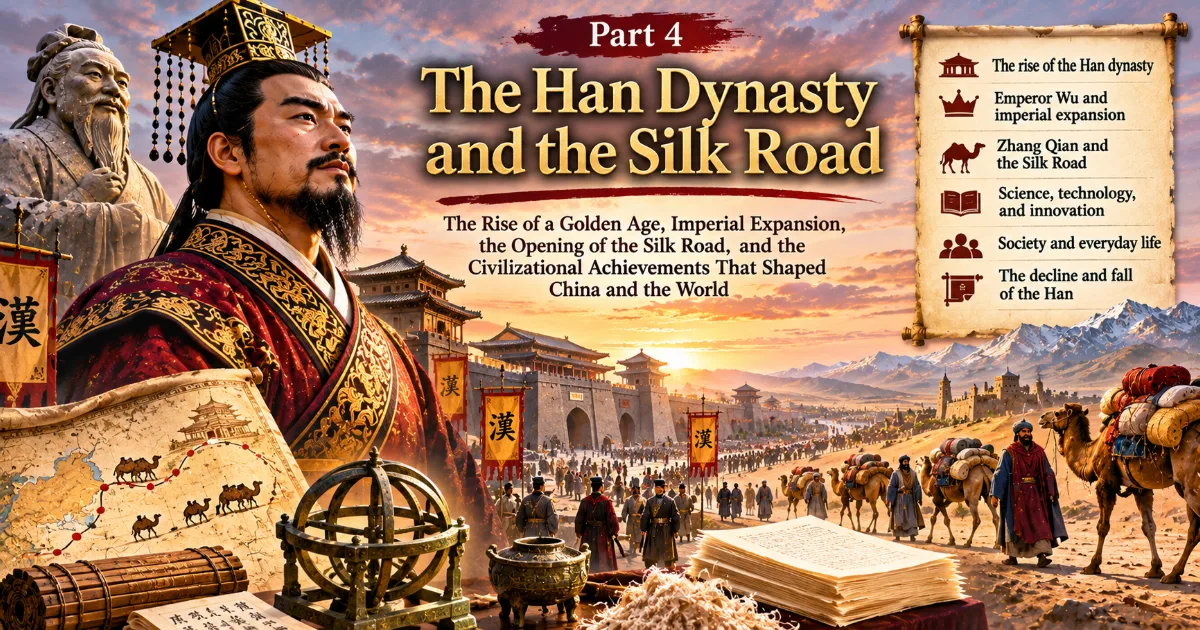
The Han Dynasty played a major role in the development of long-distance trade networks that later became known collectively as the Silk Road.
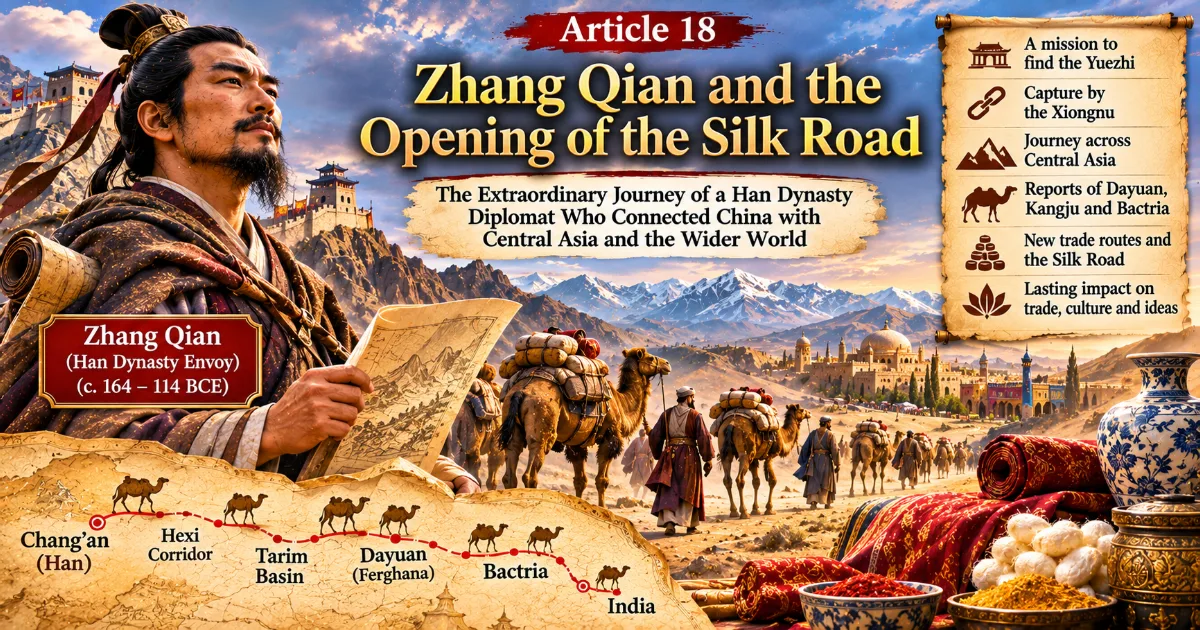
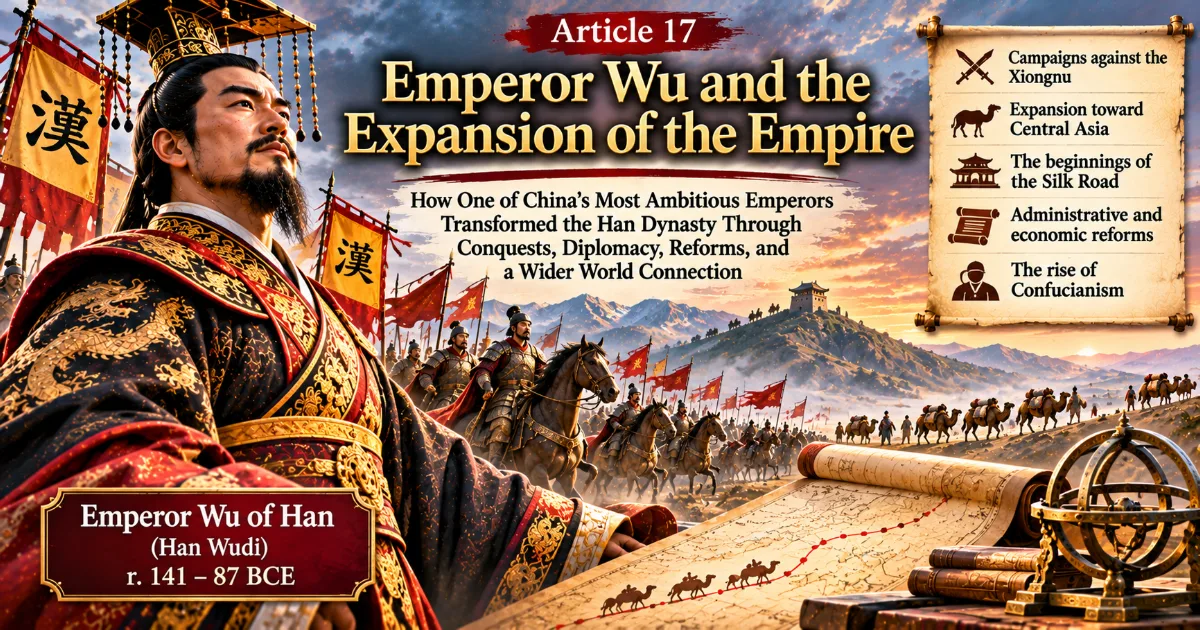
The expansion of these connections was closely associated with Emperor Wu and the diplomatic missions of Zhang Qian. After travelling into Central Asia in the second century BCE, Zhang Qian returned with information about distant kingdoms, trade opportunities, and political relationships.
His reports encouraged the Han court to develop diplomatic and military connections with Central Asian regions. The expansion of Han influence into the Hexi Corridor helped establish important routes linking China with oasis communities in the Tarim Basin.
Trade did not follow one single road. It involved interconnected routes across deserts, mountains, grasslands, and settled regions. Merchants frequently transferred goods between different groups rather than travelling the entire distance themselves.
Chinese silk moved westward, while horses, precious stones, glassware, textiles, and other products travelled eastward through different commercial networks.
Long-distance trade was difficult and dangerous. Merchants faced harsh climates, bandit attacks, political instability, difficult terrain, and the challenge of transporting goods across great distances.
Caravans provided a way to move products through some of these regions. Camels became especially valuable in desert environments because of their ability to travel long distances with limited water.
The Silk Road helped connect Han China with a much wider world. It was not only a commercial network but also a channel through which knowledge, cultural practices, artistic influences, and religious ideas gradually travelled.
Transport and Communication Across the Empire
Transportation was essential to the administration and economy of Han China. The empire required roads, waterways, bridges, canals, and organized communication systems to connect distant regions.
Road networks allowed officials, soldiers, merchants, and travellers to move between settlements. Major routes were particularly important for military campaigns and the transportation of government supplies.
Rivers and canals supported both commercial and administrative transport. Boats could carry heavy goods more efficiently than land transport in suitable regions.
The Grand Canal, which became especially important during the Sui Dynasty, should not be confused with the later large-scale waterway system. Han China nevertheless developed and maintained important canals and water transport routes that supported regional movement.
Government communication systems helped transmit official messages. Couriers and relay arrangements allowed information to travel between administrative centres and frontier regions.
The movement of information was essential during military emergencies, rebellions, natural disasters, and political changes. Delays in communication could weaken government control, particularly in distant territories.
Transport networks also influenced the growth of towns and markets. Settlements located along important roads and waterways often benefited from commercial activity and the arrival of travellers.
Housing and Domestic Life
Housing in Han China varied according to climate, local materials, wealth, and regional building traditions.
Ordinary rural homes were often constructed using locally available materials such as timber, earth, and thatch. Some buildings used rammed-earth techniques, while roofs could be made from thatch or tiles depending on household resources.
Wealthier families could afford larger residences with multiple rooms, enclosed courtyards, decorative elements, and more durable construction materials.
Urban homes were influenced by the layout of cities and the economic position of residents. Wealthy households might have private courtyards and separate spaces for different domestic activities, while poorer residents occupied simpler accommodation.
Domestic spaces were used for cooking, sleeping, storage, textile production, family gatherings, and other household responsibilities.
The arrangement of rooms and buildings could reflect family structure and social hierarchy. Ancestral spaces were particularly important in households that maintained formal traditions of ancestor worship.
Household furniture and equipment included wooden objects, pottery, storage vessels, mats, cooking utensils, and other practical items.
Archaeological discoveries, including models placed in tombs, provide valuable evidence about Han architecture and domestic life. These objects help historians understand how buildings, farms, workshops, and other environments were represented in the period.
Religion, Beliefs, and Spiritual Practices
Han society contained a diverse range of religious and spiritual traditions. People sought explanations for life, death, illness, natural events, and the relationship between human beings and the universe.
Ancestor worship was an important element of family life. Families honoured deceased relatives through offerings, ceremonies, and remembrance. These practices reflected the belief that ancestors remained connected to their descendants in important ways.
Different forms of divination and ritual practice were also used. People sought guidance about decisions, health, travel, marriage, and other aspects of life.
Ideas associated with yin and yang and the Five Phases influenced explanations of natural and human relationships. These concepts were used in different intellectual and religious traditions.
Daoist ideas developed in several forms during this broad period, while religious movements gradually emerged and changed over time. Buddhism also began entering China through routes connected to Central Asia, although its influence expanded more substantially in later centuries.
Han religious life was not uniform. Beliefs varied across regions and social groups, and people could participate in different practices without necessarily seeing them as contradictory.
The imperial court also conducted rituals intended to maintain harmony between the state, heaven, and the natural world. Such ceremonies reinforced the emperor's political and spiritual authority.
Entertainment, Music, and Leisure
People in Han China enjoyed different forms of entertainment and leisure, although opportunities varied according to social position and available resources.
Music played an important role in ceremonies, court entertainment, religious practices, and private gatherings. Instruments included bells, flutes, zithers, drums, and other musical devices.
The imperial court supported elaborate performances and ceremonial music. Wealthy households could also arrange musical entertainment for guests.
Dance and theatrical performances provided additional forms of entertainment. Acrobatic displays, storytelling, juggling, and other performances were popular in different settings.
Games and physical activities formed part of leisure culture. Board games, strategic games, archery, hunting, and various sporting activities were enjoyed by different groups.
Hunting could be a practical activity as well as a form of recreation, particularly among elites. Military training and physical exercises also had important roles in society.
Festivals and seasonal celebrations provided opportunities for communities to gather. Such occasions could involve food, music, rituals, markets, and family visits.
Entertainment was not simply a luxury. It helped maintain social relationships, express cultural identity, and provide relief from the demands of work.
Military Service and Life on the Frontiers
The Han Empire maintained a large military system to defend its borders, protect transportation routes, and expand imperial influence.
Military service affected many families. Men could be required to perform military duties or participate in labour obligations connected with state projects.
Soldiers served in different environments, including frontier garrisons, defensive installations, and active military campaigns. Conditions depended on location, assignment, and the political situation.
Frontier life could be difficult. Soldiers stationed in remote regions faced harsh climates, limited supplies, long periods away from home, and the possibility of conflict.
The northern frontier was particularly important because of the recurring tensions between the Han Empire and the Xiongnu confederation. Military campaigns and defensive operations required substantial resources.
The expansion of Han influence into Central Asia also increased the importance of military settlements and supply routes. Garrison communities could include soldiers, administrators, craftspeople, and other support personnel.
Military service was closely connected to the economy. Armies required grain, clothing, weapons, horses, tools, transport animals, and other supplies. Producing and moving these resources placed significant demands on the state and local populations.
The experiences of ordinary soldiers and their families were often very different from those of generals and imperial officials. While military victories could strengthen the prestige of the dynasty, the human and economic costs were distributed across society.
Law, Punishment, and Social Order
The Han government maintained a legal system intended to preserve order and protect imperial authority.
Laws regulated property, taxation, criminal behaviour, official responsibilities, family relationships, and other aspects of public life.
The Han Dynasty inherited important elements of Qin legal administration but gradually modified aspects of government policy. Confucian ideas increasingly influenced political discussions, although legal institutions and administrative regulations remained central to the state.
Punishments could be severe, particularly for crimes considered threats to the government or public order. Legal penalties varied according to the offence, the individual's status, and the applicable regulations.
Local officials played important roles in investigating disputes, administering justice, collecting taxes, and maintaining records.
Legal documents and administrative records helped the state monitor its population and manage obligations. The government required information about households, land, and resources to maintain an effective system of taxation and service.
However, ordinary people did not always experience the legal system equally. Wealth, influence, and connections could affect the ability to defend property or challenge powerful individuals.
The law was therefore both an instrument of administration and a reflection of the unequal structure of Han society.
Taxes, Labour, and Economic Pressure
The Han government depended on taxation and labour obligations to maintain its institutions and military forces.
Agricultural taxes were particularly important because farming produced the main economic resources of the empire. Households could also face other obligations, including taxes connected to property or personal responsibilities.
Labour service supported the construction and maintenance of roads, canals, defensive structures, government buildings, and other public projects. Military service and related obligations could also affect household labour supplies.
These responsibilities were not always easy for ordinary families to fulfil. A household that lost workers to military or public service might struggle to cultivate its fields or maintain production.
Debt was another source of economic pressure. Poor harvests, illness, family emergencies, and taxation could force households to borrow money or sell property.
When farmers lost their land, they could become tenants or depend on employment from wealthier landowners. This contributed to the concentration of land in the hands of powerful families.
The government sometimes attempted to reduce burdens through tax adjustments, relief measures, and agricultural policies. However, implementation depended on local conditions and the willingness or ability of officials to enforce central decisions.
Economic pressure became increasingly significant during periods of political instability and weakened government authority.
Wealthy Landowners and the Growth of Powerful Families
Large landowning families became increasingly influential during different phases of Han history.
Land was one of the most important sources of wealth because it provided agricultural production and income. Families that controlled extensive estates could employ labourers, collect rents, and establish economic relationships with surrounding communities.
Wealthy households could also develop political connections through education, marriage, and government service. Such networks helped them protect property and strengthen their influence.
The growth of powerful families created challenges for the central government. When large landowners gained control over local resources, the state could find it more difficult to collect taxes and maintain direct authority.
Small farmers were particularly vulnerable when economic difficulties forced them to sell land. Once their property was lost, they might become dependent on wealthy landowners.
The concentration of land and political influence contributed to social tensions during the later Han period. Powerful families could sometimes act with considerable independence, weakening the authority of local administrators and the imperial government.
This development was one of several factors that contributed to the instability of the Eastern Han Dynasty.
The Experience of Foreign Traders and Visitors
The Han Empire was increasingly connected to neighbouring regions through diplomacy, military expansion, and trade.
Foreign merchants and travellers entered Chinese territories through different routes. Some arrived from Central Asian kingdoms, while others were associated with neighbouring peoples and frontier communities.
The exchange of goods created opportunities for cultural interaction. Visitors brought unfamiliar products, clothing styles, artistic influences, and information about distant societies.
The Han court sometimes received foreign envoys and merchants through diplomatic arrangements. Such encounters could involve gifts, negotiations, trade, and political agreements.
Chinese travellers also gathered information about foreign lands. Zhang Qian's missions were particularly important because they introduced the Han court to a wider understanding of Central Asian political and commercial networks.
The movement of people was not always peaceful. Trade routes could pass through contested territories, and relations between the Han government and neighbouring groups sometimes involved warfare.
Nevertheless, contact with other societies helped expand Chinese geographical knowledge and encouraged the development of international commercial relationships.
Regional Differences Across the Han Empire
The Han Empire covered a vast geographical area, and daily life differed significantly from one region to another.
Northern China contained extensive agricultural plains and regions where millet and wheat were important crops. Climate and seasonal patterns influenced farming methods and household activities.
Southern China included warmer and wetter regions where rice cultivation became increasingly important. Rivers, lakes, and waterways influenced settlement patterns and transportation.
Frontier regions experienced different conditions. Some communities lived near military garrisons, defensive installations, and trade routes. Their economies could depend on a combination of agriculture, animal husbandry, military supplies, and commerce.
Urban centres had access to more specialized services and goods than many rural settlements. However, they also depended on transportation networks and agricultural production from surrounding regions.
Regional differences affected clothing, food, housing, religious practices, and economic opportunities.
The Han Empire was therefore not a culturally or economically uniform territory. Its unity depended on shared political institutions, administrative systems, cultural traditions, and networks of communication that connected different communities.
The Changing Conditions of Life During the Later Han
The later centuries of Han rule brought increasing difficulties for many sections of society.
Political conflicts within the imperial court weakened central authority. Powerful families expanded their influence, while corruption and administrative problems affected local government.
Economic pressures also increased. Land concentration, taxation, debt, and natural disasters created hardship for vulnerable households.
The government faced difficulties maintaining military security and controlling distant territories. Frontier conflicts demanded resources, while internal instability reduced the ability of the state to respond effectively.
The Yellow Turban Rebellion, which began in 184 CE, reflected widespread dissatisfaction and social unrest. The movement involved large numbers of people and seriously weakened the Eastern Han government.
Local military commanders and powerful regional leaders gained influence as the central administration struggled to restore order.
The collapse of the Han Dynasty in 220 CE marked the end of an imperial system that had shaped Chinese society for more than four centuries. Yet many social, economic, and cultural institutions continued beyond the dynasty's fall.
What Archaeology Reveals About Everyday Han Life
Historical documents provide important information about Han society, but archaeology offers additional evidence about how people lived.
Tombs, pottery, coins, wooden objects, textiles, tools, buildings, and household models help reconstruct different aspects of everyday life.
Han tombs have produced miniature models of houses, farms, workshops, livestock, and other structures. These objects provide clues about architecture, agriculture, social organization, and ideas about life after death.
The discovery of wooden and bamboo documents has helped historians understand administration, legal systems, taxation, and military organization.
Textile remains reveal the sophistication of weaving and clothing production. Agricultural tools demonstrate the types of equipment used by farmers, while metal objects provide evidence of industrial skill.
The Mawangdui tomb discoveries are particularly important. Sealed during the Western Han period, these tombs contained manuscripts, textiles, food remains, lacquerware, and other objects that provide an unusually detailed picture of elite life and contemporary knowledge.
Archaeological evidence also reminds historians that the past was more varied than written records sometimes suggest. Official histories often focus on emperors, ministers, and major political events. Material evidence helps bring ordinary households and working communities into the historical picture.
The Legacy of Han Society and Everyday Life
The social and economic foundations of the Han Dynasty influenced Chinese civilization long after the dynasty ended.
Agriculture remained central to the economy of later Chinese dynasties. Family organization, ancestor traditions, education, administrative institutions, and classical scholarship continued to shape society.
The Han period also strengthened the connection between political authority and a professional bureaucracy. Government service became an increasingly important path to status and influence, while classical learning developed into a major foundation of elite education.
Commercial networks established and expanded during Han rule helped connect China with distant regions. Silk became an internationally recognized product, and the routes associated with its trade supported centuries of cultural and economic exchange.
Urban life, industrial production, agricultural technology, and monetary systems also continued to develop in later periods.
The term Han eventually became an important cultural identity in Chinese history. Although the reasons for its long-term significance are complex, the dynasty's political and cultural legacy became deeply embedded in later understandings of Chinese civilization.
Conclusion: Understanding the People Behind the Han Empire
The Han Dynasty was more than a succession of emperors, wars, diplomatic missions, and technological discoveries. It was a society built through the work and experiences of millions of people.
Farmers cultivated the fields that supplied the empire with food. Women contributed essential labour to households and textile production. Artisans created tools, pottery, weapons, and luxury goods. Merchants connected markets and distant regions. Scholars preserved knowledge, while officials managed the institutions that held the empire together. Soldiers defended the frontiers and participated in campaigns that expanded imperial influence.
Their lives were shaped by family relationships, economic conditions, regional differences, religious traditions, taxation, education, and social hierarchy. Some enjoyed wealth and opportunity, while others struggled with debt, land loss, disease, and political instability.
The growth of cities and markets, the expansion of silk production, and the development of the Silk Road connected Han communities with a wider world. These networks helped transform China into a major centre of commerce and cultural exchange.
At the same time, inequalities and economic pressures created tensions that became increasingly serious during the later Han period. The weakening of central authority eventually contributed to the dynasty's collapse.
Studying everyday life allows us to understand the Han Dynasty as a living civilization rather than simply a political empire. Its history belongs not only to emperors and generals but also to the ordinary people whose labour, knowledge, and traditions sustained Chinese society.
The achievements of the Han Dynasty were built in palaces and government offices, but they were equally built in villages, farms, workshops, markets, homes, and along the roads that connected distant communities. That is where the human story of Han China can truly be understood.
#HistoryOfChina #HanDynasty #AncientChineseSociety #SilkRoad #ChineseHistory