The Emperor Who Transformed Han China
The Han dynasty began in 202 BCE under Liu Bang, known after his accession as Emperor Gaozu. Its early rulers concentrated on rebuilding the economy, restoring agricultural production, strengthening central authority, and preventing the political instability that had contributed to the collapse of the Qin dynasty. Their policies helped establish a relatively stable empire, but the Han government still faced serious challenges from powerful regional kingdoms and neighbouring peoples.
By the middle of the second century BCE, the political situation had changed considerably. The central government had strengthened its position, agricultural production had recovered in many areas, and the imperial court possessed greater resources than it had during the dynasty's early years. This created an opportunity for a new emperor to pursue a more ambitious foreign and domestic policy.
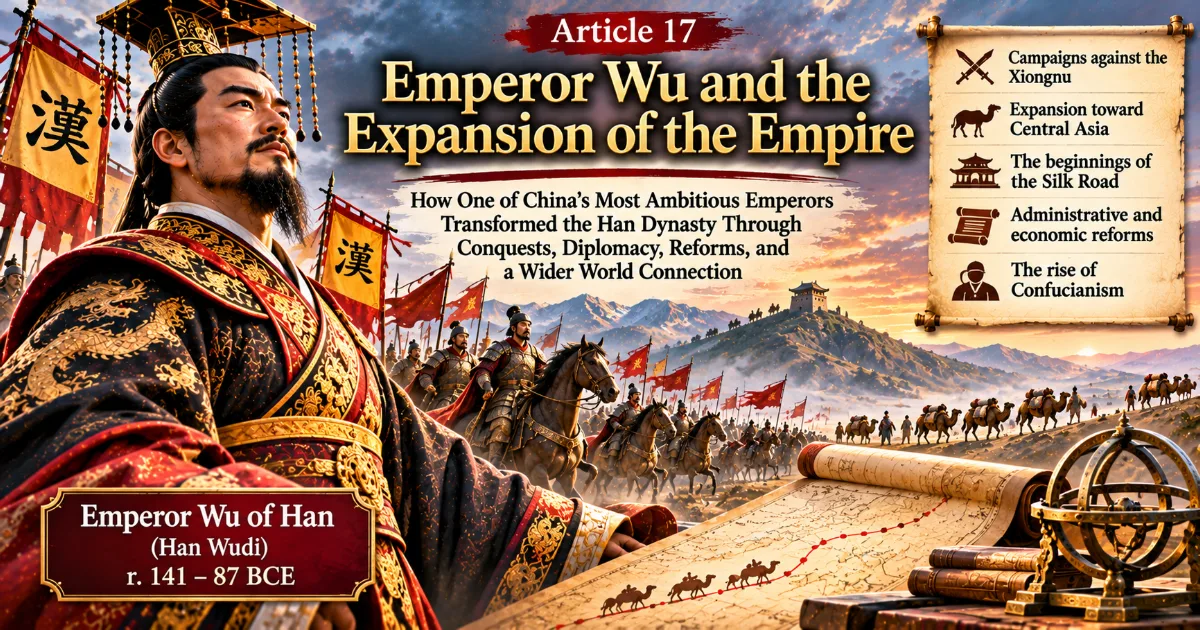
That emperor was Liu Che, known historically as Emperor Wu of Han or Han Wudi. He ruled from 141 to 87 BCE and became one of the most influential rulers in Chinese history. His reign lasted more than five decades and transformed the Han dynasty from a state focused largely on consolidation into a powerful empire with expanding territorial ambitions.
Emperor Wu pursued military campaigns against the Xiongnu confederation to the north, extended Han influence into regions of Central Asia, encouraged diplomatic missions beyond China's western frontier, and strengthened imperial control over important economic resources. His reign also witnessed major developments in government, education, philosophy, trade, and the organization of the imperial court.
Continue Reading
His foreign policy helped create the conditions for the development of the Silk Road, the network of commercial and diplomatic routes that connected China with Central Asia and more distant regions. His domestic policies strengthened the emperor's authority, but they also required substantial financial resources and placed pressure on different sections of society.
Emperor Wu's achievements were therefore accompanied by significant costs. Military expansion required taxes, supplies, manpower, and administrative effort. Some campaigns produced lasting strategic advantages, while others resulted in heavy losses. His government also experienced court conflicts, political purges, and economic difficulties.
Understanding Emperor Wu requires examining both sides of his reign. He expanded the influence of the Han dynasty and helped shape the international position of China, but his ambitions also revealed the financial and human costs of maintaining a large empire.
The Early Life and Rise of Liu Che
Liu Che was born in 156 BCE as a son of Emperor Jing. He belonged to the imperial Liu family and grew up within the political environment of the Han court.
His position in the imperial family did not initially guarantee that he would become emperor. Succession depended on court politics, family relationships, and the decisions of the reigning ruler. Liu Che eventually became crown prince, benefiting from political developments that strengthened his position within the imperial household.
When Emperor Jing died in 141 BCE, Liu Che succeeded him at a young age. He became Emperor Wu, beginning a reign that would last until 87 BCE.
The early years of his rule involved the influence of senior officials, imperial relatives, and advisers. Like other young rulers, he had to establish his authority within a court where powerful individuals competed for influence.
Over time, Emperor Wu developed a more assertive style of government. He sought to strengthen the central administration, reduce the influence of rival political interests, and place the empire on a more ambitious course.
His reign would be remembered for the scale of its military campaigns and the transformation of Han foreign policy.
The Xiongnu: A Major Challenge on the Northern Frontier
One of the most important challenges facing the Han dynasty was the Xiongnu confederation.
The Xiongnu were a powerful political and military confederation of nomadic pastoral groups whose territories extended across parts of the Mongolian Plateau and neighbouring regions. They possessed strong cavalry forces and could move rapidly across vast grasslands.
Their military organization allowed them to conduct raids, disrupt frontier settlements, and challenge the authority of neighbouring agricultural states. Their political system was organized under a supreme ruler known as the Chanyu, who exercised authority over different groups within the confederation.
Relations between the Han dynasty and the Xiongnu were complex. They were not defined only by warfare. Trade, diplomatic negotiations, marriage alliances, gift exchanges, and political agreements also shaped their relationship.
During the early Han period, the Chinese government had often followed a cautious approach. Military defeats and the cost of frontier warfare encouraged the court to negotiate with the Xiongnu rather than attempt continuous conquest.
One important diplomatic arrangement was the policy commonly associated with the heqin system. It involved marriage alliances between the Han imperial family and Xiongnu leadership, alongside the exchange of valuable goods and other diplomatic arrangements.
The policy was intended to reduce military pressure and maintain stability along the northern frontier. However, it did not eliminate conflict. Relations remained uncertain, and raids or disputes continued.
Emperor Wu believed that the Han dynasty had become strong enough to adopt a more assertive policy.
Emperor Wu Changes the Policy Toward the Xiongnu
The beginning of Emperor Wu's reign marked a major change in the Han approach to the northern frontier.
Rather than relying primarily on diplomatic payments and marriage arrangements, the emperor increasingly supported military campaigns intended to weaken Xiongnu power and extend Han influence into strategically important territories.
This change was partly driven by the desire to protect agricultural settlements and secure frontier regions. It was also connected to the emperor's ambition to establish the Han dynasty as a dominant political power in East Asia.
The decision was not without risk. The Xiongnu possessed considerable military mobility, and their cavalry forces were difficult to defeat through conventional warfare. Han armies needed better horses, improved logistics, suitable commanders, and secure supply routes.
Military expansion also required the government to mobilize large numbers of soldiers and resources. Campaigns far from the central agricultural regions could become extremely expensive.
Emperor Wu nevertheless continued to support military operations. His government gradually developed a more organized frontier strategy involving defensive settlements, military colonies, cavalry forces, and campaigns into regions controlled or influenced by the Xiongnu.
The conflict would continue throughout much of his reign.
The Battle of Mobei and the Han Military Offensive
One of the major turning points in the Han-Xiongnu conflict occurred in 119 BCE during the campaigns commonly associated with the Battle of Mobei.
The Han government organized a large military expedition into the northern territories. The operation involved major commanders, including Wei Qing and Huo Qubing, two of the most successful generals of Emperor Wu's reign.
Wei Qing had already gained experience in campaigns against the Xiongnu. His military leadership helped strengthen the Han position along the northern frontier.
Huo Qubing, a younger commander, became famous for his rapid cavalry operations and ability to conduct campaigns deep into enemy territory.
The 119 BCE offensive was designed to strike at Xiongnu power in regions beyond the immediate frontier. Han forces advanced across difficult terrain and engaged enemy groups in a series of operations.
The campaigns inflicted serious losses on the Xiongnu and demonstrated that the Han military could conduct large-scale expeditions far beyond its traditional defensive positions.
However, the operations were extremely demanding. Long distances, difficult weather, limited supplies, and the challenges of maintaining horses and soldiers made such campaigns expensive.
The Han government gained strategic advantages, but the conflict was not permanently resolved. The Xiongnu remained a significant power, and warfare continued in different forms.
Wei Qing: A General Who Strengthened the Han Frontier
Wei Qing became one of the most important military commanders of the Han dynasty.
His rise was notable because he did not come from the highest levels of the aristocracy. Through military ability and connections within the imperial household, he gained opportunities to serve the emperor.
Wei Qing demonstrated skill in organizing campaigns against the Xiongnu. He helped secure important frontier regions and contributed to the expansion of Han military influence.
His success also reflected the emperor's willingness to promote commanders who could deliver results. Military achievement became an important route to status and influence within the Han imperial system.
Wei Qing's campaigns helped change the strategic balance along the northern frontier. The Han government became more capable of defending its territories and launching operations into regions previously dominated by the Xiongnu.
His career also demonstrated how military leadership and imperial politics were closely connected during Emperor Wu's reign.
Huo Qubing: The Young Commander of the Northern Campaigns
Huo Qubing became one of the most celebrated generals of Emperor Wu's reign.
He was related to Wei Qing and gained prominence through his military service. Despite his youth, he demonstrated exceptional ability in cavalry warfare.
Huo Qubing's campaigns were characterized by speed, surprise, and deep movement into enemy territory. These operations were particularly effective against opponents whose military strength depended on mobility and control over wide grassland regions.
In 121 BCE, he conducted important campaigns against Xiongnu groups in the Hexi Corridor region. These operations helped extend Han influence into a strategically valuable area connecting the central Chinese territories with the western regions.
The Hexi Corridor was extremely important because it provided access toward the oases and routes of Central Asia. Controlling it would allow the Han government to strengthen frontier defences and improve communications with regions farther west.
Huo Qubing's victories helped establish a stronger Han presence in this corridor.
He died in 117 BCE at a relatively young age. His death ended a promising military career, but his campaigns remained an important part of Han military history.
The Strategic Importance of the Hexi Corridor
The Hexi Corridor became one of the most important geographical areas in the expansion of Han influence.
It is a narrow region of land located between mountain ranges and desert areas in what is now Gansu Province. Its geography made it a natural passage connecting the central Chinese territories with the western regions of Central Asia.
Control of this corridor provided several advantages.
It helped protect the western approaches to the Han Empire, supported military movements, and offered access to oasis settlements where travellers and merchants could obtain water and supplies.
The region also became important for the development of the Silk Road. Commercial caravans travelling between China and Central Asia needed routes through which they could cross difficult desert environments.
By strengthening its presence in the Hexi Corridor, the Han government improved its ability to communicate with the western regions and protect the routes used by diplomats and merchants.
The area later became associated with important frontier commanderies and military settlements.
Its strategic importance continued long after Emperor Wu's reign.
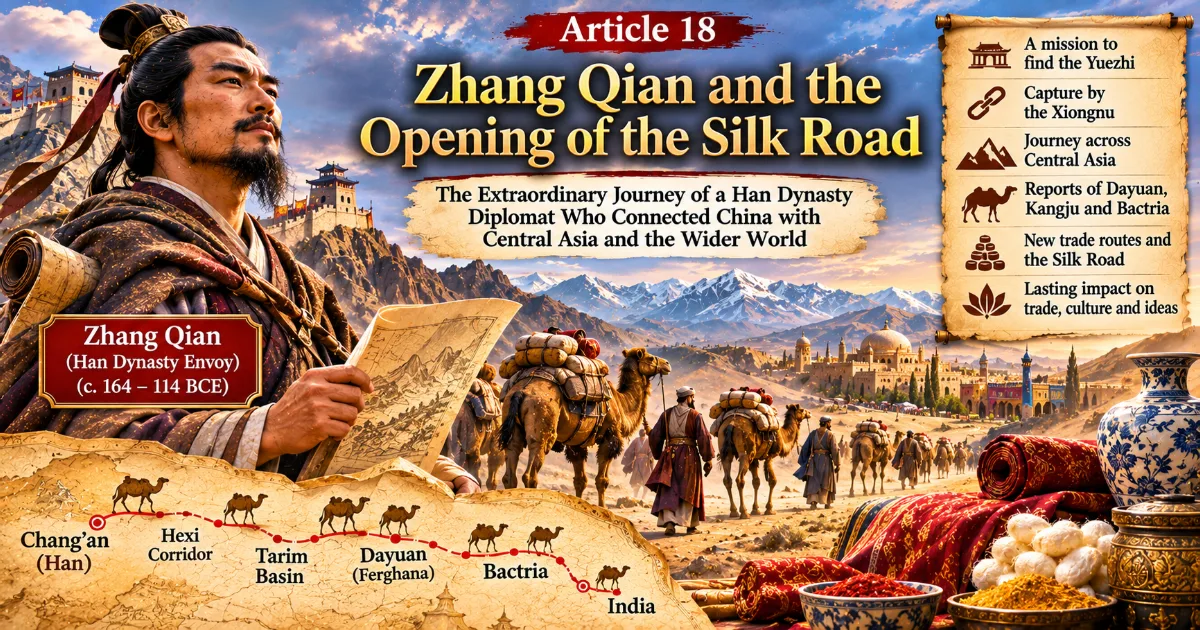
Zhang Qian and the Diplomatic Mission to the West
Emperor Wu's foreign policy was not limited to military campaigns. He also sought diplomatic relationships with political powers beyond the traditional boundaries of the Han Empire.
One of the most important figures associated with this effort was Zhang Qian.
In 138 BCE, Zhang Qian was sent on a mission westward to establish contact with the Yuezhi. The Han court hoped that an alliance with the Yuezhi might help create a common front against the Xiongnu.
The journey was extremely difficult. Zhang Qian and his companions travelled through regions controlled by the Xiongnu and were captured. He remained in captivity for several years, but eventually escaped and continued his mission.
His journey took him through Central Asian territories and introduced him to societies that were unfamiliar to the Han court.
He visited or gathered information about regions associated with the Dayuan, Kangju, and other Central Asian political communities. He also reached the Yuezhi, who had moved westward after earlier conflicts with the Xiongnu.
Zhang Qian was unable to establish the military alliance originally intended by Emperor Wu. Nevertheless, his mission was enormously valuable.
He returned with information about geography, political relationships, agricultural production, horses, trade goods, and the possibilities for diplomatic exchange.
His reports helped the Han government understand that the world beyond its western frontier contained powerful and commercially important societies.
The Importance of Central Asian Horses
One of the most important discoveries associated with Han diplomatic contact with Central Asia was the quality of the horses available in the region.
The Han government needed strong horses for cavalry warfare. The horses available in many Chinese territories were not always suitable for the demands of long-distance military operations.
Central Asian horses, particularly those associated with the Ferghana region, were highly valued for their strength and endurance.
The Han court became especially interested in the horses of Dayuan, a kingdom located in the Ferghana Valley.
These horses became famous in Chinese accounts and were sometimes described using the expression "heavenly horses."
Emperor Wu wanted to obtain them in large numbers because he believed they could strengthen the Han cavalry.
The search for these horses eventually contributed to a major military campaign against Dayuan in the late second century BCE.
This episode demonstrates how practical military requirements could influence diplomatic and commercial policy.
The expansion of Han influence into Central Asia was driven not only by territorial ambition but also by the need to secure resources that could strengthen the empire.
The Campaign Against Dayuan
Dayuan occupied a strategically important position in the Ferghana Valley, in present-day Central Asia.
Its horses were highly valued by the Han court, and diplomatic efforts to obtain them did not always produce the results Emperor Wu desired.
The emperor eventually authorized military action.
The first expedition against Dayuan, led by Li Guangli in 104 BCE, encountered serious difficulties. The Han forces suffered from shortages of supplies, harsh conditions, and resistance from local populations.
The expedition failed to achieve its objectives and suffered heavy losses.
Emperor Wu later organized a much larger campaign. Li Guangli returned with a stronger force and greater logistical support.
After a prolonged operation, the Han army forced Dayuan to negotiate. The resulting settlement provided the Han court with access to valuable horses and strengthened its diplomatic position in the region.
The campaign demonstrated the growing reach of the Han military, but it also revealed the enormous expense of projecting power far beyond the empire's central territories.
The experience showed that distant military operations required careful preparation, reliable supply systems, and realistic political objectives.
The Expansion of Han Influence into the South
Emperor Wu also expanded Han influence toward southern China and the regions beyond its traditional southern frontier.
During the early Han period, the southern territories included several kingdoms and political communities with different levels of connection to the imperial court.
One important state was Nanyue, which had emerged after the collapse of Qin authority. It occupied areas corresponding broadly to parts of modern Guangdong, Guangxi, and northern Vietnam.
Nanyue maintained a degree of independence while also participating in diplomatic and commercial relationships with the Han Empire.
In 111 BCE, Han forces conquered Nanyue and brought its territory under imperial administration.
The expansion increased Han influence across southern regions and strengthened the empire's access to important trade routes and coastal areas.
However, integrating these territories was a complex process. Local populations possessed their own languages, traditions, political institutions, and social structures.
The Han government needed to establish administrative control while managing relationships with local leaders.
The southern campaigns therefore expanded the empire geographically but also created long-term challenges associated with governing diverse territories.
Han Expansion into the Southwest
The Han government also increased its involvement in the southwestern regions.
These territories included mountainous areas and communities that were politically and culturally different from the central agricultural heartland.
The region contained important routes connecting China with areas of present-day Yunnan and neighbouring parts of mainland Southeast Asia.
The imperial court was interested in these territories for strategic, diplomatic, and economic reasons.
Han officials established commanderies and attempted to extend administrative authority into selected areas. However, geographical barriers and local resistance limited the extent of direct control.
The process of expansion was gradual and uneven. Some territories came under stronger imperial administration, while others maintained significant local autonomy.
These developments helped broaden the geographical reach of the Han state and laid foundations for later relationships between the Chinese imperial government and southwestern communities.
The Expansion Toward the Korean Peninsula
Emperor Wu's government also expanded Han influence into parts of the Korean Peninsula.
The region contained several political communities with their own rulers and institutions. One important kingdom was Gojoseon, which had developed in the northern part of the peninsula and surrounding areas.
Relations between the Han Empire and Gojoseon became increasingly tense during the second century BCE.
In 108 BCE, Han forces defeated Gojoseon and established commanderies in parts of the conquered territory.
These administrative districts became important points of contact between the Han Empire and communities on the Korean Peninsula.
However, the degree of Han control varied over time, and local political resistance remained significant.
The expansion created new diplomatic and commercial connections while also producing conflicts over territory and authority.
It demonstrated that Emperor Wu's ambitions extended in several directions, not only toward Central Asia and the northern frontier.
Centralizing Imperial Authority
Military expansion was only one part of Emperor Wu's transformation of the Han dynasty. He also introduced policies intended to strengthen central government.
The early Han system had allowed members of the imperial family and certain allied rulers to govern regional kingdoms. Although this arrangement had helped secure political loyalty after the civil war, it created a potential challenge to the emperor's authority.
The Rebellion of the Seven States in 154 BCE had demonstrated the danger of powerful regional kingdoms.
Emperor Wu continued the process of reducing their influence. One important reform was the policy associated with the imperial decree of 127 BCE, commonly known as the Tui En Ling or Order of Grace.
Under this policy, regional kings were encouraged or required to divide their territories among multiple heirs rather than passing the entire kingdom to a single successor.
This reduced the size and political strength of individual kingdoms over successive generations.
The reform was politically effective because it weakened regional power without requiring the immediate abolition of every royal title.
Over time, more authority passed to the central government and its appointed officials.
The policy helped strengthen the imperial structure and made it easier for the emperor to govern the empire through a more centralized administration.
Confucianism and the Imperial Government
Emperor Wu's reign was also important for the growing influence of Confucian scholarship.
Confucius had lived several centuries earlier, but his teachings increasingly appealed to rulers who wanted to present imperial authority as a morally responsible institution.
Confucian thought emphasized proper conduct, education, respect for social relationships, ethical leadership, and the responsibilities of rulers.
During Emperor Wu's reign, the scholar Dong Zhongshu became associated with efforts to establish Confucian learning as a central intellectual foundation of government.
The court supported institutions for the study of classical texts and the education of officials.
The Imperial Academy, traditionally dated to 124 BCE, became an important centre for training scholars in the Confucian classics.
This development helped establish a stronger relationship between education and government service.
It did not mean that the Han state abandoned other approaches to administration. Legal rules, taxation, military discipline, and practical statecraft remained essential.
Instead, Confucian learning increasingly provided the moral and intellectual language through which imperial authority was justified.
This relationship between Confucian scholarship and government became one of the defining features of later Chinese history.
Economic Reforms and State Control
Emperor Wu's military and diplomatic ambitions required substantial financial resources.
The government needed money to maintain armies, construct defensive installations, transport supplies, support officials, and manage distant territories.
To meet these demands, the emperor introduced several economic policies that increased the state's involvement in important sectors of the economy.
One major measure was the nationalization or state control of the production and distribution of salt and iron in important areas.
Salt was an essential commodity, and iron was important for agricultural tools, weapons, and military equipment. Control over these industries offered the government a significant source of revenue.
The state also introduced measures affecting the currency and commercial activity.
In 119 BCE, the government introduced important monetary reforms and strengthened central control over coin production.
These policies helped the imperial court improve revenue collection and reduce the influence of certain private economic interests.
However, state monopolies could create difficulties for merchants and producers. Government control did not always produce efficient administration, and the policies generated debate over the proper relationship between the state and the economy.
The economic measures of Emperor Wu demonstrate that imperial expansion required changes not only in military organization but also in the structure of financial administration.
The Debate on Salt and Iron
The economic policies of Emperor Wu remained controversial even after his death.
In 81 BCE, officials and representatives of different social interests participated in a major debate concerning state monopolies and economic policy. The discussion is preserved in a historical work known as the Discourses on Salt and Iron.
The debate considered whether government control over essential industries benefited society or placed unnecessary burdens on producers and merchants.
Supporters of state control argued that the revenue was necessary to defend the empire and maintain public institutions.
Critics believed that monopolies could reduce economic freedom, create administrative inefficiency, and harm ordinary producers.
The debate is important because it reveals that Han economic policy was not simply a matter of imperial orders. It involved disagreements about taxation, government responsibility, commercial activity, and the relationship between military spending and economic welfare.
The discussions continued to influence later Chinese political thought.
The Human and Financial Costs of Expansion
The territorial expansion of Emperor Wu's reign brought important strategic advantages, but it also created significant burdens.
Military campaigns required soldiers, horses, weapons, food, transport animals, and supplies. Many operations took place far from the agricultural heartland, making logistics difficult and expensive.
Farmers could be required to provide labour, transport services, or supplies. Taxation and compulsory obligations placed pressure on households, particularly during periods of repeated military campaigns.
The empire also faced the challenge of maintaining newly acquired territories. Conquest did not automatically produce stable administration. Officials, soldiers, roads, fortifications, and supply systems had to be established and maintained.
Some campaigns resulted in heavy casualties, while others failed to produce lasting advantages.
The financial pressure contributed to the emperor's later reconsideration of his policies.
Emperor Wu's reign therefore demonstrates the central dilemma of imperial expansion: territorial gains could strengthen a state, but maintaining those gains could become more expensive than the original conquest.
The Witchcraft Crisis and Political Purges
The later years of Emperor Wu's reign were also marked by serious political turmoil.
Court factions competed for influence, and the emperor became increasingly concerned about threats to his authority.
One of the most serious episodes was the so-called witchcraft crisis, which occurred in 91 BCE.
Accusations of sorcery and attempts to harm the emperor led to investigations, political conflict, and widespread executions.
The crisis involved members of the imperial family and senior officials. The crown prince Liu Ju became caught in the conflict and eventually rebelled against the court.
The uprising was defeated, and Liu Ju died after the rebellion collapsed. His death became one of the most tragic episodes of Emperor Wu's reign.
The witchcraft crisis damaged the stability of the imperial household and revealed the dangers of suspicion and factional conflict within the court.
It also showed that even a powerful emperor could become vulnerable to political manipulation and fear.
The Later Years of Emperor Wu
As Emperor Wu grew older, the costs of his ambitious policies became increasingly difficult to ignore.
Military campaigns had expanded Han influence, but they had also placed pressure on the population and government finances.
The emperor's court had experienced political struggles, and the loss of the crown prince created a succession problem.
In 89 BCE, Emperor Wu issued what is commonly known as the Luntai Edict, traditionally interpreted as an important statement of regret concerning some of his earlier policies.
The edict is associated with a shift toward reducing excessive military expansion and placing greater attention on agricultural recovery and the welfare of the population.
It did not mean that the Han Empire abandoned its territorial interests. Rather, it reflected an acknowledgment that the state needed to balance ambition with economic and social stability.
Emperor Wu died in 87 BCE after a reign of approximately fifty-four years.
He was succeeded by his young son Liu Fuling, who became Emperor Zhao.
The empire he left behind was larger and more influential than the one he had inherited, but it also faced the consequences of decades of expensive policies.
The Historical Legacy of Emperor Wu
Emperor Wu's reign had a lasting influence on Chinese history.
His military campaigns strengthened Han influence along the northern frontier and expanded the empire's reach into Central Asia, southern China, and parts of the Korean Peninsula.
His diplomatic initiatives encouraged greater contact with societies beyond China's western frontier. The journeys of Zhang Qian helped the Han court understand the political and economic possibilities of Central Asia.
These developments contributed to the growth of trade routes that later became known collectively as the Silk Road.
Emperor Wu also strengthened central government, reduced the power of regional kingdoms, and supported the growing importance of Confucian scholarship in administration.
His economic reforms increased state control over important industries and expanded the financial capacity of the imperial government.
However, his reign also revealed the costs of imperial ambition. Military expansion placed pressure on farmers and government finances, while court conflicts created instability within the imperial household.
His legacy is therefore complex. He is remembered as a powerful and ambitious ruler who expanded the influence of Han China, but also as an emperor whose policies sometimes placed excessive demands on the empire.
Conclusion: The Emperor Who Opened Han China to the World
Emperor Wu transformed the Han dynasty during one of the most consequential reigns in Chinese history.
When he came to power in 141 BCE, the dynasty had already established a relatively stable political foundation. He used that strength to pursue a more ambitious vision of imperial power.
His campaigns against the Xiongnu changed the balance of power along the northern frontier. His generals extended Han influence into strategically important regions, while diplomatic missions opened new possibilities for relationships with Central Asian kingdoms.
The journey of Zhang Qian became especially important because it introduced the Han court to a wider network of societies and commercial opportunities. The routes that developed through these contacts eventually became part of the historic Silk Road network.
At home, Emperor Wu strengthened imperial authority, reduced the independence of regional kingdoms, supported Confucian education, and expanded state involvement in important industries.
His policies created a more powerful empire, but they also demonstrated that expansion required enormous resources and could place heavy burdens on society.
The historical importance of Emperor Wu lies not only in the territories he brought under Han influence but also in the political and cultural direction he gave to China.
Under his rule, the Han dynasty became a major power whose relationships extended far beyond its traditional borders. The foundations were laid for centuries of exchange between China and the wider world.
His reign marked a decisive stage in the development of Chinese imperial civilization.
What Comes Next
The next article explores the diplomatic journey that helped connect Han China with the wider world.
Article 18: Zhang Qian and the Opening of the Silk Road will examine his extraordinary travels, encounters with Central Asian societies, the development of commercial routes, and the beginning of a network that transformed trade and cultural exchange across Eurasia.
#HistoryOfChina #EmperorWu #HanDynasty #AncientChina #SilkRoad