A New Empire Emerges from the Ashes of Qin
The fall of the Qin dynasty in 206 BCE marked the end of China's first attempt to govern the entire country under a single centralized empire. Although Qin Shi Huang had unified the competing states and introduced a powerful administrative system, his dynasty did not survive long after his death. Harsh laws, heavy taxation, compulsory labour, military campaigns, and political struggles created widespread dissatisfaction. Rebellions spread across the empire, and the authority of the Qin government rapidly collapsed.
However, the end of the Qin dynasty did not mean that China would return permanently to the divided political order that had existed before unification. The idea of a unified empire had already transformed the country's political landscape. The institutions established by Qin, including centralized administration, territorial divisions, standardized systems, and imperial authority, continued to influence the ambitions of the leaders who emerged after its collapse.
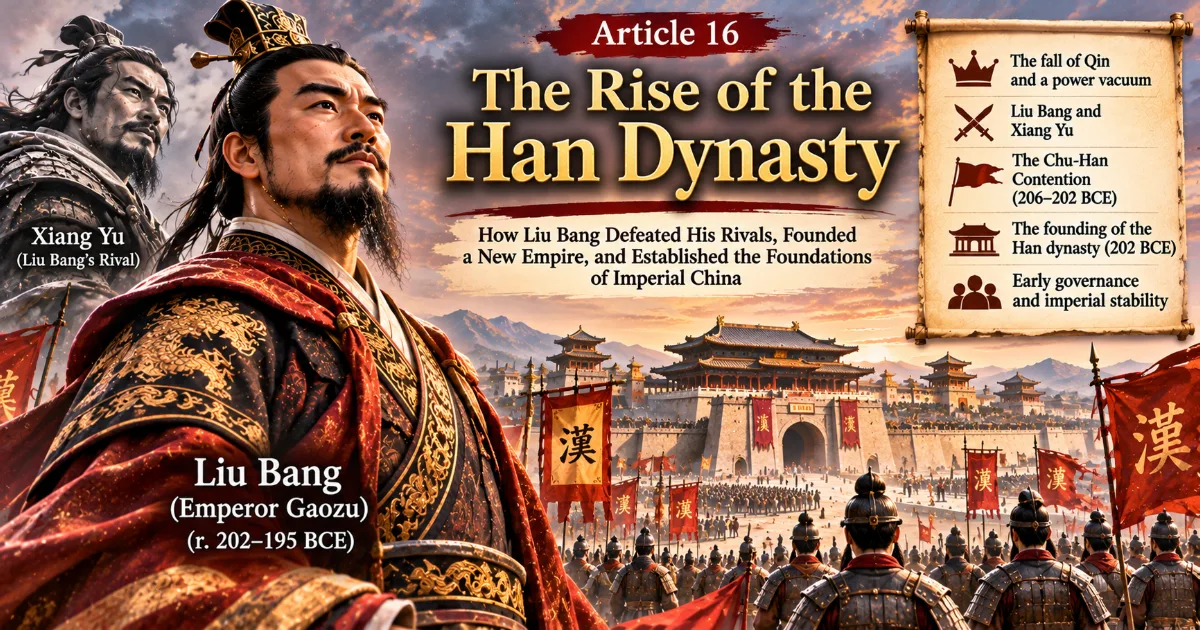
Among those leaders, two figures became especially important: Xiang Yu, a powerful military commander from the former state of Chu, and Liu Bang, a leader who came from a comparatively modest background. Both participated in the struggle against Qin, but their rivalry eventually developed into a major conflict for control of China.
Their struggle, known as the Chu-Han Contention, lasted several years and determined the future direction of Chinese civilization. Xiang Yu possessed extraordinary military ability and enjoyed considerable prestige among many former aristocratic families. Liu Bang, however, demonstrated a different kind of strength. He built alliances, attracted capable advisers, developed an effective administration, and understood the importance of gaining popular support.
Continue Reading
In 202 BCE, Liu Bang defeated Xiang Yu and established the Han dynasty. Taking the imperial title Gaozu, he became the first emperor of the new dynasty and began rebuilding a unified political system.
The Han dynasty would eventually become one of the longest-lasting and most influential dynasties in Chinese history. Its political institutions, cultural traditions, administrative practices, and international connections shaped China for centuries. The rise of the Han was therefore much more than the victory of one military leader over another. It represented the creation of a new imperial model that combined the administrative achievements of Qin with a more flexible approach to governing society.
The Political Situation After the Fall of Qin
The Qin dynasty collapsed because its government struggled to maintain control over a vast territory that had been brought together through conquest. Qin Shi Huang had created a centralized system, but the political structure depended heavily on the authority of the emperor and the efficiency of his officials.
When the First Emperor died in 210 BCE, the succession was manipulated by powerful court officials. His son, Huhai, became the Second Emperor, but he lacked the political experience and authority needed to govern effectively. Court struggles, executions, administrative pressure, and military demands weakened the government further.
In 209 BCE, an uprising led by Chen Sheng and Wu Guang helped trigger a much wider rebellion. Their revolt inspired other groups to challenge Qin authority. Former kingdoms that had been conquered during the unification campaigns began to reappear as political forces, and local leaders attempted to restore their independence.
The Qin government could no longer respond effectively to the growing number of rebellions. Its armies faced opposition across different regions, while the imperial court became increasingly divided.
By 206 BCE, the Qin dynasty had effectively ended. The collapse created a political vacuum in which several military leaders competed for territory and authority.
The question was no longer whether the Qin government could survive. It was whether China would once again become a collection of rival states or whether a new leader could establish another unified empire.
The Emergence of Liu Bang
Liu Bang, later known as Emperor Gaozu of Han, was born around 256 BCE in Pei County, in what is now Jiangsu Province. His background was very different from that of the powerful aristocratic families that had dominated many of China's earlier kingdoms.
He came from a relatively ordinary family and eventually served in a minor local administrative position. Historical accounts describe him as sociable, confident, and comfortable dealing with different kinds of people. He was not initially regarded as an obvious candidate to rule a great empire.
Liu Bang's early career brought him into contact with the weaknesses of Qin administration. His position involved responsibilities connected with local law and official duties. During one assignment, he was responsible for escorting prisoners. When some prisoners escaped, he faced the possibility of punishment under the strict Qin legal system.
According to traditional accounts, Liu Bang eventually released the remaining prisoners and became an outlaw himself. Some of those who escaped reportedly joined him, helping him build a small following.
Although the details of his early life are preserved through historical accounts written after his rise to power, the broader picture is clear. Liu Bang began as a local leader with limited resources and gradually became involved in the rebellion against Qin.
His greatest strength was not an extraordinary military reputation at the beginning of his career. It was his ability to build relationships and attract capable people who could contribute to his growing movement.
The Rebellion Against Qin
The collapse of Qin authority encouraged different rebel leaders to establish their own military and political bases. Liu Bang joined the wider resistance and gradually became one of the important commanders operating in the former Qin territories.
A major development occurred when the rebel forces moved toward the Qin heartland. Liu Bang's forces advanced toward the capital region, taking advantage of the weakening government.
In 207 BCE, Liu Bang entered the Guanzhong region, where the Qin capital of Xianyang was located. The last Qin ruler, Ziying, surrendered to him, bringing the dynasty to its final end.
Liu Bang's treatment of the defeated population became an important part of his political reputation. Traditional accounts describe him as promising to reduce the harshness of Qin rule and limiting the punishment imposed on ordinary people.
He was also associated with a simplified set of laws intended to replace the severe legal environment of the Qin government. Although the historical details require careful interpretation, these actions helped distinguish his leadership from the unpopular policies of the previous dynasty.
However, Liu Bang did not immediately become the uncontested ruler of China. Another powerful commander, Xiang Yu, held enormous military influence and regarded himself as the leading figure among the victorious rebel forces.
The destruction of Qin therefore opened a new struggle rather than producing immediate political unity.
Xiang Yu: The Powerful Rival
Xiang Yu was born into a family associated with the former state of Chu. His uncle, Xiang Liang, helped lead resistance against Qin, and Xiang Yu became an important commander within the rebellion.
Unlike Liu Bang, Xiang Yu came from a background connected with the old aristocratic military tradition. He developed a reputation for courage, strength, and battlefield leadership.
His forces achieved several important victories against Qin armies. The Battle of Julu in 207 BCE became one of his most famous military achievements. Xiang Yu's army defeated a major Qin force and helped destroy the remaining military strength of the dynasty.
After the fall of Qin, Xiang Yu possessed enormous prestige among the rebel commanders. He divided much of the former Qin territory among several regional rulers and awarded himself the title of Hegemon-King of Western Chu.
Liu Bang was given control of the region of Han, located around the upper Han River and parts of the area near modern Sichuan and Shaanxi. This territory was strategically important but was not the central position Liu Bang had expected after entering Xianyang.
Xiang Yu's distribution of territories reflected his attempt to preserve a system of regional kings rather than immediately establish a single centralized empire. He wanted to remain the dominant military authority within this arrangement.
However, his decisions created dissatisfaction among several leaders. Some believed that their contributions to the rebellion had not been properly rewarded. Others rejected the authority of the rulers appointed by Xiang Yu.
Liu Bang was among those who refused to accept a permanently subordinate position.
The Chu-Han Contention Begins
The conflict between Liu Bang and Xiang Yu became known as the Chu-Han Contention. It lasted from 206 to 202 BCE and involved a combination of military campaigns, shifting alliances, political negotiations, and strategic manoeuvres.
At first, Xiang Yu appeared to possess the stronger position. His military reputation was considerable, and he controlled a powerful army. Liu Bang, meanwhile, needed time to consolidate his territory and organize his resources.
Liu Bang's position in the western territories offered certain strategic advantages. The mountainous geography of the region provided defensive protection, while the agricultural resources of the surrounding areas could support a growing army.
He also developed relationships with capable commanders and advisers. These individuals helped him manage administration, organize supplies, plan military operations, and build political alliances.
The conflict was not simply a contest between two generals. It was a struggle between two different approaches to political leadership.
Xiang Yu relied heavily on personal military prestige and direct battlefield success. Liu Bang increasingly developed a broader political and administrative organization capable of supporting a long campaign.
This distinction became particularly important as the conflict continued.
Liu Bang Builds His Political and Military Organization
One of the most important reasons for Liu Bang's eventual success was his willingness to recognize the abilities of other people.
He attracted advisers and commanders whose expertise strengthened different aspects of his movement. Among the most important were Xiao He, Zhang Liang, and Han Xin.
Xiao He was an experienced administrator who played a major role in organizing government, managing supplies, and maintaining the administrative foundations of Liu Bang's growing power.
Zhang Liang was an influential strategist whose advice helped Liu Bang make important political and military decisions. His knowledge of strategy and court politics proved valuable during the struggle against Xiang Yu.
Han Xin became one of the most capable military commanders of the period. His strategic ability helped transform Liu Bang's military position and enabled the Han forces to challenge Xiang Yu more effectively.
These individuals had different skills, and their contributions were complementary. Liu Bang did not need to be the best administrator, strategist, and battlefield commander at the same time. Instead, he needed to recognize talent and give capable people responsibilities.
This approach gradually created a more effective organization.
Liu Bang's ability to reward loyalty, build alliances, and maintain relationships with important commanders also helped him attract support from groups that were dissatisfied with Xiang Yu.
His growing political network became one of his most important advantages.
The Strategic Importance of Guanzhong
The Guanzhong region played a central role in the rise of the Han dynasty.
Located around the Wei River valley in present-day Shaanxi, Guanzhong had been the political centre of the Qin state and later became the heartland of the Han Empire.
Its geographical position offered important defensive advantages. Mountain ranges and narrow passages limited access from several directions, making the region easier to defend than many open plains.
The area also possessed agricultural resources that could support a large population and military force. The Wei River system and surrounding farmland contributed to its economic importance.
By controlling this region, Liu Bang gained access to a strategic base from which he could organize military operations and eventually challenge Xiang Yu.
The importance of Guanzhong also influenced the decision to establish the Han capital at Chang'an. Its location allowed the imperial government to maintain strong connections with the western territories while remaining close to the central regions of China.
The choice of capital reflected the strategic lessons learned from the conflicts that followed the Qin collapse.
The Changing Balance of Power
As the Chu-Han Contention continued, the balance of power gradually shifted.
Xiang Yu remained a formidable military commander, but his political position became increasingly difficult. His treatment of rival leaders and his reliance on military authority created resentment among some of the groups that might otherwise have supported him.
Liu Bang, in contrast, expanded his influence by offering political arrangements and rewards to commanders who joined his side.
The Han forces also benefited from their growing ability to coordinate campaigns across different territories. While Liu Bang managed the broader political organization, commanders such as Han Xin carried out important military operations.
Han Xin's campaigns in the northern territories were particularly significant. He defeated rival forces and helped bring several regions under Liu Bang's influence.
The resulting expansion reduced Xiang Yu's access to allies and resources. It also forced him to fight on several fronts rather than concentrate his full strength against Liu Bang.
The conflict increasingly became a test of endurance, organization, and political coordination.
The Battle of Gaixia
The decisive stage of the Chu-Han Contention came in 202 BCE at Gaixia, in present-day Anhui Province.
By this time, Xiang Yu's position had become increasingly difficult. His forces were surrounded by the Han army and its allied troops. Liu Bang's commanders had coordinated their movements to restrict Xiang Yu's ability to escape or obtain reinforcements.
Traditional historical accounts describe a famous psychological tactic associated with the battle. Han forces reportedly used songs associated with the state of Chu to create the impression that large numbers of Xiang Yu's own people had joined the opposing side.
The sound of these songs was intended to weaken the morale of the Chu army by suggesting that its homeland had already been lost.
Whether every detail of this account occurred exactly as later historians described it is difficult to establish. Nevertheless, the story reflects the importance of psychological pressure and morale in ancient warfare.
Xiang Yu eventually attempted to break through the encirclement. He escaped the immediate battlefield with a smaller group of followers, but his remaining forces were defeated.
According to traditional accounts, Xiang Yu reached the banks of the Wu River, where he died by suicide rather than surrendering.
His death ended the principal military resistance to Liu Bang's rise.
The Battle of Gaixia became a defining moment in Chinese history because it marked the victory of Liu Bang and the beginning of a new unified imperial order.
The Founding of the Han Dynasty in 202 BCE
After defeating Xiang Yu, Liu Bang emerged as the most powerful political leader in China.
In 202 BCE, he formally established the Han dynasty and took the imperial title Gaozu. He became the first emperor of a dynasty that would leave a lasting mark on Chinese civilization.
The new government inherited a country that had experienced years of warfare, political uncertainty, and economic disruption. Large areas needed reconstruction, agricultural production required recovery, and the population needed relief from the demands of prolonged conflict.
Gaozu's immediate priority was to establish stable authority.
He selected Chang'an as the capital and began organizing the imperial administration. The new government retained many of the institutional practices developed under Qin, but it also introduced policies intended to reduce the pressures that had contributed to the previous dynasty's collapse.
The founding of the Han dynasty therefore represented both continuity and change. It preserved the idea of a centralized empire while adapting the methods used to govern it.
Why Liu Bang Chose Chang'an as His Capital
The choice of Chang'an was one of the most important decisions of the early Han government.
The city was located in the Guanzhong region, close to the former Qin capital of Xianyang. The area had already served as a major political centre and possessed the infrastructure needed to support an imperial government.
Chang'an's location offered several advantages. It was protected by natural barriers, connected to important agricultural areas, and positioned near routes leading toward the western territories.
The city developed into a major administrative and commercial centre. Its palaces, government offices, markets, workshops, and residential districts reflected the growing power of the new dynasty.
Chang'an would later become one of the most important cities in the ancient world. During the Han period, it attracted officials, merchants, craftsmen, soldiers, scholars, and diplomatic representatives.
The establishment of the capital also demonstrated that the Han rulers intended to preserve the political unity achieved under Qin rather than return to the older pattern of competing regional states.
Rebuilding the Economy After Years of War
The early Han government inherited an economy weakened by decades of political and military conflict.
Agricultural production had been disrupted in many regions. Some communities had lost workers, livestock, tools, and access to farmland. Transport networks and local markets also required restoration.
Gaozu and his successors understood that political stability depended on economic recovery.
The government adopted policies intended to reduce the burden on ordinary households. Taxation was generally kept lower than under the final years of Qin rule, although rates and obligations varied across periods and regions.
The state also encouraged people to return to agriculture and rebuild abandoned settlements. Land cultivation was essential because agricultural production provided food for the population, revenue for the government, and supplies for the army.
The early Han emperors sought to restore confidence among farmers and local communities. A more stable rural economy would make it easier for the government to collect revenue without provoking the widespread resistance that had weakened Qin.
These policies contributed to a period of recovery during the early Western Han.
The Han Approach to Government: Continuity and Reform
The Han dynasty did not reject the Qin system completely. Instead, it preserved many of its administrative foundations while changing aspects of its political and economic approach.
The Qin dynasty had divided the empire into administrative commanderies and counties governed by appointed officials. The Han government retained this system in many areas because it allowed the emperor to exercise authority through a hierarchy of administrators.
However, the early Han rulers also granted territories to members of the imperial family and certain allied leaders. These territories were organized as kingdoms with varying degrees of local autonomy.
This arrangement reflected the political realities of the time. Gaozu needed to reward allies and secure loyalty among powerful groups who had helped him win the civil war.
Yet the existence of regional kingdoms also created potential challenges to central authority. Some rulers accumulated military and economic power and eventually became difficult for the imperial government to control.
The Han dynasty therefore developed through a gradual process of centralization. The balance between imperial authority and regional power remained an important political issue throughout the early period.
The Reign of Emperor Hui and the Empress Dowager Lü
Gaozu died in 195 BCE, and his son Liu Ying succeeded him as Emperor Hui.
Emperor Hui's reign was relatively short, lasting until 188 BCE. He was not regarded as a particularly forceful political leader, and much of the practical authority of the court came to be exercised by his mother, Empress Lü.
Empress Lü, also known as Lü Zhi, became one of the most powerful women in early imperial Chinese history. She had been an important political figure during Gaozu's rise and remained influential after his death.
Following Emperor Hui's death, she continued to exercise authority through a succession of young or politically dependent rulers.
Her period of influence was marked by the promotion of members of her own family and the strengthening of the Lü clan's position at court.
This created tension with members of the Liu imperial family and officials who believed that the throne should remain firmly controlled by the descendants of Gaozu.
After Empress Lü died in 180 BCE, a political crisis developed. Officials and members of the Liu family moved against the Lü clan, removing its supporters from power and restoring control to the imperial family.
Liu Heng, a son of Gaozu, became Emperor Wen.
The events demonstrated that the Han dynasty was still developing its political institutions and that the stability of the imperial system depended on managing succession and court authority.
The Reigns of Emperors Wen and Jing
The reigns of Emperor Wen and his son Emperor Jing became known for policies that encouraged economic recovery and political stability.
Emperor Wen ruled from 180 to 157 BCE. He adopted a relatively restrained approach to government and reduced certain financial and labour burdens.
He became associated with frugality and moderation. Historical accounts describe him as avoiding unnecessary extravagance and showing concern for the economic condition of ordinary households.
Emperor Jing, who ruled from 157 to 141 BCE, continued many of these policies.
Together, their reigns are often associated with the period known as the Rule of Wen and Jing. It is remembered as a time of relative prosperity and administrative consolidation.
The government worked to strengthen central authority while maintaining economic conditions that supported agricultural production.
However, regional kingdoms remained a concern. Some of their rulers possessed considerable influence, and the imperial court increasingly sought to limit their independent power.
This tension eventually contributed to the Rebellion of the Seven States in 154 BCE.
The Rebellion of the Seven States
The Rebellion of the Seven States was one of the major political challenges faced by the early Han dynasty.
Several regional kings opposed the central government's efforts to reduce their authority. Their territories had accumulated considerable resources, and some rulers feared that further reforms would weaken their political independence.
In 154 BCE, seven kingdoms joined together in rebellion against Emperor Jing.
The revolt represented a serious challenge because it involved several territories and powerful regional forces. If the rebels had succeeded, the Han Empire could have fragmented into competing political units.
The imperial government responded with military force. The rebellion was eventually defeated, and the central government gained a stronger position.
The outcome was extremely important for the future of the dynasty. It demonstrated that the emperor could defeat regional challenges and strengthened the movement toward centralized imperial government.
After the rebellion, the authority of many regional kings was reduced. Their ability to control territory and exercise independent political power became increasingly restricted.
This process helped create a more unified state under the Han imperial court.
The Road to Emperor Wu
The reign of Emperor Jing ended in 141 BCE, and his son Liu Che succeeded him as Emperor Wu.
Emperor Wu would become one of the most influential rulers in Chinese history. His reign transformed the Han dynasty from a government primarily focused on consolidation and recovery into a powerful empire with ambitious military and diplomatic objectives.
By the time he became emperor, the dynasty had already survived the collapse of Qin, defeated powerful regional rivals, rebuilt much of the economy, and strengthened central authority.
The conditions were now suitable for a more expansive imperial policy.
Emperor Wu pursued military campaigns against the Xiongnu, expanded Han influence in several directions, encouraged diplomatic missions into Central Asia, and strengthened the authority of the imperial government.
His policies also contributed to the growing importance of Confucian scholarship within the state.
The next stage of Han history would therefore be very different from the early decades of the dynasty. The government would increasingly look beyond its original borders and develop relationships with societies across Central Asia.
Why Liu Bang Succeeded Where Xiang Yu Failed
The victory of Liu Bang over Xiang Yu remains one of the most discussed political and military struggles in Chinese history.
Xiang Yu was a brilliant battlefield commander, but his political approach had important weaknesses. He relied heavily on personal military authority and struggled to build a stable network of loyal regional rulers.
His treatment of some rival leaders created resentment, while his political arrangements failed to satisfy several of the commanders who had contributed to the fall of Qin.
Liu Bang demonstrated greater flexibility. He was willing to negotiate, reward supporters, and accept advice from people whose skills were stronger than his own in particular fields.
His organization also developed a more reliable administrative structure. The work of Xiao He, Zhang Liang, Han Xin, and other supporters allowed Liu Bang to coordinate military operations and maintain supplies over a prolonged conflict.
Another important factor was his understanding of the political mood following the collapse of Qin. People who had experienced years of harsh government and warfare were more likely to support a leader who promised stability and relief from excessive burdens.
Liu Bang was not simply a more successful general. He became a more effective political organizer.
His victory demonstrated that the creation of a lasting empire required more than battlefield success. It required administration, alliances, economic resources, and an ability to maintain the loyalty of different groups.
The Historical Significance of the Han Dynasty's Founding
The founding of the Han dynasty was a turning point in the development of Chinese civilization.
The Qin dynasty had demonstrated that China could be governed as a centralized empire, but its collapse revealed the dangers of excessive political pressure and inflexible administration.
The Han rulers preserved the core idea of imperial unity while adapting the institutions through which it was maintained.
The early Han government encouraged agricultural recovery, reduced certain burdens, and gradually strengthened central authority. Over time, the dynasty developed a political structure that would influence later Chinese governments.
The Han period also became closely associated with the development of Chinese cultural identity. The name Han eventually became associated with the largest ethnic group in China, demonstrating the dynasty's lasting importance.
Its influence extended beyond the borders of the empire. The expansion of diplomatic and commercial connections during the reign of Emperor Wu helped establish routes that later became known as the Silk Road.
The achievements of the Han dynasty in administration, philosophy, science, literature, technology, and international exchange made it one of the defining periods in China's history.
Conclusion: From Rebellion to Imperial Stability
The rise of the Han dynasty began in a period of political collapse and military conflict. The destruction of Qin authority created a struggle for control among competing leaders, and the rivalry between Liu Bang and Xiang Yu determined whether China would remain divided or develop another unified empire.
Liu Bang's victory was not based on military strength alone. His ability to attract talented advisers, build alliances, manage resources, and respond to the needs of the population helped him defeat a powerful rival.
By establishing the Han dynasty in 202 BCE, he created a government that preserved the administrative achievements of Qin while attempting to avoid the excesses that had contributed to its collapse.
The early Han rulers rebuilt the economy, strengthened imperial authority, managed regional kingdoms, and developed a more durable political structure. Their efforts created the foundations for the expansion and cultural achievements that would follow under Emperor Wu.
The story of Liu Bang and the founding of Han China illustrates an important historical lesson. A powerful state cannot survive through conquest and control alone. It must also build institutions, maintain economic stability, develop political relationships, and earn a degree of cooperation from the people it governs.
The Han dynasty transformed these lessons into one of the most enduring imperial traditions in world history.
Its rise marked the beginning of a new chapter in Chinese civilization, one that would connect China with distant societies, encourage remarkable technological achievements, and shape the identity of the country for generations.
What Comes Next
The next article explores one of the most powerful rulers of the Han dynasty.
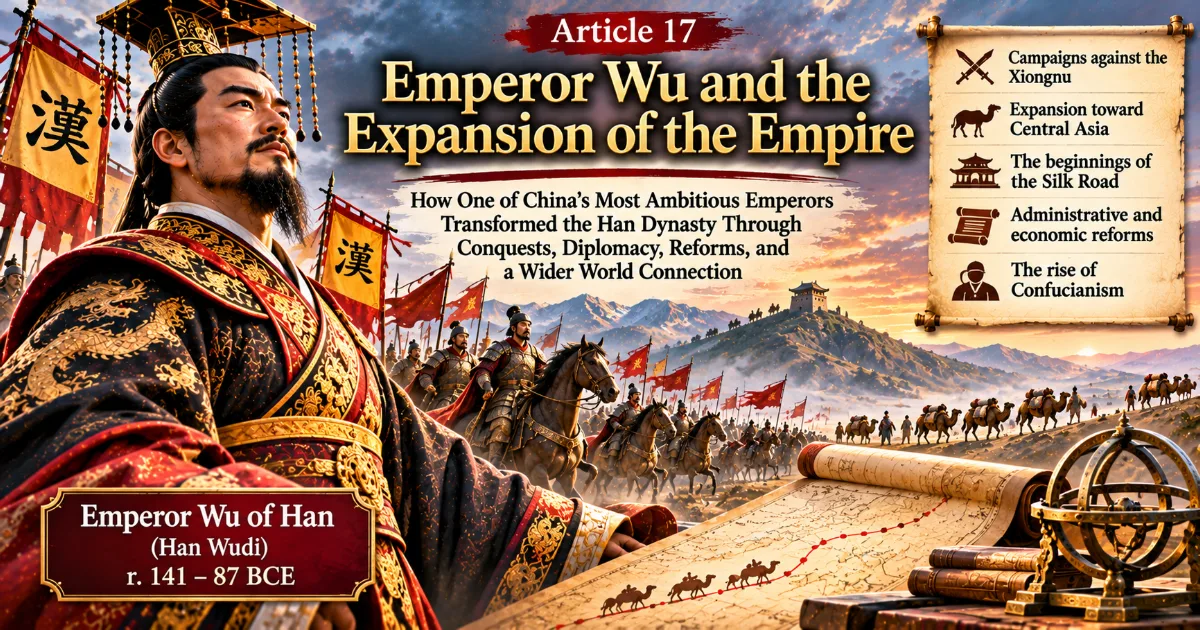
Article 17: Emperor Wu and the Expansion of the Empire will examine how Emperor Wu transformed Han China through military campaigns, diplomatic missions, administrative reforms, and the expansion of imperial influence across Central Asia.
#HistoryOfChina #HanDynasty #LiuBang #EmperorGaozu #AncientChina