The Journey That Connected China with the Wider World
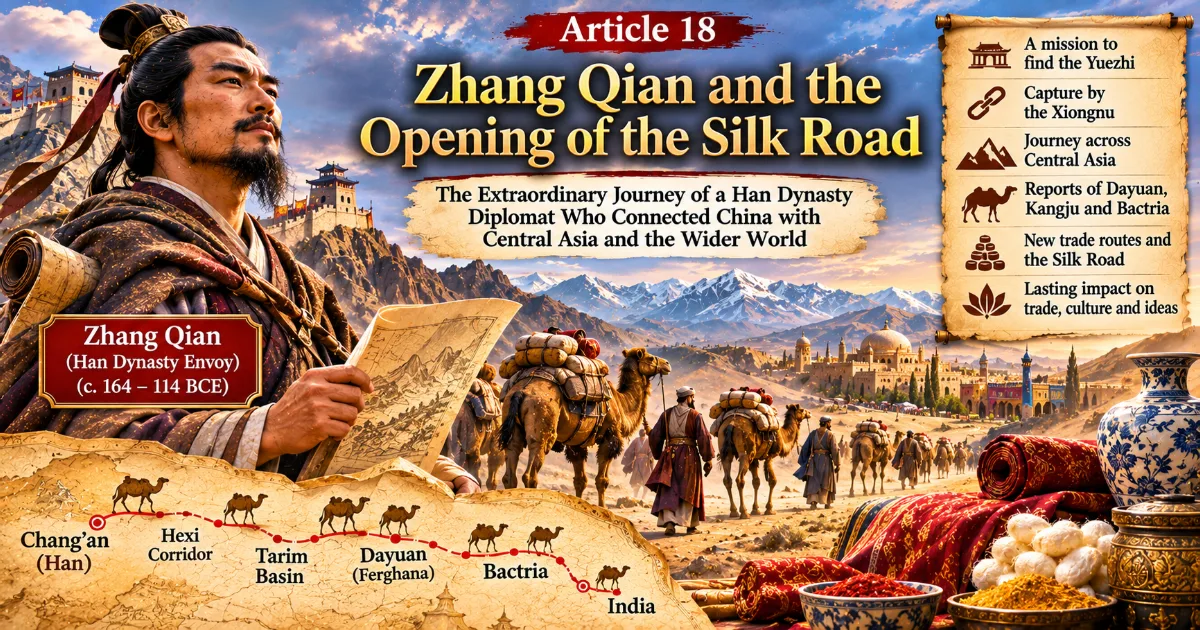
The history of the Silk Road is closely connected with one extraordinary journey undertaken during the reign of Emperor Wu of the Han dynasty. More than two thousand years ago, a Chinese diplomatic envoy travelled westward from the imperial territories into unfamiliar lands, crossing dangerous regions controlled by powerful nomadic groups and visiting kingdoms that the Han court knew little about. His mission was to find a potential ally against the Xiongnu, but his journey eventually produced consequences far greater than the original diplomatic objective.
The envoy was Zhang Qian, one of the most important figures in the history of ancient Chinese exploration and international diplomacy. His travels during the second century BCE introduced the Han government to the political, economic, and geographical realities of Central Asia. He brought back information about distant kingdoms, powerful rulers, agricultural societies, valuable horses, commercial products, and routes connecting different civilizations.
Zhang Qian did not personally create the Silk Road, and merchants had exchanged goods across parts of Eurasia long before his journey. However, his mission helped the Han government recognize the opportunities offered by western connections. His reports encouraged further diplomatic missions, military operations, commercial activity, and the development of more organized routes between China and Central Asia.
The expression Silk Road refers to a broad network of overland and maritime routes that connected societies across Asia, the Middle East, North Africa, and Europe. These routes developed over centuries and changed according to political conditions, economic opportunities, geography, and the availability of safe passage. Chinese silk became one of the most famous commodities traded along them, but the movement of goods was only one part of their importance.
Continue Reading
The routes also carried ideas, technologies, artistic styles, religious traditions, languages, scientific knowledge, and diplomatic messages. They connected communities that might otherwise have remained separated by enormous distances.
Zhang Qian's story is therefore not simply the story of an explorer travelling through distant territories. It is the story of how curiosity, diplomacy, political ambition, and commercial opportunity helped create stronger connections between civilizations.
The Han Empire Before Zhang Qian's Journey
When Zhang Qian began his mission, the Han dynasty was still a relatively young imperial power. Founded by Liu Bang in 202 BCE, the dynasty had inherited the centralized administrative foundations of the Qin Empire but had adopted a more moderate approach during its early decades.
By the time Emperor Wu came to the throne in 141 BCE, the Han government had strengthened its authority and restored much of the economy. The empire possessed a growing agricultural base, an organized administration, and increasing military resources.
However, the northern frontier remained a major concern. The Xiongnu confederation controlled extensive territories across the grasslands and regions north of the Han Empire. Its mobile cavalry forces could move rapidly across large distances, making it difficult for the Han military to defend every frontier settlement.
Relations between the Han and Xiongnu included diplomatic agreements, trade, marriage alliances, and military confrontations. Early Han rulers had often preferred negotiation because prolonged warfare was expensive and risky.
Emperor Wu adopted a more ambitious approach. He wanted to weaken Xiongnu influence and expand the strategic position of the Han Empire. Military campaigns became an important part of this policy, but the emperor also recognized that diplomatic alliances could help achieve objectives that military force alone might not accomplish.
The Han court therefore began looking westward for potential partners.
The Yuezhi: A People Displaced by the Xiongnu
The Yuezhi were an important Central Asian people whose history became connected with the development of the Silk Road.
Originally associated with territories to the west of the Han Empire, the Yuezhi experienced major political and military disruption during the second century BCE. Their conflict with the Xiongnu resulted in their displacement from earlier homeland territories.
A major turning point occurred when the Xiongnu ruler Modu Chanyu defeated the Yuezhi and forced them to move westward. Their migration took them through regions of Central Asia, where they eventually established a new political position.
The Han court learned that the Yuezhi had suffered heavily at the hands of the Xiongnu. Emperor Wu believed that their shared opposition to the northern confederation might provide an opportunity for an alliance.
The emperor hoped that a diplomatic mission could persuade the Yuezhi to cooperate with the Han Empire in a broader effort against the Xiongnu.
The proposal was strategically attractive. If the Han government could establish friendly relations with a powerful group located west of the Xiongnu, it might create pressure on its northern rival from more than one direction.
However, reaching the Yuezhi would require travelling through territories that were unfamiliar and potentially dangerous.
Zhang Qian Is Selected for the Mission
Zhang Qian was selected to lead the diplomatic expedition around 138 BCE.
Historical accounts describe him as a capable and determined official who accepted a difficult assignment at a time when the Han court possessed limited reliable information about the western regions.
His mission was organized as a diplomatic journey rather than a commercial expedition. He was expected to travel to the Yuezhi, establish contact with their leaders, and explore the possibility of an alliance.
Zhang Qian was accompanied by a group of assistants and guides. Among them was Ganfu, a man from the Xiongnu community who became an important companion during the journey.
The expedition carried diplomatic credentials and gifts intended for the rulers they hoped to meet. It also required provisions, animals, equipment, and knowledge of routes through difficult territory.
The journey began in a period when the Han government did not control the main western approaches. Much of the region between the Han frontier and Central Asia was influenced or dominated by the Xiongnu.
This meant that the diplomatic party had to pass through areas where it could be intercepted.
Despite the danger, Zhang Qian continued westward.
Capture by the Xiongnu
The expedition did not reach its destination without difficulty. Zhang Qian and his companions were captured by the Xiongnu during their journey.
The capture was a major setback. The Xiongnu understood that the Han government was attempting to develop relationships with groups beyond their territory. A diplomatic mission intended to encourage an alliance against them was therefore politically sensitive.
Zhang Qian was held in Xiongnu territory for approximately ten years. During this period, he was kept under supervision and was reportedly expected to settle into the local environment.
He was given a wife and had a son, according to traditional accounts. These arrangements were intended to keep him within Xiongnu society and reduce the possibility of escape.
However, Zhang Qian did not abandon his mission.
He retained his diplomatic credentials and continued to look for an opportunity to travel westward. His determination became one of the defining elements of his historical reputation.
The long period of captivity also meant that he had opportunities to observe the Xiongnu way of life, their political organization, their mobility, and their relationships with neighbouring communities.
Although captivity prevented him from completing his mission immediately, the experience gave him valuable knowledge about the society that represented one of the Han Empire's greatest strategic challenges.
The Escape and the Continuation of the Journey
After approximately a decade in captivity, Zhang Qian managed to escape with a small group of companions.
Ganfu, who had accompanied him from the beginning, played an important role in the continuation of the journey. Their escape was dangerous because they had to travel through regions where the Xiongnu could capture them again.
Instead of returning directly to the Han capital, Zhang Qian continued westward toward the Yuezhi.
His determination reflected the importance attached to the mission by the Han court and his own commitment to completing it.
The journey introduced him to an unfamiliar world of oasis settlements, agricultural communities, pastoral societies, and emerging regional powers.
The geography was very different from the central Chinese territories. Travellers had to cross deserts, mountain routes, grasslands, and regions where water and food could be difficult to obtain.
The survival of a diplomatic expedition depended on local knowledge and the ability to establish relationships with communities along the route.
Zhang Qian's travels gradually revealed that the regions west of China were not empty or politically insignificant lands. They contained established societies with their own governments, commercial activities, and international connections.
Zhang Qian Reaches the Yuezhi
Zhang Qian eventually reached the Yuezhi, who had settled in territories farther west than their original homeland.
However, the political circumstances had changed since their displacement by the Xiongnu.
The Yuezhi were no longer primarily focused on returning to their former territories or seeking revenge against the Xiongnu. They had established themselves in new surroundings and were developing relationships with neighbouring communities.
Zhang Qian attempted to persuade their leaders to cooperate with the Han Empire in a military alliance against the Xiongnu.
The proposal was not accepted.
The Yuezhi had their own political priorities and did not consider a major war against the Xiongnu necessary or desirable at that moment. Their leaders were more interested in maintaining their new position and pursuing opportunities in their current territories.
Although the original diplomatic objective had failed, Zhang Qian's visit was still extremely important.
He learned about the Yuezhi political situation and gathered information about other Central Asian societies. He also discovered that the region contained commercial networks connecting different kingdoms and communities.
The diplomatic mission had become a valuable journey of geographical and political discovery.
The Kingdom of Dayuan and the Ferghana Valley
One of the regions Zhang Qian learned about was Dayuan, a kingdom associated with the Ferghana Valley in present-day Central Asia.
Dayuan was known for its agricultural production, settled communities, and valuable horses. The region possessed fertile land in certain areas and was connected to wider Central Asian commercial networks.
Its horses became especially important in later Han policy. The animals were valued for their strength and endurance, qualities that made them attractive to the Han military.
Zhang Qian's reports helped the Chinese court understand that Central Asia contained resources and political powers that could be useful to the empire.
The Ferghana Valley also occupied an important geographical position. It connected routes leading toward different parts of Central Asia and provided access to communities beyond the immediate Han frontier.
The information Zhang Qian collected contributed to the growing interest of Emperor Wu in western territories.
Kangju and the Political World of Central Asia
Zhang Qian also gathered information about Kangju, a political power associated with territories around the Syr Darya region and parts of Central Asia.
Kangju occupied an important position within the network of societies between the steppe regions and the agricultural centres of Central Asia.
Its population included communities whose livelihoods depended on pastoralism, agriculture, and regional trade.
Zhang Qian's reports helped the Han government understand that political relationships in Central Asia were complex. The region did not consist of a single unified power that could be approached through one diplomatic agreement.
Different kingdoms and confederations had their own interests, alliances, and rivalries.
This knowledge was important for Han diplomacy because it encouraged the court to adopt a more informed approach toward western relations.
The empire could now consider different political partners rather than viewing the entire region simply as territory influenced by the Xiongnu.
Zhang Qian's Visit to Bactria and the Legacy of Greek Influence
Another region described in Zhang Qian's accounts was Daxia, generally associated with Bactria in Central Asia.
Bactria had a long history of interaction with the Persian world and the political traditions that developed after Alexander the Great's campaigns.
Greek influence remained visible in the region following the establishment of Hellenistic kingdoms after Alexander's death. Local cultures combined different traditions, creating a distinctive environment in which Greek, Iranian, Central Asian, and other influences interacted.
Zhang Qian observed that Daxia possessed settled agricultural communities and commercial activity. He also noted the presence of goods that appeared to have travelled from regions much farther east.
These observations were especially significant because they suggested that trade connections between distant regions already existed.
The discovery of Chinese-related products in western territories helped the Han court recognize that goods could travel across long distances through a series of intermediate markets.
The Silk Road would eventually develop through precisely this kind of interconnected commercial system.
The Discovery of India's Importance in Regional Trade
Zhang Qian's reports also contained information about a region known as Shendu, generally understood to refer to India or territories associated with the Indian subcontinent.
He learned that goods from the southwestern regions of China could reach markets connected with India through routes passing across mountainous and riverine regions.
This information was important because it suggested that the Han Empire could develop trade connections with the Indian subcontinent through routes that did not necessarily depend entirely on the northern Central Asian corridors.
The Indian subcontinent was already home to major political powers, agricultural societies, religious traditions, and commercial networks.
During this period, the Mauryan Empire had recently declined, and several regional powers were developing across different parts of the subcontinent. Trade connected northern India with Central Asia and regions farther west.
Zhang Qian's information encouraged the Han court to consider possibilities for commercial and diplomatic expansion toward the southwest.
Although direct contact remained difficult, the reports demonstrated that China was part of a much wider Asian world.
The Return Journey to China
After completing his diplomatic mission and gathering information about the western regions, Zhang Qian began the journey back toward the Han Empire.
His return was again complicated by the political conditions of the region. He and his companions were captured once more by the Xiongnu.
However, they eventually escaped during a period of political instability and returned to Han territory around 126 BCE.
The journey had lasted approximately twelve years.
Zhang Qian had originally left with the objective of establishing an alliance with the Yuezhi. He returned without securing that alliance, but he brought back information that transformed the Han court's understanding of the world beyond its western frontier.
His reports described distant kingdoms, agricultural societies, commercial goods, horses, routes, and political relationships.
The emperor and his officials now possessed information that could support more ambitious diplomatic and military planning.
Zhang Qian's return was therefore considered a major success, even though the original mission had not achieved its central objective.
The Information Zhang Qian Brought Back
Zhang Qian's reports provided the Han government with a more detailed understanding of Central Asia.
He described the existence of important political communities, including Dayuan, Kangju, the Yuezhi, and Daxia. He also reported on the commercial activity and agricultural resources of these regions.
His accounts included information about valuable horses, textiles, agricultural products, and other goods.
The reports helped the imperial court understand that the western territories were not isolated. They were connected through trade and diplomatic relationships that extended toward regions farther west and south.
The Han government could now identify potential partners and assess the strategic importance of different routes.
Zhang Qian also demonstrated that diplomatic missions could provide information that military campaigns alone could not easily obtain.
His experience became an important foundation for the development of Han foreign policy.
The Beginning of More Organized Diplomatic Contact
After Zhang Qian returned, Emperor Wu encouraged further diplomatic activity toward Central Asia.
The Han court sent additional missions to different kingdoms and communities. Some were intended to establish political relationships, while others focused on gathering information, negotiating access, and securing commercial opportunities.
Diplomatic envoys carried gifts and official messages. They also returned with representatives from foreign courts, information about local conditions, and valuable products.
These exchanges helped create more regular contact between the Han Empire and Central Asian societies.
The process was not always peaceful. Diplomatic relationships sometimes developed alongside military expansion, and the Han government occasionally used force to secure access to important routes.
Nevertheless, the number of contacts increased considerably.
The development of these relationships helped create the conditions for the gradual growth of the Silk Road.
How the Silk Road Developed
The Silk Road did not appear as a fully established international highway during Zhang Qian's lifetime.
It developed gradually through the interaction of different societies, traders, political authorities, and geographical routes.
The term Silk Road was introduced much later, in the nineteenth century. It is a modern expression used to describe the historical networks that connected China with Central Asia and regions farther west.
The overland routes included several branches. One major system connected the Han territories with the Hexi Corridor and the oasis settlements of the Tarim Basin. From there, travellers could continue through different Central Asian routes toward regions such as Ferghana, Bactria, and Persia.
Other routes connected northern China with steppe communities, while southern routes linked parts of China with the Indian subcontinent and Southeast Asia.
The network changed according to political conditions. When one route became dangerous because of warfare or instability, merchants could use another route.
The routes were therefore flexible rather than fixed.
Merchants generally did not travel the entire distance from China to the Mediterranean. Goods often passed through several commercial communities before reaching distant markets.
This system allowed products and ideas to move across enormous distances without requiring every merchant to complete the entire journey.
Why Chinese Silk Became So Valuable
Silk became one of the most famous commodities associated with the Silk Road.
China had developed advanced silk production techniques over many centuries. The process involved raising silkworms, cultivating mulberry trees, collecting cocoons, processing fibres, and weaving the resulting thread into fabric.
The quality, appearance, and texture of Chinese silk made it highly desirable.
In distant markets, silk was associated with luxury, prestige, wealth, and refined taste. Its light weight and high value made it suitable for long-distance transportation.
Chinese silk could reach Central Asian kingdoms, Persia, and markets connected with the Roman world.
However, silk was not the only commodity traded along the routes. Merchants also exchanged horses, precious stones, glassware, metals, spices, textiles, medicines, ceramics, and many other products.
The movement of these goods created commercial opportunities for communities located along the routes.
The Role of the Hexi Corridor
The Hexi Corridor became one of the most important routes connecting Han China with Central Asia.
Located in present-day Gansu Province, it forms a narrow passage between mountain ranges and desert regions.
Its geographical position made it a natural route for communication between the central Chinese territories and the western regions.
The Han government strengthened its control over the corridor during the reign of Emperor Wu.
Military campaigns against the Xiongnu helped extend Han influence into the region. The government established administrative centres and military settlements to protect the route and support travellers.
The corridor contained important oasis settlements where people could obtain water, food, and supplies.
These settlements became essential for long-distance movement because the surrounding desert environment made travel extremely difficult.
The development of the Hexi Corridor as a controlled route helped strengthen the commercial and diplomatic connections that later became central to the Silk Road.
The Oasis Cities of the Tarim Basin
The Tarim Basin was another important region within the developing Silk Road network.
Located in present-day Xinjiang, the basin is surrounded by major mountain ranges and contains the vast Taklamakan Desert.
Although the central desert is extremely difficult to cross, a series of oasis settlements developed around its edges.
These settlements provided water, agricultural land, and opportunities for trade. They became important stopping points for merchants travelling between China and Central Asia.
Different political communities controlled these oasis cities at different times. Their rulers maintained relationships with neighbouring powers and often competed for control of trade routes.
The northern and southern routes around the Taklamakan connected several important settlements.
Travellers could move from one oasis to another, obtaining supplies and arranging local guides before continuing their journeys.
These communities played a crucial role in making long-distance trade possible.
The Movement of Goods Across Civilizations
The Silk Road became a major channel for the movement of commodities between different societies.
Chinese silk travelled westward, while Central Asian horses and other products moved eastward.
Glassware, precious stones, metals, and textiles circulated through different markets. Agricultural products and manufactured goods were exchanged according to regional demand.
The routes also supported the movement of luxury objects that were used by rulers and wealthy families to demonstrate their status.
Trade was not limited to elite consumption. Everyday materials, tools, food products, and household goods also circulated through regional markets.
The commercial system encouraged the development of towns, markets, storage facilities, transport services, and specialized occupations.
Merchants became important intermediaries between different cultural and economic regions.
The Silk Road therefore contributed to the growth of commercial communities and helped create a more interconnected Eurasian economy.
The Exchange of Ideas and Knowledge
The Silk Road was important not only because of the products that travelled along it but also because of the knowledge exchanged between societies.
Travellers carried information about agriculture, medicine, astronomy, mathematics, navigation, manufacturing, and political organization.
Technologies could spread through merchants, craftsmen, diplomats, and migrant communities.
Artistic styles also travelled across the routes. Designs, decorative patterns, musical instruments, sculptures, and religious imagery influenced communities far beyond their places of origin.
The exchange was rarely a simple process in which one society copied another. Local communities adapted new ideas to their own traditions and circumstances.
Over time, this interaction created new cultural forms that combined influences from several regions.
The Silk Road therefore became one of the most important historical examples of how civilizations develop through contact and exchange.
The Later Spread of Buddhism into China
One of the most important religious developments associated with the Silk Road was the gradual spread of Buddhism into China.
Buddhism originated in the Indian subcontinent during the first millennium BCE and gradually spread into different parts of Asia.
By the centuries following Zhang Qian's journey, Buddhist communities and centres of learning had developed in regions of Central Asia.
Merchants, monks, translators, and travelling teachers helped carry Buddhist ideas toward China.
The transmission was gradual. Early Buddhist teachings entered Chinese territories through different routes, and the religion became increasingly influential during the later Han period and the centuries that followed.
Central Asian cities and monasteries played an important role in this process. They provided places where travellers could meet, exchange ideas, and receive religious instruction.
Buddhist texts were eventually translated into Chinese, allowing the teachings to reach new audiences.
The spread of Buddhism would have a profound influence on Chinese philosophy, literature, art, sculpture, architecture, and religious life.
Although this development took place over a much longer period than Zhang Qian's own journey, the diplomatic and commercial connections encouraged during the Han period helped create the environment in which such exchanges could expand.
The Silk Road and the Roman World
The Silk Road eventually connected Chinese commercial networks with markets associated with the Roman Empire.
Roman society developed a strong demand for luxury goods, including silk, which became highly valued among wealthy consumers.
Chinese silk reached Roman markets through a chain of intermediaries. Merchants from Central Asia, Persia, and other regions participated in the movement of goods.
Direct contact between the Han Empire and Rome was limited. The two powers were aware of each other through reports, travellers, and commercial networks, but they did not establish the kind of regular diplomatic relationship that existed between neighbouring states.
The Roman world generally referred to China through names associated with the people who produced silk.
The trade between the eastern and western ends of Eurasia demonstrated the remarkable reach of ancient commercial networks.
Goods produced in one part of the world could eventually reach consumers thousands of kilometres away.
The movement of silk also shows how consumer demand could encourage connections between distant societies, even when political and geographical barriers made direct contact difficult.
The Importance of Diplomats and Merchants
The development of the Silk Road depended on the contributions of many different people.
Diplomats helped establish relationships between rulers and provided information about political conditions.
Merchants organized the movement of goods and developed commercial partnerships across regional boundaries.
Guides and local communities helped travellers navigate difficult terrain, identify sources of water, and arrange accommodation.
Caravan leaders managed animals, supplies, and security. Craftsmen produced goods for local and distant markets, while translators and interpreters helped people communicate across language differences.
Religious teachers and scholars later used the same networks to carry ideas and texts.
The Silk Road was therefore not created by a single emperor or explorer. It was developed through the combined efforts of countless individuals and communities over many generations.
Zhang Qian's contribution was to encourage a more systematic Han interest in the western regions and demonstrate the value of establishing diplomatic connections beyond the empire's borders.
The Political Importance of the Silk Road for the Han Dynasty
For the Han government, the western routes had strategic importance beyond commercial profit.
Control over important passages could strengthen frontier security, improve communication, and increase the influence of the imperial court over neighbouring communities.
The Han government established military and administrative positions along important routes. These installations helped protect travellers and support official missions.
The routes also allowed the court to gather information about political developments in Central Asia.
However, maintaining control over distant territories was expensive. Soldiers needed supplies, officials required salaries, and military installations needed constant maintenance.
The government also had to manage relationships with local rulers whose cooperation was essential for safe passage.
The Silk Road therefore became both an economic opportunity and a political responsibility.
Its development reflected the wider ambitions of Emperor Wu, who wanted the Han dynasty to become a major power in the international environment of ancient Asia.
The Challenges of Travelling the Silk Road
Travel along the Silk Road was extremely difficult.
The routes crossed deserts, mountain ranges, grasslands, and regions with limited access to water. Travellers faced extreme temperatures, storms, disease, banditry, and political instability.
Caravans had to carry sufficient food and water while ensuring that animals remained healthy enough to complete the journey.
Camels became particularly important for desert travel because of their ability to survive in difficult conditions and carry heavy loads.
Horses were also essential in regions where speed and mobility were important.
Travellers depended heavily on oasis settlements and local communities. A lack of reliable information about water sources could turn a journey into a dangerous expedition.
Political conflict created additional problems. When a route passed through territory controlled by hostile rulers, merchants could face attacks, imprisonment, or confiscation of goods.
The Silk Road was therefore never a completely safe or predictable commercial system.
Its success depended on the ability of different societies to maintain political stability and provide enough security for trade to continue.
Zhang Qian's Later Career
After returning to the Han Empire, Zhang Qian became an important figure within the imperial administration.
His knowledge of Central Asia made him valuable to Emperor Wu, who continued to support diplomatic and military initiatives toward the western regions.
Zhang Qian was later involved in another mission associated with the southwestern territories.
The Han court wanted to explore possible routes connecting the empire with regions linked to India. The information gathered during his earlier travels had suggested that commercial goods could move between southwestern China and markets farther south and west.
The later mission reflected the emperor's continuing interest in expanding international connections.
Although these efforts did not immediately establish a major direct route to India, they demonstrated the growing geographical ambitions of the Han government.
Zhang Qian died around 114 BCE. His career had begun with a difficult diplomatic mission but ended with a historical reputation as one of the most important pioneers of Chinese international contact.
The Historical Legacy of Zhang Qian
Zhang Qian's importance lies in the information and opportunities created by his travels.
He introduced the Han court to a wider understanding of Central Asia and demonstrated that the regions beyond China's western frontier contained complex societies with their own political systems and commercial networks.
His reports encouraged further diplomatic missions and helped the Han government develop a more organized approach toward western relations.
The information about Central Asian horses influenced military policy, while knowledge of commercial routes encouraged greater interest in trade.
His travels also contributed to the development of relationships that later became part of the Silk Road network.
Zhang Qian is often remembered as a pioneer of the Silk Road, but his achievement should be understood in its historical context. He did not create a complete international trading system, and the routes existed in different forms before his journey.
His contribution was to help establish the diplomatic and political conditions that allowed the Han Empire to participate more actively in these wider networks.
The Silk Road's Long-Term Influence on World History
The Silk Road continued to develop long after the Han dynasty.
Different empires and kingdoms controlled sections of the routes at different times. The stability provided by powerful states could encourage trade, while wars and political fragmentation could disrupt it.
During the centuries that followed, the routes connected China with Central Asian kingdoms, Persian societies, Indian regions, and the Mediterranean world.
The movement of goods contributed to commercial development, while the exchange of religious traditions transformed the cultural history of many societies.
Buddhism spread across Central and East Asia. Artistic traditions developed through interaction between Indian, Central Asian, Persian, and Chinese influences. Technologies and scientific knowledge travelled between regions, often through gradual processes of adaptation.
The Silk Road also helped create a broader awareness of distant societies. Merchants, diplomats, and travellers carried information that expanded the geographical understanding of the world.
Its historical significance lies in the relationships it created between communities that were separated by enormous distances.
The Silk Road reminds us that the history of civilizations is not a collection of isolated national stories. Societies have always influenced one another through trade, migration, diplomacy, conflict, and cultural exchange.
Conclusion: The Explorer Who Helped Open a New World
Zhang Qian's journey began as a diplomatic mission intended to find an ally against the Xiongnu. It became one of the most important journeys in the history of ancient China.
Despite captivity, dangerous travel conditions, and the failure to secure the original alliance, he completed his mission and returned with valuable information about Central Asia.
His reports introduced the Han court to distant kingdoms, commercial networks, agricultural communities, and valuable resources. They encouraged further diplomatic contact and strengthened the emperor's interest in the western regions.
The development of the Silk Road was a gradual process involving merchants, rulers, travellers, and local communities across many generations. Zhang Qian did not create the entire network, but his journey helped the Han Empire recognize its importance and participate more actively in it.
The routes that developed connected China with distant societies and allowed goods, ideas, technologies, and religious traditions to travel across Eurasia.
The story of Zhang Qian demonstrates how a single diplomatic journey can influence the direction of history. His achievement was not measured only by the distance he travelled, but by the connections that became possible because of the knowledge he brought home.
The Silk Road eventually became one of the greatest networks of exchange in human history. Its origins in Han diplomatic expansion remind us that exploration and international cooperation can shape civilizations far beyond the intentions of those who first undertake them.
What Comes Next
The next article explores the scientific and technological achievements that helped make Han China one of the most innovative civilizations of the ancient world.
Article 19: Paper, Science, Medicine, and Han Innovations will examine the development of paper-making, advances in astronomy and mathematics, medical knowledge, metallurgy, agricultural technology, engineering, and the lasting influence of Han inventions on world history.
#HistoryOfChina #ZhangQian #SilkRoad #HanDynasty #AncientChina