How Political Fragmentation, Migration, Buddhism, and Cultural Exchange Transformed China After the Han Dynasty
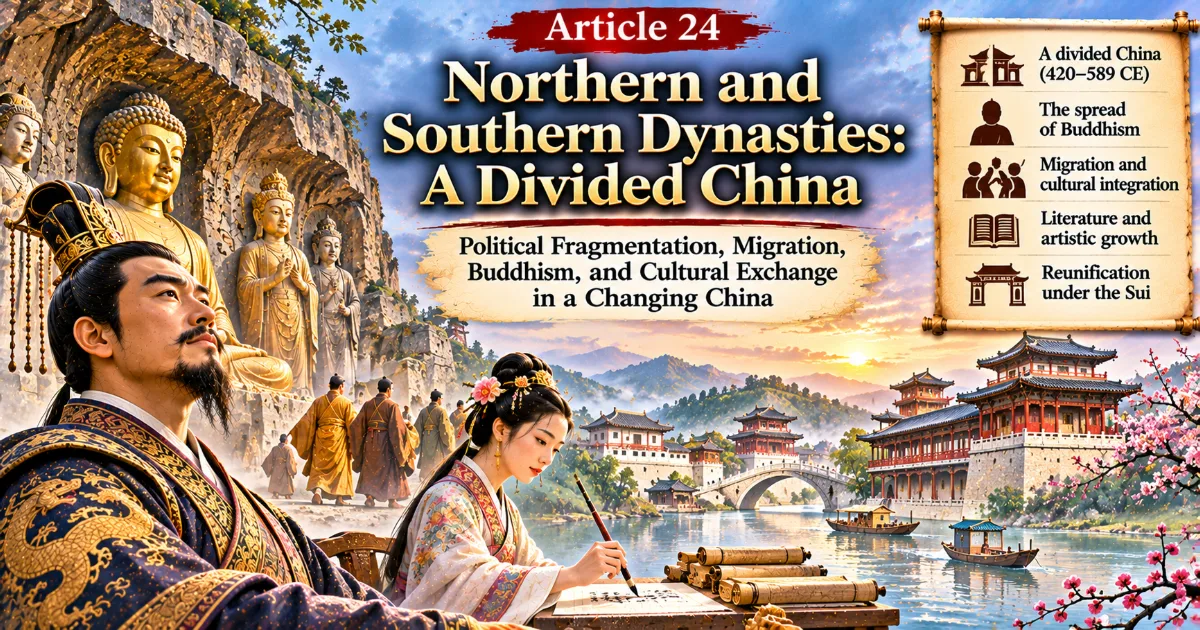
The collapse of the Han Dynasty in 220 CE began a long period of political division in Chinese history. Although the Three Kingdoms period ended with the reunification of China under the Jin Dynasty in 280 CE, this unity did not last. Internal political struggles, powerful aristocratic families, military conflicts, and invasions from northern peoples eventually divided the empire again. For several centuries, different dynasties ruled northern and southern China, creating a period of political fragmentation but also remarkable cultural and religious transformation.
The era commonly known as the Northern and Southern Dynasties lasted from 420 to 589 CE. However, its origins can be traced to the collapse of the Western Jin Dynasty in the early fourth century. After the fall of the Western Jin capital in 316 CE, the Jin imperial family continued its rule in the south, establishing the Eastern Jin Dynasty. Meanwhile, northern China became divided among several states established by different ruling groups, many of them associated with peoples who had migrated or expanded into the region from the northern and western frontiers.
The political map changed repeatedly. Northern rulers competed for territory, established new governments, and sometimes united large parts of northern China before losing control again. In the south, the Eastern Jin Dynasty was followed by a succession of four dynasties known as Liu Song, Southern Qi, Liang, and Chen. These governments ruled from the lower Yangtze region, with their political centres at Jiankang, near modern-day Nanjing.
Despite warfare and political instability, this period was not simply an age of decline. It witnessed the movement of populations, the development of new agricultural regions, the spread of Buddhism, the growth of Buddhist art and architecture, and significant advances in literature, philosophy, painting, and science. Northern and southern societies influenced each other, while cultural traditions from Central Asia and other regions became increasingly important.
Continue Reading
The Northern and Southern Dynasties period also prepared the foundations for the reunification achieved by the Sui Dynasty in 589 CE. Its history demonstrates that political division can coexist with cultural creativity and economic development. It was a period in which China changed profoundly, even though no single government controlled the entire empire.
From the Fall of Han to the Jin Dynasty
The fall of the Han Dynasty in 220 CE was followed by the establishment of three rival states: Wei, Shu, and Wu. Their competition ended in 280 CE when the Jin Dynasty conquered Wu and reunified China.
The Jin Dynasty was founded by Sima Yan, who became Emperor Wu of Jin. He inherited the administrative and military foundations of the state of Wei and established a new imperial government.
At first, reunification appeared to offer an opportunity for recovery after decades of warfare. The government attempted to restore economic production, strengthen central authority, and bring the former territories of the Three Kingdoms under one administration.
However, the Jin rulers faced serious political difficulties. Powerful aristocratic families possessed extensive land, wealth, and influence. Their relationships with the imperial court often limited the authority of the emperor.
The imperial family also struggled with succession disputes. Members of the royal household received territories and political privileges, creating competing centres of power.
These problems became especially serious after Emperor Wu's death in 290 CE. His successor, Emperor Hui, was considered incapable of managing the political conflicts surrounding the throne. Rival members of the imperial family began competing for control of the government.
The resulting conflict became known as the War of the Eight Princes. It lasted from 291 to 306 CE and devastated the political and military structure of the Western Jin Dynasty.
The War of the Eight Princes
The War of the Eight Princes was one of the most destructive internal conflicts in early medieval Chinese history.
The struggle involved powerful princes from the Sima imperial family who competed for influence over the emperor and the central administration. Their armies fought across northern China, and political alliances changed repeatedly.
The conflict weakened government institutions and exhausted military resources. Cities and agricultural regions suffered from warfare, while transportation and administrative networks became increasingly difficult to maintain.
The fighting also reduced the government's ability to defend the northern frontiers. Military commanders who might otherwise have been responsible for protecting the empire became involved in internal political struggles.
The population experienced the consequences through displacement, insecurity, and economic disruption. Farming communities faced the destruction of crops and infrastructure, while families fled areas affected by military campaigns.
The war ended in 306 CE, but the damage to the Western Jin government was severe. The dynasty had lost much of its political stability and military strength.
This weakness created opportunities for various northern peoples and regional leaders to establish independent states.
The Rise of Northern Peoples and the Formation of New States
During the centuries before the fall of Western Jin, different peoples had settled in or around northern China. These included the Xiongnu, Xianbei, Jie, Di, and Qiang, among others.
Their relationships with Chinese dynasties varied. Some groups traded with the imperial government, some served in military forces, and others maintained political independence in frontier regions.
Population movements had been taking place for generations. Warfare, trade, agricultural opportunities, diplomatic agreements, and political pressure encouraged communities to move across the northern frontier.
During the Western Jin crisis, some leaders from these groups established independent political regimes. They controlled territories that had previously belonged to the Jin government and competed with one another for influence.
Chinese historical writing often refers to several of these regimes collectively as the Sixteen Kingdoms. The term is conventional rather than a precise count of every state that existed during the period. Their governments were established by different ruling groups, and their territories and periods of control frequently changed.
These states were not all politically or culturally identical. Some attempted to adopt Chinese administrative practices, while others combined different traditions of government and military organization.
Their rulers frequently employed Chinese officials, used established bureaucratic institutions, and adopted imperial titles. At the same time, they maintained connections with their own political and cultural traditions.
The emergence of these states transformed northern China into a region of intense political competition and cultural interaction.
The Fall of the Western Jin Dynasty in 316 CE
The Western Jin Dynasty's ability to survive the northern crisis gradually disappeared.
One of the most important leaders challenging Jin authority was Liu Yuan, a ruler associated with the Xiongnu elite. In 304 CE, he established a regime that became known as Han Zhao.
His successors expanded their power and captured important territories in northern China.
In 311 CE, Han Zhao forces captured Luoyang, the Western Jin capital. The city was devastated, and Emperor Huai was taken prisoner.
The Jin government attempted to continue its resistance, but its position became increasingly desperate.
In 316 CE, Han Zhao forces captured Chang'an, another major imperial centre. Emperor Min surrendered, bringing the Western Jin Dynasty to an end.
The fall of these two important capitals represented a major turning point. The central imperial government had lost control of northern China, and the political structure established by the Jin Dynasty had collapsed.
However, the Jin imperial family was not completely eliminated. A surviving member of the ruling house, Sima Rui, established a new government in the south.
The Establishment of the Eastern Jin Dynasty
In 317 CE, Sima Rui established a new Jin government at Jiankang, near modern-day Nanjing. He became Emperor Yuan of Jin, and the new dynasty became known as Eastern Jin.
The establishment of Eastern Jin marked the beginning of a long political division between northern and southern China.
The southern government claimed continuity with the earlier Jin imperial tradition. It sought to preserve the authority of the dynasty and eventually recover the lost northern territories.
However, Eastern Jin faced considerable limitations. Its authority depended heavily on powerful aristocratic families and military commanders who controlled important regional resources.
Many members of the northern elite had migrated south during the collapse of Western Jin. They brought administrative knowledge, wealth, education, and cultural traditions with them.
These migrants became important participants in the political and intellectual life of the south. However, their arrival also created tensions with established local families.
The Eastern Jin government therefore had to balance the interests of northern migrants, southern landowners, military leaders, and the imperial household.
The Southern Migration and the Transformation of Society
The fall of northern political institutions encouraged large-scale migration toward southern China.
Families moved south to escape warfare, political persecution, and insecurity. Some migrants belonged to wealthy aristocratic households, while others were ordinary farmers, artisans, and labourers.
The migration changed the demographic and economic landscape of the Yangtze region.
Northern migrants brought agricultural knowledge, administrative experience, literary traditions, and social networks. Their arrival contributed to the development of southern cities and agricultural settlements.
The lower Yangtze region became increasingly important as a political and economic centre. Areas around Jiankang benefited from transportation networks, fertile land, and access to river systems.
The movement of people also encouraged cultural exchange. Northern and southern communities interacted through trade, marriage, education, government service, and religious institutions.
The migration was not always peaceful or easy. Settlers had to adapt to different climates, landscapes, and local customs. Competition over land and resources could create disputes between migrants and established communities.
Nevertheless, the long-term effects were significant. Southern China became more densely populated and economically developed, preparing the region for its growing importance in later dynasties.
The Northern Dynasties and the Rise of the Northern Wei
While Eastern Jin governed the south, northern China remained divided among competing states.
One of the most important political developments was the rise of the Northern Wei Dynasty, established by the Tuoba branch of the Xianbei people.
The Tuoba rulers had built their power in the northern frontier regions. Their political organization combined military traditions with growing use of Chinese administrative practices.
In 386 CE, Tuoba Gui established the Northern Wei state. He gradually expanded its territory and strengthened its political institutions.
Northern Wei became increasingly powerful under later rulers. In 439 CE, Emperor Taiwu completed the conquest of the major northern rivals and unified much of northern China.
This achievement ended the period of the Sixteen Kingdoms in the traditional historical framework and established Northern Wei as the dominant power in the north.
The Northern Wei government now faced the challenge of ruling a large population with different cultural, linguistic, and social traditions.
Its rulers adopted administrative methods influenced by earlier Chinese dynasties while maintaining important elements of their own political heritage.
The result was a government that combined different traditions and became one of the most important examples of cultural transformation during this period.
Emperor Xiaowen and the Reforms of Northern Wei
One of the most influential rulers of Northern Wei was Emperor Xiaowen, who ruled from 471 to 499 CE.
He introduced a series of reforms intended to strengthen the government and integrate the ruling elite more closely with Chinese political and cultural traditions.
One of his major initiatives was the movement of the capital from Pingcheng to Luoyang in 494 CE.
Luoyang had a long history as an important Chinese imperial centre. Moving the capital there placed the Northern Wei government within a region associated with established traditions of administration, scholarship, and imperial authority.
Emperor Xiaowen also promoted the adoption of Chinese-style surnames among the ruling elite. The Tuoba imperial family adopted the surname Yuan.
He encouraged the use of Chinese language and customs at court and promoted marriage connections between the ruling family and established Chinese aristocratic families.
These reforms were part of a wider effort to integrate the political elite and create a more unified imperial culture.
However, the reforms also generated resistance. Some members of the Xianbei military elite believed that traditional customs and identity were being weakened.
The tension between cultural integration and military tradition became an important source of political conflict.
Despite these challenges, Emperor Xiaowen's reforms helped transform Northern Wei into a major imperial state with institutions that influenced later dynasties.
The Division of Northern Wei
After Emperor Xiaowen's death, Northern Wei experienced increasing internal conflict.
Political tensions developed between different groups within the ruling elite. Disagreements over military organization, cultural reforms, court influence, and regional authority weakened the dynasty.
In 523 CE, a major military rebellion broke out among frontier garrisons. The unrest spread and exposed the weaknesses of the Northern Wei government.
Powerful commanders became increasingly independent, while the central administration struggled to maintain control.
In 534 CE, Northern Wei divided into two competing states: Eastern Wei and Western Wei.
Eastern Wei was based in the northeast and operated from Ye. Western Wei controlled territories farther west and established its political centre at Chang'an.
Although both states claimed the political legacy of Northern Wei, their governments were controlled by powerful military and aristocratic families.
Eastern Wei eventually gave way to Northern Qi in 550 CE, while Western Wei was replaced by Northern Zhou in 557 CE.
These developments created a new political arrangement in northern China, with Northern Qi and Northern Zhou competing for dominance.
The Southern Dynasties: Liu Song, Southern Qi, Liang, and Chen
While northern China experienced repeated changes of ruling houses, the south developed its own succession of dynasties.
The Eastern Jin Dynasty ended in 420 CE when the general Liu Yu forced the final Jin emperor to abdicate. Liu Yu established the Liu Song Dynasty and became Emperor Wu of Song.
The Liu Song government ruled from Jiankang and maintained control over much of southern China.
It was followed by the Southern Qi Dynasty in 479 CE, the Liang Dynasty in 502 CE, and the Chen Dynasty in 557 CE.
These four ruling houses are collectively known as the Southern Dynasties.
Their governments shared several characteristics. They relied heavily on aristocratic families, maintained a strong literary and cultural tradition, and governed territories centred around the lower Yangtze region.
Political stability varied from one reign to another. Court rivalries, succession disputes, military rebellions, and powerful regional officials sometimes weakened the governments.
Nevertheless, southern China continued to develop economically and culturally.
Jiankang became one of the most important cities of the period. Its population included officials, scholars, merchants, artisans, religious figures, and migrants from northern regions.
The Southern Dynasties also became important centres of Buddhist learning, literary production, philosophy, painting, and artistic development.
The Rise of Buddhism in Northern and Southern China
One of the most important cultural developments of this period was the spread of Buddhism.
Buddhism had entered China through networks connecting Central Asia and the western regions during the Han period. Its influence expanded gradually, particularly during the centuries of political division.
The Northern and Southern Dynasties provided conditions that encouraged Buddhist growth.
Political instability created uncertainty about life, death, and the future. Buddhist teachings offered explanations of suffering, karma, rebirth, compassion, and spiritual liberation.
Rulers also supported Buddhist institutions for political and cultural reasons. Monasteries could provide religious legitimacy, education, charity, and connections with international networks.
Buddhist monks travelled across regions, translating texts, teaching doctrines, and establishing religious communities.
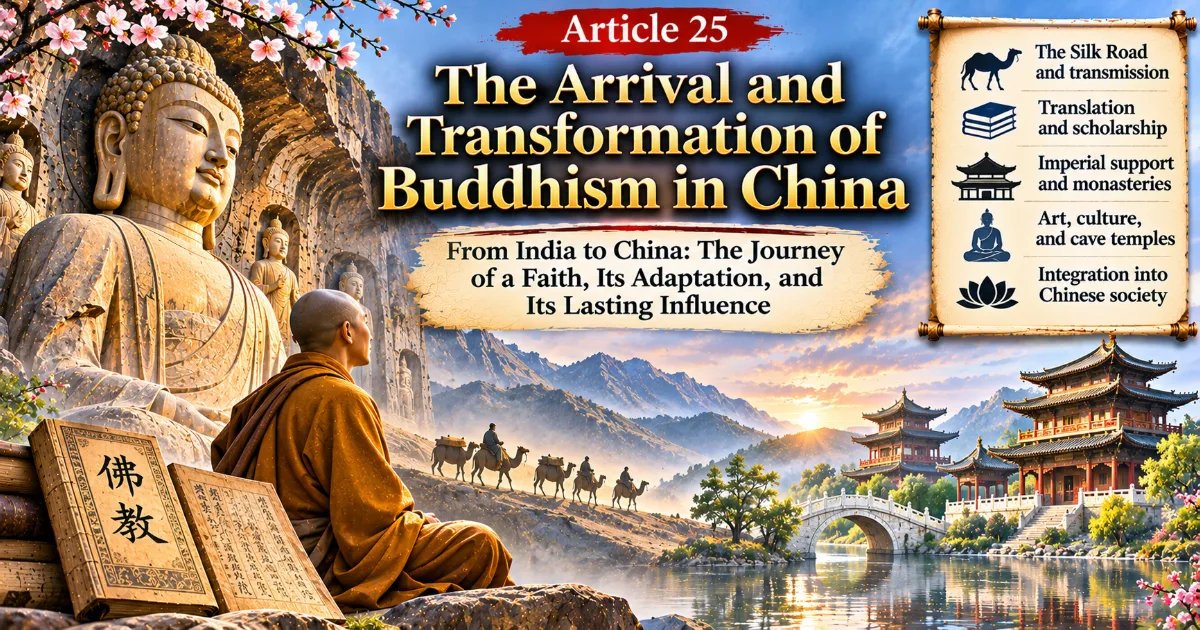
The southern courts became important centres of Buddhist scholarship and patronage. Northern rulers also supported large-scale religious projects, including monasteries, statues, and cave temples.
The spread of Buddhism did not occur in a single uniform process. It developed through interaction with existing Chinese philosophical and religious traditions.
Buddhist ideas were interpreted through concepts familiar to Chinese scholars, and debates emerged concerning the relationship between Buddhist teachings, Confucian ethics, and Daoist thought.
Over time, Buddhism became one of the major traditions shaping Chinese civilization.
The Northern Wei and the Great Buddhist Cave Temples
The Northern Wei rulers were particularly important patrons of Buddhist art and architecture.
One of the most remarkable examples is the Yungang Grottoes near present-day Datong in Shanxi Province.
Construction began in the fifth century, during the reign of Emperor Wencheng. The caves contain monumental Buddhist sculptures carved into sandstone cliffs.
The sculptures represent Buddhas, bodhisattvas, celestial beings, and other religious figures. Their artistic styles reflect a combination of Central Asian, Indian, and Chinese influences.
The Yungang Grottoes demonstrate the importance of Buddhism to Northern Wei political and cultural life. Their scale also reveals the resources and organizational ability available to the imperial government.
Another major Buddhist site is the Longmen Grottoes near Luoyang. Its development began during the Northern Wei period and continued under later dynasties.
The caves contain thousands of Buddhist images and inscriptions. They became an important centre of religious art and reflect the changing artistic traditions of Chinese Buddhism.
These monuments demonstrate that the period of political division was also a time of extraordinary artistic achievement.
Buddhism and the Transformation of Chinese Art
Buddhist art introduced new subjects, artistic techniques, and religious forms into Chinese visual culture.
Images of the Buddha and bodhisattvas became increasingly common in sculpture, painting, architecture, and decorative objects.
Early Buddhist sculptures often reflected artistic influences from Central Asia and regions farther west. Over time, these styles were adapted to Chinese preferences.
Facial features, clothing, body proportions, and decorative elements gradually developed distinctive Chinese characteristics.
Buddhist temples became important architectural institutions. Their design reflected religious requirements as well as regional building traditions.
Monasteries required halls for worship, spaces for meditation, accommodation for monks, libraries, and facilities for visitors.
The growth of Buddhist institutions encouraged the development of specialist craftspeople, sculptors, painters, translators, and builders.
Buddhist art therefore became an important channel through which cultural influences entered China and were transformed into new local traditions.
The Cultural Importance of Daoism and Confucianism
Although Buddhism expanded rapidly, Confucianism and Daoism remained important during the Northern and Southern Dynasties.
Confucian thought continued to influence government, education, family relationships, and political morality.
Many officials believed that rulers should maintain order through ethical conduct and responsible administration. Classical learning remained an important marker of elite education and status.
Daoism also developed through different philosophical and religious traditions. Its ideas about harmony, nature, longevity, and the relationship between human beings and the universe remained influential.
Religious Daoism developed institutional communities, rituals, sacred texts, and practices that shaped Chinese spiritual life.
Buddhism, Daoism, and Confucianism did not simply replace one another. They interacted, competed, and influenced each other.
Chinese scholars debated differences among the traditions, while ordinary people could participate in practices associated with more than one religious or philosophical system.
The coexistence of these traditions helped create a complex intellectual environment that continued to influence later Chinese dynasties.
Literature, Poetry, and the Growth of Southern Culture
The Southern Dynasties were an important period in the development of Chinese literature.
Poetry, historical writing, literary criticism, and artistic theory became major elements of elite culture.
One of the most important poets associated with this period was Tao Yuanming, who lived from 365 to 427 CE. His writing often reflected rural life, simplicity, nature, personal independence, and the search for a meaningful existence beyond political ambition.
His poetry became influential because it expressed an alternative to the pressures of official life and court politics.
The southern literary tradition also developed refined forms of poetry and prose. Scholars paid increasing attention to sound, structure, imagery, and stylistic elegance.
Literary gatherings became important features of elite social life. Educated individuals exchanged poems, discussed classical texts, and developed intellectual relationships.
The period also produced important works of literary criticism. Scholars examined the qualities of writing, the relationship between form and meaning, and the historical development of literary styles.
These developments contributed to the broader evolution of Chinese literature and influenced later poetic traditions.
Painting and the Development of Artistic Theory
Painting also experienced important developments during the Northern and Southern Dynasties.
One of the most celebrated artists associated with this era was Gu Kaizhi, who lived during the Eastern Jin period.
He is remembered for his contributions to figure painting and artistic theory. His work reflected an interest in expressing character, personality, and inner qualities through visual representation.
Although the original condition and attribution of surviving works require scholarly care, Gu Kaizhi's reputation became central to later Chinese art history.
The period also saw the development of more sophisticated ideas about landscape painting and the relationship between art and nature.
Artists increasingly explored how visual compositions could express emotional and philosophical meaning rather than simply reproduce physical appearance.
Painting became closely connected to scholarship, literature, and elite cultural life.
These artistic traditions provided important foundations for later developments during the Sui and Tang dynasties.
Agriculture and Economic Development in the South
Political division did not prevent southern China from experiencing economic growth.
The migration of northern populations brought additional labour, agricultural knowledge, and administrative experience to the Yangtze region.
The expansion of cultivation increased the importance of southern agricultural areas. Rice production became particularly significant in the warmer and wetter regions.
Irrigation, drainage, land clearance, and improvements in farming practices helped expand agricultural production.
The Yangtze River and its tributaries provided transportation routes that connected rural settlements with towns and cities.
Markets developed around agricultural production, craft industries, and regional trade.
The south also benefited from access to waterways and coastal routes. These connections supported the movement of goods and people across the region.
Although northern China remained an important agricultural and political region, the economic importance of the south continued to grow.
This transformation had long-term consequences. The Yangtze region would become one of China's most important economic centres in later centuries.
Trade, Transportation, and Regional Exchange
The Northern and Southern Dynasties period involved significant changes in commercial networks.
Political boundaries could interrupt trade, but they did not eliminate economic exchange. Merchants continued to transport goods between different regions through land and water routes.
The Yangtze River was particularly important for southern trade. It connected inland settlements with major cities and coastal regions.
Northern states also maintained commercial relationships with neighbouring peoples and Central Asian networks.
Trade involved agricultural products, textiles, metal objects, pottery, luxury goods, and other commodities.
Religious travellers and merchants helped carry cultural influences across political boundaries.
Buddhist monks were particularly important in the movement of ideas. They travelled between monasteries, translated texts, and established connections among religious communities.
The movement of people and goods helped maintain a degree of cultural unity even when political authority was divided.
The Northern Zhou and the Rise of a New Political Power
During the later sixth century, Northern Zhou emerged as one of the most powerful states in northern China.
It had replaced Western Wei in 557 CE and inherited important military and administrative institutions.
Northern Zhou rulers strengthened their position through military organization, political alliances, and administrative reforms.
The state also benefited from the support of powerful military families and commanders.
One of the most influential figures was Yang Jian, who served as a senior official and military leader during the later Northern Zhou period.
Yang Jian belonged to a powerful family with connections to the ruling elite. Through political relationships and military influence, he gradually became one of the most important figures in the government.
In 580 CE, after the death of Emperor Xuan, Yang Jian became regent for the young Emperor Jing.
He used his position to consolidate authority and remove political rivals.
In 581 CE, Yang Jian forced the young emperor to abdicate and established the Sui Dynasty.
He became known as Emperor Wen of Sui.
The establishment of the Sui Dynasty marked the end of Northern Zhou and the beginning of a new campaign to reunify China.
The Conquest of Southern China and the End of the Southern Dynasties
After establishing the Sui Dynasty in 581 CE, Emperor Wen worked to strengthen the northern government and prepare for the conquest of the south.
The final Southern Dynasty was the Chen Dynasty, which ruled from Jiankang.
Chen controlled a significant portion of southern China, but it faced internal political difficulties and lacked the military resources of the expanding Sui state.
The Sui government organized a major invasion in 588 CE.
Its forces advanced along several routes, using both land and river operations. The campaign placed increasing pressure on Chen's defensive system.
In 589 CE, Sui forces captured Jiankang, and the Chen ruler surrendered.
The conquest ended the Southern Dynasties and reunited China under a single imperial government.
For the first time since the fall of the Western Jin in 316 CE, northern and southern China were brought together under one ruling dynasty.
The reunification marked the end of a long period of political fragmentation.
The Importance of Reunification Under the Sui Dynasty
The reunification of China in 589 CE was one of the most significant political achievements of the early medieval period.
Emperor Wen inherited a country that had experienced centuries of division, migration, warfare, and cultural change.
The Sui government attempted to strengthen central authority, standardize administration, restore transportation networks, and improve economic coordination.
The reunification also created opportunities for greater movement between northern and southern regions.
The Sui Dynasty developed institutions that influenced the Tang Dynasty, which followed in 618 CE.
Although the Sui Dynasty itself lasted only until 618 CE, its achievements had lasting consequences.
The Grand Canal, expanded and developed during Sui rule, became one of the most important transportation systems in Chinese history. It connected major agricultural and political regions and helped support the economic integration of the empire.
The Sui reunification therefore represented more than the end of political division. It created the foundations for the prosperity and cultural achievements of the Tang Dynasty.
Why the Northern and Southern Dynasties Period Matters
The Northern and Southern Dynasties period is important because it transformed China in ways that extended far beyond political boundaries.
The migration of northern populations changed the demographic and economic structure of southern China. The development of Buddhist institutions introduced new religious ideas, artistic traditions, and international connections.
Northern rulers adopted and adapted Chinese administrative practices, while Chinese elites encountered political and cultural traditions from different frontier communities.
The period also witnessed the development of distinctive northern and southern cultural environments. Literature, poetry, painting, philosophy, and religious scholarship expanded in both regions.
Economically, the south became increasingly important as agriculture and transportation developed around the Yangtze River system.
Politically, the period demonstrated the difficulty of maintaining imperial unity when aristocratic families, military commanders, and regional governments possessed independent sources of power.
The eventual reunification under the Sui Dynasty brought these developments together within a new imperial system.
Conclusion: A Divided China That Prepared the Way for Reunification
The Northern and Southern Dynasties period was one of the most complex and transformative eras in Chinese history.
It emerged from the collapse of the Western Jin Dynasty and the division of China into competing northern and southern governments. The Eastern Jin Dynasty preserved the imperial tradition in the south, while northern states were established by different ruling groups and eventually produced powerful regimes such as Northern Wei.
The political history of the period was marked by warfare, migration, court rivalries, cultural integration, and repeated changes of ruling houses.
Yet the era also witnessed major developments in religion, literature, art, agriculture, and trade. Buddhism expanded across China, monumental cave temples were constructed, southern literary culture flourished, and northern rulers developed new forms of imperial administration.
The migration of populations helped transform the Yangtze region into an increasingly important economic centre. Cultural interaction between different communities enriched Chinese civilization and contributed to the development of new artistic and intellectual traditions.
The period finally ended when Emperor Wen of Sui conquered the Chen Dynasty in 589 CE and reunited northern and southern China.
The Sui reunification prepared the foundations for a new age of imperial prosperity, which would reach extraordinary heights under the Tang Dynasty.
The history of the Northern and Southern Dynasties demonstrates that political fragmentation does not necessarily mean cultural stagnation. Even during centuries of conflict, societies can develop new ideas, exchange knowledge, build institutions, and create artistic achievements that shape future generations.
China emerged from this period politically reunified but culturally transformed. The next stage of its history would be shaped by one of the most important religious developments in its civilization: the arrival and transformation of Buddhism.
#HistoryOfChina #NorthernAndSouthernDynasties #AncientChina #BuddhismInChina #ChineseHistory