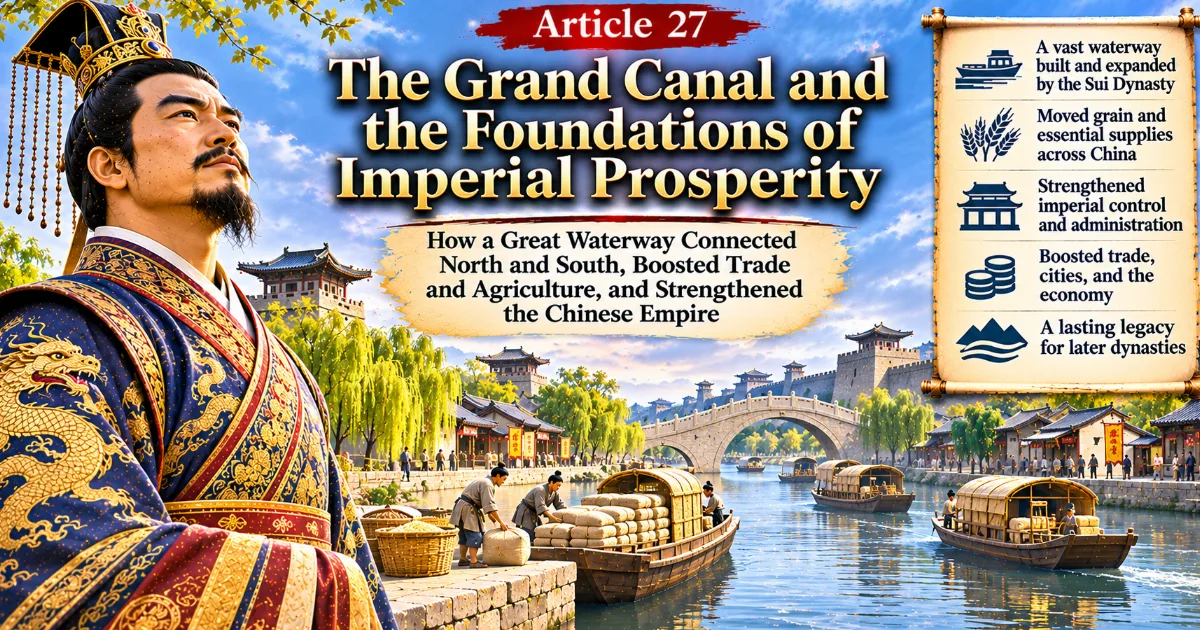
How one of the world's greatest ancient waterway systems connected northern and southern China, transformed trade and agriculture, strengthened imperial government, and shaped the country's economic development for centuries
1. The Grand Canal: An Engineering Achievement That Shaped a Civilization
Few infrastructure projects in world history have influenced a civilization as deeply as China's Grand Canal. Stretching across vast distances and connecting major river systems, the canal became an essential link between the agricultural wealth of southern China and the political centres of the north. It helped move grain, commercial goods, soldiers, officials, and travellers, making it possible for imperial governments to coordinate an enormous territory more effectively.
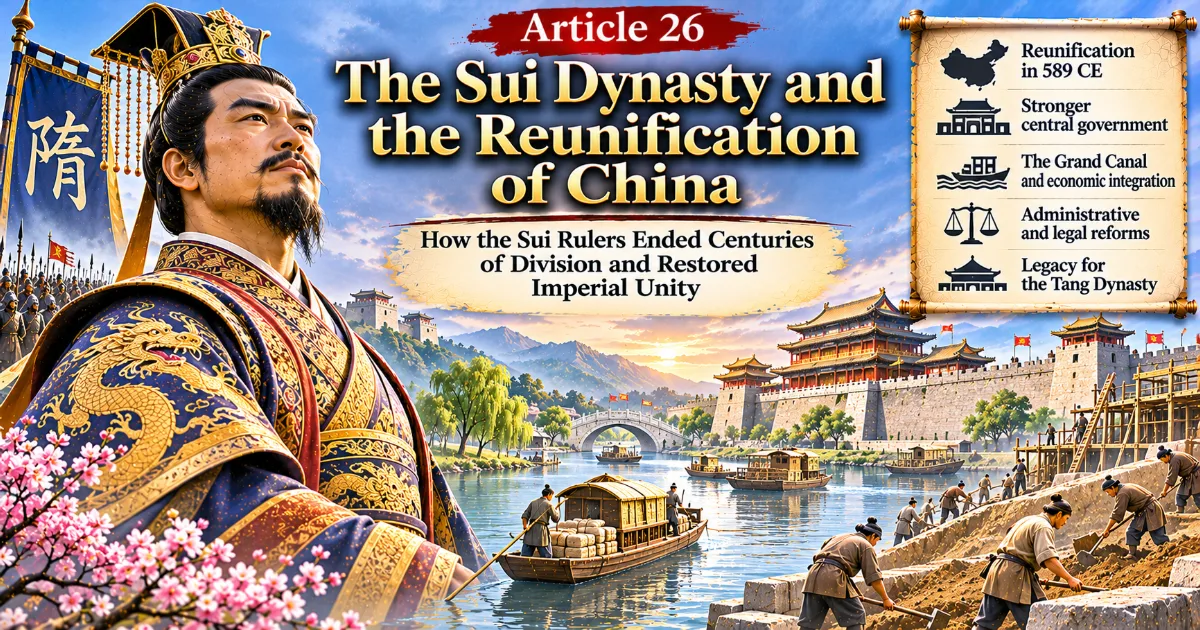
The Sui Dynasty played a decisive role in connecting and expanding earlier waterways into a major transportation network. Its construction programme was extraordinarily ambitious and placed a heavy burden on the population. Yet the canal outlived the dynasty that developed it. Later governments maintained, extended, and relied upon it, turning it into one of the most important foundations of China's economic and administrative unity.
The Grand Canal was not built in a single operation, nor was it the invention of one emperor. Its development involved centuries of regional engineering, local water-management projects, and political decisions. Earlier rulers had constructed canals for irrigation, transportation, military movement, and the supply of cities. The Sui achievement was to connect and expand important sections into a coordinated network serving the needs of a reunified empire.
Continue Reading
The canal's importance extended beyond transportation. It influenced where cities developed, how agricultural products reached markets, how governments collected resources, and how different regions became economically interdependent. Its history also reveals the relationship between technological achievement and the human costs of large-scale state projects.
2. China's Rivers and the Geography of Economic Development
The geographical conditions of China help explain why a major canal network became so important. Two river systems played particularly significant roles in the country's historical development: the Yellow River in the north and the Yangtze River in the south.
The Yellow River region was one of the earliest centres of Chinese civilization. Its surrounding plains supported agricultural communities, early cities, and political centres. Northern China also contained important military routes and territories from which successive dynasties governed the empire.
The Yangtze River basin developed into an increasingly important agricultural and commercial region. Its warmer climate, abundant water, fertile areas, and extensive tributaries supported rice cultivation and population growth. Over time, southern China became one of the most productive parts of the country.
However, the Yellow River and Yangtze River systems were not naturally connected in a way that provided convenient transportation between all the major political and economic centres. Their courses, tributaries, and surrounding landscapes created different transportation conditions.
Moving goods between north and south could therefore be difficult. Overland transport was expensive, particularly when large quantities of grain or other heavy commodities had to be carried over long distances. Roads were useful, but wagons and pack animals could not always compete with the carrying capacity of boats.
Canals offered a practical solution. By connecting rivers and creating navigable waterways, governments could transport supplies across regions that were otherwise difficult to reach efficiently.
3. Water Transportation Before the Sui Dynasty
The Sui rulers inherited a long history of Chinese water engineering. Canals and artificial waterways had existed in different parts of China for centuries before the sixth century.
One important early example was the Honggou Canal, associated with the ancient state of Wei during the Warring States period. It helped connect waterways in the Yellow River and Huai River regions and demonstrated how artificial channels could improve transportation and water management.
Another significant project was the Lingqu Canal, constructed during the Qin Dynasty. It connected the Xiang River system with the Li River system, helping link the Yangtze basin with the waterways leading towards the Pearl River region. The canal supported military movement during the Qin expansion into southern territories and became an important engineering achievement.
Other states and dynasties also developed canals for irrigation, commercial transportation, and military purposes. These projects were often regional rather than parts of a single national system.
The experience gained through earlier construction helped Chinese engineers understand the challenges of managing water levels, directing currents, controlling floods, and maintaining navigable channels.
The Sui Dynasty did not begin from nothing. It inherited knowledge and infrastructure developed over many centuries and reorganised them to serve a much larger political and economic purpose.
4. Why the Sui Dynasty Needed a Grand Canal
When Emperor Wen of Sui reunified China in 589 CE, he inherited an empire with major economic differences between its northern and southern regions.
The north contained important political centres, military establishments, and administrative institutions. The south possessed increasingly productive agricultural regions and expanding commercial networks. Both regions were essential to the strength of the unified state.
The government needed to move food and other supplies between them. Chang'an, the principal western capital, was located far from some of the most productive agricultural areas. The imperial administration and military establishments required dependable supplies, especially when the population of major cities increased.
Emperor Wen and his successor Emperor Yang recognised that improved waterways could strengthen the economic and political integration of the empire.
A connected canal network would make it easier to transport grain from southern agricultural regions to northern centres. It could also support military movement, facilitate trade, and improve communication between distant territories.
The project therefore served several purposes at once. It was an economic investment, an administrative tool, a strategic transportation system, and a symbol of imperial authority.
5. Emperor Yang and the Expansion of the Canal Network
Emperor Yang of Sui, who ruled from 604 to 618 CE, is particularly associated with the major expansion of the Grand Canal system.
His government undertook extensive construction and improvement work during the early seventh century. Rather than creating one continuous waterway from the beginning, the Sui administration connected and expanded existing channels and constructed new sections to improve communication between major regions.
The projects were undertaken in stages and involved different geographical areas. Important waterways connected the capital region around Luoyang with the Yellow River, Huai River, and Yangtze basin. Other sections extended the transportation network towards the northern regions.
The construction programme was enormous. Workers excavated channels, cleared existing waterways, built embankments, repaired riverbanks, and developed facilities for moving and storing goods.
Canal construction required technical knowledge and careful planning. Engineers had to understand the natural slope of the land, the behaviour of rivers, seasonal changes in water levels, and the movement of sediment. A poorly designed channel could become difficult to navigate or vulnerable to flooding.
The Sui government mobilised large numbers of labourers to complete the work. Although the resulting network had lasting value, the scale of compulsory labour became one of the most controversial features of Emperor Yang's reign.
6. The Main Sections of the Sui Canal Network
The Grand Canal developed as a system of connected waterways rather than a single straight channel. Different sections served different geographical and economic purposes.
The Tongji Canal connected the Luoyang region with the Yellow River and waterways leading towards the Huai River basin. It was important for moving supplies between the eastern capital and the southern regions.
The Han Canal, also known in historical discussions as the Han Gou, formed an important connection between the Huai River and the Yangtze River. It linked waterways that had previously been developed for regional transportation.
The Jiangnan Canal extended transportation connections through the lower Yangtze region. This area contained important agricultural settlements, commercial centres, and water-based communities.
Northern sections connected the canal system with areas closer to the Yellow River and the northern political and military centres. Later governments would improve and extend these routes as the needs of the empire changed.
The exact routes and condition of the Grand Canal changed over time. Rivers shifted, channels were repaired, new sections were built, and old ones were abandoned or modified. The canal should therefore be understood as an evolving transportation system rather than an unchanging construction project completed once during the Sui Dynasty.
7. Luoyang and the Strategic Importance of the Eastern Capital
The development of the Grand Canal was closely connected with the importance of Luoyang. Located in the central plains, Luoyang occupied a strategic position between northern political centres and the productive regions of the east and south.
Emperor Yang invested heavily in the expansion of Luoyang as an eastern imperial capital. The city became an important centre for administration, ceremony, commerce, and transportation.
Its location made it possible to connect government institutions with major waterways. Supplies arriving from agricultural regions could be transported towards the city and distributed to officials, soldiers, workers, and urban residents.
Luoyang also served as a centre from which the government could supervise important territories. Its position reduced some of the logistical difficulties associated with governing an enormous empire from a single capital in the northwest.
The development of the city demonstrated the relationship between urban planning and transportation. Capitals required food, construction materials, administrative supplies, and access to communication networks. Waterways made these demands easier to manage.
The canal system and the eastern capital therefore reinforced one another. Luoyang became more valuable because of its connections, while the canal network became more useful because it served an important political and economic centre.
8. Grain Transportation and the Survival of Imperial Capitals
One of the most important functions of the Grand Canal was transporting grain.
Large imperial cities could not produce enough food within their own boundaries to support their entire populations. They depended on agricultural regions for regular supplies. Government officials, soldiers, craftsmen, labourers, merchants, and members of the imperial household all required food.
The problem became more difficult when a capital was located far from the most productive agricultural territories. Transporting grain overland required considerable labour, animals, equipment, and time. Losses could occur through theft, spoilage, weather, and delays.
Water transport offered an efficient alternative. Boats could carry large quantities of grain along rivers and canals, reducing the cost of moving heavy commodities over long distances.
The Grand Canal helped establish a more reliable system for supplying northern political centres with agricultural products from the south. This became increasingly important as the economic importance of southern China grew.
The government could collect grain through taxation and transport it to places where it was needed. The canal therefore connected agricultural production with imperial administration.
Its role was not limited to feeding the capital. It also supported military garrisons, construction sites, administrative offices, and urban populations along its routes.
9. How the Grand Canal Strengthened the Imperial Government
Transportation was essential to the operation of a large empire. An emperor could issue orders from the capital, but those orders had to reach provincial officials, military commanders, and local administrators before they could be implemented.
The Grand Canal improved the movement of people and supplies between different parts of the country. Government officials could travel more efficiently, while administrative materials and essential goods could be transported by water.
The canal also strengthened the government's ability to redistribute resources. Grain collected in one region could be sent to another when necessary. Military supplies could be moved towards strategic locations, and construction materials could be delivered to major public works.
The transportation network helped the central government reduce its dependence on local resources in every region. Instead, the state could draw upon the productive capacity of a wider territory.
This strengthened the practical authority of the imperial administration. A government with reliable transportation could maintain larger cities, support distant military establishments, and coordinate regional economic activity more effectively.
However, the canal did not automatically guarantee good government. Its benefits depended on efficient administration, maintenance, secure transport routes, and reasonable taxation policies.
10. Trade and the Growth of Commercial Networks
Although the Grand Canal was closely associated with imperial grain transportation, it also supported private commerce.
Merchants used waterways to move agricultural products, textiles, timber, pottery, metal goods, tools, and other commodities. Boats could connect inland settlements with major urban markets, allowing goods to travel beyond the regions where they were produced.
Commercial activity encouraged the growth of towns along canal routes. Markets developed around ports, warehouses, bridges, and transportation junctions. Some settlements became important centres for storage and distribution.
The canal helped connect producers with consumers. Agricultural households could sell surplus crops, while artisans could reach markets beyond their immediate neighbourhoods.
It also encouraged specialisation. Regions could concentrate on producing goods suited to their climate, resources, and skills, while relying on transportation networks to obtain products from elsewhere.
The growth of commercial networks strengthened the relationship between different regional economies. A disruption in one part of the transportation system could affect markets far away, demonstrating how closely connected the regions had become.
11. Agriculture and the Economic Transformation of Southern China
The Grand Canal contributed to the increasing economic importance of southern China.
The Yangtze basin and surrounding regions possessed favourable conditions for rice cultivation. Water was essential to agricultural production, and many communities developed sophisticated methods of irrigation and land management.
As population increased, agricultural settlements expanded. Farmers cultivated additional land, improved water control, and developed production systems suited to local environments.
The ability to transport grain and other agricultural goods to distant markets made surplus production more economically valuable. Farmers and merchants could participate in wider commercial networks rather than relying entirely on local consumption.
The canal also supported the movement of agricultural equipment, building materials, and other supplies that helped communities develop their productive capacity.
Over the centuries, southern China became increasingly important to the empire's economy. The movement of grain towards northern political centres reflected this changing balance.
The Grand Canal did not single-handedly cause the economic rise of the south. Climate, population growth, migration, technological development, and political stability were also important. Nevertheless, the canal helped connect southern productivity with national markets and imperial institutions.
12. Urban Growth Along the Waterways
Transportation networks often influence the development of cities, and the Grand Canal was no exception.
Settlements along important waterways benefited from the arrival of merchants, travellers, government officials, and workers. Ports and warehouses created opportunities for trade and employment, while markets attracted producers and consumers from surrounding areas.
Some towns developed into major commercial centres because they occupied strategic positions along the canal system. Transportation junctions were especially valuable because goods could be transferred between waterways, stored, taxed, and redistributed.
Urban growth also encouraged the development of services. Boat operators, port workers, merchants, craftsmen, food sellers, accommodation providers, and officials all contributed to the economic life of canal settlements.
The expansion of commercial towns helped create a more interconnected society. People from different regions encountered one another through trade, migration, official travel, and religious activity.
These exchanges also contributed to cultural diffusion. Languages, customs, artistic techniques, religious ideas, and regional products moved along the same waterways that carried grain and commercial goods.
13. Engineering Challenges: Water Levels, Sediment, and Floods
Building a canal was only the beginning of the engineering challenge. Maintaining a navigable waterway required continuous attention to natural conditions.
Water levels changed according to rainfall, seasonal patterns, and the behaviour of connected rivers. A channel that was navigable during one season could become too shallow or too fast-flowing during another.
Sediment was another major problem. Rivers carried mud and other material that gradually accumulated in channels. If sediment was not removed, waterways could become shallow and difficult for boats to use.
Flooding could damage embankments, destroy nearby settlements, and alter the course of rivers. Engineers and workers had to maintain banks, repair damaged structures, and manage water movement.
The canal also needed bridges, ports, storage facilities, and other supporting infrastructure. These facilities required construction and regular maintenance.
Managing such a large network was a continuous responsibility for imperial governments. The effectiveness of the canal depended not only on the original engineering but also on the ability of later administrations to preserve and improve it.
14. The Human Cost of Construction
The Grand Canal became an extraordinary symbol of Chinese engineering, but its construction involved serious human suffering.
The Sui government mobilised large numbers of workers to complete the canal sections and other major public projects. Labour demands could interrupt agricultural life, separate families, and expose workers to difficult conditions.
People were required to excavate earth, transport materials, build embankments, and perform physically demanding work. Construction could take place in challenging climates, and workers often faced illness, exhaustion, and inadequate supplies.
The burden was particularly difficult for rural households. Agriculture depended on seasonal work, and the absence of family members during planting or harvesting could threaten household survival.
The canal was not the only major project during Emperor Yang's reign. The expansion of Luoyang, palace construction, road improvements, and military campaigns all competed for labour and resources.
These demands contributed to public dissatisfaction and weakened the relationship between the government and the population.
The Sui experience reveals an important historical contradiction. The canal became a major foundation of imperial prosperity, but the methods used to construct it helped create conditions that contributed to the dynasty's collapse.
15. The Sui Collapse and the Survival of the Canal
The Sui Dynasty fell in 618 CE after years of rebellion and political instability. Emperor Yang was killed, and the Tang Dynasty emerged from the struggles that followed.
The collapse of the Sui government did not destroy the canal network. Its economic and strategic value was too great for later rulers to ignore.
The Tang Dynasty inherited an important transportation system and continued to maintain and use it. The canal helped move grain and other supplies towards major political centres and supported the growing commercial life of the empire.
The Tang government also benefited from the infrastructure and administrative experience developed under the Sui. Its ability to govern a unified empire was strengthened by transportation routes that connected different regions.
The canal therefore became one of the clearest examples of how infrastructure can outlive the political regime that creates it.
Although its condition and routes changed over time, the basic principle of connecting northern political centres with southern economic regions remained central to imperial transportation policy.
16. The Grand Canal During the Tang Dynasty
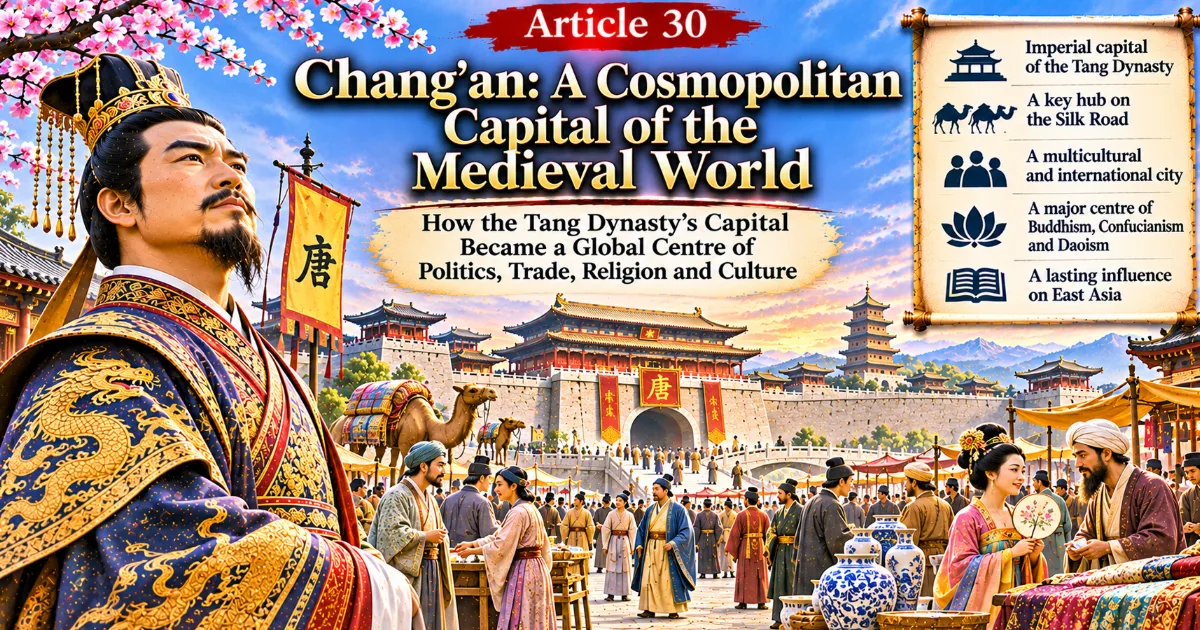
During the Tang Dynasty, China experienced major economic and cultural development. Chang'an became one of the most important cities in the world, attracting merchants, diplomats, scholars, monks, and travellers from many regions.
Supporting such a large capital required extensive food supplies and a dependable transportation system. The canal played an important role in moving grain and other goods towards northern centres.
The economic significance of the south continued to increase. Southern agricultural production supported the needs of the empire, while commercial networks connected local markets with major urban centres.
The Tang government had to maintain the canal and related transportation facilities to ensure that essential supplies reached their destinations. Interruptions caused by flooding, sediment accumulation, or political conflict could create serious problems.
The canal also supported regional trade and communication. Merchants used waterways to transport products, while officials and travellers benefited from improved connections between different parts of the country.
The Tang period therefore strengthened the canal's role as a national economic and administrative network.
17. The Grand Canal and the Changing Economic Balance Between North and South
Over time, the economic relationship between northern and southern China changed significantly.
Northern China remained politically and militarily important, but southern regions became increasingly productive and commercially influential. Population growth, agricultural expansion, and the development of markets strengthened the south's contribution to the imperial economy.
This changing balance made the Grand Canal even more important. The political centres of the north depended increasingly on supplies transported from southern regions.
The canal connected two areas with different but complementary strengths. The north contained major political and military institutions, while the south possessed extensive agricultural and commercial resources.
This relationship also influenced imperial policy. Governments had to protect transportation routes, maintain water infrastructure, and ensure that grain could move reliably between regions.
The economic integration of north and south became a defining feature of later Chinese history.
18. The Song Dynasty and the Expansion of Commercial Activity
During the Song Dynasty, the Grand Canal continued to support transportation and commercial activity. The Song period witnessed major economic changes, including urban growth, technological innovation, expanding markets, and increased maritime trade.
Water transportation remained essential to the movement of goods. The canal connected important inland markets and helped support the distribution of agricultural products and manufactured commodities.
The growing commercial economy increased demand for reliable transportation. Merchants needed routes through which they could move goods efficiently, while urban populations depended on supplies arriving from surrounding agricultural regions.
The canal was part of a wider transportation system that included rivers, roads, ports, and maritime connections.
The Song period also demonstrated that economic prosperity depended on more than agricultural production. Manufacturing, commerce, financial activity, and technological innovation became increasingly important.
The canal supported these developments by connecting producers, merchants, consumers, and administrative centres.
19. The Grand Canal Under the Yuan Dynasty
The Mongol conquest established the Yuan Dynasty in China during the thirteenth century. The new rulers inherited a vast territory and faced the challenge of administering it from northern political centres.
The capital of the Yuan Dynasty was established at Dadu, in the region of present-day Beijing. This location increased the importance of transportation routes connecting the northern capital with the agricultural regions of the south.
The existing canal system did not provide the most direct and efficient route for every transportation requirement. The Yuan government therefore undertook major improvements and extensions.
New canal sections helped create a more direct north-south transportation connection. These developments strengthened the movement of grain and other supplies towards the capital.
The Yuan government relied heavily on the canal for supplying its political and military institutions. Its improvements helped shape the later development of the waterway system.
The expansion under the Yuan demonstrates how successive dynasties adapted infrastructure to changing political priorities and capital locations.
20. The Ming Dynasty and the Importance of Beijing
The Ming Dynasty, established in 1368, continued to depend on the Grand Canal. When the Yongle Emperor moved the principal capital to Beijing in the early fifteenth century, the need for dependable transportation from southern China became especially important.
Beijing was located far from some of the empire's most productive agricultural regions. The imperial government, military establishments, and urban population required substantial supplies.
The canal provided a major route for transporting grain from southern regions towards the northern capital. Its maintenance became a central responsibility of the Ming administration.
The Ming government invested in the repair and regulation of waterways, embankments, locks, and other infrastructure. Officials supervised grain transportation and worked to ensure that the supply system operated effectively.
The canal also supported commercial exchange and the movement of people. Its routes connected cities, towns, markets, and rural communities across a vast geographical area.
The relationship between Beijing and the southern agricultural economy became one of the most important features of the imperial transportation system.
21. The Qing Dynasty and the Canal's Continued Importance
The Qing Dynasty inherited the canal system from the Ming and continued to rely on it for transportation and administration.
For centuries, the movement of grain towards northern political centres remained a major government responsibility. The canal helped support Beijing and the surrounding region, while commercial activity continued along its routes.
However, maintaining the canal became increasingly challenging. Rivers changed course, sediment accumulated, and floods damaged important sections. The Yellow River was particularly difficult to manage because its course and sediment load created repeated engineering problems.
The government had to invest in embankments, dredging, repairs, and water-management works. These responsibilities required specialised officials, engineers, and labourers.
Over time, changes in transportation technology and the development of modern railways and roads reduced the canal's exclusive importance. Nevertheless, it continued to serve important regional functions.
The Qing period demonstrates both the durability of the canal system and the difficulties of maintaining a major waterway across centuries of environmental and political change.
22. The Grand Canal and Cultural Exchange
The canal did more than move goods. It helped connect people and cultures across China.
Travellers, merchants, government officials, soldiers, monks, craftsmen, and migrants used the waterways to move between regions. Their journeys created opportunities for cultural exchange.
Different regional cuisines, textiles, artistic traditions, languages, and customs circulated through towns and commercial centres along the canal.
Religious communities also benefited from improved transportation. Monks and pilgrims could travel between monasteries and important religious sites, while scriptures, images, and devotional practices moved between regions.
The canal contributed to the spread of ideas by making long-distance movement more practical. It connected local communities with wider networks of economic and cultural activity.
This process helped strengthen the sense of connection between different parts of China. Political unity alone could not create cultural integration, but transportation and exchange made it easier for people from different regions to interact.
23. The Grand Canal and the Relationship Between State Power and Infrastructure
The history of the Grand Canal reveals how infrastructure can strengthen political authority.
Large states require systems that allow them to collect resources, move officials, supply armies, communicate with distant regions, and maintain public institutions. Roads, rivers, canals, bridges, and ports all contribute to these functions.
The Grand Canal helped imperial governments overcome some of the geographical difficulties associated with governing a vast territory. It connected agricultural production with administrative centres and allowed resources to be moved where they were needed.
However, infrastructure also created responsibilities. Governments had to finance construction, organise labour, maintain channels, regulate water levels, and protect transportation routes.
If these responsibilities were neglected, the economic benefits of the canal could decline. If construction and maintenance demands became excessive, they could create public dissatisfaction.
The Sui experience illustrates both sides of this relationship. The canal strengthened the long-term economic foundations of the empire, but the immense demands placed on the population during its construction contributed to political instability.
Infrastructure could support imperial prosperity, but it could not compensate for poor leadership or unsustainable government policies.
24. The Grand Canal in Modern China
The Grand Canal remains an important part of China's historical and cultural landscape. Although modern transportation has transformed the country's economy, sections of the canal continue to be used for navigation, water management, and regional transportation.
Its historical significance has also received international recognition. The Grand Canal was inscribed on the UNESCO World Heritage List in 2014, recognising its importance as an extraordinary example of a long-lasting cultural and engineering landscape.
The heritage system includes important waterways, historic towns, bridges, hydraulic structures, and other features associated with the canal's development.
Preserving the Grand Canal involves more than protecting old waterways. It requires attention to historic settlements, cultural traditions, engineering structures, environmental conditions, and the communities that continue to live along its routes.
The canal provides a connection between China's ancient engineering achievements and its modern identity. It demonstrates how human societies can reshape landscapes to support transportation, agriculture, trade, and political organisation.
25. What the Grand Canal Teaches Us About Chinese Civilization
The Grand Canal represents several important themes in Chinese history.
First, it demonstrates the importance of geographical conditions in shaping political and economic development. China's large river systems and the differences between northern and southern regions created a need for transportation connections that natural waterways alone could not always provide.
Second, the canal illustrates the role of state organisation. Large infrastructure projects required planning, technical knowledge, labour mobilisation, taxation, and long-term maintenance. The imperial government became an important force in coordinating these activities.
Third, the canal reveals the connection between regional economies. Northern political centres depended on southern agricultural production, while southern markets benefited from access to wider commercial networks.
Fourth, it demonstrates the long-term influence of infrastructure. A waterway developed under one dynasty could continue supporting later governments for centuries, even after the original political regime had disappeared.
Finally, the canal reminds us that great achievements can involve significant human costs. The prosperity it supported should be understood alongside the experiences of the labourers and rural families who contributed to its construction and maintenance.
Conclusion: A Waterway That Connected an Empire
The Grand Canal became one of the most important infrastructure achievements in Chinese history. Its development reflected centuries of water engineering, but the Sui Dynasty transformed the network into a major system connecting the economic resources of the south with the political centres of the north.
It supported grain transportation, commercial activity, urban growth, military logistics, and imperial administration. Later dynasties, including the Tang, Song, Yuan, Ming, and Qing, continued to depend on and improve the canal system.
Its importance was not limited to economic activity. The canal encouraged cultural exchange, connected distant communities, and helped create a more integrated national economy.
The Sui rulers who expanded the canal did not live to see the full extent of its historical influence. Their dynasty collapsed in 618 CE, but the waterway continued to shape Chinese civilization long after their political power disappeared.
The Grand Canal stands as a reminder that the foundations of prosperity are often built over generations. Political unity, productive agriculture, reliable transportation, commercial exchange, and effective administration work together to sustain a civilization.
The Grand Canal was more than a waterway. It was a connection between regions, a foundation of imperial government, and an enduring symbol of China's ability to transform its geography through engineering and organisation.
#HistoryOfChina #GrandCanal #ChineseHistory #AncientEngineering #SuiDynasty