How a Turbulent Period of Chinese History Became One of the World's Greatest Literary Epics
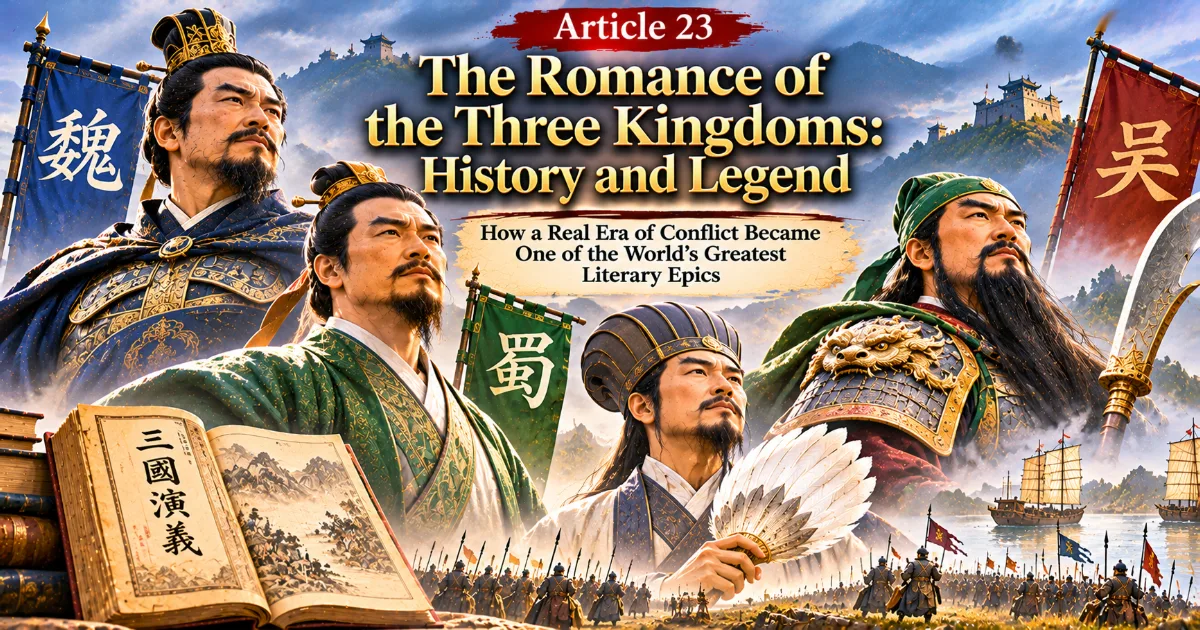
Few historical periods have captured the imagination of generations as powerfully as the Three Kingdoms era of China. The political collapse of the Han Dynasty, the rise of rival rulers, legendary military commanders, strategic alliances, dramatic betrayals, and the struggle to reunify the empire created a remarkable collection of stories. Over time, these events became the foundation of one of China's most celebrated literary works, Romance of the Three Kingdoms.
The novel is traditionally attributed to Luo Guanzhong and is generally associated with the late fourteenth century. It transforms the historical events of the third century into an expansive narrative filled with memorable characters, military strategies, political rivalries, moral dilemmas, and dramatic encounters. Its influence extends far beyond literature. It has shaped Chinese theatre, opera, storytelling, painting, popular culture, historical imagination, and ideas about leadership and loyalty.
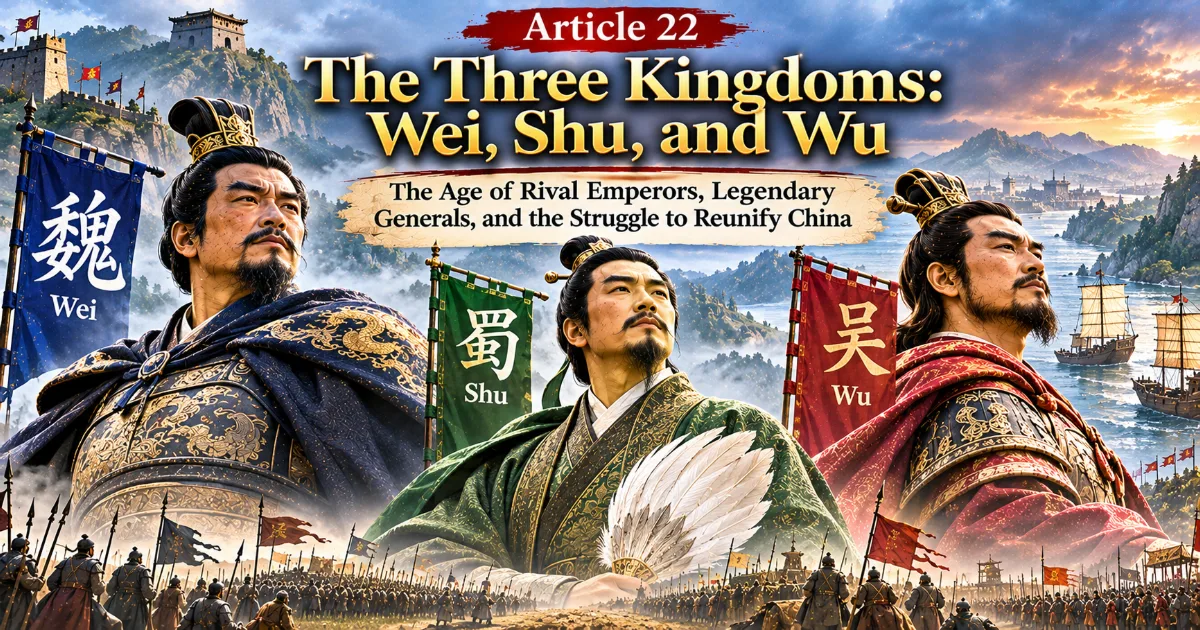
The story follows the struggle among three major states that emerged after the collapse of Han authority: Wei in the north, Shu Han in the southwest, and Eastern Wu in the southeast. Their leaders sought to establish political legitimacy and control over China, while their generals and advisers competed through warfare, diplomacy, intelligence, and strategy.
Among the most recognizable figures are Cao Cao, Liu Bei, Sun Quan, Guan Yu, Zhang Fei, Zhuge Liang, Zhao Yun, and Sima Yi. Their historical lives were already significant, but centuries of storytelling transformed them into cultural symbols. Cao Cao became a complicated representation of ambition and political intelligence. Liu Bei came to represent benevolence and loyalty to the Han tradition. Guan Yu became an enduring symbol of righteousness and brotherhood, while Zhuge Liang became the ideal of wisdom and strategic foresight.
Continue Reading
Yet the novel is not a straightforward historical record. It combines genuine events with fictional conversations, dramatic inventions, moral interpretations, and later traditions. Some events are presented with considerable historical accuracy, while others have been reshaped to make the narrative more entertaining or to emphasize particular values.
Understanding the difference between history and legend is essential to appreciating the work. Romance of the Three Kingdoms is not valuable only because it tells stories about the past. It is also important because it reveals how later generations remembered that past, interpreted political authority, and expressed ideas about loyalty, justice, intelligence, ambition, and the responsibilities of rulers.
The Historical Background: China After the Han Dynasty
The historical foundation of Romance of the Three Kingdoms lies in the final decades of the Eastern Han Dynasty.
The Han Empire had ruled China for more than four centuries, establishing political institutions, administrative traditions, commercial networks, and a powerful cultural identity. However, the later Eastern Han government became increasingly weakened by court rivalries, corruption, land concentration, economic pressures, and social unrest.
Powerful families competed for influence, while palace eunuchs and imperial relatives struggled to control the emperor. Local officials often faced difficulties enforcing central policies, and regional military commanders gradually became independent political forces.
The Yellow Turban Rebellion of 184 CE exposed the depth of the crisis. Led by Zhang Jue, the movement attracted large numbers of followers who were dissatisfied with government corruption, economic hardship, and social inequality. The imperial government eventually suppressed the major uprising, but it relied heavily on regional commanders to restore order.
Those commanders retained their soldiers and military influence after the rebellion. Their growing power accelerated the fragmentation of the empire.
The political crisis became even more serious after the death of Emperor Ling in 189 CE. Conflict within the imperial court allowed the military commander Dong Zhuo to dominate the capital. He removed Emperor Shao and installed Liu Xie, who became Emperor Xian.
Although the Han emperor remained on the throne, he gradually lost effective political authority. Regional commanders began competing for territories, resources, and influence over the imperial court.
Among the most important leaders were Cao Cao in the north, Liu Bei in the central and southwestern regions, and Sun Quan in the southeast. Their political and military rivalry eventually produced the Three Kingdoms.
The Historical Sources Behind the Novel
Romance of the Three Kingdoms was written many centuries after the events it describes. Its author drew upon an extensive tradition of historical writing, oral storytelling, theatrical performances, and popular narratives.
One of the most important historical sources is Records of the Three Kingdoms, written by Chen Shou in the third century. Chen Shou lived close to the period he described and organized accounts of the states of Wei, Shu, and Wu.
The work provides biographies of rulers, officials, military commanders, and other important figures. It records political developments, battles, diplomatic relationships, and the establishment of the three states.
However, even historical chronicles must be read critically. Their authors worked within particular political and cultural environments, and the selection of events could reflect the priorities of the governments and traditions they served.
In the fifth century, Pei Songzhi produced an influential commentary on Chen Shou's work. His commentary included additional historical accounts, quotations, explanations, and disagreements concerning earlier records.
These materials became important sources for later historians and storytellers.
Over the centuries, the historical events of the Three Kingdoms became increasingly popular through oral performances and theatrical traditions. Storytellers developed memorable episodes, expanded the personalities of famous figures, and created dramatic scenes that were easier for audiences to remember.
By the time the novel took its familiar literary form, the Three Kingdoms had become both a historical period and a vast collection of popular stories.
Luo Guanzhong and the Creation of a Literary Masterpiece
Romance of the Three Kingdoms is traditionally attributed to Luo Guanzhong, a writer associated with the late Yuan and early Ming periods. The exact details of his life and the circumstances of the novel's composition remain uncertain.
The work emerged from a long tradition of storytelling about the collapse of the Han Dynasty and the political struggles that followed.
Rather than simply reproducing historical chronicles, the novel organizes events into a dramatic narrative. It connects political developments with personal relationships, moral conflicts, military strategies, and the ambitions of individual characters.
The story is commonly divided into 120 chapters in the widely circulated version. Its scale allows the narrative to follow several generations of rulers, commanders, advisers, and families.
The novel begins with the decline of the Han imperial system and follows the rise of the three rival states. It includes the Yellow Turban Rebellion, the struggle against Dong Zhuo, the emergence of Cao Cao, the alliance between Liu Bei and Sun Quan, the Battle of Red Cliffs, Zhuge Liang's campaigns, and the eventual conquest of the three states.
Its literary structure combines historical chronology with dramatic storytelling. Some events are presented in close connection with historical records, while others are rearranged or embellished to create stronger narrative effects.
The result is a work that can be read as a political epic, a military narrative, a collection of character studies, and a reflection on the rise and fall of dynasties.
The Opening Idea: The Rise and Fall of Dynasties
One of the novel's most famous themes is the recurring movement between political unity and division.
Its opening reflects on the idea that long periods of division eventually give way to unity, while long periods of unity can eventually produce division. This observation establishes the historical atmosphere of the story.
The Han Dynasty had once united much of China under a single imperial government. Its collapse created competing states, each claiming the authority to restore order.
The novel repeatedly returns to the question of legitimate rule. Who has the right to govern? Does political authority come from imperial descent, military achievement, moral conduct, or the ability to maintain peace?
These questions were important in Chinese political thought, particularly through the concept of the Mandate of Heaven.
According to this tradition, a ruler possessed legitimate authority when he governed responsibly and maintained harmony. A dynasty that became corrupt or incapable of protecting the population could lose the Mandate, allowing another ruling house to replace it.
The novel uses the fall of Han and the rise of Wei, Shu, and Wu to explore this idea through the actions of its characters.
Liu Bei: The Ideal of Benevolent Leadership
Liu Bei is one of the central characters in Romance of the Three Kingdoms. The novel presents him as a descendant of the imperial Liu family who seeks to restore the Han Dynasty and protect the people.
His character is associated with benevolence, loyalty, compassion, and a sense of moral responsibility. Unlike leaders who rely primarily on military strength, Liu Bei is portrayed as someone who attracts followers through personal relationships and concern for others.
The historical Liu Bei did claim descent from the Han imperial family, although the practical importance and details of that ancestry are difficult to establish with certainty. He was a real military and political leader who eventually founded Shu Han.
The novel develops his personality through stories of friendship, hardship, and loyalty. His relationship with Guan Yu and Zhang Fei becomes one of the most memorable elements of the narrative.
Liu Bei's repeated setbacks also make him a character defined by perseverance. He loses territories, changes alliances, and faces powerful enemies, yet continues pursuing his political goal.
His historical achievements included gaining control of Yi Province and establishing an independent government in the southwest. In 221 CE, he declared himself emperor, claiming to continue the Han imperial tradition.
The literary portrayal of Liu Bei emphasizes moral leadership. It suggests that political authority should be supported by virtue and concern for the population, not merely by force.
Guan Yu: Loyalty, Honour, and the Making of a Cultural Hero
Guan Yu is one of the most celebrated figures in the Three Kingdoms tradition.
Historically, Guan Yu was a general who served Liu Bei and participated in major military campaigns. He became especially famous for his military service during the late Han period.
In Romance of the Three Kingdoms, Guan Yu is portrayed as an extraordinary warrior whose defining qualities are loyalty, courage, righteousness, and personal honour.
His relationship with Liu Bei and Zhang Fei is central to the novel's ideal of brotherhood. Their famous oath in the Peach Garden is one of the best-known episodes of the literary tradition.
The historical evidence does not establish that the ceremony occurred exactly as described in the novel. It became a powerful literary representation of their relationship and the values associated with it.
Guan Yu's story also includes his temporary service under Cao Cao. The novel presents this episode as a test of loyalty. Although Cao Cao treats him generously, Guan Yu eventually returns to Liu Bei because of his commitment to their relationship.
This narrative helped establish Guan Yu as a model of loyalty that could survive political pressure and personal temptation.
After his death in 220 CE, his reputation continued to grow. Over the centuries, he became an important figure in Chinese religious and cultural traditions. He was worshipped in temples, honoured by military communities, and associated with loyalty, justice, protection, and integrity.
The historical general gradually became a cultural figure whose influence extended far beyond the Three Kingdoms period.
Zhang Fei: Courage, Temper, and Brotherhood
Zhang Fei is another important character in the novel and one of Liu Bei's closest companions.
The literary version presents him as a powerful and fearless warrior with an explosive temper. He is often depicted as direct, impatient, and deeply loyal to his brothers.
His dramatic personality creates contrast with Guan Yu, whose character is generally associated with discipline and personal honour.
Historically, Zhang Fei was a military commander who served Liu Bei and played an important role in the establishment of Shu Han.
The novel's portrayal of him emphasizes the emotional dimension of loyalty. He may be difficult to control, but his commitment to Liu Bei is portrayed as unquestionable.
His character also illustrates the danger of allowing anger and personal conflict to influence decisions. The narrative sometimes uses his impulsive behaviour to create tension and tragedy.
Together, Liu Bei, Guan Yu, and Zhang Fei became symbols of a particular ideal of friendship and political brotherhood. Their relationship influenced later Chinese literature, theatre, and popular culture.
Cao Cao: The Complex Genius of Power
Cao Cao is one of the most complicated characters in Romance of the Three Kingdoms.
The novel frequently portrays him as ambitious, calculating, and ruthless. He is associated with political intelligence, military strategy, and the ability to recognize talent.
His famous reputation for being willing to sacrifice others in pursuit of power makes him a morally ambiguous character.
However, the historical Cao Cao was far more complex than a simple villain. He was an accomplished military commander, statesman, poet, and administrator.
He gained control over the Han emperor and used imperial authority to strengthen his position. He reorganized agricultural production, recruited capable officials, and established a powerful government in northern China.
Cao Cao also supported literary activity and contributed to the development of poetry during the late Han period. His family became central to the establishment of the Wei state.
The novel's negative portrayal of Cao Cao is partly connected to its sympathy for Liu Bei and the claim that Shu Han represented the continuation of the Han imperial tradition.
Nevertheless, the work does not completely deny Cao Cao's intelligence. He is often shown as a brilliant strategist whose ability makes him difficult to defeat.
This combination of talent and moral ambiguity makes him one of the most memorable characters in the novel.
Sun Quan: The Pragmatic Ruler of the Southeast
Sun Quan represents another approach to political leadership.
The novel portrays him as a ruler who understands the importance of maintaining alliances, protecting his territory, and balancing competing interests.
Historically, Sun Quan inherited the regional power established by his father Sun Jian and brother Sun Ce. He gradually strengthened his position in southeastern China and established the state of Eastern Wu in 229 CE.
His government benefited from agricultural resources, river transportation, and naval power. The Yangtze River provided both a commercial route and a defensive barrier.
Sun Quan's political decisions were often shaped by the need to maintain independence from stronger northern powers.
His alliance with Liu Bei before the Battle of Red Cliffs was one of the most important diplomatic decisions of the period. It prevented Cao Cao from immediately conquering the south.
The novel presents Sun Quan as a capable but sometimes cautious leader. His political survival depended on understanding the changing balance of power and maintaining the loyalty of his commanders.
Zhuge Liang: The Symbol of Strategic Wisdom
No character from Romance of the Three Kingdoms has become more closely associated with intelligence and strategic planning than Zhuge Liang.
Historically, Zhuge Liang served as chancellor of Shu Han and became the most influential political and military adviser to Liu Bei and his successor, Liu Shan.
He was responsible for administrative organization, diplomacy, military planning, and economic management. His work helped preserve Shu Han despite its smaller territory and limited resources.
The novel transforms him into an almost legendary figure. He is portrayed as possessing extraordinary foresight, the ability to anticipate the actions of opponents, and a deep understanding of human psychology.
One of the most famous episodes is the Empty Fort Strategy. In the literary account, Zhuge Liang faces an approaching enemy force while possessing insufficient troops to defend the city. He opens the gates and calmly plays a musical instrument, convincing the opposing commander that the apparent weakness is a trap.
The enemy withdraws rather than risk entering the city.
This episode is famous for illustrating psychological warfare, but its historical authenticity is disputed and it is not established as a reliable account of an actual event.
Other stories attribute extraordinary inventions and elaborate battlefield deceptions to Zhuge Liang. Some are connected to later traditions rather than contemporary evidence.
The historical Zhuge Liang was certainly a capable administrator and strategist, but the novel's portrayal reflects centuries of admiration and storytelling.
His literary image became a symbol of disciplined intelligence, loyalty, foresight, and dedication to public service.
The Peach Garden Oath: Brotherhood as a Political Ideal
One of the most famous episodes in Romance of the Three Kingdoms is the Peach Garden Oath.
According to the novel, Liu Bei, Guan Yu, and Zhang Fei meet during the unrest surrounding the Yellow Turban Rebellion. They decide to establish a brotherhood based on shared loyalty and commitment.
The three men make a solemn pledge in a peach garden, declaring their intention to support one another and serve the Han imperial tradition.
The oath is not established as a historical event in the surviving contemporary records. It is a literary creation that expresses the moral ideals of the story.
Its importance lies in the values it represents. Political relationships in the novel are frequently shaped by personal loyalty, trust, and shared responsibility.
The oath also provides a contrast with the rivalries and betrayals that dominate the wider political world. While ambitious rulers struggle for territory, the three brothers are presented as individuals connected through a moral bond.
The episode became one of the most recognizable scenes in Chinese cultural memory. It influenced theatre, visual art, popular storytelling, and ideas about friendship.
The Battle of Red Cliffs: History Transformed into Epic
The Battle of Red Cliffs in 208 CE is one of the most important historical events in the novel.
Cao Cao had consolidated power in northern China and moved south with the intention of defeating Liu Bei and Sun Quan.
Liu Bei and Sun Quan formed an alliance to resist him. Their forces confronted Cao Cao's army near the Yangtze River.
The historical battle involved naval operations and a major defeat for Cao Cao's forces. The victory preserved the independence of the southern powers and helped establish the political division that would become the Three Kingdoms.
Romance of the Three Kingdoms expands the event into a dramatic narrative involving intelligence operations, deception, diplomatic manoeuvres, and spectacular military tactics.
The novel gives important roles to Zhuge Liang, Zhou Yu, Huang Gai, and other commanders. Their actions are arranged into a sequence of dramatic episodes.
One famous story involves Huang Gai pretending to defect to Cao Cao. The deception allows the allied forces to launch a fire attack against the northern fleet.
Another famous episode presents Zhuge Liang as using his extraordinary knowledge of weather conditions to arrange the winds needed for the attack. This story contributes to his almost supernatural reputation.
Historical records support the use of fire in the campaign, but many of the detailed conversations, individual acts of deception, and dramatic preparations in the novel should be treated as literary embellishments.
The novel's treatment of Red Cliffs illustrates how historical events can become epic narratives through the addition of memorable characters and carefully structured dramatic scenes.
Zhou Yu and the Rivalry with Zhuge Liang
Zhou Yu was an important historical commander who served Sun Quan and played a central role in the victory at Red Cliffs.
He possessed considerable military ability and was one of the leading figures in Wu's political and military organization.
However, Romance of the Three Kingdoms portrays Zhou Yu as a proud commander whose rivalry with Zhuge Liang becomes a recurring source of conflict.
The novel frequently depicts him as frustrated by Zhuge Liang's intelligence and repeatedly defeated by his strategic manoeuvres.
This portrayal creates dramatic tension and highlights Zhuge Liang's reputation as the greatest strategist of the age.
Historically, Zhou Yu was an accomplished military leader who contributed significantly to Wu's survival. The hostile rivalry described in the novel is exaggerated and should not be treated as a complete representation of their historical relationship.
The literary contrast between the two men demonstrates how storytelling can reshape historical personalities to create moral and dramatic patterns.
Zhao Yun: The Warrior of Loyalty and Courage
Zhao Yun is one of the most admired military figures in the Three Kingdoms tradition.
He served Liu Bei and became associated with courage, discipline, and personal loyalty.
The novel's most famous episode involving Zhao Yun takes place during the retreat from Cao Cao's forces in 208 CE.
According to the story, Zhao Yun becomes separated from Liu Bei's group and discovers that Liu Bei's young son is missing. He rides into the enemy's forces, finds the child, and fights his way back through opposing soldiers.
The episode is presented as an extraordinary display of courage and devotion.
Historical sources confirm Zhao Yun's military service and importance within Shu, but the full dramatic details of the rescue are part of the literary tradition and are not established in the same form by contemporary records.
The story became one of the novel's most memorable examples of heroic loyalty.
Zhao Yun's character is particularly important because he represents a disciplined warrior who combines courage with restraint and responsibility.
Sima Yi: The Patient Architect of Political Change
Sima Yi plays an increasingly important role in the later chapters of Romance of the Three Kingdoms.
Historically, he was a leading military and political figure in Wei who served the Cao family. He became famous for his strategic caution and his ability to survive political rivalries.
His conflict with Zhuge Liang forms one of the central military rivalries of the later narrative.
The novel often depicts Sima Yi as a cautious opponent who understands that patience can be more effective than immediate confrontation.
After Zhuge Liang's death in 234 CE, Sima Yi's political influence continued to grow. In 249 CE, he carried out a coup against Cao Shuang and gained control over the Wei government.
His descendants eventually established the Jin Dynasty, which conquered the remaining rival state of Wu in 280 CE.
The historical rise of the Sima family demonstrates that the Three Kingdoms period was not only a struggle among Cao Cao, Liu Bei, and Sun Quan. It was also a period in which political power passed between families and military networks.
History Versus Legend: What the Novel Changes
One of the most important aspects of studying Romance of the Three Kingdoms is recognizing the difference between historical evidence and literary invention.
The novel is based on real rulers, battles, political developments, and military campaigns. However, it also contains fictional conversations, invented encounters, dramatic speeches, and episodes designed to strengthen its moral themes.
The Peach Garden Oath is one example. It expresses the literary relationship among Liu Bei, Guan Yu, and Zhang Fei, but the exact ceremony is not confirmed by historical sources.
The Empty Fort Strategy is another famous episode. It presents Zhuge Liang as a master of psychological warfare, but its historical authenticity is disputed.
The novel also reshapes the personality of Cao Cao. His historical achievements were considerable, but the literary narrative often emphasizes his ambition and ruthlessness to create a contrast with Liu Bei.
Guan Yu's personality is similarly elevated into an ideal of loyalty and righteousness. His historical military service is transformed into a broader cultural model of honour.
Zhou Yu's rivalry with Zhuge Liang is dramatized, while the actual historical relationship was more complex.
These differences do not make the novel historically useless. They reveal how historical memory develops through literature and popular culture.
The work should be understood as a combination of historical foundation and literary interpretation rather than a modern historical biography.
The Political Ideas of the Novel
Romance of the Three Kingdoms explores several important political ideas.
The first is the relationship between legitimacy and power. A ruler may possess military strength but still face questions about whether he has the moral authority to govern.
Liu Bei's claim to Han legitimacy is central to the novel. Cao Cao's control over the emperor gives him political authority, but his ambition creates moral uncertainty. Sun Quan's rule is presented through the practical needs of maintaining an independent state.
The second major theme is the importance of capable advisers. The novel repeatedly demonstrates that rulers require intelligent and trustworthy officials. Zhuge Liang, Guo Jia, Xun Yu, Zhou Yu, and Sima Yi represent different forms of political and strategic ability.
The third theme is the danger of excessive ambition. Leaders who become consumed by personal power may damage the institutions and relationships that support their rule.
The fourth theme is loyalty. Characters are repeatedly tested by political pressure, personal advantage, and changing alliances.
Finally, the novel explores the limits of human control. Even the most intelligent strategists cannot predict every event. Illness, betrayal, weather, supply shortages, and unexpected decisions can alter the course of history.
These ideas helped make the novel relevant beyond the specific period it describes.
Military Strategy and the Influence of the Novel
Romance of the Three Kingdoms became an important source of popular knowledge about military strategy.
Its stories emphasize intelligence, deception, supply management, terrain, psychological warfare, diplomacy, and the importance of understanding an opponent.
The Battle of Red Cliffs illustrates how a smaller allied force can defeat a larger army through careful planning and environmental awareness.
The campaigns of Zhuge Liang demonstrate the importance of logistics and preparation. His difficulties in sustaining military operations show that strategic brilliance cannot compensate indefinitely for limited resources.
Cao Cao's victory at Guandu demonstrates how attacking an enemy's supply system can be more effective than engaging in a direct confrontation.
The novel also explores the value of alliances. Liu Bei and Sun Quan cooperate because their combined strength is necessary to resist Cao Cao, even though their long-term interests are not identical.
These stories have influenced discussions about leadership and strategy in China and beyond. However, the novel should not be treated as a technical military manual. Its dramatic episodes often simplify or embellish the historical realities of warfare.
The Novel's Influence on Chinese Theatre and Popular Culture
The Three Kingdoms tradition became deeply embedded in Chinese cultural life.
Stories about Liu Bei, Guan Yu, Zhang Fei, Cao Cao, and Zhuge Liang were performed through theatrical traditions, storytelling, and later popular entertainment.
Chinese opera developed many famous episodes involving these characters. Costumes, facial designs, gestures, and stage conventions helped audiences recognize personalities and moral qualities.
Guan Yu became particularly important in theatrical representation. His distinctive appearance and association with righteousness made him one of the most recognizable figures in traditional Chinese performance.
Visual artists also depicted major battles, famous generals, and dramatic episodes from the novel. Paintings, woodblock illustrations, decorative objects, and temple imagery helped spread the stories.
In later centuries, the Three Kingdoms became a major subject of novels, television dramas, films, comics, animation, and video games.
The characters are now recognized far beyond China. Their stories have been translated into many languages and adapted for audiences with different cultural backgrounds.
The novel's continued popularity demonstrates how a historical period can become a shared cultural world that remains alive long after the original political events have ended.
Romance of the Three Kingdoms Beyond China
The novel's influence spread throughout East Asia and eventually reached readers around the world.
Its stories became familiar in Japan, Korea, and other regions through translation, adaptation, theatre, and popular storytelling.
In Japan, Three Kingdoms figures became important subjects in literature, visual art, and later entertainment. Japanese adaptations often emphasized military strategy, heroic personalities, and the dramatic rivalries among the leading figures.
In Korea, the novel also became part of the broader East Asian literary tradition, influencing storytelling and historical imagination.
Modern translations introduced the work to international readers. Its themes of ambition, loyalty, political legitimacy, friendship, and strategy proved understandable across cultural boundaries.
The novel's popularity in contemporary entertainment has also created new generations of readers who encounter the historical period through games, films, and television before exploring its actual history.
This international influence shows that the Three Kingdoms story has become more than a Chinese historical narrative. It is part of a wider literary tradition concerned with leadership, conflict, and human character.
How to Read the Novel as a Historical Work
Readers interested in Chinese history can gain a great deal from Romance of the Three Kingdoms, but it is important to approach it with an understanding of its literary nature.
The novel provides an accessible introduction to the major political figures and events of the third century. It helps readers understand the broad sequence of the Han collapse, the rise of regional powers, the formation of Wei, Shu, and Wu, and the eventual reunification under Jin.
However, individual episodes should be checked against historical sources before being accepted as fact.
The Records of the Three Kingdoms by Chen Shou is an essential historical source, along with Pei Songzhi's commentary. Other historical writings from the period and later dynasties provide additional context.
Comparing the novel with historical accounts reveals how storytelling changes the past. It also shows which figures became cultural heroes and which political interpretations gained popularity over time.
The most valuable approach is not to reject the novel because it contains fictional elements, nor to accept every episode as historical truth. Instead, readers should appreciate it both as literature and as evidence of how later generations remembered the Three Kingdoms.
Conclusion: When History Becomes Legend
Romance of the Three Kingdoms transformed one of the most turbulent periods in Chinese history into an enduring literary masterpiece.
Its historical foundation lies in the collapse of the Han Dynasty and the emergence of three rival states. Its central characters were real rulers, generals, and advisers whose decisions shaped the political future of China.
Yet centuries of storytelling added new dimensions to their lives. Liu Bei became a symbol of benevolent leadership, Guan Yu represented loyalty and righteousness, Zhang Fei embodied courage and brotherhood, Cao Cao became a complex image of ambition, and Zhuge Liang emerged as the ideal strategist.
The novel's battles, alliances, political struggles, and dramatic encounters continue to influence literature and popular culture. Its themes remain relevant because they explore questions that societies have faced throughout history: What makes a ruler legitimate? How should leaders use power? What is the value of loyalty? Can intelligence overcome superior strength? Why do great political systems collapse?
The distinction between history and legend is essential, but the two are not entirely separate. Historical events provide the foundation, while literature reveals how societies interpret those events and turn them into lasting cultural memory.
The Three Kingdoms period ended with the reunification of China under the Jin Dynasty in 280 CE. The states disappeared, their rulers passed into history, and the political map changed. Yet the stories created around them survived.
More than a thousand years later, Romance of the Three Kingdoms remains one of the most influential works of Chinese literature. It continues to introduce readers to the ambitions, struggles, achievements, and failures of a remarkable age.
Its lasting importance lies not only in what it tells us about ancient China but also in what it reveals about the human experience of power, friendship, ambition, loyalty, and the search for unity.
#HistoryOfChina #RomanceOfTheThreeKingdoms #ChineseLiterature #ThreeKingdoms #ChineseHistory