The Age of Rival Emperors, Legendary Generals, Political Ambition, and the Struggle to Reunify China
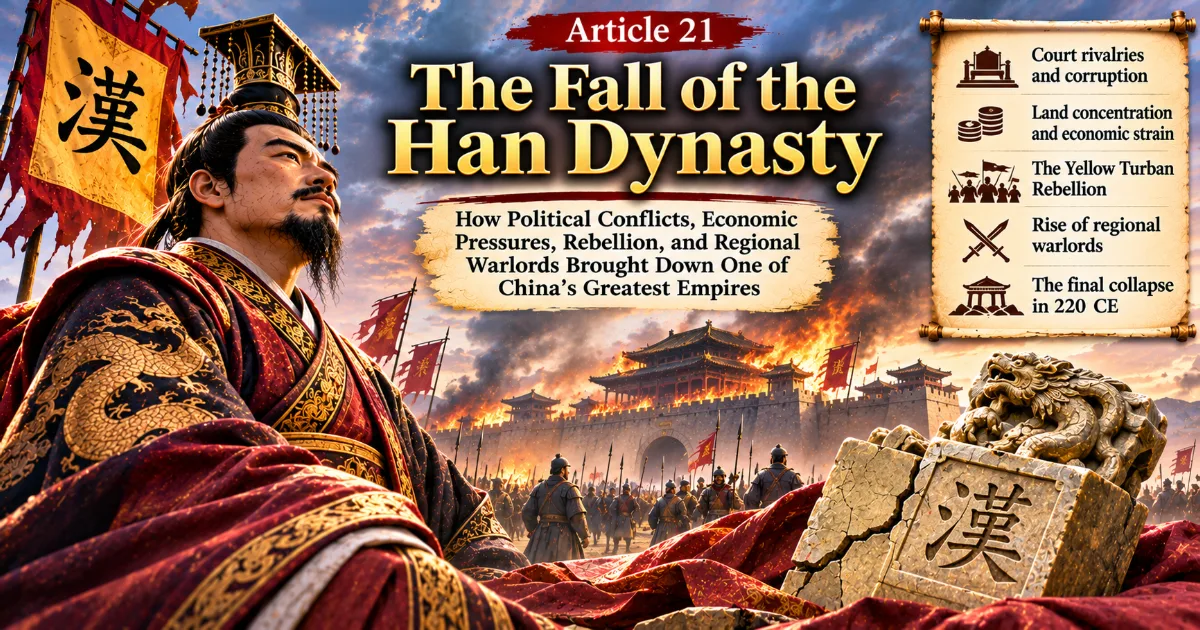
The fall of the Han Dynasty in 220 CE marked the beginning of one of the most dramatic periods in Chinese history. For more than four centuries, the Han Empire had provided a powerful political framework that connected vast territories through centralized administration, shared cultural traditions, trade, and imperial authority. However, decades of political corruption, court rivalries, economic inequality, rebellions, and military conflicts had gradually destroyed the foundations of the dynasty. By the beginning of the third century, the emperor had lost effective control over much of the empire, and regional military commanders had become the most powerful political figures in China.
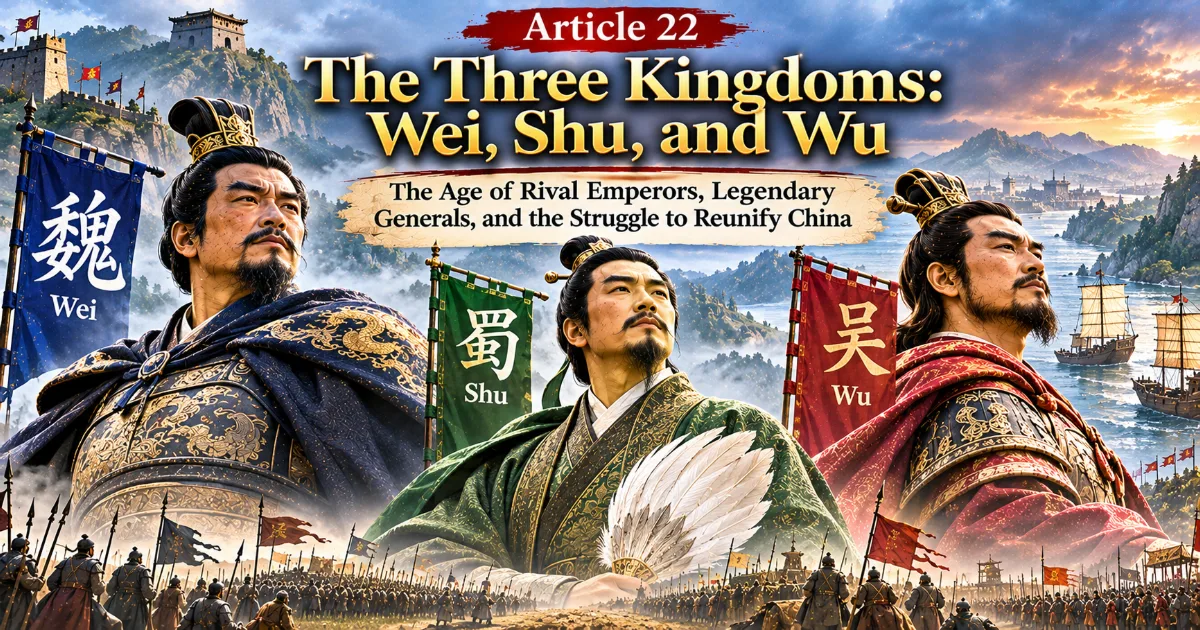
Out of this crisis emerged three competing states: Wei in the north, Shu Han in the southwest, and Wu in the southeast. Together, they became known as the Three Kingdoms. Each government claimed political legitimacy, maintained its own administration, developed military forces, and sought to expand its influence. Their leaders represented different political traditions and ambitions, but all faced the same fundamental challenge: how to establish lasting authority over a divided China.
The Three Kingdoms period lasted from 220 to 280 CE, although the political fragmentation that produced it began much earlier. It was an era of military campaigns, diplomatic alliances, ambitious rulers, talented strategists, and constantly changing political relationships. Battles such as Guandu and Red Cliffs shaped the balance of power, while figures such as Cao Cao, Liu Bei, Sun Quan, Zhuge Liang, and Sima Yi became central to the history and later cultural imagination of China.
The period is especially famous because of the literary masterpiece Romance of the Three Kingdoms, which transformed historical figures and events into an enduring story of loyalty, strategy, courage, betrayal, and ambition. However, the historical Three Kingdoms were more complex than their literary representations. Their governments had to manage agriculture, taxation, military recruitment, diplomacy, infrastructure, and the daily needs of their populations while fighting for survival.
Continue Reading
The Three Kingdoms period eventually ended when the Jin Dynasty defeated Wu in 280 CE and reunited China under a single imperial government. Yet the political struggles of this era left a lasting impression on Chinese history. They demonstrated the consequences of imperial collapse, the importance of regional power, and the difficulty of rebuilding unity after prolonged conflict.
How the Han Dynasty Gave Way to Three Rival Powers
The origins of the Three Kingdoms can be traced to the weakening of the Eastern Han Dynasty during the second century CE. Although the Han government continued to function formally, its ability to maintain order was increasingly challenged by court factions, powerful landowners, economic difficulties, and popular unrest.
The Yellow Turban Rebellion of 184 CE was a major turning point. Led by Zhang Jue, the movement attracted large numbers of people who were dissatisfied with political corruption, taxation, economic hardship, and social inequality. The Han government eventually suppressed the main rebellion, but the military response strengthened regional commanders who were allowed to recruit and organize their own forces.
The central government became increasingly dependent on these commanders. Instead of restoring effective imperial control, the suppression of the rebellion encouraged the growth of independent military power.
The crisis deepened in 189 CE following the death of Emperor Ling. Rivalries between palace eunuchs, imperial relatives, and senior officials led to violence in the capital. General He Jin was assassinated, palace factions were destroyed, and the military commander Dong Zhuo entered Luoyang with his troops.
Dong Zhuo removed Emperor Shao and installed Liu Xie, who became Emperor Xian. He controlled the court through military force and eventually moved the imperial government to Chang'an. His actions provoked opposition among regional commanders, who formed a coalition against him.
Although Dong Zhuo was assassinated in 192 CE, his death did not restore stability. His former subordinates continued fighting, while regional leaders expanded their territories. The emperor remained politically important because control over the imperial court provided legitimacy, but his ability to govern independently had largely disappeared.
During the following years, several military commanders competed for control of northern, southern, and central China. Among them, Cao Cao, Liu Bei, and Sun Quan gradually emerged as the most influential leaders.
Cao Cao and the Rise of Northern Power
Cao Cao was one of the most important political and military figures of the late Han period. Born in 155 CE, he came from a family with connections to the imperial administration and developed a reputation as a capable military commander.
He became increasingly influential during the political crisis of the late second century. Unlike some regional commanders who pursued territorial expansion without a broader administrative strategy, Cao Cao understood the importance of combining military strength with political legitimacy and economic organization.
In 196 CE, he brought Emperor Xian under his protection at Xuchang. This decision gave him control over the imperial court and allowed him to issue government orders in the emperor's name.
The emperor's presence strengthened Cao Cao's political position. He could present military campaigns as efforts to restore imperial authority rather than simply as personal attempts to conquer territory. In practice, however, the emperor became increasingly dependent on Cao Cao's power.
Cao Cao also worked to rebuild agricultural production in the territories under his control. Years of warfare had damaged farmland, displaced populations, and disrupted food supplies. His government developed agricultural settlement systems known as tuntian, which organized cultivation on land controlled by the state or military authorities.
These arrangements helped provide grain for soldiers and civilians. They also strengthened the administrative foundations of Cao Cao's growing power.
Cao Cao recruited capable officials and military commanders, sometimes promoting individuals because of their abilities rather than relying entirely on aristocratic background. His political and military organization allowed him to defeat several competing leaders and consolidate control over northern China.
His most famous early victory was the Battle of Guandu in 200 CE, where he defeated the powerful northern commander Yuan Shao.
The Battle of Guandu and the Unification of Northern China
Yuan Shao controlled a large territory in northern China and possessed substantial military resources. After defeating several rivals, he became one of the most powerful regional commanders and posed a serious threat to Cao Cao.
The two leaders eventually confronted each other near Guandu in 200 CE. Yuan Shao's forces were considerably larger, and his position appeared stronger at the beginning of the campaign.
However, Cao Cao used careful planning, intelligence, and effective military organization to compensate for his numerical disadvantage.
One of the most important moments occurred when Cao Cao's forces attacked Yuan Shao's supply depots at Wuchao. The destruction of these supplies severely weakened Yuan Shao's army and damaged its ability to continue the campaign.
Cao Cao then defeated Yuan Shao's forces and gained a decisive advantage in northern China.
The victory at Guandu changed the political balance of the region. Yuan Shao died in 202 CE, and his sons struggled over the inheritance of his power. Their divisions allowed Cao Cao to defeat them in subsequent campaigns.
By 207 CE, Cao Cao had established control over much of northern China. His victory created the strongest political and military base in the empire, although he still faced powerful rivals in the south.
Guandu became an important example of how military strategy, supply management, intelligence, and leadership could determine the outcome of a campaign even when one side possessed greater numerical strength.
Liu Bei and the Restoration of the Han Ideal
Liu Bei was another major figure in the political struggles of the late Han period. He claimed descent from the imperial Liu family and presented himself as a defender of the Han dynasty.
His early career was far less successful than Cao Cao's. Liu Bei spent years moving between different regional commanders, sometimes serving as an ally and sometimes becoming involved in conflicts with former supporters.
He developed a reputation for personal loyalty and concern for his followers. His ability to attract capable military officers and political advisers helped him survive repeated setbacks.
Among his most famous associates were Guan Yu and Zhang Fei, two generals traditionally remembered for their loyalty and military ability. Their relationships with Liu Bei became central to later stories about brotherhood and devotion.
Liu Bei also developed alliances with other influential leaders. However, his political position remained unstable because he lacked a secure territorial base.
His fortunes changed through his association with the powerful Jing Province region and his eventual relationship with the strategist Zhuge Liang.
Liu Bei's claim to Han legitimacy became an important political resource. At a time when many regional commanders were pursuing personal power, he argued that the Han imperial tradition should be preserved.
His government later adopted the name Shu Han, emphasizing its claimed connection to the former dynasty.
Zhuge Liang and the Strategic Vision of Shu Han
Zhuge Liang became one of the most famous strategists in Chinese history. Born in 181 CE, he developed a reputation for intelligence, administrative ability, and political judgment.
According to traditional accounts, Liu Bei visited Zhuge Liang several times at his residence in Longzhong before persuading him to become an adviser. Their discussions produced a strategic vision often known as the Longzhong Plan.
The plan recognized that Liu Bei could not defeat Cao Cao immediately because of the latter's superior resources in northern China. Instead, Liu Bei needed to establish a secure base in the west and develop an alliance with Sun Quan in the southeast.
The strategy involved gaining control of Jing Province and eventually securing Yi Province, which included the fertile Sichuan Basin. These territories could provide food, manpower, and defensive advantages.
The plan also recognized that cooperation with Sun Quan was essential. A southern alliance could prevent Cao Cao from concentrating all his forces against Liu Bei.
Although the political situation changed over time, the basic strategic vision helped shape the emergence of Shu Han.
Zhuge Liang later became chancellor and took responsibility for administration, military organization, diplomacy, and economic management. His historical importance extended beyond battlefield strategy. He worked to strengthen government institutions, organize agricultural production, and maintain the stability of a relatively small state.
Later literature portrayed him as an almost supernatural strategist, but historical evidence shows that his influence came from practical political and administrative ability as well as military planning.
Sun Quan and the Strength of the Southeast
Sun Quan inherited a powerful regional base established by his father, Sun Jian, and older brother, Sun Ce.
Sun Jian had been a military commander during the final years of the Han Dynasty. His son Sun Ce expanded the family's influence across the lower Yangtze region and established control over important territories.
After Sun Ce's death in 200 CE, Sun Quan succeeded him. Although relatively young, he gradually proved capable of managing military commanders, local elites, and regional political interests.
The territories controlled by Sun Quan benefited from agricultural production, river transportation, and access to important commercial networks. The Yangtze River provided a major geographical advantage, allowing the state to move supplies and troops by water.
Sun Quan also maintained relationships with powerful local families whose support was essential for governing the region.
Unlike Cao Cao, whose power was based primarily in the north, Sun Quan developed a political and military system suited to the geography of southeastern China.
His forces became particularly skilled in naval warfare. Control of the Yangtze River was essential because it formed a natural barrier between northern and southern territories.
Sun Quan's government later became known as Eastern Wu. Its political centre was established at Jianye, near modern-day Nanjing.
The Battle of Red Cliffs: The Turning Point of the Three Kingdoms
The Battle of Red Cliffs in 208 CE was one of the most important events in the history of the Three Kingdoms.
After consolidating control over northern China, Cao Cao turned his attention toward the south. His objective was to extend his authority over the Yangtze region and defeat the remaining independent military powers.
Liu Bei's forces were unable to resist Cao Cao alone. He therefore sought an alliance with Sun Quan.
The alliance was strategically important because the two leaders recognized that allowing Cao Cao to control the entire Yangtze region would leave them vulnerable.
Sun Quan accepted cooperation, and the allied forces prepared to resist the northern army.
Cao Cao's forces advanced toward the Yangtze River, but the southern commanders used their knowledge of local geography and naval conditions to their advantage.
The decisive fighting took place near Red Cliffs. The allied forces used fire attacks against Cao Cao's fleet, contributing to a major defeat for the northern army.
The exact details of the battle and the scale of the forces involved remain subjects of historical discussion. Later literary accounts expanded the event into a dramatic story involving elaborate deception and individual acts of heroism.
Historically, the battle demonstrated that Cao Cao could not easily conquer the south. His defeat preserved the independence of Sun Quan and created an opportunity for Liu Bei to establish a stronger territorial base.
Red Cliffs therefore helped establish the political division that would define the Three Kingdoms period.
The Formation of Shu Han in the Southwest
Following the Battle of Red Cliffs, Liu Bei strengthened his position in southern and central China.
He initially gained influence in Jing Province, an important strategic region connecting the central Yangtze with routes toward the southwest.
Liu Bei later expanded into Yi Province, which contained the fertile Sichuan Basin. The region's mountains and natural barriers provided defensive advantages, while its agricultural resources could support a substantial population.
The conquest of Yi Province gave Liu Bei the territorial foundation he needed to establish an independent government.
In 214 CE, Liu Bei gained control over the region after defeating its existing ruler, Liu Zhang.
He subsequently strengthened his position in Hanzhong, a strategically important area connecting the Sichuan Basin with northern China. In 219 CE, his forces defeated Cao Cao's army in the Hanzhong campaign.
These victories increased Liu Bei's prestige and allowed him to claim greater political authority.
In 221 CE, following the formal end of the Han Dynasty, Liu Bei declared himself emperor of Shu Han. He argued that his imperial descent and commitment to the Han tradition gave his government legitimacy.
Shu Han became one of the three major states, with its political centre at Chengdu.
The Formation of Wei
Cao Cao never formally declared himself emperor, although he held enormous power over the Han court.
In 216 CE, Emperor Xian granted him the title of King of Wei, reflecting his dominant political position.
Cao Cao died in 220 CE. His son Cao Pi inherited his authority and continued to control the imperial court.
Later that year, Emperor Xian abdicated in favour of Cao Pi. Cao Pi then established the state of Cao Wei and declared himself emperor.
This event formally ended the Han Dynasty.
The new Wei government claimed that the Mandate of Heaven had passed from the Han rulers to the Cao family. Its political legitimacy was based on the argument that the previous dynasty had lost the ability to govern and that a new ruler had restored order.
Wei controlled the largest territory among the three states and possessed substantial agricultural and human resources.
Its political centre was established at Luoyang, the former Eastern Han capital.
Cao Pi worked to strengthen the new government and consolidate his family's authority. However, the state faced continuing military competition with Shu and Wu.
The Formation of Eastern Wu
Sun Quan initially maintained his position as a regional ruler while the Han Dynasty formally continued to exist.
After Cao Pi established Wei and Liu Bei declared himself emperor of Shu Han, Sun Quan faced increasing pressure to define his own political position.
In 229 CE, Sun Quan declared himself emperor and established the state of Eastern Wu.
His government controlled much of southeastern China, including important territories along the Yangtze River.
Wu benefited from fertile agricultural regions, river transportation, and access to maritime routes. Its location also created opportunities for trade and diplomatic contact with neighbouring regions.
The state developed a strong naval tradition because the Yangtze River and coastal waterways were essential for military and commercial activity.
Sun Quan's government also expanded its influence toward southern territories. Relations with local communities and neighbouring populations were important to the state's territorial development.
Although Wu was geographically distant from the northern centres of power, it remained a major political and military force throughout the Three Kingdoms period.
The Three Kingdoms Compared
The three states developed different political and economic strengths.
Wei controlled the north and possessed the largest population and agricultural base. Its government inherited many administrative institutions from the Han period and maintained a strong military system.
Shu Han controlled the Sichuan Basin and surrounding regions. Its smaller population and territory created limitations, but its geographical position offered defensive advantages.
Wu controlled the southeast and benefited from river transport, agriculture, and naval strength. Its ability to operate along the Yangtze River helped protect it from northern military pressure.
These differences influenced their strategies.
Wei generally possessed the resources necessary for large-scale campaigns, but it had to overcome the geographical barriers separating it from the south and southwest.
Shu Han depended heavily on careful administration and military planning because it could not match Wei's resources directly.
Wu relied on its river systems, naval forces, and regional economic strength to defend its independence.
Each state attempted to strengthen its legitimacy by presenting itself as the rightful successor to the Han political tradition or as the government capable of restoring order.
Zhuge Liang's Northern Expeditions
After Liu Bei's death in 223 CE, his son Liu Shan became emperor of Shu Han. Zhuge Liang continued to serve as the leading political and military figure.
The state faced serious challenges. Its population and resources were smaller than those of Wei, and it needed to maintain a stable relationship with Wu while protecting its northern frontier.
Zhuge Liang worked to restore the alliance with Wu and strengthen Shu's internal administration.
He also organized several military campaigns against Wei, commonly known as the Northern Expeditions.
Beginning in 228 CE, these campaigns aimed to weaken Wei's control over the northern territories and potentially restore the Han imperial order.
Zhuge Liang faced formidable opponents, including the experienced Wei commander Sima Yi.
The campaigns involved difficult mountain routes, supply problems, and the challenge of moving armies across demanding terrain.
Although Zhuge Liang achieved some tactical successes, he was unable to secure a decisive victory against Wei.
His greatest challenge was maintaining sufficient supplies for prolonged military operations. The mountainous geography of the region made transportation difficult, and the smaller resources of Shu limited the scale of its campaigns.
In 234 CE, Zhuge Liang launched another major expedition and reached the Wuzhang Plains. He faced Sima Yi's forces, but the campaign became a prolonged confrontation.
Zhuge Liang died during the campaign in 234 CE. His death was a major loss for Shu Han because he had been the state's most influential administrator and strategist.
The northern expeditions did not achieve their ultimate objective, but they became an important part of the historical memory of the Three Kingdoms.
Sima Yi and the Growing Power of the Sima Family
Sima Yi was one of the most important political and military figures in the history of Wei.
He served under the Cao family and became known for his administrative ability, strategic judgment, and caution in military operations.
His confrontation with Zhuge Liang became one of the defining rivalries of the period.
However, Sima Yi's historical importance extended far beyond his campaigns against Shu. Over time, he gained increasing political influence within Wei.
After the death of Cao Rui in 239 CE, the young emperor Cao Fang came to the throne. A regency arrangement initially involved Cao Shuang and Sima Yi.
The relationship between the two men deteriorated as they competed for control of the government.
In 249 CE, Sima Yi carried out a political and military coup at Gaoping Tombs. He removed Cao Shuang and his supporters from power and established control over the Wei government.
The event marked a major turning point. Although the Cao family remained on the throne, the Sima family increasingly controlled the state.
Sima Yi died in 251 CE, but his sons Sima Shi and Sima Zhao continued to expand the family's political authority.
The eventual establishment of the Jin Dynasty would emerge directly from the political position created by the Sima family during the later years of Wei.
The Decline of Shu Han
After Zhuge Liang's death, Shu Han continued under the leadership of Liu Shan.
The state remained politically stable for some time, but its military and economic limitations became increasingly important.
Later commanders and officials attempted to maintain the defensive system established during Zhuge Liang's administration.
However, internal political divisions and changes in military leadership weakened the state's ability to compete with Wei.
One of the most important later commanders was Jiang Wei, who continued campaigns against Wei and sought to preserve the strategic vision of Zhuge Liang.
His military efforts consumed considerable resources, and the results were limited.
Wei eventually launched a major invasion of Shu in 263 CE. The campaign involved several commanders and exploited weaknesses in Shu's defensive arrangements.
Deng Ai led a daring advance through difficult mountain terrain and reached the region near Chengdu. Other Wei forces also applied pressure along the northern approaches.
Liu Shan surrendered in 263 CE, bringing the state of Shu Han to an end.
The fall of Shu demonstrated that geographical defences and determined leadership could not guarantee survival when a smaller state faced a stronger opponent with greater resources.
The Fall of Eastern Wu
After the conquest of Shu, the state of Wei, now increasingly controlled by the Sima family, prepared to eliminate the remaining independent kingdom.
In 265 CE, Sima Yan forced the last Wei emperor to abdicate and established the Jin Dynasty.
The new Jin government inherited the military and administrative resources of Wei and turned its attention toward the conquest of Wu.
Eastern Wu had experienced serious internal problems during its later years. Political conflicts, succession disputes, court rivalries, and administrative weaknesses reduced the effectiveness of its government.
Sun Quan had died in 252 CE, and the succession of later rulers became increasingly unstable.
Some officials and military commanders disagreed over government policy, while others became involved in factional struggles.
The final Wu emperor, Sun Hao, came to the throne in 264 CE. His reign was marked by political difficulties and a deteriorating relationship with sections of the government.
In 279 CE, the Jin government launched a major invasion of Wu.
Jin forces advanced along several routes, using both land and river operations. The military pressure overwhelmed Wu's defensive arrangements.
In 280 CE, Sun Hao surrendered to the Jin forces. The state of Eastern Wu collapsed, bringing the Three Kingdoms period to an end.
For the first time since the fall of the Han Dynasty, China was reunited under a single imperial government.
The Establishment of the Jin Dynasty
Sima Yan established the Jin Dynasty in 265 CE after replacing the Wei imperial house. The conquest of Wu in 280 CE completed the reunification of China.
The early Jin government inherited much of the administrative and military structure developed by Wei. It attempted to restore stability after decades of warfare and political division.
However, reunification did not solve all the problems that had weakened the previous states.
The Jin Dynasty faced internal political conflicts, powerful aristocratic families, and difficulties managing the imperial succession.
The War of the Eight Princes, which began in the late third century, eventually devastated the central government and weakened the dynasty.
The Western Jin Dynasty was overthrown in 316 CE following invasions and political crises. The Jin imperial house continued in the south as the Eastern Jin Dynasty, beginning in 317 CE.
China therefore entered another period of political division after the temporary reunification achieved by Sima Yan.
The end of the Three Kingdoms was not the end of instability in Chinese history, but it represented an important stage in the long struggle to rebuild imperial unity.
Society and Everyday Life During the Three Kingdoms Period
The Three Kingdoms period is often remembered through military commanders and famous battles, but ordinary people experienced the consequences of political division in much more direct ways.
Agricultural production was frequently disrupted by warfare. Farmers could lose land, livestock, tools, and stored grain when armies moved through their regions.
Military recruitment removed labour from households, while repeated campaigns created demand for food, weapons, transport animals, and other supplies.
Some communities were displaced by fighting and forced to move toward safer territories. Others experienced increased taxation and labour obligations as rival governments attempted to finance their armies.
The movement of populations also influenced regional development. The Sichuan Basin, lower Yangtze region, and other areas became increasingly important as political and economic centres.
Governments attempted to restore agricultural production through settlement policies, irrigation, and administrative reforms. The tuntian system associated with Cao Cao was one example of efforts to connect agriculture with military supply.
Despite the hardships of war, the period also witnessed continued cultural and administrative activity. Scholars, engineers, craftsmen, and officials worked within the three governments, preserving many traditions inherited from the Han Dynasty.
The Three Kingdoms were therefore not simply military camps competing for territory. They were functioning states with populations, economies, institutions, and cultural traditions.
The Military Innovations and Strategies of the Era
Military organization was central to the Three Kingdoms period.
The three states inherited different elements of the Han military system but adapted their forces to changing political and geographical conditions.
Wei benefited from its large northern population and agricultural resources. Its armies could draw on extensive supplies and established administrative institutions.
Shu relied on mountain fortifications, carefully selected routes, and defensive positions. Its commanders had to use limited resources efficiently.
Wu developed strong naval capabilities because control of rivers and waterways was essential to its security.
Military campaigns involved infantry, cavalry, archers, engineers, naval forces, and logistical support units. Supply management was often as important as battlefield tactics.
The use of fortifications and strategic passes reflected the importance of geography. Armies moving through mountainous regions faced different challenges from those operating on open plains.
The Three Kingdoms period also demonstrated the importance of intelligence, diplomacy, alliances, and psychological warfare.
A commander who could understand an opponent's intentions, protect supply routes, and maintain the loyalty of subordinates often possessed advantages beyond the number of soldiers under his command.
These lessons contributed to the long history of Chinese military thought.
Culture, Literature, and the Historical Memory of the Three Kingdoms
The Three Kingdoms period became one of the most influential eras in Chinese cultural memory.
Its historical figures and political conflicts were preserved through official histories, biographies, later chronicles, storytelling traditions, theatre, and literature.
One of the most important historical sources is the Records of the Three Kingdoms, written by Chen Shou in the third century. The work provides accounts of the three states and their leading figures.
Pei Songzhi later produced an influential commentary that added additional historical material and explanations.
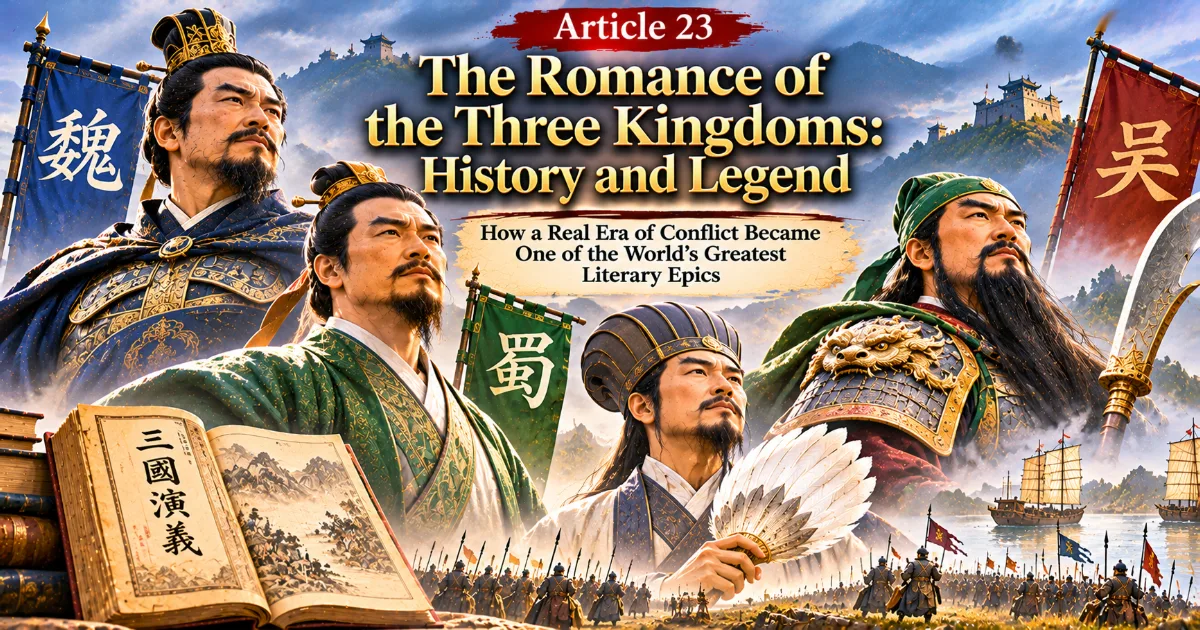
Centuries later, the novel Romance of the Three Kingdoms transformed the period into one of the greatest literary narratives in Chinese history.
The novel is traditionally attributed to Luo Guanzhong and is generally associated with the late fourteenth century, although questions about its development and textual history remain subjects of scholarship.
The literary work presents the era through memorable characters, dramatic speeches, military strategies, rivalries, and moral conflicts.
Liu Bei is often portrayed as a virtuous leader devoted to the Han tradition. Cao Cao appears as an ambitious and complex political figure, while Zhuge Liang becomes the model of strategic wisdom and loyalty.
The novel contains many historical events but also includes invented scenes, altered conversations, dramatic exaggerations, and fictional interpretations.
For this reason, the literary Three Kingdoms should be distinguished from the historical period. The novel is valuable for understanding Chinese culture and historical memory, but it is not a completely reliable record of events.
Why the Three Kingdoms Period Matters
The Three Kingdoms period is important because it demonstrates how political authority can fragment when a central government loses control over military and administrative institutions.
The Han Dynasty had maintained unity through a combination of imperial legitimacy, bureaucratic administration, economic resources, and cultural traditions. Once the central government weakened, regional commanders gained the ability to establish independent political systems.
The three states showed different methods of building authority. Wei used its northern resources and administrative strength, Shu relied on strategic geography and the claim of Han legitimacy, and Wu used river power and regional economic networks.
Their competition also demonstrated that military victory alone was not enough to create lasting unity. A successful government required effective administration, reliable food supplies, political cooperation, and public stability.
The period influenced later Chinese military thought and political literature. Its leaders became symbols of different approaches to power, loyalty, strategy, and governance.
The reunification under Jin in 280 CE showed that the division could be overcome, but the later collapse of Western Jin demonstrated how difficult it was to maintain stability after prolonged conflict.
Conclusion: Three Kingdoms, One Civilization, and the Search for Unity
The Three Kingdoms period was one of the most dramatic chapters in Chinese history. Emerging from the collapse of the Han Dynasty, it was shaped by ambitious leaders, military campaigns, political alliances, and the struggle to establish a legitimate government over a divided empire.
Cao Cao built a powerful northern state and established the foundations of Wei. Liu Bei used his claimed connection to the Han imperial family and the strategic leadership of Zhuge Liang to establish Shu Han in the southwest. Sun Quan strengthened the southeast through regional alliances, economic development, and naval power, creating Eastern Wu.
The Battle of Guandu helped establish Cao Cao's dominance in northern China, while the Battle of Red Cliffs prevented him from conquering the south. Zhuge Liang's Northern Expeditions, Sima Yi's political rise, and the eventual conquest of Shu and Wu shaped the final stages of the period.
In 220 CE, the Han Dynasty formally ended when Emperor Xian abdicated in favour of Cao Pi. The resulting states competed for decades until the Jin Dynasty conquered Wu in 280 CE and reunited China.
The period left behind an extraordinary historical and cultural legacy. Its political struggles became the foundation for one of China's most famous literary traditions, while its leaders continued to inspire discussions about loyalty, leadership, intelligence, ambition, and the responsibilities of government.
Yet behind the famous generals and strategic victories were ordinary people who endured displacement, taxation, military recruitment, and the economic consequences of prolonged warfare.
The Three Kingdoms period reminds us that the fall of an empire does not immediately end the civilization it governed. Political institutions may fragment, rulers may compete, and territories may divide, but cultural traditions, administrative knowledge, and shared historical memory can survive.
China's search for unity continued beyond the Three Kingdoms, and the next chapter would bring further political division, the spread of Buddhism, and eventually another attempt to reunite the empire.
#HistoryOfChina #ThreeKingdoms #WeiShuWu #AncientChineseHistory #ChineseCivilization