How Political Corruption, Court Conflicts, Economic Inequality, Rebellion, and Military Rivalries Brought Down One of China's Greatest Empires
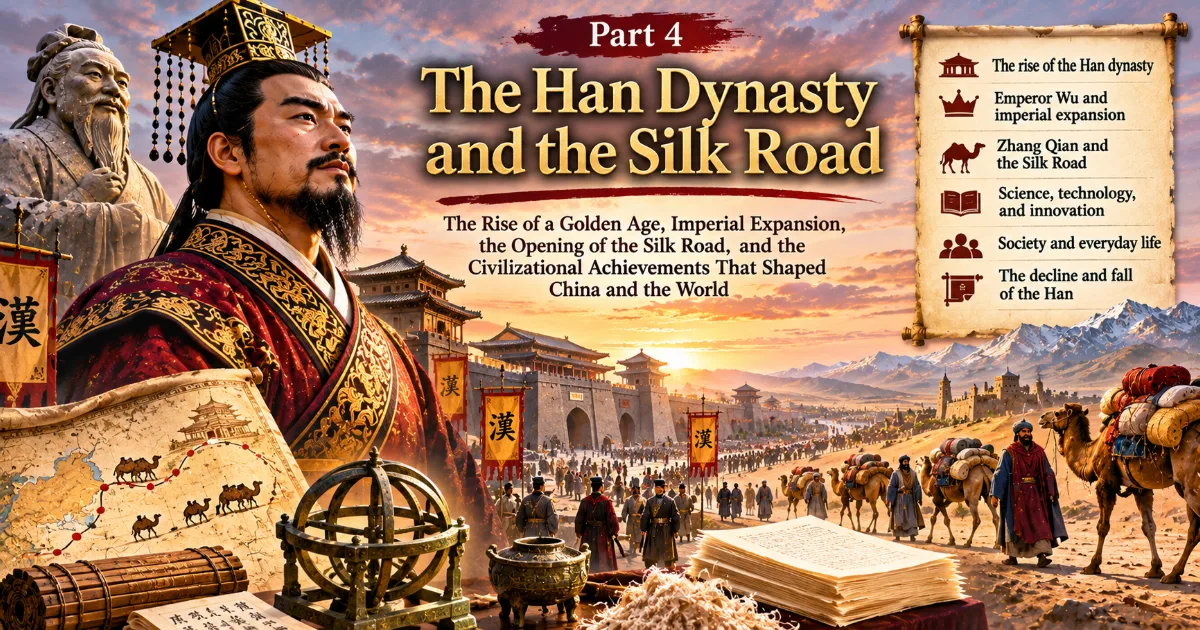
The Han Dynasty was one of the most powerful and influential ruling houses in Chinese history. Established in 206 BCE after the collapse of the Qin Dynasty, it governed China for more than four centuries, with an interruption between the Western Han and Eastern Han periods. During this time, the empire expanded its territory, strengthened its administration, developed international trade, encouraged scholarship, and produced important advances in technology, agriculture, medicine, and culture.
The Han Dynasty became so influential that the name Han eventually developed into an important cultural identity associated with the majority ethnic group in China. Its political institutions and intellectual traditions shaped later dynasties, while its commercial networks connected China with distant regions through routes that became known as the Silk Road.
However, the achievements of the Han Empire did not guarantee its survival. Over time, political rivalries weakened the imperial court, powerful families accumulated land and influence, economic pressures increased, and local communities became increasingly vulnerable. Natural disasters, rebellions, military conflicts, and administrative failures placed additional pressure on the government.
The Eastern Han Dynasty, which began in 25 CE after the restoration of imperial rule by the Guangwu Emperor, experienced repeated struggles between imperial relatives, palace eunuchs, senior officials, and powerful landowning families. These conflicts gradually weakened the central administration. The Yellow Turban Rebellion of 184 CE exposed the depth of social dissatisfaction and forced the government to rely increasingly on regional military commanders.
Continue Reading
Although the rebellion was eventually suppressed, the political consequences were severe. Generals and provincial leaders gained control over soldiers, resources, and territories. The imperial court became increasingly dependent on military figures whose interests did not always align with the survival of the dynasty.
By the beginning of the third century, the Han emperor possessed little effective power. In 220 CE, Emperor Xian formally abdicated, bringing the dynasty to an end and opening the way for the Three Kingdoms period.
The fall of the Han Dynasty was not caused by a single event or one individual. It was the result of a long process in which political institutions weakened, social inequalities deepened, and regional military power increasingly replaced central authority. Understanding this collapse reveals how even a powerful empire can become vulnerable when its political, economic, and social foundations deteriorate.
The Han Empire at the Height of Its Power
To understand the collapse of the Han Dynasty, it is necessary to examine the achievements that made it one of the greatest empires of the ancient world.
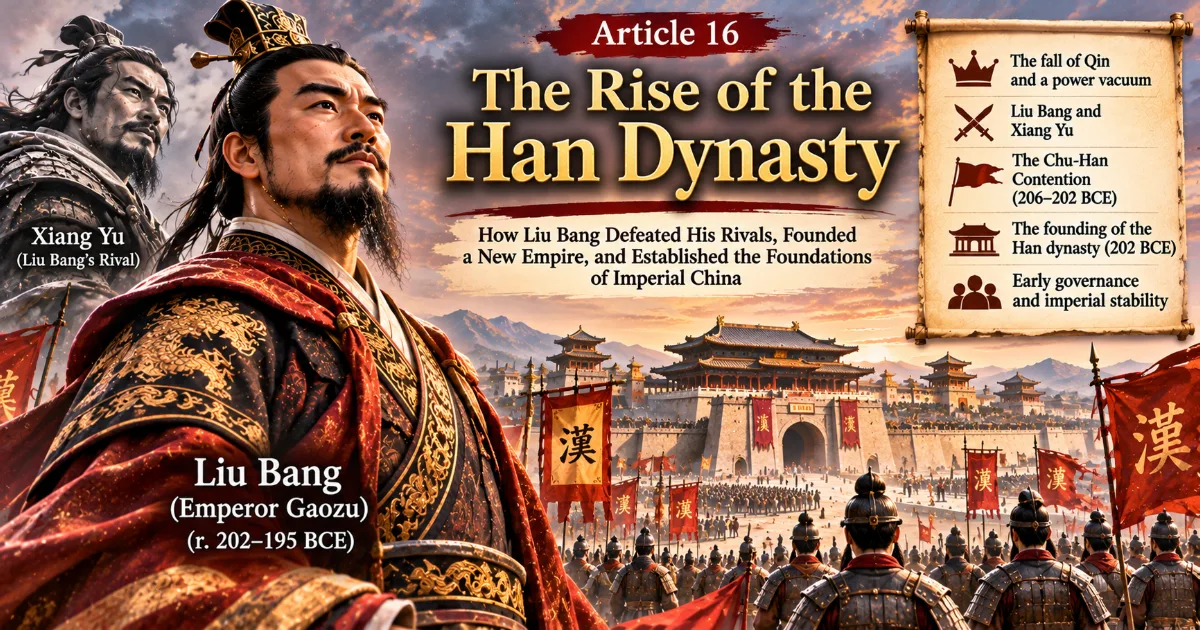
The Western Han Dynasty was founded by Liu Bang, who became Emperor Gaozu after defeating his rivals following the collapse of Qin rule. The early Han rulers retained important administrative institutions from the Qin period but adjusted policies that had contributed to the previous dynasty's unpopularity.
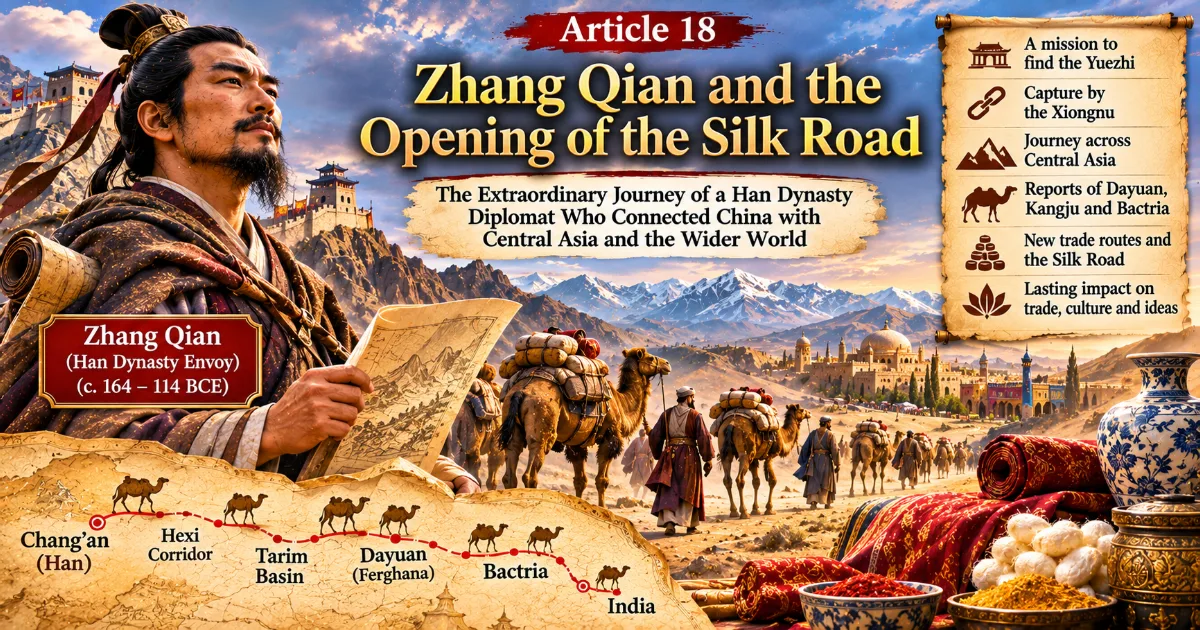
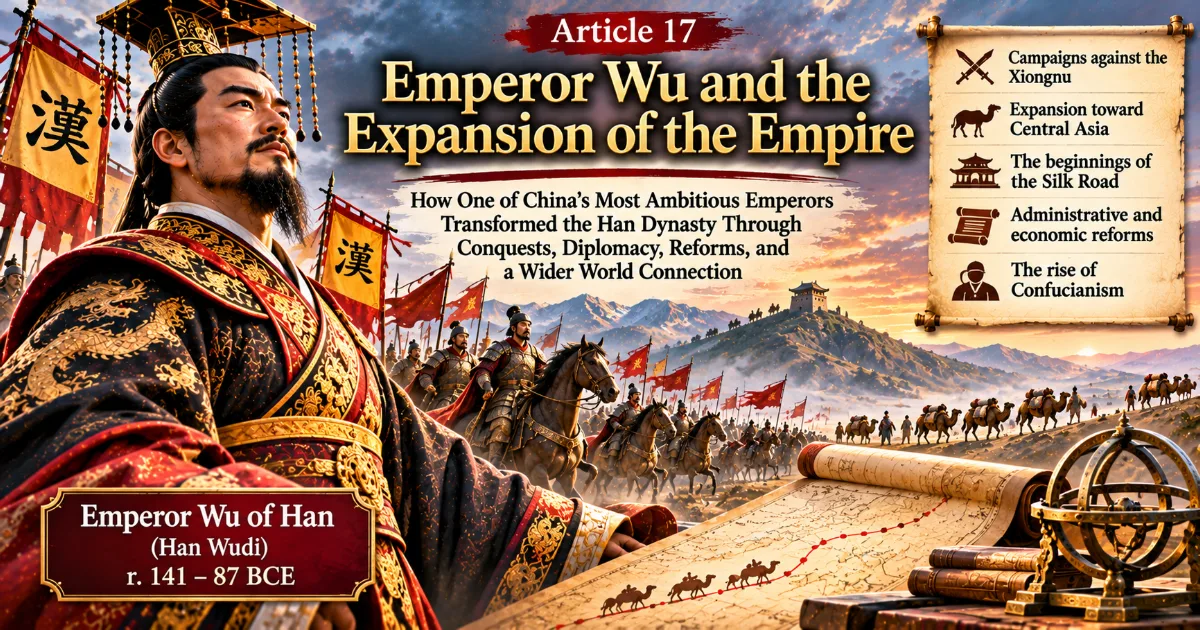
The government gradually established a more stable relationship between central authority and regional administration. Agriculture recovered, population increased, and trade expanded. Under Emperor Wu, who ruled from 141 to 87 BCE, the empire extended its influence into Central Asia, strengthened its military position, and developed diplomatic connections that helped create the foundations of the Silk Road.
Han China also experienced significant intellectual and technological development. Scholars preserved historical records, mathematicians developed practical methods of calculation, physicians organized medical knowledge, and engineers improved agricultural and mechanical technologies. Papermaking was refined during the Eastern Han period, while Zhang Heng made important contributions to astronomy and mechanical engineering.
The prosperity of the Han Empire depended on agriculture, trade, manufacturing, taxation, and an extensive administrative system. Its government collected revenue, maintained roads and canals, managed military garrisons, and supervised local officials.
However, the empire's size also created administrative challenges. Distant territories were difficult to govern, communication could be slow, and local officials sometimes became more powerful than the central government intended.
The Han system relied heavily on the ability of the emperor and senior officials to maintain cooperation among different political and economic interests. When imperial leadership became weak, these relationships could deteriorate rapidly.
The End of the Western Han Dynasty
The first major collapse of Han rule occurred in the early first century CE.
By the final decades of the Western Han period, the imperial court faced serious problems involving succession, political rivalry, land concentration, and the growing influence of powerful families.
The reign of Emperor Cheng, who ruled from 33 to 7 BCE, was marked by court factionalism and the growing influence of imperial relatives. Powerful families connected to the imperial household gained access to appointments and political influence.
After Emperor Cheng's death, Emperor Ai ruled from 7 to 1 BCE. His short reign did not resolve the deeper problems affecting the court. Following his death, Emperor Ping came to the throne as a child in 1 BCE, creating an opportunity for powerful regents to dominate government affairs.
One of the most influential figures during this period was Wang Mang, a member of a powerful family connected to the imperial court. He gradually accumulated political authority and became regent during the reign of the young emperor.
Wang Mang presented himself as a defender of classical values and an opponent of corruption. He attracted support among some scholars and officials who believed that the Han government required fundamental reform.
In 9 CE, Wang Mang declared the establishment of a new dynasty known as Xin, ending Western Han rule.
His government attempted major changes in land policy, currency, administration, and economic regulation. One of his most ambitious proposals involved the restructuring of land ownership. He sought to limit the concentration of land and reorganize agricultural property.
However, the reforms encountered strong opposition from powerful landowners and were difficult to implement. Changes in currency and economic regulation also created confusion. Government authority weakened as officials struggled to enforce new policies across the empire.
Natural disasters and flooding further increased economic hardship. The Yellow River changed its course during this period, causing serious damage to agricultural regions and contributing to displacement and social unrest.
Rebellions eventually spread, and Wang Mang's government lost control of large parts of the country. In 23 CE, rebel forces captured Chang'an, and Wang Mang was killed.
The Xin Dynasty collapsed after only about fifteen years. The failure of Wang Mang's government created the conditions for the restoration of Han imperial rule.
The Restoration of the Han Dynasty
After Wang Mang's fall, several political and military leaders competed for control of the former Han territories.
One of the most successful was Liu Xiu, a descendant of the imperial Liu family. He emerged as a leading figure during the conflicts that followed the collapse of the Xin Dynasty.
Liu Xiu gradually defeated rival forces and established control over important territories. In 25 CE, he declared himself emperor and restored the Han Dynasty.
He became known as Emperor Guangwu of Han and established the Eastern Han capital at Luoyang.
The restoration brought a period of political recovery. Guangwu worked to rebuild administrative institutions, restore agricultural production, and strengthen central authority. His government attempted to reduce the burdens imposed on ordinary households and stabilize the empire after years of conflict.
The Eastern Han Dynasty inherited the traditions and institutions of the Western Han but faced a different political environment. Powerful landowning families had become increasingly influential, and the imperial court relied on relationships with aristocratic and regional elites.
For much of the first century CE, the Eastern Han remained relatively stable. Several emperors maintained effective administration, and the empire continued to benefit from agricultural production, trade, and intellectual development.
Nevertheless, the structural problems that had weakened the Western Han were not completely resolved. Over time, the influence of imperial relatives, court factions, and wealthy landowners created new pressures on the dynasty.
The Growing Power of Imperial Relatives
One of the recurring political problems of the Eastern Han Dynasty was the influence of families connected to the imperial household.
When an emperor came to the throne as a child, his mother or another senior female relative could become empress dowager and exercise authority as regent. Her male relatives might receive important government positions and gain influence over imperial appointments.
This arrangement could provide stability when an emperor was too young to govern. However, it also created opportunities for powerful families to dominate the court.
Some relatives of empresses accumulated enormous political influence. They could control access to the emperor, influence the appointment of officials, and shape major government decisions.
When a young emperor reached adulthood, he might attempt to remove the relatives who had dominated the court during his childhood. Such efforts could lead to violent political struggles.
The conflict between imperial relatives and other court factions weakened the stability of government. Officials became divided into competing groups, each seeking influence over the emperor and the administration.
These rivalries consumed political attention that could otherwise have been directed toward economic reform, local administration, frontier security, and the needs of ordinary people.
The Growing Influence of Palace Eunuchs
Eunuchs were men who had been castrated and served within imperial households and palace institutions. They had a long history in Chinese courts, where they performed domestic, administrative, and ceremonial duties.
During the Eastern Han period, some eunuchs gained significant political influence because of their close access to the emperor.
They could control communication within the palace, manage access to the ruler, and influence the transmission of information. In some circumstances, their position allowed them to become important political advisers.
The power of palace eunuchs increased during periods when emperors were young, isolated, or dependent on court officials.
Their influence created tensions with senior scholars and officials who believed that government should be controlled by educated administrators rather than palace insiders.
Some eunuchs became involved in corruption, political appointments, and the distribution of privileges. However, it would be inaccurate to assume that every eunuch was corrupt or that they alone caused the collapse of the Han Dynasty. The deeper problem was the absence of stable institutions capable of limiting competing centres of power.
As conflict intensified, eunuchs and imperial relatives sometimes formed opposing factions. Their struggles damaged the credibility of the imperial government and encouraged political violence.
The Struggle Between Court Factions
The later Eastern Han court became increasingly divided between powerful groups.
One faction included palace eunuchs and individuals who benefited from their influence. Another included Confucian scholars and senior officials who opposed the growing authority of palace networks.
Imperial relatives and military figures could also become involved in these conflicts.
The central issue was not simply a disagreement over personal behaviour. It involved competing ideas about who should control the government and how political authority should be exercised.
Scholars often argued that government should follow moral principles, classical learning, and proper administrative conduct. They criticized officials who gained influence through personal connections rather than merit.
Eunuchs and their supporters often defended their position through loyalty to the emperor and control of palace administration. In practice, political power depended on access to the ruler, control over appointments, and the ability to command armed supporters.
These rivalries created an atmosphere of suspicion. Officials could be accused of disloyalty, removed from office, or punished because of their political connections.
The court became less capable of responding to problems outside the capital. Local officials faced growing challenges, while powerful families and regional commanders expanded their independence.
The decline of central authority was therefore both a political and an administrative crisis.
The First Disaster: The Proscription of Partisans
One of the most significant political conflicts of the later Eastern Han period involved the persecution of scholars and officials known as the partisans.
During the reign of Emperor Huan, who ruled from 146 to 168 CE, criticism of palace corruption and political influence became increasingly intense.
Some scholars and officials called for reforms and condemned the behaviour of powerful court figures. They believed that the government had departed from Confucian principles and that corrupt appointments were damaging the empire.
These critics developed networks of supporters among students, scholars, and officials. Their political activity attracted attention from the palace factions.
In 166 CE, the court launched a major persecution against individuals accused of forming an unlawful political faction. Many scholars were arrested, dismissed from office, or placed under restrictions.
The persecution became known as the first Proscription of Partisans.
A second major wave of repression followed in 169 CE during the reign of Emperor Ling. The authorities targeted additional scholars and their supporters, and some individuals were executed.
These events weakened the administrative and intellectual capacity of the government. Experienced officials were removed from public life, while political debate became increasingly dangerous.
The persecutions also damaged trust between the court and sections of the educated elite. Many scholars believed that the government had become hostile to the very people who should have helped maintain its stability.
The conflict revealed how deeply political factionalism had penetrated the Han court.
Land Concentration and the Decline of Small Farmers
Political corruption was only one part of the Han crisis. Economic inequality also weakened the foundations of the empire.
Agriculture was the main source of wealth and government revenue. Most households depended on access to land for survival. However, land ownership became increasingly concentrated in the hands of powerful families.
Wealthy landowners could purchase property from farmers facing debt, poor harvests, or taxation difficulties. Once small farmers lost their land, they might become tenants, labourers, or dependants of powerful households.
Large estates could employ many workers and exercise significant influence over local communities. Some landowners developed private networks that allowed them to protect their interests even when government officials attempted to enforce regulations.
Land concentration created difficulties for the imperial state. Farmers who lost independent ownership could become harder to tax directly. Powerful landowners might negotiate favourable arrangements or interfere with local administration.
The government needed agricultural revenue to maintain its army, officials, and infrastructure. When the tax base weakened, the central administration faced growing financial difficulties.
The decline of small farming households also created social instability. Families struggling with debt and taxation were more vulnerable to migration, rebellion, and recruitment by armed movements.
Economic inequality did not cause the fall of the Han Dynasty by itself, but it weakened the social foundation on which imperial government depended.
Taxation, Labour, and the Burden on Ordinary People
The Han state required substantial resources to maintain its institutions. Taxes and labour obligations supported public administration, military campaigns, transportation systems, defensive structures, and other government activities.
Agricultural households faced different forms of taxation and service requirements. These obligations could become especially difficult during periods of poor harvests or economic disruption.
Labour service might require people to participate in construction, transportation, maintenance, or other public projects. Military responsibilities could also remove working members from their households.
For poor families, the loss of labour could reduce agricultural output and increase dependence on borrowing.
When taxation remained high despite difficult economic conditions, resentment could grow. Local officials were responsible for collecting government obligations, but their behaviour varied. Some acted responsibly, while others exploited their positions.
Corruption and unequal enforcement damaged the legitimacy of local administration. People who believed that powerful families could avoid obligations while ordinary households carried the burden had little reason to trust the government.
The state sometimes attempted to reduce taxes or provide relief, but these measures could be undermined by weak administration and the influence of local elites.
The economic difficulties of the later Han period made it increasingly difficult for the government to maintain public confidence.
Natural Disasters and Agricultural Hardship
Natural disasters repeatedly challenged the Han Empire.
Floods, droughts, crop failures, epidemics, and other environmental problems could destroy harvests and displace entire communities.
The Yellow River was particularly important because it supported agricultural regions but could also cause severe destruction when its waters overflowed or changed course.
Flooding could destroy fields, homes, roads, and irrigation systems. Families might lose stored grain, livestock, and farming equipment. Rebuilding could require years of effort.
Drought created different but equally serious problems. A lack of rainfall could reduce crop production, increase food prices, and force households to seek assistance or migrate.
The government was expected to respond to such disasters by organizing relief, repairing infrastructure, and maintaining food supplies. However, political conflict and financial weakness reduced its ability to act effectively.
Natural disasters also had political significance. Traditional Chinese political thought associated the moral conduct of rulers with the condition of the natural world. Repeated disasters could therefore be interpreted as evidence that the emperor had lost the Mandate of Heaven.
Such beliefs did not mean that people ignored practical causes of environmental disasters. They show how political legitimacy, morality, and natural events were connected in the intellectual culture of the period.
The accumulation of natural and economic difficulties created conditions in which rebellion became more likely.
Emperor Ling and the Weakening of Imperial Authority
Emperor Ling ruled from 168 to 189 CE and presided over one of the most troubled periods in Eastern Han history.
During his reign, palace eunuchs gained considerable influence, while court factions continued to struggle for control.
The government also faced financial pressures and growing social unrest. Some accounts describe the sale of official positions and other practices that damaged the reputation of the administration.
The practice of selling appointments reflected the state's need for revenue and the growing influence of individuals who could use wealth to obtain political status. Such arrangements weakened confidence in the idea that public office should be awarded through ability and appropriate service.
Emperor Ling's government struggled to maintain authority beyond the capital. Powerful families and regional leaders became increasingly important in local politics.
The central court remained occupied with internal disputes even as social conditions deteriorated across the empire.
When Emperor Ling died in 189 CE, the succession crisis created an opportunity for a dramatic political confrontation.
The Yellow Turban Rebellion of 184 CE
The Yellow Turban Rebellion was one of the most important uprisings in Chinese history and a major turning point in the decline of the Han Dynasty.
The rebellion emerged from widespread social and economic dissatisfaction. Poor harvests, disease, taxation, corruption, land inequality, and political instability contributed to an atmosphere of unrest.
The movement was led by Zhang Jue, a religious and charismatic figure who developed a large following through a movement associated with faith healing, spiritual renewal, and the promise of a new political order.
Zhang Jue and his brothers organized supporters across several regions. Followers became known as the Yellow Turbans because of the yellow head coverings associated with the movement.
The colour yellow carried symbolic meaning, particularly in connection with ideas about cosmic change and the Five Phases. The rebellion's ideology suggested that the existing political order had reached the end of its legitimacy and that a new era was approaching.
In 184 CE, the Yellow Turban movement launched a major uprising against the Han government.
Rebel forces attacked government offices, administrative centres, and other institutions. The movement spread rapidly and threatened the authority of the imperial administration.
The government responded by mobilizing military forces and appointing commanders to suppress the rebellion.
Among the commanders who became prominent during the crisis were Huangfu Song, Zhu Jun, and Lu Zhi. Their campaigns inflicted serious defeats on the rebels.
The rebellion was eventually suppressed as an organized military movement, but its consequences were far greater than the immediate fighting.
The Han government had been forced to rely heavily on regional military commanders. These commanders gained experience, soldiers, and political influence that would later become central to the empire's fragmentation.
Why the Yellow Turban Rebellion Was So Important
The Yellow Turban Rebellion did not directly destroy the Han Dynasty, but it exposed the weaknesses of the imperial state.
The scale of the uprising demonstrated that dissatisfaction had spread beyond isolated local disputes. Large numbers of people were willing to challenge the government, and the existing administrative system struggled to respond.
The rebellion also changed the relationship between the central government and regional military leaders.
In order to suppress the uprising, the court allowed commanders and local authorities greater freedom to organize armed forces. These forces often depended on personal loyalty rather than direct imperial control.
Once the immediate rebellion ended, many military leaders retained their soldiers and influence.
The government therefore faced a new problem. It had survived a major rebellion, but in doing so it had strengthened regional forces that could challenge the emperor.
The crisis marked a turning point from an empire governed primarily through central administration toward a political environment in which military commanders increasingly determined regional affairs.
The Crisis of 189 CE: The Struggle for Control of the Capital
The death of Emperor Ling in 189 CE created a succession crisis that accelerated the collapse of central authority.
His young son Liu Bian became emperor, later known as Emperor Shao. Because the new emperor was a minor, his mother, Empress Dowager He, exercised influence through the court.
Her brother, He Jin, became one of the most powerful political figures in the capital.
He Jin opposed the growing influence of the palace eunuchs and sought to eliminate their political power. However, his plans were complicated by court rivalries and the need to secure military support.
He Jin invited regional military commanders to bring troops toward the capital in order to pressure the palace faction.
Among those summoned was Dong Zhuo, a powerful general stationed in the northwest.
Before He Jin could complete his plans, the eunuchs arranged his assassination in September 189 CE. His supporters then entered the palace and killed several eunuchs.
The resulting violence created chaos within the capital.
Dong Zhuo arrived with military forces and took advantage of the disorder. He gained control over the imperial court and soon became the dominant political figure.
The crisis demonstrated how the struggle between palace factions had destroyed the ability of the government to maintain order.
Dong Zhuo and the Destruction of Imperial Stability
Dong Zhuo was a military commander who had gained influence through service on the northwestern frontier.
After entering the capital in 189 CE, he used his military power to dominate the court.
He removed Emperor Shao and installed the younger Liu Xie as emperor. Liu Xie became known as Emperor Xian, the final ruler of the Han Dynasty.
Dong Zhuo presented himself as the protector of the imperial system, but his actions made the emperor increasingly dependent on military force.
He controlled access to the court, influenced appointments, and exercised authority through intimidation.
His behaviour alarmed many senior officials and regional commanders. They feared that Dong Zhuo intended to establish personal rule over the empire.
In 190 CE, a coalition of regional leaders formed against him. The coalition included several important figures who would later become major players in the political struggles of the Three Kingdoms period.
Dong Zhuo responded by moving the imperial court from Luoyang to Chang'an. The relocation involved the destruction and abandonment of important areas of the old capital.
The move weakened the political and economic foundations of the central government. The emperor became a dependent figure within a court controlled by military power.
Dong Zhuo was eventually assassinated in 192 CE by Lü Bu, a military figure who had previously served him.
However, his death did not restore stability. His former subordinates continued to fight for control, and the imperial court remained trapped in military conflict.
The Rise of Regional Warlords
The collapse of central authority allowed powerful regional commanders to establish independent bases of power.
These leaders controlled soldiers, territories, taxation, and local administration. Their ability to command military resources made them more influential than many imperial officials.
Some warlords claimed to defend the Han emperor, while others pursued their own political ambitions.
The distinction between loyalty to the dynasty and personal ambition became increasingly difficult to determine. Regional leaders could use imperial titles and official appointments to legitimize their actions while operating independently.
Among the most important figures were Cao Cao, Yuan Shao, Liu Bei, Sun Quan, and several other commanders.
Their rise marked a fundamental transformation in Chinese politics. The empire was no longer governed effectively by a single central authority. Instead, political power was divided among military leaders who competed for territory and legitimacy.
The imperial government still existed, but its authority depended on whichever military faction controlled the emperor and the capital.
Cao Cao and the Restoration of Order in Northern China
One of the most influential figures during the final years of the Han Dynasty was Cao Cao.
Cao Cao was a military commander and statesman who gained prominence during the political crisis of the late second century.
He recognized the symbolic value of controlling the emperor and the administrative institutions associated with the Han government.
In 196 CE, Cao Cao brought Emperor Xian under his protection at Xuchang. He established a government structure around the emperor and used imperial authority to strengthen his own political position.
This strategy allowed him to issue decrees in the emperor's name and claim legitimacy while building an independent military and administrative power base.
Cao Cao reorganized agricultural production in areas under his control. He supported the development of military agricultural colonies, known as tuntian systems, which helped provide food for soldiers and civilian populations.
His forces also defeated rival commanders and expanded control over northern China.
In 200 CE, Cao Cao defeated Yuan Shao at the Battle of Guandu. This victory was a major turning point in the struggle for control of northern China.
Cao Cao later defeated several additional rivals and became the dominant political and military figure in the north.
Although he never formally declared himself emperor, he held enormous power over the Han court.
The Rise of Liu Bei and Sun Quan
While Cao Cao consolidated power in northern China, other leaders developed strong political bases in different regions.
Liu Bei claimed descent from the imperial Liu family and presented himself as a defender of Han legitimacy.
He faced many military setbacks but gradually established relationships with influential supporters and commanders. His reputation for loyalty to the Han dynasty helped attract followers.
Liu Bei eventually gained control over parts of southwestern China, including the strategically important region of Shu.
Sun Quan inherited the political and military position established by his family in the lower Yangtze region. He strengthened his authority over the southeastern territories and developed a government based at Jianye, near present-day Nanjing.
These regional powers developed their own administrative institutions, military forces, and economic systems.
The competition among Cao Cao, Liu Bei, and Sun Quan shaped the final years of the Han Dynasty and laid the foundations for the Three Kingdoms period.
The Battle of Red Cliffs and the Division of China
One of the most famous military events of the late Han period was the Battle of Red Cliffs in 208 CE.
Cao Cao had gained control over much of northern China and sought to extend his authority southward.
His army moved toward the Yangtze River region, where Liu Bei and Sun Quan recognized the danger posed by the expansion of northern power.
The two leaders formed an alliance to resist Cao Cao.
The opposing forces met near the Yangtze River in a campaign that involved naval operations, difficult geography, and complex military manoeuvres.
The allied forces used fire attacks against Cao Cao's fleet, contributing to a major defeat for the northern army.
The battle prevented Cao Cao from immediately conquering the southern territories and helped preserve the independence of the regional powers led by Liu Bei and Sun Quan.
Red Cliffs became a defining event in the political division of China. It demonstrated that the Han Empire could no longer be restored through the authority of one military leader alone.
The defeat also established the conditions under which three major political centres would emerge.
The Three Kingdoms Take Shape
Following the Battle of Red Cliffs, China became increasingly divided among three major powers.
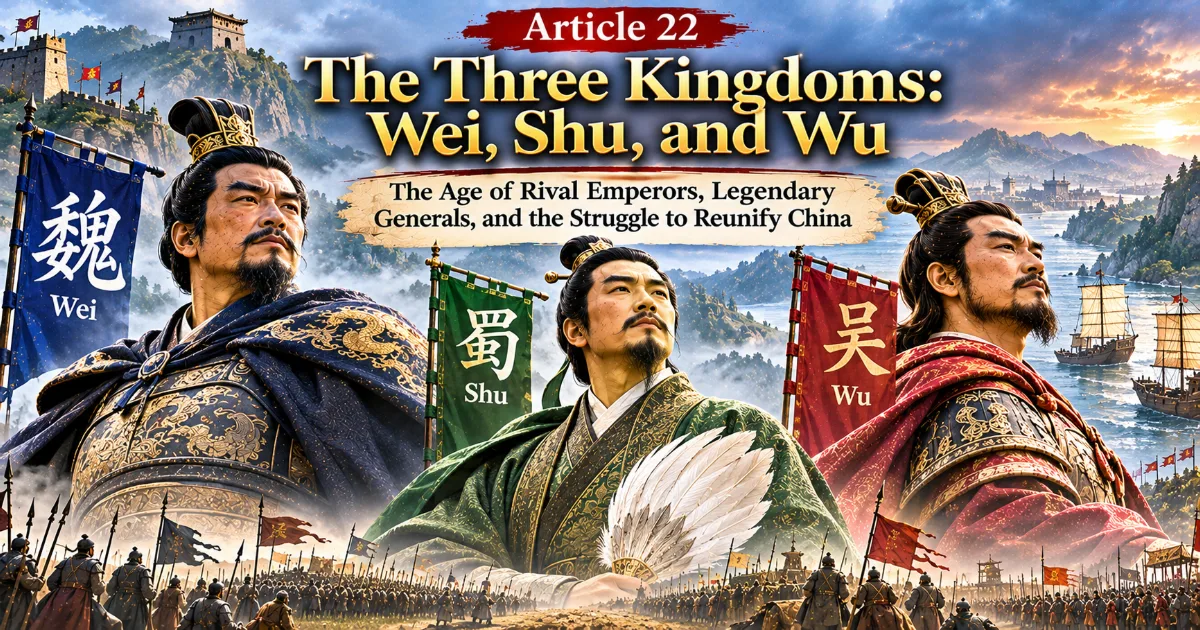
Cao Cao controlled much of northern China. His son Cao Pi later inherited his political position and established the state of Wei.
Liu Bei consolidated control over the region of Shu and eventually declared himself emperor of Shu Han in 221 CE.
Sun Quan maintained his authority in the southeast and established the state of Wu in 229 CE.
These three powers became known as Wei, Shu, and Wu.
Their emergence marked the beginning of the Three Kingdoms period, one of the most famous eras in Chinese history.
The Three Kingdoms competed through military campaigns, diplomacy, economic development, and efforts to establish political legitimacy.
Although the Han Dynasty had formally survived for a short period after the major crises of the late second century, its effective authority had already disappeared.
The Abdication of Emperor Xian in 220 CE
The final end of the Han Dynasty came in 220 CE.
Cao Cao died in 220, and his son Cao Pi succeeded him as the leading political figure in the north.
Cao Pi controlled the imperial court and had sufficient military and political power to end the remaining formal independence of the Han emperor.
Emperor Xian was persuaded or compelled to abdicate. Cao Pi then established the state of Wei and declared himself emperor.
The abdication formally ended the Han Dynasty after more than four centuries of imperial rule, including the interruption caused by Wang Mang's Xin Dynasty.
Emperor Xian was given a noble title and lived for several more years after losing the throne.
The Han imperial system had not disappeared without influence. Its institutions, political traditions, and cultural legacy continued to shape the governments that emerged during the Three Kingdoms period.
The formal end of the dynasty represented the conclusion of an important chapter in Chinese history, but it also marked the beginning of a new era of political competition.
Why the Han Dynasty Collapsed
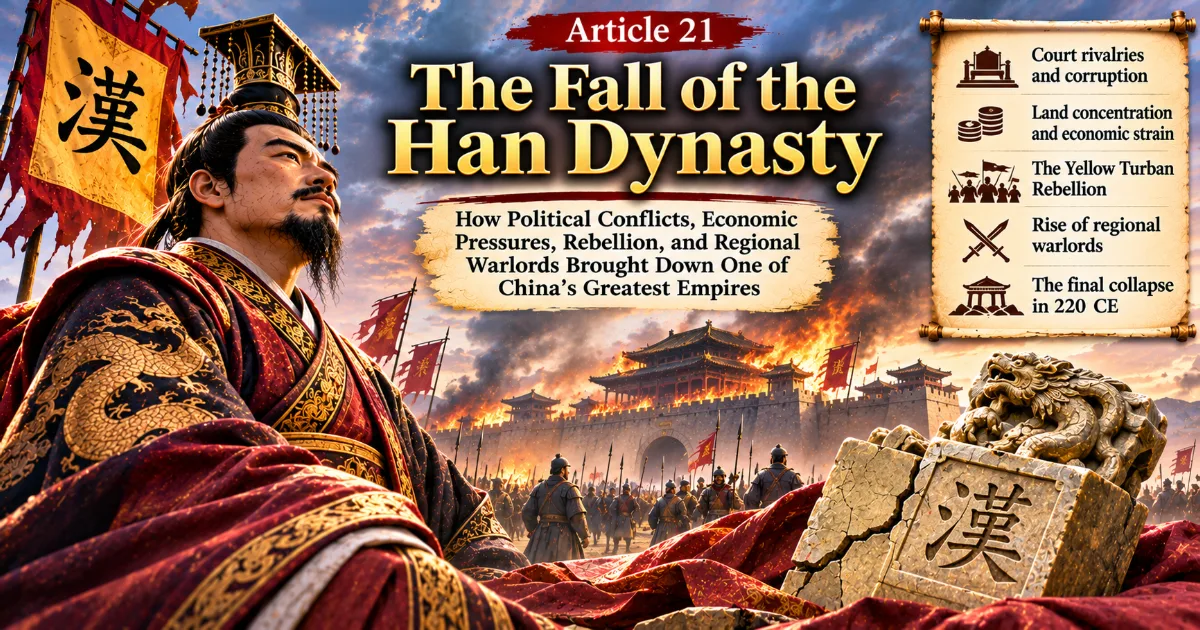
The fall of the Han Dynasty was caused by several connected problems rather than one isolated event.
Political factionalism weakened the imperial court. Rivalries between palace eunuchs, imperial relatives, and senior officials prevented effective administration and damaged the authority of the emperor.
Economic inequality undermined the rural population. Land concentration and debt weakened small farming households, while powerful landowners gained increasing control over local communities.
Taxation and labour obligations created pressure on ordinary families. During periods of poor harvests and natural disasters, these burdens became especially difficult to manage.
Natural disasters intensified social instability. Floods, droughts, and agricultural crises reduced production, displaced people, and increased dissatisfaction.
The Yellow Turban Rebellion exposed the depth of public discontent and forced the government to rely on regional military commanders.
The crisis of 189 CE destroyed the remaining stability of the imperial court. Dong Zhuo's intervention demonstrated that military force had become more important than established administrative authority.
Finally, the rise of regional warlords divided the empire into competing political territories. Cao Cao, Liu Bei, Sun Quan, and other leaders built military systems that could operate independently of the central government.
The Han Dynasty fell because its political institutions could no longer coordinate the interests of the empire or maintain control over the forces that had emerged within it.
The Legacy of the Han Dynasty After Its Fall
Although the Han Dynasty ended in 220 CE, its influence remained central to Chinese civilization.
The administrative structure developed during Han rule provided important foundations for later dynasties. Subsequent governments continued to use bureaucratic institutions, centralized political authority, and systems of local administration that had developed during the imperial period.
Confucian learning remained influential in government and education. Later dynasties continued to emphasize classical scholarship and the moral responsibilities of rulers and officials.
The Han period also strengthened the cultural identity associated with the name Han. The term eventually became one of the most important ethnic and cultural identifiers in China.
Technological and intellectual achievements continued to influence later generations. Papermaking, mathematics, medicine, astronomy, agriculture, and engineering developed through traditions that had been strengthened during the Han period.
The Silk Road networks established and expanded during Han rule continued to connect China with Central Asia and regions farther west. These connections supported the movement of goods, ideas, religions, and cultural influences.
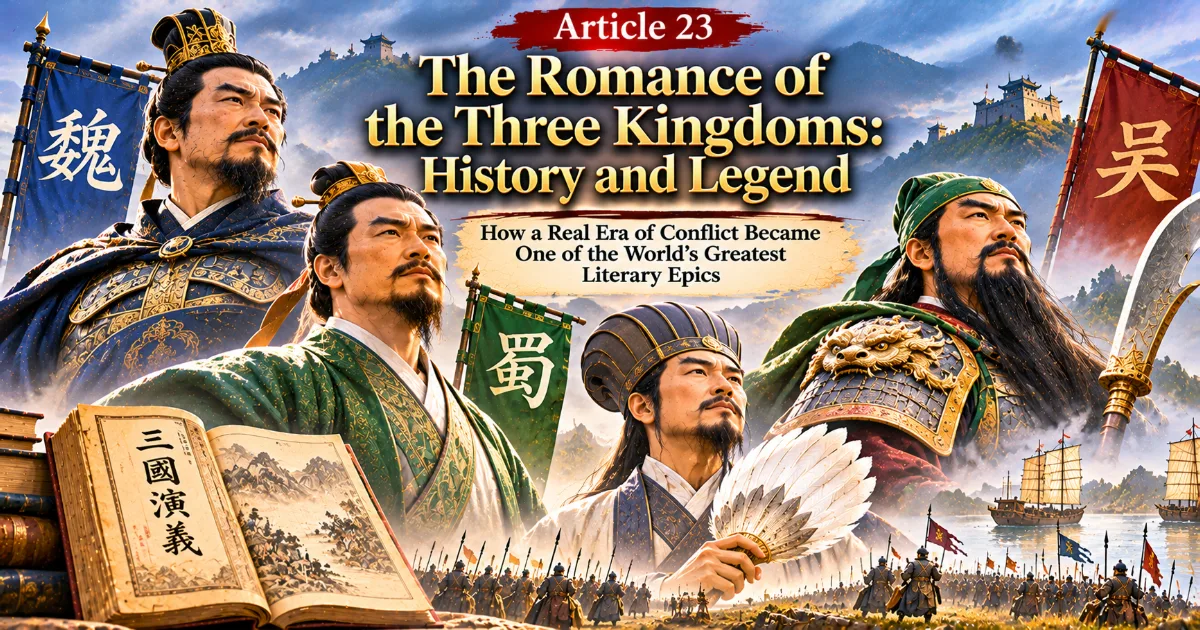
The political division that followed the Han collapse also produced important historical developments. The Three Kingdoms period became a lasting part of Chinese historical memory and later inspired literature, drama, art, and popular culture.
Conclusion: The End of an Empire and the Beginning of a New Era
The fall of the Han Dynasty was one of the most significant turning points in Chinese history. An empire that had once controlled vast territories, maintained extensive trade networks, and produced extraordinary cultural and technological achievements gradually lost its ability to govern itself.
The collapse began with political and economic problems that developed over generations. The end of Western Han rule under Wang Mang was followed by restoration under Emperor Guangwu, but the Eastern Han government struggled to control the growing influence of court factions and powerful families.
The persecution of scholars, the concentration of land, taxation pressures, natural disasters, and social unrest weakened the foundations of imperial authority. The Yellow Turban Rebellion of 184 CE exposed the crisis and encouraged the rise of regional military commanders.
The political violence of 189 CE further destroyed the stability of the court. Dong Zhuo's domination of the capital and the subsequent rise of powerful warlords transformed the empire into a collection of competing military territories.
Cao Cao, Liu Bei, and Sun Quan became central figures in the struggle for control of China. Their rivalry led to the political division that defined the Three Kingdoms period.
When Emperor Xian abdicated in 220 CE, the Han Dynasty formally ended. Yet its cultural, political, administrative, and technological influence survived.
The history of the Han Dynasty demonstrates that the survival of an empire depends on more than military strength or economic prosperity. Political institutions must remain capable of managing conflict, protecting ordinary people, maintaining public trust, and responding to changing conditions.
The Han Dynasty created one of the most influential foundations of Chinese civilization, but its collapse revealed the dangers of unchecked political rivalry, economic inequality, and the fragmentation of state authority.
Its story remains a powerful reminder that even the greatest empires can decline when the institutions that hold them together become weaker than the forces pulling them apart.
#HistoryOfChina #HanDynasty #FallOfTheHan #ThreeKingdoms #AncientChineseHistory