How Divination, Metalworking, and the Earliest Chinese Inscriptions Revealed the Power and Beliefs of an Ancient Civilization
Introduction: The Innovations That Preserved Ancient China
The Shang Dynasty left behind one of the most remarkable archaeological records of the ancient world. Its rulers commissioned elaborate bronze vessels, consulted ancestral spirits through divination, and used a sophisticated writing system to record questions about warfare, harvests, health, weather, and royal ceremonies. These practices were not isolated achievements. They were closely connected to the organization of political power, the development of specialized craftsmanship, and the emergence of a society in which written records played an important role in royal life.
Oracle bones, bronze vessels, and early Chinese writing are especially significant because they provide different kinds of evidence about the same civilization. Oracle-bone inscriptions reveal the concerns of the royal court in words recorded during the Shang period. Bronze objects demonstrate the technical abilities of specialized craftspeople and the resources available to powerful families. The development of writing reveals how early Chinese society created durable ways to record information, names, questions, and ritual activities.
These achievements developed over time rather than appearing suddenly. Bronze production required knowledge of materials, furnaces, and casting techniques. Writing required shared conventions for representing language, as well as people capable of reading and producing inscriptions. Divination relied on established ritual practices and the belief that ancestral powers could influence events in the living world.
The evidence is particularly rich at Yinxu, the archaeological site associated with the later Shang royal center near modern Anyang in Henan Province. Excavations there uncovered large collections of inscribed bones and turtle shells, elite burials, workshops, bronze objects, and architectural remains. These discoveries allow historians to investigate a society that would otherwise be known primarily through later historical traditions.
The innovations of the Shang also had consequences beyond the dynasty itself. Chinese writing continued to evolve through later periods, while bronze technology and ritual practices influenced subsequent societies. The Shang's written records established an unusually direct connection between the people of ancient China and the modern study of their world.
Understanding these innovations helps explain why the Shang occupies such an important position in Chinese history. It was a period when political authority, religious practice, technical knowledge, and written communication came together in ways that left a lasting historical record.
1. Oracle Bones: Discovering the Written Records of Ancient China
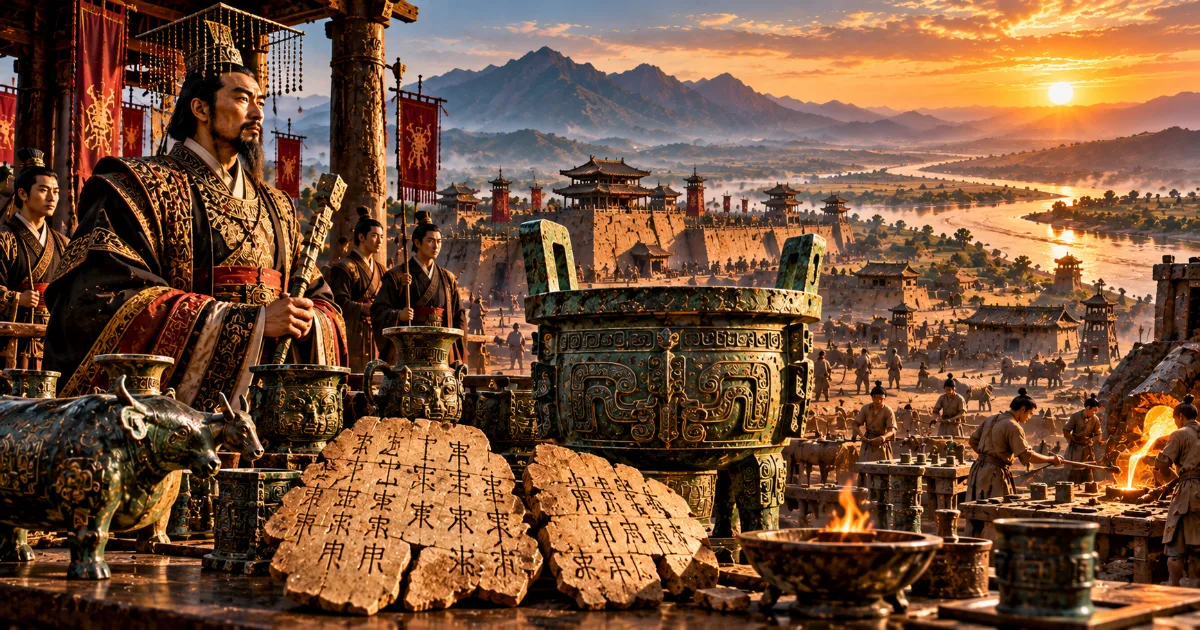
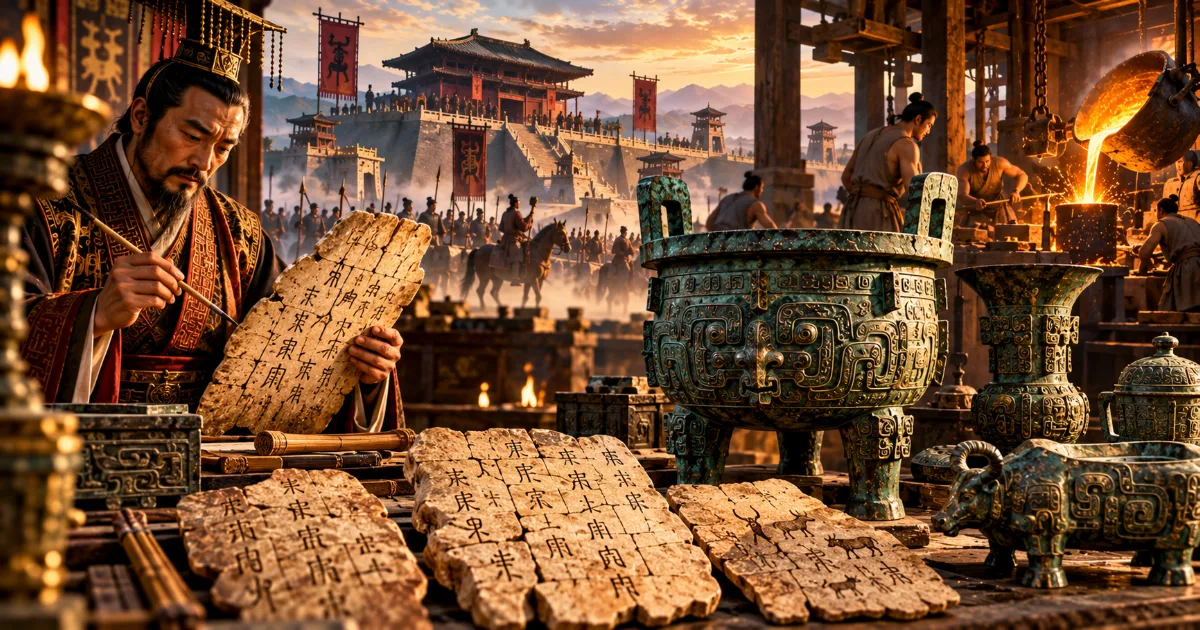
The discovery of oracle bones transformed the study of early Chinese civilization. These objects, usually made from animal bones or turtle shells, preserve inscriptions associated with divination at the Shang royal court. They provide direct evidence of the questions Shang rulers asked and the ritual procedures through which they sought guidance about uncertain events.
For centuries, the importance of these objects was not understood in the way it is today. In the late nineteenth century, inscribed bones and shells were being collected and sold in China, sometimes described as dragon bones and used in traditional medicinal preparations. Scholars eventually recognized that the markings were ancient writing rather than random scratches or decorative patterns.
The identification of these inscriptions opened a new chapter in Chinese historical research. Archaeological investigations, particularly those conducted at Anyang beginning in the twentieth century, uncovered large numbers of oracle bones in their archaeological context. Researchers could examine the objects themselves, study the inscriptions, and connect them with other evidence from the Shang royal center.
The inscriptions are especially valuable because they were created during the period they describe. Unlike historical narratives written centuries later, oracle bones preserve records associated with actual Shang ritual activities. They name royal ancestors, refer to military campaigns, and record questions about events that mattered to the court.
An oracle bone was not simply a writing surface. It was part of a religious procedure. The material was prepared, heat was applied to produce cracks, and the resulting patterns were interpreted. Questions and related observations could then be inscribed on the object. Some records also preserve the king's judgment or an assessment made after the event.
The surviving inscriptions are not all equally complete. Some objects contain only fragments, while others preserve several lines of writing. Archaeologists and scholars compare recurring signs, names, dates, and phrases to interpret them. Many inscriptions have been deciphered, but some characters and passages remain uncertain.
The discovery of oracle bones demonstrates the importance of combining archaeology with the study of writing. An inscription gains historical meaning from the context in which it was found, while the surrounding objects and structures help explain how it was used. Together, these forms of evidence reveal a royal society in which writing and divination were closely connected.
2. How Oracle-Bone Divination Worked
Oracle-bone divination was a formal practice through which Shang rulers sought answers about the future and guidance concerning important decisions. It was especially associated with the royal court, where political leadership and religious responsibility were closely intertwined.
The process generally began with the preparation of a suitable bone or turtle shell. Animal shoulder blades and turtle plastrons were among the materials used. The surface could be shaped or prepared before heat was applied to create cracks. The patterns produced by heating were interpreted by diviners within an established ritual framework.
Questions concerned matters such as rainfall, agricultural production, hunting, military campaigns, illness, childbirth, royal ceremonies, and the timing of offerings. These were not abstract questions. They related to the survival of households, the success of the kingdom, and the well-being of the royal family.
A king might seek guidance about whether a military expedition should take place or whether a particular day would be suitable for a ritual. Questions about rain and harvests reflected the importance of agricultural conditions. In a society dependent on farming, uncertainty about weather could have serious consequences for food supplies and political stability.
The inscriptions sometimes record predictions or judgments and, in certain cases, notes concerning outcomes. These records suggest that divination was not merely a private spiritual exercise. It formed part of an organized system through which the royal court considered decisions and preserved information about them.
The precise procedure could vary. Not every inscription records every stage of the ritual, and the surviving evidence does not provide a complete manual of Shang divination. Nevertheless, the objects demonstrate that the process followed recognizable conventions and involved specialized knowledge.
Divination also created a setting in which royal authority could be reinforced. The king was closely associated with the ritual system, and his decisions were connected to communication with powerful spiritual forces. By consulting ancestral powers, the royal household presented its actions as part of a relationship between the living and the supernatural world.
This did not mean that divination removed uncertainty from political life. The Shang rulers still faced military threats, environmental risks, and competing interests. Rather, divination provided a recognized method for interpreting uncertainty and deciding how to respond to it.
Oracle bones therefore reveal both religious belief and political organization. They show how a royal court used ritual procedures to address practical problems while strengthening the position of the ruler at the center of the kingdom.
3. Ancestors, Spirits, and the Shang Understanding of the World
The Shang religious world placed great importance on deceased members of the royal family. Ancestors were believed to retain influence after death and could affect the fortunes of their descendants. Maintaining relationships with them was therefore a significant responsibility of the living royal household.
Oracle-bone inscriptions frequently refer to royal ancestors. Rulers sought their assistance or asked whether particular ceremonies would be favorable. These records indicate that ancestors were not simply remembered as honored members of a family. They were treated as active spiritual powers whose attitudes and actions could affect the living world.
Ritual offerings helped maintain these relationships. Food, drink, and animal sacrifices formed part of ceremonies intended to honor ancestors and seek their support. Bronze vessels were important in many elite ritual contexts because they could be used to prepare, hold, or present offerings. Their elaborate manufacture also communicated the wealth and status of the families that possessed them.
The Shang royal household also recognized other supernatural powers, including forces associated with nature and a high deity often referred to as Di. The exact nature of these beings and their relationships to royal ancestors remain subjects of scholarly debate. The inscriptions do not provide a complete theological system, and their meaning must be reconstructed carefully.
The king's role in ritual practice helped distinguish him from other political leaders. He was responsible for major ceremonies and was closely associated with the process of divination. His position therefore combined political leadership with religious responsibilities.
This relationship between kingship and ritual had practical implications. Agricultural success, military victory, and the health of the royal family were all matters of political concern. If ancestral spirits could influence these outcomes, then the ruler's ability to maintain proper relationships with them became part of his public responsibility.
Religious practices were not necessarily identical throughout Shang society. The oracle bones primarily represent the concerns of the royal court, and they tell us less about the beliefs of ordinary farming households or distant communities. Local traditions may have differed, and many religious practices left little material evidence.
Even with these limitations, the inscriptions show that spiritual relationships were central to the Shang royal system. They reveal a society in which political decisions were made within a worldview that connected human affairs to ancestors, supernatural powers, and ritual obligations.
4. The Origins and Development of Early Chinese Writing
The Shang inscriptions represent the earliest extensive and securely documented stage of Chinese writing. They show that by the late Shang period, people associated with the royal court could record names, dates, questions, and ritual information through a developed system of written signs.
Writing did not emerge as a fully formed invention in a single moment. Its origins are difficult to reconstruct because marks on earlier objects do not always demonstrate a complete writing system. Some Neolithic artifacts contain symbols or signs, but their relationship to the later Chinese script remains uncertain. The oracle-bone inscriptions provide much clearer evidence of a system capable of representing language in complex ways.
The Shang script included characters associated with people, animals, natural phenomena, numbers, places, and ritual activities. Some signs appear to have developed from recognizable pictures, while others combined visual elements to convey meaning or sound. Over time, these conventions made it possible to record increasingly complex information.
A writing system depends on shared understanding. The people who carved and interpreted oracle-bone inscriptions needed to recognize the signs and understand how they functioned within written expressions. The existence of recurring names, phrases, dates, and formulaic questions indicates that Shang writing followed established conventions.
The royal court was a major setting for this practice. Divination records helped preserve the details of ritual sessions, while written names and references to ancestors supported the maintenance of royal genealogies and ceremonial traditions. The inscriptions also demonstrate that certain individuals possessed specialized knowledge of writing.
It is possible that writing was used on other materials that have not survived in comparable quantities. Wood, bamboo, textiles, and other organic surfaces decay much more readily than bone, shell, stone, or bronze. The archaeological record may therefore preserve only part of the writing practices that existed in the Shang world.
The oracle bones nevertheless provide a strong foundation for studying early Chinese writing. They reveal a system already capable of recording meaningful language, not merely a collection of isolated symbols. Their significance extends beyond the Shang because later Chinese scripts developed through a long historical process from earlier writing traditions.
The Shang evidence does not mean that every modern Chinese character can be traced in a simple, uninterrupted line to a particular oracle-bone sign. Some characters changed greatly, while others became less common or disappeared. The development of Chinese writing involved many stages and regional practices.
What the inscriptions establish is that writing had become an important instrument of royal life. It helped preserve information, formalize ritual activity, and connect political authority with a durable record of words and names.
5. How Oracle-Bone Characters Were Formed
The characters carved on oracle bones were not all constructed in the same way. Their forms reveal a variety of strategies for representing language, including pictures, combinations of meaningful elements, and signs that could convey sound.
Some characters retain visual features that resemble the things they represent. A sign associated with an animal, for example, might preserve a simplified outline of its body or distinctive features. Over time, such signs could become more abstract as their shapes changed through repeated use and adaptation to different writing materials.
Other characters combined elements. A written sign might contain one component associated with meaning and another associated with pronunciation, although the functions of individual components varied across historical periods. These combinations allowed the writing system to represent concepts that were difficult to express through simple pictures alone.
It is important to avoid assuming that every character originated as a straightforward drawing. Some signs have uncertain origins, and modern interpretations can be affected by incomplete evidence. Scholars compare different examples and historical forms to determine how a character may have developed.
The physical process of writing also influenced the appearance of oracle-bone characters. Carving into hard material required different techniques from writing with a brush on softer surfaces. The shape and depth of the strokes depended partly on the tools and materials available.
The inscriptions often followed recognizable patterns. Questions could begin with a date or refer to a named person, ancestor, or event. Such repeated structures helped scribes record information consistently and made the inscriptions more understandable to those familiar with the system.
The study of these characters requires patience because many inscriptions survive only in fragments. A single sign may have several possible interpretations, and the meaning of a passage may depend on the surrounding characters. Scholars therefore examine recurring patterns across large collections rather than relying on one isolated example.
This process has gradually improved understanding of the Shang script. New discoveries, improved photographs, comparisons with related inscriptions, and advances in archaeological interpretation can help clarify uncertain readings. Some characters remain unresolved, reminding researchers that the writing system is still being studied.
The oracle-bone script is important not only because it is ancient but because it demonstrates how human societies develop systems for preserving meaning. The Shang court used written signs to connect spoken language, ritual practice, and durable objects. This achievement became part of the long history of Chinese literacy.
6. Bronze Technology: A Major Achievement of Shang Craftspeople
The Shang Dynasty is famous for its bronze vessels, weapons, and other objects. These artifacts demonstrate sophisticated craftsmanship and reveal the resources available to powerful families and royal institutions.
Bronze is an alloy made primarily from copper and another metal, commonly tin in many historical contexts. The exact composition of ancient objects varied. Producing bronze required access to raw materials, fuel, furnaces, molds, and people with specialized technical knowledge.
The production process was demanding. Metal had to be prepared and melted at high temperatures, then poured into molds designed to create the desired shape. Large vessels required careful planning because a casting failure could waste valuable materials and considerable labor.
Shang artisans became highly skilled in producing vessels with elaborate shapes and decorative patterns. Many objects display animal imagery, geometric designs, and complex surfaces. The level of detail indicates that bronze casting was not an occasional household activity but a specialized craft supported by organized production.
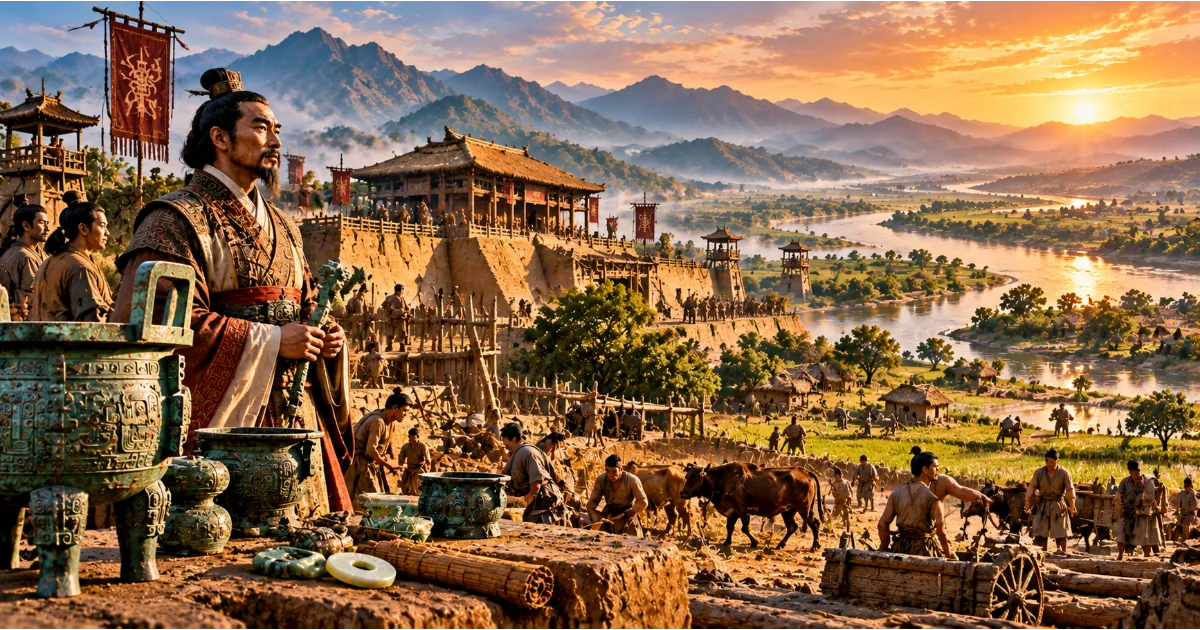
The use of bronze also reflects the wider economy. Raw materials often had to be obtained through exchange or transported from distant sources. Craftspeople needed food and shelter while they worked, and large workshops required coordination. These demands connected bronze production to agriculture, trade, political authority, and social hierarchy.
Bronze weapons demonstrate another application of the technology. Axes, spearheads, and other military objects could be associated with the ability to fight and command armed forces. Yet bronze was not equally accessible to everyone. Its cost and the expertise required to produce it meant that many objects were concentrated among people with access to resources and influential networks.
The archaeological evidence suggests that bronze objects could serve several purposes at once. A vessel might be used in ritual ceremonies, display the status of its owner, and demonstrate the technical abilities of the workshop that produced it. An object could therefore carry practical, ceremonial, and political significance.
The Shang bronze tradition also illustrates the importance of skilled workers whose names were rarely preserved. Royal inscriptions often focus on kings, ancestors, and major events, while the identities of individual artisans remain largely unknown. Their expertise was nevertheless essential to the achievements associated with the dynasty.
Bronze technology continued to develop after the Shang. Later societies changed vessel forms, decorative styles, and methods of use, but Shang craftsmanship established an important foundation for the long history of Chinese bronze art.
7. The Art and Meaning of Shang Bronze Vessels
Shang bronze vessels are among the most recognizable objects of early Chinese civilization. Some have tripod forms, while others feature handles, lids, animal-shaped details, or tall bodies designed for particular uses. Their variety reflects the range of ceremonial and practical functions they could perform.
Many vessels were used in rituals involving food and drink. Such ceremonies helped maintain relationships between the living and their ancestors. The objects used in these activities were therefore more than containers. They were part of a system of practices through which families and political leaders expressed respect, sought support, and reinforced their social position.
Decorative designs are often among the most striking features of Shang bronzes. Some objects display complex animal motifs and patterns that seem to combine recognizable features with abstract arrangements. The term taotie is commonly used by modern scholars to describe a particular style of mask-like design, but its precise meaning in Shang society is not known with certainty.
It is tempting to assign a single religious meaning to every motif, but the evidence does not always support such certainty. Designs may have carried symbolic associations, marked particular workshops, expressed elite tastes, or served several purposes simultaneously. Their interpretation requires comparison with the wider archaeological and historical context.
The production of large bronze vessels also made a statement about wealth and power. Commissioning such an object required access to materials, technical specialists, and labor. The finished vessel could be displayed during ceremonies and passed through generations, becoming associated with family identity and inherited status.
Bronze vessels are also valuable to archaeologists because their forms and manufacturing methods can be compared across sites and periods. Differences in shape, decoration, and composition help researchers study technological development and relationships between communities. Such comparisons can reveal patterns of exchange and changing cultural preferences.
The Shang bronze tradition demonstrates that technological achievement and artistic expression were closely connected. Craftspeople solved demanding engineering problems while creating objects with carefully designed surfaces and proportions. Their work contributed to a material culture in which political authority, ritual practice, and artistic skill reinforced one another.
These vessels remain important historical sources because they preserve evidence of a world in which craftsmanship was deeply connected to the organization of society. They show how skilled production could become a visible expression of power and cultural identity.
8. The Organization of Bronze Workshops
The production of bronze objects required more than individual skill. It depended on a network of activities that began with obtaining raw materials and continued through preparation, casting, finishing, and distribution.
Copper and other metals had to be acquired from suitable sources. Fuel was needed to maintain high temperatures, and molds had to be made with precision. Workers responsible for different stages of production needed to coordinate their efforts so that materials and equipment were available at the appropriate time.
Archaeological evidence from Shang sites includes remains associated with specialized craft production. These discoveries indicate that metalworking was supported by organized working areas rather than being limited to occasional activity within ordinary households.
The existence of workshops suggests a degree of specialization. Some people may have concentrated on preparing molds, while others handled furnaces, casting, or finishing. The precise division of labor is difficult to reconstruct in every case, but the complexity of surviving objects makes it clear that advanced skills were required.
Political institutions may have played an important role in supporting this production. Royal and elite demand created reasons to commission prestigious vessels and weapons. Leaders who controlled access to resources or organized large projects could influence which objects were produced and who received them.
The movement of raw materials and finished products also linked workshops to wider economic networks. A royal center could obtain resources from distant regions, while finished objects might be distributed to allies, local leaders, or members of the elite. Such exchanges could strengthen political relationships.
The scale of production should not lead us to assume that every workshop was directly controlled by the king. Different arrangements may have existed, and the relationship between royal authority and individual craft workers remains an area of research. What the evidence supports is the presence of specialized production connected to a broader system of resource management and elite demand.
Bronze workshops help explain how early states could concentrate technical knowledge and material resources. Their products were visible symbols of power, but their creation depended on complex relationships among workers, suppliers, agricultural producers, and political leaders.
9. Writing and Bronze Together: Recording Power and Preserving Memory
Oracle bones and bronze vessels served different purposes, yet both reveal how the Shang royal world connected material objects with political and ritual authority.
Oracle bones preserved written records associated with divination. They captured questions about events that mattered to the king and his household. Bronze vessels, meanwhile, were important in elite ceremonies and displayed the technical resources available to powerful families.
Both kinds of objects depended on specialized knowledge. Oracle-bone inscriptions required people who understood the written signs and ritual procedures. Bronze vessels required craftspeople who could manage materials, molds, and casting. These activities suggest a society in which particular skills were concentrated among trained individuals.
The objects also reveal different ways of preserving information. An oracle bone could record a question, a date, or the name of an ancestor. A bronze vessel could preserve a family's material wealth and ceremonial identity. In later periods, inscriptions on bronze objects would become an important source of historical information, although the evidence and practices varied over time.
It is essential to distinguish the kinds of inscriptions found on different objects. The oracle bones are particularly associated with divination records, while many Shang bronze vessels are notable for their forms and decoration. Longer commemorative inscriptions became especially important in later Bronze Age traditions. The Shang should not be described as if every bronze vessel carried a detailed written history.
Together, these objects reveal a political culture that used both words and material displays to maintain authority. Writing helped record royal concerns, while bronze craftsmanship made wealth and ritual status visible. Both were part of a larger system connecting the royal household with its ancestors and surrounding communities.
The combination also demonstrates why archaeology is so powerful when different kinds of evidence survive from the same period. Inscriptions can be interpreted alongside the objects on which they appear, while the broader settlement context helps explain how those objects were produced and used.
The Shang legacy therefore rests not on one invention alone but on the interaction of technology, writing, ritual, and political organization. These elements made its society unusually visible to modern historians and helped establish foundations for later developments in Chinese civilization.
10. The Limits of the Evidence and the Importance of Historical Accuracy
Although oracle bones and bronze objects provide exceptional evidence, they do not reveal every aspect of Shang life. The surviving records are uneven, and much of the written material reflects the priorities of the royal court.
Oracle-bone inscriptions concentrate on matters that rulers considered important enough to bring into divination. They provide less information about the ordinary routines of farming families, the personal experiences of craftspeople, or the beliefs of communities far from the royal center.
Bronze objects also reflect social selection. Elaborate vessels and prestigious artifacts are more likely to attract archaeological attention and to survive in rich burials than many ordinary tools or household items. Their prominence in museum collections should not lead us to assume that bronze vessels dominated the daily lives of every Shang person.
The archaeological record has other limitations. Organic materials often decay, buildings may be preserved only as foundations, and some sites have been disturbed by later activity. Researchers must therefore reconstruct ancient life from incomplete evidence.
Interpretation also requires caution. A written sign may have several possible readings, while a decorative motif may have meanings that cannot be established with certainty. Scholars compare evidence across objects, sites, and periods, but some questions remain unresolved.
The distinction between the Shang and the earlier Xia is particularly important. The oracle-bone inscriptions provide direct evidence for the Shang royal court, but they do not conclusively establish the historical details of the Xia Dynasty. The existence of Shang writing should not be used to claim that every earlier dynasty described in later histories has been independently verified.
Historical research advances through the careful comparison of sources. Archaeology establishes physical contexts, inscriptions provide contemporary written evidence, and later texts preserve traditions that can be examined critically. Each source has strengths and limitations.
Recognizing uncertainty does not diminish the Shang achievement. It makes our understanding more reliable by separating evidence from speculation. The surviving objects are extraordinary precisely because they allow historians to make detailed arguments while continuing to investigate unanswered questions.
11. The Lasting Legacy of Shang Innovations
The Shang Dynasty's achievements influenced the societies that followed. Its bronze technology established important traditions of metalworking, while its writing system represents an early documented stage in the long development of Chinese literacy.
After the Shang was replaced by the Zhou, bronze vessels continued to play important roles in elite ritual and political life. Their forms and uses changed, but the connection between metal objects, ancestral ceremonies, and social status remained influential in early Chinese culture.
Writing also continued to evolve. Later Chinese scripts changed in appearance and function, and the uses of writing expanded across different political and cultural settings. The oracle-bone inscriptions remain a crucial source for understanding this development because they provide evidence of an established writing system during the Shang period.
The Shang also left a lasting record of the relationship between political authority and ritual practice. Its rulers sought guidance from ancestors and supernatural powers, while later Chinese societies developed their own systems of religious, philosophical, and political thought. The exact beliefs changed, but the broader question of how rulers should maintain order and justify authority continued to matter.
The dynasty's archaeological remains have also influenced modern understandings of Chinese history. Before the discovery and interpretation of oracle bones, the early dynastic past depended much more heavily on later written traditions. The inscriptions provided independent evidence that could be compared with those traditions and used to refine historical chronologies.
Today, Shang artifacts are important to archaeology, museum collections, historical education, and the study of ancient writing. They show how a society organized resources, developed specialized skills, and used material objects to express power and belief.
Their significance reaches beyond China. The Shang provides a valuable example of how early states developed complex technologies, writing systems, and ritual institutions. Its history allows scholars to compare the development of political authority and record keeping across different ancient civilizations.
The most enduring lesson is that technological innovations become historically significant through the societies that use them. Bronze casting, writing, and divination were not isolated achievements. They were woven into the relationships, institutions, and beliefs that shaped Shang civilization.
Conclusion: The Evidence That Brought Ancient China to Life
Oracle bones, bronze technology, and early Chinese writing reveal a society that possessed sophisticated skills and a highly organized royal culture. The Shang rulers used divination to seek guidance about uncertain events, while written inscriptions preserved questions and ritual information that historians can still study today.
Bronze vessels demonstrate the abilities of specialized craftspeople and the resources required to support their work. Their ceremonial uses connected material wealth with ancestral relationships and political status. The workshops that produced them depended on agricultural supplies, skilled labor, and networks that linked different regions.
The oracle-bone script provides particularly strong evidence for the early development of Chinese writing. It was already capable of recording meaningful language and complex information during the late Shang period. Its survival allows researchers to investigate royal concerns through contemporary inscriptions rather than relying entirely on later historical narratives.
These innovations were closely connected to the organization of Shang society. Writing supported royal ritual and record keeping, bronze production displayed technical and economic power, and divination linked political decisions with the spiritual world. Together, they reveal how early Chinese kingship operated and how specialized knowledge became part of political authority.
The Shang Dynasty's importance lies in the evidence it left behind. Its inscriptions and artifacts allow modern historians to study the past through objects produced by the people who lived in it. Although many questions remain unanswered, the combination of archaeology and written evidence has made the Shang one of the best-documented early societies in East Asia.
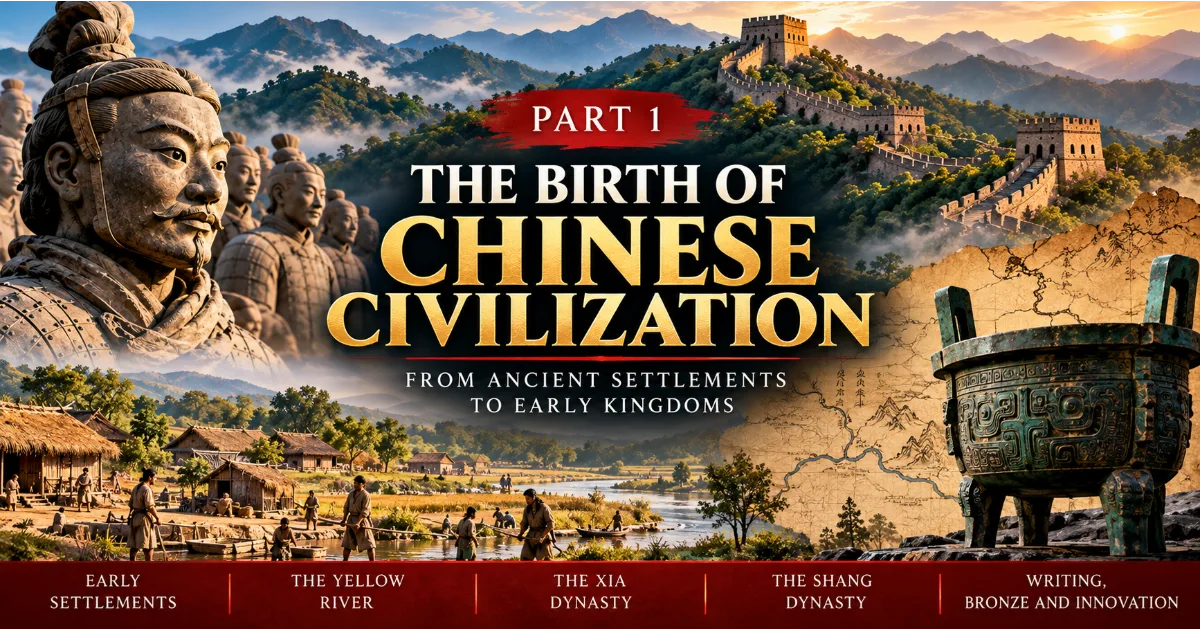
With this article, Part 1: The Birth of Chinese Civilization is complete. We have explored the origins of early Chinese communities, the role of the Yellow River, the debated Xia tradition, the documented Shang kingdom, and the innovations that made the Shang world visible through surviving evidence.
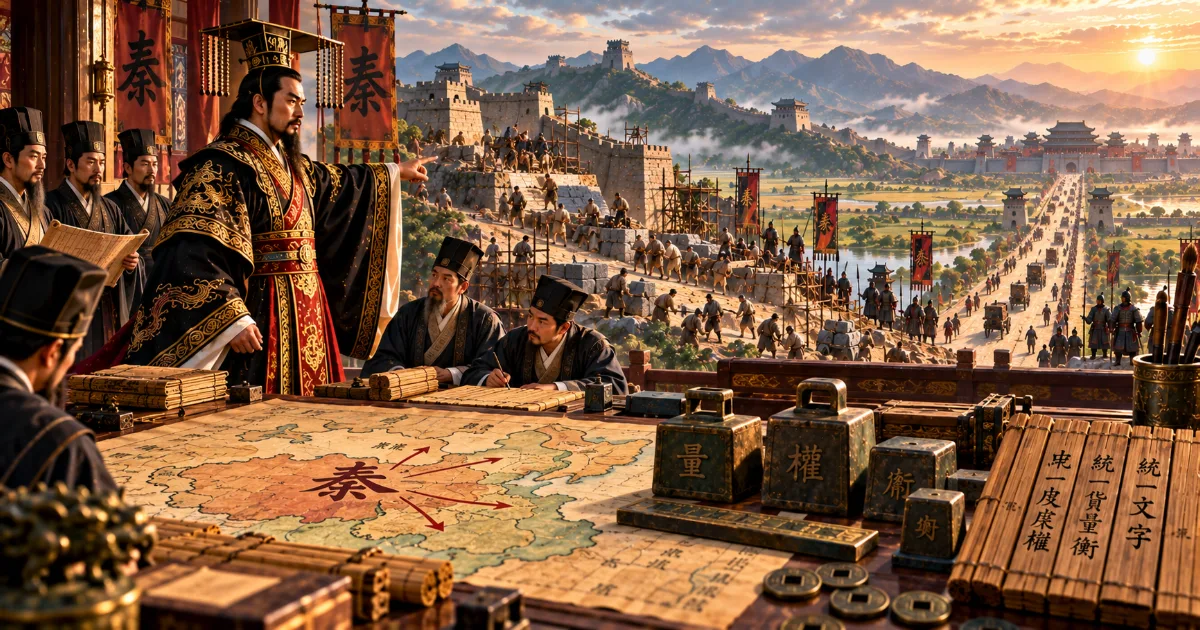
The next stage of the series will begin with Part 2: The Zhou Dynasty and the Age of Philosophers, starting with the Zhou conquest and the development of the Mandate of Heaven, an idea that would shape Chinese political thought for centuries.
#HistoryOfChina #OracleBones #ShangDynasty #AncientChineseWriting #BronzeAge #ChineseCivilization #Archaeology #WorldHistory