Exploring China's Earliest Traditional Dynasty, the Archaeological Evidence Behind Its Story, and the Origins of Chinese Kingship
The Xia Dynasty occupies a special place in Chinese historical tradition. It is remembered as the first dynasty in China's long succession of ruling houses, preceding the Shang and Zhou dynasties. According to traditional accounts, the Xia emerged when communities along the Yellow River were developing agriculture, organizing large settlements, managing floods, and creating increasingly complex political institutions. Its legendary rulers, especially Yu the Great, became symbols of leadership, public responsibility, and the struggle to bring order to a challenging natural environment.
Yet the Xia presents historians with a difficult question: how much of its traditional history can be established through evidence? Unlike the later Shang Dynasty, whose rulers and activities are supported by inscriptions on oracle bones and a substantial archaeological record, the Xia has not been conclusively identified through contemporary written documents. Ancient Chinese texts describe its kings, political struggles, and eventual overthrow, but these accounts were written or compiled centuries after the period in which the dynasty is traditionally believed to have existed.
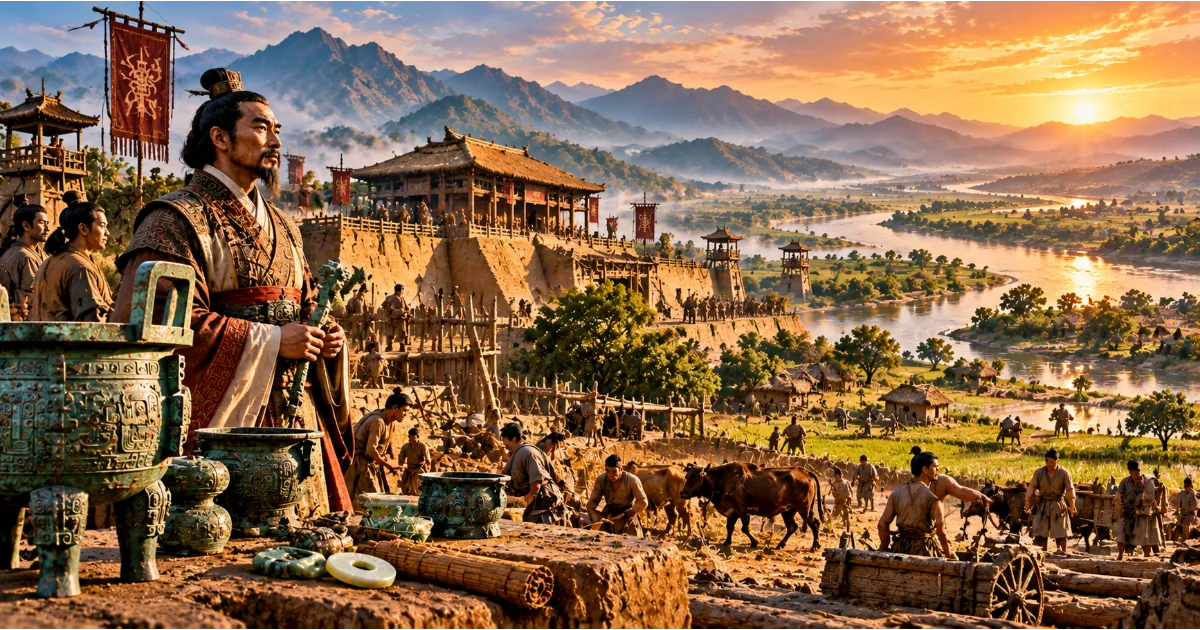
Archaeology has nevertheless revealed powerful Bronze Age societies in the region traditionally associated with the Xia. Among the most important discoveries are the remains at Erlitou in present-day Henan Province. Dating broadly to the early second millennium BCE, Erlitou contains evidence of planned settlement areas, large buildings, craft production, bronze technology, and social distinctions. Many scholars consider Erlitou a strong candidate for the archaeological culture associated with the Xia, although the precise relationship remains debated.
Understanding the Xia therefore requires two approaches. The first examines the stories that Chinese historians preserved about the dynasty and the values those stories communicated. The second studies archaeological discoveries that reveal how early political power developed in northern China. Neither approach should be mistaken for the other. A traditional narrative can preserve memories of an earlier society while also reflecting the beliefs and political concerns of later generations. Archaeological remains can establish the existence of complex communities without automatically confirming the names of their rulers.
The story of the Xia is not simply a search for a lost dynasty. It is an investigation into how early communities became states, how leadership became hereditary, how historical memory was created, and how later Chinese civilizations explained the beginnings of their political order.
1. China Before the Xia: A World of Emerging Communities
Long before the Xia Dynasty appears in traditional accounts, the lands of present-day China were home to diverse communities with distinct ways of life. These communities developed over thousands of years, adapting to local environments and gradually transforming their relationships with land, animals, plants, and one another.
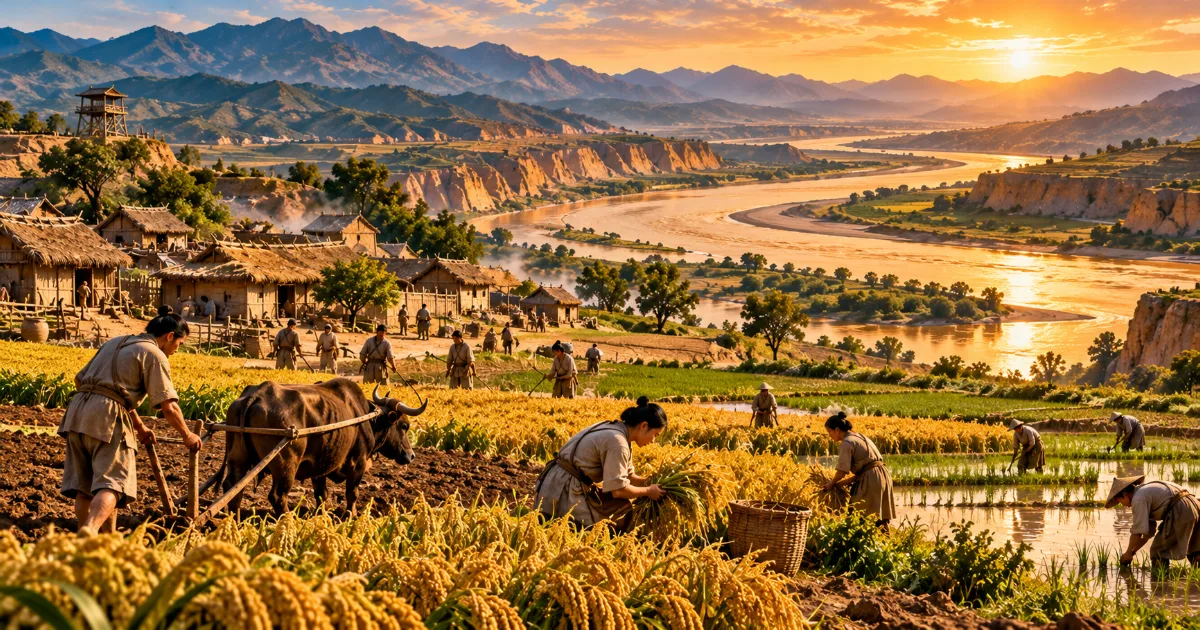
The Yellow River basin became one of the most important centers of early agricultural development. Its surrounding plains and loess-covered uplands supported the cultivation of millet, while rivers and streams supplied water and created opportunities for fishing, gathering, and transport. Farther south, communities around the Yangtze River developed rice agriculture in wetter environments. Other regions maintained different combinations of farming, hunting, fishing, and gathering.
There was no single moment when all these communities became one civilization. The development of early Chinese society was a gradual process involving regional interaction, competition, migration, technological exchange, and the growth of local centers of authority. Archaeologists have identified numerous Neolithic cultures across the region, including communities associated with Yangshao and Longshan traditions. These cultures differed in their pottery, settlement patterns, burial practices, tools, and social organization.
By the late Neolithic period, some settlements had grown considerably in size and complexity. Defensive walls appeared at certain sites, craft production became more specialized, and differences between burials suggested that wealth and status were not distributed equally. These changes indicate that some communities had begun to develop political and economic structures beyond those of small, relatively autonomous villages.
Agriculture was central to this transformation. Farming allowed communities to produce food in quantities that could support larger populations, although harvests remained vulnerable to drought, flooding, pests, and other environmental challenges. Surplus production could support people who spent less time growing food and more time making tools, conducting rituals, organizing labor, or exercising authority. It also created new pressures because stored food and productive land became valuable resources that leaders might seek to control.
The growth of settlement networks encouraged exchange between communities. Stone tools, pottery, ornaments, and other materials circulated through local and regional connections. Such exchanges transmitted techniques and ideas while also creating opportunities for alliances and rivalry. Communities that controlled important resources or routes could gain influence over their neighbors.
By the early second millennium BCE, parts of northern China had developed substantial centers of population and political activity. These were not yet unified under a single state in the modern sense, but some had the organizational capacity to mobilize labor, build large structures, coordinate craft production, and maintain social hierarchies.
It was within this wider world of regional development that the Xia Dynasty is traditionally placed. Whether the Xia existed as a single dynasty in the form later texts describe, its story belongs to a genuine historical transformation: the emergence of increasingly centralized political authority in early China.
2. Yu the Great and the Legend of the Great Flood
Among the figures associated with the Xia Dynasty, Yu the Great is the most celebrated. Traditional histories portray him as a remarkable leader who confronted catastrophic flooding and helped establish the foundations of organized government. His story combines environmental struggle, personal discipline, technical knowledge, and the moral responsibilities of leadership. It also provides a powerful explanation for why a ruler might deserve authority over other communities.
Flooding was a serious challenge for populations living near the Yellow River and its tributaries. The river carries large quantities of fine sediment from the Loess Plateau. Over long periods, sediment can accumulate in river channels and surrounding plains, changing the course of waterways and contributing to dangerous floods. The scale and timing of particular ancient floods remain subjects of scientific investigation, but the broader environmental challenge is well established.
In the traditional account, Yu's father, Gun, was appointed to control the waters but failed. Some versions describe Gun attempting to contain the floods with barriers. Yu approached the task differently. Rather than trying only to block the water, he is said to have directed it through channels and waterways toward the sea. He surveyed the land, organized workers, and developed a practical understanding of the landscape.
The contrast between Gun and Yu is important to the moral structure of the story. Gun represents an unsuccessful approach, while Yu represents persistence, adaptability, and an understanding of natural forces. The legend suggests that good leadership requires more than issuing commands. It requires observing conditions, choosing workable methods, and coordinating people toward a shared objective.
Yu's personal sacrifices became another central element of his reputation. Traditional stories describe him spending years away from home while working on flood control. One famous account says he passed his own house several times without entering because he believed his duty to the people had to come first. The details belong to the legendary tradition, but the story communicates an enduring ideal: a leader should place public responsibilities above personal comfort.
Flood control also provides a plausible historical setting for the development of political authority. Large-scale water management can require organized labor, shared planning, the distribution of food, and decisions about where communities should live or cultivate land. A leader who coordinated these tasks successfully could gain prestige and influence. Over time, that influence might become attached to a ruling family or political institution.
It is important, however, not to treat the legend as a literal engineering report. There is no contemporary inscription confirming Yu's identity or documenting his supposed flood-control program. Nor can the traditional account be securely connected to one specific geological event. The story may preserve memories of recurring floods, regional cooperation, or influential leaders, but those possibilities remain interpretations rather than established facts.
What can be said with confidence is that water management would have mattered greatly to agricultural communities. Floods could destroy crops, damage settlements, and threaten stored food. Communities needed practical knowledge of their surroundings, even when they lacked modern scientific explanations. The Yu tradition gave this essential work a human face and made it part of China's remembered political beginnings.
3. From Heroic Leader to Founder of a Dynasty
In traditional Chinese accounts, Yu's achievements eventually brought him political authority. He is commonly associated with the transition from an earlier system of selecting respected leaders to hereditary kingship. After Yu, his son Qi is said to have succeeded him, establishing the Xia as a dynasty.
This transition is central to the story because it represents a change in how political power was passed from one generation to the next. A leader might originally gain influence through success in warfare, ritual, resource management, or the ability to settle disputes. Hereditary succession transformed that personal authority into a claim that could be inherited by descendants.
The traditional account of Qi's succession is not entirely straightforward. Some versions portray Yu as intending to pass authority to a respected associate, often named Yi, before Qi ultimately became ruler. The story has been interpreted as a memory of competition between different principles of succession: leadership earned through merit and leadership inherited through family. It is impossible to determine exactly what happened from the surviving accounts, but the narrative reveals that later Chinese thinkers considered the legitimacy of hereditary rule an important historical question.
Hereditary succession offered certain advantages to an emerging political order. It could reduce uncertainty about who would lead after a ruler's death, preserve alliances between ruling families, and maintain control over resources and ritual institutions. Yet it could also create conflict when heirs competed for power or when a ruler's descendants lacked the abilities expected of a leader.
The transition to dynasty did not necessarily mean that every community in the region accepted a single king's authority. Early political systems were likely uneven, with a central settlement exercising varying degrees of influence over surrounding communities. Some local leaders may have cooperated with a dominant center, while others maintained considerable independence. Authority could depend on alliances, exchange networks, military strength, ritual prestige, and the ability to organize labor.
This distinction matters because the term dynasty can make an early political system sound more unified than it may actually have been. The Xia of later histories is presented as a succession of kings governing a recognizable realm. The archaeological record, by contrast, reveals changing centers of power and regional cultures whose political relationships cannot always be reconstructed.
If the Xia did correspond to an early ruling house, it may have governed through personal relationships and local alliances rather than through a standardized bureaucracy. Officials, if present, would not necessarily have worked within a system comparable to the ministries and administrative divisions of later Chinese empires. Early kingship developed gradually, and its institutions should not be confused with those of much later periods.
Even with these uncertainties, the traditional transition from Yu to Qi points toward a fundamental development in political history. Leadership was becoming associated not only with the achievements of an individual but also with the continuity of a ruling family. This would become a defining feature of Chinese political tradition for many centuries.
4. What Ancient Chinese Texts Say About the Xia
Much of the written story of the Xia comes from texts composed or compiled long after the dynasty's traditional dates. These works include the Records of the Grand Historian, written by Sima Qian during the Han Dynasty, as well as earlier historical and philosophical traditions preserved in texts such as the Book of Documents and the Bamboo Annals. Their accounts are valuable evidence for how later Chinese societies understood the ancient past, but they cannot automatically be treated as eyewitness records.
Sima Qian, who lived around the second and first centuries BCE, organized Chinese history into a sequence of rulers and dynasties. His work presented the Xia as preceding the Shang and described a line of kings whose reigns ended with the dynasty's final ruler. He was writing within a historical culture that sought to establish continuity between ancient rulers and the political world of the Han Empire.
The Book of Documents contains traditions associated with ancient kings and the moral responsibilities of government. However, its chapters have complicated histories of composition and transmission. Some sections may preserve early material, while others reflect later editorial work or political thought. The text must therefore be evaluated chapter by chapter rather than treated as a single document written at one time.
The Bamboo Annals, known through a complicated transmission history, also preserve a chronological tradition about early rulers and dynasties. Their value lies partly in the differences between their accounts and those found in other historical works. Such differences remind us that ancient Chinese history was not transmitted through one perfectly consistent narrative.
Later writers had reasons to organize the past into a sequence of dynasties. A historical succession provided a framework for explaining the origins of political institutions, the rise and fall of rulers, and the moral principles that supposedly governed legitimate authority. It also connected contemporary states to an ancient heritage.
This does not mean that the Xia story was simply invented. Traditions can preserve older memories even when their surviving written forms are much later. Oral accounts, ritual practices, place names, genealogies, and regional legends can transmit information across generations. Yet they can also change as communities reinterpret the past to meet new political or cultural needs.
Historians therefore ask several questions when evaluating these sources. How early is a particular account? Does it appear in more than one independent tradition? Does it contain details that can be tested against archaeology? Does it reflect the concerns of the period in which it was recorded? Can its chronology be reconciled with evidence from settlements and material culture?
For the Xia, these questions remain difficult because no securely identified contemporary written record names the dynasty and documents its rulers. The Shang, by contrast, left oracle-bone inscriptions that refer to kings, ancestors, warfare, sacrifices, and divination. This difference is one of the most important reasons the historical status of the Xia remains debated.
The written sources should thus be read in two ways. They provide a traditional account of early Chinese political history, and they reveal how later generations understood kingship, virtue, succession, and historical change. Both forms of evidence matter, but they answer different questions.
5. The Last King of Xia and the Fall of the Dynasty
Traditional histories describe the final Xia ruler, Jie, as a king whose cruelty and extravagance weakened his authority. He is often portrayed as arrogant, indulgent, and indifferent to the suffering of his subjects. In the familiar account, his behavior alienated the people and encouraged other leaders to challenge his rule.
The rebellion against Jie is associated with Tang, the founder of the Shang Dynasty. Tang is remembered as a leader who gathered support against the Xia king and defeated him, bringing the Xia era to an end. The story is often presented as a moral contrast: Jie lost power because he failed to govern responsibly, while Tang gained power because he acted against a ruler who had become unworthy of his position.
This narrative became part of a broader pattern in Chinese historical writing. Dynasties rise under capable leaders, prosper when rulers maintain order and fulfill their obligations, and decline when their rulers become oppressive or incompetent. The fall of one ruling house then provides an opportunity for another to claim authority.
The story of Jie also served as a warning to later monarchs. A ruler's position might appear secure because of ancestry, military strength, or possession of a throne, but traditional political thought insisted that these advantages could not guarantee lasting legitimacy. A king who abused power risked losing the loyalty of officials, local leaders, and ordinary people.
Yet the details of Jie's life are difficult to verify. No contemporary record securely establishes his identity or confirms the events described in later narratives. Stories of his cruelty may preserve memories of political conflict, but they may also reflect the conventions through which later historians explained the replacement of one dynasty by another.
It is particularly important to recognize that the surviving accounts were shaped by the worldview of the Zhou and later periods. The Zhou rulers had a strong interest in explaining why their predecessors, the Shang, had been justified in overthrowing the Xia and why the Zhou themselves had been justified in overthrowing the Shang. A pattern of morally justified succession helped make dynastic change understandable within a shared political philosophy.
The Xia's supposed collapse therefore belongs both to the history of early state formation and to the later development of Chinese political ideas. Whether every detail of the traditional narrative reflects actual events is uncertain. What is clear is that Chinese writers used the Xia story to explore a recurring problem: what happens when a ruling family loses the trust and support on which its authority depends?
6. The Erlitou Archaeological Site: A Possible Link to the Xia
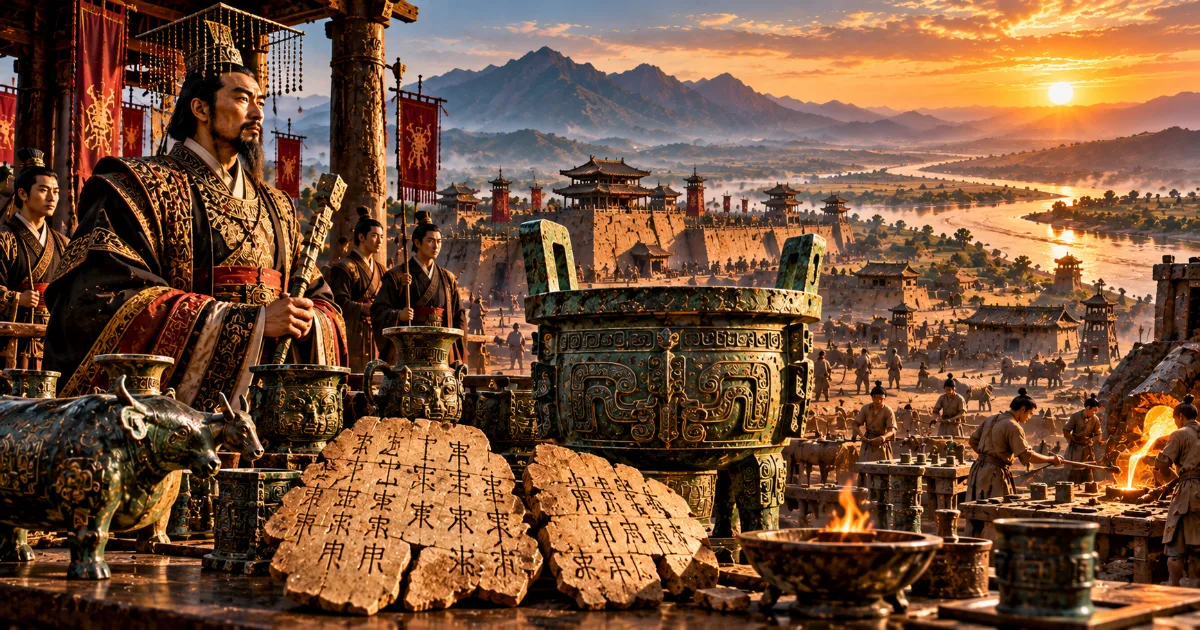
The most important archaeological discovery associated with the Xia debate is Erlitou, located in present-day Henan Province in central China. Excavations have revealed the remains of a substantial early Bronze Age center, including large buildings, organized activity areas, craft production, and evidence of social differentiation. The site is generally dated to approximately the first half of the second millennium BCE, although the chronology and interpretation of particular phases remain subjects of scholarly discussion.
Erlitou is significant because its scale and organization distinguish it from a simple agricultural village. Archaeologists have identified large architectural foundations, planned spaces, roads or pathways, workshops, and evidence of specialized production. These features suggest that the settlement served as a major political and economic center within a wider region.
The remains of large buildings are especially important. Constructing substantial structures would have required the organization of labor, the movement of materials, and decisions about how space should be used. Such projects suggest that some people possessed the authority to coordinate work beyond the needs of a single household. Large buildings may have served administrative, ceremonial, residential, or other elite purposes, although the precise function of every structure cannot be known with certainty.
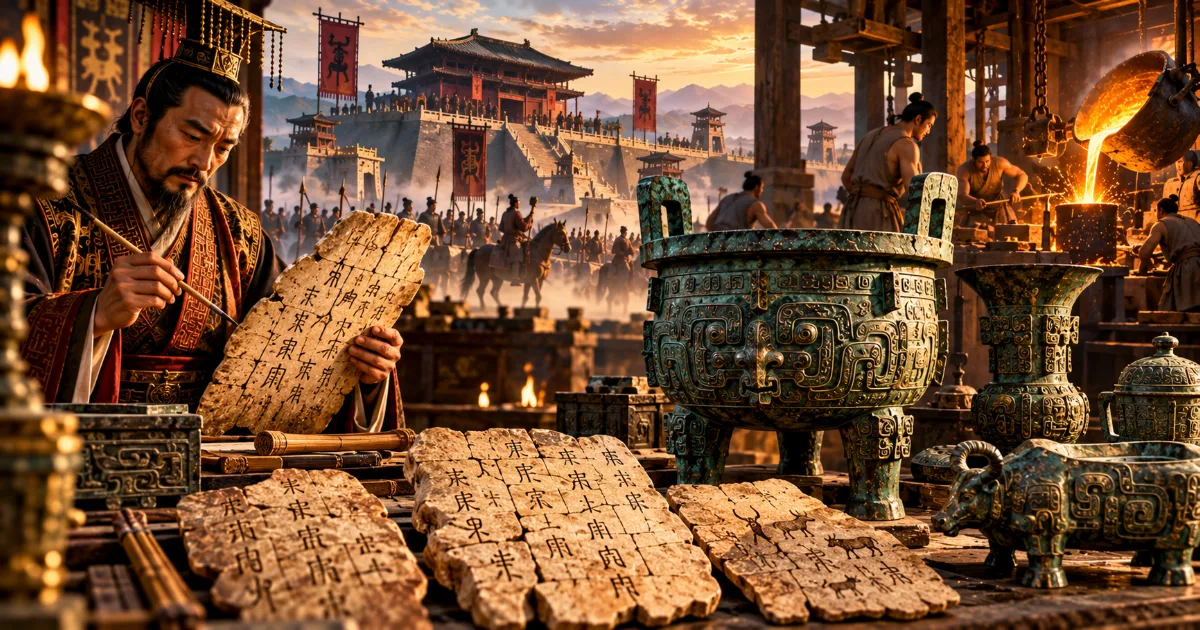
Craft production provides another clue to the site's importance. Erlitou is associated with early bronze objects and evidence of sophisticated metalworking. Bronze technology required access to raw materials, knowledge of smelting and casting, and specialized skills. Production could also involve workers who did not grow their own food, making it dependent on agricultural surpluses and systems of exchange.
The presence of elite objects and differences in material remains suggests that social status was becoming more pronounced. Some people had access to resources and goods that were unavailable to others. These differences may reflect political office, ritual authority, control over exchange, family position, or a combination of factors. Archaeology can identify patterns of inequality more readily than it can recover the exact titles or personal identities of those involved.
Erlitou is frequently discussed in connection with the Xia because its approximate date, location, and level of political development appear compatible with the traditional period assigned to that dynasty. Some scholars argue that Erlitou represents the material culture of the Xia state. Others emphasize that the archaeological evidence does not independently establish the name Xia or prove that the site was ruled by the kings described in later texts.
The distinction is essential. Archaeologists can identify buildings, objects, settlement patterns, production techniques, and changes over time. They cannot automatically assign a historical dynasty's name to a site unless evidence connects the two. Such evidence might include contemporary inscriptions, a securely identified royal genealogy, or other records that directly establish the political identity of the settlement.
No widely accepted contemporary inscription from Erlitou names the Xia Dynasty or identifies a ruler such as Yu, Qi, or Jie. As a result, the association remains a reasoned hypothesis rather than a conclusive identification.
Nevertheless, Erlitou has transformed the discussion. The question is no longer whether complex political centers existed in the relevant region and period. Archaeology clearly demonstrates that they did. The remaining challenge is to understand their political organization and determine how, if at all, they correspond to the dynastic framework preserved in ancient texts.
7. Bronze, Buildings, and the Organization of Power
The development of bronze technology was one of the major changes in early Chinese society. Bronze objects could be used for tools, weapons, ornaments, and ritual purposes. In early elite contexts, bronze vessels became particularly important because they could display wealth, technical skill, and connections to ceremonial practices.
Producing bronze required more than a talented craft worker. Communities needed access to copper and other metals, fuel for high-temperature furnaces, molds, and the knowledge to manage the production process. The movement of raw materials and finished objects linked different regions, while skilled artisans developed specialized techniques that could be passed from one generation to another.
When a political center supported large-scale craft production, it could become a focus for economic activity and social influence. Leaders might control access to raw materials, commission objects for rituals, or distribute valuable goods to allies. The relationship between craft production and political power would become particularly visible in later Bronze Age states.
The architecture associated with Erlitou also points to growing organizational capacity. Large construction projects require labor to be assembled and supplied. Workers need food, tools, and materials. Someone must decide which structures to build and how the work should proceed. These requirements do not prove the existence of a fully developed bureaucracy, but they suggest that authority had become more coordinated and durable than in many small farming settlements.
Agriculture underpinned these developments. Farmers produced the food that sustained craftspeople, ritual specialists, guards, builders, and leaders. A successful center needed access to productive land and reliable connections with surrounding communities. Its influence might depend on negotiation and exchange as much as on coercion.
Political power was therefore likely based on several connected foundations: control over resources, the ability to mobilize labor, relationships with local elites, ritual prestige, and the capacity to defend a settlement. The balance among these elements may have changed over time. Some leaders could have gained influence by organizing public works or ceremonies, while others may have expanded their authority through conflict.
The traditional story of Yu fits this general pattern because it presents flood management as the basis for exceptional leadership. Although the specific events cannot be verified, the story reflects the practical importance of organizing collective labor in an agricultural society. A leader who could coordinate people during a crisis might acquire influence that extended beyond the immediate task.
Erlitou does not prove that Yu personally directed such work. It does, however, show that communities in the region were capable of constructing large buildings and sustaining specialized activities during a period broadly associated with the traditional Xia chronology. The archaeological record offers a concrete picture of social complexity that helps explain why stories of early kingship emerged.
8. Daily Life in the World Associated with the Xia
The surviving remains of early Bronze Age centers reveal only part of the society that supported them. Behind large buildings and elite objects were farmers, animal keepers, potters, builders, traders, cooks, and families whose daily work sustained the settlement.
Millet remained an important crop in northern China. Farming households prepared land, planted seeds, managed weeds, harvested crops, and stored grain for future use. They also relied on other food sources, including gathered plants, animals, and products from livestock. The exact combination varied by region and household, and the evidence does not support a single uniform lifestyle across all communities.
Agricultural work followed seasonal rhythms. Planting and harvesting required concentrated labor, while other periods could be devoted to repairing tools, maintaining homes, making pottery, caring for animals, and preparing food. Communities had to manage uncertainty because weather conditions could change from year to year. Flooding, drought, and poor harvests threatened household security and could create pressure on local leaders.
Homes were likely built using materials available in the surrounding environment. Archaeological traces can reveal building foundations, postholes, floors, storage features, and evidence of cooking or craft work. Yet many details of family life remain difficult to reconstruct because wood, textiles, baskets, and other organic materials often decay. Pottery, stone tools, animal bones, seeds, and architectural traces therefore become crucial sources for understanding ordinary life.
Work was divided in ways that varied according to age, skill, household needs, and social position. Specialized craftspeople could devote more time to producing pottery, ornaments, tools, or bronze objects, while other people concentrated on farming and domestic tasks. The growth of specialist work suggests that food production and exchange had become sufficiently organized to support different occupations.
Social inequality also affected daily experience. Some households had access to better goods, larger living spaces, or stronger connections to political and ritual centers. Others may have performed demanding agricultural or construction work without receiving equivalent privileges. Archaeology can indicate differences in status, but it cannot always establish whether a particular worker was a free laborer, dependent household member, captive, or person in another social position.
Ritual activity probably played an important role in community life, as it did in later Bronze Age societies. People sought explanations for illness, death, weather, crop success, and other events that affected survival. Ritual specialists and leaders could help organize ceremonies intended to secure protection, fertility, prosperity, or social stability. However, the precise beliefs of Erlitou's inhabitants remain uncertain because their religious ideas cannot be read directly from the material remains alone.
The people living in this world should not be imagined as a single culturally uniform population. Regional traditions and local identities would have remained important. Political centers could draw communities into wider networks without erasing their differences. The emergence of early states was therefore not simply the replacement of villages by a unified kingdom. It involved changing relationships among settlements, families, leaders, and regions.
This perspective helps restore ordinary people to the story of the Xia. The dynasty's legendary kings dominate later historical narratives, but any early state depended on the labor, knowledge, and cooperation of many people whose names were never recorded. Their work made large-scale political organization possible.
9. The Xia and the Question of Historical Evidence
The debate over the Xia Dynasty illustrates a central challenge in studying ancient history: the difference between a tradition that has been preserved and an event that can be independently demonstrated. Historians do not have to choose between accepting every traditional story as literal fact and dismissing the entire tradition as fiction. They can examine individual claims and assess the evidence supporting each one.
Three broad possibilities are often considered. The first is that the Xia existed substantially as later Chinese histories describe it, with a recognizable ruling family whose memory survived through oral and written traditions. The second is that the traditional Xia story preserves memories of one or more early political centers, but that later writers organized those memories into a more unified dynasty than originally existed. The third is that some elements of the account were developed or reshaped to explain political ideas and dynastic succession, even if they were not based on a single identifiable ruling house.
These possibilities are not equally easy to test, and they are not necessarily mutually exclusive. A historical tradition can preserve genuine memories while also changing through retelling. A powerful settlement might have inspired stories later attached to a famous ruler. Several generations of conflict could be condensed into the biography of one legendary king. Later historians might then arrange these stories into a sequence that reflected their understanding of political history.
Archaeology can help evaluate these possibilities by establishing when settlements developed, when large buildings were constructed, what technologies were used, and how political and economic relationships changed. Scientific dating methods, including radiocarbon dating of suitable organic material, help establish chronologies. Analysis of pottery, animal remains, plant remains, metals, and settlement patterns can reveal connections between communities.
Written evidence is equally important, but its absence must be interpreted carefully. The lack of a surviving Xia inscription does not prove that the dynasty never existed. Ancient documents are often lost, and writing may have been used in ways that left little recoverable evidence. At the same time, the absence of direct contemporary confirmation means historians should not present the traditional genealogy or the deeds of individual Xia kings as established facts.
The distinction between the Xia and Shang is especially instructive. Shang oracle-bone inscriptions provide direct evidence for royal names, divination, sacrifices, warfare, and other concerns of the ruling court. These inscriptions allow historians to connect material remains with a political world that the people themselves recorded. Comparable evidence has not been securely identified for the Xia.
The most responsible conclusion is therefore cautious. Early Bronze Age political centers existed in the region and period associated with the Xia tradition. Erlitou is a major candidate for understanding this development, but its precise relationship to the named dynasty remains unresolved. The Xia occupies an important place in Chinese historical tradition, while its status as a clearly identifiable historical dynasty remains a subject of scholarly debate.
This uncertainty is not a weakness in historical study. It demonstrates how knowledge improves when claims are tested against different kinds of evidence. Archaeology, textual criticism, scientific dating, and comparative analysis each contribute something different. Their combined use allows historians to reconstruct the past without claiming more certainty than the evidence supports.
10. Why the Xia Dynasty Matters to Chinese Historical Memory
Even without definitive confirmation of every traditional detail, the Xia has played a major role in how Chinese history has been understood. It stands at the beginning of a dynastic sequence that later historians used to organize the political past. The Xia was followed by the Shang, then the Zhou, and eventually by many other ruling houses whose histories shaped the development of China.
This sequence offered a way to understand political change across long periods. Instead of seeing history as a disconnected collection of wars and rulers, historians could explain it through the rise, flourishing, and decline of dynasties. Each ruling house inherited a political world from its predecessor, altered its institutions, and eventually faced challenges that might lead to its replacement.
The Xia story also gave particular importance to the relationship between leadership and public welfare. Yu the Great was remembered not merely as a conqueror but as a leader who solved a practical problem affecting the survival of communities. His reputation rested on service, perseverance, and the ability to organize collective action. These qualities contrasted with the traditional image of Jie, whose supposed misconduct justified the dynasty's downfall.
Such stories helped shape a moral interpretation of history. A ruler's success was not necessarily proof of permanent legitimacy, and inherited status did not guarantee good government. The conduct of rulers mattered because political authority was expected to serve a wider social purpose.
Later Chinese political thinkers developed these ideas in different ways. The Zhou concept of the Mandate of Heaven became especially influential in explaining why a dynasty could lose legitimacy and why a new ruling house might claim the right to govern. The Xia story formed part of the historical background through which such ideas were understood, although the precise development of these traditions cannot be reduced to one event or one text.
The dynasty also became important to the idea of cultural continuity. Later generations looked back toward the earliest rulers as part of a shared past, linking ancient traditions with contemporary political institutions. Such historical memory could strengthen a sense of belonging, but it could also be used to support the authority of particular ruling houses.
Studying this process reveals that history is not only a record of what happened. It is also the study of how societies remember, interpret, and sometimes reshape their past. The traditional Xia narrative tells us something about early Chinese political history, but it also tells us how later Chinese writers understood leadership, legitimacy, order, and the consequences of failed government.
11. From the Xia Tradition to the Better-Documented Shang Dynasty
The next stage in the traditional dynastic sequence is the Shang Dynasty, which provides much firmer evidence for early Chinese kingship. Archaeological discoveries at sites associated with Shang political centers, particularly Anyang, have revealed palaces, elite burials, bronze workshops, and large collections of oracle bones bearing inscriptions.
These inscriptions are especially valuable because they record questions posed to royal ancestors and other spiritual powers. Shang rulers sought guidance about warfare, hunting, harvests, illness, childbirth, weather, and ritual obligations. The inscriptions reveal a political system in which royal authority, religious practice, and the management of the kingdom were closely connected.
Shang bronze vessels demonstrate the technical sophistication and ritual importance of metalworking. Their production required specialized knowledge, substantial resources, and organized labor. Elite burials reveal significant social distinctions, while inscriptions help identify some rulers and aspects of their family relationships. Together, these forms of evidence make the Shang far more directly accessible to historians than the Xia.
The transition from the Xia to the Shang remains difficult to reconstruct in exact detail. Traditional texts describe Tang's overthrow of Jie, but the archaeological record does not independently confirm every element of that account. Scholars continue to examine how the earliest Bronze Age political centers developed, competed, and changed over time.
What the evidence does establish is that early Chinese society underwent substantial transformations during the second millennium BCE. Political centers grew in influence, bronze technology became increasingly important, elite institutions developed, and writing eventually provides direct evidence of royal activities. These developments created foundations for the better-documented states that followed.
The comparison between the Xia and Shang also shows why historians distinguish between different levels of certainty. The Shang's inscriptions provide a direct link between written records and archaeological remains. The Xia's traditional history remains important, but its rulers and events cannot be verified in the same way. Recognizing this difference allows the history of early China to be presented both accurately and meaningfully.
Conclusion: Between Legend and History
The Xia Dynasty stands at a crossroads between traditional memory and archaeological investigation. Ancient Chinese histories remember it as the first dynasty, founded through the achievements of Yu the Great and brought to an end by the failings of its last ruler. These accounts describe the emergence of hereditary kingship, the importance of public responsibility, and the belief that political authority could be lost through misconduct.
Modern archaeology has revealed that the period associated with the Xia was far from an age of isolated villages. Large settlements, organized construction, specialized craft production, and early bronze technology demonstrate the growing complexity of societies in central China. The Erlitou site provides especially important evidence for this transformation, although its exact relationship to the Xia Dynasty remains unresolved.
The most careful historical approach recognizes both the significance and the limits of the evidence. The Xia is a major part of China's historical tradition, but the dynasty's precise boundaries, rulers, chronology, and relationship to particular archaeological sites remain uncertain. The stories of Yu, Qi, and Jie should be understood as traditional accounts unless independent evidence confirms their details.
The importance of the Xia does not depend entirely on whether every part of its traditional history can be proven. Its story preserves ideas about leadership, collective responsibility, hereditary power, and the moral evaluation of rulers. Its archaeological context reveals the material changes that made early states possible. Together, these perspectives help explain how Chinese civilization moved from diverse agricultural communities toward increasingly complex political institutions.
The Xia also reminds us that history is a continuing investigation. New discoveries may clarify old questions, while improved methods may change how existing evidence is interpreted. The past does not always provide simple answers, but careful research can distinguish what is known, what is plausible, and what remains uncertain.
In the next article, we will explore The Shang Dynasty: China's Earliest Documented Kingdom, examining the rulers, oracle-bone inscriptions, bronze technology, and archaeological discoveries that bring early Chinese history into clearer focus.
#HistoryOfChina #XiaDynasty #YuTheGreat #AncientChina #ChineseCivilization #Archaeology #WorldHistory #History
Download the article image