From Ancient Settlements to the Foundations of a Great Civilization
Every great civilization begins with a story. Long before China became a powerful empire ruled by emperors, its foundations were laid by farmers, craftspeople, communities, and early rulers who transformed river valleys into centers of human settlement.
The story of China begins thousands of years ago, when people learned to cultivate crops, raise animals, make pottery, build permanent homes, and organize their communities. Over generations, these settlements developed into complex societies with specialized crafts, religious practices, social hierarchies, and systems of leadership.
The Yellow River and the Yangtze River played important roles in this transformation. Their surrounding landscapes supported agriculture and connected communities, although floods, droughts, and changing environmental conditions also created serious challenges.
In time, some communities developed into powerful regional centers. Bronze technology advanced, early forms of Chinese writing emerged, and rulers began exercising authority over increasingly organized societies. These developments laid important foundations for the dynasties that would shape Chinese history.
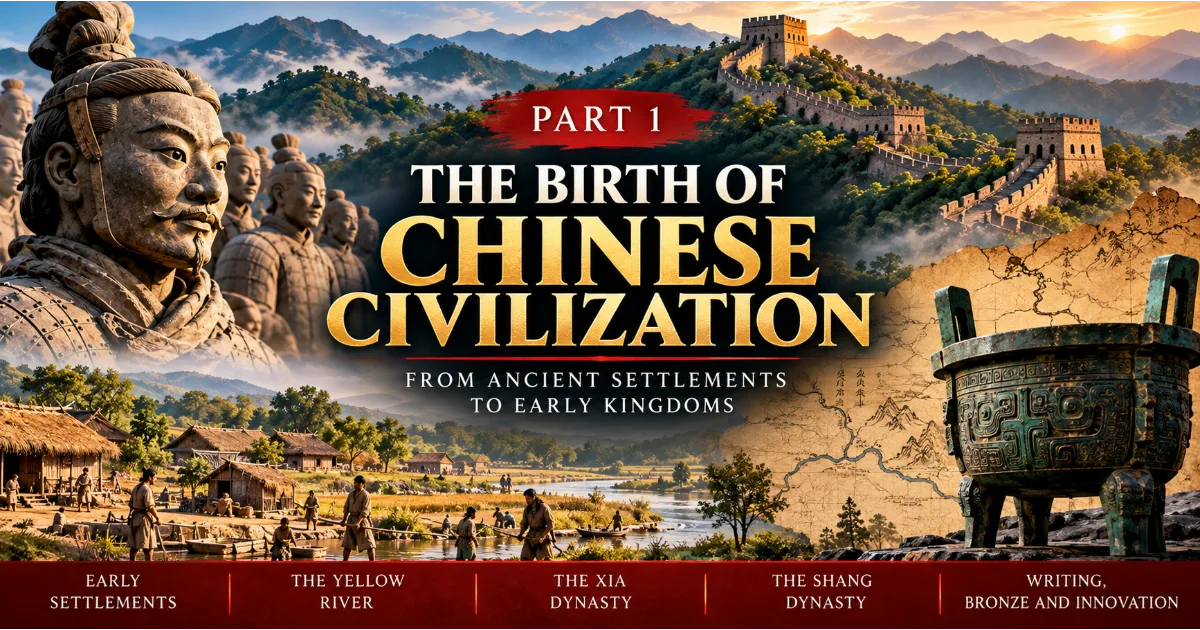
This first part of our History of China series explores the origins of Chinese civilization, from early agricultural communities to the Shang dynasty, the earliest Chinese dynasty supported by substantial written and archaeological evidence.
What We Will Explore in Part 1
Article 1: Ancient China: The Origins of a Great Civilization
We will begin with the earliest communities in the lands that became China. Discover how prehistoric people adapted to their environment, developed agriculture, and gradually created settled societies.
Article 2: The Yellow River and the Birth of Chinese Agriculture
Explore the importance of the Yellow River and other major river systems in the development of early Chinese communities. We will examine farming, village life, environmental challenges, and the gradual emergence of organized settlements.
Article 3: The Xia Dynasty: Between Legend and History
Chinese historical traditions describe the Xia dynasty as an early ruling dynasty. We will investigate its place in Chinese historical memory, the archaeological evidence associated with early Bronze Age societies, and why historians continue to debate the relationship between tradition and verifiable history.
Article 4: The Shang Dynasty: China's Earliest Documented Kingdom
Meet the Shang rulers and discover a society that developed powerful royal centers, advanced bronze craftsmanship, elaborate rituals, and a sophisticated political culture. We will explore what archaeology reveals about their world.
Article 5: Oracle Bones, Bronze Technology, and Early Chinese Writing
Discover how inscriptions on oracle bones provide some of the earliest substantial evidence of Chinese writing. We will also examine bronze vessels, religious practices, craftsmanship, and the ways these achievements help historians reconstruct the Shang world.
Why This Period Matters
The earliest centuries of Chinese civilization established traditions that continued to influence later generations. Agriculture supported growing populations. Craft specialization encouraged technological development. Religious rituals helped reinforce royal authority, while writing eventually became an essential instrument of administration, scholarship, and cultural continuity.
These developments did not occur in a single place or at one precise moment. Early Chinese civilization emerged through interactions among different communities and regional cultures. Archaeological discoveries continue to refine our understanding of how these societies developed and how their traditions eventually contributed to the rise of early states.
It is also important to distinguish between what ancient traditions tell us and what physical evidence can establish. The Xia dynasty occupies a central place in traditional Chinese accounts, but its status as a fully documented historical dynasty remains debated. The Shang dynasty, by contrast, is supported by inscriptions and archaeological discoveries that provide direct evidence of its rulers, religious practices, and political life.
By studying these beginnings, we can understand how a civilization developed over many generations rather than appearing suddenly as a unified empire.
The Journey Begins
The history of China is a story of continuity and transformation. Its earliest communities faced environmental challenges, developed new technologies, and built increasingly complex societies. Their achievements created foundations upon which later dynasties would establish powerful governments, develop philosophical traditions, and connect China with the wider world.
In Part 1, we will travel back to these formative centuries and examine the evidence, people, places, and ideas that shaped the beginning of Chinese civilization.
Join us as we uncover the past, one historical story at a time.
History of China | A Journey Through Time
#HistoryOfChina #ChineseCivilization #AncientChina #WorldHistory #AncientHistory #HistorySeries

