How the Han Dynasty Transformed Knowledge, Technology, and Everyday Life in Ancient China
The Han Dynasty, which ruled China from 206 BCE to 220 CE, was one of the most influential periods in the history of Chinese civilization. Its achievements extended far beyond territorial expansion, political administration, and international trade. The Han era witnessed remarkable developments in science, medicine, mathematics, astronomy, agriculture, engineering, metallurgy, and the production of written materials. Many of these innovations transformed everyday life within China, strengthened the imperial government, and influenced technological development in later centuries.
The Han period is particularly important because it helped establish a culture of organized learning and practical innovation. Government officials needed accurate calendars, engineers required reliable mathematical methods, farmers depended on improved agricultural equipment, and physicians developed increasingly systematic approaches to understanding illness and the human body. At the same time, scholars preserved earlier knowledge, examined natural phenomena, and recorded observations that contributed to future generations.
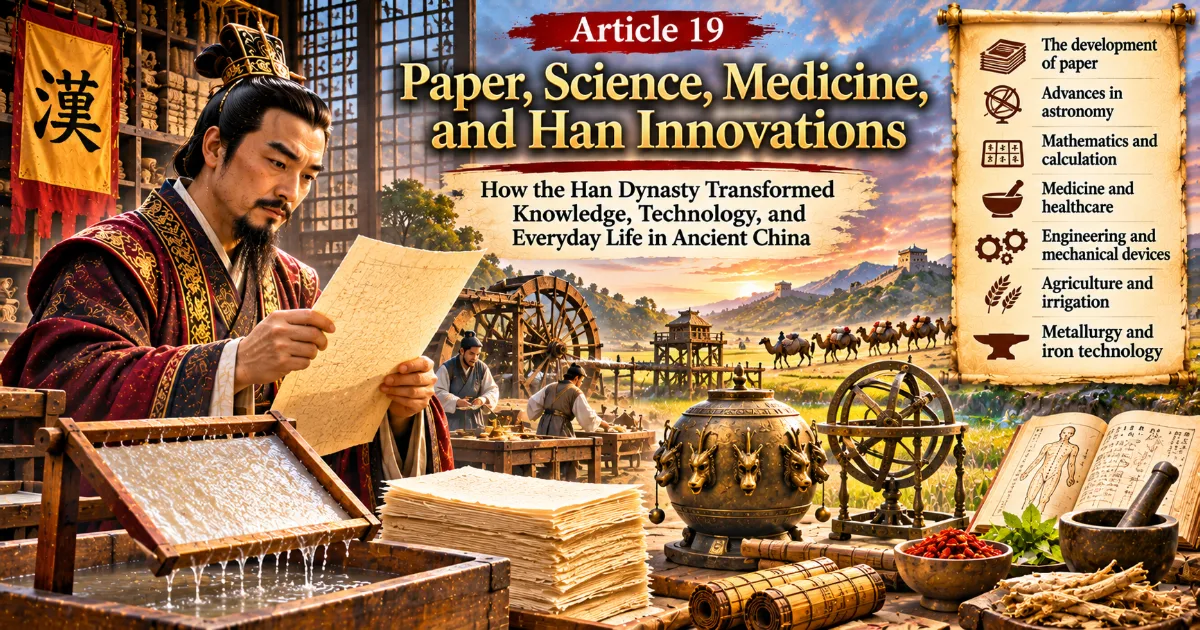
Among the most famous developments associated with the Han Dynasty was the improvement of papermaking, traditionally connected with the Eastern Han official Cai Lun. Paper eventually became one of China's most significant contributions to world civilization. However, Han achievements were not limited to paper. The dynasty also produced important astronomical instruments, advanced mathematical works, medical literature, iron tools, water-powered machinery, improved agricultural systems, and early earthquake-detection technology.
These developments did not emerge from a single invention or a single individual. They were the result of centuries of accumulated knowledge, practical experience, experimentation, government support, and cultural exchange. Understanding Han innovations provides a deeper picture of how ancient Chinese society approached problems and developed solutions that continued to shape the world long after the dynasty disappeared.
Continue Reading
The Importance of Innovation During the Han Dynasty
The Han Dynasty inherited a complex technological and intellectual tradition from earlier Chinese kingdoms. The Shang and Zhou periods had developed sophisticated bronze production, writing systems, agricultural practices, calendars, and philosophical traditions. The Qin Dynasty introduced important administrative and infrastructural reforms, including standardized systems of measurement and centralized government institutions. The Han rulers preserved many of these foundations while encouraging further development.
The stability achieved during significant portions of Han rule created opportunities for specialists, craftsmen, scholars, physicians, engineers, and administrators. A large empire required effective communication, reliable transportation, agricultural productivity, military equipment, and administrative records. These practical demands encouraged technological progress.
Agriculture was especially important. Most people lived in rural communities, and the prosperity of the empire depended heavily on agricultural production. Governments needed sufficient grain supplies to support cities, armies, officials, and public infrastructure. Improvements in irrigation, ploughing, harvesting, and storage therefore had direct political and economic importance.
The imperial administration also required educated officials who could read documents, maintain records, interpret laws, calculate taxes, and manage public projects. Written communication was essential, but traditional writing materials could be expensive, heavy, or inconvenient. This created a strong incentive to develop more practical materials for recording information.
Scientific knowledge was closely connected to government responsibilities. Astronomy helped determine calendars, predict seasonal changes, and interpret events considered important to imperial legitimacy. Mathematics supported taxation, land measurement, engineering, trade, and military logistics. Medicine helped preserve the health of soldiers, officials, workers, and ordinary families.
Han innovation should therefore be understood as a combination of intellectual curiosity and practical necessity. Scientific and technological developments were not isolated activities. They were connected to the functioning of society and the responsibilities of the state.
The Development of Paper in Han China
One of the most important technological developments associated with the Han Dynasty was the improvement of papermaking. Before paper became widely available, people in ancient China used several materials for writing and recording information. These included bamboo strips, wooden tablets, silk, and other surfaces.
Bamboo and wooden writing materials were widely used because they were available and durable. However, they had significant disadvantages. A large document could require many strips tied together with cords. Such documents were heavy and difficult to transport or store. Silk offered a lighter writing surface, but it was expensive and unsuitable for widespread everyday use.
The need for a more affordable and convenient writing material became increasingly important as government administration expanded and scholarly activity developed.
Archaeological discoveries have revealed that paper-like materials existed in China before the traditionally celebrated reforms of Cai Lun. Some early specimens date to the Western Han period. These findings demonstrate that the development of paper was a gradual process rather than a sudden invention by one individual.
The most famous figure associated with the improvement of papermaking is Cai Lun, a court official who served during the Eastern Han Dynasty. In 105 CE, he presented an improved papermaking process to Emperor He of Han, according to traditional historical accounts.
Cai Lun is credited with refining the use of materials such as tree bark, hemp waste, old cloth, and fishing nets. These materials could be processed into fibres, mixed with water, and formed into thin sheets. Once the sheets were dried, they provided a relatively lightweight and practical surface for writing.
The process involved breaking down fibrous materials, separating the fibres, mixing them with water, spreading the mixture across a screen or mould, allowing the water to drain, and drying the resulting sheet. The quality of the finished paper depended on the materials and the skill of the papermaker.
The significance of Cai Lun's contribution lies not simply in the creation of a new object but in the improvement of a manufacturing process that could be repeated and adapted. Paper could be produced using materials that were more accessible than silk, making written communication more practical.
How Paper Changed Chinese Society
The development of paper gradually transformed education, administration, literature, and communication in China. As paper production improved and became more widespread, written records became easier to create, transport, and preserve.
Government offices benefited greatly. An empire as large as Han China needed extensive records concerning taxation, population, land ownership, military supplies, legal decisions, and official correspondence. Paper offered an increasingly useful medium for administrative work.
Scholars also benefited. Philosophical discussions, historical accounts, poetry, medical knowledge, and technical instructions could be recorded more conveniently. Written materials helped preserve knowledge that might otherwise have depended on oral transmission or expensive writing surfaces.
Paper also made learning more accessible over time. Although literacy remained limited and access to education was unequal, the availability of more affordable writing materials created opportunities for the expansion of written culture.
It is important not to imagine that paper immediately replaced bamboo and wooden documents throughout China after 105 CE. Different materials continued to be used for different purposes, and the spread of paper took time. Bamboo and wooden slips remained important in various administrative and archaeological contexts.
The long-term consequences were enormous. Papermaking eventually spread beyond China through networks of trade, cultural contact, and technological exchange. It reached Central Asia and the Islamic world before becoming established in Europe. Over many centuries, paper supported the expansion of scholarship, religious literature, commercial records, education, and eventually printing.
The invention and improvement of paper became one of the most influential technological developments in world history because it helped societies preserve and circulate information on a much larger scale.
Astronomy and the Han Understanding of the Universe
Astronomy occupied an important position in Han intellectual life. Ancient Chinese scholars carefully observed the movements of the Sun, Moon, planets, stars, and other celestial phenomena. Their observations were closely connected to agriculture, calendar-making, political authority, and philosophical ideas about the relationship between heaven and human society.
The Chinese imperial calendar was essential for organizing agricultural activities and official ceremonies. Farmers needed to understand seasonal patterns, while government officials required a reliable system for determining dates and planning public responsibilities.
Astronomers observed eclipses, planetary movements, comets, and unusual celestial events. These observations were sometimes interpreted through political and philosophical traditions that associated the condition of the heavens with the conduct of rulers.
The idea of the Mandate of Heaven had already become an important element of Chinese political thought during the Zhou period. Under this worldview, unusual natural events could be understood as signs that a ruler had lost the moral authority to govern. Such interpretations did not replace observation, but they influenced the way astronomical information was understood and communicated.
Han scholars also worked to improve astronomical instruments and mathematical models. They sought to explain the movement of celestial bodies and construct systems that could predict important events.
One notable scholar was Zhang Heng, who lived from 78 to 139 CE during the Eastern Han Dynasty. He made important contributions to astronomy, mathematics, geography, and mechanical engineering.
Zhang Heng developed a sophisticated understanding of celestial movements and is associated with a detailed description of the celestial sphere. He worked on astronomical instruments that helped represent the apparent movement of the heavens.
His work reflected the broader Han interest in understanding the universe through observation, mathematical reasoning, and mechanical models.
Zhang Heng and the Seismoscope
Among Zhang Heng's most remarkable achievements was the creation of an early earthquake-detection instrument, traditionally dated to 132 CE.
Ancient China experienced destructive earthquakes, particularly in regions where geological activity could threaten settlements and infrastructure. Detecting distant earthquakes could help officials understand where disasters had occurred and organize responses.
Zhang Heng's instrument is commonly known as a seismoscope. Historical descriptions explain that it was a large bronze vessel containing an internal mechanism connected to a series of external dragon and toad figures. Each dragon held a small ball in its mouth, positioned above a corresponding toad.
When an earthquake occurred, the internal mechanism was designed to activate one of the dragons, releasing its ball into the mouth of the toad beneath it. The direction indicated by the released ball was intended to identify the direction from which the earthquake had originated.
The instrument was remarkable because it attempted to detect an earthquake even when the shaking was not necessarily obvious to people standing near the device.
The original instrument has not survived, and historians cannot fully reconstruct its internal mechanism from the available descriptions. It would therefore be inaccurate to claim that its precise engineering design is completely understood.
Nevertheless, Zhang Heng's seismoscope represents an important chapter in the history of scientific instruments. It demonstrates that Han engineers were interested in detecting natural phenomena through mechanical systems rather than relying exclusively on human observation.
The instrument also illustrates the connection between science and public administration. Earthquake detection had practical value because information about distant disasters could help the government respond to affected regions.
Mathematics and the Development of Practical Calculation
Mathematics was essential to the functioning of Han China. Administrators, merchants, engineers, architects, surveyors, and military officials all depended on accurate calculations.
Land measurement was necessary for taxation and agricultural planning. Construction projects required calculations involving distance, area, volume, materials, and labour. Trade required reliable arithmetic, while government officials needed methods for handling grain supplies, population figures, and financial records.
One of the most important mathematical works associated with ancient China is the text known as The Nine Chapters on the Mathematical Art. Its origins are complex, and the surviving form developed over a long period rather than being written entirely by one Han author.
The work contains practical mathematical problems covering land measurement, proportions, taxation, distribution, construction, and other subjects. It demonstrates how mathematics was connected to everyday economic and administrative needs.
The text also presents methods for solving systems of linear equations. Its procedures involved the use of counting rods arranged on a counting surface. These methods allowed mathematicians to organize numerical information and perform calculations systematically.
The Nine Chapters included techniques for calculating areas of different shapes, determining the volumes of containers, working with fractions, and solving problems involving proportional relationships.
One particularly important achievement was the development of systematic methods for handling positive and negative numbers in calculation. Ancient Chinese mathematicians used different arrangements of counting rods to represent quantities with different signs.
The mathematical traditions represented by The Nine Chapters influenced later Chinese scholarship. Commentaries and explanations helped preserve and develop its methods over many centuries.
The importance of Han mathematics was not limited to theoretical knowledge. It helped government officials manage resources, supported engineering projects, and contributed to the practical organization of a large agricultural empire.
Medicine and the Search for Health
Medicine developed significantly during the Han period, although Chinese medical traditions had roots extending much further into the past. Physicians and scholars combined observation, inherited knowledge, philosophical ideas, herbal practices, and theories about the functioning of the human body.
Traditional Chinese medicine developed within a worldview that emphasized relationships between the human body, natural processes, and the surrounding environment. Concepts such as yin and yang and the Five Phases became important frameworks for interpreting health and disease.
Yin and yang represented complementary aspects of natural processes. In medical thinking, health was associated with an appropriate balance between these aspects, while illness could be interpreted as a disturbance in their relationships.
The Five Phases, often translated as Wood, Fire, Earth, Metal, and Water, provided another conceptual framework for describing relationships among natural processes and bodily functions.
These concepts were part of the historical development of Chinese medical theory. They should be understood within their cultural and intellectual context rather than treated as direct equivalents of modern biological explanations.
Physicians also paid attention to symptoms, pulse characteristics, bodily appearance, diet, environmental conditions, and patterns of illness. Their observations contributed to the development of medical traditions that continued to evolve long after the Han Dynasty.
Herbal medicine was an important element of treatment. Practitioners used plants and other natural substances in preparations intended to address different conditions. Knowledge of medicinal materials was accumulated through experience and recorded in medical traditions.
Acupuncture and related practices also developed within the broader history of Chinese medicine. Archaeological discoveries and early medical texts provide evidence of changing ideas about the body and therapeutic techniques.
The Han period was therefore an important stage in the organization and preservation of Chinese medical knowledge.
The Huangdi Neijing and the Foundations of Chinese Medical Theory
One of the most influential works in the history of Chinese medicine is the Huangdi Neijing, commonly translated as The Yellow Emperor's Inner Canon.
The text is traditionally associated with the legendary Yellow Emperor, but its composition was not the work of a single historical individual. It developed through the accumulation and organization of medical ideas over time, with important material associated with the late Warring States and Han periods.
The Huangdi Neijing discusses the human body, disease, diagnosis, treatment, seasonal influences, and the relationship between health and the natural environment.
It is generally divided into two major sections known as the Suwen and the Lingshu. These sections address different aspects of medical theory and practice, although the text's structure and transmission developed over time.
The work presents the idea that health depends partly on the relationship between internal bodily processes and external environmental conditions. Seasonal changes, diet, activity, emotional states, and other influences were considered relevant to physical well-being.
It also discusses channels or pathways through which qi, often translated as vital energy, was understood to circulate. These ideas became important in later Chinese medical traditions.
The historical importance of the Huangdi Neijing lies in its role as a major foundation of Chinese medical literature. It influenced generations of physicians, scholars, and practitioners.
Modern medicine evaluates treatments and theories through scientific evidence and clinical testing. Historical Chinese medical texts should therefore be studied as important intellectual and cultural documents, while the effectiveness and safety of particular treatments must be assessed separately using contemporary medical standards.
Acupuncture and the Development of Therapeutic Practice
Acupuncture became an important part of Chinese medical history, and the Han period contributed to the development of the theories and practices associated with it.
The practice involves inserting thin needles into particular points on the body. Traditional explanations connect these points with channels through which qi was believed to move.
Early medical traditions described the body through networks of pathways and relationships among organs and bodily functions. The identification and classification of acupuncture points developed gradually, and later medical texts expanded the systems used by practitioners.
The Mawangdui archaeological discoveries, which include medical manuscripts from a tomb sealed in 168 BCE, provide valuable evidence of early Chinese medical thinking. Some of these manuscripts discuss therapeutic exercises, bodily pathways, and medical practices that help historians understand the development of early Chinese medicine.
These documents show that medical knowledge during the Han period was not uniform or fully standardized. Different traditions existed, and medical ideas continued to develop through discussion, practice, and the preservation of written records.
Acupuncture's historical significance extends beyond the treatment techniques themselves. Its development reflects the wider effort to understand the human body through organized systems of observation and explanation.
Metallurgy and the Expansion of Iron Technology
The Han Dynasty inherited a long tradition of metalworking, but iron technology became increasingly important during this period.
Iron was valuable because it could be used to produce agricultural tools, weapons, household equipment, and construction materials. Improvements in metal production helped support both the economy and the military.
Chinese metalworkers had developed sophisticated ironworking techniques before the Han Dynasty. During Han rule, iron production expanded in many regions, and the state took a strong interest in controlling important industrial resources.
Iron ploughshares, hoes, sickles, and other agricultural implements helped farmers work the land more effectively. Stronger tools could improve the preparation of fields and make certain agricultural activities more efficient.
Iron was also essential for military equipment. Weapons, armour components, and tools used by soldiers and military workshops depended on the availability of metal.
The Han government sometimes established monopolies over important industries, including iron and salt. These policies reflected the economic importance of such resources and the state's desire to control revenue and strategic production.
Ironworking involved complex processes such as smelting, casting, forging, and the management of furnaces. Chinese metallurgists developed techniques that allowed them to produce a wide variety of objects in significant quantities.
Cast iron was particularly important in China. The ability to produce cast iron objects at an early date demonstrated a high level of technical skill. Different products required different properties, and metalworkers developed methods to adapt iron for particular uses.
The expansion of iron technology strengthened agricultural productivity, supported military organization, and contributed to the economic foundations of the Han Empire.
Agricultural Technology and the Transformation of Farming
Agriculture remained the foundation of Han society. Most families depended directly or indirectly on farming, and the prosperity of the state was closely connected to the amount of food produced.
Han rulers understood that agricultural productivity was essential for political stability. Crop failures could create hunger, migration, social unrest, and financial difficulties for the government.
The dynasty therefore supported improvements in farming equipment, irrigation systems, water management, and cultivation practices.
One important agricultural development was the wider use and improvement of iron plough equipment. More effective ploughshares could help farmers prepare soil for planting, although the availability and quality of equipment varied across regions and economic circumstances.
The use of oxen for ploughing was also important. Animal power allowed farmers to cultivate larger areas than would have been possible through human labour alone.
Improvements in plough design helped make cultivation more efficient. Some plough systems included multiple components that allowed farmers to control the depth and direction of soil movement.
Agricultural production also benefited from improvements in irrigation. Canals, reservoirs, ditches, and water-control structures helped distribute water to fields and reduce dependence on rainfall.
In areas where flooding was a recurring danger, embankments and other water-management structures could protect agricultural land. However, large irrigation and flood-control projects required substantial labour and careful maintenance.
The Han government sometimes organized major public works to improve agricultural conditions. Such projects could benefit large populations, but they also imposed obligations on workers and local communities.
The Spread of the Seed Drill and Improved Cultivation
Among the agricultural technologies associated with ancient China was the development of seed-drilling equipment.
Traditional broadcasting involved scattering seeds across prepared soil. Although simple, this method could result in uneven distribution and wasted seed.
A seed drill allowed seeds to be placed in more organized rows or at more controlled intervals. Such equipment could improve planting efficiency and make it easier to manage crops.
Chinese agricultural traditions developed different forms of seed-drilling equipment, and the precise chronology and spread of individual designs require careful historical interpretation. Nevertheless, ancient Chinese agricultural engineering contributed important ideas to the development of more systematic planting methods.
Organized planting could also make weeding and field maintenance easier. Farmers could work more efficiently when crops were arranged in predictable patterns.
Crop rotation, careful soil management, and the use of animal manure also formed part of agricultural practice. These methods helped maintain soil fertility and reduce the risks associated with repeatedly cultivating the same land in the same way.
Agricultural knowledge was passed through families, local experience, and written traditions. Practical improvements often developed through experimentation by farmers rather than through formal imperial invention.
The success of Han agriculture therefore depended on both technological progress and the accumulated knowledge of rural communities.
Irrigation Engineering and the Control of Water
Water management was one of the greatest engineering challenges facing ancient Chinese governments.
The Yellow River and other major rivers supported agriculture and transportation, but they could also cause devastating floods. Seasonal rainfall and regional differences in water availability created additional difficulties.
The Han government continued earlier traditions of constructing canals, embankments, reservoirs, and irrigation networks.
These systems could direct water toward agricultural fields, drain excess water, and support settlements. Their construction required surveying, calculations, labour organization, and knowledge of local geography.
Engineers needed to understand elevation, water flow, soil conditions, and the strength of construction materials. Poorly designed water systems could fail or cause damage to surrounding communities.
The maintenance of canals and embankments was equally important. Sediment accumulation, erosion, and structural damage could reduce the effectiveness of infrastructure over time.
Irrigation projects also strengthened the relationship between the imperial state and local populations. Governments could gain legitimacy by improving agricultural conditions, but large public works could become burdensome when labour demands were excessive.
The Han experience demonstrates that engineering was not simply a matter of building structures. It required long-term planning, financial resources, administrative coordination, and an understanding of environmental conditions.
Mechanical Engineering and Water-Powered Technology
Han engineers developed a variety of mechanical devices designed to reduce human labour and improve production.
Water power was particularly valuable because it could be used to operate machinery. Flowing water could drive wheels and mechanisms that performed repetitive tasks.
Water-powered systems were used in different forms of agricultural and industrial activity in ancient China. Their development reflected an understanding of how natural energy could be converted into mechanical movement.
One important device in the broader history of Chinese engineering was the water-powered trip hammer. Such machinery could use the movement of a waterwheel to raise and drop heavy tools repeatedly.
Trip hammers were useful for processing materials and reducing the physical effort required for certain industrial tasks. Their development demonstrates the growing sophistication of mechanical engineering in ancient China.
Water power also supported grain processing. Mills could use mechanical movement to grind grain, helping communities process agricultural products more efficiently.
Not every Han community had access to advanced machinery. Local conditions, financial resources, and the availability of skilled workers influenced the adoption of technology.
Nevertheless, the use of mechanical systems represented an important step toward the development of more efficient production methods.
The Invention and Improvement of the Wheelbarrow
The wheelbarrow is another important example of Chinese technological development.
Although the exact chronology and early forms are debated, evidence from ancient China indicates that single-wheeled transport devices were developed long before they became common in many other parts of the world.
The wheelbarrow offered a practical way to transport heavy materials using a relatively simple mechanical arrangement. By concentrating much of the load over a wheel, it reduced the effort needed to move goods compared with carrying them entirely by hand.
Such devices could be useful in agriculture, construction, military logistics, and everyday transport.
A wheelbarrow could carry soil, stones, harvested crops, tools, and supplies. Its usefulness depended on the quality of the wheel, the balance of the load, and the condition of the path.
The development of such a device reflects an important characteristic of Han-era engineering: many valuable innovations were practical solutions to ordinary problems.
Technology did not always require complicated instruments or expensive materials. A simple improvement in the distribution of weight could produce significant benefits for workers.
Geography, Cartography, and the Study of the Land
The expansion of the Han Empire created a need for better geographical knowledge.
Officials needed information about roads, rivers, mountains, agricultural regions, military routes, and distant territories. Merchants required knowledge of trade routes, while military commanders depended on geographical information for planning campaigns.
Chinese scholars developed traditions of geographical writing and mapmaking that helped organize knowledge about the empire and surrounding regions.
The Han period produced important geographical records, including descriptions of regional resources, settlements, transportation routes, and political boundaries.
One of the important surviving works from the broader Han intellectual tradition is the Shiji, or Records of the Grand Historian, written by Sima Qian. Although primarily a historical work, it includes geographical and economic information that helps historians understand the world known to Han scholars.
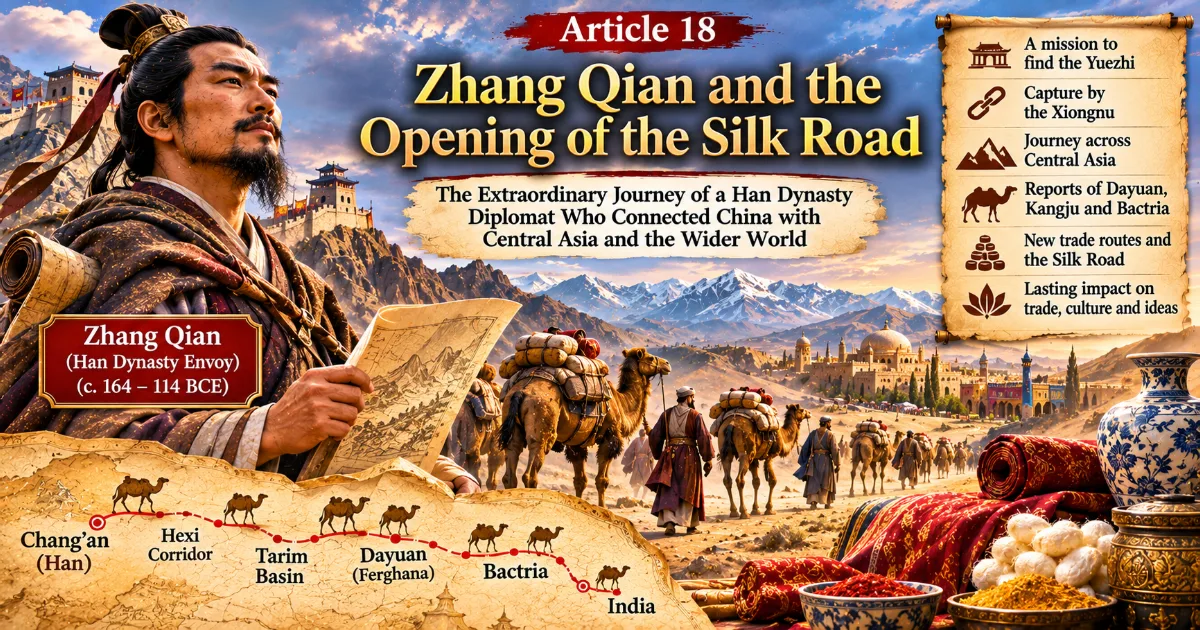
Geographical knowledge also expanded through diplomatic and commercial journeys. Zhang Qian's missions into Central Asia during the reign of Emperor Wu provided the Han court with valuable information about distant peoples, political organizations, agricultural products, and trade opportunities.
These journeys contributed to the development of the networks later associated with the Silk Road.
Maps and geographical descriptions supported the administration of an expanding empire. They helped officials understand territories that were far removed from the imperial capital.
Silk, Textiles, and Technical Craftsmanship
The Han Dynasty was famous for silk production, and textile manufacturing remained one of the most important skilled industries in China.
Silk was produced from the cocoons of silkworms. The process required careful cultivation of mulberry trees, raising silkworms, collecting cocoons, extracting fibres, spinning thread, and weaving fabric.
Chinese textile workers developed advanced techniques that produced fabrics of exceptional quality. Patterns, colours, embroidery, and weaving methods reflected both practical skills and artistic creativity.
Silk was valuable within China and became an important commodity in international trade. It was exchanged for horses, precious materials, luxury goods, and other products from distant regions.
The movement of silk across Eurasia contributed to the development of commercial connections between China, Central Asia, South Asia, the Middle East, and eventually the Mediterranean world.
Silk production also encouraged the development of specialized occupations. Farmers, silkworm breeders, spinners, dyers, weavers, merchants, and transport workers all contributed to the industry.
The economic importance of silk demonstrates how traditional craftsmanship could become part of a large international trading system.
The Role of Government in Scientific and Technological Progress
The Han imperial government played an important role in supporting and directing technological development.
The state needed engineers to construct roads, canals, walls, bridges, and administrative buildings. It needed metalworkers to produce weapons and tools, astronomers to maintain the calendar, and officials capable of managing financial and agricultural records.
Government workshops and specialist institutions helped organize production in areas considered important to imperial administration and military security.
The state also regulated certain industries because their products were strategically and economically significant. Salt and iron were particularly important examples.
However, government involvement was not always beneficial to every group. State monopolies could generate revenue but also create resentment among merchants and local producers.
The debate over the salt and iron monopolies became especially prominent during the Han period. The famous Discourses on Salt and Iron, associated with discussions in 81 BCE, records arguments about economic policy, government control, military expenditure, and the responsibilities of the state.
These discussions reveal that economic and technological development was connected to broader questions about governance.
Some officials argued that government control of strategic industries was necessary to fund defence and public administration. Others criticized monopolies for harming ordinary people and interfering with private economic activity.
The debate demonstrates the complexity of managing a large empire whose prosperity depended on agriculture, trade, manufacturing, and public investment.
The Spread of Knowledge Along the Silk Road
The Han Dynasty's scientific and technological achievements developed within a world of increasing contact with neighbouring regions.
The expansion of the Silk Road created opportunities for the exchange of products, ideas, artistic styles, religious traditions, and technical knowledge.
Chinese merchants and officials encountered Central Asian communities, while traders from distant regions travelled toward Chinese markets. These connections gradually linked societies across a vast geographical area.
Silk was one of the best-known products moving westward, but trade involved many other goods. Horses, precious stones, glassware, spices, textiles, metals, and agricultural products travelled through different routes.
Knowledge also moved through these networks. Travellers carried information about geography, political systems, customs, and commercial opportunities.
It is important not to assume that every major invention travelled along the Silk Road during the Han period. The movement of technologies occurred at different times and through different channels. Nevertheless, the commercial networks established and expanded during the Han era created conditions that later supported wider technological exchange.
The history of paper provides a particularly clear example. Papermaking spread beyond China over many centuries, eventually becoming an essential technology in several major civilizations.
The Silk Road was therefore not simply a route for luxury goods. It was part of a much larger system of cultural and intellectual interaction.
Education, Scholarship, and the Preservation of Knowledge
The Han Dynasty placed increasing importance on scholarship and the preservation of classical learning.
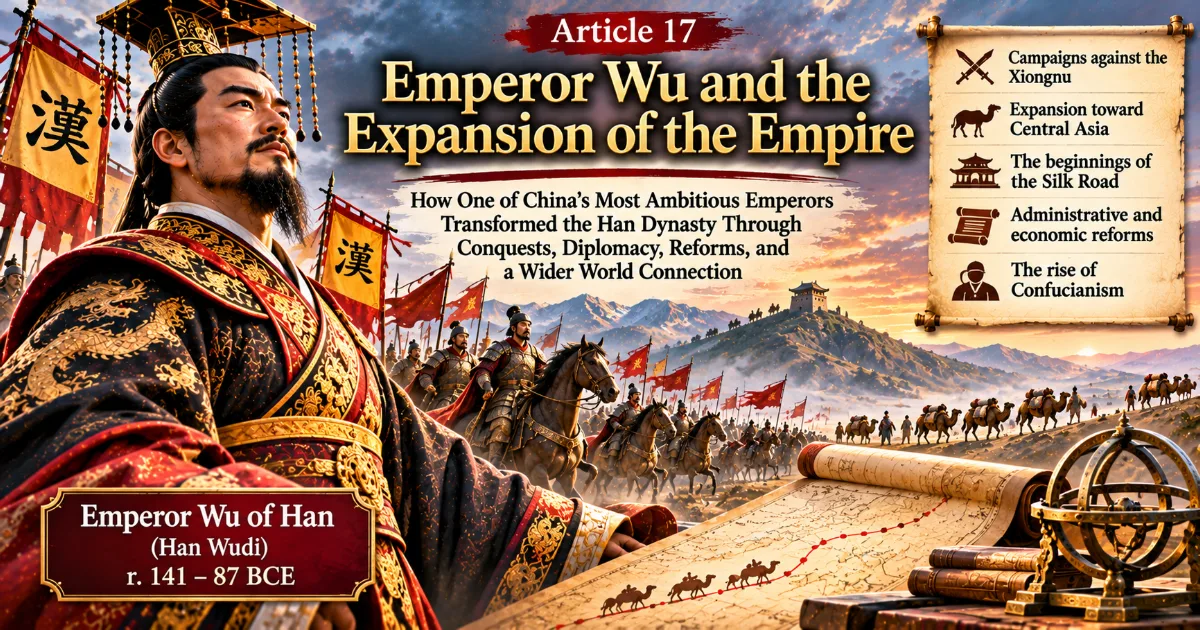
Confucian thought became closely connected with imperial education and official administration, particularly during the reign of Emperor Wu. The government supported institutions that encouraged the study of classical texts and trained scholars for administrative responsibilities.
Education was not equally accessible to all sections of society. Wealth, family background, location, and social connections influenced opportunities for learning. Nevertheless, the development of scholarly institutions helped establish a more organized intellectual culture.
Written records played an important role in this process. Historical accounts, philosophical works, medical texts, mathematical treatises, and administrative documents preserved information that could be studied by later generations.
The development of paper eventually strengthened this tradition, although bamboo slips and other materials remained important during the period.
The preservation of knowledge was itself a major achievement. Scientific progress depends not only on making discoveries but also on recording observations, explaining methods, and allowing later researchers to build upon earlier work.
Han scholars contributed to this process by collecting and organizing information from different periods and traditions.
The Limits and Challenges of Han Innovation
Although the Han Dynasty produced remarkable achievements, technological development was uneven and faced significant limitations.
Many innovations were available only in certain regions or to particular social groups. Advanced agricultural equipment required resources that poorer households might not possess. Large engineering projects depended on government support and substantial labour.
Medical knowledge was limited by the scientific understanding of the time. Physicians could observe symptoms and develop treatments, but they did not possess modern knowledge of microorganisms, genetics, or the biological mechanisms behind many diseases.
Astronomical observations were often highly detailed, but interpretations could combine empirical observation with philosophical and political beliefs.
Mechanical inventions also required skilled workers and maintenance. A device that worked effectively in one environment might not be suitable for another.
Political instability could disrupt scientific and industrial activity. The later Han Dynasty experienced court conflicts, economic pressures, rebellion, and the weakening of central authority. These problems affected the resources available for public works and administration.
It is therefore important to recognize both the achievements and the limitations of Han technology. The dynasty did not possess modern science, but its scholars and craftspeople developed sophisticated methods within the knowledge and resources available to them.
The Lasting Influence of Han Innovations
The influence of Han innovations continued long after the dynasty ended in 220 CE.
Paper became one of the most important technologies in human history. Its later spread helped transform education, government administration, literature, commerce, and religious scholarship across different civilizations.
Chinese mathematical traditions continued to develop through later dynasties. Works such as The Nine Chapters on the Mathematical Art remained influential, and later scholars expanded the methods used in arithmetic, geometry, and algebraic problem-solving.
Chinese medical literature also continued to evolve. The Huangdi Neijing remained a foundational text in traditional Chinese medicine, influencing medical education and practice for centuries.
Astronomical observation became an enduring feature of Chinese scholarly and governmental life. The tradition of recording celestial events provided valuable historical information and contributed to later developments in astronomy.
Agricultural engineering, irrigation, metalworking, and mechanical devices continued to be refined. Later Chinese dynasties inherited and expanded many of the technologies that had developed during earlier periods.
The Han Dynasty's contribution was therefore not simply a collection of isolated inventions. It helped establish a durable intellectual and technological tradition.
Why Han Innovation Matters in World History
The history of Han technology reminds us that major transformations in civilization often emerge through gradual improvements rather than sudden discoveries.
Papermaking developed from earlier experiments with fibrous materials. Mathematical knowledge grew from the practical demands of administration and construction. Medical traditions evolved through observation, discussion, and the preservation of experience. Agricultural engineering improved through the accumulated work of farmers and craftsmen.
These achievements were connected to the needs of a large and complex society. The Han Empire required food, communication, transport, defence, medical care, and reliable administration. Each challenge created opportunities for innovation.
The dynasty also demonstrates the importance of institutions in preserving knowledge. Scholars, government officials, workshops, physicians, and engineers all contributed to a culture in which practical knowledge could be developed and transmitted.
Some Han innovations eventually influenced societies far beyond China. Paper, in particular, became a foundation for the expansion of written communication across the world.
The history of science is often told through famous individuals, but the Han experience shows that innovation is also a collective achievement. Countless farmers, metalworkers, builders, scribes, physicians, and artisans contributed to technological progress without leaving their names in historical records.
Their work helped create the material foundations of one of the most influential civilizations in human history.
Conclusion: The Han Dynasty as an Age of Knowledge and Practical Achievement
The Han Dynasty was a period of extraordinary development in Chinese science, medicine, mathematics, agriculture, engineering, and craftsmanship. Its achievements strengthened the imperial administration, improved economic productivity, supported military organization, and expanded the possibilities of written communication.
The improvement of papermaking associated with Cai Lun became one of the most influential technological contributions in world history. The astronomical work of Zhang Heng demonstrated the sophistication of Han scientific observation and mechanical engineering. Mathematical texts such as The Nine Chapters on the Mathematical Art preserved practical methods that influenced later generations. Medical literature helped establish traditions that remained central to Chinese intellectual history.
Advances in ironworking, irrigation, agricultural equipment, water-powered machinery, geography, and textile production supported the daily life and economic strength of the empire.
These innovations were not created in isolation. They emerged from earlier Chinese traditions, practical challenges, scholarly investigation, government requirements, and expanding international connections.
The Han Dynasty eventually fell because of political conflict, economic difficulties, social unrest, and the weakening of imperial authority. Yet its scientific and technological legacy survived the collapse of the dynasty.
The history of Han innovation shows that the strength of a civilization cannot be measured only by the size of its armies or the power of its rulers. It must also be understood through the knowledge it creates, the problems it solves, the skills it preserves, and the ideas it passes to future generations.
The Han Dynasty helped build a foundation for China's continuing scientific and cultural development. Its contributions remind us that the progress of civilization depends on curiosity, observation, practical knowledge, and the ability to learn from earlier generations.
#HistoryOfChina #HanDynasty #AncientChineseScience #HistoryOfTechnology #ChineseInnovations