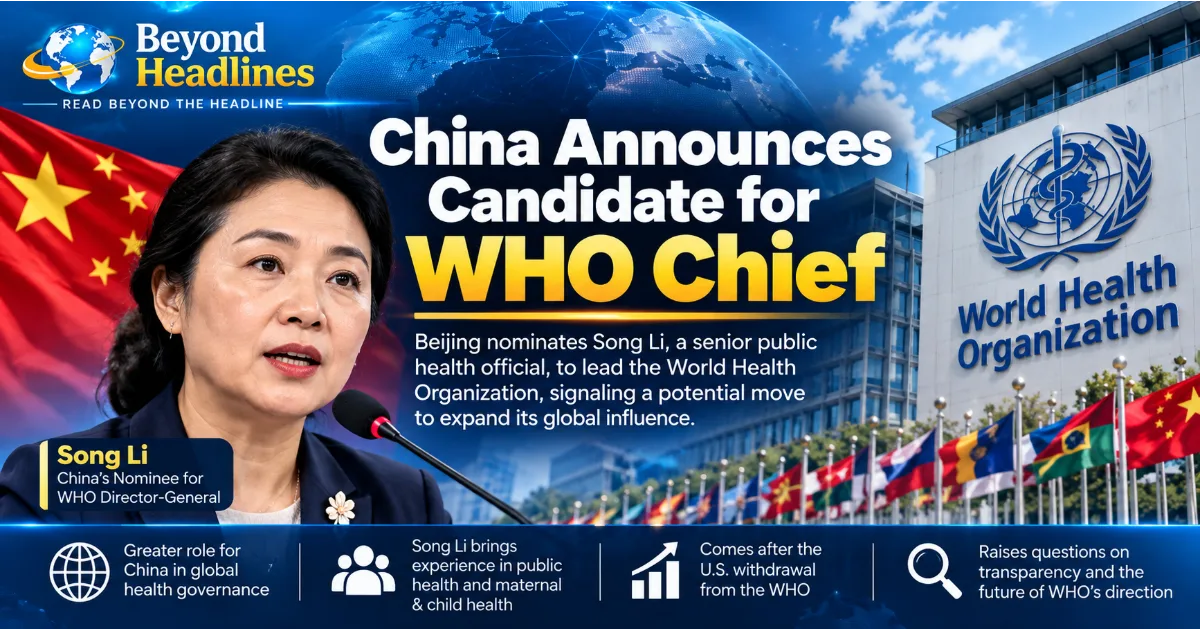
China has formally entered the race to lead the World Health Organization, putting forward senior public health official Song Li as its candidate for the organisation’s next Director-General. The announcement, made by Chinese Foreign Ministry spokesperson Mao Ning on October 8, 2026, comes at a particularly important moment for the WHO, which is preparing for a leadership transition while also dealing with the consequences of the United States’ withdrawal and a difficult global health financing environment. Reuters
The nomination is significant for more than just the identity of the person being proposed. The WHO sits at the centre of international cooperation on infectious diseases, vaccination, health emergencies, maternal and child health, pandemic preparedness and universal health coverage. Whoever succeeds Tedros Adhanom Ghebreyesus will inherit an organisation facing financial pressure, geopolitical disagreements and renewed questions about how global health institutions should operate in a world where cooperation between major powers is becoming increasingly complicated.
China's decision to nominate Song Li therefore has both a public health dimension and an international governance dimension. Beijing has described the nomination as evidence of its support for multilateralism and said Song's leadership would help the WHO play a greater role in improving global health. At the same time, outside observers have interpreted the move as part of China's broader effort to strengthen its position inside international institutions following the US withdrawal from the WHO. China Foreign Affairs
The two interpretations can exist simultaneously. A candidate can have substantial public health experience while her nomination can also carry geopolitical significance. The important question is therefore not simply whether China wants influence at the WHO. It is how that influence might be exercised, what priorities a future WHO leadership could pursue, and how member states will evaluate the candidates before the final vote.
Who Is Song Li?
Song Li is a senior Chinese public health official whose career has focused primarily on women’s and children’s health. She currently serves as a senior official in the Department of Women and Children's Health at China's National Health Commission. The WHO has previously listed her as Deputy Director-General of that department and as a member of its technical advisory groups on maternal, newborn, child and adolescent health and nutrition. World Health Organization
Her professional experience is considerably broader than a single policy area. A curriculum vitae submitted by China during an earlier WHO regional leadership process shows that Song began working in the National Health Commission's maternal and child health system in 2002. She subsequently held positions of increasing responsibility, including work in women's health, before becoming Deputy Director-General and later Director-General of the maternal and child health department. World Health Organization
Her academic background is also closely connected to public health. The curriculum vitae submitted to the WHO lists a master's degree in clinical medicine with a focus on gynaecology and obstetrics from Shandong Medical University and a doctorate in public health from Peking University. It also records a period as a visiting scholar in global health at Harvard University. World Health Organization
Song has also worked with international health organisations and expert groups. The WHO lists her as a member of its Mother and Newborn Information for Tracking Outcomes and Results advisory group, while previous WHO documentation lists her as a member of a strategic and technical advisory group covering maternal, newborn, child, adolescent health and nutrition. World Health Organization
Her professional record includes work connected with public health emergencies. A biography published through a maternal health programme describes her involvement in China's response to SARS, avian influenza and COVID-19, alongside her broader responsibilities for national and international health programmes. partners-popdev.org
This background matters because the WHO Director-General is not simply a political representative. The position requires the ability to manage a large international institution, coordinate governments, work with scientists and health agencies, mobilise funding and respond to emergencies. Song's career gives her experience in at least several of these areas, particularly public health administration, international health cooperation and maternal and child health.
Why Is China Making This Move Now?
The timing is central to understanding the significance of the nomination.
The United States formally moved to withdraw from the WHO under President Donald Trump. The White House announced the withdrawal process in January 2025 and subsequently issued further directives in 2026 concerning US participation and funding in international organisations. The WHO said in January 2026 that it regretted the US decision and warned that the withdrawal would create consequences for global health cooperation. The White House
For decades, the United States was the WHO's largest donor and one of its most important partners. WHO records show that the United States contributed approximately $1.284 billion to the organisation during the 2022 to 2023 biennium through assessed contributions and voluntary funding. World Health Organization
The loss of such a major contributor has consequences beyond the organisation's balance sheet. WHO programmes rely on international cooperation, technical expertise and funding to operate disease surveillance systems, emergency responses, vaccination programmes and health initiatives in countries with limited resources.
WHO leadership warned that the US withdrawal would create a substantial financial challenge. In 2025, Director-General Tedros said the United States represented about 18 percent of WHO income and that its withdrawal could create a funding gap of almost $600 million in that year alone. World Health Organization
The organisation subsequently moved toward further financial reforms. Member states approved a 20 percent increase in assessed contributions for the 2026 to 2027 budget, which was set at approximately $4.2 billion. The move was designed to make the organisation less dependent on a small group of voluntary donors. World Health Organization
This is the environment in which China is entering the leadership contest.
Reuters reported before the formal announcement that Chinese officials were preparing to nominate Song Li and that diplomats viewed the move as an opportunity for Beijing to expand its influence after the US withdrawal. Reuters
That does not automatically mean that Song's nomination should be understood only as a geopolitical strategy. China has extensive experience in public health and has participated in WHO programmes for decades. But international organisations operate within political systems, and leadership elections inevitably involve questions of representation, influence and diplomatic priorities.
The WHO Leadership Contest Is Already Underway
Song Li is not entering an empty field.
Other governments have already put forward candidates for the position, including nominees from Belgium, Qatar, Saudi Arabia, Spain, Indonesia and Botswana. The contest therefore represents a genuinely international competition involving candidates with different professional backgrounds and different regional perspectives. LinkedIn
Among the publicly identified candidates is Indonesia's Health Minister Budi Gunadi Sadikin, who has spoken about the importance of rebuilding cooperation with the United States and reforming the WHO. Other candidates include senior health officials with experience in European, Middle Eastern and international health institutions. Reuters
The process itself is structured rather than a direct public election.
According to the WHO's official election timetable, member states submitted nominations by September 24, 2026. The names of candidates are scheduled to be formally announced after the conclusion of the relevant regional committee meetings, with the first candidates' forum scheduled for November. The Executive Board is expected to shortlist and nominate up to three candidates in January 2027. The World Health Assembly will then choose the next Director-General in May 2027. World Health Organization
Tedros Adhanom Ghebreyesus cannot seek another term because the WHO Director-General can be reappointed only once. His second five-year term began in August 2022 and is scheduled to end on August 15, 2027. World Health Organization
This means that the 2027 election will mark a genuine change in leadership at the top of the organisation.
Why the Candidate's Professional Background Matters
Song Li's career in maternal and child health gives her a particular perspective on global health.
Maternal and child health remains one of the most important indicators of whether health systems are functioning effectively. It involves prenatal care, safe childbirth, newborn health, nutrition, vaccination, reproductive health, disease prevention and access to medical services.
These issues also reveal inequalities between countries. A global health organisation cannot focus only on highly visible outbreaks. It must also deal with the everyday health problems that affect millions of people, including preventable maternal deaths, childhood malnutrition, inadequate primary care and limited access to reproductive healthcare.
Song's previous work has included policies concerning prenatal diagnosis, assisted reproductive technology and other areas connected with women's and children's health. Her earlier WHO curriculum vitae also records involvement in programmes designed to improve maternal and child health services and access in rural areas. World Health Organization
Her experience could therefore be relevant to a WHO that is trying to balance emergency preparedness with long-term health-system development.
The next Director-General will have to deal with both.
A future pandemic can create an immediate global emergency, but the ability of countries to respond effectively depends heavily on the strength of their basic healthcare systems. Countries with strong primary care, disease surveillance, laboratories, trained health workers and reliable supply chains are better positioned to respond when a new outbreak appears.
The distinction between emergency response and routine healthcare is therefore increasingly difficult to maintain.
The COVID-19 Question Will Follow the Election
There is another issue that makes China's nomination particularly sensitive.
The WHO's handling of the COVID-19 pandemic remains politically controversial, and China's role in the early stages of the pandemic continues to be scrutinised internationally.
The first recognised outbreak was identified in Wuhan in late 2019. Questions have continued over the availability of early information, the timing and completeness of data sharing and the circumstances surrounding the emergence of the virus.
The United States government has publicly criticised the WHO's handling of the pandemic. The White House order announcing the US withdrawal cited what it described as WHO failures related to COVID-19 and other global health crises, as well as concerns about the organisation's independence. The White House
Those are the stated US government positions and should be distinguished from established scientific findings. The question of the origins of COVID-19 remains subject to scientific and political debate, and claims about the precise origins of the virus should not be treated as settled simply because individual governments have adopted particular positions.
China has rejected accusations that it improperly influenced the WHO and has criticised the United States for what Beijing describes as an attempt to shift responsibility.
This history means that any Chinese candidate for WHO Director-General will inevitably face questions about transparency, pandemic preparedness and the relationship between national governments and international health institutions.
For Song Li, this will be an important part of the international discussion surrounding her candidacy.
China's Relationship With the WHO Is More Complicated Than the Election
China is not new to the WHO.
The country has worked with the organisation on a wide range of health issues, including maternal and child health, infectious diseases and public health development. Chinese officials have also participated in WHO technical groups and regional programmes.
Song herself has previously served on WHO expert groups, demonstrating that her professional relationship with the organisation predates this leadership campaign. World Health Organization
China has also previously backed a Chinese candidate for WHO leadership.
Margaret Chan, who was born in Hong Kong, served as WHO Director-General from 2007 to 2017. If Song Li were eventually elected, she would become the second Chinese national to lead the organisation, although her election would also represent the first time a mainland Chinese official had headed the WHO, according to reporting on the current contest. South China Morning Post
That historical connection gives China additional institutional experience in the organisation.
At the same time, China's expanding role in global institutions has become an important subject of international debate. Beijing has sought greater participation in multilateral institutions and has increased its engagement across parts of Asia, Africa and other developing regions.
The WHO is especially important because health cooperation frequently extends beyond traditional diplomacy. Countries work together on vaccines, disease surveillance, medical research, emergency response and health infrastructure even when they disagree on other geopolitical issues.
The Director-General therefore operates in a space where science and diplomacy constantly intersect.
What Would a Chinese WHO Director-General Actually Control?
It is important not to exaggerate what the Director-General can do.
The WHO is not a global health government. It does not directly control national healthcare systems, hospitals or vaccination programmes. Its authority comes largely from its member states, international agreements, technical expertise and its ability to coordinate governments and partners.
The Director-General serves as the organisation's chief technical and administrative officer. The WHO's governance structure means major decisions are ultimately made by member states through bodies such as the World Health Assembly and Executive Board. World Health Organization
A Director-General can influence priorities, organisational culture, crisis communication and international cooperation. But the position does not give the office-holder unilateral authority over the world's health policies.
This distinction matters when discussing China's potential influence.
If Song Li were elected, China would gain greater symbolic representation at the head of the organisation. It could also strengthen Beijing's diplomatic position within global health discussions. But the Director-General would still have to work with member states representing different interests and political systems.
The success of any WHO leader therefore depends heavily on the ability to build broad coalitions.
The Funding Problem May Be as Important as the Leadership Race
The incoming Director-General will inherit a WHO undergoing financial restructuring.
The United States' departure has created a significant funding challenge, but the organisation was already trying to reduce its dependence on voluntary contributions from a limited number of major donors.
WHO data show that voluntary contributions accounted for the overwhelming majority of the organisation's income in earlier years. The organisation has been working to increase assessed contributions from member states so that a larger share of its core budget is financed through predictable membership payments. World Health Organization
This is important because voluntary funding can sometimes be directed toward specific programmes, whereas flexible funding gives the organisation greater freedom to decide where resources are most urgently needed.
The WHO's four-year base budget for the 2025 to 2028 period is approximately $11.1 billion, with assessed contributions expected to cover around $4 billion and voluntary contributions making up the remaining requirement. World Health Organization
The next Director-General will therefore have to work on fundraising, financial stability and donor diversification.
China could become more important in this environment, but it is unlikely to replace the United States simply by increasing its own contributions. The scale of the funding gap and the complexity of global health financing require broader participation from governments, foundations, development institutions and other partners.
This is one reason the leadership election is connected to a much larger question about the future structure of global health governance.
Could China's Influence Grow?
Reuters and other international reports have described China's nomination as an opportunity for Beijing to increase its influence at the WHO following the US withdrawal. Reuters
There are several reasons why that interpretation has emerged.
China is one of the world's largest economies, has a huge domestic healthcare system and has extensive experience managing public health programmes across a large population. It has also expanded its international engagement over the past two decades.
A Chinese Director-General could give Beijing greater visibility in discussions about global health policy, pandemic preparedness, medical supply chains and international health cooperation.
But influence is not determined by nationality alone.
The WHO Director-General must work with Europe, Africa, Asia, the Americas, the Middle East and the Pacific. Countries will assess the leader based on how effectively the organisation responds to outbreaks, how transparent its processes are and whether it can maintain confidence across political divides.
A leader seen as too closely aligned with any one government could face difficulties building trust.
That is why the question surrounding Song Li is not simply whether she is Chinese. It is how she would define her role if elected.
The Independence Question
The independence of international institutions will be one of the central themes of the 2027 election.
Governments naturally want international organisations to reflect their interests. At the same time, organisations such as the WHO are expected to operate according to scientific evidence, technical standards and rules agreed by their member states.
Maintaining that balance is difficult.
The United States has argued that the WHO has not always demonstrated sufficient independence from political influence. China has rejected such accusations and presents its own participation as support for multilateral cooperation.
The debate is therefore unlikely to disappear with the election.
Instead, the next Director-General will probably face continuous pressure from governments seeking to shape the organisation's priorities.
For the WHO, credibility will depend partly on whether it can demonstrate that technical decisions are based on evidence and established procedures rather than geopolitical pressure.
This issue matters because global health cooperation ultimately depends on trust.
If governments do not trust information coming from international health institutions, cooperation during an emergency becomes much harder. If scientific experts believe political considerations are overriding technical evidence, confidence can decline. And if poorer countries believe powerful nations dominate decision-making, support for multilateral health institutions can weaken.
What Happens Next?
China's nomination does not mean Song Li is the next WHO Director-General.
The election process still has several stages.
The WHO's official timetable states that candidate names will be formally announced after the conclusion of the relevant regional committee process in early November. The first candidates' forum is scheduled for November 18, 2026, while another forum is scheduled for March 2027. The Executive Board is expected to shortlist up to three candidates in January 2027. World Health Organization
The World Health Assembly will ultimately decide who becomes Director-General in May 2027.
That means the next several months will involve significant diplomatic activity.
Candidates will have to explain their priorities, demonstrate their experience and answer questions about how they would manage the WHO through a period of financial and geopolitical uncertainty.
For Song Li, questions about China's role in the WHO and the organisation's experience during COVID-19 are likely to remain important.
For other candidates, different questions will arise based on their professional backgrounds and the regions they represent.
The election will therefore be more than a contest between individuals. It will also be a discussion about what the WHO should become in the next phase of global health cooperation.
The Bigger Question Is Who Can Rebuild Trust
The WHO's next leader will inherit an organisation facing a difficult combination of challenges.
The United States has withdrawn. Funding arrangements are changing. Pandemic preparedness remains a global concern. Countries continue to disagree over how much authority international institutions should have. At the same time, infectious diseases, antimicrobial resistance, climate-related health risks and unequal access to healthcare continue to affect populations around the world.
The leadership question is therefore inseparable from the question of institutional trust.
A successful Director-General will need to maintain relationships with governments that disagree with one another while preserving the WHO's technical credibility. The organisation will need predictable funding without becoming overly dependent on any single donor. It will need to respond rapidly to emergencies while also strengthening basic healthcare systems.
These responsibilities cannot be solved by one country.
China's nomination demonstrates that Beijing is prepared to compete for a more prominent role in the organisation's future. The United States' withdrawal has changed the geopolitical environment in which that competition is taking place. But the eventual direction of the WHO will still depend on decisions made collectively by its member states.
What China's Nomination Really Signals
The headline is that China has nominated Song Li to lead the WHO.
The deeper story is that the global health order is entering a new phase.
For decades, the United States played a central role in financing and supporting international health programmes. China has increasingly expanded its engagement with global institutions. The WHO now finds itself navigating a world in which the traditional balance of influence is changing.
Song Li brings substantial experience in maternal and child health, public health administration and international cooperation. WHO records show that she has already participated in international technical work, while China's earlier curriculum vitae documented decades of experience inside its national health system. World Health Organization
Whether that experience translates into the leadership of a global institution will ultimately be decided by member states.
The most important test will not simply be where the next Director-General comes from. It will be whether that person can build confidence among countries with very different political systems and priorities.
The WHO was created on the principle that diseases do not stop at national borders. That principle has become even more relevant in an era of pandemics, international travel, climate change and interconnected supply chains.
China's nomination of Song Li is therefore not just another diplomatic announcement.
It is an early indication of how the competition for influence in global health may develop after the US withdrawal. It also places renewed attention on the relationship between national interests and international health institutions.
The final decision is still months away.
But the debate has already begun, and it will extend far beyond the question of who occupies the WHO's top office. The larger question is whether the organisation can maintain its independence, secure sustainable funding and rebuild confidence across a divided international system.
That is the challenge the next WHO Director-General will inherit.
#BeyondHeadlines #China #SongLi #WHO #WorldHealthOrganization #WHOChief #GlobalHealth #GlobalHealthGovernance #PublicHealth #Healthcare #HealthDiplomacy #PandemicPreparedness #COVID19 #ChinaWHO #InternationalRelations #Multilateralism #HealthPolicy #GlobalHealthSecurity #TedrosAdhanomGhebreyesus #WHOLeadership #GlobalGovernance #PublicHealthPolicy #MaternalHealth #ChildHealth #HealthcareLeadership #UnitedNations #GlobalHealthCrisis #HealthSystems #InternationalHealth #BeyondTheHeadline