The Empire That Could Not Survive Its Founder
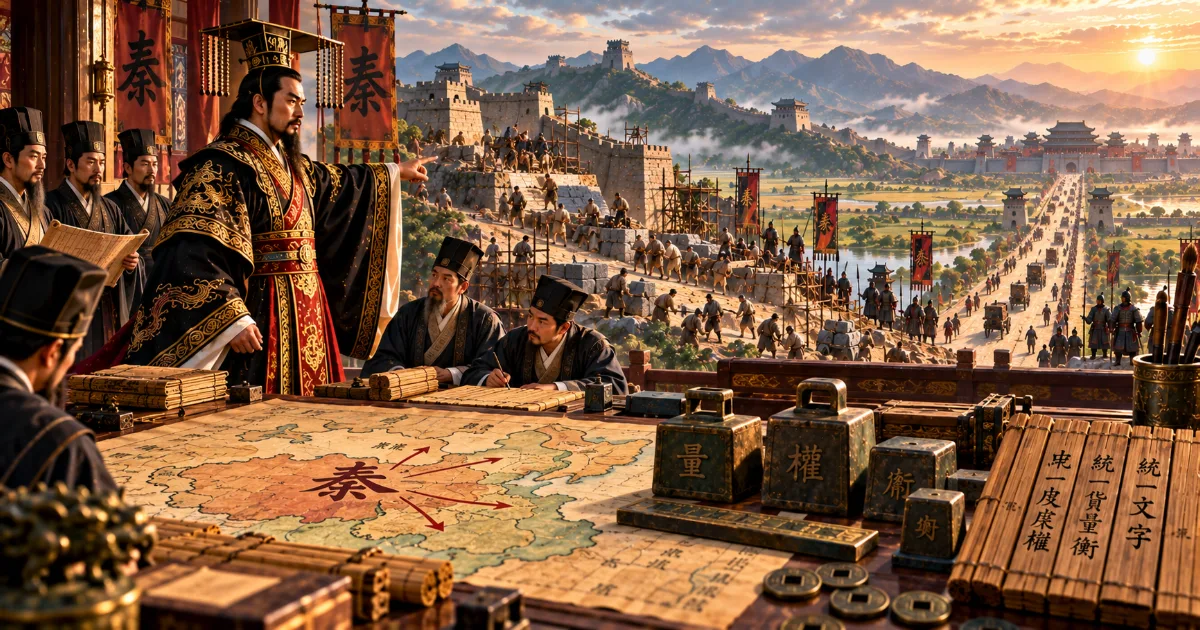
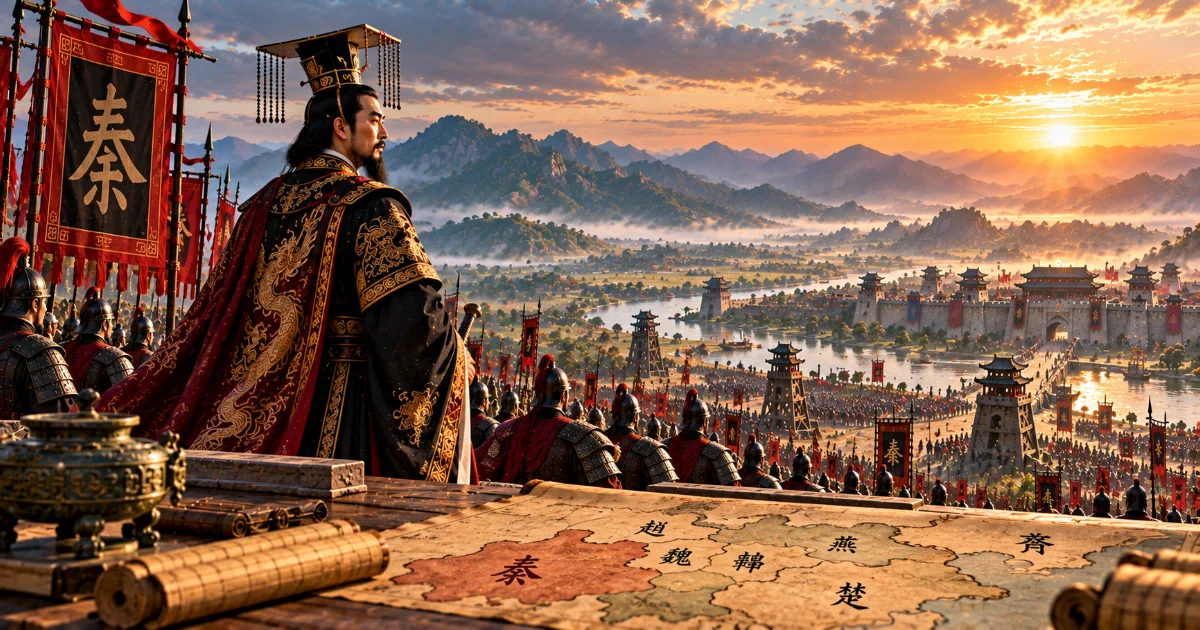
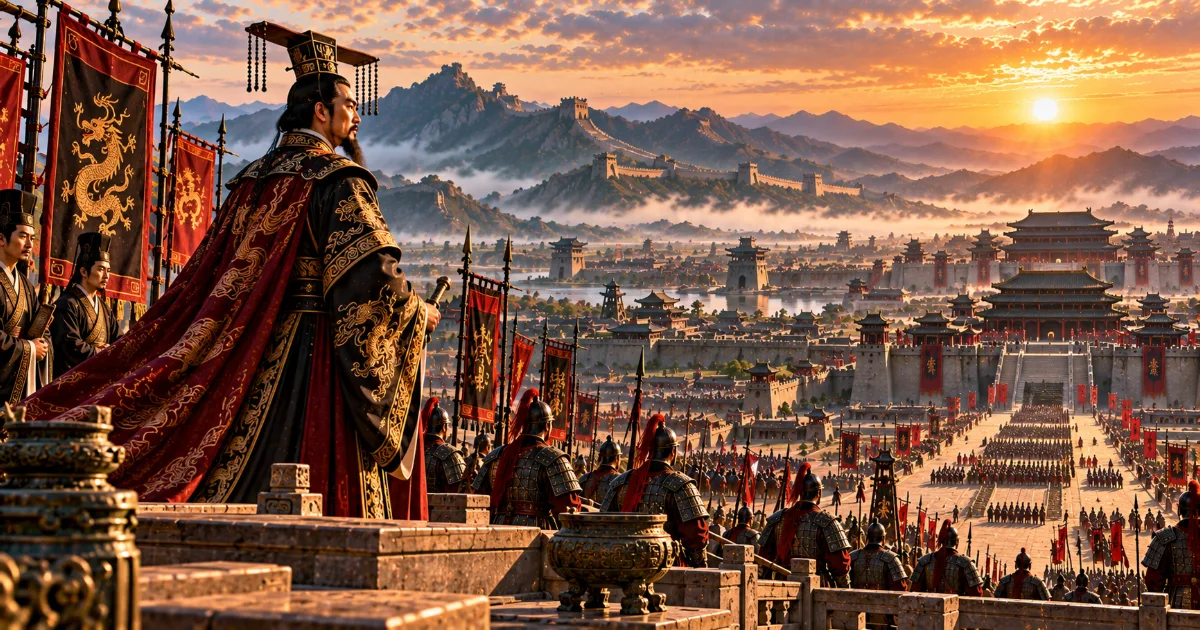
In 221 BCE, Qin Shi Huang achieved something that had remained beyond the reach of China's earlier rulers. After centuries of political division and warfare, he defeated the rival kingdoms and established the first unified Chinese empire. His government introduced centralized administration, standardized writing, currency, weights and measures, and an extensive network of roads. The Qin state demonstrated extraordinary military strength and administrative ambition.
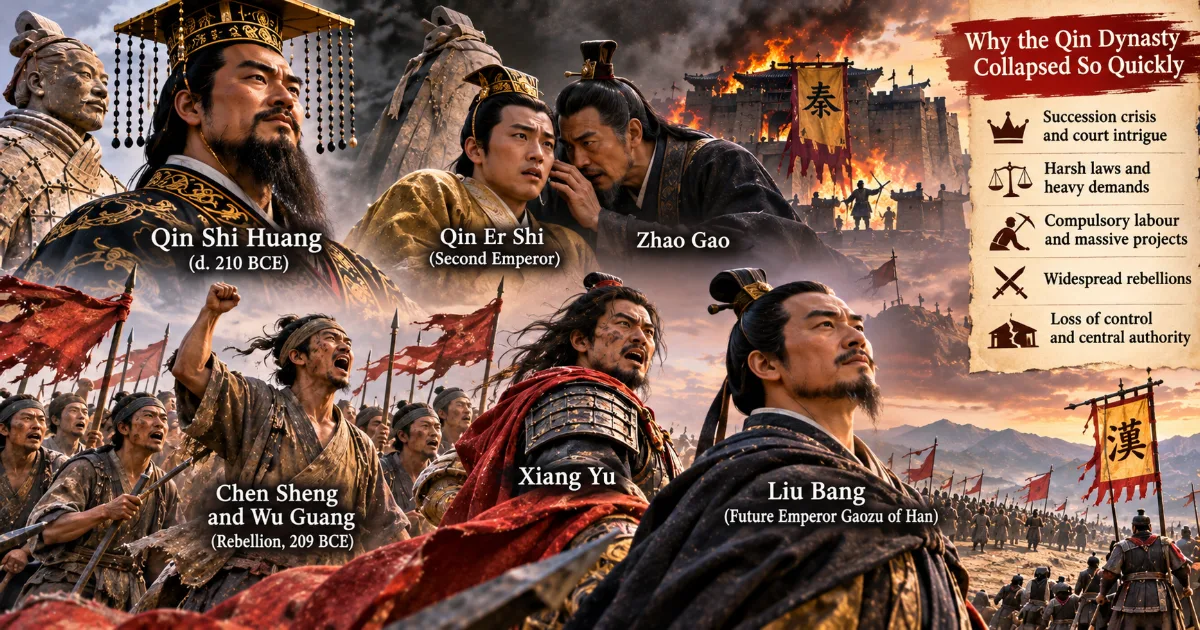
Yet the empire that had conquered the other kingdoms did not survive for long after its founder's death. Qin Shi Huang died in 210 BCE, and by 206 BCE the Qin dynasty had collapsed. In just a few years, the powerful imperial system that had transformed China was overwhelmed by political intrigue, rebellion, military defeats, and a crisis of legitimacy.
The speed of the collapse raises an important historical question. How could a dynasty capable of unifying China fail so quickly? Was its downfall caused by the cruelty of its government, the weakness of its successors, the ambition of powerful officials, or the enormous demands placed upon ordinary people?
The answer involves all these factors, but none alone explains the entire crisis. The Qin dynasty created an effective system of centralized administration, but its political structure depended heavily on the authority of one ruler. When Qin Shi Huang died, the empire lacked a stable succession arrangement capable of maintaining unity. His successors inherited an enormous state but not his political authority or ability to control competing interests.
Continue Reading
At the same time, the population faced demanding taxes, compulsory labour, military service, and strict legal punishments. Large construction projects and military campaigns required substantial resources. These obligations contributed to resentment, especially among farmers and labourers whose livelihoods depended on agricultural production.
Political intrigue inside the imperial court weakened the government further. Powerful officials manipulated the succession, removed rivals, and influenced the Second Emperor. Meanwhile, rebellions that began in the countryside developed into larger movements capable of challenging imperial authority.
The fall of the Qin dynasty was therefore not simply the result of one bad emperor or one rebellion. It was the consequence of structural weaknesses, political decisions, economic pressures, and military instability interacting during a short but decisive period.
Understanding the collapse is essential to understanding the development of imperial China. The Han dynasty that followed preserved many of the administrative achievements of Qin while modifying aspects of its political and legal approach. The Qin dynasty disappeared, but its institutional legacy became a foundation for later Chinese government.
1. The Death of Qin Shi Huang in 210 BCE
Qin Shi Huang's death marked the beginning of the crisis that destroyed his dynasty. He died in 210 BCE while travelling through the eastern regions of his empire. His journeys were partly connected with imperial inspection, ceremonial responsibilities, and his continuing interest in finding methods of extending his life.
The emperor had spent years consolidating his authority. He had defeated rival kingdoms, reorganized the administration, and established a political system in which the central government exercised extensive control over the empire. His personal authority was the most important element holding this system together.
The problem was that the empire had not developed a sufficiently secure mechanism for transferring power after his death. Although the imperial court had officials, administrators, and members of the royal family, succession depended heavily on political influence and the decisions made by those closest to the emperor.
Qin Shi Huang's death created uncertainty at the highest level of government. The emperor's eldest son, Fusu, had been associated with the imperial administration and was considered by many to be an important potential successor. However, he was away from the emperor's immediate court and had become involved in disagreements concerning imperial policy.
The circumstances surrounding the succession became deeply controversial. According to the traditional account recorded by the Han historian Sima Qian, powerful court figures manipulated the situation to prevent Fusu from becoming emperor.
This succession crisis exposed a weakness in the Qin political system. The empire had created a powerful central government, but its future depended on the decisions and relationships of a small group of officials around the ruler.
When the emperor died, the system had no universally accepted arrangement capable of preventing court factions from competing for control.
2. The Succession Crisis and the Rise of Qin Er Shi
Following Qin Shi Huang's death, his younger son Huhai became emperor. He is known historically as Qin Er Shi, meaning Second Emperor of Qin.
The succession was influenced by Zhao Gao, an influential court official, and Li Si, the empire's powerful chancellor. Traditional accounts describe how they became involved in concealing the emperor's death and manipulating the succession in favour of Huhai.
The historical details are complex and should be treated carefully. Much of the surviving narrative comes from later historical writing, particularly Sima Qian's Records of the Grand Historian. Nevertheless, the broader picture indicates that the succession was politically contested and that powerful officials played a major role in determining the new ruler.
Fusu, who was away from the court, was reportedly presented with an imperial order requiring him to take his own life. Another important general, Meng Tian, was also caught in the political struggle and eventually died.
The removal of Fusu and Meng Tian eliminated influential figures who might have provided alternative leadership or challenged the authority of the officials controlling the new emperor.
Qin Er Shi inherited the imperial title, but he lacked the political experience and authority of his father. Instead of establishing his own independent leadership, he became increasingly dependent on Zhao Gao.
This dependence weakened the court. Decisions were influenced by political intrigue rather than a coherent strategy for managing the empire. Officials became more concerned about their personal safety and position than about the problems affecting the population.
The Second Emperor's government continued to demand resources from the empire while failing to respond effectively to growing dissatisfaction. As rebellions expanded, the court became increasingly isolated from the realities of the provinces.
The succession crisis had transformed a powerful imperial state into a government struggling to maintain control.
3. Zhao Gao and the Politics of Court Intrigue
Zhao Gao became one of the most influential figures during the reign of Qin Er Shi. His political power grew through his position within the imperial court and his relationship with the emperor.
Traditional historical accounts portray Zhao Gao as ambitious and manipulative. He is frequently associated with the weakening of the court, the removal of officials, and the creation of an atmosphere in which fear replaced responsible administration.
One famous story associated with Zhao Gao is the incident known as pointing at a deer and calling it a horse. According to the traditional account, Zhao Gao presented a deer to the emperor and insisted that it was a horse. When officials disagreed, he used their responses to identify those who supported him and those who might oppose his authority.
The story is commonly interpreted as an illustration of political manipulation and the danger of unquestioning obedience. Its historical details have been debated, but its symbolic meaning became important in Chinese political culture.
The episode reflects a broader problem within the Qin court. Officials were expected to obey the central authority, but when the emperor became dependent on a powerful adviser, the distinction between imperial command and personal ambition became blurred.
Government administration requires accurate information, honest advice, and the ability of officials to communicate problems without fear. A political environment in which disagreement becomes dangerous can prevent rulers from understanding the actual condition of their territories.
During the Qin crisis, court officials faced increasing pressure to demonstrate loyalty. Political rivals could be accused of disobedience or disloyalty, and important positions became connected with personal competition.
Zhao Gao's influence contributed to the weakening of the imperial leadership. However, the collapse should not be attributed to him alone. The empire was already facing deep structural pressures, and the court's political dysfunction made those pressures more difficult to manage.
4. The Harshness of Qin Government
The Qin dynasty's approach to government was strongly influenced by Legalist political ideas. Legalism emphasized the importance of clear laws, strict enforcement, administrative discipline, and the ability of the state to maintain order.
The Qin state had developed an effective system of administration during the Warring States period. Its rulers used legal and organizational reforms to strengthen military recruitment, agricultural production, taxation, and territorial control.
After unification, these methods were extended across the empire. The government divided territories into administrative units, appointed officials, and reduced the independence of hereditary regional rulers.
These reforms helped establish centralized imperial government. However, the system could also become harsh when strict enforcement was combined with excessive state demands.
Qin laws prescribed penalties for a range of offences, and officials were expected to enforce government regulations. Collective responsibility and strict accountability could make ordinary people vulnerable to punishment for the actions of others or for failures to meet administrative obligations.
The government also required labour and military service. Farmers and other subjects could be called upon to perform duties for the state, sometimes for extended periods and far from their homes.
The system was designed to ensure that the empire could mobilize resources efficiently. Yet its demands could place serious pressure on communities that depended on seasonal agricultural work.
When the government failed to provide flexibility or respond to local difficulties, legal discipline could become a source of resentment.
The problem was not simply that the Qin government had laws. Every organized state requires laws and administrative institutions. The deeper problem was the relationship between government authority and the burdens imposed upon the population.
The Qin system concentrated power at the centre and offered limited opportunities for local communities to influence the policies affecting their lives. When hardship increased, people had few effective ways to express dissatisfaction without risking punishment.
This helped turn administrative pressure into political opposition.
5. Heavy Labour Demands and Monumental Construction
Qin Shi Huang's reign was associated with enormous construction projects. These included the imperial palace complex, roads, defensive works, and the mausoleum near Mount Li.
The projects demonstrated the organizational capacity of the Qin state. They required engineers, architects, craftsmen, labourers, transport systems, and administrative supervision.
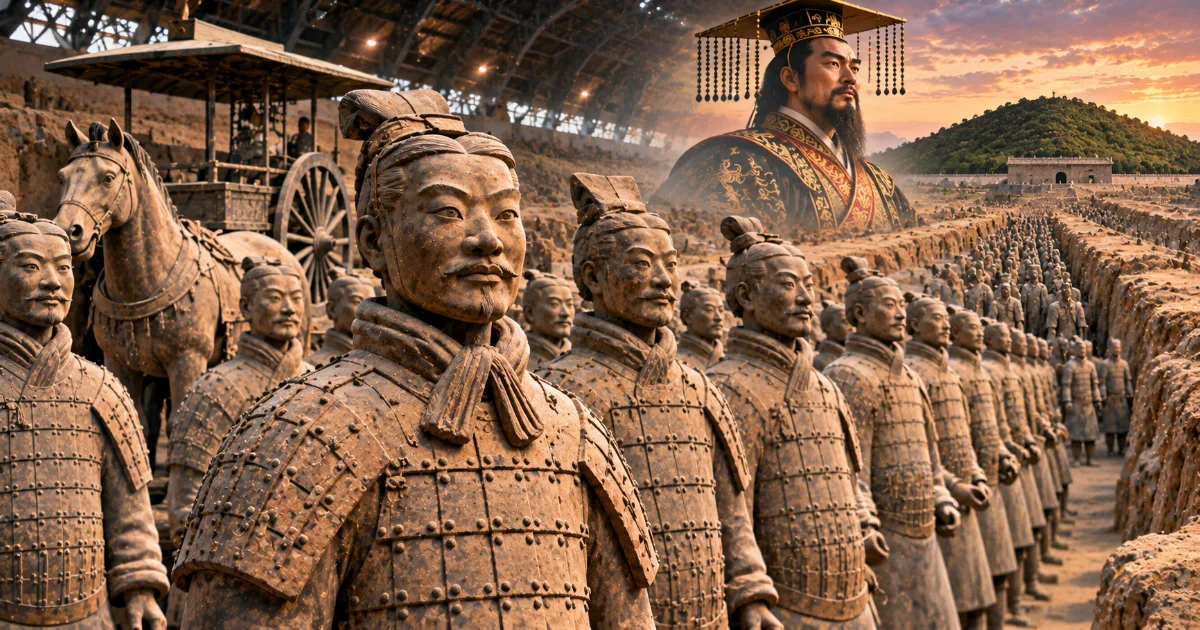
The construction of the First Emperor's mausoleum was particularly extensive. The Terracotta Army formed only one part of the burial complex, which included multiple pits, structures, and installations.
The government also developed roads connecting important regions of the empire. These routes supported communication, military movement, and administrative coordination.
Northern defensive works were strengthened and extended to protect vulnerable frontier regions. The projects were intended to improve security, but they also required substantial resources and labour.
For the state, these construction activities represented long-term investments in political authority, infrastructure, and military defence. For ordinary workers, however, they could mean compulsory service, separation from families, and physically demanding conditions.
Agricultural communities depended on predictable seasonal cycles. If farmers were required to work on construction projects during important periods, their ability to plant, harvest, and maintain their households could be affected.
The consequences extended beyond individual workers. Families had to manage farms with fewer available labourers, and local communities could experience economic disruption.
The Qin government was not the first ancient state to organize large construction projects through compulsory labour. Monumental building was a feature of many early civilizations. What made the Qin situation particularly difficult was the combination of extensive construction, military obligations, taxation, and strict legal enforcement.
These demands contributed to the perception that the state was consuming the resources of its population without providing sufficient relief.
6. Military Campaigns and the Cost of Expansion
The Qin Empire had been created through warfare, and military power remained essential to maintaining its authority.
After unification, the government continued military operations in different regions. Campaigns were conducted in the south, while northern defences were strengthened against groups beyond the empire's frontier.
Military expansion required soldiers, weapons, horses, food supplies, transport, and administrative coordination. Armies operating far from the central regions depended upon extensive supply networks.
The southern campaigns brought new territories under imperial control, but maintaining authority in distant regions was difficult. The terrain, climate, and local political conditions created challenges for Qin administrators and military commanders.
In the north, the government invested in defensive infrastructure and military deployments. Frontier security required a continuous supply of personnel and resources.
These commitments placed additional pressure on the population. Military service could remove working-age men from agricultural communities, while taxation and supply obligations required families to contribute resources to the state.
The empire's military achievements had helped create unity, but continued military demands became increasingly difficult to sustain.
When the central government faced rebellion, it needed reliable armies to restore order. However, the same system that had supported expansion was now under pressure from political instability, desertions, and the loss of confidence in imperial leadership.
Military power could suppress opposition when the government was strong and its forces remained loyal. It became much less effective when rebellion spread across several regions and the imperial court could no longer coordinate an effective response.
7. The First Major Rebellion: Chen Sheng and Wu Guang
The rebellion that exposed the weakness of Qin authority began in 209 BCE. Two men, Chen Sheng and Wu Guang, were leading a group of conscripted labourers or soldiers toward their assigned destination when delays threatened to prevent them from arriving on time.
Traditional accounts explain that strict Qin regulations imposed severe penalties for failing to meet official deadlines. Facing the possibility of punishment, Chen Sheng and Wu Guang decided to rebel rather than submit to the consequences.
The exact circumstances of the incident are described in later historical accounts, and some details remain uncertain. However, the rebellion became an important turning point in the collapse of Qin authority.
Chen Sheng and Wu Guang recognized that the empire's political situation offered an opportunity to challenge the government. Their uprising demonstrated that even people with limited resources could mobilize resistance when dissatisfaction was widespread.
They raised a force and attracted support from others who were unhappy with Qin rule. The rebellion spread through parts of the empire, encouraging additional local leaders to oppose imperial officials.
Chen Sheng is traditionally associated with the declaration that people should not accept a predetermined destiny based on birth or social status. Whether the surviving wording accurately reflects his original statement is uncertain, but the idea became symbolically important.
The rebellion was eventually defeated, and both leaders lost their lives. Nevertheless, its importance went far beyond its immediate military results.
It showed that the Qin government was vulnerable. The empire's subjects were not universally loyal, and the central authorities could no longer rely on fear alone to guarantee obedience.
The rebellion also encouraged other groups to organize their own movements. Once the idea of resisting Qin authority had become visible, opposition could spread more easily across the empire.
8. Why the Rebellion Spread Across the Empire
The uprising of Chen Sheng and Wu Guang was not an isolated event. It emerged within a society already experiencing significant pressure.
Farmers faced taxation and compulsory obligations. Labourers could be assigned to construction projects or other state duties. Soldiers were required for campaigns and frontier service. Local communities had to respond to administrative demands that could disrupt their economic lives.
The Qin government had reduced the political independence of the former kingdoms, but it had not immediately created a strong sense of shared imperial identity across all regions.
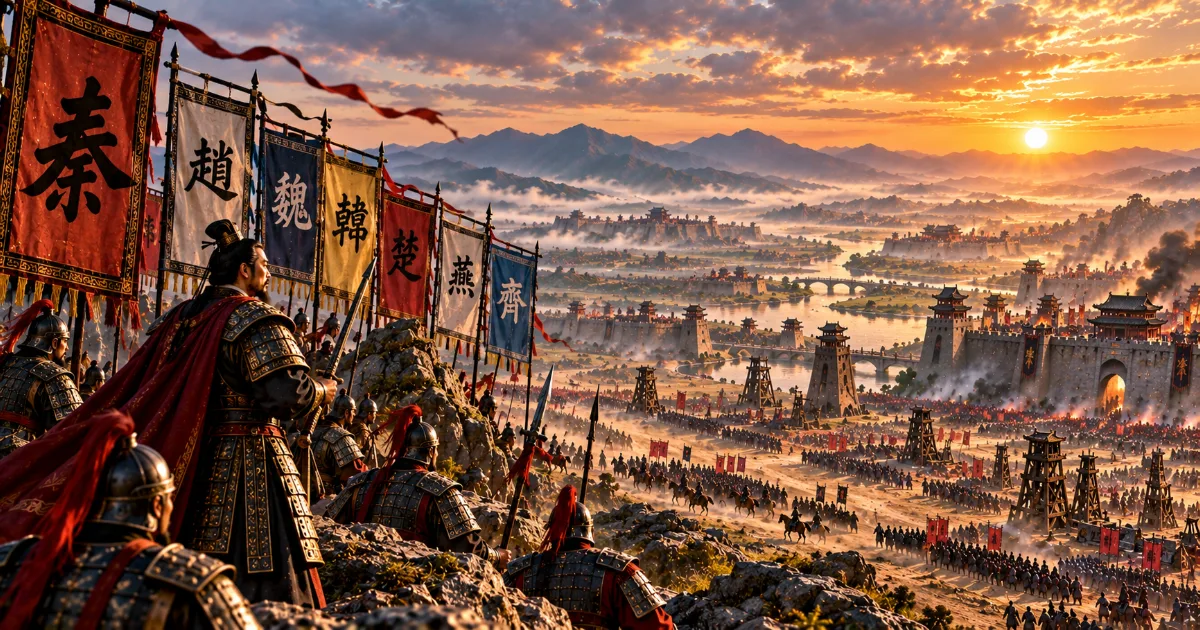
Many people continued to identify with their former states and local traditions. The political memories of Chu, Zhao, Wei, Han, Yan, and Qi remained important in different areas.
When the Qin government weakened, local leaders could use these identities to mobilize support. Some rebellions were motivated by opposition to Qin policies, while others reflected the ambitions of regional elites who wanted to restore their former political positions.
The rebellion therefore developed into a broader political struggle. It was no longer simply a protest by labourers against harsh regulations. It became a challenge to the entire imperial order.
The central government faced an expanding number of opponents. Some groups controlled local territories, while others assembled military forces capable of confronting Qin armies.
The situation became increasingly difficult because the imperial court was also experiencing internal political conflict. Instead of coordinating an effective response, the government struggled with competing interests and unreliable leadership.
The collapse of central authority encouraged more rebellion, and each new uprising made it harder for the Qin government to restore order.
9. The Rise of Xiang Yu
One of the most important figures to emerge during the rebellion against Qin was Xiang Yu, a military leader associated with the former state of Chu.
Xiang Yu came from a family with a military background and became involved in the resistance against Qin authority. He was known for his military ability, personal courage, and determination to defeat the imperial government.
As the Qin dynasty weakened, Xiang Yu developed into one of the most powerful commanders among the rebel forces.
He participated in major campaigns against Qin armies and became especially influential after the destruction of important imperial forces.
One of the most significant episodes associated with Xiang Yu was the Battle of Julu in 207 BCE. The conflict involved Qin forces attempting to maintain control against rebel armies.
Traditional accounts describe Xiang Yu taking decisive action and demonstrating exceptional military leadership. His victory severely damaged the Qin military position and helped establish his reputation as a major contender for political power.
Xiang Yu's military success made him an important figure in the struggle to replace Qin rule. However, defeating the Qin dynasty did not automatically create a stable political order.
After the collapse of the empire, rival rebel leaders began competing for territory and authority. Xiang Yu would eventually face another powerful leader, Liu Bang, in a struggle that determined the future of China.
His role in the destruction of Qin therefore marked the beginning of a new political contest rather than the immediate establishment of lasting peace.
10. Liu Bang: The Rebel Leader Who Would Become Emperor
Another important figure during the collapse of Qin was Liu Bang, a man whose background differed significantly from that of many traditional aristocratic rulers.
Liu Bang came from a relatively modest family in the former state of Chu. Before becoming a major political leader, he served in a local administrative capacity.
He became involved in the rebellion against Qin and gradually developed a following. His leadership style was different from that of Xiang Yu. Liu Bang often relied on political relationships, negotiation, administrative organization, and the ability to attract capable advisers.
As the Qin government weakened, Liu Bang's forces gained control of important territories. His campaign toward the Qin heartland became a major part of the final phase of the dynasty's collapse.
In 207 BCE, Liu Bang's forces entered the Qin capital region, and the last Qin ruler, Ziying, surrendered. The event marked the effective end of the Qin dynasty.
Liu Bang's role did not end with the defeat of Qin. He would later become the principal rival of Xiang Yu in the struggle for control of the former empire.
After years of conflict, Liu Bang emerged victorious and established the Han dynasty in 202 BCE, adopting the imperial title Emperor Gaozu.
His rise from a relatively modest background to the founder of one of China's most influential dynasties demonstrates the political opportunities created by the collapse of Qin authority.
11. The Final Emperor and the End of the Qin Dynasty
Qin Er Shi's reign became increasingly unstable as rebellion spread and the imperial court lost control of events.
Zhao Gao continued to exercise influence, but the government's position deteriorated. Military defeats weakened imperial authority, and the court became increasingly disconnected from the problems affecting the provinces.
Eventually, Zhao Gao turned against Qin Er Shi. The emperor was forced to take his own life in 207 BCE according to the traditional historical account.
Ziying, a member of the Qin royal family, was then placed in a position of imperial authority. His exact title and constitutional status are discussed by historians, but he is commonly identified as the final ruler of the Qin dynasty.
Ziying reportedly moved against Zhao Gao and had him killed. However, this attempt to restore control came too late.
The Qin military situation had already deteriorated, and rebel forces were advancing toward the imperial heartland.
When Liu Bang's army approached, Ziying surrendered in 207 BCE. The Qin ruling house lost power, bringing the dynasty's brief existence to an end.
The surrender represented the failure of a political system that had once appeared nearly unstoppable. The empire had been created through military conquest, but its rulers could not maintain the political relationships and public support necessary to preserve it.
12. Was the Qin Dynasty Destroyed by Its Own Policies?
One of the most common explanations for the fall of Qin is that the dynasty collapsed because its government was excessively harsh.
This interpretation contains important truth, but it requires careful examination. The Qin state had developed strict administrative practices before unification, and these practices contributed to its military success.
The empire needed a strong system of taxation, recruitment, record keeping, and law enforcement. Without these institutions, it would have been difficult to govern territories that had previously belonged to separate kingdoms.
However, the scale of state demands after unification created serious problems. Construction projects, military campaigns, taxation, and compulsory labour placed substantial pressure on ordinary households.
The government's strict legal approach could make these obligations particularly difficult. People facing hardship might have little flexibility to meet official requirements, and failure could bring severe consequences.
The system also lacked sufficient mechanisms for responding to local dissatisfaction. Centralized authority made it possible to issue orders across the empire, but it could also make the government less responsive to the needs of distant communities.
The Qin dynasty therefore faced a problem common to powerful centralized states. The administrative system that enabled rapid mobilization could become politically dangerous when it demanded more resources than society could sustain.
Nevertheless, harsh policies alone do not explain the collapse. A stronger succession arrangement or more capable leadership might have allowed the government to respond to rebellion and modify its policies.
The speed of the Qin collapse resulted from the combination of excessive pressure on the population and a political leadership unable to manage the resulting crisis.
13. The Role of the Former Kingdoms
The unification of China in 221 BCE ended the political independence of the major rival kingdoms, but it did not erase their historical identities.
For centuries, these states had maintained separate royal families, administrative traditions, military institutions, and cultural identities. Their populations had experienced warfare and political competition under different rulers.
Qin Shi Huang attempted to replace the old political structure with a centralized imperial system. The government reorganized territories and appointed officials to administer them.
However, the population's memories of former kingdoms remained important. When Qin authority weakened, local leaders could use these identities to encourage resistance.
Some rebel movements claimed to restore the political traditions or ruling houses of the former states. Others used regional loyalties to attract soldiers and supporters.
The fall of Qin therefore involved more than opposition to harsh government policies. It also reflected the difficulty of transforming a collection of historically separate kingdoms into a unified political community within a very short period.
The empire had achieved territorial unity, but social and political integration required more time.
The Han dynasty would inherit this challenge. Its rulers needed to preserve the benefits of centralization while developing a political culture that could maintain loyalty across different regions.
14. The Han Dynasty Learns from the Qin Collapse
The fall of Qin created an important lesson for the rulers who followed. Centralized administration was useful and necessary for governing a large empire, but excessive coercion could undermine political stability.
Liu Bang established the Han dynasty in 202 BCE after defeating Xiang Yu in the conflict commonly known as the Chu-Han Contention.
The Han government retained many important elements of the Qin administrative system. It continued to use centralized institutions, territorial administration, taxation, official appointments, and legal structures.
However, early Han rulers adopted a more cautious approach toward the population. They reduced certain state burdens and sought to restore agricultural production after years of warfare.
The government also used a combination of centralized administration and regional kingdoms, particularly during the early years of the dynasty. This arrangement changed over time as Han rulers strengthened central authority.
The Han political system did not completely reject Qin institutions. Instead, it adapted them to create a more durable imperial structure.
This is one of the most important consequences of the Qin collapse. The dynasty failed as a ruling house, but many of its administrative innovations became permanent features of Chinese government.
Later Chinese rulers continued to draw upon the political model established by Qin, even when they criticized the harshness associated with its first emperor.
The relationship between Qin and Han demonstrates how political institutions can survive the collapse of the governments that created them.
15. The Historical Legacy of the Qin Dynasty
The Qin dynasty ruled for only a short period, but its influence on Chinese history was extraordinary.
Before Qin unification, China was divided among competing kingdoms. After 221 BCE, the idea of a unified empire became a central feature of Chinese political history.
The Qin government established administrative practices that later dynasties adapted and expanded. Territorial divisions, appointed officials, standardized systems, and centralized authority became important foundations of imperial government.
The standardization of writing helped strengthen communication across the empire. Common currency and measurements supported economic exchange and administration. Roads improved transportation and military movement.
The Qin dynasty also demonstrated the power and risks of large-scale state mobilization. Its construction projects and military campaigns showed what a centralized government could achieve, but its collapse revealed the dangers of excessive demands and political rigidity.
Qin Shi Huang's mausoleum and the Terracotta Army remain extraordinary reminders of the dynasty's ambitions. They reveal the artistic, technical, and administrative capabilities of the empire while also reflecting the enormous resources placed under imperial command.
The name China is commonly connected to the Qin, although the exact linguistic development of the name across different languages is complex. The dynasty's historical significance is therefore reflected not only in political institutions but also in the way later civilizations came to identify the country.
The Qin dynasty's legacy is both impressive and cautionary. It created the first unified Chinese empire, but its political system could not survive the pressures that followed the death of its founder.
16. What the Collapse of Qin Teaches Us About Political Power
The fall of the Qin dynasty provides lessons about leadership, governance, public trust, and institutional stability.
First, the succession crisis demonstrates the importance of a reliable transfer of political authority. A government may appear powerful under one ruler, but if its institutions depend too heavily on that person's individual leadership, the system can become unstable when the ruler dies.
Second, the Qin experience shows that administrative efficiency is not the same as political legitimacy. A government can issue orders, collect taxes, organize armies, and construct monuments, but these achievements do not automatically create lasting loyalty among the population.
Third, excessive public demands can undermine the economic foundations of a state. Agricultural communities require sufficient time and resources to maintain production. When taxation, compulsory labour, and military service become too demanding, the government's own ability to collect resources may eventually weaken.
Fourth, political institutions require accurate information and responsible advice. When officials fear disagreement and court politics reward manipulation, rulers may become isolated from the realities of the country.
Finally, military power alone cannot guarantee long-term stability. The Qin dynasty had defeated its rivals through military organization, but when rebellion spread across the empire, its armies could not restore political unity.
The collapse was therefore not simply the story of a weak successor replacing a strong founder. It was the story of a powerful state whose institutions were unable to adapt when its political leadership changed and public dissatisfaction became widespread.
Conclusion: A Short Dynasty That Changed Chinese History Forever
The Qin dynasty's collapse was one of the most dramatic political transformations in ancient Chinese history. In 221 BCE, Qin Shi Huang unified the major kingdoms and established the first Chinese empire. Yet by 206 BCE, his dynasty had disappeared.
The succession crisis following his death weakened the imperial court. Qin Er Shi depended heavily on powerful officials, while Zhao Gao's political influence contributed to instability and the removal of important figures. Meanwhile, strict laws, compulsory labour, taxation, and military obligations created widespread dissatisfaction.
The rebellion of Chen Sheng and Wu Guang exposed the weakness of imperial authority. Other leaders, including Xiang Yu and Liu Bang, developed powerful movements that challenged the Qin government. Military defeats and political disintegration eventually forced the last Qin ruler to surrender.
However, the Qin dynasty's failure did not erase its achievements. The Han dynasty preserved many of its administrative institutions and developed them into a more durable system of imperial government.
The history of Qin demonstrates that creating an empire and maintaining one are very different challenges. Military conquest can establish political unity, and administrative reforms can strengthen a central government. But lasting stability also requires capable leadership, responsible institutions, sustainable public demands, and a degree of political legitimacy.
Qin Shi Huang wanted to create a dynasty that would last for generations. His ruling house survived only briefly, but the imperial structure he established shaped Chinese political history for more than two thousand years.
The dynasty was short-lived, but its influence was permanent. The fall of Qin marked the end of China's first imperial experiment and opened the way for the Han dynasty, one of the most important periods in the history of Chinese civilization.