How Centuries of Warfare, Political Competition, and Philosophical Debate Transformed Ancient China and Prepared the Way for Unification
Introduction: China on the Edge of Transformation
The Warring States period was one of the most turbulent and consequential chapters in the history of ancient China. For centuries, rival kingdoms competed for territory, resources, political authority, and survival. Armies grew larger, military technology advanced, governments became more centralized, and rulers introduced far-reaching reforms to strengthen their states. The old political order associated with the Zhou dynasty gradually lost its authority, leaving China divided among ambitious powers determined to dominate their neighbours.
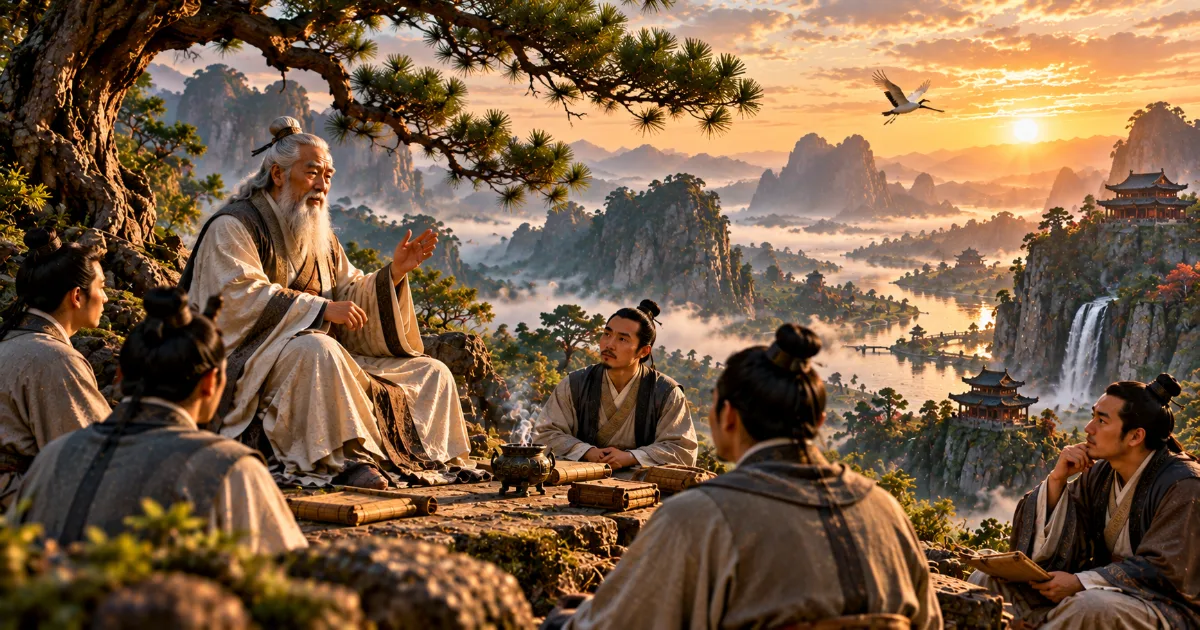
Yet the Warring States period was not simply an age of destruction. It was also a time of remarkable intellectual creativity. As rulers searched for ways to win wars and govern expanding territories, philosophers debated the nature of human beings, the meaning of justice, the responsibilities of rulers, and the foundations of a stable society. Confucianism, Daoism, Mohism, Legalism, and other schools of thought developed in an environment where ideas were tested against urgent political realities.
The period is conventionally dated from 475 BCE to 221 BCE, although the political divisions that produced it had developed earlier. Its name comes from the Warring States chronicle traditionally known as the Zhanguo Ce, or Strategies of the Warring States, which preserves stories about diplomacy, political manoeuvring, and competition among the kingdoms. The period ended when the state of Qin defeated its rivals and established the first unified imperial government under Qin Shi Huang in 221 BCE.
The transformation was enormous. A political world once characterized by a Zhou king and numerous regional rulers became a collection of powerful states with increasingly sophisticated administrations. Traditional aristocratic authority weakened, military service became more important, and talented advisers could rise through royal service. The relationship between rulers and ordinary people also changed as governments sought greater revenue, more soldiers, and more productive agricultural communities.
The Warring States period therefore stands at the crossroads between ancient Chinese society and the imperial civilization that followed. Its wars reshaped the political map, while its philosophers created ideas that continued to influence Chinese culture for more than two thousand years. Understanding this period reveals why the eventual unification of China was possible and why the intellectual traditions that emerged from conflict became so enduring.
1. From the Zhou Dynasty to a Divided Political World
The Zhou dynasty traditionally began around 1046 BCE, when the Zhou defeated the Shang dynasty and established a new royal order. The Zhou rulers justified their authority through the Mandate of Heaven, the belief that Heaven granted legitimacy to a ruler who governed responsibly and maintained harmony within the kingdom. A ruler who became cruel, corrupt, or incapable could lose this mandate, allowing another house to replace him.
To administer their expanding territories, early Zhou rulers distributed lands and authority among members of the royal family, allies, and other aristocratic lineages. These regional lords governed their own territories while acknowledging the Zhou king's superior position. In principle, this arrangement created a hierarchy of political obligations, military service, ritual relationships, and hereditary responsibilities.
In practice, the regional lords gradually developed their own interests and ambitions. As generations passed, some became powerful enough to challenge royal authority. They controlled armies, collected resources, managed local populations, and established independent political networks. The Zhou king increasingly depended upon the cooperation of rulers whose power he could no longer reliably command.
A major turning point came in 771 BCE, when an attack on the Zhou royal centre led to the killing of King You and the displacement of the royal court. The Zhou rulers subsequently established their capital farther east, beginning the Eastern Zhou period. The royal house survived, but its political and military position was considerably weakened.
During the Spring and Autumn period, powerful regional states competed for influence while still operating within a political culture that recognized the Zhou king as a source of symbolic legitimacy. Some rulers claimed leadership over other states and presented themselves as defenders of the established order. Their actual authority, however, depended increasingly upon military strength, diplomatic relationships, and administrative capacity.
By the fifth century BCE, this balance was breaking down. Rival states were no longer simply competing for leadership within a shared aristocratic order. They were increasingly reorganizing their societies to wage larger wars and absorb weaker neighbours. Their rulers sought direct control over territory and population rather than relying exclusively upon inherited relationships with local aristocrats.
The transition to the Warring States period reflected this deeper change. Warfare became more systematic, states became more bureaucratic, and the survival of a kingdom increasingly depended upon its ability to mobilize people and resources on a large scale.
2. The Seven Major States and Their Rivalries
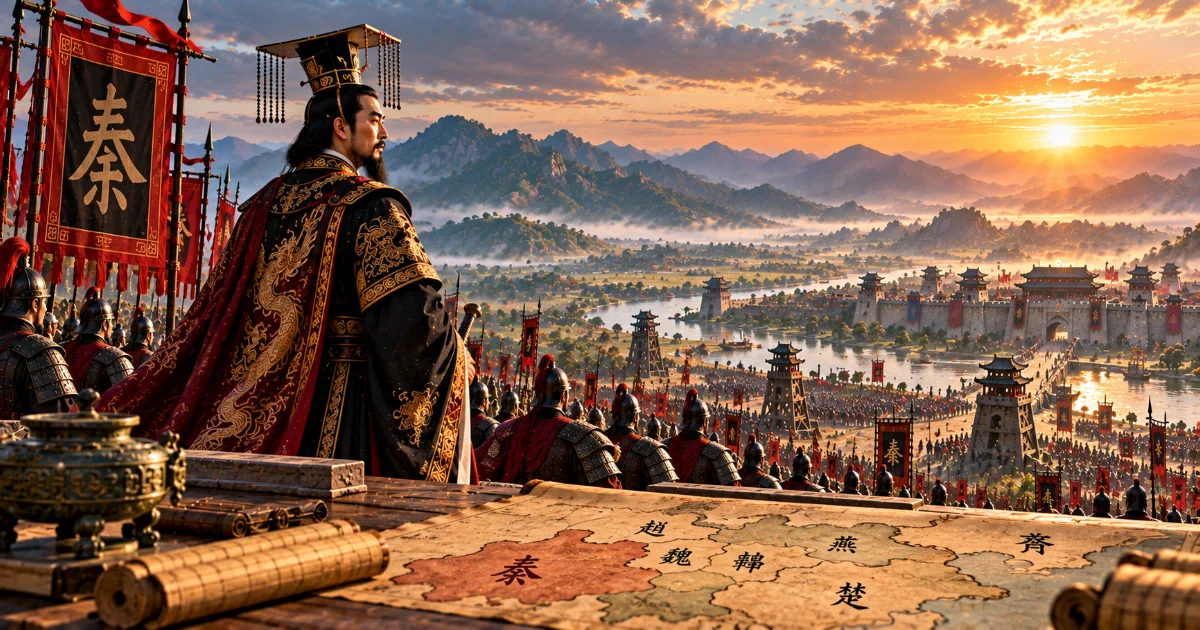
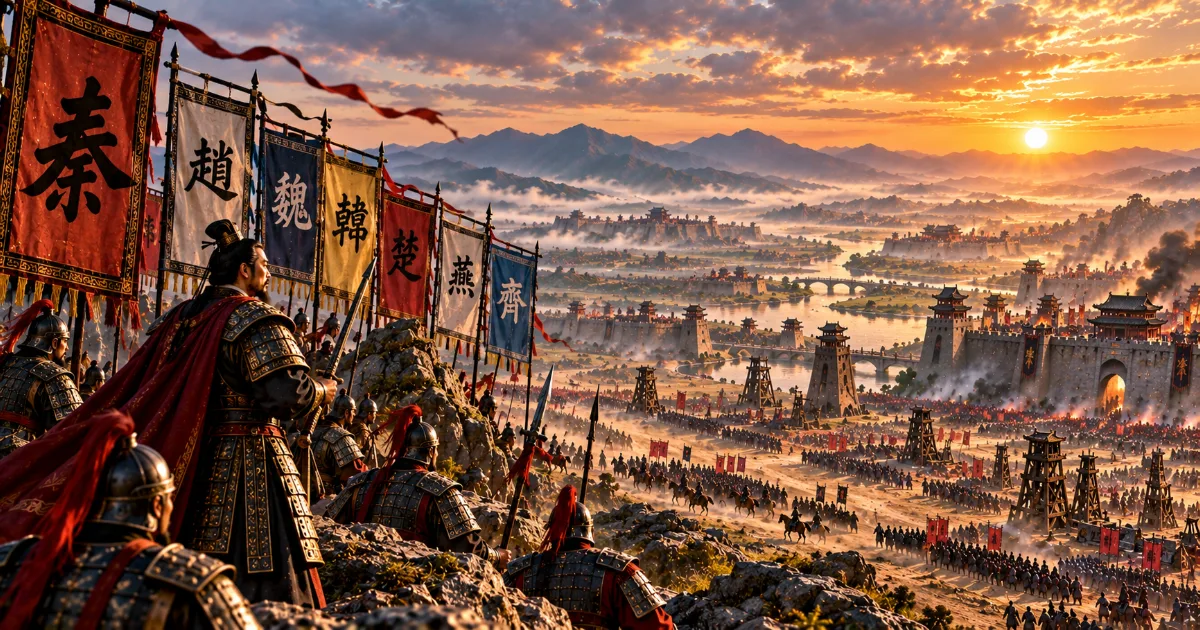
Although numerous political communities existed in ancient China, seven states became especially important during the Warring States period. They were Qin, Chu, Qi, Yan, Han, Zhao, and Wei. Each possessed distinctive geographical advantages, political traditions, and military challenges.
The state of Qin occupied much of the western region, including the Wei River valley. Its location offered a defensible position behind mountain ranges and other natural barriers. Over time, Qin developed a powerful agricultural and military system that allowed it to expand eastward. Its reforms strengthened the authority of the ruler and made the state increasingly capable of organizing large armies.
Chu controlled extensive territories in the south, including areas around the middle and lower Yangtze River system. Its lands included fertile agricultural regions, rivers, forests, and varied local communities. Chu was often larger geographically than its northern rivals, but maintaining control over a broad territory created administrative and military challenges.
Qi occupied the eastern region around the Shandong Peninsula. It benefited from access to coastal trade, productive agricultural land, and commercial activity. Its political and intellectual centres attracted scholars and advisers, particularly during periods when rulers encouraged philosophical debate.
Yan lay in the northeast, near regions that connected the Chinese states with different frontier societies. Its geographical position exposed it to northern military pressures but also gave it strategic opportunities in conflicts with its neighbours.
Han occupied a relatively central position among the major states. Its territory included important routes and strategically valuable regions, but its location also made it vulnerable to pressure from stronger neighbours. Han's survival depended heavily on diplomacy, fortifications, and the ability to preserve its limited strategic space.
Zhao controlled territories to the north of the central plains. Its rulers faced challenges from rival Chinese states and peoples beyond the northern frontier. Zhao became particularly associated with military reform and the development of cavalry forces, which helped it respond to the demands of warfare in northern terrain.
Wei emerged as one of the most influential states during the earlier Warring States period. It benefited from important agricultural and commercial regions, as well as a central position that allowed it to influence neighbouring states. However, its location also meant that it faced pressure from several directions.
These seven states were not permanent or internally uniform political entities. Their borders changed, rulers rose and fell, and their relative strengths shifted over time. Alliances were frequently made and broken. A state that cooperated with one neighbour in one decade might fight the same neighbour in the next.
The competition was not driven solely by personal ambition. Population growth, access to agricultural land, control of transportation routes, military security, and the desire to prevent rivals from becoming too powerful all contributed to the struggle. Rulers who failed to strengthen their states risked defeat, territorial loss, or absorption by a stronger kingdom.
This competitive environment encouraged innovation. Governments studied the successes of their rivals and adopted reforms that appeared to improve military performance or administrative efficiency. The result was a prolonged process in which political survival rewarded states capable of mobilizing resources and adapting to changing conditions.
3. Why Warfare Became More Destructive
Warfare existed throughout earlier Chinese history, but the Warring States period saw changes in the scale and organization of military conflict. Armies increasingly included large numbers of infantry soldiers rather than depending primarily on small groups of aristocratic charioteers and their retainers. Military service became more closely connected with the state's ability to register households, collect taxes, provide equipment, and organize agricultural production.
The growth of infantry forces reflected broader social and technological changes. Iron tools became more widespread during the late Zhou period, although bronze continued to be important in various contexts. Improvements in metalworking, weapons production, and agricultural equipment supported larger populations and more extensive military mobilization.
The crossbow became particularly important in Chinese warfare. Its mechanical design allowed soldiers to launch bolts with considerable force, and its use could be integrated into organized infantry tactics. Crossbows required training and maintenance, but they provided states with a weapon that could be produced and deployed on a large scale.
Chariots did not disappear immediately, and cavalry developed unevenly across the different states. However, the military importance of mass infantry increased. Commanders had to manage large formations, supply routes, fortified positions, and complex operations involving multiple units.
Siege warfare also became increasingly significant. As states strengthened their cities and defensive walls, attackers required methods to breach fortifications, cut supply lines, and force defenders into surrender. Military campaigns could therefore involve prolonged operations rather than a single decisive battle.
The consequences for ordinary people were severe. Armies needed food, clothing, weapons, transport animals, and replacement soldiers. Governments imposed taxes and labour obligations to support military activity. Agricultural communities could be disrupted when men were recruited, crops were destroyed, or enemy forces moved through their territories.
Captives and conquered populations could be relocated, forced into labour, or incorporated into the winning state's administrative system. The destruction of rival armies could also be accompanied by mass killing. Ancient accounts sometimes report enormous casualty figures, although such numbers must be treated cautiously because historical writers could exaggerate victories or use dramatic totals to communicate the scale of an event.
War affected political thinking as well as daily life. The repeated experience of violence encouraged rulers to seek more reliable systems of administration and military organization. Philosophers, in turn, were forced to confront difficult questions. Could a state achieve peace through moral example? Was military strength necessary for survival? Could strict laws prevent disorder? Should rulers prioritize the welfare of ordinary people, or did the demands of competition justify harsh measures?
These questions formed part of the intellectual environment in which Chinese philosophy developed. The search for order was not an abstract exercise. It was a response to a world in which political failure could bring invasion, displacement, and the collapse of a state.
4. The Transformation of Government and Society
One of the most important developments of the Warring States period was the movement away from government based primarily on hereditary aristocratic relationships. Earlier Zhou political organization relied heavily upon noble lineages whose authority was connected with land, ancestry, and personal obligations. During the Warring States period, rulers increasingly sought officials whose positions depended upon appointment and demonstrated service.
This transformation was neither complete nor identical in every state. Aristocratic families continued to hold influence, and hereditary status remained important. Nevertheless, administrative reforms gave rulers new ways to govern territories directly and reduce their dependence upon powerful local nobles.
States expanded systems for recording households, organizing taxation, and assigning military obligations. Officials managed agricultural production, legal administration, infrastructure, and the movement of resources. The state became more involved in the lives of ordinary people because rulers required reliable information about population, land, and production.
Agricultural communities were particularly important. Grain supported armies and cities, while farming households supplied taxes and labour. Governments therefore had strong incentives to encourage cultivation, expand irrigation, clear land, and improve the organization of rural production. These measures could support economic growth, but they could also increase the burdens placed upon farmers.
Political reformers argued that states should reward productive work and military achievement rather than preserve every privilege associated with inherited rank. Such ideas became especially influential in Qin, where reforms connected status and reward more closely with service to the state.
The expansion of bureaucratic administration created opportunities for talented men who did not belong to the most powerful aristocratic families. A person with military ability, legal knowledge, diplomatic skill, or administrative experience could potentially gain influence through service to a ruler. Yet this did not create an equal society in the modern sense. Access to education, elite networks, and political opportunities remained uneven.
The changes also affected the meaning of political loyalty. In an older aristocratic order, relationships among noble families could be rooted in ancestry, ritual obligations, and inherited ties. In the increasingly centralized states, officials were expected to serve the ruler and carry out assigned responsibilities. Their success depended more heavily upon the performance of their duties and the confidence of the sovereign.
These developments helped prepare the institutional foundations of imperial China. When Qin eventually unified the major states, it inherited a political environment in which centralized administration, territorial control, and large-scale mobilization were already well established. Unification was therefore not simply the result of one ambitious ruler. It was also the culmination of centuries of institutional change.
5. Shang Yang and the Rise of Qin
The transformation of Qin was one of the decisive developments of the Warring States period. During the fourth century BCE, the state adopted reforms associated with Shang Yang, a political thinker and administrator whose ideas became central to the tradition later known as Legalism.
Shang Yang served under Duke Xiao of Qin. His reforms are traditionally associated with major changes in law, agriculture, taxation, military organization, and the relationship between individuals and the state. Although the details of some accounts require caution, the broader historical significance of Qin's administrative transformation is clear.
One important objective was to weaken the political independence of powerful hereditary families. Shang Yang's reforms encouraged a system in which rank and rewards were connected more closely to service, particularly military achievement. This approach allowed the ruler to strengthen central authority while giving soldiers a direct incentive to contribute to the state's campaigns.
Agricultural production was also emphasized. Farming households provided the food necessary to sustain the population and support armies. Policies that encouraged cultivation and made agricultural output central to state priorities helped strengthen Qin's resource base. The government also expanded its ability to register households and impose obligations.
Legal rules and penalties were used to regulate behaviour and enforce state objectives. The reforming approach associated with Shang Yang placed strong emphasis on clear standards, administrative accountability, and predictable consequences for violations. Its supporters argued that a state could not depend solely on the personal virtue of its officials or the goodwill of its population. It needed institutions capable of producing consistent results.
These measures strengthened Qin's capacity to mobilize people and resources. The state's western position also provided strategic advantages, while its expanding agricultural base supported sustained military activity. Qin gradually became a formidable power capable of defeating neighbouring states and expanding into important territories.
Shang Yang's reforms were controversial, and later accounts describe his violent death following a change in political circumstances. The story illustrates the risks faced by reformers who challenged powerful interests, although the precise details of his final days are shaped by historical tradition.
His legacy remained influential because Qin continued to rely upon institutions associated with centralized administration and state discipline. These institutions later helped Qin Shi Huang achieve unification, even though the first empire's harsh policies also contributed to its instability.
The rise of Qin demonstrates a central feature of the Warring States period: successful states were those that combined geographical advantages with effective administration, agricultural resources, military organization, and the political determination to sustain reform.
6. Legalism: Government Through Law, Standards, and Authority
Legalism was one of the most influential intellectual traditions of the Warring States period. The term is a modern label for a group of thinkers whose ideas differed in important respects but shared a concern with how rulers could establish and maintain effective political authority.
Legalist thinkers were skeptical of the assumption that good government could depend primarily upon the moral character of individual rulers and officials. They argued that human behaviour was shaped by incentives, circumstances, and institutional arrangements. A government that relied entirely upon personal virtue might function well under an exceptional ruler but fail when a less capable person came to power.
Shang Yang emphasized laws, administrative discipline, agricultural production, and military achievement. Han Fei, writing later in the Warring States period, developed a systematic account of political power, methods of administration, and the importance of the ruler's position. Shen Buhai, another influential thinker, emphasized techniques of administration and the management of officials.
These thinkers did not all advocate exactly the same policies. Nevertheless, they shared a concern with the practical mechanisms through which a state could govern effectively. They asked how officials should be appointed, how their performance should be evaluated, how rewards and punishments should be applied, and how a ruler could prevent subordinates from using their positions for private advantage.
Legalist approaches became attractive to rulers facing intense military competition. In a world where defeat could mean the destruction of a kingdom, a government that could collect taxes reliably, organize armies, and enforce decisions possessed a major advantage.
However, the same emphasis on discipline could produce severe consequences. Strict penalties, compulsory service, and intrusive administration could place enormous burdens on ordinary people. A government that valued efficiency above all other concerns risked treating its population primarily as a source of labour, revenue, and soldiers.
Legalism therefore represents both an important stage in the development of Chinese political institutions and a continuing subject of ethical debate. Its advocates sought to solve the problem of unreliable government through strong institutions and enforceable rules. Critics questioned whether political order achieved through fear could create lasting loyalty or genuine social harmony.
The Qin dynasty adopted many principles associated with Legalist statecraft. Its centralized administration and uniform systems helped unify China, but its severe demands also contributed to widespread resentment. The collapse of Qin showed that administrative strength could support rapid conquest without necessarily guaranteeing long-term stability.
7. Confucianism in an Age of War
Confucianism developed as one of the major responses to the political disorder of ancient China. Confucius, traditionally dated to 551 to 479 BCE, lived before the conventional beginning of the Warring States period, but his teachings became increasingly influential as later thinkers debated the causes of social breakdown.
Confucius believed that a stable society depended upon moral cultivation, responsible leadership, proper relationships, and education. He argued that rulers should govern through virtue rather than relying exclusively upon punishment. A leader who behaved responsibly could encourage people to develop their own sense of duty, while a government that relied only on fear might secure outward obedience without cultivating genuine respect.
Confucian thought gave particular importance to ren, often translated as humaneness or benevolence, and li, which refers to ritual propriety and appropriate conduct. These concepts were connected to the idea that people develop moral character through relationships and repeated practice. The family served as an important setting for learning respect, responsibility, and care.
During the Warring States period, Confucian thinkers expanded and debated these ideas. Mencius, traditionally dated to 372 to 289 BCE, argued that human beings possess tendencies toward goodness that can be cultivated through appropriate conditions. He believed that rulers had moral responsibilities toward the population and that oppressive government could undermine political legitimacy.
Mencius also developed a forceful critique of rulers who placed personal ambition above the welfare of ordinary people. He argued that a ruler who destroyed the conditions necessary for the people's well-being could lose the moral basis of authority. This reasoning echoed the broader Chinese tradition of the Mandate of Heaven while giving greater emphasis to the people's welfare.
Xunzi, who lived later in the Warring States period, offered a different account of human nature. He argued that human desires could produce conflict unless they were shaped through education, ritual, and deliberate cultivation. His approach placed strong emphasis on learning, social institutions, and the disciplined development of character.
The differences between Mencius and Xunzi demonstrate that Confucianism was not a completely uniform doctrine. Its thinkers debated fundamental questions about human nature and the methods through which society could achieve order.
Confucianism also competed with other schools for the attention of rulers. Some governments valued its emphasis on moral example and education, while others considered its methods insufficient for the immediate demands of warfare and administration. Nevertheless, Confucian ideas survived the political upheavals of the period and later became central to imperial Chinese education and official culture.
8. Mencius and the Moral Responsibilities of Rulers
Mencius is particularly important for understanding the ethical debates of the Warring States period. He travelled among several courts, seeking rulers who would adopt policies based on benevolence and moral responsibility. Like many philosophers of his time, he hoped to influence government directly rather than confining his teachings to private discussion.
Mencius believed that a ruler's legitimacy depended upon conduct that supported the people's welfare. Food, security, and stable livelihoods were not merely economic concerns. They created the conditions in which people could develop moral character and participate in an ordered society.
He criticized governments that burdened their populations with excessive taxes, forced labour, and military campaigns driven by ambition. In his view, rulers who neglected ordinary people undermined their own authority. A government could possess an army and enforce its commands, yet still fail in the deeper sense of responsible rule.
Mencius's account of human nature was connected to this political philosophy. He argued that people possess moral tendencies that can develop when circumstances allow. His famous examples describe spontaneous responses to the suffering of others, suggesting that compassion is not entirely imposed from outside but has roots in human experience.
However, Mencius did not believe that good intentions alone were sufficient. Moral tendencies required cultivation, education, and supportive social conditions. A population struggling constantly to survive would find it difficult to sustain stable family life and moral development. The ruler therefore had a responsibility to create conditions that allowed people to live securely.
His arguments placed ethical limits on political power. They suggested that rulers should not evaluate success only through territorial expansion or military victory. A state that conquered its neighbours while impoverishing its own population might be powerful in the short term but morally defective.
These ideas were not a modern theory of democracy, and Mencius did not advocate equal political participation in the contemporary sense. Nevertheless, his emphasis on the ruler's obligations toward the people became an important element of Chinese political thought. It preserved the belief that political authority required justification through conduct and that a ruler's failures could have consequences beyond the battlefield.
9. Mohism: Impartial Concern and Practical Benefit
Mohism emerged during the late Spring and Autumn and Warring States periods and became one of the major alternatives to Confucian thought. It is associated with Mozi, traditionally dated to the fifth or fourth century BCE, although details of his life remain uncertain.
Mozi and his followers criticized practices they considered wasteful, socially divisive, or harmful to ordinary people. They questioned extravagant ceremonies, elaborate funerals, aggressive warfare, and forms of social preference that allowed people to care for their own families while neglecting the suffering of others.
One of Mohism's central ideas was jian ai, commonly translated as impartial care or inclusive concern. Mohist thinkers argued that many conflicts arose because people placed the interests of their own group above those of everyone else. If individuals and rulers extended their concern more broadly, the reasoning went, they would have less incentive to exploit or attack others.
Mohism also emphasized practical benefit. Policies should be judged partly by whether they improved people's lives, strengthened social order, and reduced suffering. This gave Mohist thought a distinctive character within the intellectual debates of the period.
Mohists strongly criticized aggressive war. They argued that attacking another state brought destruction, loss of life, economic damage, and suffering to people who had not personally caused the conflict. Their criticism was particularly relevant during an age when rulers frequently justified military expansion through claims of prestige, security, or political necessity.
At the same time, Mohists were not simply opponents of all military activity. They developed a reputation for practical defensive expertise and are traditionally associated with techniques for protecting fortified cities. Their position distinguished aggressive conquest from the defence of communities facing attack.
Mohist organizations also appear to have emphasized discipline and collective commitment. Their followers were associated with practical skills, ethical argument, and efforts to persuade rulers to adopt policies consistent with their teachings.
Although Mohism eventually lost much of its prominence as an organized intellectual movement, its arguments remain important in the history of Chinese thought. It challenged conventional social hierarchies, questioned wasteful elite practices, and insisted that political decisions should be evaluated according to their consequences for ordinary people.
Its debate with Confucianism also illustrates the diversity of ancient Chinese philosophy. Where Confucian thinkers emphasized differentiated relationships and duties, Mohists stressed a broader and more impartial concern for human welfare. Both traditions sought social order, but they disagreed about the moral principles most likely to achieve it.
10. Zhuangzi and the Freedom of the Mind
Zhuangzi was one of the most influential thinkers associated with philosophical Daoism. He probably lived during the fourth century BCE, although the details of his life are uncertain. The text known as the Zhuangzi preserves a collection of philosophical passages, stories, dialogues, and imaginative parables associated with his name.
Zhuangzi questioned the assumption that human beings could always establish absolute distinctions between right and wrong, success and failure, or wisdom and ignorance through ordinary judgment. He was particularly interested in how social conventions and personal attachments could restrict perception.
His writings frequently use humour, surprising transformations, and imaginative stories to expose the limits of rigid thinking. Animals, artisans, dreamers, and unconventional figures appear in narratives that challenge the reader's expectations. Rather than offering a simple list of moral rules, the text encourages a flexible understanding of experience.
One of the best-known stories associated with Zhuangzi concerns a dream in which he becomes a butterfly. After awakening, he wonders whether he is Zhuangzi who dreamed of being a butterfly or a butterfly dreaming of being Zhuangzi. The story is not merely an entertaining puzzle. It raises questions about identity, perception, and the boundaries through which people understand reality.
Another famous story describes a skilled butcher whose movements become so fluid that the work appears effortless. The butcher's expertise is presented as the result of deep familiarity with the structure of the task. Rather than forcing the blade through every obstacle, he follows natural openings and works with the form of the animal. The story is often interpreted as an illustration of wu wei, or effective action without unnecessary forcing.
Zhuangzi also criticized the pursuit of reputation and official success. A person might gain status while losing freedom, or avoid public advancement in order to preserve a more independent life. These ideas resonated with scholars who viewed political service as dangerous, corrupting, or incompatible with personal integrity.
His philosophy differs from more systematic forms of political thought. Rather than presenting a detailed administrative program, Zhuangzi explored the conditions of intellectual and personal freedom. He asked how people might escape the limitations created by rigid judgments, ambition, and dependence upon social approval.
Zhuangzi's influence on Chinese literature, art, and philosophy was enormous. His stories became models of philosophical writing that combined humour with profound reflection. They also helped establish Daoism as a tradition concerned not only with political restraint but with the transformation of individual understanding.
11. The Hundred Schools of Thought
The intellectual activity of the Warring States period is often described through the traditional expression "the Hundred Schools of Thought." The phrase does not mean that exactly one hundred organized philosophical schools existed. Rather, it conveys the diversity of intellectual approaches that flourished during the era.
Confucians, Daoists, Mohists, Legalists, and other thinkers debated the nature of human beings, the origins of social disorder, the proper role of rulers, the value of ritual, the meaning of justice, and the methods through which a state could achieve stability.
Some thinkers sought to restore an idealized moral order associated with earlier Zhou traditions. Others argued that political institutions needed fundamental reform. Some emphasized education and moral example, while others placed greater confidence in law, incentives, and administrative techniques. Still others questioned whether the pursuit of political power was worth the cost to individual freedom.
The courts of powerful rulers became important centres of intellectual activity. Officials, scholars, diplomats, and advisers travelled between states seeking employment and influence. A ruler who attracted talented thinkers could potentially gain advantages in diplomacy, administration, or warfare.
One particularly important centre of scholarship was associated with the Jixia Academy in the state of Qi. Although the exact organization and development of the institution remain subjects of historical study, it is remembered as a place where scholars associated with different intellectual traditions could gather and debate.
This environment encouraged the development of arguments and the refinement of philosophical positions. Thinkers could respond to criticism, challenge rivals, and adapt their ideas to changing circumstances. The resulting traditions were not isolated from practical politics. Their survival often depended upon whether rulers and communities found their arguments persuasive or useful.
The intellectual achievements of the period became especially important after political unification. The Qin dynasty attempted to establish ideological and administrative uniformity, but many philosophical traditions survived. After the fall of Qin, the Han dynasty incorporated elements of earlier thought into a new imperial order, and Confucianism eventually gained a particularly prominent official role.
The Warring States period therefore produced more than a collection of competing ideas. It established a lasting framework for Chinese debates about government, morality, education, human nature, and the relationship between individuals and society.
12. Diplomacy, Alliances, and Political Strategy
Military power alone did not determine the outcome of the Warring States conflicts. Diplomacy played an equally important role. States formed alliances to prevent stronger rivals from becoming dominant, negotiated temporary agreements, offered gifts, arranged marriages, and employed advisers who specialized in persuasion and strategic calculation.
Two broad diplomatic approaches became especially significant in later accounts of the period. One was the strategy of combining several states to resist Qin, often described as a vertical alliance because it connected states along a north-south axis. The alternative was a horizontal strategy of cooperation with Qin, sometimes intended to secure advantages or avoid immediate destruction.
These labels are associated with the activities of diplomatic strategists, including Su Qin and Zhang Yi, whose careers became famous through later historical narratives. The stories about them emphasize their ability to influence rulers through argument, promises, warnings, and carefully calculated appeals to self-interest. However, the details of individual speeches and episodes should not always be treated as verbatim records.
The underlying diplomatic problem was real. No state could assume that its neighbours would remain loyal. An alliance might provide temporary security, but each participant also had incentives to negotiate separately if circumstances changed. A ruler might prefer collective resistance against Qin while another concluded that cooperation with Qin offered better immediate prospects.
These calculations often weakened the states that hoped to contain Qin. If rivals failed to coordinate their military resources, Qin could defeat them separately. Diplomatic division could therefore become as important as battlefield superiority.
Political advisers occupied an unusual position in this environment. Their influence depended upon the confidence of rulers, but their recommendations could also threaten established interests. A successful adviser might gain wealth and authority, while a failed strategy could lead to dismissal, disgrace, or death.
The Warring States diplomatic tradition became an important subject in Chinese political literature. It demonstrated how language, information, persuasion, and the understanding of human motives could shape the fate of states. The ability to anticipate a rival's incentives was treated as a practical skill rather than merely an intellectual exercise.
The history of these alliances also reveals the limits of cooperation in a highly competitive environment. States could recognize a common threat and still struggle to sustain a collective response. Their leaders had to balance long-term security against short-term advantage, and their choices often created opportunities for the most strategically disciplined rival.
13. The Battle of Changping and the Cost of Rivalry
The Battle of Changping, fought in 260 BCE between Qin and Zhao, became one of the most notorious military episodes of the Warring States period. It demonstrated the scale of the conflict and the devastating consequences that could follow when rival states committed enormous resources to a single campaign.
Qin and Zhao were both major military powers. Zhao's northern position had encouraged the development of strong armed forces, while Qin had become increasingly capable of sustaining prolonged campaigns. Control of strategically important territory in the region around Changping was central to their rivalry.
The campaign developed through a series of military operations rather than a single brief encounter. Commanders had to manage supply lines, troop movements, fortified positions, and the challenge of maintaining large armies over an extended period. The final defeat of Zhao's forces became a major turning point in the balance of power between the two states.
Ancient historical accounts report that Qin commander Bai Qi captured and killed a very large number of Zhao soldiers after the decisive outcome. The traditional figure of more than four hundred thousand is famous, but modern historians treat such totals cautiously. Ancient casualty figures can be difficult to verify, and the numbers may have been exaggerated or calculated according to conventions that differ from modern military records.
Even if the precise figure remains uncertain, the battle's historical significance is clear. Zhao suffered a major military setback, while Qin demonstrated its capacity to destroy a rival army on a vast scale. The defeat weakened Zhao's ability to resist further expansion and increased Qin's strategic advantage.
The battle also illustrates the relationship between warfare and state organization. Such campaigns required substantial supplies, recruitment systems, command structures, and administrative coordination. A state that could sustain its forces over time gained an advantage over rivals whose resources or political cohesion were weaker.
Changping became a symbol of the brutal logic of the Warring States period. Military victory could reshape the balance of power, but it came at an enormous human cost. Soldiers, families, agricultural communities, and entire regions were affected by the demands of prolonged conflict.
The campaign did not immediately unify China, and Qin still faced several formidable rivals. Nevertheless, it helped establish the conditions under which Qin could continue its expansion. By weakening Zhao and demonstrating its military superiority, Qin moved closer to the position from which it would eventually conquer the remaining states.
14. The Decline of the Old Zhou Order
While the rival states became increasingly powerful, the Zhou royal house continued to exist as a symbolic institution. However, the king's practical authority had become extremely limited. Regional rulers made their own decisions about warfare, diplomacy, taxation, and territorial expansion.
The old Zhou political order had depended upon a network of relationships among the royal house, aristocratic families, and regional authorities. As these relationships weakened, states developed institutions that could function without relying upon the king's direct supervision.
By the Warring States period, rulers of the major states increasingly adopted royal titles for themselves. This was more than a matter of ceremony. It reflected a political world in which several rulers claimed sovereign authority rather than accepting the Zhou king's superior status.
The Zhou monarchy was divided into Eastern and Western branches for part of its later history, and the royal house's territory had become small compared with the powerful states surrounding it. Its rulers lacked the resources necessary to compel obedience from their stronger neighbours.
The formal end of the Zhou dynasty is conventionally dated to 256 BCE, when Qin defeated the remaining Zhou royal state and brought its political existence to an end. The date is sometimes discussed alongside the distinction between the Eastern Zhou period and the longer cultural legacy of Zhou institutions. Although the dynasty ceased to function as a ruling house, its political and ethical ideas continued to influence Chinese thought.
The Mandate of Heaven remained an important concept in later political argument. Confucian thinkers continued to use it to discuss the legitimacy of rulers, while later dynasties invoked similar reasoning to justify the replacement of failed regimes.
The decline of Zhou authority also demonstrates that political institutions can survive in symbolic form long after their practical power has disappeared. The Zhou kings retained historical prestige, but the ability to shape events had passed to states with stronger armies, more effective administrations, and greater access to resources.
The collapse of the old order did not produce an immediate replacement. Instead, it created a prolonged period of competition in which rival states developed new ways of governing and fighting. The eventual victory of Qin would end the division, but it would do so through a system of authority that differed substantially from the earlier Zhou model.
15. Why Qin Eventually Gained the Advantage
The success of Qin cannot be explained through a single cause. Its victory resulted from a combination of administrative reform, agricultural resources, military organization, geography, strategic leadership, and the weaknesses of its rivals.
First, Qin developed institutions that allowed the ruler to mobilize resources more directly. Reforms associated with Shang Yang strengthened the state's capacity to register households, organize taxation, reward military service, and limit the independence of hereditary elites. These changes supported a more centralized political system.
Second, Qin possessed a strong agricultural foundation. The Wei River valley and surrounding regions provided productive land, while irrigation and other improvements supported population growth and state revenue. Agricultural output supplied armies and helped sustain prolonged campaigns.
Third, Qin benefited from its western location. Natural barriers offered defensive advantages, while expansion into strategically important territories created opportunities to move eastward. Geography did not guarantee victory, but it influenced the costs and possibilities of military operations.
Fourth, Qin developed an increasingly effective military system. Its rulers could mobilize large forces, reward successful commanders, and sustain campaigns against neighbouring states. The ability to coordinate military activity with administration and resource extraction gave Qin an advantage in prolonged conflict.
Fifth, Qin's rivals struggled to cooperate consistently. Although states sometimes formed alliances to contain Qin, mistrust and competing interests weakened their collective response. Qin could exploit these divisions through diplomacy and sequential campaigns.
Finally, Qin benefited from political leadership during the final stages of the conflict. The rulers and advisers who directed its expansion combined strategic planning with a willingness to use force on a large scale. The process was neither effortless nor inevitable, but Qin gradually established the superiority necessary to defeat its opponents.
It is important to recognize that Qin's success did not prove that every aspect of its political system was sustainable. The centralized state could mobilize enormous resources, but its severe demands placed heavy pressure on the population. Its institutions were highly effective at conquest, yet the dynasty that emerged in 221 BCE collapsed only a few years later.
This distinction is essential to understanding the period. The qualities that allow a state to win a prolonged struggle are not always the same qualities required to maintain legitimacy and stability after victory. Qin solved the problem of military unification, but its rulers still faced the challenge of governing a vast and diverse population.
16. The Road to Unification in 221 BCE
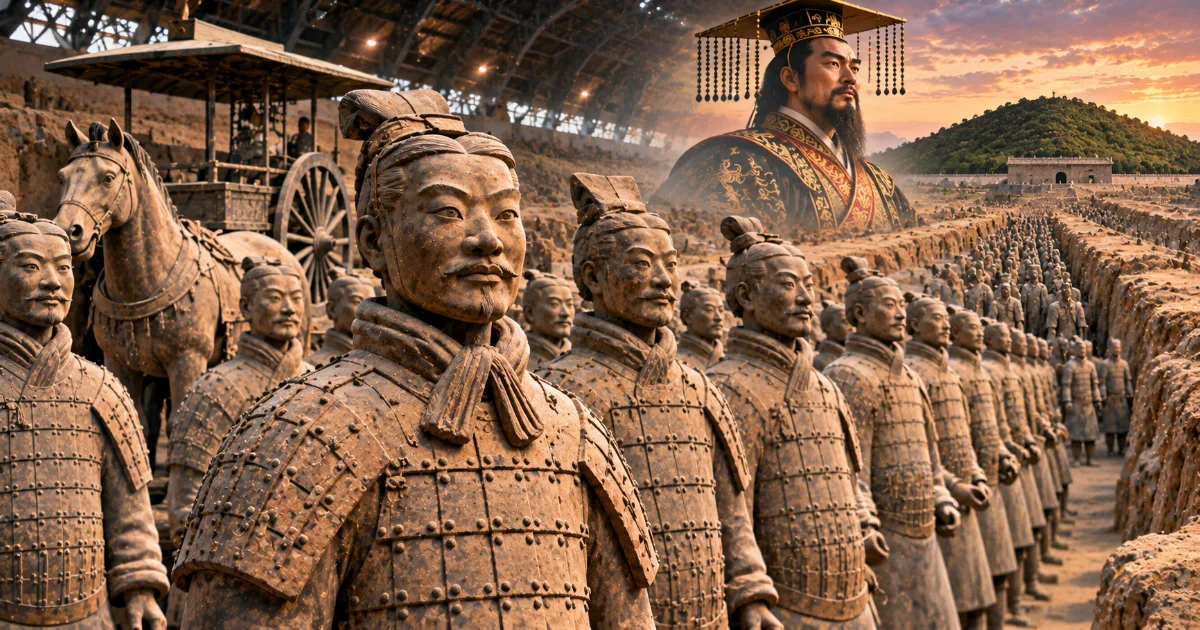
By the third century BCE, Qin had become the most powerful of the major states. Its rulers increasingly pursued a strategy of defeating rivals one by one rather than allowing them to combine their resources against Qin. The final phase of unification took place during the reign of the Qin king Zheng, who later became known as Qin Shi Huang, the First Emperor.
The conquest of the remaining states unfolded through a series of campaigns. Han fell in 230 BCE, followed by Zhao in 228 BCE, although resistance and further operations continued in parts of the former Zhao territory. Yan was defeated in 226 BCE after a campaign that included the famous attempt to assassinate the Qin ruler. Wei fell in 225 BCE, and Chu was conquered in 223 BCE after difficult military operations.
Qi, which had remained relatively insulated from some of the earlier fighting, was conquered in 221 BCE. Its defeat marked the completion of Qin's unification of the principal rival states. For the first time in the historical period under discussion, a single imperial government controlled the territories that had been divided among the major competing kingdoms.
The achievement was extraordinary, but it should not be understood as the sudden creation of a unified civilization from completely separate societies. The states shared important cultural traditions, written practices, political concepts, and historical connections. Yet they also maintained distinct institutions, regional identities, and political interests. Unification required the conquest of those institutions and the replacement of rival sovereign authorities.
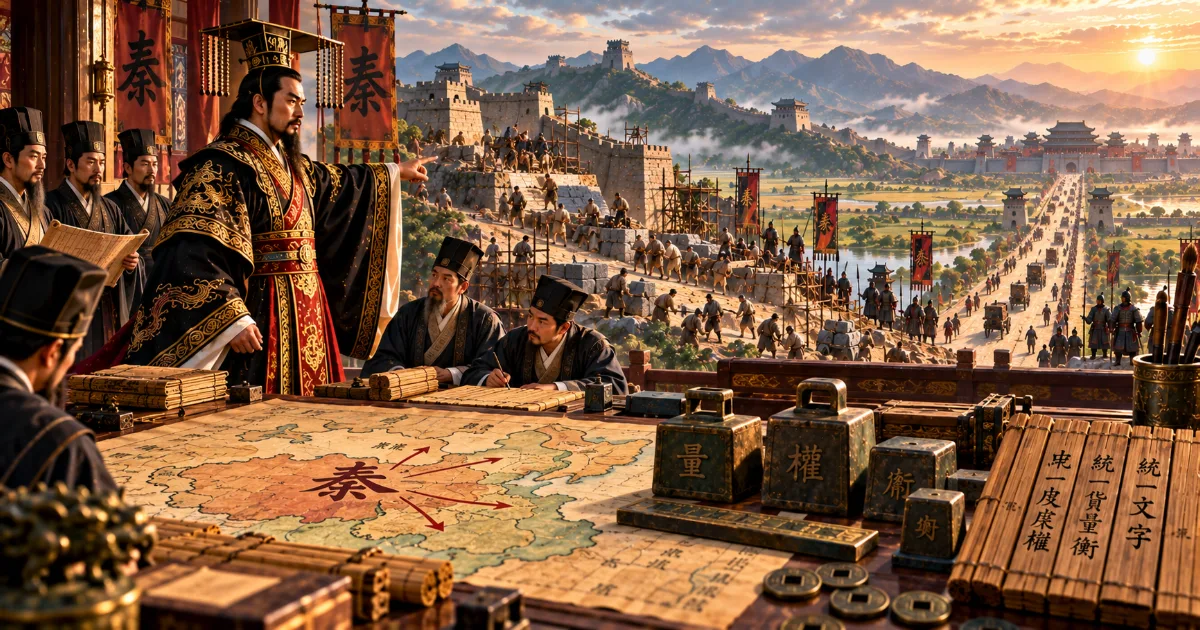
After victory, Qin Shi Huang and his advisers reorganized the empire. The new government divided territory into administrative units, appointed officials, standardized important systems, and sought to reduce the possibility that powerful regional families could re-establish independent kingdoms. The empire's institutions reflected developments that had emerged during the Warring States period, particularly the emphasis on centralized administration and direct state control.
The unification of 221 BCE therefore represented both a political revolution and the culmination of a long transformation. Qin's rulers created an empire, but the methods that made this possible had developed through centuries of competition among the Zhou successor states.
The victory also established a new historical pattern. Later Chinese dynasties repeatedly drew upon the memory of Qin's unification, even when they rejected its harshest policies. The idea that a single imperial government could unite a large part of China became one of the most influential legacies of the Warring States period.
17. The Human Cost of the Warring States Period
The political and intellectual achievements of the Warring States period should not obscure the suffering caused by prolonged conflict. The same reforms that strengthened states often increased their ability to demand labour, collect taxes, and recruit soldiers. Military success could bring territorial expansion, but the people living in conquered regions frequently faced displacement, new obligations, and changes in political authority.
Farmers were particularly vulnerable because agricultural production depended upon seasonal labour and stable access to land. When large numbers of men were recruited into the army, households could lose essential workers. Campaigns conducted during planting or harvesting seasons could damage production. Armies moving through rural regions required supplies, which might be purchased, requisitioned, or seized.
Governments also built fortifications, roads, irrigation systems, and other infrastructure that supported administration and military operations. Such projects could create lasting benefits, but they required labour and resources. When obligations became excessive, the burden fell heavily upon ordinary communities.
The human consequences of warfare were not limited to those who died in battle. Families faced uncertainty, economic loss, and the possibility that relatives might never return. Conquered populations could be transferred to new settlements, while the destruction of local political institutions could disrupt established relationships and practices.
Ancient historical sources often focus on rulers, generals, and advisers because these figures shaped the political decisions recorded by elite writers. The experiences of ordinary people are less fully documented. Historians therefore have to reconstruct social consequences through administrative records, archaeological evidence, material remains, and the broader patterns of state development.
The period's philosophical writings offer indirect evidence of the anxieties created by warfare. Confucian thinkers criticized rulers who neglected the population. Mohists condemned aggressive campaigns. Daoist writings questioned excessive interference and ambition. Legalist thinkers sought methods through which states could impose order and survive. These different responses reflect a shared awareness that political instability had become a central problem.
The Warring States period also reminds us that historical change can produce both extraordinary achievements and profound suffering. The development of centralized administration, military technology, and philosophical traditions shaped the future of China, but these developments emerged within a world where human lives were frequently subordinated to the demands of political competition.
A balanced understanding of the period must therefore consider both its institutional accomplishments and its human cost.
Conclusion: An Age That Changed China Forever
The Warring States period was a decisive turning point in Chinese history. The weakening of the Zhou royal order created a political environment in which rival kingdoms competed for survival and supremacy. Their wars encouraged the development of larger armies, stronger bureaucracies, improved military technologies, and new methods of taxation and administration.
The rise of Qin demonstrated the advantages of centralized government, agricultural mobilization, and sustained reform. Under rulers who strengthened the state's institutions, Qin gradually defeated its rivals and completed the unification of China in 221 BCE. The resulting empire transformed the political structure of the region and established a model that later dynasties would repeatedly reconsider.
Yet the period's importance extends beyond warfare and conquest. Its philosophers created some of the most influential traditions in Chinese intellectual history. Confucianism explored moral cultivation and the responsibilities of rulers. Daoism questioned excessive ambition and encouraged harmony with the natural order. Mohism promoted impartial concern and criticized aggressive warfare. Legalist thinkers examined the institutions and incentives through which states could maintain authority.
These traditions did not offer identical solutions, and their disagreements were often profound. Their shared historical environment, however, encouraged sustained reflection on the problems of human behaviour, political power, and social order. The resulting ideas influenced education, government, religion, literature, and moral thought long after the original kingdoms disappeared.
The Warring States period also teaches an important lesson about the relationship between political strength and political stability. Qin proved that a highly organized state could conquer its rivals, but the rapid collapse of the Qin dynasty later showed that military success alone could not guarantee lasting rule. A durable political order required more than the ability to command armies. It also needed institutions capable of governing society without provoking overwhelming resistance.
By the end of the period, China had changed in fundamental ways. The old aristocratic order had been weakened, centralized administration had become increasingly important, and the idea of imperial unity had gained a powerful historical foundation. The philosophers of the era had also left behind questions that continued to shape Chinese civilization for centuries.
The Warring States period was therefore both an age of destruction and an age of creation. Its kingdoms fought to determine who would rule China, while its thinkers struggled to understand what good rule should mean. The empire that emerged from these conflicts inherited both the administrative innovations of the competing states and the intellectual traditions that had developed in response to their turmoil.
The next article will begin Part 3 of the History of China series: Qin Shi Huang and the First Empire, exploring how the king of Qin became China's First Emperor and how he attempted to reshape a newly unified country.
#HistoryOfChina #WarringStatesPeriod #AncientChina #ChineseHistory #QinDynasty #QinShiHuang #Confucianism #Daoism #Legalism #Mohism #AncientPhilosophy #ChineseCivilization #HistoryEducation