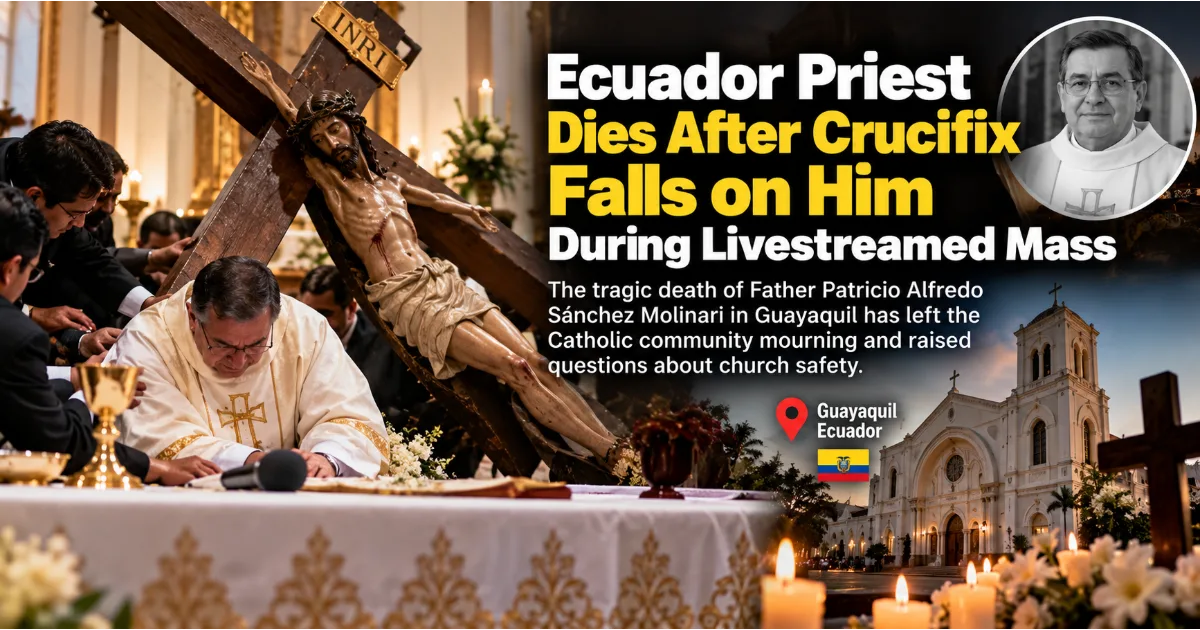
The tragic death of Father Patricio Alfredo Sánchez Molinari in Guayaquil has left the Catholic community mourning and raised difficult questions about church safety, the vulnerability of religious leaders, and the risks hidden behind ordinary moments of worship
A church service is usually a place where people gather in search of peace, comfort, reflection, and spiritual connection. For many believers, attending Mass is part of a familiar routine that provides stability during uncertain times. Yet, on October 17, 2026, a religious gathering in Guayaquil, Ecuador, became the setting for a devastating accident that claimed the life of a Catholic priest in front of worshippers and viewers watching an online broadcast.
Father Patricio Alfredo Sánchez Molinari was leading Mass at Our Lady of Perpetual Help Church when a large wooden crucifix mounted behind him reportedly detached from the wall and fell onto him. The incident was captured during the service's livestream, and footage subsequently circulated online. The priest died following the incident, with the Archdiocese of Guayaquil confirming his death the next day.
The tragedy has drawn attention not only because of the circumstances in which it occurred, but also because of the symbolism of the object involved. A crucifix depicting Jesus Christ is among the most recognisable symbols of Christianity. It represents sacrifice, suffering, redemption, and the central beliefs of the Christian faith. Seeing such an object fall during a religious service has understandably made the incident particularly distressing for many people.
However, the circumstances must be approached with care. There is no established evidence that the accident carried any supernatural meaning. The available accounts describe a physical incident involving a heavy religious structure. The precise reason it fell has not been officially established in the reports reviewed, and any explanation concerning its mounting, condition, or maintenance requires evidence.
Beyond the shocking footage, this is a story about a priest who lost his life while performing his religious duties, a congregation confronted with an unexpected emergency, and a community left to mourn. It also raises an important practical question: how can places of worship preserve their spiritual character while ensuring that the structures, decorations, and installations inside them are safe for the people who gather there?
What Happened During the Mass in Guayaquil?
The incident took place on Saturday, October 17, 2026, at Nuestra Señora del Perpetuo Socorro Church, known in English as Our Lady of Perpetual Help Church, in Guayaquil, Ecuador. Father Sánchez Molinari was conducting Mass when the large crucifix positioned behind him reportedly came loose and fell.
The crucifix was a substantial wooden structure depicting Jesus on the cross. Such installations are common in Catholic churches, where they occupy prominent positions near the altar or behind the celebrant. Their purpose is religious and symbolic, reminding worshippers of the central event of Christian faith and the meaning associated with Christ's sacrifice.
During a service, the attention of the congregation is generally directed towards prayer, scripture readings, the Eucharist, and the priest leading the liturgy. Worshippers do not ordinarily expect large fixtures attached to walls to become dangerous. This makes the sudden failure of a heavy object particularly alarming.
The incident reportedly occurred while the service was being livestreamed. As a result, the event was not confined to those physically present in the church. Footage from the broadcast circulated online, bringing the tragedy to the attention of people far beyond Guayaquil.
The recording's circulation has contributed to public awareness, but it has also made the event emotionally difficult for viewers. Images of a fatal accident can spread rapidly because of their shocking nature, sometimes reaching people who did not choose to watch graphic or distressing material. The circumstances call for restraint in how the footage is shared and discussed.
The most important confirmed outcome is that Father Sánchez Molinari died following the incident. The Archdiocese of Guayaquil subsequently acknowledged his death, leaving the local Catholic community to grieve the loss of a priest who had been carrying out his ministry.
The available reporting does not establish the precise mechanical reason the crucifix fell. It would therefore be premature to attribute the accident to negligence, poor construction, inadequate maintenance, or any other specific cause without the findings of a proper examination. Those questions require evidence about the installation, the condition of the structure, and the circumstances immediately preceding its failure.
Who Was Father Patricio Alfredo Sánchez Molinari?
Father Patricio Alfredo Sánchez Molinari was a Catholic priest serving in Guayaquil, one of Ecuador's largest cities and an important centre of commerce, culture, and religious life. He belonged to the Congregation of the Most Holy Redeemer, commonly known as the Redemptorists, a Catholic religious congregation with a long tradition of preaching, pastoral work, and service to communities.
A priest's responsibilities often extend well beyond conducting Mass. Depending on his assignment, he may guide parishioners through important life events, visit people who are ill, offer spiritual counsel, help families experiencing grief, provide religious instruction, and support charitable activities. The daily work of ministry can involve both public ceremonies and quiet personal encounters that never attract media attention.
The death of a priest during a service therefore affects more than the immediate congregation. Parishioners may have relied on him for guidance, companionship, or support during difficult periods. Fellow clergy may have worked alongside him in pastoral activities. Families may have known him through baptisms, weddings, funerals, and other moments in which religion forms part of personal and community life.
The available accounts establish the circumstances of his death, but they do not provide enough verified biographical detail to describe every stage of his life or his full contribution to the congregation. It is important not to invent personal anecdotes, career milestones, or details about his private relationships simply to make a tragic story more dramatic.
What can be said with confidence is that his death occurred while he was fulfilling his religious responsibilities. That fact has given the incident a particular emotional weight for those who understand the priesthood as a vocation of service.
For Catholics, priests occupy a distinctive role in the life of the Church. They lead liturgical celebrations, administer sacraments, interpret religious teachings within their pastoral responsibilities, and accompany people through moments of joy and suffering. Losing a priest unexpectedly can therefore create a sense of absence that extends across a parish community.
The circumstances of Father Sánchez Molinari's death also remind people that those who serve others remain vulnerable to ordinary physical dangers. A religious vocation does not protect someone from structural failures, accidents, or sudden emergencies. Behind the public role of a priest is an individual whose life matters to family, colleagues, fellow believers, and the wider community.
Why the Incident Has Shocked Christians Around the World
The crucifix occupies a central place in Catholic worship and Christian visual culture. It depicts Jesus Christ on the cross and serves as a reminder of the suffering and sacrifice associated with the Christian understanding of salvation. In churches, it is often positioned where worshippers can see it clearly during prayer and liturgical celebrations.
Because the crucifix carries such profound religious meaning, an accident involving one can be especially distressing. The object is not ordinarily viewed as a piece of furniture or decoration. It is a devotional symbol connected with centuries of religious teaching, art, ritual, and personal belief.
The tragedy in Guayaquil has combined this symbolism with the sudden loss of a priest. The fact that the accident occurred during Mass has intensified the emotional response because the service is traditionally associated with reverence, order, and spiritual reflection.
For worshippers who witnessed the event, the shock may have come from several sources at once. They were gathered for a familiar religious ceremony, watching a priest carry out his duties, when an unexpected physical danger interrupted the service. The suddenness of such an event can leave people struggling to process what they have seen.
People watching the livestream may have experienced a different but still powerful reaction. A broadcast creates the impression of participating in a distant event, even when viewers are not physically present. When something tragic occurs, the camera can expose viewers to an incident they were not prepared to witness.
The circulation of the footage has also brought the story into conversations among Christians who may have no direct connection to Ecuador. Some are responding with prayers for the deceased priest and the local congregation. Others are reflecting on the fragility of life and the unpredictable nature of accidents.
These responses are understandable, but they should not be confused with evidence about why the crucifix fell. Religious symbolism can shape how people emotionally interpret an event, yet the physical cause of an accident must be established through factual investigation.
A respectful response can acknowledge the importance of the crucifix to Christian belief without assigning a supernatural explanation to its fall. It can recognise the grief of the community while allowing practical questions about safety to be examined carefully.
The Meaning of the Crucifix in Catholic Worship
To understand why the accident has attracted such attention, it is helpful to understand the role of the crucifix in Catholic tradition. The cross is the central symbol of Christianity, while a crucifix specifically includes a representation of Jesus Christ on it. In Catholic churches, crucifixes are commonly displayed near altars, in chapels, along walls, and in places used for prayer.
The crucifix recalls the Passion of Christ, the Christian account of Jesus' suffering and death. For believers, it is inseparable from the understanding of sacrifice, love, forgiveness, and the hope of resurrection. It is also a visual reminder that Christian faith does not deny suffering but seeks meaning and hope in the face of it.
During Mass, the crucifix helps orient worshippers towards the central themes of the liturgy. Its presence is not merely decorative. It connects the service to the wider story of Christ's life, death, and resurrection, which forms the foundation of Christian worship.
Many churches preserve historic crucifixes or commission large artistic installations to reflect the character of their buildings. These objects may be made from wood, metal, stone, or combinations of materials. Some are centuries old, while others are modern creations designed to fit a particular architectural setting.
Their religious importance, however, does not remove the need for safe installation. A crucifix mounted high on a wall must be supported by an appropriate structure and suitable fixings. Its weight, dimensions, age, material, and the condition of the wall all affect the way it should be secured.
This is not a contradiction between faith and practical responsibility. Protecting a religious object and ensuring that it cannot fall onto worshippers are compatible goals. In fact, careful maintenance can be understood as part of the responsibility that a church has towards its congregation.
The Guayaquil tragedy has brought these considerations into focus because the object involved was both a powerful religious symbol and a substantial physical structure. The symbolism explains the emotional impact of the incident, while the physical properties of the installation are relevant to determining how the accident occurred.
The Unanswered Question: Why Did the Crucifix Fall?
One of the most important questions following the incident is why the crucifix detached from the wall. At the time of the available reports, the precise cause had not been officially established. That uncertainty matters because several different factors can cause a heavy structure to fall, and it would be irresponsible to select one without evidence.
The mounting system is one possible area that investigators or technical specialists may examine. Large objects are often secured using brackets, anchors, bolts, or other fixings appropriate to the structure and the load they must support. If a fixing is unsuitable, damaged, improperly installed, or affected by deterioration, it may fail under stress.
The wall itself is another consideration. A mounting system can be correctly selected but still prove inadequate if the supporting material is weak, damaged, or unsuitable for the load. Masonry, concrete, timber, and other building materials require different installation methods, and the condition of the structure matters as much as the hardware attached to it.
Age and maintenance can also be relevant. Materials may deteriorate over time, particularly if they are exposed to humidity, temperature changes, moisture, corrosion, or repeated movement. A structure that appeared secure in the past may require inspection as conditions change.
However, these are general possibilities, not established explanations for what happened in Guayaquil. There is no basis for concluding that the church failed to maintain the crucifix or that anyone acted negligently unless reliable evidence supports that conclusion.
A proper examination would consider the condition of the crucifix, the mounting hardware, the wall, and any available records relating to installation or maintenance. Photographs, video footage, physical evidence, and expert assessment may help establish the sequence of events and identify the failure mechanism.
Investigators would also need to determine whether there were warning signs before the incident. Evidence of movement, cracking, damaged fixings, or earlier repairs could be relevant if such signs existed. Equally, the absence of known warning signs would need to be considered in understanding whether the failure was foreseeable.
The purpose of such an examination is not simply to assign blame. It is to establish what happened, determine whether any preventable failure occurred, and identify measures that could reduce the risk of a similar accident elsewhere.
Church Safety and the Responsibility to Protect Worshippers
Places of worship are often designed to create an atmosphere of peace and reflection. Their architecture may include high ceilings, decorative walls, statues, chandeliers, large crosses, suspended lighting, and other fixtures that contribute to the visual character of the building.
Because these structures are familiar, visitors may rarely consider the engineering behind them. A heavy object fixed above a congregation can appear permanent, yet its safety depends on materials, installation quality, structural condition, and maintenance.
Churches, like other buildings used by the public, have a responsibility to take reasonable steps to protect those who enter. That responsibility includes maintaining the building, inspecting potentially hazardous installations, addressing visible damage, and obtaining qualified advice when the safety of a structure is uncertain.
The requirements will vary according to the building, local regulations, the age of the structure, and the type of installation. A small decorative item does not pose the same risk as a heavy wooden crucifix mounted high above an altar. The assessment should reflect the actual weight and potential consequences of failure.
Large installations may need professional evaluation, especially when their mounting systems are old, undocumented, or difficult to inspect. Qualified personnel can assess the supporting wall, the type and condition of the fixings, and whether the structure is suitable for the load. Where uncertainty exists, restricting access to the area until the risk is assessed may be a sensible precaution.
Maintenance also needs to be systematic. Visual checks can identify obvious signs of damage, but they may not reveal problems hidden behind a fixture or inside a wall. A church that relies entirely on casual observation may miss deterioration that requires closer inspection.
These principles apply to all places where people gather, including schools, theatres, museums, community halls, offices, and public buildings. Large decorative objects, suspended equipment, and overhead fixtures can create risks if they are not installed and maintained appropriately.
The lesson is not that churches are inherently unsafe. Most religious services take place without such incidents. Rather, the tragedy highlights the importance of treating structural safety as a continuing responsibility rather than assuming that familiar installations will remain secure indefinitely.
Livestreaming and the Unintended Reach of Tragedy
The fact that the Mass was being livestreamed has played a major role in the story's visibility. Livestreaming allows religious communities to reach people who cannot attend in person because of illness, distance, work, disability, or other circumstances. It can help parishioners remain connected when they are travelling or living away from their home communities.
For many churches, digital broadcasting has become an extension of pastoral outreach. It allows families to participate in important services, supports older or housebound worshippers, and creates a record of ceremonies that can be watched later.
However, a live broadcast also captures unexpected events. Unlike an edited recording, a livestream may continue while organisers are still trying to understand what has happened. An accident, medical emergency, or other disturbance can therefore be transmitted before anyone has an opportunity to stop the broadcast.
In the Guayaquil case, the footage reportedly captured the moment the crucifix fell. Once recordings began circulating online, the tragedy reached audiences who were not connected to the church. The same technology that had been intended to share a religious service also exposed viewers to a fatal accident.
This raises an important question about the responsibilities of people who manage livestreams. A broadcast team may not be able to prevent every unexpected event, but it can establish procedures for responding to emergencies. These may include stopping the transmission, avoiding unnecessary close-up footage of injured people, and coordinating with those responsible for providing assistance.
Such measures are not about hiding the truth. They are about distinguishing public information from material that may unnecessarily violate the dignity of a person who has been seriously injured or killed.
Viewers also have a responsibility when deciding whether to share footage. A recording may provide evidence of what occurred, but repeatedly distributing the most distressing moments can turn a person's death into online spectacle. Sharing a factual report about the incident can inform people without exposing them to graphic material.
Digital platforms make it easy for a clip to travel across countries in minutes. That reach increases the importance of thoughtful editorial decisions, especially when the people shown did not consent to becoming part of a viral news event.
The Emotional Impact on the Congregation
People who witness a sudden death may experience shock, confusion, grief, or difficulty accepting what happened. These reactions can occur even when a person was not physically injured. Witnessing a serious accident in a familiar place can challenge a person's sense of safety and leave memories that are difficult to process.
For the congregation at Our Lady of Perpetual Help Church, the incident occurred in a setting associated with prayer and community. The priest leading the service was not simply a public figure performing a ceremony. He was a religious leader whose role may have been familiar to the people gathered there.
When such a person dies unexpectedly, the congregation can experience both personal grief and a disruption to its shared religious life. Worshippers may remember the priest through services, conversations, guidance, and moments when he supported them through important events. The loss can therefore extend beyond the shock of the accident itself.
The incident may also make people more conscious of physical safety in the church. A building that previously felt entirely familiar may now be associated with a frightening memory. Some worshippers may feel anxious about returning, particularly if they are uncertain whether other fixtures are safe.
Pastoral support can help a community respond to these concerns. Religious leaders can acknowledge the loss, provide opportunities for prayer and remembrance, and communicate what is known about any safety assessments. Clear information can help prevent rumours from taking hold and reassure people when appropriate precautions have been completed.
Emotional support may also be important for those who directly witnessed the incident or attempted to help. People respond differently to traumatic events, and some may need more time or professional assistance to recover. No one should feel pressured to process the experience according to a particular timetable.
The community's grief deserves respect. It should not be reduced to a dramatic video or a debate about symbolism. Father Sánchez Molinari's death was a human loss, and the people who knew him are entitled to mourn without having their experience turned into an online spectacle.
Faith, Suffering, and the Search for Meaning
When tragedy occurs in a religious setting, people often look for meaning. Some turn to prayer, others seek comfort in scripture, and many ask why an event happened in a place where they expected to find peace. Such questions are a natural part of grief, especially when the circumstances appear particularly painful or unexpected.
Christianity has a long tradition of reflecting on suffering, death, and the limits of human understanding. The crucifix itself is central to this reflection because it represents the suffering and death of Jesus Christ while also pointing towards the Christian hope of resurrection.
For believers, the story of the crucifixion is not a declaration that suffering is good or that every tragedy has an obvious explanation. Rather, it is understood as a story in which suffering is confronted and ultimately connected to hope, redemption, and divine love.
The death of a priest during Mass may therefore provoke difficult theological questions. Some people may wonder whether the circumstances carry a particular message. Others may reject attempts to interpret the accident as a sign and focus instead on the practical reality that a person died in a preventable or potentially preventable incident.
It is important to allow room for personal grief and religious reflection without presenting speculation as fact. No verified evidence establishes that the crucifix fell for a supernatural reason or that the incident should be interpreted as a divine warning. The physical cause remains a separate question that requires investigation.
Faith communities can offer comfort without claiming certainty about why an accident occurred. They can pray for the deceased, support those who are grieving, and work to ensure that the church remains safe for future services. These responses do not diminish the spiritual significance of the event.
The tragedy also reminds people that religious belief does not remove the need for practical responsibility. A place of worship can be spiritually meaningful while still requiring maintenance, professional inspections, emergency planning, and careful attention to the safety of those who gather there.
The Difference Between Symbolism and Evidence
The image of a crucifix falling during Mass is powerful because of its religious significance. It is understandable that people may feel the event is especially striking or unsettling. Yet the emotional power of an image does not establish a particular explanation for it.
Human beings naturally search for patterns and meaning, particularly when an unexpected event occurs at a moment of religious or personal importance. A coincidence can feel deeply significant to someone who is grieving or trying to understand a loss. Such feelings are part of the human response to uncertainty.
However, reporting on a fatal accident requires a clear distinction between interpretation and evidence. A physical structure can fall because of a mechanical failure, deterioration, unsuitable installation, or other factors. Which explanation applies in this case cannot be determined simply from the symbolism of the object or the timing of the incident.
The same principle applies to claims circulating online. Some posts may describe the event as a miracle, a warning, a curse, or a supernatural message. These interpretations may attract attention, but they are not established explanations of the accident.
A responsible article can acknowledge the religious context and the emotions it evokes while remaining careful about what is known. It can explain why the incident has resonated with believers without claiming to know the intentions of God or the hidden meaning of the event.
This distinction protects both factual accuracy and religious sensitivity. It avoids exploiting the death of a priest to generate sensational claims, and it leaves individuals free to reflect on the event according to their own beliefs.
The strongest response combines compassion with clear thinking. It recognises the human loss, supports the grieving community, and encourages a factual investigation into the circumstances that led to the crucifix falling.
What Other Places of Worship Can Learn
The accident in Guayaquil offers a practical opportunity for religious institutions to review how they manage heavy fixtures and architectural installations. The purpose of such a review should be prevention, not panic. An isolated incident does not prove that similar objects in other churches are unsafe, but it does illustrate why their condition should not be taken for granted.
Church administrators can begin by identifying large or elevated objects that could cause serious injury if they fell. These may include crucifixes, statues, chandeliers, wall-mounted artworks, speakers, lighting equipment, and decorative panels. The review should consider the weight of each item, its mounting method, the condition of the supporting structure, and the number of people who gather beneath it.
Installations that are old, unusually heavy, visibly damaged, or poorly documented may require professional inspection. If there is a credible concern about stability, access to the affected area can be restricted until a qualified assessment has been completed.
Records are also important. Keeping information about installation dates, repairs, inspections, and changes to the building can help future administrators understand how an object is supported and when further checks may be appropriate. Without records, a church may have difficulty determining whether an old fixture has been inspected adequately.
Safety planning should extend to emergencies. Staff and volunteers can benefit from knowing how to contact emergency services, direct people away from a hazard, provide basic assistance within their training, and communicate clearly during an incident. A simple plan can reduce confusion when seconds matter.
These measures do not need to undermine the character of a religious building. The aim is to preserve its spiritual and architectural features while ensuring that they do not expose worshippers to avoidable danger.
Places of worship serve people of different ages and physical abilities, including children, older adults, and people who may need assistance moving quickly. Safety planning should consider their needs rather than assume that everyone can react to an emergency in the same way.
Ultimately, maintenance is an expression of responsibility towards the community. Protecting a sacred building includes protecting the people who gather inside it.
The Responsibility of News Media and Online Audiences
A fatal incident involving a religious symbol creates strong public interest, but that interest can also encourage sensational reporting. Headlines may emphasise the shocking image of a crucifix falling, while social media posts may frame the event as something supernatural or inexplicable. Such approaches can attract attention at the expense of accuracy and compassion.
News organisations have a responsibility to report what happened, identify what remains unknown, and avoid turning an unverified interpretation into a factual claim. The identity of the deceased, the location, the circumstances of the incident, and any official findings should be reported accurately. Speculation about motives or supernatural meaning should be clearly distinguished from established information.
Respect for the deceased also matters. Photographs and videos should be selected carefully, especially when they show a person at the moment of injury or death. The fact that footage is publicly accessible does not mean every publication or repost is justified.
Online audiences play a role in how a story develops. A person who shares an unverified claim may unintentionally spread misinformation. Someone who reposts distressing footage may expose people to images they would not otherwise have encountered. A thoughtful approach can reduce these harms without preventing discussion of the event.
Readers can help by sharing reliable accounts, avoiding unsupported accusations, and treating the priest's death as a human tragedy rather than merely a dramatic clip. They can also recognise that uncertainty is sometimes unavoidable during the first stages of an investigation.
Responsible coverage does not require removing emotion from the story. The shock and grief surrounding the accident are part of its significance. The goal is to communicate those emotions without sacrificing evidence, dignity, or context.
Conclusion: Remembering a Priest and Learning from a Tragedy
The death of Father Patricio Alfredo Sánchez Molinari after a large crucifix fell on him during a livestreamed Mass in Guayaquil has left the local Catholic community mourning and drawn attention from audiences around the world. The incident occurred on October 17, 2026, and the Archdiocese of Guayaquil confirmed his death the following day.
The circumstances are especially distressing because the accident happened during a religious service, involving an object that holds deep meaning for Christians. The crucifix represents the suffering and sacrifice of Jesus Christ, and its sudden fall has understandably prompted strong emotional responses. Yet no established evidence shows that the accident carried a supernatural meaning, and the precise physical cause has not been confirmed in the reports reviewed.
The central fact remains the loss of a human life. Father Sánchez Molinari died while carrying out his religious duties, leaving a community to grieve and remember him. The people who witnessed the incident, those who knew him, and those affected by the circulating footage deserve compassion and respect.
The tragedy also raises practical questions that should not be overlooked. Heavy objects mounted in public buildings require suitable installation, regular attention, and professional assessment where necessary. Churches, like schools, theatres, and other public spaces, have a responsibility to take reasonable measures to protect the people who gather within them.
The livestream has made the incident visible far beyond Ecuador, but visibility should not turn grief into spectacle. Sharing the story responsibly means acknowledging what is known, being honest about what remains uncertain, and avoiding claims that the evidence does not support.
Beyond Headlines, this is not simply a story about a crucifix falling. It is about a priest who lost his life, a congregation confronted with an unimaginable moment, and the responsibility to learn from tragedy without exploiting it. The most meaningful response is to honour the deceased, support those who are grieving, establish the facts, and take practical steps that may help prevent similar accidents in the future.
#BeyondHeadlines #Ecuador #FatherPatricioSanchezMolinari #CatholicChurch #Guayaquil #Christianity #ChurchSafety #FaithAndCommunity #WorldNews #HumanTragedy #PublicSafety #CatholicFaith