
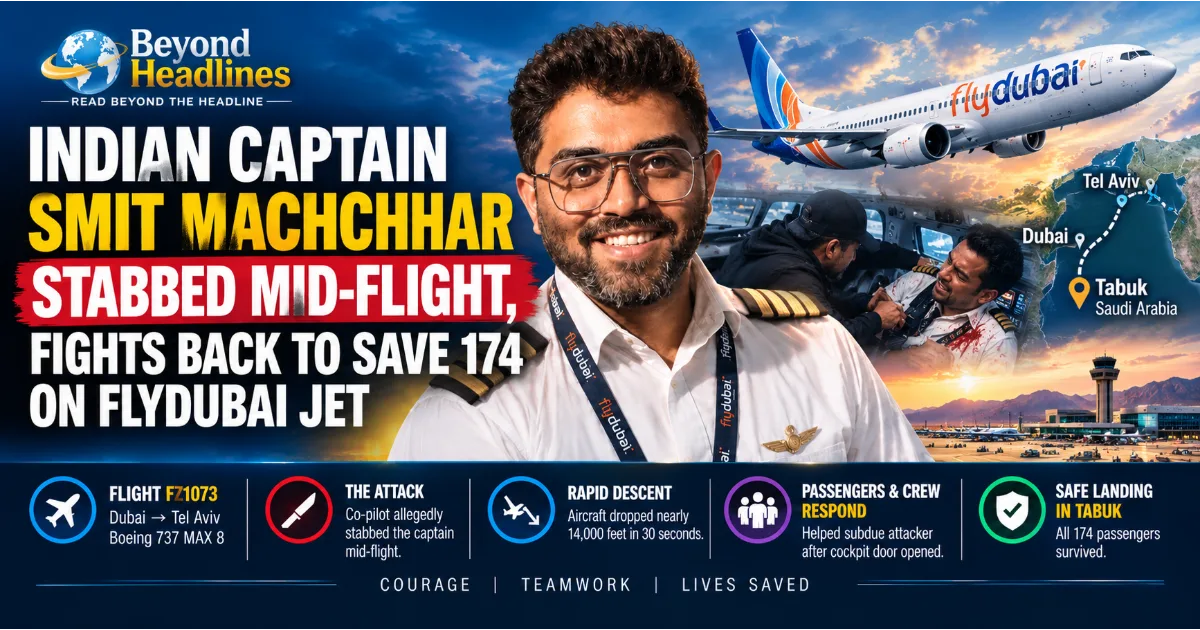
What began as a routine commercial flight from Dubai to Tel Aviv turned into a life-threatening emergency over Saudi Arabia on September 30, when the captain of a Flydubai Boeing 737 MAX 8 was allegedly attacked by his own co-pilot in the cockpit. Captain Smit Machchhar, an Indian national from Mumbai, was seriously injured during the confrontation, yet managed to take an action that became critical to the survival of everyone aboard. Despite being wounded, he opened the cockpit door, allowing passengers and crew members to enter and overpower the attacker. Two off-duty Flydubai pilots who were travelling as passengers then helped regain control of the aircraft and land it safely at Tabuk Airport in northwestern Saudi Arabia. The flight was carrying 174 passengers, all of whom survived the incident.
The extraordinary sequence of events has led Indian and Israeli leaders to publicly praise Machchhar, while aviation authorities in the United Arab Emirates, Saudi Arabia and Israel have begun investigations into what happened and why. The circumstances surrounding the confrontation, including the motive of the co-pilot and whether the incident involved prior planning, remain under investigation. Flydubai has specifically urged people not to engage in premature speculation while authorities establish the facts. The UAE General Civil Aviation Authority has likewise said that its investigation teams are examining the operational and security aspects of the incident.
The dramatic incident highlights something that is rarely visible to airline passengers. Modern commercial aviation is built around layers of procedures designed to prevent a single failure from becoming catastrophic. Yet the possibility of a security incident involving someone already inside the cockpit creates an exceptionally difficult situation. In this case, the injured captain's ability to open the cockpit door, the intervention of passengers and crew, and the presence of two off-duty pilots among those travelling on the aircraft all became crucial elements in bringing the emergency under control. The episode demonstrates how quickly an aviation emergency can move beyond the procedures of normal flight and require human decisions under extreme pressure.
A flight that suddenly plunged into crisis
Flydubai Flight FZ1073 departed Dubai International Airport on September 30 bound for Ben Gurion International Airport near Tel Aviv. The Boeing 737 MAX 8 was operating a route that has become increasingly significant since the United Arab Emirates and Israel normalised relations in 2020. The flight initially appeared to be a normal commercial journey, but while the aircraft was over northern Saudi Arabia, the situation inside the cockpit changed dramatically.
According to accounts from passengers and officials, the co-pilot allegedly attacked Captain Machchhar with a knife. The confrontation reportedly caused the aircraft to enter a rapid descent. Reuters reported that the aircraft dropped nearly 14,000 feet in less than 30 seconds. Passengers initially experienced what some thought was severe turbulence, before the nature of the emergency became apparent.
The aircraft also transmitted a hijack alert, according to reporting on the incident. The rapid descent and cockpit struggle created an emergency in which the normal command structure of the aircraft had effectively been disrupted. The captain was injured, the co-pilot was allegedly attempting to take control of the aircraft, and hundreds of people were suddenly dependent on the actions of those inside and around the cockpit.
What happened next was critical.
Machchhar, despite suffering serious injuries, managed to activate the cockpit door release. That allowed people from the cabin to gain access to the cockpit. Passengers and crew members then helped subdue the co-pilot. Among the people aboard the flight were two off-duty Flydubai pilots, who were able to take over the aircraft's operation after the confrontation was brought under control. They ultimately landed the aircraft at Tabuk Airport in Saudi Arabia.
The aircraft was diverted rather than continuing to Israel because the emergency required an immediate landing at a suitable airport. Tabuk provided the necessary destination for the emergency landing, after which injured members of the flight crew were transported to hospital. Flydubai confirmed that the aircraft had landed safely and that passengers were safe and accounted for.
The passengers were later able to continue their journey, while Machchhar remained in medical care.
Who is Captain Smit Machchhar?
The pilot at the centre of the incident is an Indian national from Mumbai. Machchhar's professional career had already taken him through more than a decade of commercial aviation before the Flydubai emergency.
According to reporting based on his professional profile, Machchhar spent nearly 11 years with India's SpiceJet before joining Flydubai in 2022. He joined Flydubai as a direct-entry captain and became a Boeing 737 specialist. Reports about his professional background describe experience in safety and compliance as well as involvement in mentoring other pilots.
Reuters reported that Machchhar had accumulated nearly 9,750 flight hours over approximately 15 years in aviation. His career had therefore given him substantial experience in commercial airline operations before the incident.
There is also an interesting detail in his earlier public conversations about aviation. In a podcast interview recorded before the incident, Machchhar discussed the importance of cabin crew and other people aboard an aircraft during emergencies. He explained that when something goes wrong at altitude, crew members can play an important role in helping passengers survive. Less than a year later, he found himself in precisely such an emergency, with the actions of the cabin crew and passengers becoming an important part of the response.
Reports about his personal background indicate that aviation was not initially the obvious path for him. Reuters reported that he had originally considered joining his family's textile business before developing an interest in aviation at the age of 19. He subsequently trained in New Zealand and built his professional career as a commercial pilot.
Those details have attracted attention because the story is not simply about a pilot who happened to be at the controls during an emergency. Machchhar was already an experienced captain with years of commercial aviation experience when confronted with a situation that was fundamentally different from the emergencies pilots train for in ordinary flight operations.
The moment that changed everything
The most consequential action attributed to Machchhar came after he had already been injured.
According to accounts of the incident, he was on the cockpit floor and bleeding when he managed to release the cockpit door. That decision enabled people outside the cockpit to intervene. Had the door remained closed, the situation could have continued with the attacker inside the flight deck and the aircraft descending rapidly.
The details of exactly how the confrontation unfolded remain part of the investigation. However, the broad sequence has been reported by multiple sources: an alleged attack on the captain, a rapid descent, the injured captain opening the cockpit door, passengers and crew entering, the attacker being subdued and other pilots aboard taking control of the aircraft.
This sequence also explains why the incident cannot be attributed solely to one person. Machchhar's actions were central, but other people aboard the aircraft also played important roles. Passengers helped reach the cockpit and subdue the alleged attacker. Crew members were involved in the response. Two off-duty pilots were available to help operate the aircraft after the cockpit confrontation.
The survival of everyone aboard was therefore the result of a chain of actions under extraordinary circumstances.
That point is important when discussing aviation emergencies. Commercial aircraft are designed around redundancy. Pilots work in pairs, cabin crew are trained in emergency procedures, aircraft systems have multiple layers of protection and airports maintain emergency response capabilities. But no safety system can anticipate every possible sequence of human behaviour.
In this case, the presence of additional trained pilots among the passengers provided an unusual but extremely valuable layer of redundancy.
Two off-duty pilots became crucial
The two off-duty Flydubai pilots aboard the aircraft were not originally assigned to operate Flight FZ1073. They were travelling as passengers. Yet after the cockpit confrontation, their aviation experience became essential.
Once the co-pilot had been subdued and the captain was incapacitated by his injuries, the aircraft still had to be flown. A Boeing 737 MAX 8 travelling at altitude cannot simply be left without qualified pilots. The emergency therefore had two separate dimensions. First, the immediate threat inside the cockpit had to be stopped. Second, control of the aircraft had to be restored and the plane safely landed.
The two off-duty pilots helped perform the second task. Reuters reported that they helped land the aircraft at Tabuk.
Their presence was unusual, but their role illustrates the importance of professional aviation communities. Commercial pilots travel frequently as passengers, particularly when commuting between assignments. In most flights, their professional identity has no relevance beyond their own travel. In this case, it became potentially decisive.
The incident therefore involved several layers of human intervention. The captain acted despite his injuries. Passengers and crew responded to the cockpit emergency. Off-duty pilots provided additional flight expertise. Airport and medical authorities in Saudi Arabia then responded after the emergency landing.
Each stage had to succeed.
The 14,000-foot descent
One of the most frightening elements of the incident was the reported speed of the aircraft's descent.
Reuters reported that the aircraft lost nearly 14,000 feet in approximately 30 seconds. That is an extraordinary change in altitude for a passenger aircraft and would have been immediately apparent to those aboard. Passengers described the experience as chaotic, with some initially believing they were experiencing severe turbulence.
A sudden descent can create intense physical and psychological stress inside an aircraft. Passengers may not immediately know whether the aircraft is experiencing mechanical failure, severe weather or another emergency. In this case, the situation was even more complex because the problem was reportedly taking place inside the cockpit.
The rapid loss of altitude also reduced the amount of time available for the people aboard the aircraft to respond.
That is one reason the eventual emergency landing in Saudi Arabia was significant. The aircraft did not continue toward its original destination. Instead, it was diverted to Tabuk, where emergency services were able to respond and injured crew members could receive medical treatment.
Captain Machchhar's injuries
Machchhar suffered serious injuries in the confrontation and was initially taken to a hospital in Tabuk after the aircraft landed. The Indian Embassy in Saudi Arabia confirmed that it was following his condition and working with Saudi authorities and his family. He was initially reported to be stable.
India's Ministry of External Affairs later said Machchhar had been transferred from Tabuk to Abu Dhabi for continued medical treatment and recovery. The Indian Ambassador in the UAE met him at the hospital and checked on his condition, while Indian diplomatic officials continued to coordinate with his family and local authorities.
The fact that he remained conscious and capable of taking action after being injured is central to the accounts of what happened. However, the full medical details have not been publicly disclosed, and there is no need to speculate about injuries beyond what authorities and reliable reporting have established.
What is known is that he required medical care, underwent treatment and was considered stable in the initial reports.
What happened to the co-pilot?
The co-pilot was detained by Saudi authorities following the emergency landing. The precise circumstances of his arrest and interrogation have not been fully disclosed publicly.
Most importantly, the motive remains unclear.
That point has been repeatedly emphasised by Flydubai and other authorities. The airline said the underlying reasons for the incident were unknown and urged people to avoid premature speculation. The UAE Attorney General has ordered an investigation intended to collect evidence, establish what happened, determine the circumstances and motives and assess whether the incident had any connection to terrorist activity, prior planning or external direction.
This means that descriptions of the incident as an attempted hijacking or deliberate attempt to crash the aircraft should currently be attributed to the statements of officials rather than treated as a final judicial determination.
Israeli Prime Minister Benjamin Netanyahu publicly described the incident as an attempt by one pilot to stab the other and then crash the plane. Israeli officials subsequently praised Machchhar for his role in preventing a catastrophe. However, the formal investigation is still necessary to establish the complete sequence of events and the motive behind the alleged attack.
The distinction matters because aviation security incidents can involve multiple possible explanations, and investigators need to establish evidence before reaching final conclusions.
Why the investigation matters
The UAE General Civil Aviation Authority has said investigators are reviewing both the operational and security aspects of the incident. The authority also warned against the circulation of unofficial information and said findings would be provided once the investigation is complete.
Investigators will likely need to reconstruct the sequence of events using several sources of evidence. These can include cockpit voice recordings, flight data, airport records, security information, passenger and crew statements, physical evidence from the cockpit and communications between the aircraft and air traffic control.
The exact sequence of cockpit movements will be especially important.
Investigators will need to understand how the aircraft began its rapid descent, what controls were affected, how the captain was injured, how the cockpit door was opened and when the other pilots took control. They will also need to establish whether the alleged attack was spontaneous or planned.
The UAE Attorney General's investigation will also examine whether there was any connection to terrorism or other organised activity. At this stage, there is no established public evidence that the incident was part of a wider terrorist operation. The investigation is specifically intended to determine that question rather than assume an answer.
A rare type of aviation emergency
Incidents involving deliberate action by someone inside an aircraft's cockpit are among the most difficult security scenarios for commercial aviation.
Following the terrorist attacks of September 11, 2001, aviation authorities around the world introduced extensive cockpit security measures. Reinforced cockpit doors, access procedures and communication protocols became standard features of commercial aviation.
The basic purpose is straightforward. Once an aircraft is airborne, the flight deck must remain protected from unauthorised access.
The Flydubai incident demonstrates the complexity of that security philosophy. The cockpit door exists to prevent threats from entering, but in this case the emergency involved a person who was already inside the cockpit. That fundamentally changes the security problem.
It also explains why the reported decision by Machchhar to open the door was so consequential. The door was not opened under ordinary circumstances. It was opened because the situation inside the cockpit had become an immediate threat and intervention from outside was necessary.
The incident therefore raises questions for aviation-security experts about how airlines train crews for threats originating within the flight deck itself. Those questions should be answered through the formal investigation rather than through assumptions based on the limited public information currently available.
The importance of passengers in an emergency
Passengers are generally expected to follow crew instructions during an aviation emergency. Most have no specialised training in aviation security or aircraft operations.
Yet extraordinary circumstances can change that.
In the Flydubai incident, passengers reportedly entered the cockpit after the door was opened and helped subdue the co-pilot. The presence of a trained plumber and a dentist among those who helped has also been highlighted in international reporting, illustrating how ordinary passengers can suddenly become participants in an emergency response.
Their involvement should not be interpreted as a recommendation for passengers to independently intervene in cockpit emergencies. Such situations are extremely dangerous and require professional assessment. But in this specific incident, the people aboard the aircraft responded to an immediate threat after the cockpit door was opened.
The successful outcome demonstrates another characteristic of aviation emergencies: survival can depend on several people making the right decisions within seconds.
Why the incident has resonated in India
The fact that the captain was an Indian national has made the incident particularly significant in India. Machchhar's professional history connects him to India's commercial aviation industry through his years with SpiceJet, before he moved to Flydubai.
Indian Prime Minister Narendra Modi publicly praised the captain, describing his actions as an example of courage under extreme circumstances. Indian diplomatic officials have also remained in contact with Machchhar's family and the authorities treating him.
The response has extended beyond India. Israeli Prime Minister Benjamin Netanyahu also praised Machchhar, saying that his actions helped save 174 people aboard the aircraft. The incident occurred on a flight carrying Israeli and other passengers, making the successful emergency landing particularly significant for both countries.
The international reaction has consequently focused heavily on the captain's actions. But behind the public tributes is an aviation investigation that remains incomplete.
That distinction is important. Public recognition can acknowledge what has already been established, while investigators still need to determine exactly why the incident occurred.
Flydubai's response
Flydubai confirmed that Flight FZ1073 had experienced an incident while travelling from Dubai to Tel Aviv and that the aircraft had landed safely at Tabuk. The airline said all passengers were safe and accounted for and that its teams were working with relevant authorities.
The airline has also emphasised that the reasons behind the incident remain unknown.
That statement reflects a standard but important principle in aviation investigations. Initial reports can be incomplete, particularly when an incident involves injuries, conflicting accounts and a rapidly evolving emergency. Authorities therefore need time to gather evidence before determining the cause.
Flydubai also suspended flights to and from Israel following the incident while investigations continued, according to Reuters reporting.
The decision demonstrates the broader operational consequences of a single serious aviation-security incident. Even when an aircraft lands safely and passengers survive, airlines may need to reassess routes, security procedures and operational risks.
The role of Saudi Arabia
Saudi Arabia became an unexpected but crucial part of the story because the aircraft was diverted to Tabuk.
The emergency landing placed Saudi authorities in a position where they had to respond simultaneously to an aviation emergency, injured crew members and an alleged violent incident aboard a foreign-operated aircraft travelling between the United Arab Emirates and Israel.
The Tabuk airport authorities confirmed that the captain and first officer were taken to hospital after sustaining injuries. Saudi authorities also detained the co-pilot for questioning.
The country's involvement will be important in establishing what happened after the aircraft landed and in determining the circumstances surrounding the alleged attack.
Because the incident occurred in Saudi airspace, Saudi authorities have an important role in the investigation and in the handling of the alleged attacker.
More than a story about one pilot
The story has understandably been framed around Captain Machchhar's bravery. Yet the deeper aviation lesson is about the interaction between people, procedures and redundancy.
The aircraft had two operating pilots. When the cockpit became the scene of an alleged attack, that redundancy was compromised. The injured captain was nevertheless able to open the cockpit door. Passengers and crew then intervened. Two off-duty pilots happened to be aboard. Those pilots helped restore control of the aircraft and land it safely.
It was an extraordinary chain of circumstances.
Had any one of those elements unfolded differently, the outcome could have been far more serious. But it is not possible to say precisely what would have happened in an alternative scenario, and investigators will ultimately need to establish the factual sequence rather than speculate about hypothetical outcomes.
What can be said is that 174 passengers survived, the aircraft landed safely and the injured captain received medical treatment.
An emergency measured in seconds
Aviation safety often depends on preparation for events that may never happen.
Pilots train for engine failures, fire, decompression, severe weather, system malfunctions and other emergencies. Cabin crew train for evacuations, medical emergencies and passenger safety. Airports maintain emergency response teams. Airlines establish procedures for communication, diversion and crisis management.
But the Flydubai incident demonstrates the unpredictable human dimension of aviation.
A flight can be operating normally and then experience a sudden emergency that does not fit neatly into a single category. In this case, a cockpit security incident became a flight-control emergency, which then became a medical emergency and an emergency diversion.
Every stage required a response.
The captain's injuries did not end his ability to contribute. The passengers did not remain passive when the cockpit door opened. The off-duty pilots did not remain simply passengers once their expertise became necessary. The airline and authorities then coordinated the emergency landing and medical response.
That sequence is what ultimately prevented a cockpit crisis from becoming an aircraft disaster.
What investigators still need to establish
Several questions remain unanswered.
Why did the co-pilot allegedly attack the captain?
Was the incident spontaneous or planned?
What caused the aircraft's rapid descent?
How did control of the aircraft change during the cockpit confrontation?
How long did the aircraft remain in the dangerous descent?
What precisely happened before the cockpit door was opened?
How did the passengers and crew gain control of the situation?
When did the off-duty pilots take over?
Were there warning signs before the incident?
Did the co-pilot display any behaviour that could have raised security concerns before departure?
Were there any external communications or instructions connected to the event?
These are questions for investigators rather than commentators.
The UAE authorities have explicitly warned against unofficial accounts while the investigation is underway. That warning is particularly relevant in the age of social media, where a single unverified claim can spread internationally within minutes.
A captain recovering far from home
While public attention has focused on the dramatic events aboard the aircraft, Machchhar's personal recovery is now the immediate concern for his family and colleagues.
He was initially treated in Tabuk before being transferred to Abu Dhabi for continued medical care. India's External Affairs Ministry said the Indian Ambassador in the UAE met him in hospital and that Indian diplomatic officials remained in contact with his family.
The transition from emergency to recovery is often overlooked in stories about aviation incidents. For Machchhar, the emergency did not end when the aircraft landed. He had suffered serious injuries and required continuing medical attention.
His colleagues and passengers, meanwhile, are likely to carry their own memories of the event. For passengers, a commercial flight that began as an ordinary journey suddenly became a potentially life-threatening emergency. For the crew, the experience was even more immediate.
The eventual safe landing does not erase the severity of what occurred.
The wider aviation lesson
The Flydubai incident is likely to be examined closely by aviation-security authorities because it involves an unusual combination of factors. An alleged attack by a cockpit crew member, a rapid loss of altitude, the opening of a secured cockpit door, intervention by passengers and the involvement of off-duty pilots are all elements that investigators will need to reconstruct.
The objective should not simply be to assign blame. Aviation investigations traditionally seek to understand how an incident occurred and what can be learned from it.
If the investigation identifies weaknesses in procedures, training or security protocols, those findings could potentially influence future practices.
At the same time, it is important not to assume that a single unusual event demonstrates a systemic failure across commercial aviation. The facts of this particular incident remain under investigation, and any recommendations will depend on the evidence gathered by the relevant authorities.
A story of courage, but also of systems
Captain Smit Machchhar's actions have rightly attracted international attention because he continued to act after being seriously injured. His decision to open the cockpit door allowed others to intervene at a moment when the aircraft was descending rapidly and the cockpit had become the centre of the emergency.
But the survival of the 174 passengers was not the result of one action alone.
It involved the captain, passengers, cabin crew, two off-duty pilots, air traffic controllers, emergency personnel, airport authorities, medical workers and others who became involved after the aircraft diverted to Tabuk.
That is perhaps the most important part of the story.
Commercial aviation is often presented as an environment in which technology controls almost everything. Autopilot systems, navigation equipment, weather radar, aircraft computers and sophisticated communication networks all play critical roles. Yet when an unexpected human emergency occurs, the people aboard the aircraft remain central to the outcome.
On Flight FZ1073, technology could not by itself resolve the crisis inside the cockpit. Human decisions became decisive.
Captain Machchhar's ability to respond despite his injuries, passengers' intervention after the cockpit door was opened and the availability of two trained pilots among those aboard combined to prevent a potentially catastrophic situation from becoming an even greater tragedy.
The investigation will determine exactly how the incident unfolded and why.
For now, the established facts are striking enough. A Flydubai aircraft travelling from Dubai to Tel Aviv encountered a severe security incident over Saudi Arabia. Captain Smit Machchhar, an Indian pilot, was seriously injured. The aircraft rapidly lost altitude. The cockpit door was opened. Passengers and crew helped subdue the alleged attacker. Two off-duty Flydubai pilots helped operate the aircraft. The Boeing 737 MAX 8 landed safely in Tabuk. The 174 passengers survived. Machchhar received emergency treatment and was later transferred to Abu Dhabi for continued recovery.
The unanswered questions remain important, but they should not overshadow what is already known.
For the passengers aboard Flight FZ1073, September 30 was supposed to be a journey between two cities. Instead, it became an extraordinary fight to regain control of an aircraft in mid-flight.
And at the centre of that emergency was an Indian captain who, despite being seriously wounded, still found a way to open the door and give others a chance to act.
That decision changed the outcome of the flight.
#BeyondHeadlines #SmitMachchhar #CaptainSmitMachchhar #Flydubai #FlydubaiFZ1073 #India #IndianPilot #Aviation #AviationNews #Dubai #TelAviv #SaudiArabia #Tabuk #Pilot #AviationSafety #FlightSafety #AirlineNews #AviationSecurity #Boeing737MAX #IndianAviation #GlobalNews #WorldNews #MiddleEast #Israel #UAE #EmergencyLanding #PilotBravery #AirTravel #BeyondTheHeadline