
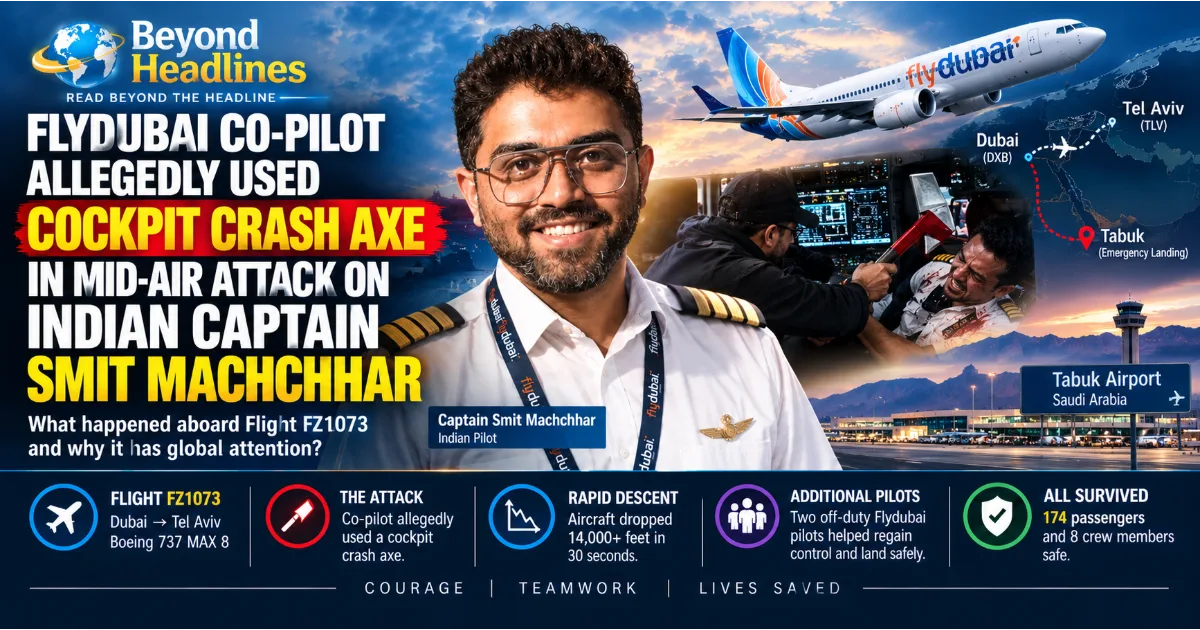
The Flydubai flight that descended thousands of feet over Saudi Arabia on September 30 has now become the subject of a far more serious investigation after United Arab Emirates authorities said the co-pilot attacked Captain Smit Machchhar with a cockpit crash axe and attempted to take control of the aircraft. What initially emerged as reports of a cockpit altercation has developed into an officially described attempted terrorist act, according to the UAE Attorney General. The revelation changes the understanding of the incident, because investigators are no longer examining only an extraordinary fight between two pilots. They are examining whether a deliberate plan was carried out inside the flight deck of a commercial aircraft carrying 174 passengers and eight crew members. (WAM)
The aircraft, Flydubai Flight FZ1073, was travelling from Dubai International Airport to Ben Gurion Airport near Tel Aviv when the emergency unfolded over Saudi Arabia. According to flight-tracking data cited by Reuters and other reporting, the Boeing 737 MAX 8 was cruising at roughly 34,000 feet before losing more than 16,000 feet in a little over 30 seconds. The aircraft eventually diverted to Tabuk in northwestern Saudi Arabia, where it landed safely. Captain Machchhar was seriously injured, while the co-pilot was detained after passengers, crew and other pilots aboard the aircraft intervened. The survival of everyone aboard turned what could have been an aviation catastrophe into a story of emergency response, cockpit resilience and extraordinary human intervention. (Reuters)
The latest revelations also raise uncomfortable questions about aviation security. A crash axe is not an improvised object brought onto an aircraft by a passenger. It is emergency equipment carried aboard aircraft for specific purposes. The International Civil Aviation Organization's aviation taxonomy defines a crash axe as equipment intended to enable survivors to cut an exit path from an aircraft when normal exits are obstructed after an accident. The presence of such equipment inside an aircraft is therefore part of established emergency planning. What investigators now have to examine is how an item designed for survival in an emergency became an alleged weapon during an attack initiated from inside the cockpit itself. (ICAO)
From cockpit altercation to suspected terrorist attack
When the first reports emerged on September 30, the circumstances were unclear. Flydubai confirmed that FZ1073 had experienced an incident while travelling from Dubai to Tel Aviv, that the aircraft had diverted to Tabuk and that all passengers were safe and accounted for. The UAE General Civil Aviation Authority described it as a security incident and said crew members had been injured and taken to hospital. At that stage, officials deliberately avoided speculation about the cause or motive. (WAM)
The UAE Attorney General then ordered a formal investigation on October 1. The investigation was tasked with establishing the facts, circumstances and motives and determining whether the incident involved terrorist activity, prior planning or outside direction. Authorities also warned the public against circulating unverified information. That caution was important because many conflicting accounts had already appeared online, while the precise events inside the cockpit were not yet publicly established. (WAM)
By October 3, however, the official picture had changed significantly. UAE Attorney General Hamad Saif Al Shamsi said the investigation had found that the co-pilot attempted to carry out a terrorist act. According to the statement carried by the Emirates News Agency, the co-pilot attacked the captain inside the flight deck with a crash axe and attempted to take control of the aircraft. The investigation remains open, particularly regarding motives, connections, technical evidence and the full circumstances surrounding the incident. (WAM)
That distinction is important. The characterization of the incident as an attempted terrorist act now comes from the UAE's senior prosecutorial authority, rather than simply from passengers or political officials. But several questions remain unresolved, including whether the alleged attacker acted alone, what motivated him, whether he had any organisational connections and how he was cleared to serve as a commercial airline co-pilot. Those questions will ultimately determine the broader security implications of the case.
The attack inside the cockpit
The most dramatic part of the incident occurred in the flight deck. Captain Smit Machchhar was the pilot in command of the aircraft. The co-pilot was the other operating pilot. The cockpit was therefore a highly restricted environment containing the people responsible for controlling a Boeing 737 MAX 8 carrying hundreds of people.
According to the UAE investigation, the co-pilot used the aircraft's crash axe to attack Machchhar and then attempted to take control of the aircraft. Earlier accounts had described the incident as a stabbing, but the later investigation indicates that the weapon involved was the cockpit crash axe. The change in understanding is significant because it provides investigators with a specific account of how the attack allegedly began. (Reuters)
Passenger accounts and later statements from Machchhar provide additional detail about the moments surrounding the attack. According to an account reported by the Indian Express, Machchhar said the co-pilot stood up and said he wanted to pray. The captain did not regard the request as unusual and did not turn around because he understood that his colleague was praying behind him. Several minutes later, Machchhar said he felt a powerful blow to the back of his head. He initially did not understand what had happened. A second blow made him realise that he was being attacked. (The Indian Express)
These details remain part of the captain's account of the incident, rather than a complete independently reconstructed sequence. Investigators will need to compare his testimony with cockpit recordings, aircraft data, physical evidence, statements from other crew members and passengers, and any other available evidence. Nevertheless, his account helps explain why the initial moments were so difficult to comprehend. A pilot who believes his aircraft has suffered an external impact may lose precious seconds before understanding that the danger is coming from another person inside the cockpit.
The aircraft begins its terrifying descent
The attack did not remain confined to the flight deck. It immediately affected the aircraft's flight path.
FZ1073 had been cruising at approximately 34,000 feet. Flight-tracking data showed an extraordinary descent during the confrontation. Reuters reported that the aircraft lost more than 14,000 feet in about 30 seconds in its initial descent, while later reporting based on tracking data put the total loss at approximately 16,625 feet in just over 30 seconds. The precise measurement differs depending on the portion of the descent being examined, but there is no dispute that the aircraft underwent an exceptionally rapid loss of altitude. (Reuters)
For passengers, the experience initially felt like severe turbulence. People aboard the aircraft described the aircraft suddenly dropping and then stabilising before descending again. Some passengers did not immediately understand that something was happening inside the cockpit. That confusion is understandable. At cruising altitude, passengers have no direct view of the flight deck and generally depend on cabin crew announcements to understand unusual aircraft behaviour.
As the aircraft descended, the cockpit became the centre of the emergency. The captain had been injured. The co-pilot was allegedly attempting to seize control. And the aircraft itself was no longer maintaining its normal cruising profile.
The situation created a dangerous combination of a security emergency and a flight-control emergency.
Captain Machchhar's last push to open the cockpit door
One of the most important moments came when the injured captain reached the cockpit door.
Modern commercial aircraft have reinforced cockpit doors designed to protect the flight deck from unauthorised access. Access from the cabin is controlled, and the system is designed to prevent an attacker outside the cockpit from simply entering. In this incident, however, the threat was reportedly already inside.
According to Machchhar's account to Indian Prime Minister Narendra Modi and later comments reported from his conversation with Israeli Prime Minister Benjamin Netanyahu, he realised that the aircraft was descending and that he had to act despite his injuries. He managed to reach the cockpit door and open it, although the door was reportedly closed again before he made another attempt. On the second attempt, the door opened and people outside entered the cockpit. (CBS News)
That decision became a critical turning point.
The captain was badly injured, but opening the cockpit door allowed other people aboard the aircraft to intervene. Passengers and crew members moved into the flight deck, where they confronted the attacker. The co-pilot was eventually subdued, removing the immediate threat to the aircraft's controls.
The incident therefore depended on an unusual chain of events. The injured captain had to regain enough physical control to reach the door. People in the cabin had to understand that an emergency was occurring. They then had to enter the cockpit and stop the alleged attacker. Finally, qualified pilots had to take control of the aircraft and bring it safely to the ground.
Two additional pilots were on board
Perhaps one of the most extraordinary details is that FZ1073 was carrying two additional Flydubai pilots who were travelling as passengers.
They were not originally operating the flight. They were reportedly travelling to Tel Aviv because they were scheduled to operate the return journey. In aviation terminology, this type of repositioning is commonly known as deadheading. Their presence aboard FZ1073 was therefore routine from an airline staffing perspective, but it became extraordinarily important once both operating pilots were involved in the cockpit incident. (The Indian Express)
After the cockpit door opened and passengers and crew intervened, the two additional pilots moved into the flight deck and helped regain control of the aircraft. They were able to use their training and knowledge of the Boeing 737 to stabilise the aircraft and prepare for an emergency landing.
This is one of the reasons the incident is unusual from an aviation perspective. The aircraft had four Flydubai pilots aboard, but only two were scheduled to operate the flight. When the two operating pilots became involved in the confrontation, the presence of the two repositioning pilots provided an extraordinary layer of redundancy.
The additional pilots were not simply passengers who happened to understand aviation. They were qualified professionals familiar with the aircraft and airline procedures. Their presence gave the passengers and crew an immediate way to transition from fighting the attacker to recovering control of the aircraft.
The role of the passengers and cabin crew
The response inside the aircraft was not limited to professional pilots.
Passengers and crew members moved toward the cockpit after realising that something was seriously wrong. Reuters reported that passengers and crew entered the flight deck after the captain opened the door and helped subdue the co-pilot. Video verified by Reuters showed the aftermath, including the injured captain and the subdued attacker. (Reuters)
The passengers were confronted with a situation that ordinary airline safety briefings do not prepare them to experience. They were not simply dealing with turbulence or a mechanical emergency. There was an alleged violent attack inside the cockpit and an aircraft that had already undergone a dramatic descent.
Their response was therefore significant.
The UAE aviation authority specifically praised the courage and speed of response of Captain Machchhar, the crew and the passengers who helped bring the situation under control. The GCAA said their decisive intervention prevented more serious consequences. It also confirmed that Machchhar had returned safely to the UAE and was receiving medical treatment. (WAM)
The episode illustrates how emergency preparedness can extend beyond formal procedures. Commercial aviation is designed around professional crews, but an extreme situation can involve everyone aboard an aircraft. In this case, the survival outcome depended on cooperation between people who had very different roles and levels of training.
What is a cockpit crash axe actually for?
The revelation that a crash axe was allegedly used as a weapon has prompted widespread questions about why an aircraft carries such an object in the first place.
The answer is connected to emergency survivability.
Aircraft carry emergency equipment because passengers and crew may need to escape from an aircraft that has been damaged. A crash can deform doors, block passageways or create structural obstacles that prevent people from reaching normal exits. The ICAO ECCAIRS aviation taxonomy describes a crash axe as equipment provided to help survivors cut an exit path when an aircraft has sustained damage that obstructs normal exits. (ICAO)
The axe is therefore part of the broader emergency equipment philosophy of commercial aviation. It exists because an aircraft can suffer structural damage in an accident and people may need tools to reach an exit.
The fact that it can cause injury does not make its presence unusual. Many emergency tools have potentially dangerous physical capabilities because they are designed for situations in which ordinary methods of escape may no longer work.
What makes the Flydubai case exceptional is that the tool was allegedly turned against a crew member during flight.
That is precisely why the incident is likely to attract aviation-security scrutiny. Investigators will need to understand the storage arrangements, access procedures and cockpit protocols surrounding the equipment, while also recognising that the alleged attacker was a member of the flight crew who would already have access to the flight deck.
The question is therefore not simply why an axe was aboard the aircraft. It is how security procedures account for the possibility that an authorised person inside the cockpit could misuse emergency equipment.
The investigation into the co-pilot's background
The incident has also triggered questions about how the co-pilot was recruited and cleared to fly.
Reuters and other outlets identified the co-pilot as Omani national Hammam al-Hammami, although the UAE authorities have not publicly confirmed his identity in the same manner. Reports citing US officials and other sources have said that he had previously been suspended or barred from flying in Oman over security concerns and allegations relating to extremist views. Those claims are now part of the public debate surrounding the case, but they must be distinguished from findings formally established by investigators. (ABC News)
Reports have also said he was subsequently moved into an administrative position at Oman Air before later working for Flydubai. The precise sequence of his employment history and the reasons behind previous employment decisions remain subjects of scrutiny.
This is potentially one of the most important questions raised by the case.
Airline pilot recruitment is necessarily intensive. Pilots responsible for carrying hundreds of passengers undergo professional training, licensing, medical assessments and background checks. The system also depends on airlines and aviation authorities being able to identify information that could affect flight safety or security.
If it is established that a previous authority had identified a serious security concern and that information did not reach the relevant airline or regulator, the consequences could extend beyond this individual incident. It could prompt questions about how international pilot records are shared, how security information moves across borders and how airlines assess applicants who have previously worked for other carriers.
But those conclusions should wait for the investigation.
The unusual question of an Omani pilot on a Tel Aviv flight
Another issue attracting attention is how an Omani national came to serve as a pilot on a flight to Israel.
Oman does not have diplomatic relations with Israel. Israeli officials have previously stated that pilots from countries without diplomatic relations with Israel face restrictions relating to operating flights there. Reuters reported that Israeli officials were examining how the co-pilot came to be assigned to FZ1073 and whether anyone else was involved in his actions. (Global Banking & Finance Review)
This issue is separate from the alleged attack itself.
A pilot's nationality does not establish motive, intent or political affiliation. The relevant question for investigators is how the airline's operational and security systems allowed this particular individual to be assigned to a Tel Aviv-bound flight and whether all applicable procedures were followed.
The distinction matters because the investigation must focus on evidence rather than nationality.
UAE authorities now describe it as an attempted terrorist act
The language used by authorities has become significantly stronger since the incident.
On October 1, the UAE Attorney General was still directing investigators to determine whether the incident had any terrorist connection or whether it had been planned or directed. Two days later, the Attorney General said the investigation had found that the co-pilot attempted to carry out a terrorist act. (WAM)
That represents an important development.
The UAE is not merely describing an act of violence between two pilots. Its prosecutor general says the investigation has found evidence of an intended terrorist act involving an attempt to seize control of the aircraft.
At the same time, the investigation remains open. The Attorney General said investigators were continuing to examine the circumstances, motives and related connections, as well as physical and digital evidence. That means the public has not yet received a complete account of the alleged plan or its origins. (The National News)
The difference between an official preliminary finding and a completed judicial process is important. The investigation may establish additional facts that clarify or modify the current understanding of the event.
Was there a wider extremist connection?
Authorities and media reports have raised the possibility that the co-pilot had extremist ideological views. Some officials have gone further, publicly characterising his background as involving radicalisation.
Those claims require careful handling.
There is a difference between an individual's alleged extremist views, a confirmed affiliation with an extremist organisation and evidence of an organised terrorist plot. The first does not automatically establish the second or third.
The UAE investigation is examining whether there were connections behind the incident. Reuters reported that Israeli officials were expected to participate in the investigation and that Israeli authorities were examining whether the co-pilot had acted under anyone's direction. (Global Banking & Finance Review)
Until investigators establish evidence of such a connection, the safest conclusion is that the UAE has classified the incident as an attempted terrorist act while the question of whether the suspect acted alone or with outside support remains under investigation.
That distinction will be particularly important because the flight was bound for Israel and most of the passengers were Israeli nationals. The possibility of political or ideological motivation is therefore being examined seriously, but motive cannot be established solely from the destination of the aircraft or the nationality of those aboard.
The dramatic flight path tells its own story
The flight data provides an unusually clear indication of how severe the emergency became.
FZ1073 departed Dubai and climbed to its cruising altitude. For much of the journey, the flight appeared normal. Then, during the cockpit confrontation, the aircraft's altitude changed dramatically. Flight-tracking data showed a descent from approximately 34,000 feet to far lower altitude levels within a matter of seconds and minutes. The aircraft then stabilised before descending again as the crew worked to regain control and divert to Tabuk. (Reuters)
The aircraft's route also changed.
Instead of continuing toward Tel Aviv, the Boeing 737 turned toward Tabuk in northwestern Saudi Arabia. The emergency landing gave the injured captain and other crew members access to medical treatment and removed the aircraft from the immediate danger created by the cockpit incident.
Saudi authorities later confirmed that the aircraft landed safely at Tabuk carrying 174 passengers and eight crew members. All passengers and crew were provided with necessary care. (Gulf News)
The numbers matter because early reports varied in how they described those aboard. Some reports referred to approximately 170 passengers, while others referred to 182 people in total. The Saudi Interior Ministry's account provides the clearest breakdown cited here: 174 passengers and eight crew members. (Gulf News)
Captain Machchhar's injuries and recovery
Machchhar was seriously injured during the attack and required medical treatment after the emergency landing.
The UAE General Civil Aviation Authority later confirmed that he had returned safely to the UAE and was in good condition while receiving further medical care. Indian authorities have also remained in contact with his family and local authorities. (WAM)
His recovery has become a major part of the story in India, where his actions have been widely praised.
Indian Prime Minister Narendra Modi spoke to Machchhar while he was receiving treatment. According to reporting on their conversation, the captain described recognising that the aircraft was descending and deciding that he had to make one more attempt to reach and open the cockpit door. (CBS News)
His account gives the incident a human dimension that flight-tracking data cannot provide.
The data shows the altitude falling. It does not show what it feels like to be injured, disoriented and lying inside a cockpit while knowing that hundreds of people depend on the aircraft being controlled.
Machchhar's testimony provides a glimpse into those moments.
Why the presence of two extra pilots mattered so much
The two additional Flydubai pilots aboard FZ1073 were not there because of the emergency. They were reportedly repositioning for a subsequent flight.
Their presence illustrates how ordinary airline logistics can unexpectedly become a safety advantage.
Once the operating captain was injured and the co-pilot had been subdued, the aircraft needed qualified people to fly it. Passengers could help restrain an attacker, but they could not simply take over a Boeing 737 MAX 8. The two additional pilots could.
Their intervention therefore created a bridge between the security emergency and the aviation emergency.
They stabilised the aircraft, communicated with air traffic control and helped guide it toward Tabuk. Their professional familiarity with the aircraft meant that the flight could continue under controlled conditions rather than becoming a prolonged crisis.
The fact that they were aboard was described by passengers as extraordinary. It was also a reminder that aviation safety can sometimes depend on circumstances that are not specifically designed into an emergency plan.
What the crash axe revelation changes
The first reports of a stabbing suggested a violent confrontation inside the cockpit. The revelation that the UAE investigation says a crash axe was used provides a more specific understanding of the alleged attack.
It also creates a different set of security questions.
The crash axe is emergency equipment. It is not classified as a passenger weapon in the normal sense. Its presence on an aircraft is linked to emergency survival and aircraft safety. ICAO's taxonomy specifically recognises the crash axe as equipment for cutting an escape path through damaged aircraft structures. (ICAO)
The incident therefore illustrates an unusual security problem: equipment designed to improve survival can potentially be misused by an authorised individual.
That does not mean crash axes are inherently a security flaw. Removing essential emergency equipment could create risks of its own. Instead, the case raises questions about access, storage, cockpit procedures and crew security protocols.
Those questions will need to be examined through the formal investigation.
The aviation-security implications could extend beyond Flydubai
The most important consequences may emerge after investigators complete their work.
If the investigation establishes that the co-pilot had previously been identified as a security concern and that relevant information was not adequately shared, airlines and regulators could examine international systems for pilot background screening.
If investigators find that cockpit emergency equipment was accessible in ways that created an avoidable vulnerability, airlines could review procedures governing such equipment.
If the incident demonstrates weaknesses in monitoring the mental or ideological conduct of flight crew, aviation authorities could examine whether existing safeguards are sufficient.
But it would be premature to assume that any of these weaknesses have been established.
The UAE GCAA has specifically warned that it will not comment on claims that could pre-empt the investigation. The authority said the investigation team is following approved procedures and coordinating with relevant regional and international organisations. (WAM)
That approach is important because aviation investigations depend on evidence rather than speculation.
The cockpit door became the decisive point
The reinforced cockpit door is designed to protect pilots from threats originating in the cabin.
In this case, the situation was reversed.
The threat was already inside.
That is what makes the Flydubai incident particularly difficult from a security perspective. A cockpit door can prevent an unauthorised person from entering, but it cannot by itself prevent a person who has legitimate access to the flight deck from becoming violent.
The captain's ability to open that door from inside became the decisive factor that allowed others to intervene.
The episode does not mean cockpit security systems failed in a conventional sense. Rather, it exposes a different category of threat that aviation security has to consider: the insider threat.
The insider threat is not unique to aviation. Security systems across airports, airlines and critical infrastructure must account for the fact that authorised personnel have access that ordinary outsiders do not.
The challenge is to maintain trust and operational efficiency while identifying genuine security risks without treating every employee as a potential threat.
The Flydubai investigation could therefore have implications beyond the specific airline if it identifies lessons about insider threats within commercial aviation.
A story of teamwork rather than one person alone
Captain Machchhar has been widely celebrated as the central figure in the incident, and his actions clearly played a critical role.
But the outcome depended on more than one person.
The captain reached the door despite his injuries. Passengers and crew entered the cockpit. The alleged attacker was subdued. Two additional pilots took control. Saudi authorities prepared for the emergency landing. Medical teams treated the injured crew members. UAE authorities launched a formal investigation.
The GCAA itself emphasised this collective response, praising the captain, crew and passengers for their courage and speed. (WAM)
This matters because aviation safety is fundamentally a system.
A single pilot cannot normally compensate for every possible failure. A single passenger cannot land a commercial jet. A single airport team cannot resolve a cockpit security emergency without cooperation from the aircraft crew.
The survival of everyone aboard FZ1073 resulted from multiple layers of intervention operating in sequence.
What remains unanswered
Despite the growing amount of information, some of the most important questions remain open.
Why did the co-pilot attack the captain?
Was the crash axe attack planned before the aircraft departed Dubai?
Was the alleged attack connected to extremist ideology?
Did the suspect act alone?
Did anyone assist, encourage or direct him?
What was the precise sequence of events inside the cockpit?
Why did the aircraft lose altitude so rapidly?
How much damage did the aircraft sustain?
What information did previous employers or authorities have about the co-pilot?
How was he cleared to operate a flight to Israel?
Were all recruitment and security procedures followed?
What changes, if any, will regulators recommend?
These questions will require evidence from multiple jurisdictions. The UAE is leading the investigation, while Saudi Arabia and Israel have been involved in aspects of the case. Reuters has reported that Israeli investigators are expected to participate, particularly given the destination and passenger profile of the flight. (Global Banking & Finance Review)
The international nature of the investigation is itself significant. The aircraft was UAE-registered and operated by a UAE airline, the incident occurred over Saudi Arabia, the flight was bound for Israel, the captain was Indian and the alleged attacker was Omani.
One flight therefore brought together aviation authorities and investigators from several countries.
The wider significance for commercial aviation
The Flydubai incident is likely to become a case study in aviation security because it combines several rare circumstances.
A commercial aircraft suffered an alleged deliberate attack by one of its own operating pilots. An emergency tool was allegedly used as a weapon. The aircraft underwent an extreme descent. The captain was seriously injured but managed to open the cockpit door. Passengers and crew intervened. Two additional pilots happened to be travelling aboard the aircraft and took over flight duties. The aircraft then made an emergency landing in another country.
Each element is unusual by itself.
Together, they created a scenario in which conventional aviation procedures were tested under extreme pressure.
The International Civil Aviation Organization's framework recognises the importance of cabin safety, crew training, equipment and security-related procedures in international commercial aviation. The organisation's safety framework covers areas ranging from emergency equipment and crew duties to security procedures designed to prevent unlawful acts against civil aviation. (ICAO)
The FZ1073 incident will inevitably raise questions about how those principles apply when the alleged threat originates from within the flight deck.
The human factor remains at the centre
Technology played a role in the survival of the flight. The aircraft's systems continued operating, flight data was recorded and air traffic control was able to support the diversion.
But the most decisive actions were human.
The captain recognised the danger and acted despite his injuries. Passengers and crew responded quickly. The additional pilots used their training to stabilise the aircraft. Saudi emergency services received the aircraft and treated the injured crew.
That combination of professional training and individual courage prevented the incident from becoming something far worse.
It is also why the case has resonated so strongly in India.
Captain Smit Machchhar was not merely performing his normal duties. He was suddenly fighting for his own life while also confronting the possibility that the aircraft could be lost with everyone aboard. His decision to make one more attempt to open the cockpit door gave others an opportunity to intervene.
The fact that he survived and has returned to the UAE for treatment adds an important final chapter to the immediate crisis.
From an ordinary flight to an extraordinary emergency
Flight FZ1073 began as an ordinary commercial service between Dubai and Tel Aviv.
It ended as one of the most extraordinary aviation-security incidents of recent years.
The aircraft carried 174 passengers and eight crew members. It climbed to cruising altitude. Then an alleged attack inside the cockpit triggered a dramatic descent and a desperate struggle for control.
The UAE now says the co-pilot used a crash axe to attack Captain Machchhar and attempted to take control of the aircraft in what authorities have classified as an attempted terrorist act. Investigators are continuing to examine the suspect's motive, background, possible connections and the full sequence of events. (WAM)
The crash axe itself was never designed to be a weapon. It exists because aircraft accidents can make normal exits inaccessible. Yet on this flight, according to investigators, an emergency tool was allegedly turned into an instrument of attack.
That contradiction is at the heart of the security questions now facing aviation authorities.
The story is also a reminder that aviation emergencies do not always unfold according to training scenarios. A pilot may become a victim. Passengers may suddenly become part of the emergency response. Off-duty pilots may become the only people available to restore control. A routine repositioning journey may become the difference between disaster and survival.
The investigation will determine what happens next
The immediate crisis ended when FZ1073 landed safely in Tabuk.
The larger investigation is only beginning.
Authorities must now reconstruct the incident from the aircraft's flight data, cockpit evidence, physical evidence, passenger and crew testimony and other intelligence. They must determine whether the attack was planned, why it occurred and whether anyone else was involved.
They must also examine the recruitment and security history of the accused co-pilot and determine whether any warning signs were missed or whether the available information was insufficient to prevent his assignment to a commercial cockpit.
The findings could influence aviation security practices well beyond Flydubai.
For now, however, the most important distinction is between what has been established and what remains under investigation. The UAE Attorney General has officially described the incident as an attempted terrorist act and said the co-pilot attacked the captain with a crash axe while attempting to take control of the aircraft. The aircraft's dramatic descent and emergency landing are supported by flight-tracking data and official statements. The captain's injuries and the intervention of passengers, crew and additional pilots are also well documented. (Reuters)
The motive, the extent of any extremist connection, whether the suspect acted alone and whether any security failures contributed to his presence in the cockpit remain questions for investigators.
What is already clear is that the aircraft came dangerously close to catastrophe.
Captain Smit Machchhar's injuries did not prevent him from making a final attempt to reach the cockpit door. That action allowed passengers and crew to intervene. Two additional pilots then helped stabilise the aircraft. The Boeing 737 MAX 8 was diverted to Tabuk, where all 174 passengers and eight crew members survived.
The story therefore goes beyond the shocking revelation that a crash axe was allegedly used inside a commercial cockpit.
It is also a story about what happens when a security threat emerges from inside the most protected part of an aircraft, when a captain is injured, when a plane begins falling thousands of feet and when the people aboard have only moments to respond.
It is a story of an alleged terrorist attempt that investigators are still working to fully understand.
It is a story of a cockpit security system tested by an insider threat.
And above all, it is a story of how an injured captain, passengers, cabin crew and additional pilots collectively prevented Flight FZ1073 from becoming a tragedy.
For Beyond Headlines, the most important question is not only how the attack happened. It is what the aviation industry can learn from it. If the investigation identifies failures in recruitment, information sharing, security screening or cockpit procedures, those lessons could shape how airlines approach insider threats in the future. If no systemic failure is identified, the case will still demonstrate the importance of training, redundancy and human decision-making during extreme emergencies.
The final answers will come from investigators.
But the central fact remains extraordinary. A commercial jet carrying 174 passengers and eight crew members was placed in extreme danger after an alleged attack inside its cockpit. The captain was seriously injured. The aircraft plunged from cruising altitude. Yet the cockpit door was opened, the attacker was subdued, additional pilots took control and the aircraft reached the ground safely.
The crash axe revelation has made the incident more serious, not less. It has transformed an initially mysterious cockpit confrontation into an officially investigated attempted terrorist act and placed new focus on the question of how aviation systems protect themselves from threats originating within.
The world will now be watching the investigation for answers.
#BeyondHeadlines #Flydubai #FlydubaiFZ1073 #SmitMachchhar #CaptainSmitMachchhar #AviationSecurity #AviationSafety #CockpitAttack #CrashAxe #Terrorism #TerroristAttack #India #IndianPilot #UAE #SaudiArabia #Tabuk #Israel #Dubai #AviationNews #AirlineSecurity #Boeing737MAX #Pilot #CommercialAviation #FlightSafety #AviationInvestigation #MiddleEast #GlobalSecurity #InternationalNews #WorldNews #ReadBeyondTheHeadline