
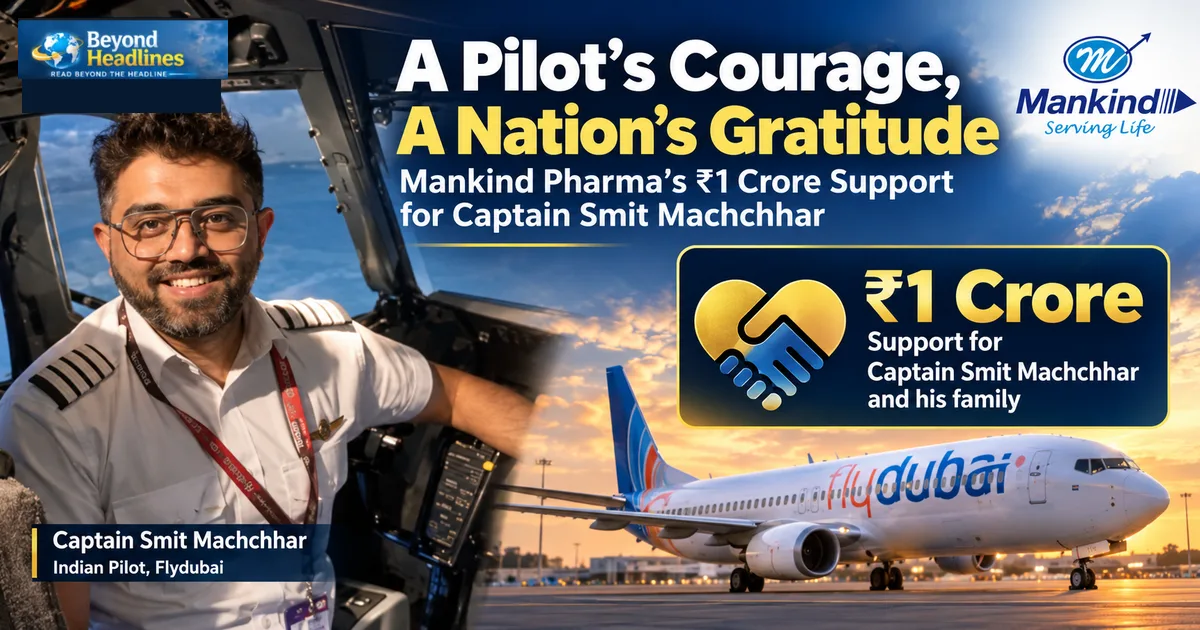
There are moments when a person's professional responsibility becomes something much larger than a job. For Captain Smit Machchhar, that moment came thousands of feet above the ground when a routine Flydubai flight from Dubai to Tel Aviv turned into a life-threatening cockpit emergency. Seriously injured during the confrontation, Machchhar nevertheless remained focused on protecting the aircraft and the people inside it. His actions helped prevent what could have become a catastrophic aviation disaster. Reuters
Days after the incident, the story moved from aviation headlines into a broader conversation about courage, responsibility and how society should respond when an individual puts the safety of others before his own. Mankind Pharma has now announced ₹1 crore in financial support for Captain Machchhar and his family, describing the contribution as an expression of gratitude for his courage, composure and sense of responsibility during the crisis. Passionate In Marketing
At first glance, ₹1 crore may look like the central part of the story. It is a large amount of money, particularly when offered to an individual outside the company's normal business relationships. But the more meaningful question is why a pharmaceutical company decided to step forward for an airline captain.
The answer lies in the nature of the gesture itself. Mankind Pharma has framed the contribution not as a commercial transaction, sponsorship or reward for performance, but as an expression of gratitude. The company's Vice Chairman and Managing Director, Rajeev Juneja, said that some acts of courage deserve more than words of appreciation and that the company wanted its gratitude to take the form of meaningful support for Machchhar and his family. Passionate In Marketing
That distinction matters because Captain Machchhar did not perform an extraordinary act expecting recognition. He was doing what pilots are trained and entrusted to do. The difference was that he was forced to perform that duty under circumstances that placed his own life in immediate danger.
The story therefore goes beyond a corporate announcement. It raises a larger question about how we recognize courage in a society where many people are expected to perform difficult responsibilities quietly, often without public attention.
The Flight That Changed Everything
On September 30, 2026, Flydubai flight FZ1073 was travelling from Dubai to Tel Aviv when an extraordinary confrontation unfolded inside the cockpit. Captain Smit Machchhar was reportedly attacked by his Omani co-pilot during the flight. Reports said the aircraft subsequently entered a steep descent before control was regained. AP News
The precise circumstances and motive behind the attack remain matters for investigation. Authorities have been examining the incident, and it is important not to turn allegations or early reports into established facts before investigations are completed.
What is clear from multiple reports is that Machchhar suffered serious injuries and nevertheless played a crucial role in the effort to regain control of the aircraft.
The aircraft eventually diverted to Tabuk in Saudi Arabia, where it landed safely. Reports have differed in how they describe the number of people aboard, with several accounts citing 174 passengers and others referring to a total of 182 people including passengers and crew. What is not in dispute is that a large number of people were on board and that the aircraft reached safety after an extremely serious cockpit emergency. AP News
The incident could easily have ended differently.
An aircraft in flight is an environment where seconds matter. A problem in the cockpit can rapidly become a problem for everyone on board. A pilot dealing with injuries, an uncontrolled confrontation and a rapidly changing aircraft situation has very little room for error.
That is why Machchhar's response received such widespread attention.
Courage Under Conditions Nobody Can Rehearse
Aviation training prepares pilots for emergencies, but no training exercise can perfectly reproduce every possible real-world crisis.
Pilots practise engine failures, system malfunctions, communication problems, unusual attitudes and other emergency scenarios. They learn procedures because procedures reduce uncertainty when the pressure is extreme.
But a physical attack inside the cockpit is an entirely different challenge.
Machchhar reportedly suffered multiple injuries while trying to maintain control of the situation. According to reports, he managed to open the cockpit door, allowing passengers and crew members to intervene. Two off-duty pilots who were travelling as passengers also became involved in helping bring the aircraft under control. Reuters
This detail is important because the story should not be reduced to one person acting alone.
Machchhar played a central role, but aviation safety is built around teamwork. Once the cockpit door was opened, other people were able to assist. Other pilots on board contributed their expertise. Cabin crew and passengers also played roles in bringing the confrontation under control.
The successful outcome was therefore a combination of individual courage, professional training, teamwork and circumstances that ultimately allowed the aircraft to land safely.
That makes the story even more valuable.
Leadership during a crisis is not always about doing everything yourself. Sometimes it is about creating the conditions in which other people can help.
The Moment When Duty Became Personal
A pilot's responsibility is often described in technical terms. The captain is responsible for the aircraft, the crew and the passengers. Regulations define responsibilities. Training establishes procedures. Airlines create safety systems.
But behind those formal responsibilities is a human reality.
Every passenger sitting in an aircraft has placed a remarkable amount of trust in people they may never meet personally.
They trust the pilots to make decisions.
They trust the engineers who maintain the aircraft.
They trust the cabin crew.
They trust air traffic controllers.
They trust airport security.
Most of the time, that trust is invisible because nothing goes wrong.
When something does go wrong, however, the importance of that trust becomes impossible to ignore.
Captain Machchhar's actions brought that responsibility into public view.
He was not protecting an abstract statistic.
He was protecting hundreds of individual lives.
Each passenger had a family, a career, relationships and a future waiting for them at their destination.
That is what makes the story emotionally powerful.
From Aviation Story to National Conversation
The incident quickly became a major story in India.
Prime Minister Narendra Modi publicly praised Machchhar's courage and said his actions helped save lives and avert a major tragedy. The Prime Minister's Office described Machchhar as a hero who showed immense courage and an unwavering resolve to protect others despite being seriously injured. Press Information Bureau
Modi later spoke directly with Machchhar and expressed admiration for his courage and recovery. The Prime Minister also highlighted the support that Machchhar had received in Saudi Arabia and the UAE during his treatment. PM India
Israeli officials also praised the Indian pilot.
The international response was significant because the people whose lives were at risk were from different backgrounds and nationalities. The aircraft was travelling toward Israel from Dubai, while the captain was Indian and the co-pilot was Omani. Passengers and other individuals on board became part of an emergency that crossed national boundaries. Reuters
That made Machchhar's actions a story not just about India, but about aviation, human responsibility and cooperation across borders.
Why Mankind Pharma Stepped In
Mankind Pharma's decision to provide ₹1 crore support gives the story another dimension.
A pharmaceutical company has no direct operational connection with an airline captain. The company was not responsible for the flight, the aircraft or the emergency.
Yet it chose to recognize the person at the centre of the incident.
Mankind Pharma said the contribution was intended to acknowledge Machchhar's courage, composure and commitment to the safety and well-being of those entrusted to his care. Passionate In Marketing
Rajeev Juneja's message emphasized that words alone did not feel sufficient and that the company wanted its appreciation to become meaningful support for Machchhar and his family. Passionate In Marketing
This is where the announcement becomes more interesting than a conventional corporate donation.
It represents a form of social recognition.
The company is effectively saying that certain acts have a value that cannot be measured through ordinary commercial calculations.
Can Money Ever Equal the Value of Lives Saved?
The obvious answer is no.
₹1 crore cannot place a monetary value on hundreds of human lives.
It cannot calculate the value of families remaining together.
It cannot measure the future experiences of people who were able to return home.
It cannot quantify the emotional impact of a disaster that did not happen.
That is why Mankind Pharma's announcement should not be interpreted as paying Machchhar for saving lives.
The company itself framed the money as a contribution and gesture of gratitude rather than a price attached to his actions. Passionate In Marketing
This distinction is essential.
When society financially recognizes a hero, the money does not purchase the courage that was demonstrated.
It acknowledges it.
The amount becomes symbolic as much as financial.
The real message is that someone noticed.
Someone recognized the sacrifice.
Someone decided that words alone were not enough.
The Importance of Supporting the Family
There is another reason the contribution matters.
When someone experiences an extraordinary crisis, the consequences rarely affect that person alone.
Captain Machchhar was injured.
His recovery requires medical care and time.
His family has also lived through the uncertainty and fear surrounding the incident.
His wife, children and parents have had to deal with the emotional consequences of seeing someone they love placed in extreme danger.
Prime Minister Modi's later conversation with Machchhar included references to his family and his children, highlighting how much the incident affected those around him. PM India
Financial support can never remove that emotional burden.
But it can provide practical security.
Medical treatment, recovery, rehabilitation, travel and other consequences of a serious injury can create costs that continue long after news coverage disappears.
Supporting the family therefore turns recognition into something tangible.
A Different Kind of Corporate Responsibility
Corporate social responsibility is often associated with education, healthcare, environmental programmes and community development.
Those areas remain important.
But companies can also respond to extraordinary circumstances in less predictable ways.
Mankind Pharma's support for Machchhar demonstrates another form of corporate citizenship.
It is the recognition of an individual act that reflects values the company wants to associate with its own identity.
Courage.
Responsibility.
Humanity.
Care for others.
These values are not exclusive to aviation.
They exist in healthcare, business, manufacturing, public service and everyday life.
A pharmaceutical company, in particular, operates in a sector built around human health.
Supporting someone who acted to protect human life therefore carries a natural symbolic connection with the company's broader purpose.
Why Small Gestures Can Matter
The phrase "small gesture" may sound strange when the amount involved is ₹1 crore.
Financially, it is not small.
But compared with the value of the lives involved, the company's gesture can reasonably be described as small in the sense that it cannot match what was at stake.
This is exactly why the gesture has attracted attention.
The company is not claiming that money can repay Machchhar.
It is acknowledging that gratitude can be expressed through action.
There is an important lesson here for society.
Recognition does not always have to be enormous.
A phone call can matter.
A visit can matter.
A public acknowledgement can matter.
A scholarship can matter.
A job opportunity can matter.
Financial assistance can matter.
What makes recognition meaningful is the intention behind it and whether it responds to the real needs of the person being recognized.
The Difference Between Praise and Support
Modern society is very good at producing praise.
A person does something extraordinary and social media fills with posts.
Politicians issue statements.
Celebrities publish messages.
Brands share photographs.
Hashtags trend.
For a few days, everyone knows the person's name.
Then the attention moves elsewhere.
This creates a problem.
Public recognition is valuable, but it can be temporary.
A serious injury is not temporary.
Recovery is not temporary.
Family responsibilities do not disappear when the news cycle ends.
That is why the distinction between praise and support matters.
Praise tells someone that society noticed.
Support helps someone after the cameras move away.
Mankind Pharma's contribution is significant precisely because it attempts to bridge that gap.
The Risk of Turning Heroism Into Entertainment
There is also a responsibility on everyone covering stories like this.
Heroic incidents can easily become entertainment.
Videos circulate.
Dramatic descriptions are repeated.
People speculate about what happened inside the cockpit.
Unverified details become accepted as facts.
The person at the centre of the story can become a symbol before they have even recovered from what happened.
That is dangerous.
Captain Machchhar's courage deserves recognition, but his privacy and recovery also deserve respect.
The investigation into the incident must be allowed to proceed.
Claims about motives, terrorism or the psychological condition of the attacker should not be treated as settled facts unless supported by authoritative findings.
This is particularly important because the incident has international implications.
Responsible reporting requires separating what is known from what is alleged.
The Story of Teamwork Is Just as Important
There is another part of the story that deserves greater attention.
Captain Machchhar's actions were crucial, but he was not alone in preventing disaster.
Passengers and crew members became involved after the cockpit door was opened.
Other pilots on board helped operate the aircraft.
The flight was diverted and eventually landed safely in Tabuk. AP News
This reminds us that crisis leadership is rarely a one-person phenomenon.
One individual can create the opportunity for others to act.
A captain can stabilize a situation.
A crew can respond.
Passengers can assist.
Professionals with relevant expertise can step forward.
The final outcome can depend on many people making correct decisions in a short period.
Machchhar's courage therefore should not erase the contribution of others.
Instead, it should highlight how courage can activate teamwork.
What Captain Machchhar's Story Teaches About Leadership
The word leadership is used constantly in business.
Companies conduct leadership programmes.
Executives attend seminars.
Managers read books about decision-making.
People discuss emotional intelligence, strategic thinking and crisis management.
But sometimes the clearest examples of leadership appear outside the corporate world.
Captain Machchhar's situation demonstrated several elements of leadership under extreme pressure.
The first was responsibility.
He understood that the aircraft was carrying other human beings whose safety depended on the cockpit crew.
The second was composure.
The circumstances were extraordinary, yet he continued to act.
The third was decision-making under uncertainty.
There was no opportunity to stop, reflect for an hour and create a perfect plan.
The fourth was willingness to accept personal risk.
Leadership becomes most meaningful when the person making the decision has something significant to lose.
These lessons are relevant far beyond aviation.
A hospital emergency room can produce similar pressures.
So can a factory accident.
So can a natural disaster.
So can a cybersecurity attack.
So can a crisis inside a company.
The details differ, but the underlying question remains the same.
What does a person do when responsibility becomes more important than personal comfort?
Why the Story Resonates So Strongly in India
India has a long tradition of celebrating individuals who place duty before themselves.
Military personnel, firefighters, police officers, doctors, emergency workers and ordinary citizens have all become symbols of courage after extraordinary events.
Captain Machchhar's story fits naturally into that cultural context.
He is an Indian pilot working internationally who was suddenly placed in a situation where his actions had consequences for people from multiple countries.
His response therefore became a source of national pride.
Prime Minister Modi explicitly described Machchhar as a hero and said India was proud of him. Press Information Bureau
But there is an important distinction between national pride and nationalism.
The most powerful part of the story is not simply that Machchhar is Indian.
It is that he protected people regardless of their nationality.
That makes the story universal.
A passenger sitting behind him did not matter because of their passport.
They mattered because they were human beings whose lives were entrusted to the flight crew.
Courage Has No Balance Sheet
Businesses operate through numbers.
Revenue is measured.
Profit is measured.
Costs are measured.
Investment is measured.
Shareholder returns are measured.
But courage does not fit comfortably into a balance sheet.
Neither does responsibility.
Neither does sacrifice.
Neither does the value of a life saved.
That is why gestures like Mankind Pharma's support are meaningful.
They create a bridge between the measurable and the immeasurable.
₹1 crore is measurable.
The value of the lives protected is not.
The contribution therefore becomes a symbolic financial expression of something that cannot actually be priced.
This is why the story should not become a discussion simply about whether ₹1 crore is enough.
It cannot be enough.
No amount could be enough in that sense.
The more relevant question is whether the gesture communicates genuine gratitude and whether it provides useful support to Machchhar and his family.
Recognition Can Shape Corporate Culture
There is also a lesson here for businesses.
Companies frequently talk about values.
Integrity.
Responsibility.
Courage.
Customer first.
People first.
Excellence.
But corporate values become meaningful when organizations demonstrate them through decisions.
Mankind Pharma's support provides an example of a company connecting its stated appreciation with a concrete action.
Whether one views the contribution primarily as philanthropy, corporate social responsibility or a gesture of gratitude, the message is clear.
The company believes extraordinary responsibility deserves recognition.
That can influence how employees and customers perceive an organization.
People remember what companies do.
They may forget advertisements.
They may forget slogans.
But they often remember moments when a company demonstrated a principle through action.
The Story Also Raises Questions About Aviation Safety
Beyond the emotional response, the incident raises serious questions for the aviation industry.
Cockpit security has evolved significantly since the terrorist attacks of September 11, 2001.
Modern commercial aircraft have reinforced cockpit doors, controlled access procedures and strict security protocols.
The reason is straightforward.
The cockpit must remain protected because control of the aircraft depends on it.
An incident involving an attack inside the cockpit therefore deserves careful examination.
Authorities will need to establish exactly what happened, how the confrontation began, how cockpit access was handled, how quickly the aircraft lost altitude, how control was restored and what procedures were followed afterward.
The investigation should ultimately produce lessons for airlines and regulators.
The goal should not simply be to identify blame.
It should be to understand how future incidents can be prevented or contained.
A Heroic Outcome Should Not Hide the Systemic Questions
There is a temptation after a successful emergency to focus entirely on the hero.
That is understandable.
People want to celebrate the person who prevented disaster.
But aviation safety improves when successful emergencies are studied as carefully as accidents.
Investigators need to understand not only what went right but also what vulnerabilities existed.
Why was the confrontation possible?
How did the cockpit door become accessible?
How did the aircraft respond?
How did other pilots become involved?
How did the crew coordinate?
How did authorities respond after landing?
Which procedures worked?
Which ones could be improved?
These questions do not diminish Captain Machchhar's courage.
They honour it by turning the experience into knowledge that could protect future passengers.
The Human Being Behind the Hero
There is a risk that once someone becomes a hero, the public stops seeing them as an ordinary person.
Captain Machchhar has become a symbol of courage.
But he is also a husband, father, son and professional who went through a deeply traumatic experience.
Prime Minister Modi's conversation with him highlighted his family and recovery, showing the human side of the story behind the public image. PM India
That is important.
Heroes also need time to heal.
They can experience fear.
They can experience exhaustion.
They can struggle with memories of what happened.
They can need emotional support just as much as physical treatment.
Recognizing heroism should therefore include recognizing the person's humanity.
What Mankind Pharma's Gesture Really Represents
The ₹1 crore contribution is not the story of a company giving money to a famous pilot.
It is better understood as an example of society responding to courage.
The company saw an act that had already been recognized nationally and internationally and decided to add tangible support.
That is why the gesture has resonated.
It communicates a simple idea.
When someone risks everything to protect others, society should not merely applaud.
It should stand beside that person.
The contribution cannot erase the injuries Machchhar suffered.
It cannot change what happened inside the cockpit.
It cannot replace the fear experienced by his family.
But it can help make the road to recovery a little more secure.
Sometimes that is what meaningful gratitude looks like.
Beyond the Headline
The headline is easy to write.
"Mankind Pharma gives ₹1 crore to Captain Smit Machchhar."
But the real story is much larger.
It begins with a pilot sitting in a cockpit performing one of the most responsibility-intensive jobs in the world.
It moves into an unexpected crisis in which that responsibility becomes a matter of life and death.
It continues with a seriously injured captain finding a way to help protect the aircraft and enable others to intervene.
It expands into a story involving passengers, crew, other pilots and emergency responders.
It reaches across borders through the response of India, Israel, Saudi Arabia and the UAE.
It becomes a national story when India's Prime Minister praises the captain.
And finally, it becomes a corporate story when Mankind Pharma decides that words of appreciation should be accompanied by meaningful support. PM India
The most important lesson may be the simplest one.
Responsibility becomes meaningful when it is tested.
Almost anyone can say they care about others when nothing is at stake.
The difficult moment comes when helping someone else requires personal sacrifice.
Captain Smit Machchhar faced that moment inside an aircraft.
He had every reason to focus on his own injuries.
Instead, his actions remained connected to the safety of the people who had entrusted their lives to him.
That is why his story has resonated so deeply.
And that is also why Mankind Pharma's contribution matters.
The money is not a price for bravery.
It is a way of saying that bravery was seen.
The gesture is not large enough to measure the value of what happened.
Nothing could be.
But recognition does not always need to repay an act.
Sometimes it simply needs to tell the person who performed it that society remembers.
In an age when corporate announcements often revolve around products, profits, acquisitions and market expansion, a company choosing to support an individual because he protected human lives stands out.
It reminds us that businesses are also part of society.
They can decide what kinds of behaviour they want to celebrate.
They can decide which values deserve public recognition.
And they can choose whether appreciation remains a sentence in a press release or becomes something tangible.
Captain Machchhar's story is ultimately not about ₹1 crore.
It is about responsibility under pressure, courage without preparation for applause and the human instinct to protect others even when personal safety is at risk.
Mankind Pharma's gesture simply adds another chapter to that story.
A pilot protected lives.
A nation recognized him.
A company decided to stand beside him.
And millions of people were reminded that some acts of courage are impossible to repay, but they should never be forgotten.
#BeyondHeadlines #CaptainSmitMachchhar #SmitMachchhar #FlyDubai #FlydubaiFZ1073 #MankindPharma #Courage #Bravery #Leadership #Humanity #Aviation #AviationSafety #India #IndianPilot #IndianHeroes #CorporateSocialResponsibility #CSR #Gratitude #Responsibility #CrisisLeadership #Heroism #HumanValues #LeadershipUnderPressure #PublicSafety #AviationIndia #IndiaProud #BeyondTheHeadline