
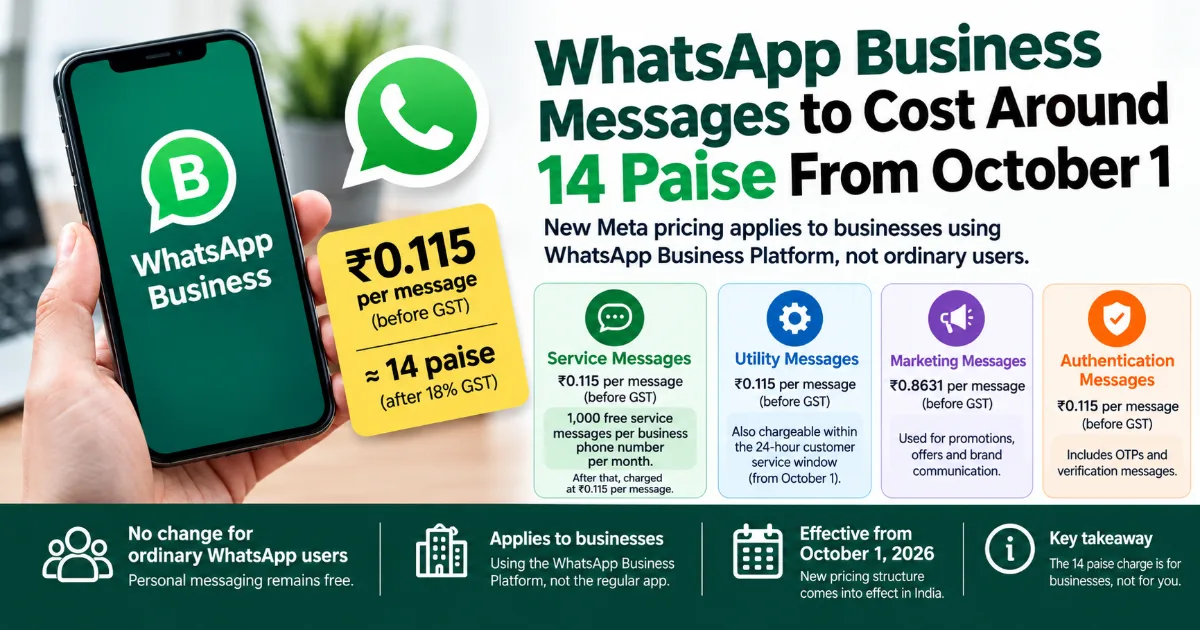
A new pricing change from Meta is set to alter the economics of business communication on WhatsApp in India from October 1, 2026. Reports about the change have generated confusion because headlines suggesting that “WhatsApp messages will cost 14 paise each” can easily be interpreted as meaning that ordinary users will have to pay to send messages. That is not what the new pricing structure means. The change applies to businesses using the WhatsApp Business Platform for customer communication, while ordinary users will continue to use personal WhatsApp messaging without a per-message charge.
The change is nevertheless significant for companies that depend heavily on WhatsApp for customer support, order updates, delivery notifications, account communication and automated service conversations. Meta is changing how certain business messages are billed, including messages sent during the 24-hour customer service window that businesses have traditionally used to respond to customers. In India, the applicable utility and service rate is ₹0.115 per delivered message before GST, which works out to approximately 14 paise after 18 percent GST.
The distinction between WhatsApp for ordinary users and the WhatsApp Business Platform is therefore at the heart of this story. A person chatting with family members, friends or colleagues is not suddenly going to be charged 14 paise every time a message is sent. A customer who receives an order confirmation or replies to a company's support team will not receive a bill from WhatsApp either. The charge is part of Meta's business messaging pricing structure and is paid by businesses using the platform for customer communication.
What Changes From October 1
The most important change concerns service messages. Until September 30, businesses using the WhatsApp Business Platform can generally send free-form replies to customers during the 24-hour customer service window without a separate Meta messaging charge. From October 1, that changes. Meta will provide each business phone number with a monthly allowance of 1,000 free service messages, after which additional service messages will be charged at the applicable rate. For Indian recipients, that rate is ₹0.115 per delivered service message before GST.
This means the widely reported 14 paise figure is not exactly the base price published by Meta. The underlying rate is ₹0.115, or 11.5 paise, before tax. Once 18 percent GST is included, the amount becomes approximately ₹0.136, which is usually rounded to around 14 paise. This distinction matters because businesses budgeting their communication expenses need to account for the pre-tax Meta charge as well as applicable taxes and potentially other fees charged by technology providers.
The new system also changes the treatment of utility messages. Utility messages are communications connected to a customer's transaction or relationship with a business. Examples include order confirmations, delivery updates, account alerts and similar information. From October 1, businesses can be charged for these messages even when they are sent during the 24-hour customer service window. India Today reports that the utility rate is ₹0.115 per delivered message before GST.
That is an important change because the 24-hour window has often been understood by businesses as a period in which they can communicate with customers more freely once the customer initiates a conversation. Under the new structure, the existence of that window does not automatically make every type of business message free. The category of the message matters.
The 1,000 Free Messages Matter
Meta's introduction of a 1,000-message monthly allowance provides some protection for businesses with relatively low customer-service volumes. The allowance applies to service messages for each business phone number. Once the monthly allowance has been used, additional service messages become chargeable. The allowance resets each month rather than accumulating indefinitely.
For a small business receiving only a modest number of WhatsApp enquiries, the change may therefore have little or no immediate financial effect. A business that sends fewer than 1,000 qualifying service replies through a particular business phone number in a month could remain within the free allowance for those service messages.
The situation is different for businesses operating large customer-support operations. An online retailer, financial services company, travel company, food delivery platform or large consumer brand may have thousands or millions of customer interactions every month. Even a relatively small per-message charge can become a meaningful operating cost when multiplied across a large number of outbound messages.
Consider a business that sends 100,000 chargeable service messages in a month after exhausting its free allowance. At the published Indian rate of ₹0.115 before GST, the Meta messaging charge would be ₹11,500 before tax. With 18 percent GST, that would be approximately ₹13,570. This is only an illustration of the Meta messaging component. A business could have additional charges from the technology provider or business messaging platform through which it operates WhatsApp.
The important point is that businesses will need to think about WhatsApp communication in terms of message volume, not simply the number of customers. A company may have a relatively small customer base but generate large messaging volumes if every transaction triggers several automated notifications and support replies.
Marketing Messages Are a Different Category
The 14 paise figure should also not be confused with the cost of marketing messages. Meta separates business communications into different categories, and marketing messages have a substantially higher rate in India.
The reported India rate for marketing messages is ₹0.8631 per delivered message before GST. These are communications such as promotional offers, sale announcements and other marketing-oriented messages. With 18 percent GST, the amount is approximately ₹1.02 per message.
That difference means a business cannot assume that every WhatsApp message it sends will cost around 14 paise. The actual price depends on the message category and the applicable Meta pricing rules.
Utility and authentication messages are listed at ₹0.115 per delivered message before GST for Indian recipients. Authentication communications can include one-time passwords and other verification messages. Service messages, after the monthly free allowance is exhausted, use the same ₹0.115 rate in India according to the reported October rate card.
The distinction is important for businesses because communication strategy can influence their messaging costs. A company sending promotional material is operating under a different pricing category from a company responding to a customer's support question. The new rules therefore do not simply introduce one universal WhatsApp Business charge.
Ordinary WhatsApp Users Are Not Being Charged
Perhaps the biggest source of confusion surrounding the announcement is the phrase “WhatsApp messages will cost 14 paise.” Taken literally, that statement is misleading.
There is no announcement that personal WhatsApp users will have to pay 14 paise whenever they send a message. Personal chats remain outside this business messaging pricing system. The change applies to businesses using the WhatsApp Business Platform. Reports covering the new rules have specifically emphasized that regular WhatsApp users are not affected by the per-message charge.
This also means that a customer does not have to pay simply because they are communicating with a business. If a person sends a message to a bank, retailer, airline or online shopping company through WhatsApp, the customer is not charged 14 paise for sending that message.
The cost is on the business side of the communication. This distinction is particularly important in India because WhatsApp has become a major customer-service channel for companies of all sizes. Many businesses use WhatsApp not only for marketing but also for transaction updates, customer questions, payment reminders and support.
WhatsApp Business App and Business Platform Are Not the Same
Another important distinction concerns the different products that can be described as “WhatsApp Business.”
The standard WhatsApp Business app is designed for businesses that communicate directly with customers, often from a smartphone. The WhatsApp Business Platform, by contrast, is designed for larger-scale business messaging and integration with customer-service software, automation systems and other technology.
The October pricing change being reported applies to the WhatsApp Business Platform. It should not be interpreted as a blanket announcement that every small business using the WhatsApp Business app will suddenly be billed 14 paise for every message sent from its phone.
This distinction is particularly relevant for India's millions of small businesses. A neighbourhood retailer, consultant, restaurant or local service provider may use the WhatsApp Business app manually to communicate with customers. A large e-commerce company may use the WhatsApp Business Platform to automatically send thousands of order confirmations and delivery notifications.
The two situations should not be treated as identical.
Why Meta Is Making the Change
The pricing revision is part of the broader evolution of WhatsApp from a messaging service into a major business communication platform. WhatsApp has become an important channel through which companies interact with customers, and Meta has increasingly developed commercial tools around that activity.
The shift toward per-message business pricing allows Meta to monetise communications that companies depend on for customer engagement and support. It also creates a more structured pricing system in which businesses pay according to the type and volume of messages they send.
For businesses, this means WhatsApp can no longer be treated simply as a free communication channel once a customer has initiated a conversation. The economics of customer service on the platform are becoming more measurable.
The change also reflects the broader transformation of digital messaging. Communication that once happened through email, SMS or telephone calls increasingly takes place inside messaging applications. When messaging platforms become essential business infrastructure, the cost of operating on them becomes an important part of corporate planning.
Impact on E-Commerce
E-commerce companies are among the businesses that could be affected by the change because they frequently use WhatsApp for transactional communication.
An online purchase can generate several communications. A customer might receive an order confirmation, payment confirmation, dispatch notification, delivery update and post-delivery communication. If the customer then contacts support, the conversation can generate additional outbound responses.
Individually, each message may cost only a fraction of a rupee. Across millions of orders, however, the cumulative volume can become substantial.
Businesses will therefore have an incentive to examine how many messages are generated by each transaction. They may look at whether several pieces of information can be combined into a single useful notification rather than sending multiple separate messages.
The purpose should not simply be to reduce the number of messages. Customer communication that becomes too compressed or incomplete can create additional support queries. Businesses will have to balance messaging efficiency against the need to provide customers with clear and timely information.
Impact on Banks and Financial Services
Financial institutions are another major category of businesses that use messaging platforms extensively.
Banks and financial companies communicate with customers about transactions, account activity, service requests, verification and security. WhatsApp can provide a convenient alternative to conventional SMS or call-centre communication for some types of interaction.
Authentication messages, including one-time passwords and verification communications, have their own pricing category. The reported Indian rate is ₹0.115 before GST for the relevant authentication messages.
For financial institutions, security and reliability will remain more important than the small individual cost of a message. However, large-scale messaging operations still have to account for the cumulative cost of sending millions of communications.
The new structure could therefore become another factor in decisions about which communication channel should be used for different customer interactions.
Impact on Customer Support
Customer support may be one of the areas where the change is most noticeable.
Under the previous arrangement, once a customer contacted a business, the company could respond within the 24-hour customer service window without paying a separate charge for ordinary service replies. From October 1, that model changes after the monthly free allowance is exhausted.
For a support agent, a conversation that involves one customer question and one business response represents a small amount of messaging volume. But complex support cases can involve many outbound replies. A customer may ask for clarification, provide additional information, receive instructions, respond again and then require further assistance.
Because Meta charges based on messages rather than simply treating an entire support conversation as one unit, the number of outbound messages can influence the final bill. Businesses with high-volume support operations will therefore need better visibility into how their agents and automated systems use the platform.
The change could encourage companies to improve support workflows, provide more comprehensive responses and reduce unnecessary message fragmentation.
The 72-Hour Free Entry Point Window
There are also circumstances in which WhatsApp business communication can remain free under a separate mechanism.
Reports on the revised pricing say the existing 72-hour free entry point window associated with certain Click-to-WhatsApp advertisements or Facebook Page call-to-action interactions remains available. The exact conditions attached to such free entry points are important because the free period is tied to how the conversation was initiated.
This means businesses cannot simply assume that every WhatsApp conversation will be treated in the same way. The source of the customer interaction, the type of message and the applicable time window can all affect whether Meta charges for the communication.
For companies managing large WhatsApp operations, understanding these categories will become increasingly important.
A New Cost for India's Digital Businesses
India has become one of the world's largest markets for digital messaging and online commerce. WhatsApp's enormous consumer reach has made it attractive to businesses that want to communicate with customers through a familiar platform.
That reach is one reason the new pricing structure matters even though the individual charge appears small.
A rate of 14 paise does not sound significant when viewed in isolation. But businesses do not send one message. They send thousands, hundreds of thousands or millions of messages. The economics change when the small individual cost is multiplied by large volumes.
For smaller companies that remain within the 1,000 free service messages per business phone number each month, the immediate effect may be limited. For larger companies, the additional expense could become part of their regular customer-service and communications budgets.
Businesses may also have to account for charges from technology providers in addition to Meta's own messaging fees. Meta's published rates are therefore not necessarily the same as the final amount a company spends on its complete WhatsApp communication infrastructure.
What Businesses Are Likely to Watch
The most important question for businesses will be how much messaging volume they generate under each category.
Companies that already monitor customer communication closely will be able to estimate the impact by examining their monthly number of service, utility, authentication and marketing messages. Businesses that have not historically tracked WhatsApp communication at this level may need to introduce new monitoring and budgeting systems.
The change may also lead companies to reconsider the frequency of automated notifications. If a transaction generates several separate WhatsApp messages, businesses may evaluate whether every notification is necessary.
At the same time, companies will need to avoid reducing useful communication simply to save money. Customers still expect timely order updates, accurate delivery information and effective support. Poor communication can generate additional enquiries, cancellations and complaints, potentially creating costs elsewhere.
The challenge for businesses will therefore be to make WhatsApp communication more efficient without making it less useful.
What This Means for Consumers
For consumers, the immediate message is much simpler.
There is no need to start paying 14 paise every time a personal WhatsApp message is sent. The new pricing system is a business-side charge connected to the WhatsApp Business Platform. Customers can continue sending personal messages without this new per-message fee.
Customers who communicate with businesses also do not receive a separate bill simply because they receive a business message.
What could change indirectly is how companies use WhatsApp. Some businesses may adjust the number of automated notifications they send or reconsider which messages are delivered through WhatsApp. Others may continue using the platform in much the same way while absorbing the additional cost into their customer-service expenses.
The consumer experience will therefore depend largely on how individual businesses respond to the new pricing structure.
The Bigger Story Behind the 14 Paise Headline
The real story is not that WhatsApp is suddenly becoming a paid messaging service for India's hundreds of millions of users. The more important development is that Meta is expanding the portion of business communication that can generate a messaging charge.
From October 1, businesses using the WhatsApp Business Platform will face a revised model in which service replies after the first 1,000 free messages per business phone number are charged, while utility messages can also be charged within the 24-hour customer service window. In India, the relevant utility and service rate is ₹0.115 per delivered message before GST, approximately 14 paise after 18 percent GST.
Marketing communications remain substantially more expensive at ₹0.8631 per delivered message before GST, while authentication messages are listed at ₹0.115 before GST.
For ordinary WhatsApp users, however, the change is fundamentally different from what some headlines may suggest. Personal messaging is not being converted into a per-message paid service.
For businesses, October marks a shift in the economics of WhatsApp customer communication. A platform that has become central to customer support, commerce and transaction notifications is becoming more explicitly metered. The individual charge may be small, but for companies operating at scale, message volume can turn fractions of a rupee into a meaningful monthly expense.
The coming months will show how businesses respond. Some may redesign automated communication, some may consolidate notifications, and others may absorb the additional cost as part of their customer-service operations. What is already clear is that the WhatsApp Business Platform is moving further toward a structured commercial messaging model, while the everyday WhatsApp experience for personal users remains outside this particular pricing change.
For Indian consumers, the most important takeaway is therefore simple: the much-discussed 14 paise charge is not a new fee for sending ordinary WhatsApp messages. It is a business messaging charge that affects companies using Meta's WhatsApp Business Platform under the revised pricing structure beginning October 1, 2026.
#BeyondHeadlines #WhatsApp #WhatsAppBusiness #Meta #WhatsAppPricing #WhatsAppIndia #BusinessMessaging #DigitalIndia #IndiaTech #TechnologyNews #MetaIndia #WhatsAppBusinessPlatform #DigitalBusiness #Ecommerce #CustomerService #OnlineBusiness #BusinessNews #TechNews #MessagingApps #DigitalEconomy #IndianBusinesses #SmallBusiness #EcommerceIndia #Fintech #CustomerSupport #BusinessCommunication #WhatsAppUpdate #Technology #India #BeyondTheHeadline