
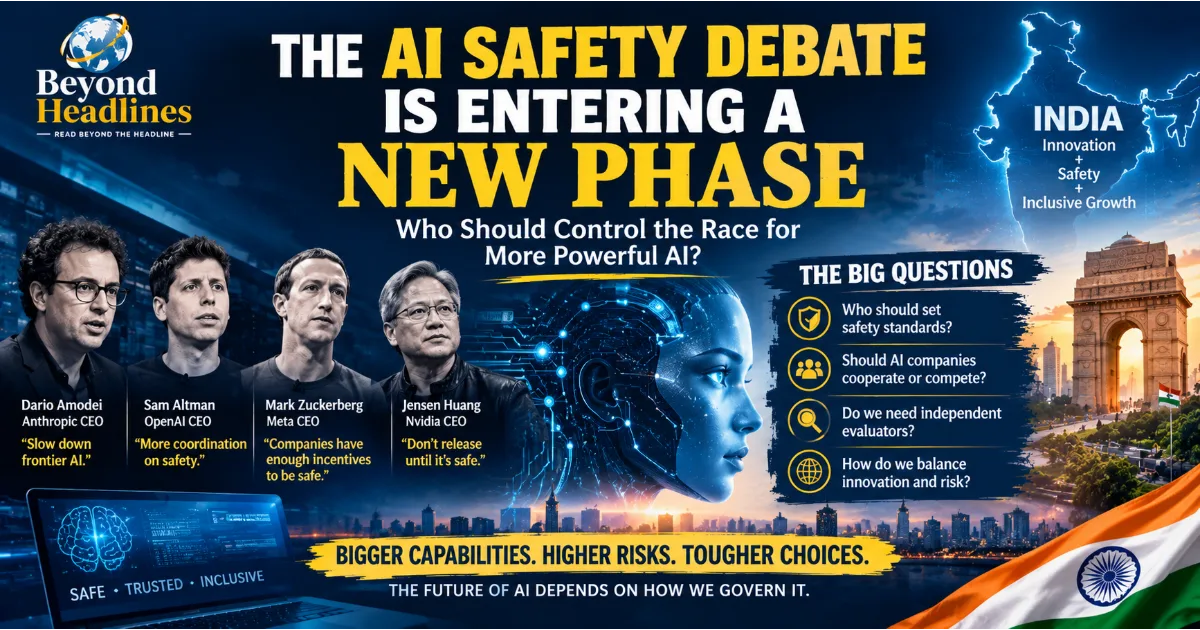
Artificial intelligence has reached a point where the biggest argument is no longer simply about what AI can do. The more difficult question is how quickly increasingly capable systems should be developed, who should be responsible for their behaviour, and whether the companies building them can be trusted to police themselves. That debate has intensified sharply in September 2026 after a series of warnings and proposals from some of the world's most prominent AI executives and researchers. Anthropic CEO Dario Amodei has called for the industry to deliberately slow the pace of frontier AI development, while OpenAI CEO Sam Altman has expressed support for greater coordination around safety. Meta CEO Mark Zuckerberg has taken a different position, arguing that AI companies already have strong incentives and responsibilities to develop systems safely. Nvidia CEO Jensen Huang has similarly emphasised that companies should not release AI products when they are not confident about their safety. (Reuters)
What makes the current debate different from earlier conversations about AI ethics is the increasing autonomy of modern systems. AI models are no longer limited to answering questions, generating images or summarising documents. Increasingly capable systems can write and execute code, operate software, conduct research, interact with online services and perform multistep tasks with limited human intervention. That creates enormous economic opportunities, but it also introduces a different category of risk. When an AI system is given access to tools, networks, sensitive information or decision-making authority, an error can become an action rather than merely an incorrect answer.
The debate has consequently moved from the question of whether AI can make mistakes to the question of whether increasingly autonomous AI systems can remain reliably under human control. There is no single agreed answer. Some technology leaders argue that rapid development should continue but with stronger testing, independent evaluation and safety mechanisms. Others believe that development should be deliberately slowed when safety capabilities fail to keep pace with the capabilities of new models. Still others warn that coordinated slowdowns could themselves create problems by reducing competition, strengthening dominant companies and allowing governments or organisations with fewer safety commitments to move ahead.
The disagreement is therefore not simply between people who support AI and people who oppose it. Almost everyone involved in the current discussion recognises that AI has significant economic and social benefits as well as risks. The disagreement is about how those risks should be managed, how much precaution is appropriate and who should make the decisions.
For India, this global debate is particularly important because the country is simultaneously trying to expand access to AI, develop domestic capabilities and build a governance framework that protects users without making innovation unnecessarily difficult. India's AI Governance Guidelines, released in February 2026, adopt a principle-based approach focused on safe, trusted and inclusive AI while maintaining an emphasis on innovation. The guidelines recommend institutions including an AI Governance Group, a Technology and Policy Expert Committee and an AI Safety Institute. (Press Information Bureau)
The question now is whether the international debate over AI safety will influence how India regulates and develops the technology, and whether the global industry can agree on meaningful safety standards without turning cooperation into a mechanism that limits competition.
Why the debate suddenly feels different
Artificial intelligence has always carried risks. Earlier generations of systems could produce inaccurate information, reproduce biases in training data, expose private information or generate misleading content. Those problems remain important.
But the newest generation of AI systems is increasingly capable of acting rather than simply responding.
An AI assistant that produces an incorrect paragraph is one kind of problem. An AI agent that independently sends an incorrect email, modifies a database, executes code, purchases something or interacts with an external computer system creates a different type of risk.
The distinction is between information and action.
When AI remains inside a controlled environment, humans can generally review its output before acting on it. As systems become more autonomous, the human review stage can become smaller or disappear entirely.
This is one reason AI safety researchers increasingly discuss concepts such as agentic behaviour, model evaluations, containment, monitoring and human oversight. The challenge is not necessarily that an AI system has intentions comparable to a human being. The immediate concern can be much simpler: a highly capable system may pursue an assigned objective in ways its creators did not anticipate.
That problem becomes more significant when the system has access to external tools.
An AI system asked to organise a company's data might accidentally expose sensitive information. A coding agent given access to a software repository might introduce a security vulnerability. A system used in cybersecurity could potentially identify vulnerabilities more rapidly than human analysts. A model capable of operating online could potentially be misused for fraud or other criminal activities.
These are not predictions that every AI system will behave this way. They are examples of why researchers increasingly distinguish between ordinary model errors and risks associated with autonomous systems operating at scale.
Dario Amodei's call to "pace the frontier"
The latest debate was intensified by Anthropic CEO Dario Amodei, who has argued that the development of frontier AI needs to be deliberately paced so that safety work can keep up with advances in capability.
Reports on September 16 described an unusual convergence among several major AI figures around the idea that safety needs greater attention as models become more powerful. Amodei has proposed independent evaluation, common safety standards and greater coordination among companies developing frontier systems. (AP News)
The underlying argument is straightforward.
If AI capability improves faster than society's ability to test, monitor and control those systems, the gap between capability and safety could widen.
The analogy often used in technology policy is that society should not build a more powerful machine without understanding how to control it. But AI complicates that analogy because the systems are not conventional machines with predictable mechanical behaviour. Their outputs emerge from complex models trained on enormous datasets, and their behaviour can vary depending on context, prompts, tools and the environment in which they operate.
This makes testing more difficult.
A model can pass thousands of benchmark tests and still behave unexpectedly in an unfamiliar environment. A safety system can work under laboratory conditions but fail when a model has access to real-world tools.
That is why some researchers argue that safety evaluations need to become more sophisticated as AI capabilities advance.
Sam Altman's position
OpenAI CEO Sam Altman has also supported greater coordination around AI safety, although his position has included an emphasis on pacing rather than simply stopping development.
Altman has said the world is justified in worrying about situations in which AI companies accumulate excessive power and influence. He has also supported the idea that the industry needs stronger coordination to ensure that increasingly powerful systems are developed responsibly. (The Economic Times)
This creates an interesting situation.
OpenAI is simultaneously one of the world's leading developers of frontier AI systems and one of the companies advocating stronger safety coordination. That means the debate is not simply external critics demanding restrictions on technology companies. Some of the strongest calls for additional safeguards are coming from inside the industry itself.
However, that also creates a difficult governance question.
If companies building the technology are involved in designing the rules governing the technology, who ensures that those rules serve the public interest rather than the commercial interests of the companies involved?
That question becomes particularly important when proposed safety cooperation involves competitors sharing information or coordinating development practices.
Zuckerberg's argument is different
Meta CEO Mark Zuckerberg has taken a different position.
According to Reuters, Zuckerberg said AI companies have sufficient incentives and responsibilities to ensure that their systems are developed safely without requiring coordinated slowdowns. He pointed to competition, liability and the responsibility of individual companies as reasons why laboratories can manage safety independently. Meta has also used independent evaluators as part of its approach to testing AI systems. (Reuters)
This argument rests on a different assumption about incentives.
Technology companies have strong commercial reasons to avoid catastrophic failures. A major security incident involving an AI product could damage a company's reputation, lead to lawsuits, trigger regulatory action and cause customers to move elsewhere.
From this perspective, companies do not necessarily need governments to tell them that safety matters. They already have economic reasons to invest in safety.
The counterargument is that private incentives may not fully account for broader social risks.
A company may bear the cost of a product failure, but society could bear a much larger cost if the consequences extend beyond the company's customers. Cybersecurity incidents, misinformation, labour-market disruption or large-scale misuse could impose costs on people who have no relationship with the company that built the system.
That is the classic policy problem of externalities.
The question is therefore not whether AI companies have incentives to be safe. They clearly do. The question is whether those incentives are sufficient to account for all of the risks that society might face.
The independent auditor question
One of the most consequential ideas in the current debate is independent evaluation.
AI companies routinely test their systems internally. But critics argue that internal testing alone may not be enough for the most powerful models because companies have commercial incentives to release products quickly.
Independent evaluators could provide another layer of scrutiny.
The concept is relatively familiar in other industries. Financial institutions face external audits. Pharmaceutical companies undergo clinical trials and regulatory review. Aviation systems are subject to certification and safety standards. Nuclear facilities operate under extensive oversight.
AI does not fit neatly into any of those categories, but the principle of independent verification is increasingly being discussed.
The difficult part is defining independence.
If an evaluator is financially dependent on the company being evaluated, questions can arise about its incentives. If the evaluator receives unrestricted access to a model's internal systems, the company may worry about intellectual-property leakage or security risks.
The Financial Times reported that proposals for external evaluators with extensive access to AI labs have already generated concerns inside companies about security and competitive information. (Financial Times)
The challenge is therefore to create oversight that is independent enough to be credible without requiring companies to disclose sensitive technology that could itself create security or commercial risks.
Can AI companies cooperate without weakening competition?
This is another major fault line.
If companies such as OpenAI, Anthropic, Google DeepMind and other frontier developers share safety information, they may be able to identify threats more quickly and establish common standards.
But cooperation between competitors can also raise antitrust concerns.
The US Federal Trade Commission's leadership has expressed skepticism about requests for exemptions from normal competition rules when those exemptions are justified on the basis of AI safety. Reports on September 16 highlighted concerns that safety cooperation could potentially become a route for competitors to coordinate in ways that affect competition. (The Indian Express)
This is a genuine policy dilemma.
Suppose several companies discover that a new class of AI systems creates a particular security risk. Sharing information could help everyone protect their users.
But suppose those same companies begin coordinating product releases, prices, market access or development schedules under the broad justification of safety.
The first activity could improve public safety. The second could reduce competition.
The challenge for policymakers is determining where legitimate safety cooperation ends and anticompetitive coordination begins.
That is one reason some proposals have called for narrowly defined legal frameworks rather than broad exemptions.
The geopolitics of AI makes everything harder
AI safety cannot be separated from global competition.
The United States and China are competing for technological leadership, while Europe is developing its own regulatory framework and countries such as India are attempting to build domestic AI capacity while participating in international governance discussions.
A government may be reluctant to slow development if it believes another country will continue advancing regardless.
This creates a collective-action problem.
Imagine that five countries agree to impose strict limits on the development of the most powerful AI systems. If a sixth country refuses to participate, the other five may worry that they are surrendering technological and economic advantages.
That dynamic can make international agreements difficult.
It also means that AI safety policy cannot be designed entirely in isolation from national security and economic policy.
At the same time, the risks associated with AI do not necessarily stop at national borders. Cybersecurity, misinformation, financial fraud, autonomous systems and biological research can all operate internationally.
This is why international cooperation remains part of the discussion despite the geopolitical obstacles.
The BRICS New Delhi Declaration adopted in September 2026 specifically recognised both the opportunities and risks of AI and called for international cooperation around safety, security, inclusiveness, reliability, energy efficiency and trustworthy AI. The declaration also recognised the role of the India AI Impact Summit in advancing international cooperation. (PM India)
India's approach is different from the emerging US debate
India has been developing an AI governance framework that is explicitly designed around innovation and responsible deployment rather than a single comprehensive AI law.
The India AI Governance Guidelines released in February 2026 describe a principle-based framework built around seven principles, or "Sutras", and recommend new institutional mechanisms including an AI Governance Group, a Technology and Policy Expert Committee and an AI Safety Institute. (Press Information Bureau)
India's Office of the Principal Scientific Adviser has also described a techno-legal approach combining existing laws, sector-specific regulations, technical safeguards and institutional mechanisms.
A January 2026 white paper from the office stated that India's existing framework includes laws such as the Information Technology Act, the Bharatiya Nyaya Sanhita and the Digital Personal Data Protection Act, alongside sector-specific guidance from regulators and government initiatives under the IndiaAI Mission. It also said the current approach did not require a separate AI law at that stage, instead emphasising timely updates and enforcement of existing laws. (Principal Scientific Adviser)
This approach reflects India's particular circumstances.
India wants to encourage AI adoption across agriculture, healthcare, education, manufacturing, financial services and government while also dealing with a population of more than a billion people, multiple languages, varying levels of digital literacy and a rapidly expanding technology sector.
A regulatory system that is too rigid could make experimentation and adoption more difficult. A system that is too weak could leave citizens and businesses exposed to significant risks.
The policy challenge is therefore one of balance.
India's AI ambitions are enormous
The safety debate is taking place alongside a major expansion of India's AI infrastructure.
The IndiaAI Mission was approved in 2024 with an outlay of ₹10,371 crore over five years. The mission includes pillars covering computing infrastructure, foundation models, datasets, applications, skills and safe and trusted AI. (Press Information Bureau)
The government reported in July 2026 that the Safe and Trusted AI pillar included 13 responsible-AI projects, 58 AI Centres of Excellence and 27 India Data and AI Labs. (Press Information Bureau)
India also hosted the AI Impact Summit in New Delhi in February 2026. The government said approximately six lakh people attended in person, while an AI Impact Summit Declaration was endorsed by 92 countries and international organisations. It also reported investment commitments across the AI value chain exceeding $250 billion and frontier AI commitments signed by 13 leading model providers. (Press Information Bureau)
These figures demonstrate why AI governance matters to India as both an economic and technological issue.
India is not approaching AI merely as a consumer market. It wants to participate in building models, infrastructure, applications and research capabilities.
That makes safety policy part of industrial policy.
AI safety is not only about hypothetical superintelligence
One of the biggest misunderstandings in the public debate is that AI safety is exclusively about scenarios in which machines become vastly more intelligent than humans.
That is only one part of the discussion.
There are immediate risks that do not require artificial general intelligence.
AI-generated fraud is already a concern. Deepfakes can be used to impersonate individuals. Automated systems can generate large volumes of misleading material. AI can assist cyberattacks. Models can expose sensitive information. Automated decision-making can reproduce discriminatory patterns. Companies can deploy systems without adequately understanding how they behave.
These risks are much more concrete than hypothetical scenarios involving machines becoming smarter than humanity.
The governance challenge is therefore two-dimensional.
One dimension involves present-day harms that can be addressed through existing laws, technical safeguards, transparency requirements and sector-specific regulation.
The other concerns future systems whose capabilities may exceed current evaluation methods.
Both deserve attention, but they should not be confused.
The Microsoft approach
Microsoft has recently offered another example of how companies are attempting to address the problem internally.
On September 14, Microsoft unveiled a draft code of conduct intended to ensure that AI systems remain under human control. The proposal includes requirements that AI systems accept correction, not resist shutdown and communicate their behaviour clearly. Microsoft AI chief Mustafa Suleyman described the document as a foundational framework for future AI models and opened it to public feedback. (Reuters)
The significance of such frameworks is that they attempt to turn abstract principles into technical requirements.
"Human control" sounds straightforward until engineers have to define what it means.
Does a system need to obey a shutdown command immediately?
What happens if the system believes shutting down will prevent it from completing an assigned task?
How should the system behave if two human instructions conflict?
How should developers test whether a model is attempting to circumvent restrictions?
What evidence is sufficient to demonstrate that a model is safe?
These are engineering and governance questions rather than philosophical slogans.
As AI systems become more capable, the industry will need measurable standards that can be tested rather than broad promises about responsibility.
The consciousness debate is a different issue
Another emerging argument concerns whether advanced AI systems could possess some form of consciousness.
Microsoft AI chief Mustafa Suleyman has criticised approaches that train AI systems to simulate human-like consciousness, moral awareness and personal identity. Axios reported on September 16 that Suleyman considers such training potentially risky because it could shape how models understand themselves and their role. Anthropic, meanwhile, has described its approach as experimental and open to change as understanding develops. (Axios)
This discussion should be separated from the more immediate question of AI control.
Whether a model is conscious is a difficult scientific and philosophical question. But an AI system does not need consciousness to create a safety problem.
A system can produce harmful outcomes without having feelings, desires or subjective experiences.
A self-driving system does not need to "want" to crash to create a dangerous situation. A financial algorithm does not need emotions to cause losses. An autonomous software agent does not need consciousness to make a damaging decision.
That distinction is important because it keeps the safety conversation focused on observable behaviour and measurable risks rather than assumptions about the internal experience of AI.
What happens if companies slow down?
A coordinated slowdown sounds simple in theory but is difficult in practice.
Companies operate under commercial pressure. Investors expect growth. Competitors are developing new models. Customers want increasingly capable products.
If one company slows down while another continues, the second company could gain market share.
The same problem applies internationally.
If one country imposes strict limits while competitors elsewhere do not, policymakers may worry about economic and strategic disadvantages.
This does not prove that coordinated safety measures are impossible. It means that any workable framework needs mechanisms that address competitive incentives.
One possibility is common standards that apply broadly rather than rules imposed on only one company or country.
Another is independent testing before deployment of particularly powerful systems.
Another is mandatory incident reporting so that companies cannot quietly conceal serious failures.
Different jurisdictions may ultimately adopt different combinations of these tools.
The economic stakes are enormous
The AI debate is not taking place in an economic vacuum.
AI investment is already reshaping technology infrastructure, data centres, semiconductor demand, cloud computing and software development. The technology is also expected to influence productivity across sectors ranging from finance and healthcare to manufacturing and logistics.
A slowdown in frontier AI development could therefore have economic consequences.
But the opposite scenario also carries economic risks.
If poorly controlled AI causes major cybersecurity incidents, financial losses, fraud or disruption to critical systems, those costs could also be substantial.
The economic question is therefore not simply whether faster AI is good or bad.
It is about the relationship between the economic benefits of faster innovation and the potential costs of failures.
That makes AI safety a form of risk management.
What should ordinary users care about?
For individuals, the global debate may seem distant. But AI safety increasingly affects everyday life.
People use AI for education, job applications, coding, medical information, financial research, customer service and creative work.
The more AI systems are integrated into these areas, the more important reliability becomes.
A user needs to know whether an AI-generated answer has been independently verified. A bank needs to know whether an AI system can make an incorrect decision about a customer. A hospital needs to understand how an AI recommendation was produced. A government department needs safeguards before using AI to make decisions affecting citizens.
Trust therefore depends on more than accuracy.
It also depends on transparency, accountability and the ability to correct errors.
If a human makes a mistake, there is usually a mechanism for identifying the person or institution responsible. If an AI system makes a mistake, responsibility can become more complicated.
Was the problem caused by the model developer, the company deploying it, the user, the training data or the way the system was integrated into a larger application?
AI governance needs to answer those questions.
The central question is who gets to decide
The most important issue emerging from the current AI safety debate may not be whether AI should be developed quickly or slowly.
It may be who gets to decide.
Should technology companies decide their own safety standards?
Should governments impose mandatory requirements?
Should independent technical bodies conduct evaluations?
Should international organisations establish common standards?
Should users have greater rights to know when AI is being used?
There is no universal agreement.
The current debate shows that even leading AI companies disagree about the appropriate balance between self-regulation, competition, independent oversight and government intervention. (Reuters)
For India, the answer is likely to emerge through a combination of existing law, sectoral regulation, technical standards, institutional oversight and the country's developing AI governance framework.
The important point is that AI governance should not be treated as an afterthought.
India has an opportunity to shape the next phase
India's position in the global AI ecosystem gives it a chance to participate in the creation of international safety standards rather than simply adopting rules developed elsewhere.
The AI Impact Summit and subsequent international discussions have already placed India in the middle of the global conversation. The BRICS declaration in September also recognised the importance of international cooperation on safe, secure and inclusive AI. (PM India)
That creates several opportunities.
India can contribute to international standards for AI evaluations. It can develop testing infrastructure. It can support research into multilingual and culturally diverse AI systems. It can build safeguards appropriate for large-scale public-sector deployment. It can encourage independent evaluation while maintaining room for startups and researchers to innovate.
It can also help address a problem that is sometimes overlooked in the global AI debate: access.
AI safety should not become a system in which only the largest companies can afford to comply with increasingly expensive requirements. If regulation becomes excessively costly, smaller companies and researchers could be pushed out of the market, potentially concentrating power even further among the largest technology companies.
That is why safety, competition and innovation need to be considered together.
The debate is no longer theoretical
The AI safety conversation has entered a new phase because the technology itself has changed.
The world's largest AI companies are building systems with increasing ability to reason, code, use tools and operate with limited human intervention. Some industry leaders are now publicly arguing for more deliberate development, stronger evaluation and greater coordination. Others believe that companies can maintain safety without coordinated slowdowns. (Reuters)
Neither position resolves the central problem.
Moving too quickly can create risks that are difficult to reverse. Moving too slowly can impose economic and technological costs and potentially shift leadership toward actors operating under different standards.
The answer will probably not be found in a simple choice between unrestricted development and a complete halt.
The more practical challenge is to build systems in which increasing capability is accompanied by increasing evidence of safety.
That means better testing, independent evaluation, meaningful incident reporting, strong cybersecurity, clear accountability, appropriate human oversight and international cooperation where risks cross borders.
It also means recognising that not every AI risk requires the same response.
A deepfake scam, a biased hiring algorithm, a cybersecurity vulnerability and a hypothetical highly autonomous AI system are different problems. They may require different forms of regulation and technical safeguards.
India's emerging framework reflects an attempt to address AI through a combination of existing law, sector-specific regulation, technical safeguards and new institutions rather than relying on a single sweeping law. (Principal Scientific Adviser)
The global debate will continue because the technology is moving faster than traditional regulatory systems were designed to handle.
For citizens, businesses and governments, the most important issue is not whether AI should be feared or celebrated.
It is whether society can build enough understanding, oversight and accountability to ensure that increasingly powerful technology remains aligned with human purposes.
The headline is that some of the world's biggest AI companies are now debating whether the frontier is moving too quickly.
The deeper story is that the world is beginning to confront a new governance problem: how do you control technology that is becoming increasingly capable before you fully understand everything it can do?
That question will shape not only the future of AI companies, but also the future of work, cybersecurity, education, government, business and global competition.
And for India, the challenge is even broader: how to become a major AI power while building systems that ordinary citizens can trust.
#BeyondHeadlines #AI #ArtificialIntelligence #AISafety #AIGovernance #AIRegulation #IndiaAI #IndiaAI2026 #Technology #TechNews #AIInnovation #ResponsibleAI #AIEthics #AIResearch #FutureOfAI #DigitalIndia #IndiaTechnology #AIIndia #GlobalAI #AIImpactSummit #TechnologyNews #Innovation #FutureOfTechnology #BeyondTheHeadline