
India's Unified Payments Interface has become so deeply embedded in everyday life that paying through a QR code often feels less like a financial transaction and more like a routine gesture. A customer buys groceries, pays a restaurant bill, books a service, transfers money to a family member or settles an online purchase, and the payment happens within seconds. For millions of Indians, the most important feature of UPI has been its simplicity. There has generally been no visible transaction charge for the person making a normal UPI payment. That model is now changing for a specific category of transactions.
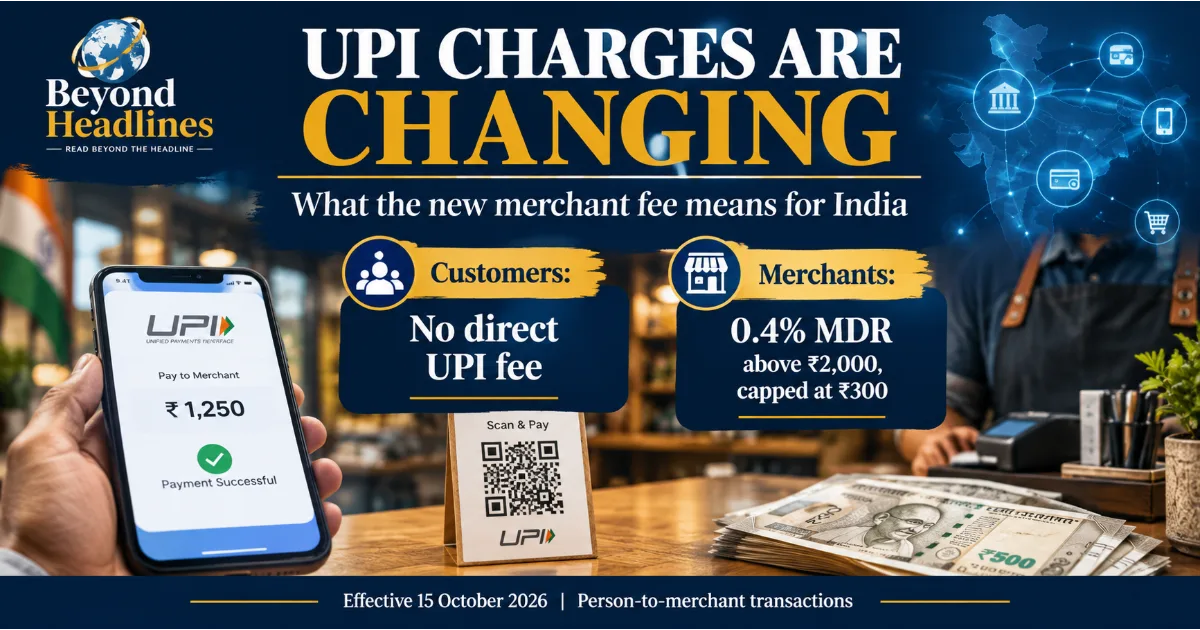
From October 15, 2026, a new Merchant Discount Rate, or MDR, will apply to specified person-to-merchant UPI transactions above Rs 2,000. The standard rate will be 0.4 percent of the transaction value, with a maximum charge of Rs 300 per transaction. Certain categories, including specified payments involving railways, fuel, insurance and other services, have a different flat MDR structure. Importantly, the new MDR is designed as a charge within the payments ecosystem and is not a tax imposed by the government on consumers. The government has also stated that person-to-person UPI transfers will remain completely free, while payments to merchants up to Rs 2,000 and transactions covered by the zero-MDR framework for small merchants will remain free. The Finance Ministry says approximately 96 percent of person-to-merchant UPI transactions will remain unaffected.
That distinction matters because the first reaction to the announcement has been shaped by a much broader question: is the same rupee being taxed again and again as it moves through the economy? The concern is understandable, but the comparison between income tax, GST and the new UPI MDR needs to be examined carefully. These are three different mechanisms, charged to different parties, at different stages, and for different purposes. Treating them as three separate taxes on exactly the same rupee can create a misleading picture of how the system actually works.
The new UPI framework is nevertheless significant because it marks a change in the economics of a payment network that has operated for years without a conventional merchant charge on most transactions. It raises questions about who ultimately bears payment costs, whether merchants can absorb the expense, how digital payment companies will share the revenue, and whether the new model can support the continued expansion and maintenance of India's digital payments infrastructure.
The simplest way to understand the change is to begin with what is not changing.
If you transfer Rs 5,000 to a friend or family member through UPI after October 15, there will be no MDR merely because the amount exceeds Rs 2,000. Person-to-person transactions remain outside the new framework. If you pay a merchant Rs 1,500 through UPI, the new 0.4 percent MDR does not apply. If an eligible small merchant falls within the zero-MDR provisions, that merchant can also continue receiving payments without the new charge. The new fee therefore does not mean that every UPI transaction above Rs 2,000 suddenly becomes chargeable to the individual sending the money.
The change applies principally to specified person-to-merchant transactions above the threshold.
Suppose a customer purchases a television for Rs 50,000 and pays the merchant through UPI. Under the new standard rate, the MDR would be 0.4 percent, which works out to Rs 200. The framework places the charge on the merchant side of the transaction rather than directly charging the customer at the point of payment. If the transaction is Rs 75,000, 0.4 percent equals Rs 300, which reaches the stated cap. A payment above Rs 75,000 does not generate an MDR higher than Rs 300 under the standard structure.
This is where the issue becomes more complicated than the phrase "UPI charges" suggests.
A merchant does not operate in isolation. Every business has costs, including rent, salaries, electricity, inventory, logistics, technology, taxes and payment processing. If an additional payment processing cost appears, the business has several possible ways of dealing with it. It can absorb the cost, reduce another expense, adjust its pricing, negotiate with payment service providers, or potentially change the payment options it promotes. The framework itself does not mean that every merchant will increase prices by exactly 0.4 percent. Whether a business passes any part of the cost to customers will depend on competition, margins, contracts and the nature of the business.
The Finance Ministry has said banks have been advised to ensure that merchants do not pass the newly introduced MDR to customers for UPI payments.
That makes an important distinction between the formal charge and its possible economic effect. The formal MDR is imposed within the merchant payments ecosystem. The customer is not supposed to see a separate UPI surcharge simply because the payment exceeds Rs 2,000. But economists and businesses can still debate whether payment costs might indirectly influence prices over time. An indirect effect through business pricing is not the same thing as a government tax collected from the consumer at the moment of payment.
This distinction is essential when discussing the claim that Indians are being taxed three times on the same rupee.
Income tax operates on income according to the applicable tax rules. GST is an indirect tax applied to the supply of goods and services, subject to the relevant rates, exemptions and rules. MDR is a payment processing charge within the financial ecosystem. The legal basis, payer, recipient and purpose of each are different.
Consider an employee who earns a salary. Income tax, where applicable, is calculated according to the income tax system and the individual's taxable income and circumstances. After receiving income, the individual may spend some of that money on a taxable good or service. GST may then form part of the price paid for that good or service, depending on what is being purchased and the applicable tax treatment. If the customer uses UPI to make the payment, the merchant may now incur an MDR under the new rules if the transaction falls within the relevant category and exceeds Rs 2,000.
It is therefore possible for the same economic value to pass through several stages where different charges or taxes are relevant. But describing every stage as taxation of the same rupee can obscure the difference between a tax on income, a tax on consumption and a payment processing fee.
The distinction is not merely technical. It affects who actually bears the cost.
Income tax is generally imposed on taxable income under the income tax framework. GST is collected by registered businesses from customers as part of taxable supplies and is ultimately remitted through the tax system according to GST rules. MDR, by contrast, is a fee associated with processing a merchant payment and is distributed among participants in the payments ecosystem rather than being collected by the government as tax revenue. The Finance Ministry has explicitly stated that MDR is neither a tax nor a charge collected by the government or NPCI.
The government says the purpose of the new framework is to support the sustainability and continued expansion of the UPI ecosystem while keeping everyday digital payments accessible. The argument is straightforward. UPI has grown at extraordinary scale, but payment infrastructure requires technology, cybersecurity, banking infrastructure, customer support, fraud prevention, compliance systems and continual investment. A payment system processing billions of transactions needs a sustainable economic model.
Reuters reported that UPI processed about 24 billion transactions worth approximately $311 billion in August 2026. The sheer scale of the network illustrates why the economics of UPI have become a major policy and business issue.
The original appeal of UPI was partly built around the absence of conventional merchant charges. That helped make QR-based payments attractive to small businesses and consumers. A street vendor could display a QR code without needing the infrastructure traditionally associated with card acceptance. A customer could scan and pay without handling cash. A merchant could receive money almost immediately in a bank account.
That model contributed to the rapid spread of digital payments across India.
The challenge is that a payment network cannot be evaluated only by the cost of an individual transaction. Behind every successful payment are multiple systems that need to remain operational. Banks maintain accounts and payment infrastructure. Payment service providers operate technology platforms. Apps provide customer interfaces. Acquiring institutions support merchant acceptance. Fraud detection systems monitor suspicious activity. Cybersecurity teams protect the network. Settlement infrastructure moves money between participants.
The economic question is therefore how those costs should be funded.
For several years, the Indian policy approach prioritised widespread adoption of digital payments. Keeping UPI free at the point of use helped reduce friction and encouraged consumers and merchants to move away from cash. The government also used incentives and policy support to maintain the ecosystem. The introduction of MDR on selected higher-value merchant transactions represents a shift toward a model in which at least some transactions contribute directly to the economics of the payment network.
That does not mean the free UPI model is disappearing.
The Finance Ministry says all person-to-person transactions will remain free regardless of the amount transferred. Merchant payments up to Rs 2,000 will also remain free, and small merchants receiving up to Rs 1 lakh per month through qualifying UPI QR transactions will continue to receive zero MDR under the specified framework. The government says around 96 percent of person-to-merchant transactions will remain unaffected.
This is particularly important for India's small-business economy.
A large share of India's retail economy consists of neighbourhood shops, street vendors, small service providers and micro businesses. For these businesses, even a seemingly small transaction fee can matter if applied repeatedly across thousands of payments. The framework therefore attempts to protect small merchants by maintaining zero MDR for qualifying businesses.
The structure also reflects an attempt to distinguish between everyday low-value transactions and larger merchant payments.
A Rs 150 payment at a local shop is fundamentally different from a Rs 50,000 purchase of a television, smartphone, appliance or other high-value product. Under the new framework, the former remains outside the standard MDR threshold while the latter can attract the merchant fee. The policy therefore concentrates the charge on higher-value transactions rather than applying a uniform fee across the entire UPI system.
This distinction is important because the public debate can easily become distorted when the phrase "UPI will no longer be free" is used without qualification.
UPI remains free for person-to-person transfers. UPI remains free for merchant payments up to Rs 2,000. Eligible small merchants remain protected by zero-MDR provisions. The change concerns specified merchant transactions above the threshold.
The new system also has special categories.
According to the announced framework, specified sectors such as railways, fuel, insurance and telecommunications can have a flat MDR of Rs 5 for transactions above Rs 2,000 instead of the standard 0.4 percent rate. This means the treatment of a payment depends not only on its value but also on the category of the merchant or service.
For consumers, the immediate practical question is therefore simple: will the amount debited from their bank account change because of this rule?
Under the framework, the answer is no. The MDR is not supposed to be separately added to the customer's UPI payment. A customer paying Rs 10,000 to an eligible merchant should not see Rs 10,040 deducted simply because of the new MDR. The merchant's payment ecosystem bears the specified MDR. The Finance Ministry has specifically said banks have been advised to ensure merchants do not pass the charge to customers.
But the broader economic question remains open.
If merchants face a new processing cost, what happens to their overall cost structure? In a competitive market, a business may decide to absorb the cost because customers can easily switch to competitors. In a low-margin business, the merchant may have less flexibility. In sectors where payment processing represents only a small portion of operating costs, the impact may be negligible. In sectors with high transaction values and tight margins, the effect may receive greater attention.
The actual outcome will therefore vary across businesses.
There is another important question involving the payment companies themselves.
For years, digital payment applications have competed aggressively for users and merchant acceptance. UPI has allowed companies to build large consumer platforms around payments, financial services, commerce and other products. The absence of a conventional merchant fee made payment volume particularly important because companies could focus on acquiring users and merchants even when the payment itself did not generate a direct MDR revenue stream.
The new framework creates a new pool of payment-related revenue. Reuters reported that the new structure is expected to generate additional revenue for banks, payment applications and other participants in the ecosystem. The exact distribution of the revenue will depend on the structure of the payment transaction and the agreements among ecosystem participants.
That could change the competitive dynamics of India's digital payments market.
Payment companies may have greater incentives to maintain and expand merchant acceptance. Banks and technology providers may have additional resources to invest in fraud prevention, cybersecurity, infrastructure and customer support. At the same time, the industry will have to ensure that the introduction of fees does not discourage merchants from accepting UPI or encourage customers to shift toward less efficient payment methods.
The design of the framework therefore attempts to balance two objectives that can sometimes pull in different directions.
The first objective is keeping UPI inexpensive and accessible enough to remain a mass-market payment system. The second is creating a financial structure that can support the enormous infrastructure required to operate the network at scale.
The government's decision to exempt small-value payments and qualifying small merchants is central to that balancing act.
There is also a broader issue of competition between payment methods.
India's payment ecosystem includes UPI, debit cards, credit cards, net banking, wallets and cash. Different methods have different cost structures. Credit and debit card transactions, for example, have historically involved merchant fees, while UPI became widely known for its zero-MDR model on many transactions. The introduction of selected UPI MDR could alter the relative economics of these payment methods, particularly for high-value merchant transactions.
This does not necessarily mean consumers will immediately change how they pay. Convenience remains a powerful factor. UPI has an enormous network effect because consumers know they can use it at millions of merchants, while merchants accept it because customers expect it. That network is difficult to replicate.
The larger question is whether a modest merchant-side fee changes behaviour at the margin.
A large retailer processing thousands of high-value UPI payments may pay meaningful aggregate MDR. A small shop processing mostly low-value payments may remain largely unaffected. A consumer paying a friend remains outside the charge. The impact will therefore be uneven.
That unevenness is one reason the new policy should not be understood as a simple return of charges to all UPI users.
The policy is much more targeted.
It also demonstrates how India's digital public infrastructure is evolving. UPI began as a system designed to make bank-to-bank digital payments easier. It has become a foundational layer of the Indian digital economy. E-commerce, retail, restaurants, transportation, utilities, education, government services and countless small businesses now rely on digital payments.
As that infrastructure becomes more important, questions about who pays for it become unavoidable.
There is a larger lesson here about digital public infrastructure. Free at the point of use does not necessarily mean costless to operate. Someone must finance the technology, security, settlement systems and support structures behind a national payments network. The policy debate is therefore not simply about whether UPI should be free. It is about which transactions should remain free, which participants should contribute to the cost and how the system can remain sustainable without discouraging adoption.
That is where the new MDR framework becomes more interesting than the headline announcing a UPI fee.
The headline can create the impression that consumers are suddenly being charged for using UPI. The actual framework is more limited. It targets specified merchant transactions above Rs 2,000, leaves person-to-person payments outside the MDR system and maintains exemptions for small-value transactions and qualifying small merchants.
The debate about taxation also deserves the same level of precision.
An individual may pay income tax on taxable income. That individual may then use part of the remaining money to buy a taxable product or service, where GST may apply. A merchant accepting a UPI payment for that purchase may then face MDR under the new framework. But the three mechanisms should not be described as three government taxes imposed on the same rupee. Income tax and GST are taxes under the tax system. MDR is a payment ecosystem charge, and the government has explicitly said it is not government revenue.
That does not make the concern about the overall cost burden irrelevant.
Households naturally care about how much of their income ultimately remains available for consumption and savings. Businesses care about the combined effect of taxes, wages, rent, logistics, financing costs and payment costs. From that perspective, the total economic burden of conducting a transaction can matter even when the individual components have different legal and economic identities.
The more useful question, therefore, is not whether one rupee is literally being taxed three times.
The more useful question is how much it costs an individual or business to earn, spend, save and transact that rupee, and how those costs are distributed across the economy.
That is the conversation the UPI change is likely to generate.
For consumers, the immediate message is relatively straightforward. There is no new general UPI fee for sending money to friends and family. Payments to merchants up to Rs 2,000 remain free under the announced framework. Qualifying small merchants remain covered by zero-MDR provisions. For higher-value merchant transactions, the MDR is a merchant-side payment processing charge, with the standard rate set at 0.4 percent and a cap of Rs 300.
For merchants, the change is more consequential. Businesses that regularly receive high-value UPI payments will need to understand how the MDR affects their payment costs and how their acquiring bank or payment provider applies the framework. They will also need to consider how payment methods are presented to customers and how the new cost interacts with their margins.
For banks and payment companies, the policy creates a new source of revenue but also a new responsibility. The additional revenue is expected to support the wider payments ecosystem, while competition will determine how effectively companies use the opportunity to improve services and maintain merchant and consumer engagement.
For policymakers, the challenge will be to monitor whether the new model achieves its stated purpose without weakening one of the strongest features of UPI, its simplicity.
India's digital payments story has been built on scale. A street vendor and a multinational retailer can both display a QR code. A student can pay a restaurant. A parent can transfer money to a child. A customer can pay an online merchant. The underlying system is largely invisible, which is precisely what makes it powerful.
The introduction of MDR makes part of that hidden economic structure more visible.
It forces businesses, consumers and policymakers to confront the question of who pays for digital infrastructure and how a payment system that has become essential can remain financially sustainable.
The answer will not be found simply by saying that UPI is becoming paid or that UPI remains free. Both statements can be misleading without context. UPI remains free for many of its most common uses, while selected merchant transactions will carry a new charge from October 15.
The same principle applies to the debate over income tax and GST. A household can experience several different financial obligations during the life of a rupee, but those obligations arise from different parts of the economic system. Understanding those distinctions is important if the public conversation is going to focus on the actual impact rather than on a simplified description.
The bigger story is that India's digital payments system has reached a new stage.
The first stage was adoption. The second was scale. The next stage is sustainability.
UPI has become too important to India's economy for the discussion to be limited to whether an individual sees a fee on a payment screen. The more important questions concern infrastructure, cybersecurity, merchant economics, competition, consumer protection and the long-term financing of a payments network used by hundreds of millions of people.
The October 15 change is therefore not simply a story about a 0.4 percent charge.
It is a story about what happens when a digital public infrastructure system becomes so large that maintaining it requires a more defined economic model.
For the ordinary UPI user, the practical message is reassuring in one respect. Sending money to another person will remain free, and ordinary low-value merchant payments will continue without the new MDR. For merchants, especially those handling larger transactions, the economics will change. For banks, payment applications and other ecosystem participants, a new revenue stream is being created.
And for India, the bigger question is whether the country can preserve the simplicity and reach that made UPI a global example of digital payments while developing a sustainable financial structure underneath it.
That is the story beyond the headline.
#BeyondHeadlines #UPI #UPICharges #UPIMDR #DigitalPayments #IndiaEconomy #IndianEconomy #NPCI #DigitalIndia #Fintech #IndianBusiness #PersonalFinance #MerchantPayments #PaymentsInfrastructure #GST #IncomeTax #FinancialNews #BusinessNews #India #BeyondTheHeadline