
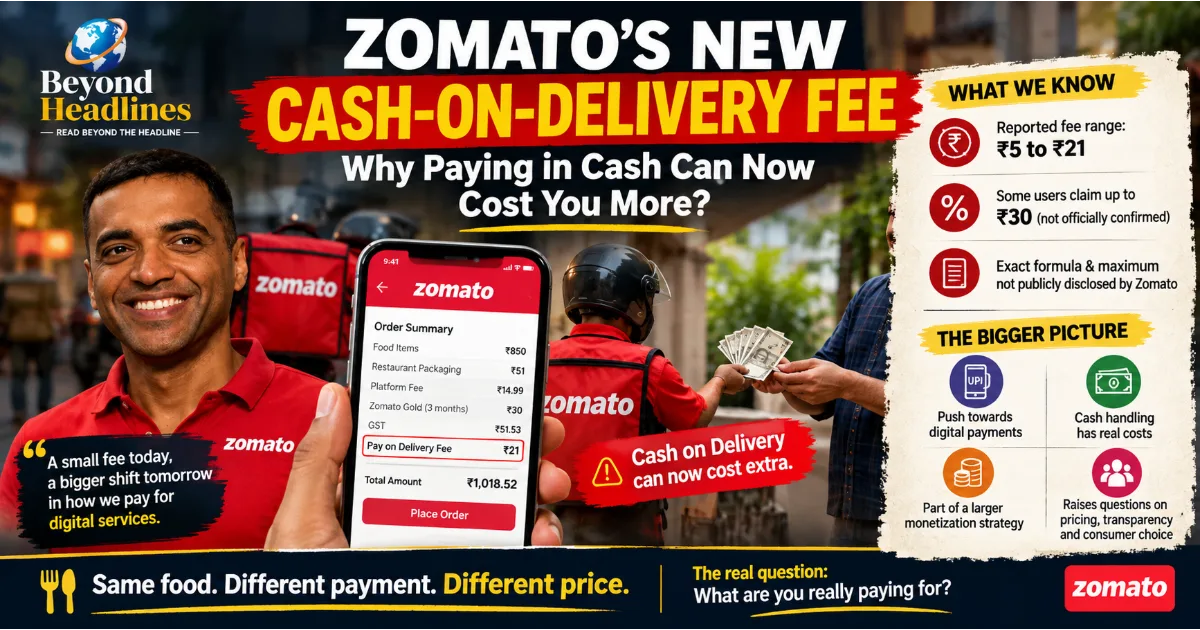
A food order on Zomato has traditionally given customers a relatively simple choice at checkout: pay online or pay in cash when the delivery arrives. That distinction is now becoming more expensive. In September 2026, Zomato began introducing an additional charge for customers who choose cash on delivery, with the fee appearing separately in the bill as a “Pay on Delivery Fee.” Reports from customers and Indian business publications indicate that the charge varies by order. Some customers have seen a ₹5 fee, while other reported bills have shown ₹7, ₹20 and ₹21. A user-circulated claim has suggested that the fee can reach ₹30, allegedly calculated at 2% of the order value and capped at ₹30, but Zomato has not publicly confirmed that exact formula.
The development matters for a reason that goes beyond the relatively small amount involved. Food-delivery platforms have spent the past several years transforming the economics of ordering food online. What initially looked like a straightforward digital marketplace has evolved into a layered business in which restaurants, delivery partners and customers interact through a platform that generates revenue through commissions, advertising, delivery-related charges, subscriptions and customer-facing fees. The latest Zomato charge adds another dimension to that model: the payment method itself can now affect the final price of the order.
That makes the story larger than a ₹5 or ₹20 charge. It raises questions about how digital platforms price convenience, how companies manage the cost of cash, how much customers ultimately pay for food delivery, and whether the steady expansion of small fees is changing consumers’ understanding of what an apparently inexpensive online order actually costs.
What has Zomato changed?
The new charge is relatively straightforward in principle. When a customer chooses to pay for an order in cash at the time of delivery, Zomato can add a separate “Pay on Delivery Fee” to the order bill. Customers who pay online do not incur this particular fee. Financial Express reported that the charge was typically ₹5, although some users had been charged ₹7 and others as much as ₹20. Business Today reported a customer bill showing a ₹21 pay-on-delivery fee on an ₹850 order.
The ₹21 example is particularly useful because it shows how the charge appears in the actual economics of an order. According to Business Today, the customer’s ₹850 food-item total was accompanied by ₹51 in restaurant packaging charges, a ₹14.99 platform fee, a ₹30 charge for three months of Zomato Gold and ₹51.53 in GST. The additional ₹21 pay-on-delivery fee pushed the total higher. The report also noted that the exact formula used to determine the new fee had not been publicly confirmed by Zomato.
This distinction is important because the viral claim in the image circulating online is more specific than the information independently confirmed by news reports. The image says Zomato has started charging customers up to ₹30 simply to let them pay cash on delivery. Reports have indeed documented the new fee, but the maximum of ₹30 and the precise 2% formula appear to come from user reports rather than an official Zomato announcement. NDTV reported that a user claimed the fee was 2% of the order value with a maximum of ₹30, while also noting that the precise basis of the charge had not been independently established.
So the most defensible description at present is that Zomato has introduced a variable pay-on-delivery charge for cash orders, with reported fees ranging from ₹5 into the ₹20-plus range, while the exact pricing formula and maximum remain unclear publicly.
That uncertainty itself is worth noting. When companies introduce a new fee, customers naturally want to know whether it is fixed, percentage-based, location-based, linked to order size, or determined through other variables. Without a clear public explanation, customers may see different charges on apparently similar orders and struggle to understand why.
Why would a food-delivery platform charge for cash?
Cash may look cheaper from a customer’s perspective because it does not involve a digital transaction. From a platform’s operational perspective, however, cash can create additional handling requirements.
A digital payment can move electronically from the customer to the merchant ecosystem, creating a relatively straightforward transaction record. A cash-on-delivery transaction requires the delivery partner to collect physical currency from the customer. That cash then has to be reconciled and eventually transferred through the relevant settlement process. It can create accounting work, reconciliation requirements, security concerns and operational friction.
The basic economics of cash handling are therefore different from those of a prepaid digital transaction. That does not by itself establish that Zomato’s new fee is designed solely to recover cash-handling costs. The company has not publicly explained the rationale for the new charge in the reports available so far. Financial Express reported that Zomato did not publicly comment on the introduction of the fee.
There is also another possible economic effect. Charging for cash can encourage customers to pay digitally. That may make transactions easier to reconcile, reduce cash-handling requirements and potentially lower certain operational costs. Digital payment also gives platforms an immediate electronic record of payment rather than requiring the collection and reconciliation of physical currency.
This is particularly relevant in India, where digital payments have expanded rapidly. UPI has become deeply integrated into everyday commerce, and customers increasingly expect to pay through QR codes, mobile applications and other digital channels. The shift has changed the meaning of cash on delivery. It is no longer necessarily the default alternative to an online transaction. It is increasingly one payment option among several.
A fee attached specifically to that option changes the incentives around the choice.
Zomato is not starting from zero when it comes to customer fees
The cash-on-delivery fee becomes easier to understand when placed alongside the evolution of Zomato’s platform fee.
Food-delivery platforms began experimenting with customer-facing platform fees in India in 2023. Business Today reported that Zomato initially introduced a ₹2 platform fee and subsequently increased it over time. The fee reached ₹10 in October 2024 and later rose to ₹12.50 before being increased to ₹14.99 earlier in 2026, with GST charged separately.
This means the latest cash-payment charge is not an isolated development. It belongs to a broader evolution in the way food-delivery companies monetize transactions.
When online food delivery was still a relatively new business, platforms frequently emphasized customer acquisition, restaurant expansion and order growth. Low prices, discounts, free delivery campaigns and promotional offers were central to the expansion strategy. As the industry matured, the focus increasingly shifted toward monetization and profitability.
The economics of the industry have made that transition necessary. Food delivery involves restaurants, technology infrastructure, customer support, delivery fleets, payment systems, discounts, refunds and logistics. A platform cannot rely indefinitely on growth in order volume without developing sustainable ways to capture value from that activity.
The introduction of platform fees was one response.
The latest pay-on-delivery charge represents another.
For customers, however, this means the final bill increasingly consists of several different components. The food itself may be only one part of the total. Depending on the order, customers can encounter delivery charges, packaging charges, platform fees, taxes, membership-related charges and now, in some cases, a fee associated with the payment method itself. Zomato's terms also state that delivery charges and applicable taxes may apply depending on the delivery arrangement.
The result is a shift in how customers should think about the price of online food.
The menu price is no longer necessarily the meaningful measure of what the customer pays.
The final checkout amount is.
The significance of the ₹14.99 platform fee
The platform fee is particularly relevant because it demonstrates how small individual charges can become meaningful at scale.
Zomato increased its platform fee to ₹14.99 earlier this year from ₹12.50. NDTV reported the increase in March 2026, noting that the new platform fee was quoted before GST.
A few rupees may not significantly affect a customer deciding whether to order dinner. But a platform processing millions of orders can generate substantial revenue from relatively small per-order charges.
Financial Express reported that Zomato's food-delivery operation processes an estimated 2.3 million to 2.5 million orders per day. At a purely hypothetical level, even a ₹5 charge applied to every order would represent more than ₹1 crore per day. But that calculation should not be interpreted as an estimate of Zomato's actual revenue from the new fee because only a portion of customers use cash on delivery.
That distinction matters.
The number of orders placed through the platform is large, but the percentage of those orders that are paid in cash is not publicly established in the reports covering the new fee. Therefore, multiplying the maximum charge by total order volume would dramatically overstate the potential revenue impact.
The broader point is simply that digital platforms operate at enormous transaction volumes. Small charges that appear almost insignificant to an individual consumer can become meaningful components of a large-scale business model.
Zomato's food-delivery business is now part of a much larger company
There is another reason the fee story deserves context.
The company operating the Zomato brand is now Eternal Limited, which has expanded far beyond food delivery. Its portfolio includes Zomato food delivery, Blinkit quick commerce, Hyperpure and District. The corporate evolution reflects the changing economics of India's digital consumer market.
Eternal's June 2026 quarter results showed that Zomato's food-delivery business remained a substantial and growing operation. According to the company's shareholder letter, food-delivery Net Order Value growth exceeded 20% year over year in the quarter, reaching ₹10,769 crore.
The food-delivery business has also become more focused on profitability. Eternal's earlier quarterly disclosures showed improving adjusted EBITDA margins in food delivery, while quick commerce has become a major growth engine for the broader group.
This matters because the company's incentives are no longer exactly the same as they were during the early growth phase of food delivery.
A mature platform has to think about revenue per order, contribution margins, customer acquisition costs, delivery efficiency and payment economics. Every component of the transaction becomes relevant.
The new cash fee can therefore be viewed as one small part of a much larger shift from growth-at-any-cost digital commerce toward increasingly granular monetization.
Is the customer actually being charged for using cash?
In practical terms, yes, if the charge appears on the order.
But there is an important distinction between saying that customers are paying a cash-on-delivery fee and saying that Zomato is charging customers for cash because cash itself costs the company a specific amount.
The first is documented.
The second requires evidence about Zomato's internal cost structure and the rationale behind the fee.
At present, the public reporting does not provide enough information to establish exactly how Zomato calculated the fee or whether it is intended to fully recover the company's cash-handling costs. Zomato had not publicly explained the formula in the reports available at the time of publication.
That leaves several possibilities.
The fee could partly compensate for operational costs associated with cash collection and reconciliation. It could also be designed to encourage digital payments. It could be part of broader monetization efforts. Or it could reflect a combination of these considerations.
Without a company statement, it would be premature to assign a single motive.
Why the payment method matters more than it seems
The more interesting development is that the customer's payment preference is becoming part of the platform's pricing architecture.
For years, customers generally understood that choosing cash or digital payment affected convenience rather than price. The difference was primarily about when the money changed hands.
Now, at least on Zomato for affected orders, the choice can affect the bill itself.
This resembles developments seen across digital commerce where platforms use different pricing mechanisms to shape customer behavior. Delivery fees can encourage customers to reach a minimum order value. Membership programs can incentivize repeat purchases. Discounts can steer customers toward particular restaurants or order sizes. Surge pricing can alter demand during high-demand periods. A payment-related fee can similarly make one payment method more attractive than another.
From an economic perspective, this is a form of behavioral pricing.
The customer remains free to choose cash, but the financial incentive points toward digital payment.
That does not necessarily mean the company is forcing customers to abandon cash. Instead, it changes the relative cost of the alternatives.
What does this mean for customers who prefer cash?
For customers who routinely use cash on delivery, the immediate effect is straightforward. Their final bill may be higher than it would have been if they had prepaid online.
The amount could be modest on a small order. But repeated charges can accumulate over time.
Consider a customer placing eight cash orders in a month and paying an additional ₹10 on each order. The monthly effect would be ₹80. At ₹20 per order, it would become ₹160. Those amounts are not transformative in isolation, but they demonstrate why customers may notice the change over repeated use.
The percentage impact is also larger for smaller orders.
A ₹10 fee on a ₹1,000 order represents 1% of the order value before considering other charges. A ₹20 fee on a ₹500 order represents 4%. This is why apparently small fixed charges can matter more to low-value transactions than their absolute number suggests.
The actual impact will depend on the fee structure that Zomato ultimately applies and the frequency with which individual customers use cash.
The move also highlights India's changing relationship with cash
India's payment landscape has changed dramatically over the past decade. UPI, cards, wallets and mobile banking have transformed how consumers pay for everyday purchases.
Food delivery has been one of the sectors where digital payment became particularly convenient because the customer can complete the entire transaction before the delivery partner arrives.
That convenience reduces the need for the delivery partner to carry or collect cash.
For platforms, a greater share of prepaid orders can simplify reconciliation and potentially reduce certain risks associated with physical money.
But cash has not disappeared.
Some customers prefer cash because they do not want to link a payment method to an application. Others may have limited access to digital payment infrastructure or may simply prefer to pay only after receiving the order. Cash can also provide a sense of control to customers who do not want to pay before seeing whether the delivery arrives correctly.
A fee attached to cash therefore affects more than payment technology. It touches questions of access, preference and consumer choice.
At the same time, the existence of a digital alternative means the new fee is not necessarily a barrier to ordering. Customers who are comfortable paying online can avoid this particular charge.
What about Zomato's competitors?
The competitive dimension is important because Zomato is not operating in isolation.
India's food-delivery market has historically been dominated by Zomato and Swiggy, while newer entrants and adjacent platforms have increasingly experimented with alternative models.
Financial Express and Business Today reported that Swiggy had not introduced a comparable cash-on-delivery fee at the time of their reporting.
That creates a clear point of comparison for consumers.
If one platform charges extra for cash while another does not, the difference becomes part of the customer's decision about where to place an order.
However, competitive pricing can change quickly. A fee introduced by one major platform can be retained, modified, removed or eventually adopted by competitors. The current difference should therefore be understood as a snapshot of the market in September 2026, not as a permanent structural distinction.
The competitive environment is also becoming more crowded. Financial Express noted the emergence and expansion of players including Rapido's Ownly, Flipkart's food-delivery initiative and Swish, adding pressure to a market that was previously dominated by the two largest platforms.
That competition could make customer-facing fees more significant.
Consumers can compare not only restaurant selection and delivery time, but also platform fees, memberships, discounts, delivery charges and payment-related costs.
Could the fee encourage more digital payments?
Almost certainly, at least at the level of incentives.
If two payment options are available and one carries an additional fee, the no-fee option becomes financially more attractive, all else being equal.
For Zomato, encouraging prepaid orders could potentially have operational advantages. Digital transactions are electronically recorded and do not require a delivery partner to collect and reconcile physical cash.
The question is how customers respond.
Some may simply switch to UPI or cards. Others may decide that the additional fee is acceptable because they specifically prefer cash. Some may reduce their order frequency or move to another platform.
The impact will therefore depend not just on the size of the fee but also on the sensitivity of customers to small price differences.
The larger story is about the end of the ultra-cheap digital transaction
The Zomato development arrives during a broader period in which the economics of digital payments and platforms in India are changing.
This week, India also announced a new Merchant Discount Rate structure for certain UPI merchant transactions above ₹2,000 beginning October 15, 2026. Under the announced framework, the MDR is generally 0.4% for qualifying person-to-merchant transactions above ₹2,000, while consumers are not directly charged the MDR. Person-to-person transfers remain free.
The two developments are not the same.
Zomato's pay-on-delivery fee is a platform-level charge applied to customers who choose cash on delivery.
The UPI MDR is a merchant-side payment fee.
But together they illustrate a broader transformation in India's digital economy. For years, consumers became accustomed to digital services that appeared extremely inexpensive or even free at the point of use. Behind the scenes, companies were often relying on investment, advertising, commissions, subsidies, cross-selling or other revenue sources to support those services.
As platforms mature, the pressure to monetize individual transactions increases.
That is what makes a ₹5 cash fee interesting.
The number itself is small.
The business-model shift behind it is not.
What customers should look at before placing an order
The practical lesson is that customers should focus on the final payable amount rather than the headline food price.
A restaurant may advertise a meal at a particular price, but the final bill can include several additional components. Delivery charges, packaging charges, platform fees, taxes, membership charges and payment-related fees can all affect the final amount depending on the order.
The safest way to compare two orders is therefore to look at the checkout summary.
For cash-on-delivery customers, the key question is whether a “Pay on Delivery Fee” appears in the bill. If it does, the customer can compare the final amount with the prepaid option before confirming the order.
This is particularly relevant for customers who use cash because of preference rather than necessity. If the same order costs less through a digital payment method, the economic difference is immediately visible.
For customers who specifically require cash payment, the choice is different. The relevant question becomes whether the convenience of cash is worth the additional charge.
That is ultimately a personal decision rather than a question with one universal answer.
What remains unclear
Several important details about the new fee remain unresolved.
The first is the precise pricing formula. Reports show that the fee varies between orders, but Zomato has not publicly explained all the factors that determine it.
The second is the maximum charge. A ₹30 ceiling has circulated through user posts and social media, but the reports documenting the fee have not established that as an officially published Zomato policy. NDTV specifically reported the user claim while noting that the exact basis of the fee had not been independently established.
The third is whether the company intends to apply the same structure across all customers, locations and order values.
The fourth is whether the fee will remain a permanent part of Zomato's pricing system or be modified as the company observes customer behavior.
These questions matter because a variable fee can have different effects from a simple fixed charge.
A ₹5 universal fee is easy for customers to understand.
A percentage-based fee with a ceiling is more complex.
A fee determined by multiple undisclosed variables is more difficult for consumers to predict.
Transparency therefore becomes an important part of the story.
Why this small fee deserves attention
It would be easy to dismiss the Zomato cash-on-delivery charge as another minor fee on a food-delivery bill.
But that would miss the broader transformation taking place in India's consumer technology economy.
Digital platforms are increasingly moving from a model built primarily around user growth toward one focused on monetizing different parts of the customer journey.
The customer does not just pay for food anymore.
The customer can pay for delivery, convenience, platform access, membership benefits and, increasingly, particular transaction choices.
Zomato's new pay-on-delivery charge is a clear example of this shift.
It also illustrates how pricing power can move from the product itself to the surrounding digital infrastructure. The food may cost the same whether a customer pays through UPI or cash, but the platform can assign a different economic value to the payment method.
That is an important change in the relationship between consumers and digital platforms.
The question is not simply whether ₹5, ₹20 or even ₹30 is a lot of money.
The more significant question is what customers are actually paying for when they use a supposedly convenient digital service.
If cash handling creates genuine costs, companies may have an economic reason to price it differently. If the purpose is to encourage digital payment, the fee functions as a behavioral incentive. If it is primarily a new revenue stream, it becomes another component of platform monetization.
The public information available today does not establish exactly which of these explanations dominates.
What is clear is that Zomato has begun charging an additional fee on at least some cash-on-delivery orders, while online prepaid customers do not face this specific charge. The fee has been reported at ₹5, ₹7, ₹20 and ₹21 in individual cases, while a ₹30 maximum has been claimed by users but not publicly confirmed by Zomato.
For consumers, that means the checkout page is becoming more important than ever.
The headline price of a meal tells only part of the story.
The final bill tells the rest.
And as India's digital commerce platforms become more sophisticated, the difference between those two numbers is becoming an increasingly important part of the business story.
#BeyondHeadlines #Zomato #Eternal #ZomatoCharges #CashOnDelivery #COD #PayOnDelivery #FoodDelivery #FoodTech #IndianStartups #IndianBusiness #DigitalIndia #ConsumerNews #ConsumerRights #PlatformEconomy #GigEconomy #Fintech #DigitalPayments #UPI #IndiaEconomy #BusinessNews #StartupNews #TechnologyNews #Ecommerce #FoodDeliveryIndia #BeyondTheHeadline