
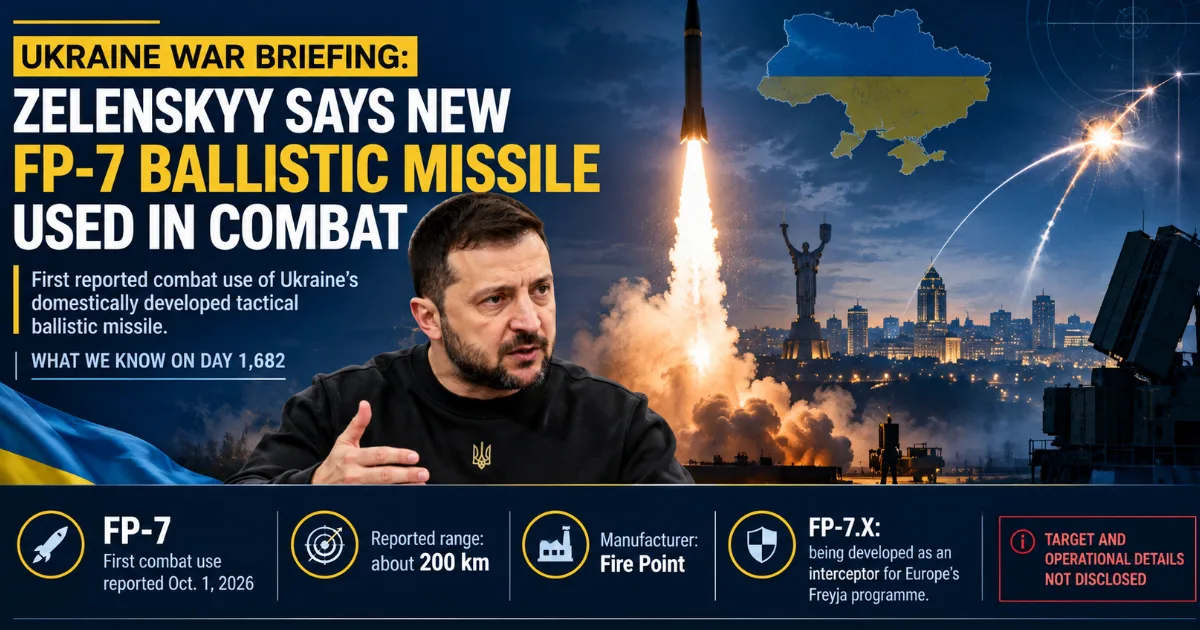
Ukraine has announced the first combat use of its domestically developed FP-7 tactical ballistic missile, marking another significant stage in Kyiv’s effort to build an indigenous strike capability while reducing dependence on foreign weapons and ammunition. President Volodymyr Zelenskyy announced the development on October 1, saying the Ukrainian missile had been used in combat for the first time and indicating that the next priority would be production. He did not disclose where the missile was launched, what it targeted, how many missiles were used or what damage was caused. Ukrainian officials have subsequently declined to identify the target.
The announcement is important not simply because a new missile has appeared on the battlefield, but because the FP-7 sits at the intersection of two developments that have become increasingly important during the war. The first is Ukraine’s attempt to develop weapons capable of striking targets at considerable distances without relying entirely on Western-supplied systems. The second is the country’s effort to build a new generation of missile defence capabilities with European partners. The FP-7 itself is being developed by Ukrainian defence company Fire Point, while a related version, the FP-7.X, is intended to form the basis of the interceptor for the European Freyja anti-ballistic missile programme.
That dual role makes the missile particularly interesting. The FP-7 is being developed as a ballistic missile capable of attacking ground targets, while the FP-7.X represents an evolution intended for interception of incoming ballistic threats. In other words, the same broader Ukrainian technological programme is contributing to both sides of the modern missile equation: the ability to strike at distance and the ability to defend against missiles launched by an adversary. The combat debut of the FP-7 therefore provides an early indication of what Ukrainian engineers and manufacturers have been able to bring from development into operational use, although it does not by itself establish how effective the system will ultimately be or how quickly it can be manufactured at scale.
The first combat launch
Zelenskyy’s announcement was deliberately brief. He described the FP-7 as a Ukrainian tactical ballistic missile and said it had been used in combat for the first time. He thanked those responsible for the result and immediately pointed toward the next objective, production. The accompanying video showed a missile launch, but the Ukrainian government has not publicly disclosed the location of the firing position or the target.
That lack of information is significant. In wartime, governments frequently withhold operational details about new weapons, particularly during an initial deployment. Revealing the launch location, flight path, target or number of missiles used could provide useful information to the opposing side. Consequently, the available evidence currently establishes the fact of the announced combat use, but it does not provide enough information to independently assess the tactical outcome of the strike.
Ukraine's communications adviser was asked what the FP-7 had hit and replied that the country was not disclosing the information. That means claims circulating about specific targets should be treated cautiously unless they are subsequently confirmed by reliable Ukrainian, Russian or independent sources.
The distinction matters because a weapon's first battlefield deployment and its battlefield effectiveness are not necessarily the same thing. A successful launch demonstrates that a missile has reached an operational stage. It does not automatically establish its accuracy, reliability, survivability against enemy air defence, production rate or effectiveness against different categories of targets. Those questions generally require repeated operational use and independent assessment.
For Ukraine, however, the milestone itself has considerable importance. Russia has maintained a large ballistic and cruise missile capability throughout the war, while Ukraine has depended heavily on Western systems for both long-range strike and missile defence. Developing a domestic ballistic missile provides Kyiv with another option in an environment in which access to foreign weapons can depend on production capacity, political decisions, delivery schedules and the availability of specialised ammunition.
What is the FP-7?
Publicly available information about the FP-7 remains limited, and some technical specifications reported by Ukrainian sources and defence publications have not been independently verified. Reuters has described it as a short-range ballistic missile with a range of approximately 200 kilometres. Ukrainian military analysts have also described it in that general range category.
Some Ukrainian reporting has cited longer figures and additional specifications, but those should be treated as reported claims rather than established independent specifications. The available reporting also indicates that Fire Point has designed the FP-7 as a system capable of attacking ground targets, while the related FP-7.X is being developed for interception duties.
The distinction between the two variants is important. A ballistic missile designed to hit a ground target follows a different operational requirement from an interceptor designed to destroy an incoming missile. An interceptor needs sophisticated detection, tracking, guidance and terminal manoeuvring capabilities, supported by a wider network of radars and command systems. Fire Point's development programme therefore goes beyond simply manufacturing a missile body and propulsion system.
The FP-7's development also reflects a broader transformation within Ukraine's defence industry. Fire Point was established after the full-scale Russian invasion and has expanded from drone production into missile technology. Reuters has reported that the company is also developing the longer-range FP-9, with a projected range of up to about 850 kilometres. Company plans and future capabilities remain subject to testing and production, meaning projected specifications should not be confused with demonstrated battlefield performance.
That progression is part of a much larger Ukrainian attempt to build domestic weapons production. Ukraine has become known for rapidly developing drones, electronic warfare systems and other battlefield technologies during the war. Ballistic missiles are considerably more technically demanding than many drone systems, however, because they require reliable propulsion, guidance, control, manufacturing precision and testing.
The challenge becomes even greater when production moves from prototypes or limited batches to sustained wartime manufacturing. A missile that can be successfully tested is one achievement. Producing hundreds or thousands of reliable weapons while maintaining quality, supply chains and secure manufacturing facilities is another.
Why ballistic missiles matter
Ballistic missiles occupy a particular position in modern warfare because of their speed and flight profile. Unlike many drones, which can be comparatively slow, ballistic missiles can travel at very high speeds and provide defenders with considerably less time to detect, identify and engage them. This is one reason why ballistic missile defence is technically demanding and why systems capable of intercepting them are among the most valuable and expensive components of modern air defence.
Russia has repeatedly used ballistic missiles against Ukrainian cities and infrastructure. Ukraine has consequently sought systems capable of intercepting these threats, with the U.S.-supplied Patriot system playing a central role. Reuters reported that Ukraine has faced shortages of Patriot interceptor missiles and that the limitations of global production have contributed to pressure on Kyiv's air-defence network.
This creates a difficult strategic equation. Ukraine needs interceptors to defend its cities and infrastructure, but interceptors are expensive and can be difficult to replace. At the same time, Russia can launch repeated waves of missiles and drones, forcing Ukraine to decide which threats require the use of its most capable defensive systems.
The development of domestic missile technology therefore has two potential effects. First, it could give Ukraine greater independence in offensive strike capabilities. Second, through the FP-7.X and Freyja programme, it could contribute to a future defensive architecture designed specifically to address ballistic missile threats.
Neither objective is simple. The battlefield will ultimately determine how well the systems perform.
From FP-7 to Freyja
The most consequential part of the FP-7 story may ultimately extend beyond the missile's use as a strike weapon. Fire Point is developing the FP-7.X as the interceptor for the Freyja European missile-defence programme. Reuters reported in June that the FP-7.X had completed a controlled manoeuvring flight test and was intended to serve as the foundation of the future Freyja interceptor.
The Freyja project is being developed as a European effort involving Ukraine and several NATO countries. Its purpose is to create an anti-ballistic missile system that could eventually complement or provide an alternative to existing systems such as Patriot. Ukraine's official presidency said in September that the programme involves Ukraine, Denmark, France, Germany, Italy, the Netherlands, Norway, Spain, Sweden and the United Kingdom, with companies including Fire Point, Kongsberg, Weibel, Saab, Diehl Defence, Hensoldt, Thales, Safran, Sener and Leonardo involved in discussions or implementation.
The architecture is intended to be multinational rather than entirely Ukrainian. Ukraine contributes missile and launcher technology, while European partners contribute radar, guidance, command and other components. That structure reflects the complexity of modern air defence. The interceptor itself is only one part of the system.
In June, Fire Point said German defence company Hensoldt would provide its TRML-4D radar technology for the project. Fire Point was also discussing infrared and radio-frequency seeker technologies with European companies. These components are critical because an interceptor must first detect and track an incoming missile before its guidance system can direct it toward the target.
By August, Reuters reported that Fire Point had agreements with more than a dozen European defence companies for radar, guidance and other technologies, with the various components beginning to be integrated. Norway's Kongsberg was involved in the command-centre architecture. Fire Point said at the time that it aimed to achieve its first successful interception by mid-2027.
This is a crucial point when interpreting the FP-7 combat debut. The missile that has now entered combat should not be automatically described as a completed European anti-ballistic defence system. Freyja is still under development. The FP-7.X is related to the FP-7 but has a different intended mission. The wider system requires radars, command-and-control infrastructure, seekers and other technologies before it can function as an integrated ballistic missile defence network.
The Patriot problem
The urgency behind Freyja is partly explained by the limitations of existing missile defence. Ukraine has relied heavily on Patriot systems for protection against ballistic missiles, but interceptor missiles are expensive and production capacity is limited.
Reuters reported in July that Ukraine was chronically dependent on Patriot for reliable defence against Russian ballistic missiles and that supplies had been affected by low stocks, production limitations and broader political factors. Ukrainian officials were therefore pushing for a European system that could eventually provide another source of ballistic missile defence capacity.
This does not mean Freyja is about to replace Patriot. The project is still at the development and testing stage, and a prototype is targeted for the first half of 2027. The more immediate objective is to demonstrate that a European consortium can produce a functional interceptor architecture and then determine whether it can be manufactured and deployed at meaningful scale.
Cost is also part of the equation. Fire Point has said that it aims to produce an interceptor for less than €1 million, which the company has described as substantially below the estimated cost of a Patriot interceptor. Such comparisons are company claims and should not be treated as a final assessment of system cost, because the total cost of an air-defence architecture includes radar, launchers, command systems, maintenance, training and other infrastructure.
Nevertheless, the underlying economic problem is straightforward. A country cannot indefinitely defend itself against large numbers of incoming missiles if every defensive interception requires an extremely expensive missile and the attacker can maintain a large stockpile. The search for cheaper but effective interceptors is therefore a major issue for Ukraine and European defence planners.
Ukraine's wartime defence industry
The FP-7 is also evidence of how dramatically Ukraine's defence industry has changed during the war. Before Russia's full-scale invasion, Ukraine possessed significant Soviet-era and post-Soviet defence manufacturing expertise, but the scale and speed of wartime innovation have transformed the sector.
Companies that began by developing drones have expanded into cruise missiles, ballistic systems and air-defence technologies. Fire Point is one example. Reuters has reported that the company produces large numbers of long-range drones and has developed the Flamingo cruise missile alongside its ballistic missile work.
The significance of this industrial transformation goes beyond individual weapons. Modern warfare increasingly depends on the ability to adapt systems quickly, analyse battlefield performance, alter designs and move successful prototypes into production. Ukraine has been forced to do this under wartime conditions, while its industrial infrastructure remains vulnerable to Russian attacks.
That creates a paradox. The war has accelerated Ukrainian defence innovation, but it has also made the manufacturing process more difficult. Production facilities, electricity supplies, transportation networks and specialised components all remain vulnerable. The ability to produce a sophisticated missile consistently may ultimately prove more important than the ability to demonstrate one successful launch.
This is why Zelenskyy's statement that the next step is production deserves attention. The combat debut is only the beginning of the industrial challenge.
Production could be the real test
A modern missile programme can be divided into several stages. There is design, testing, operational validation, manufacturing, quality control, logistics, deployment and sustained replacement. Ukraine has now publicly announced the operational use of the FP-7. The next question is whether the missile can be produced in sufficient numbers to influence battlefield calculations.
Scale matters because a small number of missiles may have tactical value but limited strategic effect. A sustained production programme could create a different situation by giving Ukrainian commanders a larger pool of domestically manufactured weapons and reducing dependence on foreign stocks.
But scaling production of ballistic missiles is not comparable to simply increasing the output of commercial products. Propulsion systems, guidance electronics, precision manufacturing and specialised materials require secure and reliable supply chains. Components must meet tight tolerances, and every production batch must be tested.
The war also creates an incentive to keep manufacturing methods flexible. A design that depends heavily on a single imported component could become vulnerable if that component becomes unavailable. Ukraine's wider defence industry has therefore increasingly sought partnerships with European companies, allowing individual systems to combine technologies from several countries.
The Freyja programme illustrates this model. Rather than attempting to build every component domestically, Ukraine and its partners are working toward an open architecture in which radar, guidance, command and missile technologies can come from different industrial sources. Ukrainian officials have described the concept as allowing different European countries to integrate their own technologies into the wider system.
What the FP-7 combat debut does not tell us
The announcement has generated considerable attention, but several important questions remain unanswered.
The first is the target. Ukraine has not identified it. Without knowing the target, it is impossible to assess whether the missile was used against a military facility, infrastructure, logistics site or another objective.
The second is accuracy. A missile can be successfully launched without achieving the intended level of precision. Publicly available evidence does not yet provide enough information to independently assess the FP-7's battlefield accuracy.
The third is reliability. One launch cannot establish how consistently the missile performs under operational conditions.
The fourth is production capacity. Ukraine has indicated that production is the next priority, but public information does not establish how many FP-7 missiles are currently available or how quickly the manufacturing rate can increase.
The fifth is Russian response. Moscow may seek to locate production facilities, launch infrastructure and supply chains associated with Ukraine's missile programme. That could create a new contest between Ukrainian manufacturing and Russian efforts to disrupt it.
The sixth is the relationship between the FP-7 and future FP-7.X interceptor systems. Although the two are technically related, an interceptor requires additional technologies and an integrated air-defence network. The success of the strike missile does not automatically demonstrate that the future Freyja system will succeed in intercepting Russian ballistic missiles.
These distinctions are important because the battlefield often produces a gap between announcements and demonstrated capability. A new weapon can be strategically significant while still being in an early phase of development.
A new chapter in the missile war
The FP-7's appearance also comes at a moment when the character of the air war over Ukraine is becoming increasingly complex. Russia continues to use combinations of drones, cruise missiles and ballistic missiles, forcing Ukraine to operate multiple layers of air defence simultaneously. Ukrainian officials have recently described an increasing threat from fast jet-powered drones as well as ballistic missile attacks.
This creates a technological race in which every new offensive capability generates demand for a corresponding defensive system.
Russia develops or deploys weapons that challenge Ukrainian air defences. Ukraine seeks additional interceptors, electronic warfare systems and fighter aircraft. Russia adapts its tactics. Ukraine modifies its systems. Both sides attempt to overwhelm the other's ability to detect, track and respond.
The FP-7 therefore represents more than another missile designation. It is part of a broader cycle of adaptation.
For Ukraine, the ability to manufacture tactical ballistic missiles domestically could offer greater freedom in planning strikes. Instead of relying entirely on Western decisions about which weapons can be supplied, Kyiv can potentially determine how and when domestically produced systems are used, subject to its own available resources and operational requirements.
At the same time, the development of FP-7.X and Freyja indicates that Ukraine does not view the missile challenge solely through the lens of offensive capability. It is also trying to become a contributor to Europe's missile-defence architecture.
That distinction is particularly important for the future of European security. The war has exposed limitations in European missile-defence capacity and production. Countries across Europe are now examining how quickly they can expand defence manufacturing, increase interceptor stocks and develop systems capable of dealing with increasingly sophisticated missile threats.
Europe becomes part of the technology equation
Freyja could eventually become an example of a different approach to European defence development. Instead of relying on one national system or a single manufacturer, the programme is designed around cooperation among several countries and companies.
The participating organisations bring different areas of expertise. Radar manufacturers can contribute detection and tracking technology. Missile companies can contribute propulsion and interceptor design. Other firms can contribute seekers, electronics, command systems and communications.
The benefit of such an arrangement is potentially greater industrial flexibility. The disadvantage is complexity. Integrating systems developed by different companies in different countries is difficult. Software, communications protocols, radar data and missile guidance systems must work together under extremely demanding conditions.
The first successful interception will therefore be an important milestone, but even that will not represent the end of the process. A prototype must eventually become a reliable production system. It must be manufactured in quantity, maintained in the field and operated by trained personnel.
Ukraine's experience provides a particularly demanding environment for testing such technologies because the threat is real and continuous. That has accelerated development, but it also means that failures can have immediate consequences.
The significance of the FP-7 for Ukraine
For Ukraine, the FP-7 represents an attempt to change the balance between dependence and domestic production. Foreign weapons have been essential to Ukraine's defence, but no country can assume that external supplies will always arrive at the required speed or quantity.
Domestic missile production does not eliminate the need for international assistance. Ukraine still requires foreign radar systems, air-defence interceptors, electronics, financial support and industrial cooperation. But every successful domestic system adds another layer of resilience.
That is why the phrase "Next, production" in Zelenskyy's announcement is arguably more consequential than the launch itself. The first combat use demonstrates that the programme has reached an operational milestone. Sustained manufacturing will determine whether that milestone becomes a meaningful battlefield capability.
Ukraine's development of the FP-7 also illustrates how warfare can compress technological timelines. Weapons that might normally require years of development have been accelerated because battlefield requirements are immediate. Fire Point's FP-7.X testing earlier this year and the subsequent creation of the wider Freyja coalition demonstrate how rapidly the programme has moved from missile development toward an integrated European defence project.
What comes next
The coming months should provide more information about the FP-7. Ukraine may eventually disclose the target involved in the first combat launch, additional details about the missile's performance or information about production numbers. Independent assessments could also emerge from satellite imagery, battlefield evidence or other open-source intelligence.
At the same time, attention will increasingly turn to FP-7.X and Freyja. Fire Point and its European partners are working toward a prototype anti-ballistic system, with Ukrainian officials targeting the first half of 2027 for a minimum viable system.
The success or failure of that programme will depend on far more than the missile itself. Radar coverage, target tracking, seeker performance, command-and-control systems, software integration, launchers and interceptor reliability will all matter.
The FP-7's combat debut is therefore best understood as one part of a much larger transformation. Ukraine is attempting to develop a domestic missile industry while simultaneously helping create a European ballistic missile defence architecture. The same technological ecosystem that produces weapons capable of striking targets is now being connected to systems designed to intercept incoming missiles.
That development reflects the nature of the war itself. Ukraine and Russia are no longer relying solely on inherited weapons systems. Both sides are adapting technologies, changing production methods and attempting to shorten the distance between engineering laboratories and the battlefield.
For Ukraine, the immediate test is whether the FP-7 can move from a headline-making first launch to a dependable production programme. For Europe, the larger test is whether Freyja can evolve from an ambitious multinational project into a functioning anti-ballistic defence system. And for the wider security environment, the emergence of another domestically produced ballistic missile underlines how the technology of modern warfare is spreading beyond the traditional group of major missile-producing powers.
The FP-7's first combat use does not, by itself, change the course of the war. It is one missile, one announced operational milestone and a programme whose full capabilities remain only partly visible. But it does demonstrate something that has become increasingly clear during the conflict: Ukraine's defence industry is moving from emergency adaptation toward the development of increasingly sophisticated indigenous weapons.
The real story will now be measured not by the launch video, but by what happens afterward. Can Ukraine produce the missile consistently? Can it build enough of them to matter? Can the related FP-7.X become a reliable interceptor? Can European companies integrate their technologies into Freyja? And can these systems survive the operational, industrial and financial pressures of a prolonged war?
Those questions remain unanswered. What is clear is that the FP-7 has now crossed an important threshold from development into combat. Ukraine has publicly demonstrated that a domestically developed tactical ballistic missile has reached the battlefield. The next stage is no longer simply proving that the missile can fly. It is proving that Ukraine can manufacture, deploy and sustain it at scale.
That is where the significance of the FP-7 will ultimately be decided.
#BeyondHeadlines #Ukraine #Russia #UkraineWar #FP7 #FP7Missile #BallisticMissile #Zelenskyy #FirePoint #Freyja #MissileDefence #AirDefence #UkraineDefence #EuropeanDefence #MilitaryTechnology #DefenceTechnology #Geopolitics #RussiaUkraineWar #WarInUkraine #MissileTechnology #DefenceIndustry #WorldAffairs #InternationalSecurity #EuropeSecurity