When a Luxury Car Brand Chooses Profit Over Volume
Porsche has built its reputation on speed, engineering excellence, distinctive design and the emotional appeal of driving a high-performance sports car. For decades, the German manufacturer has occupied a valuable position between mainstream premium vehicles and the more exclusive world of luxury sports cars. Its brand has been associated with performance, craftsmanship and the ability to command prices that many ordinary carmakers cannot achieve.
Yet even a prestigious automotive brand can face serious financial pressure when its markets change, costs rise and its product strategy no longer matches customer demand. Porsche is now responding with a significant restructuring plan that aims to make the business leaner, more exclusive and more profitable over the coming years.
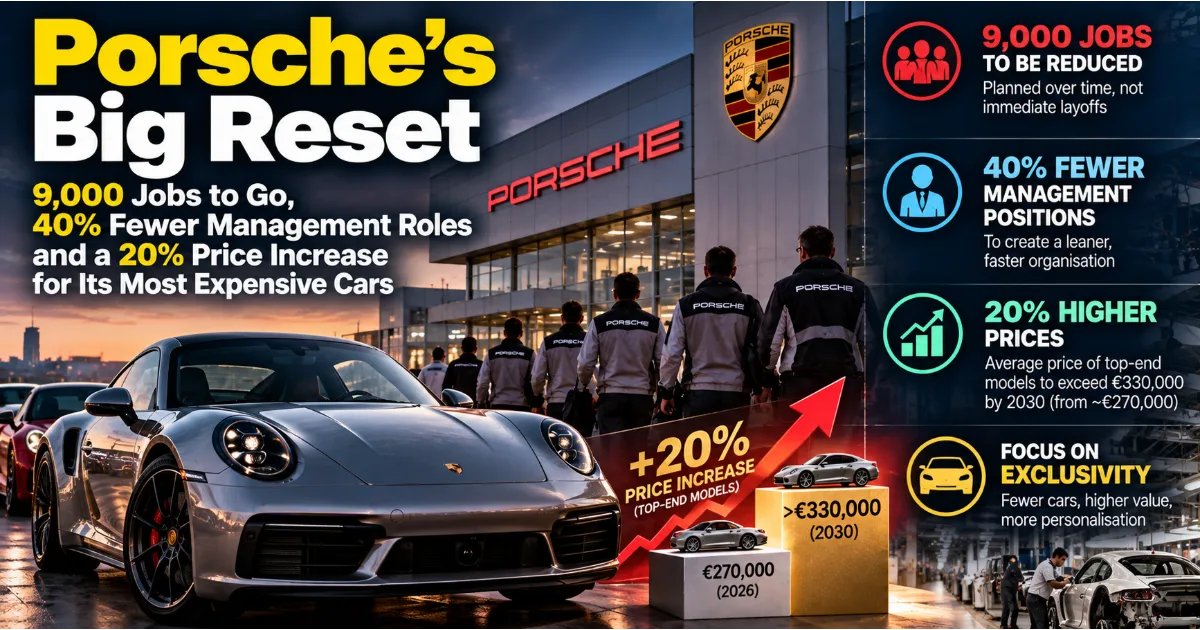
The company's strategy, presented on October 7, 2026, includes a socially responsible reduction of approximately 9,000 jobs, a medium-term reduction of 40% in management positions and an increase of around 20% in the average selling price of its highest-end models. Porsche also wants to reduce its break-even point to fewer than 200,000 vehicles, signalling that it intends to become less dependent on selling large numbers of cars.
These announcements have attracted attention because they combine two seemingly contradictory decisions. Porsche plans to reduce its workforce while making its most expensive vehicles even more expensive. Rather than trying to restore growth by selling more cars at broadly similar prices, it is seeking to generate greater value from each vehicle and simplify the organisation behind the brand.
The workforce announcement also requires careful interpretation. The 9,000-job reduction is a planned change over time, not a statement that 9,000 employees will be dismissed immediately. Porsche describes the programme as socially responsible and says it has agreed to protect the jobs of its core workforce through 2035. Its wider strategy refers to a 25% medium-term reduction in the workforce, with a longer-term strategic target of 30%, while management positions are targeted to fall by 40%.
The price increase is equally specific. Porsche is targeting an approximately 20% increase in the average selling price of its top-of-the-range models, not a blanket increase of 20% across every car it sells. Reports place the average price of these highest-end models at around €270,000 in 2026, with a target of more than €330,000 by 2030.
Behind these figures lies a broader transformation. Porsche is dealing with weaker demand in China, declining global deliveries, the costs of revising its electric-vehicle strategy and the challenge of protecting profitability in a competitive global automotive market. Its leadership is betting that exclusivity, carefully selected new products, greater personalisation and a more efficient organisation can strengthen the company's financial position.
The question is whether Porsche can successfully move towards a business model built on fewer vehicles, higher prices and greater exclusivity without weakening the brand appeal that made it successful in the first place.
What Porsche Has Announced
Porsche's new strategy, called Sportwagenschmiede '35, sets out its ambitions through 2035. The German word in the strategy's name evokes the idea of a sports-car workshop, reflecting the company's intention to strengthen its identity as a manufacturer of distinctive performance vehicles rather than simply maximise production volumes.
The plan combines changes to employment, management, production, product development, pricing and the overall range of vehicles offered to customers. These elements are connected. A company cannot necessarily achieve higher profitability simply by increasing prices if its internal costs remain too high, its product range becomes inefficient or customers stop buying its vehicles.
The reduction of approximately 9,000 jobs is part of a broader effort to reduce personnel costs and improve productivity. The company says the agreed measures include a commitment to protect the jobs of its core workforce through 2035. This is an important qualification because headlines about job cuts can create the impression of immediate mass dismissals, whereas Porsche's stated plan is a longer-term restructuring.
Management positions are also targeted for a 40% reduction in the medium term. The company expects leaner management structures to support faster decisions and reduce organisational complexity. In large companies, layers of management can make coordination expensive and slow, particularly when several departments are involved in product development, production and distribution.
Porsche is also simplifying its vehicle portfolio. It aims to reduce the number of model variants by approximately 20%, with the expectation that sales per variant can rise by about 30% in the medium term. Fewer variants can reduce engineering complexity, improve production planning and make purchasing more efficient.
At the same time, the company plans to expand its presence in higher-value vehicle segments, develop new flagship products and increase the range of personalisation options available to customers. Its target is to increase the average selling price of its top-of-the-range models by around 20% in the medium term.
Together, these measures show that Porsche is not relying on a single cost-cutting exercise. It is attempting to change how the business operates, which vehicles it prioritises, how much value it earns from each sale and the level of exclusivity it offers to customers.
Why Is Porsche Planning to Reduce 9,000 Jobs?
Workforce reductions are among the most sensitive elements of Porsche's restructuring because they affect employees, families, suppliers and the communities surrounding its German operations. For the company, however, the programme is part of a wider effort to reduce fixed costs and bring its operating structure into line with a smaller and more selective sales strategy.
Porsche has agreed to a reduction of approximately 9,000 jobs as part of its Future Package. The company describes the programme as socially responsible and says the agreement includes protection for the core workforce until 2035. The exact effect on individual employees will depend on how the measures are implemented over time.
A significant point is that a planned reduction in the number of jobs does not necessarily mean that every affected position will be eliminated through compulsory dismissal. Workforce changes can take place through retirement, natural attrition, voluntary departure arrangements, organisational consolidation and the closure or transfer of activities. Porsche's stated approach is framed as a socially responsible reduction, although the precise experience of individual workers will depend on the measures that apply to their roles.
The distinction matters because automotive manufacturing is a complex industry. Employees work across vehicle assembly, engineering, research, procurement, logistics, software, administration, sales and support services. Reducing staffing in one part of the organisation does not have the same consequences as reducing it in another. Some areas may become smaller, while others may require additional expertise as Porsche develops new technologies and products.
The company's plans also involve reducing personnel costs in production by up to 30% in the medium term. Porsche says process optimisation, production-oriented vehicle design and greater flexibility in manufacturing can contribute to this goal. It also plans to reduce development costs for future vehicle lines by up to 20%, partly through shorter development cycles, more modular processes and less complexity across the range.
For employees, the central concern is how the restructuring will be managed in practice. A long-term employment commitment can provide important reassurance, but it does not mean that every current job, department or activity will remain unchanged. Employees may still face changes in responsibilities, reporting structures, working methods or opportunities within the organisation.
For Porsche, the challenge is to lower costs without losing the engineering knowledge and production expertise that distinguish its vehicles. The company cannot protect its brand merely by cutting expenses. It must continue developing cars that customers consider desirable, reliable and worth their price.
The success of the workforce programme will therefore depend on whether Porsche can simplify its operations while retaining the skills necessary to build competitive sports cars. Cutting costs may improve financial results in the short term, but excessive reductions in essential expertise could create longer-term problems if they weaken product quality or delay important launches.
Why Is Porsche Cutting 40% of Management Positions?
The planned reduction of 40% in management positions is another important part of Porsche's strategy. Management layers can be valuable when they provide clear accountability, strong technical oversight and coordination across a large organisation. They can also create unnecessary complexity when responsibilities overlap or decisions require approval from too many levels.
Porsche says it wants a leaner, faster and more effective organisation. Reducing management positions is intended to make decision-making more agile and strengthen individual responsibility. The target is separate from the overall workforce reduction, which is set at 25% in the medium term, with a longer-term strategic target of 30%.
The figures should not be confused. A 40% reduction in management positions does not mean that 40% of all Porsche employees will lose their jobs. Management is one category within the broader workforce, and the company has announced separate targets for each.
Why does management structure matter so much in the automotive industry? Developing a modern vehicle requires coordination between design, engineering, software, safety, procurement, manufacturing, marketing and regulatory teams. A decision about a new component can affect costs, production schedules, vehicle performance and supplier relationships. When responsibilities are unclear, decisions can become slow and expensive.
A leaner organisation can help by reducing duplicated work and giving teams clearer authority. It can also shorten communication channels between technical experts and senior decision-makers. In a market where technology and customer expectations are changing rapidly, speed can be an important competitive advantage.
However, reducing management positions does not automatically improve efficiency. If too many experienced managers are removed without redesigning responsibilities, the remaining employees may face heavier workloads and weaker coordination. Essential decisions could become concentrated in fewer people, creating new bottlenecks rather than eliminating old ones.
The distinction between removing unnecessary layers and removing necessary expertise is therefore crucial. Porsche will need to clarify who makes decisions, how teams collaborate and how accountability is maintained after the restructuring.
The company must also ensure that its workforce understands the purpose of the changes. Employees are more likely to adapt successfully when responsibilities are clear and the organisation communicates openly about how its new structure will work.
If Porsche can simplify its organisation without damaging collaboration, the management cuts could help it become more responsive and cost-efficient. If the changes create uncertainty or overload the remaining teams, some of the expected savings could be offset by operational problems.
The 20% Price Increase: Porsche Wants More Value From Every Car
The most striking part of Porsche's strategy may be its plan to increase the average selling price of its highest-end models by around 20%. The company is not announcing a uniform increase for every vehicle. It wants to raise the average price of its top-of-the-range models from approximately €270,000 in 2026 to more than €330,000 by 2030.
This represents a deliberate move towards a more exclusive product mix. Porsche wants a larger share of its business to come from expensive vehicles and higher-margin derivatives, including models with special performance characteristics, distinctive equipment and extensive personalisation options.
The logic is straightforward. Selling more vehicles does not always generate the highest possible profit. A company may achieve better financial results by selling fewer cars at stronger margins, provided demand remains healthy and the additional value offered to customers justifies the higher price.
Luxury brands often compete through exclusivity as well as engineering and performance. Buyers may be willing to pay more for distinctive specifications, limited availability, special materials, bespoke finishes or a vehicle that occupies a unique position in the market. Porsche wants to strengthen this part of its identity.
Its strategy includes expanding the Sonderwunsch programme, which enables highly individualised vehicles, and increasing revenue from this business sixfold in the medium term. It also plans to organise its performance, exclusivity and heritage activities under a broader luxury sports-car offering.
Personalisation can create value because customers are not simply purchasing transportation. They may be purchasing an expression of taste, status and individual preference. Custom colours, materials, interior details and special configurations can make a vehicle feel more personal and differentiate it from standard production models.
However, the pricing strategy carries risks. Customers have limits, even in the luxury market. If a higher price is not supported by a meaningful improvement in the product or ownership experience, some buyers may choose alternatives. A more exclusive positioning can strengthen a brand, but excessive price increases can also make it less attractive to customers who have historically viewed it as a combination of performance, quality and relative value.
Porsche's challenge is to ensure that higher prices reflect stronger products and a more compelling customer experience. The company itself says the higher price positioning will be supported by corresponding product substance.
This is why the 20% target should not be understood simply as a decision to charge more for an unchanged car. It forms part of a wider strategy to develop higher-value models, strengthen personalisation and shift the product portfolio towards more exclusive segments.
Whether customers accept that positioning will be one of the most important tests of the plan.
Porsche's China Problem and the Decline in Global Deliveries
The restructuring is taking place against a difficult market backdrop. Porsche's recent sales performance shows why its leadership is seeking a different balance between volume and profitability.
Porsche reported 178,532 vehicle deliveries worldwide during the first nine months of 2026, compared with 212,509 during the same period in 2025. That represents a decline of 16%. Deliveries in China fell by 33% to 21,493 vehicles, while deliveries in North America declined by 13% and those in Europe excluding Germany fell by 11%.
China is particularly important because it was once a major growth engine for Porsche. The market has become more challenging as consumer demand has weakened and local manufacturers have expanded their offerings in premium and electric vehicles. Competition is no longer limited to established European luxury brands. Chinese companies are also developing vehicles that combine technology, digital features and performance at prices that can appeal to buyers seeking alternatives.
For Porsche, the issue is not simply that fewer vehicles are being sold. A weaker market can also make it harder to maintain pricing power, manage production capacity and spread fixed costs across a large number of cars. When deliveries decline, factories and development programmes still require resources, making cost management more important.
The company has also been affected by product availability changes. Porsche has identified the phase-out of its 718 model line and the effects of a strong prior-year comparison for the electric Macan as factors influencing delivery trends.
There are still areas of resilience. Porsche's 911 remained in demand, with worldwide deliveries rising 12% to 42,217 vehicles in the first nine months of 2026. The company has pointed to continued interest in its high-performance GTS, Turbo and GT variants as evidence that desirable products can continue attracting customers even when the broader market is weak.
That contrast helps explain the company's strategic direction. Rather than trying to increase sales across every model line, Porsche wants to prioritise the vehicles and configurations that customers most strongly desire and that can generate stronger returns.
But the approach also depends on careful judgement. A luxury carmaker cannot assume that the demand for its most desirable sports cars will automatically compensate for weakness across other categories. The company must ensure that its future portfolio appeals to customers in different regions and that its product decisions match changing preferences.
The Electric-Vehicle Strategy Adds to the Pressure
Porsche's restructuring also follows a costly reassessment of its electric-vehicle ambitions. The automotive industry has been investing heavily in electrification, software, batteries and new production technologies, but demand has not developed at the same pace in every market or vehicle category.
Luxury buyers have different preferences, and demand can be affected by charging infrastructure, driving range, vehicle prices, government policy and the availability of suitable models. Some customers want electric vehicles, while others continue to prefer combustion engines or hybrids. A manufacturer that commits too heavily to one path may face expensive adjustments if customer demand evolves differently than expected.
Porsche's revised approach is designed to maintain flexibility across powertrains. Its strategy includes investments in combustion-engine and plug-in hybrid vehicles as well as the next generation of battery technology. The company has also outlined plans for electric versions of the 718 Boxster and Cayman, with their first full year of production expected to support sales in 2028.
This does not mean Porsche is abandoning electric vehicles. Instead, it is seeking a product strategy that can respond to different customer requirements while preserving the performance and character associated with the brand.
The financial challenge is substantial. Developing modern vehicles requires significant investment in engineering, safety, software, manufacturing equipment and supplier networks. When a company changes its powertrain plans, some previous investments may become less valuable, while new programmes require additional spending.
Porsche is attempting to control these costs by simplifying its product range, reducing development expenses and sharing selected platforms and technologies with partners within the Volkswagen Group. The company says it wants to reduce development costs for future model lines by up to 20% in the medium term.
This strategy could allow Porsche to preserve investment in the features that distinguish its vehicles while reducing duplication in areas where common technologies make economic sense. The challenge is to achieve those savings without making its cars feel less distinctive.
A Shift From Volume to Exclusivity
Porsche's strategy can be summarised by its emphasis on value over volume. Rather than maximising the number of vehicles sold, the company wants to increase the financial value generated by each vehicle and make its product portfolio more selective.
The strategy includes expanding the share of higher-value D and E vehicle segments in its portfolio by about 45% in the medium term. Porsche also plans to launch at least one brand-defining new product every year through 2030 and is developing a potential mid-engined super sports-car platform positioned above the 911. It is also exploring the possibility of an SUV positioned above the Cayenne.
These plans suggest that Porsche wants to move further into premium territory while continuing to protect the identity of its core sports cars. A larger range of exclusive derivatives, new flagship vehicles and personalisation options could support higher average prices.
The strategy resembles a broader approach used by some luxury manufacturers: limit the importance of pure sales volume and concentrate on desirability, scarcity and higher-value products. However, Porsche must preserve a balance between exclusivity and the scale that supports its engineering and production capabilities.
If too much of the business depends on a narrow group of expensive vehicles, the company may become more exposed to changes in luxury spending. Economic uncertainty can affect even affluent consumers, and buyers may delay purchases when confidence weakens.
The company is therefore trying to strengthen its position across multiple segments while making its most expensive vehicles more exclusive. Its success will depend on whether new products attract customers without diluting the brand or creating unnecessary complexity.
Can Porsche Become More Profitable by Selling Fewer Cars?
Porsche's strategy is built around the belief that profitability can improve even when sales volumes remain below previous levels. The company wants to lower its break-even point to fewer than 200,000 vehicles, meaning it aims to cover its costs at a lower level of annual sales than before.
This target is important because it could make Porsche less vulnerable to sudden declines in demand. A company with a high break-even point must sell a large number of vehicles to cover its fixed costs. If sales fall, profitability can deteriorate quickly. Reducing the break-even point can provide greater flexibility when markets weaken.
Porsche's financial ambitions reflect that goal. In the medium term, it is targeting a group operating return on sales of 10% to 15% and an automotive net cash flow margin of 9% to 12%. Its longer-term targets are a 15% group operating return on sales and a 12% automotive net cash flow margin.
Achieving these targets will require more than higher prices. Porsche must also control manufacturing costs, improve the efficiency of product development, manage inventory carefully and ensure that new models generate sufficient demand. It must maintain the quality and desirability of its vehicles while reducing organisational complexity.
The company is also focusing on its core business. Its announced measures include selling certain investments, planning the closure of some non-core development and production activities, and consolidating parts of its technology operations.
These changes suggest that management is trying to simplify the business and direct resources towards the activities it considers most important for Porsche's future. The objective is to create a company that can generate stronger cash flow and maintain its identity even when market conditions are difficult.
Nevertheless, targets are not guarantees. Porsche must still demonstrate that its higher-end products can command the prices it wants, that cost reductions can be achieved without weakening its capabilities, and that customers remain interested in its future model range.
The company's strategy will therefore need to be evaluated over several years rather than through a single announcement. Its progress in China, the reception of new vehicles, its margins and its ability to control costs will all provide evidence of whether the plan is working.
What Does the Restructuring Mean for the Automotive Industry?
Porsche's plans reflect pressures facing established automakers more broadly. Manufacturers must invest in electric vehicles, software, safety technologies and new production systems while responding to changing demand and competition from new entrants. These investments are expensive, and the market may not reward every product strategy equally.
The decline in Porsche deliveries is part of a wider challenge for German automakers in China. Volkswagen also reported a sharp fall in third-quarter deliveries in 2026, with weakness in China contributing to the declin
For traditional manufacturers, the challenge is to preserve the strengths of their established brands while adapting to a market that is becoming more competitive and technologically complex. Longstanding engineering expertise remains valuable, but it must be supported by products that meet current customer expectations and by cost structures that allow companies to compete.
Porsche's approach illustrates one possible response. It is prioritising high-value products, reducing complexity and attempting to strengthen profitability rather than pursuing volume growth at any cost. Other manufacturers may pursue different approaches depending on their market position, product mix and financial resources.
The consequences will extend beyond the company itself. Suppliers may have to adapt to changes in production volumes and model programmes. Employees may face new organisational structures. Dealers will need to sell a more focused range of vehicles, while customers may encounter a greater emphasis on bespoke specifications and high-performance models.
For the wider industry, the restructuring highlights the importance of strategic flexibility. Automakers need to make long-term investments, but they must also be willing to revise plans when demand, technology or competitive conditions change.
Conclusion: Porsche Is Rebuilding Its Business Around Exclusivity
Porsche's restructuring is a major attempt to reshape the business for the next decade. The company plans to reduce its workforce by approximately 9,000 jobs, cut management positions by 40% in the medium term and increase the average selling price of its highest-end models by around 20%. These measures form part of a wider strategy to lower costs, simplify operations and generate more value from each vehicle.
The job reductions are planned over time and should not be interpreted as 9,000 immediate dismissals. Porsche says the agreed package is socially responsible and includes protection for its core workforce through 2035. Its 40% management reduction is also separate from the broader workforce targets.
The price increase is similarly targeted. Porsche is seeking to raise the average price of its most expensive models to more than €330,000 by 2030, rather than increasing the price of every vehicle by 20%. The plan depends on customers seeing sufficient value in the company's performance, engineering, personalisation and exclusivity.
The pressure behind these decisions is real. Global deliveries fell 16% in the first nine months of 2026, while deliveries in China declined 33%. At the same time, the 911 continued to show resilience, suggesting that Porsche still has products with strong customer appeal.
The company's future will depend on whether it can extend that appeal across a more focused portfolio while managing costs and adapting to changing demand. Higher prices may support profitability, but only if customers continue to believe the products justify them. Workforce reductions may improve efficiency, but only if the company retains the people and capabilities required to develop outstanding cars.
Porsche is making a clear strategic choice: become more selective, more exclusive and less dependent on high sales volumes. That approach could strengthen its financial position, but it also places greater responsibility on every new product and every decision about the brand.
The real test will be whether Porsche can sell fewer cars, command higher prices and still deliver the performance, quality and emotional appeal that made its name valuable in the first place.
#BeyondHeadlines #Porsche #PorscheRestructuring #PorscheJobs #AutomotiveIndustry #LuxuryCars #GermanAutomotive #JobCuts #BusinessStrategy #ChinaMarket #ElectricVehicles #LuxuryMarket #GlobalEconomy #AutomotiveNews #BeyondTheHeadline