
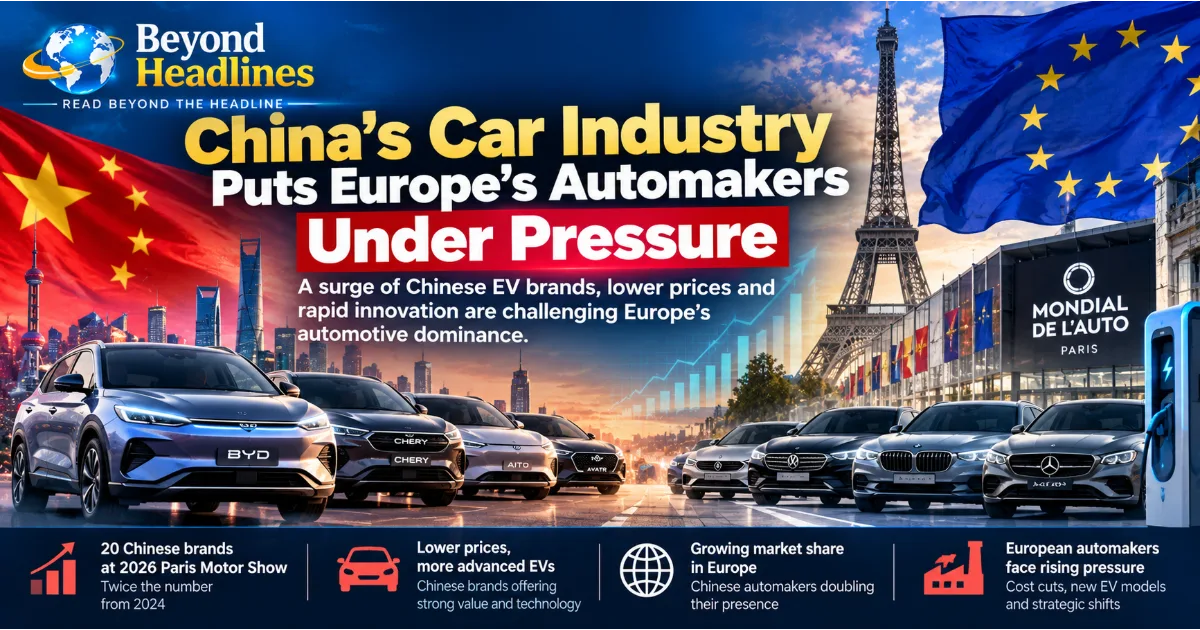
The global automotive industry is entering a period of profound change, and China's growing presence in Europe is becoming one of its most important developments. At the 2026 Paris Motor Show, a record 20 Chinese car brands are expected to participate, twice the number present at the 2024 event. Their growing presence reflects a broader transformation in the industry, as Chinese manufacturers expand beyond their domestic market and challenge established European companies with competitively priced vehicles, electric vehicle technology and increasingly ambitious international strategies.
For decades, European manufacturers such as Volkswagen, Mercedes-Benz, BMW, Renault, Peugeot and Stellantis brands built their reputations on engineering, design, manufacturing expertise and strong relationships with customers. Their vehicles became symbols of European industrial strength, while the continent developed an extensive network of factories, component suppliers, dealerships and skilled workers. Today, however, these companies face a competitive environment in which their historic advantages are no longer sufficient to guarantee leadership.
Chinese automakers are arriving with a different set of strengths. Many have developed electric vehicles rapidly, established extensive battery supply chains and learned to bring new models to market at a pace that traditional manufacturers are struggling to match. They are also targeting customers who want modern technology, attractive designs and lower purchase prices at a time when the cost of owning a new vehicle has become a major concern for households.
The pressure is becoming visible in sales figures, corporate restructuring, investment decisions and political debates about trade. Chinese brands have expanded their presence in European markets even after the European Union introduced additional duties on certain electric vehicles manufactured in China. At the same time, European companies are trying to reduce costs, develop more affordable electric models and determine how much of their future production should take place in Europe or in partnership with Chinese manufacturers.
The story is not simply about one country defeating another in the car business. It is about a shift in how vehicles are designed, manufactured, priced and sold. It also raises a difficult question for Europe: can its automotive industry adapt quickly enough to remain competitive while protecting the jobs, technological capabilities and industrial communities that have depended on it for generations?
The growing Chinese presence at the Paris Motor Show provides a timely illustration of this challenge. It brings established European manufacturers and increasingly ambitious Chinese competitors into the same spotlight, where their products, strategies and visions for the future can be compared directly.
The Paris Motor Show Becomes a Symbol of a Changing Industry
The Paris Motor Show has long been an important stage for European automotive companies. France has a deep history of car manufacturing, and the event traditionally provides manufacturers with an opportunity to introduce new vehicles, present technological developments and demonstrate their ambitions to customers and industry professionals. The participation of a record number of Chinese brands in 2026 changes the character of the event, turning it into a visible demonstration of how quickly the competitive landscape is evolving.
Chinese manufacturers attending the show include established names such as BYD and Chery, alongside newer entrants including Aito and Avatr. Their participation reflects a market strategy that goes beyond exporting a limited number of vehicles. These companies want to build lasting recognition, develop dealership networks, understand European customers and establish themselves as serious alternatives to familiar brands.
Motor shows are important because buying a car involves more than comparing technical specifications. Customers want to see the vehicle, experience its interior, assess its comfort and understand whether the brand can be trusted to provide service and support. A strong presence at a major European exhibition gives Chinese companies an opportunity to engage with customers who might previously have considered only local or established international manufacturers.
For European automakers, the event also creates a direct comparison between their products and those of competitors that may have different cost structures and development cycles. The pressure is especially significant in electric vehicles, where battery performance, charging capability, software, digital features and purchase price increasingly influence consumer decisions.
The motor show is therefore more than a display of new cars. It is a meeting point between two industrial approaches. European manufacturers bring long-established brands, engineering expertise and manufacturing infrastructure. Chinese manufacturers bring scale in batteries and electronics, rapid product development and a growing ability to offer sophisticated vehicles at competitive prices.
Neither side has an automatic guarantee of success. But the increasing visibility of Chinese companies shows that the competitive balance is no longer defined solely by the historical reputation of European brands.
How Chinese Automakers Built Their Advantage
China's progress in the automotive sector did not happen overnight. It developed through years of industrial investment, a large domestic market, the expansion of battery manufacturing and the rapid adoption of electric vehicles. The country also developed extensive supply chains covering components that are essential to modern cars, including batteries, electric motors, power electronics and digital systems.
The size of the Chinese market gave domestic manufacturers an important testing ground. Companies could introduce new models, observe customer reactions, improve software and manufacturing processes, and use the experience to refine later products. A large customer base also allowed manufacturers and suppliers to pursue economies of scale, potentially reducing the cost of producing individual vehicles.
The transition toward electric mobility created an additional opportunity. European companies had spent decades refining internal combustion engines, transmissions and related technologies. Chinese manufacturers also developed combustion-engine vehicles, but the growth of electric mobility allowed newer competitors to build capabilities in areas where the established order was less deeply rooted.
Batteries became particularly important. They represent a major portion of an electric vehicle's cost and influence its driving range, charging speed, performance and longevity. Companies with strong battery supply chains can benefit from greater control over production, technical development and procurement costs.
Chinese manufacturers have also increasingly treated the car as a digital product. Touchscreen interfaces, connected services, driver-assistance features and software updates are central to the customer experience in many modern vehicles. This approach appeals to consumers who expect their cars to offer technology similar to that found in smartphones and other connected devices.
The combination of batteries, electronics, manufacturing scale and rapid product development has helped Chinese brands become more competitive internationally. It does not mean that every Chinese vehicle is cheaper, better or more reliable than every European alternative. Product quality varies between manufacturers and models, just as it does across the wider automotive industry. The important point is that Chinese companies now compete across a much broader range of capabilities than they did when their international presence was limited.
Price Has Become a Powerful Competitive Weapon
One of the most important advantages associated with Chinese carmakers is their ability to offer vehicles at prices that challenge comparable models from established manufacturers. For customers facing high living costs, expensive financing and uncertainty about future fuel prices, affordability can become the deciding factor in a purchase.
An analysis of European sales in 2025 found that Chinese brands doubled their combined share of the broader European car market to around 6%. Some Chinese vehicles were priced as much as €10,000 below comparable models from European manufacturers, although the difference varies considerably by vehicle, equipment and market.
That gap can influence a household's decision. A customer comparing two electric vehicles may find that both offer adequate range, modern safety equipment and similar everyday usability, but one costs significantly less. If the lower-priced model also offers a well-designed interior, a long warranty and an attractive technology package, the established brand may find it harder to justify its premium.
European manufacturers have traditionally relied on brand identity and perceived quality to support their prices. Premium manufacturers can still command higher prices when customers value performance, comfort, craftsmanship, driving dynamics or prestige. However, in the mass market, buyers often focus more directly on the overall package they receive for their money.
Price competition is especially difficult when manufacturers are trying to recover large investments in new technology. Developing electric vehicles requires spending on platforms, batteries, software, factories and supply chains. European companies must manage these investments while continuing to support their existing combustion-engine businesses and comply with changing environmental requirements.
Chinese competitors are also investing heavily, and their advantage is not simply that they can make cars cheaply. It is the combination of cost control, product development, component integration and an ability to compete across multiple price segments. European automakers need to improve these capabilities without compromising safety, durability or the quality that customers expect.
The Electric Vehicle Market Is Changing the Rules
The transition from petrol and diesel vehicles to electric mobility is one of the biggest structural changes the automotive industry has faced in decades. It affects the components required in a vehicle, the skills needed to develop it, the infrastructure needed to operate it and the economics of manufacturing.
In the European Union, battery-electric vehicles accounted for 19.7% of new car registrations during the first four months of 2026, compared with 15.3% in the same period of 2025. The increase illustrates the growing importance of electric mobility, although the pace of adoption differs between countries and customer groups.
As the market changes, manufacturers that can provide attractive electric vehicles at accessible prices gain opportunities to reach new customers. Chinese companies have been particularly active in this area, offering vehicles ranging from compact urban models to family SUVs and premium electric cars.
European brands are not absent from this competition. Volkswagen, Renault, BMW, Mercedes-Benz, Stellantis and other manufacturers have launched or developed electric models and continue to invest in new platforms. Several European companies also possess strong engineering capabilities, established customer relationships and extensive service networks. The challenge is to turn those advantages into products that can compete on both price and technology.
The difficulty is that the transition does not happen in a clean break. Manufacturers must support combustion-engine vehicles that still generate revenue while investing in electric models that may initially deliver different profit margins. They also have to manage uncertainty over charging infrastructure, electricity prices, government incentives and consumer preferences.
Some buyers are ready to switch to electric vehicles, while others remain concerned about charging access, long-distance travel, resale values or the cost of replacing a battery outside warranty. Hybrids and plug-in hybrids remain important alternatives for customers who want lower fuel consumption without relying entirely on charging infrastructure.
Chinese manufacturers have increasingly targeted these different needs. Their growth is not limited to pure electric vehicles, and the European response cannot rely on battery-electric competition alone. It must account for the full range of technologies that customers are willing to buy.
The Tariff Question: Protection or a Temporary Barrier?
The European Union has already taken action against certain Chinese-made electric vehicles by imposing additional countervailing duties following an investigation into government support and competition conditions. The measures were intended to address concerns that subsidies could give Chinese manufacturers an unfair advantage over European producers.
These duties vary by company and are applied in addition to the EU's standard import tariff. Their impact has not been uniform. An analysis published by the transport campaign group Transport and Environment found that Chinese-made vehicles accounted for 17% of the EU battery-electric market in the first quarter of 2026, down from a peak of 22% in 2024. Yet sales of several Chinese brands continued to grow, demonstrating that tariffs have not eliminated their competitive momentum.
Tariffs are a complicated instrument because they can provide some relief to domestic manufacturers while also increasing prices for consumers. If the additional duties make imported vehicles more expensive, European brands may gain breathing room. But buyers could also face fewer affordable options, particularly if local manufacturers do not quickly introduce competitive alternatives.
There is also a distinction between a car's brand and where it is manufactured. A Chinese company may eventually build vehicles inside Europe, while a European manufacturer may produce certain models in China. Trade rules based on manufacturing location can therefore influence where companies invest, rather than simply determining which national brands succeed.
This is one reason tariffs cannot be treated as a complete industrial strategy. They may change the economics of imports, but they do not automatically create better batteries, lower production costs, stronger software capabilities or more efficient factories.
European governments must decide how to protect fair competition without insulating domestic manufacturers from the need to innovate. If protection becomes permanent without meaningful improvements in productivity and technology, consumers may pay more while the underlying competitive gap remains.
Conversely, if policy offers no response to structural market distortions, European manufacturers may face a difficult adjustment that affects employment, suppliers and industrial investment. The policy challenge is to address unfair practices while preserving the incentives that make companies more competitive.
European Automakers Are Fighting on Several Fronts
The arrival of more Chinese competitors comes at a difficult time for Europe's automotive industry. Manufacturers are managing the transition to electric mobility, weaker demand in some markets, high development costs and uncertainty about trade policy. At the same time, they must maintain existing production facilities, negotiate with workers and suppliers, and satisfy customers whose expectations are changing.
Volkswagen illustrates the scale of the challenge facing established manufacturers. The group remains one of Europe's largest automotive businesses, with a broad portfolio of brands and a substantial manufacturing network. However, it has also faced pressure to reduce costs and restructure operations as it responds to competition, changing demand and the expense of developing new vehicles.
The consequences extend beyond a single company. Automotive manufacturing supports a large network of component makers, engineering firms, logistics providers, dealerships and local service businesses. When a manufacturer reduces production or closes a factory, the effects can spread throughout the regional economy.
European companies are also competing against one another while facing Chinese challengers. Volkswagen, Renault, BMW, Mercedes-Benz and Stellantis must decide where to invest, which technologies to prioritise and how to differentiate their products. Each company has its own financial position, customer base and product strategy, so the impact of Chinese competition will not be identical across the industry.
Premium brands may retain customers who value their heritage, performance and driving experience. Manufacturers focused on affordable family cars face a different challenge because price differences can have a greater influence on purchasing decisions. Companies that occupy several market segments must find ways to compete at different price points without weakening their brand identities.
Cost reduction is therefore becoming central to the industry's future. Manufacturers are reviewing production systems, simplifying vehicle platforms, negotiating supplier contracts and looking for ways to share components across multiple models. The objective is to make development and production more efficient while preserving the features customers value.
However, cutting costs cannot solve every problem. If a company reduces investment in research, software or product development too aggressively, it risks falling further behind competitors. The real task is to remove inefficiencies while continuing to build capabilities that will matter in the next generation of vehicles.
The Battle Is About Software as Much as Steel
A modern car is increasingly a computer-controlled product. Software manages battery performance, energy consumption, driver-assistance systems, infotainment, navigation and many other functions. Connected services and over-the-air updates can also change how a vehicle performs or feels after it leaves the showroom.
Chinese manufacturers have made software integration a prominent part of their product strategies. Some have developed vehicles around digital interfaces and connected experiences that appeal to customers accustomed to smartphones and other consumer electronics. Their approach can shorten the distance between automotive engineering and the technology sector.
European manufacturers have considerable engineering expertise, but integrating software across complex vehicle platforms has proved challenging for many established companies. Legacy systems, multiple brands and long development cycles can make it difficult to introduce changes quickly. A new digital feature may require coordination between several departments, suppliers and engineering teams.
Customers do not necessarily care which department developed a feature. They care whether the navigation system works, whether the interface is easy to use, whether the charging information is accurate and whether the vehicle receives useful updates. If a less expensive competitor offers a smoother digital experience, a familiar brand may struggle to justify a higher price.
Software also creates opportunities for differentiation. Manufacturers can improve energy management, add functions and provide services after the initial sale. But these benefits depend on reliable engineering, strong cybersecurity and clear rules around customer data. A vehicle must remain safe and dependable even as its digital systems become more sophisticated.
Europe's response will require closer cooperation between automakers, software developers, battery suppliers and research institutions. It will also require a shift in organisational thinking. The car cannot be treated only as a mechanical product with technology added later. Digital capability must be integrated into vehicle design from the beginning.
Batteries and Supply Chains Are at the Centre of the Competition
The automotive industry's transformation has increased the strategic importance of batteries and the materials needed to manufacture them. Lithium, graphite, nickel, manganese and other materials play different roles depending on battery chemistry. Processing capacity, cell manufacturing, recycling and the development of alternative chemistries all influence the final cost of an electric vehicle.
China has developed a particularly strong position across important parts of the battery supply chain. This gives Chinese manufacturers access to suppliers, manufacturing expertise and industrial capacity that can be difficult for competitors to reproduce quickly.
European companies are attempting to strengthen their own battery capabilities and diversify their supply chains. But building a competitive battery ecosystem requires significant investment, technical knowledge, reliable energy supplies and a large enough market to support efficient production.
The challenge is not simply to build more factories. Battery manufacturers need to achieve consistent quality, high production yields and competitive costs. They must also improve recycling systems and reduce the environmental impact of extracting and processing raw materials.
Vehicle manufacturers can respond through partnerships, long-term supply agreements, local production and investment in battery research. They can also explore different battery chemistries and vehicle designs that reduce the amount of expensive material required.
Supply chain resilience has become particularly important because geopolitical tensions can affect trade, access to materials and investment decisions. Europe wants to avoid becoming excessively dependent on a limited number of external suppliers for technologies that will shape its industrial future.
Yet complete self-sufficiency would be expensive and difficult to achieve. The more realistic objective is to build a diversified supply chain that combines domestic capabilities with dependable international partnerships. The industry needs competition and trade, but it also needs the ability to withstand disruptions.
Chinese Companies Are Also Learning to Localise
Selling cars in Europe requires more than shipping vehicles from Chinese factories. Manufacturers must understand local driving habits, safety requirements, customer expectations, charging infrastructure and service needs. They must also establish relationships with dealers, suppliers and repair networks.
That is why localisation is becoming an important part of Chinese manufacturers' expansion strategies. Some are exploring or developing manufacturing capacity in Europe, while others are building partnerships that can help them understand local markets. Producing vehicles within Europe can also change the economics of serving customers and reduce exposure to some import-related trade barriers.
Local production could create jobs and generate new business for European suppliers. It may also encourage knowledge transfer and increase competition among manufacturers operating in the same region.
However, the benefits will depend on the nature of the investment. A factory that imports most components, performs limited assembly and maintains few local engineering functions creates a different economic contribution from a facility supported by a broad domestic supplier network, research operations and skilled employment.
European policymakers will therefore need to look beyond the number of factories announced. They should consider the depth of local sourcing, the quality of jobs created, the transfer of technical capabilities and the long-term commitment of investors.
For Chinese companies, localisation is also a way to build credibility. Customers may be more comfortable with a brand that has local service centres, readily available spare parts and a clear long-term presence. A manufacturer that intends to remain in the market must demonstrate that it will support its vehicles years after the initial sale.
This could make European expansion more expensive in the short term, but it may also make the business more sustainable.
What This Means for European Workers
The pressure on automakers is not an abstract corporate issue. Millions of jobs across Europe depend directly or indirectly on the automotive industry. These include factory workers, engineers, software developers, designers, logistics employees, mechanics and workers at companies that supply components.
The transition to electric vehicles changes the skills required to build a car. Electric drivetrains have fewer moving parts than conventional combustion-engine systems, and battery production involves different manufacturing processes. Software, electronics and power management are becoming more important, while demand for some traditional components may decline.
This does not mean every job associated with petrol and diesel vehicles will disappear. Combustion-engine cars will remain on the road for years, and hybrids will continue to require a mixture of technologies. But the direction of investment is changing, and workers will need opportunities to retrain as production systems evolve.
If European manufacturers lose market share without developing competitive new products, the consequences could include factory closures, reduced supplier orders and pressure on local employment. Smaller suppliers may be particularly vulnerable because they often depend on a limited number of large customers.
Governments and manufacturers therefore have a shared interest in managing the transition carefully. Training programmes, apprenticeships and partnerships with technical institutions can help workers develop skills in battery manufacturing, electronics, automation, software and advanced production.
Industrial policy should also support regions that depend heavily on automotive employment. New factories and research centres can help, but they must be connected to local skills, infrastructure and supplier networks to generate lasting benefits.
Protecting workers does not require preventing technological change. It requires ensuring that people and communities have a realistic opportunity to participate in the industries that emerge from it.
Can European Brands Win Customers Back?
European manufacturers still possess important advantages. Many have established reputations for safety, engineering, performance and quality. They have extensive dealership networks, experience serving different customer segments and long relationships with suppliers. Their premium brands also carry cultural significance and customer loyalty that new entrants may take years to develop.
These advantages remain valuable, but they cannot replace competitive products. Customers who trust a brand may still consider alternatives if its vehicles are too expensive, offer insufficient range or lack the technology they expect.
European companies will need to respond with vehicles that meet everyday needs at realistic prices. That means compact electric cars for cities, affordable family vehicles, efficient commercial vans and premium models that justify their prices through performance, comfort and engineering.
The market also requires more clarity. Consumers need understandable information about battery warranties, charging performance, real-world driving range, servicing costs and resale values. Manufacturers that communicate honestly and provide dependable support can build trust over time.
Speed will matter as well. If development takes too long, customer preferences and competing products may change before a vehicle reaches the market. Manufacturers need efficient decision-making, modular platforms and stronger cooperation between design, engineering and software teams.
At the same time, Europe should not assume that every Chinese manufacturer will succeed. Expanding internationally is expensive, and a strong domestic position does not guarantee profitable sales abroad. New entrants must manage warranty costs, dealer relationships, brand awareness, regulatory compliance and customer expectations. They will also face competition from other Chinese companies.
The contest will therefore reward manufacturers that combine technology and affordability with reliability and long-term customer support.
What About the Environment?
The growth of electric vehicles is often presented as a straightforward environmental benefit, but the full picture is more complicated. Electric cars have no tailpipe emissions while driving, and they can reduce transport-related emissions, particularly when charged using relatively low-carbon electricity. Their overall environmental impact depends on manufacturing, battery production, electricity generation, vehicle size and how long they remain in use.
A rapid expansion of electric vehicle sales can help reduce dependence on petrol and diesel, but it also increases demand for electricity, battery materials and charging infrastructure. Governments must plan for those requirements rather than treating vehicle electrification as an isolated policy.
Battery recycling will become increasingly important as the first large waves of electric vehicles reach the end of their useful lives. Better recycling can recover valuable materials, reduce waste and lessen some pressure on new mineral extraction. It will not eliminate every environmental challenge, but it can become an important part of a more circular automotive economy.
European manufacturers can compete by developing efficient vehicles, reducing material use, improving battery durability and designing products that are easier to repair and recycle. Chinese manufacturers can contribute through similar innovation, particularly as they expand production and bring more electric vehicles into international markets.
Environmental standards should apply consistently across manufacturers. The objective should be to encourage cleaner transport while ensuring that the environmental costs of production are properly understood and managed.
The Risk of Turning Competition Into a Trade War
As Chinese manufacturers gain market share, political pressure for stronger trade measures is likely to remain part of the debate. European governments must balance the interests of manufacturers, workers and consumers while considering the broader economic relationship with China.
A trade conflict could affect more than car imports. Automotive supply chains are interconnected with batteries, electronics, raw materials, machinery and other industrial sectors. Retaliatory measures could create additional costs for companies on both sides and complicate investment decisions.
At the same time, open markets do not automatically guarantee fair competition. Governments have legitimate reasons to investigate subsidies, market access restrictions and practices that may distort competition. The important question is how such concerns are addressed.
A predictable and transparent framework can help businesses plan investments and make decisions with greater confidence. Sudden policy changes, unclear rules or repeated retaliatory measures make it harder to develop factories and supplier networks that require years of planning.
Europe will need to combine trade enforcement with a serious industrial strategy. That means investing in research, skills, charging infrastructure, battery supply chains and efficient manufacturing. Tariffs may form part of the response, but they cannot substitute for innovation.
China and Europe also have reasons to maintain commercial relationships. European companies sell vehicles and components in China, while Chinese manufacturers want access to European customers and industrial expertise. Cooperation in areas such as battery recycling, safety standards and lower-emission production could provide mutual benefits, provided the terms are fair and transparent.
The challenge is to manage competition without allowing it to become a permanent barrier to productive cooperation.
What the Industry Should Learn From This Moment
The growing Chinese presence at the Paris Motor Show should be understood as a signal of structural change rather than a short-lived marketing trend. Chinese manufacturers have invested in capabilities that are increasingly important to modern vehicles, and they are now using those capabilities to expand internationally.
European automakers should not respond by assuming that their historical strengths will protect them indefinitely. Nor should they assume that Chinese competitors are unbeatable. The outcome will depend on decisions made by companies, governments, workers and consumers over the coming years.
Manufacturers need to focus on the fundamentals: competitive costs, useful technology, dependable quality, efficient development and strong customer support. They also need to understand that the market is changing at different speeds. Some consumers will adopt electric vehicles quickly, while others will continue to prefer hybrids or combustion-engine vehicles for practical or financial reasons.
Policymakers need to support investment and innovation while maintaining fair competition. They must also help workers adapt to changing skills requirements and ensure that the transition does not leave industrial regions behind.
Consumers, meanwhile, stand to benefit when competition leads to better products, lower prices and more choice. But they also need clear information about vehicle safety, warranties, servicing and the long-term availability of parts. A low purchase price is only one part of the total cost of owning a car.
The automotive industry has reinvented itself before. Companies that once dominated one technology have sometimes struggled when customer needs and production methods changed. Others have adapted and found new sources of strength. There is no reason to assume the present competition will produce a single permanent winner.
Conclusion: Europe's Automotive Future Will Depend on Its Ability to Adapt
The record participation of Chinese car brands at the 2026 Paris Motor Show reflects a wider shift in global automotive competition. Chinese manufacturers are no longer content to remain primarily domestic players. They are building international brands, expanding their product ranges and competing directly for European customers.
Their progress is putting pressure on established manufacturers at a time when the industry is already dealing with expensive technological change, uncertain demand and difficult investment decisions. The rise of Chinese brands is visible in market share figures, while the response from European companies includes new models, cost reduction, localisation and calls for measures to address trade concerns.
Europe still has substantial strengths in engineering, premium brands, manufacturing experience and supplier networks. But preserving those strengths will require more than defending the existing industrial structure. The continent must make its vehicles more competitive, strengthen its battery and software capabilities and develop an automotive ecosystem that can respond quickly to changing customer expectations.
China's manufacturers also face challenges. They must build trust, establish dependable service networks, manage geopolitical risks and prove that international expansion can deliver sustainable businesses rather than only rapid sales growth. Their long-term success will depend on how effectively they address these requirements.
The future of the global car industry will not be determined by nationality alone. It will be shaped by the ability to combine technology, affordability, quality, sustainability and customer confidence. The companies that understand this combination will be best placed to compete.
The Paris Motor Show offers a clear view of the direction in which the industry is moving. The question is no longer whether Chinese automakers will participate in Europe's automotive future. They are already doing so. The more important question is how European manufacturers will respond, and whether the competition will encourage a stronger industry or deepen the economic and political divisions surrounding it.
For Europe, the answer will have consequences far beyond the cars displayed at an exhibition. It will influence manufacturing employment, industrial investment, technological independence, consumer choice and the continent's role in one of the world's most important industries.
#BeyondHeadlines #China #ChineseAutomakers #EuropeanAutomotiveIndustry #ParisMotorShow #ElectricVehicles #EVMarket #BYD #Chery #Volkswagen #BMW #MercedesBenz #Renault #Stellantis #AutomotiveIndustry #GlobalCompetition #ElectricMobility #BatteryTechnology #AutomotiveInnovation #EuropeanUnion #TradePolicy #EVTariffs #CleanTransport #BatterySupplyChain #Manufacturing #FutureOfMobility #AutoIndustry #GreenTechnology #IndustrialPolicy #GlobalEconomy #BeyondTheHeadline