Why Is Netflix Cutting Jobs?
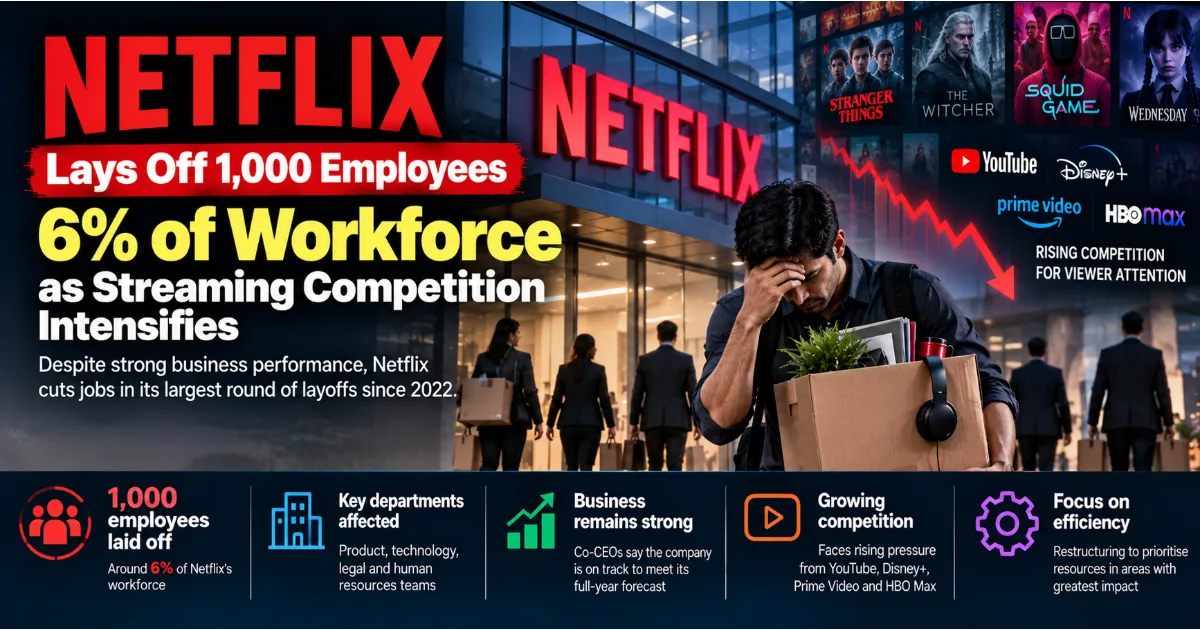
Netflix's latest round of layoffs has renewed an important debate about employment in the global technology and entertainment industries. The streaming giant is reportedly cutting approximately 1,000 jobs, representing around 6% of its workforce, in what has been described as its largest round of layoffs since 2022. The announcement, reported on October 14, 2026, comes at a time when digital entertainment remains a fiercely competitive business and companies are under pressure to make their operations more efficient.
The development raises an obvious question: why would a major entertainment company reduce its workforce when it continues to operate a globally recognised streaming service and invest in new content and technology? For employees, the announcement creates uncertainty about job security, career progression and the future of work in an industry that once appeared to offer expanding opportunities. For investors, it raises questions about operating costs, productivity and whether the company can continue to grow without increasing its organisational complexity.
The reported cuts affect a range of corporate functions, including product, technology, legal and human resources teams. These areas are important to Netflix's operations, but their inclusion also illustrates that restructuring is not limited to traditional administrative positions. Even employees working in technology-related roles can be affected when a company changes its priorities, reorganises teams or decides that certain activities no longer require the same level of staffing.
Netflix's situation also reflects a wider shift in how businesses approach growth. During periods of rapid expansion, companies often recruit aggressively, develop new teams and invest in projects intended to capture future opportunities. When market conditions change, management may reassess those decisions, combine overlapping functions and redirect resources towards activities expected to deliver stronger results.
However, it would be inaccurate to assume that every layoff is evidence of financial distress. Companies can cut jobs while continuing to generate revenue, maintain substantial customer bases and invest in new products. Workforce reductions may be driven by changes in strategy, organisational design, technology, competitive pressure or a desire to improve profitability. In some cases, several factors operate simultaneously.
Netflix's reported decision therefore deserves examination beyond the headline figure of 1,000 employees. It offers a window into the pressures shaping the streaming business, the changing relationship between technology and employment, and the difficult choices faced by companies trying to balance innovation with efficiency.
The central issue is not simply whether Netflix can operate with fewer employees. It is whether the company can continue delivering compelling entertainment, improving its service and competing for viewers while managing the human and organisational consequences of reducing its workforce.
The Scale of the Layoffs: What the Numbers Reveal
The reported reduction of approximately 1,000 jobs represents around 6% of Netflix's workforce. The company had about 16,000 full-time employees at the end of 2025, according to its regulatory filing, making this one of its most significant workforce reductions in recent years. The latest cuts are considerably larger than the approximately 450 positions eliminated during its 2022 layoffs.
The percentage matters because it provides a clearer picture of the scale of the decision. A company employing tens of thousands of people can experience significant organisational change even when it eliminates a relatively small proportion of its workforce. In Netflix's case, the reported reduction is large enough to affect teams, reporting structures and ongoing projects across several business functions.
Product, technology, legal and human resources are among the areas expected to experience the greatest impact. These departments play different roles in the company's operations. Product teams help shape the experience subscribers encounter, technology teams maintain and develop the platform, legal teams manage contractual and regulatory matters, and human resources teams support recruitment and employee management.
Cuts across these functions suggest a broader organisational restructuring rather than a reduction limited to one isolated project. Nevertheless, the publicly reported information does not establish the exact number of positions being eliminated in each department, the full geographical distribution of the cuts or the individual circumstances of affected employees.
It is also important to distinguish layoffs from the complete closure of a business unit. A company can eliminate positions while continuing to operate the same service, or it can reorganise a department without abandoning its core responsibilities. Some work may be consolidated, some projects may be discontinued and some remaining employees may take on different responsibilities.
For workers, however, the distinction offers little immediate comfort. Losing a job can disrupt household finances, professional plans and family responsibilities. Employees in specialised roles may also face uncertainty about whether comparable positions are available elsewhere, particularly when other companies are reducing headcount at the same time.
The broader technology industry has already demonstrated that employment can change quickly when companies revise their strategies. Netflix's announcement adds to the sense that even established businesses with recognisable brands and global reach are not immune to workforce uncertainty.
Competition Is No Longer Just About Other Streaming Services
Netflix helped transform how audiences watch films and television programmes. Its subscription model, recommendation systems and investment in original content made it a major force in global entertainment. Yet the market in which it operates has changed considerably. Netflix is no longer competing only against traditional broadcasters or other paid streaming services. It is competing for the limited attention people have available throughout the day.
YouTube is a particularly important rival because users can access an enormous range of videos, including interviews, educational material, music, entertainment, livestreams and creator-produced programmes. Much of this content is available without a paid subscription, although the platform also offers paid services and advertising-free options in some markets.
TikTok and other short-form video platforms create a different kind of competition. Their rapid, personalised feeds encourage users to move from one video to another, often in brief sessions. A person who might otherwise watch a television episode could spend that time viewing short clips, creator commentary or highlights from a larger entertainment property.
Traditional media companies also remain important competitors. Film studios, broadcasters and streaming platforms compete for popular talent, compelling stories, sports rights and franchise-based entertainment. The market is crowded with services asking consumers to pay for subscriptions or spend time watching advertising.
This changes the way Netflix must think about growth. A strong catalogue is essential, but the company must also persuade viewers to open the application regularly, find something appealing and continue watching. The availability of thousands of titles does not automatically mean that every subscriber feels engaged with the service.
Viewer engagement is therefore a critical business consideration. If customers pay for a subscription but rarely watch, they may eventually decide that the service is no longer worth the expense. If people use a competing platform more frequently, Netflix may have to work harder to maintain its place in their entertainment routines.
The challenge is not necessarily that Netflix lacks popular content. Instead, the company must continually produce, acquire and promote entertainment that attracts different audiences while managing the cost and uncertainty of creative production. A successful series can generate enormous attention, but predicting which programmes will become hits is difficult.
The competition for attention also affects advertising. An advertising-supported streaming service must offer brands an audience that is large enough and engaged enough to justify their spending. If viewers spend less time watching, advertising opportunities may become less valuable even when the platform continues to attract subscribers.
Netflix's restructuring arrives against this background of intensified competition. It suggests that management is reassessing how the organisation allocates its resources as it tries to remain competitive in an entertainment market where consumer attention is divided across many platforms.
Why Strong Business Performance Does Not Prevent Layoffs
One of the most striking aspects of the announcement is the contrast between the job cuts and Netflix's public assessment of its business. Co-CEOs Ted Sarandos and Greg Peters told employees that the company remained strong and was on track to meet its full-year forecast. They also said Netflix would continue investing aggressively in areas expected to improve its service and support future growth.
This distinction matters because people often assume that layoffs happen only when a company is losing money or approaching financial failure. In practice, workforce reductions can occur for several reasons, and financial distress is only one of them.
A company may have growing revenue while discovering that its organisational structure has become more complicated than necessary. It may have overlapping teams, projects that no longer match its priorities or management layers that slow decision-making. Restructuring can be an attempt to address those issues, although it does not guarantee that the resulting organisation will perform better.
Businesses may also redirect resources from one area to another. If management believes that advertising technology, live programming or a particular product feature offers greater future potential, it may choose to spend more on those activities and less on other functions. The decision can involve eliminating existing jobs even while the company continues hiring in selected areas.
There is a difference, however, between improving efficiency and simply reducing headcount. Genuine efficiency means achieving better results with an appropriate use of resources. Cutting employees may lower costs in the short term, but it can also remove institutional knowledge, slow projects and increase the workload of remaining staff.
If a company reduces too many people in critical areas, it may find that the savings are offset by weaker execution or the need to rebuild teams later. This is why workforce reductions should be evaluated alongside subsequent performance, rather than treated automatically as evidence of sound management.
Netflix's statement that it remains on track to meet its annual forecast is important context, but it does not eliminate the uncertainties facing the company. Forecasts depend on assumptions about revenue, expenses, viewer behaviour and future business conditions. Meeting a forecast also does not guarantee that every product initiative or investment will succeed.
The company faces a difficult balancing act. It must control costs while continuing to produce content, maintain its technology platform, attract subscribers and develop new revenue sources. Management is signalling that it intends to focus resources on activities it considers most important. Whether that strategy delivers lasting benefits will become clearer through its subsequent financial and operating results.
For employees, the experience is more immediate. A business can be performing well overall while individual workers lose their positions. This is one of the uncomfortable realities of modern corporate restructuring: the health of a company and the security of every job within it are not the same thing.
Netflix's Search for New Sources of Revenue
Netflix's original business model relied heavily on subscriptions. Customers paid recurring fees in exchange for access to a library of films, series and other programming. The model helped the company build a large international audience and encouraged a shift away from conventional television schedules.
However, subscription businesses face a continuing challenge. They must attract new customers, retain existing ones and persuade people that the service remains worth paying for. As a company grows, it can become harder to find additional subscribers in markets where the service is already widely available or where consumers have many alternatives.
Netflix has been expanding beyond its traditional subscription approach through advertising, live programming and gaming. These initiatives are intended to create additional ways to engage audiences and generate revenue. Their success depends on execution, consumer response and the economics of each business.
Advertising offers a potential opportunity because it allows a streaming platform to earn money from viewers who pay a lower subscription price in exchange for watching advertisements. It can also create another revenue stream from existing audiences. But building an effective advertising business requires technology, measurement systems, relationships with advertisers and a viewing experience that balances commercial interests with audience satisfaction.
Live programming offers a different advantage. Events can encourage viewers to watch at a particular time rather than postponing a programme indefinitely. Live entertainment, competitions, special broadcasts and sports-related content can create moments of shared attention that are difficult to replicate with a conventional on-demand catalogue.
Yet live programming can involve expensive rights, production requirements and operational risks. The economics differ from those of a scripted series, and a programme that attracts a large audience once may not create the same value over time. Netflix must determine which formats fit its brand and deliver sustainable returns.
Gaming represents another attempt to expand the relationship between entertainment and interactive experiences. Games can potentially increase engagement and introduce audiences to different forms of storytelling. However, developing and maintaining a successful gaming operation requires specialist talent, investment and a clear understanding of what subscribers actually want.
The challenge is that diversification does not guarantee success. New initiatives may take time to produce meaningful revenue, and some may never become central to the business. A company must decide which experiments deserve continued investment and which should be scaled back.
This is where organisational restructuring becomes relevant. Netflix may want to concentrate its resources on initiatives that management believes can strengthen its long-term position. But reducing staff and prioritising projects are only parts of the process. The company must also make sound creative decisions, build effective products and demonstrate that viewers value what it offers.
The key question is whether Netflix can turn its global reach and established brand into a broader entertainment business without losing the focus that helped it become successful in the first place.
The Warner Bros. Discovery Deal and Strategic Uncertainty
Netflix's layoffs are also taking place during a period of significant change in the wider media industry. One important development was its unsuccessful attempt to acquire Warner Bros. Discovery's streaming and studio assets. The proposed deal became part of a larger competition over valuable entertainment libraries, established franchises and the future structure of the streaming market.
Reuters reported that Netflix lost out to Paramount Skydance in the bidding contest. Paramount subsequently completed a reported $110 billion acquisition of Warner Bros. Discovery, creating a larger media organisation with a substantial portfolio of entertainment assets.
The outcome matters because established film and television libraries can provide significant strategic advantages. Well-known characters, successful franchises and extensive collections of existing programmes can attract viewers, support new productions and provide material for distribution across different formats. Ownership can also influence licensing arrangements and the competitive balance between streaming services.
For Netflix, acquiring major studio assets could have offered opportunities to expand its catalogue and strengthen its position in the entertainment industry. However, large acquisitions also bring financial, operational and regulatory complications. They can require substantial capital, integration work and decisions about how to combine businesses with different histories and operating structures.
Not winning a major acquisition does not automatically place Netflix at a disadvantage. The company can continue to invest in original productions, negotiate licensing agreements and develop its existing franchises. Avoiding an expensive transaction may also preserve financial flexibility, depending on the terms of the proposed deal and the alternatives available.
Nevertheless, the failed bid illustrates the strategic choices confronting the company. Netflix must decide how much to invest in content it owns, how much to spend on licensed programming and how to respond when competitors gain control of valuable entertainment assets. Those decisions affect its financial commitments and the capabilities it needs internally.
It would be too simplistic to conclude that the failed acquisition directly caused the layoffs. The available reporting identifies broader organisational changes and pressure to allocate resources carefully, rather than establishing a direct causal connection between the deal and every eliminated position.
The larger lesson is that media companies are competing on several fronts at once. They must attract viewers, secure desirable content, manage costs, develop new revenue sources and determine which assets are worth owning. Workforce restructuring can form part of this process, but it is not a substitute for a coherent long-term strategy.
Is Artificial Intelligence Responsible for the Job Cuts?
Whenever a major technology company announces layoffs, artificial intelligence becomes part of the discussion. AI tools can automate certain tasks, assist employees with research and software development, accelerate content workflows and reduce the time required for some repetitive activities. These capabilities have led many businesses to reconsider how their teams operate.
However, the reported Netflix announcement does not establish that AI is the direct cause of the approximately 1,000 job cuts. The stated explanation centres on organisational changes and the need to prioritise people and resources. It would therefore be misleading to present the announcement as a confirmed example of 1,000 employees being replaced by AI.
AI could still influence the broader environment in which companies make staffing decisions. When a new tool changes how work is performed, managers may reassess team size, responsibilities and the skills needed for future projects. Some tasks may require fewer working hours, while others may become more important because automation creates new opportunities or risks.
In technology departments, AI-assisted development tools may help engineers write, review or test code. In administrative functions, automated systems may support document processing and routine analysis. In customer service, conversational tools may answer common questions before a human employee becomes involved. The practical effect varies depending on the quality of the technology, the complexity of the task and the level of human oversight required.
Creative industries present a more complicated picture. AI can assist with editing, transcription, localisation and certain production processes, but entertainment also depends on human judgement, storytelling, cultural understanding and collaboration. A more efficient technical workflow does not automatically produce a successful film or series.
The risk is that companies may overestimate what automation can accomplish or underestimate the importance of experience and human expertise. Reducing a team before a replacement process is reliable can introduce errors, damage service quality and create expensive problems later.
Workers also need to distinguish between genuine automation-driven restructuring and layoffs attributed to AI without supporting evidence. Public discussion can sometimes combine several different developments into a single narrative, making it difficult to understand what is actually happening inside a company.
For Netflix employees and the wider industry, the most useful question is not whether AI will eliminate every job in a particular department. It is how responsibilities are changing, which skills remain valuable and whether employers provide opportunities for workers to adapt.
AI will likely affect entertainment production and corporate operations in different ways. But in the case of Netflix's October 2026 layoffs, the evidence supports a discussion of organisational restructuring and competitive pressure, not a definitive claim that AI replaced the affected employees.
What the Layoffs Mean for Employees and the Technology Industry
For the employees affected by Netflix's decision, the immediate consequences are personal and financial. A job loss can mean the sudden loss of regular income, uncertainty about healthcare or other benefits where applicable, and the need to reconsider career plans. Even professionals with considerable experience may need time to find a suitable position, particularly if companies in similar sectors are also restructuring.
The effects can extend beyond those who receive termination notices. Employees who remain may wonder whether additional cuts are possible, whether their teams will be reorganised and whether their responsibilities will increase. Uncertainty can affect morale and make it harder for organisations to retain people who possess valuable experience.
Employers therefore need to consider how layoffs are communicated and implemented. Clear information, respectful treatment, appropriate transition support and transparent explanations can help affected workers understand their situation. For remaining employees, honest communication about future priorities can reduce speculation, although it cannot remove every concern.
The wider technology industry should also recognise that repeated restructuring can affect how workers view long-term employment. Professionals may become more cautious about depending on a single employer, while placing greater importance on transferable skills, professional networks and financial resilience.
This does not mean that every worker should constantly prepare for unemployment. It does mean that the relationship between companies and employees is changing as business models evolve and investment priorities shift. Skills that are valuable today may need to be supplemented by new capabilities over time.
Companies also have a responsibility to avoid treating employees as disposable costs. Experienced workers carry institutional knowledge, understand customer needs and often help organisations solve problems that cannot be anticipated in formal procedures. Reducing headcount may produce immediate savings, but rebuilding lost expertise can be difficult and expensive.
The long-term consequences of Netflix's decision will depend partly on whether the company can preserve its ability to innovate while maintaining an effective workforce. If the restructuring improves decision-making and allows stronger investment in valuable projects, management may regard it as successful. If it damages execution, weakens morale or creates new operational problems, the benefits may be more limited.
What This Means for India and Its Technology Workforce
Netflix's global workforce decisions are relevant to India because the country's technology professionals increasingly work across international entertainment, software and digital services markets. Bengaluru, Hyderabad, Mumbai, Pune and other Indian technology centres host businesses and professionals connected to software development, media production, analytics, customer support and digital operations.
However, the announcement should not be interpreted as proof that approximately 1,000 Indian employees will lose their jobs. The reported figure concerns Netflix's workforce overall, and the available reports do not establish a detailed country-by-country breakdown of the affected positions. The direct impact on India therefore remains uncertain.
The broader implications are still worth considering. Indian professionals working in multinational companies may encounter organisational changes driven by global priorities, even when local operations continue to perform well. A decision made at a company's headquarters can affect teams in several countries, depending on how responsibilities and projects are distributed.
The entertainment industry also creates opportunities for Indian professionals beyond conventional technology jobs. Production, post-production, animation, localisation, subtitling, dubbing, marketing and audience analysis all contribute to the delivery of global content. Changes in how streaming platforms invest in programming and technology can influence demand across these connected sectors.
For job seekers, the practical lesson is to develop skills that can transfer between employers and industries. Software engineering, data analysis, cybersecurity, cloud infrastructure, product management, content operations and communication skills can be useful across different types of organisations. The most suitable career path will depend on an individual's experience, interests and local employment opportunities.
Employers in India can also learn from the distinction between business growth and job security. A company may continue expanding its customer base while restructuring certain teams. Workers and managers should therefore evaluate an organisation through several indicators, including its business model, financial performance, strategic direction and approach to workforce development.
At the same time, job security should not become the only measure of a good career. Opportunities to learn, build meaningful products, work with capable colleagues and develop expertise also matter. Companies that communicate clearly and invest in their employees can create stronger working relationships, even in an environment where business priorities inevitably change.
Conclusion: A Business Restructuring With Wider Implications
Netflix's reported decision to eliminate approximately 1,000 jobs, representing around 6% of its workforce, highlights the pressures facing even the most established companies in the digital economy. The cuts are concentrated in product, technology, legal and human resources teams and represent the company's largest reported round of layoffs since 2022. At the same time, its co-CEOs have said the business remains strong and on track to meet its full-year forecast.
The apparent contradiction reveals an important reality of modern business. A company can remain commercially strong while deciding that its organisational structure needs to change. Revenue growth does not guarantee that every department will retain its existing size, and workforce reductions do not automatically indicate that a company is failing.
Netflix is confronting an entertainment market in which viewers have more choices than ever. Paid streaming services compete with one another, while free video platforms and social media compete for the same limited hours of attention. The company's efforts to expand advertising, live programming and gaming demonstrate its search for new ways to engage audiences and diversify revenue.
Its unsuccessful attempt to acquire Warner Bros. Discovery's streaming and studio assets also illustrates the strategic decisions facing major entertainment businesses. Content ownership, financial discipline, product development and audience engagement all influence how these companies compete. None of these challenges can be solved through workforce reductions alone.
The human consequences of the decision must remain part of the discussion. Approximately 1,000 affected employees face uncertainty even as Netflix continues pursuing its commercial objectives. Their experience is a reminder that organisational changes have consequences beyond financial statements, productivity targets and investor expectations.
It is equally important not to attribute the layoffs directly to artificial intelligence without evidence. Automation may reshape work across the industry, but the reported explanation for this particular decision focuses on organisational changes and resource allocation. Understanding the difference between confirmed reasons and broader industry trends is essential to any serious assessment.
Ultimately, Netflix's next challenge is to demonstrate that a leaner organisation can deliver better entertainment, improve the subscriber experience and create sustainable growth. The company must continue investing in creative talent and technology while ensuring that efficiency does not come at the expense of quality or long-term capability.
The Netflix layoffs are not simply a story about 1,000 jobs disappearing. They are a reminder that in today's digital economy, even successful companies must constantly adapt, and that the people affected by those decisions deserve as much attention as the strategies that drive them.
#BeyondHeadlines #Netflix #NetflixLayoffs #TechLayoffs #JobCuts #StreamingIndustry #EntertainmentBusiness #TechnologyNews #FutureOfWork #ArtificialIntelligence #CorporateRestructuring #GlobalEconomy #DigitalEntertainment #Employment #BusinessNews #BeyondTheHeadline