
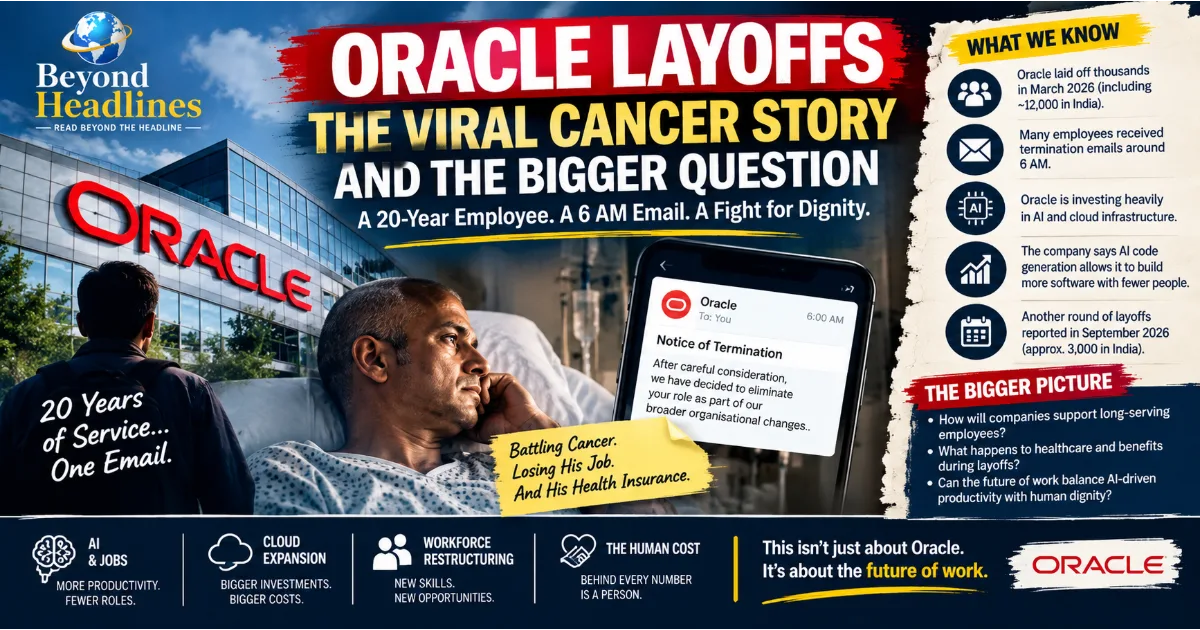
A viral story about an Oracle employee battling cancer has put a deeply personal face on one of the technology industry's biggest restructuring stories of 2026. According to a Reddit post that was widely shared across social media and later reported by multiple Indian publications, a user's father had worked at Oracle for 20 years, remained under the same manager throughout that period and was laid off by email during the company's March 2026 workforce reductions. The post said the employee was dealing with cancer and was only about two years away from retirement. It also claimed that losing the job meant losing health insurance. The identity of the employee and the family member who posted the account were not publicly disclosed, and news organizations including Economic Times, NDTV and India Today explicitly noted that the allegations could not be independently verified. (The Economic Times)
The human story spread because it collided with a much larger corporate story. Oracle was undertaking substantial workforce restructuring at the same time that it was dramatically increasing its investment in artificial intelligence and cloud infrastructure. In its March 2026 results announcement, Oracle itself said AI code-generation technology was allowing it to restructure product development teams into smaller groups and build more software with fewer people. The company described the technology as making its SaaS businesses more competitive and profitable. (Oracle)
That combination makes the Oracle episode more complicated than a simple story about one employee being dismissed. It is a story about what happens when a company with decades of institutional history changes the way it builds software, allocates capital and organises its workforce. It is also a story about the gap between the financial logic of restructuring and the human reality experienced by people whose careers have been built around the organisation.
The viral post should therefore be treated carefully. It is not evidence that Oracle deliberately targeted a cancer patient, nor does it establish that the employee was based in Bengaluru. The image circulating online frames the story as involving a Bengaluru man, but the original Reddit account cited by major publications did not publicly establish the employee's location. What can be established is that the post alleged a 20-year Oracle employee with cancer was informed of his termination by email, and that the claim became part of a wider wave of employee accounts surrounding Oracle's 2026 layoffs. (The Economic Times)
The distinction matters because a viral story can be emotionally powerful while still containing details that have not been independently verified.
The story that went viral
The original account appeared in the employeesOfOracle subreddit under the title “After 20 years and 2 years before retirement, my dad just got laid off via Email.” The author said the father had worked for Oracle for two decades and under the same boss for those 20 years. The post complained that there had been no phone call before the termination and said the employee was undergoing cancer treatment. It also raised the immediate concern that the employee would no longer have health insurance. (The Economic Times)
The post resonated because the details were unusually personal.
A layoff is normally discussed through numbers. Ten thousand jobs. Twenty thousand jobs. Thirty thousand jobs. A percentage reduction in workforce. A restructuring charge in a financial statement.
But a person does not experience a layoff as a percentage.
They experience it as the loss of a salary, a routine, colleagues, professional identity, benefits and often a sense of stability.
For someone dealing with a serious illness, the consequences can be even more complicated, particularly in countries where health insurance is closely connected to employment.
That is why the Reddit post generated such a strong reaction.
Other employees and former employees responded with their own stories of receiving termination notifications through email. Some claimed to have spent 17, 19, 26 or even 29 years at Oracle before being informed that their roles had been eliminated. These individual accounts are also largely anecdotal, but they demonstrate the emotional context surrounding the layoffs. (The Economic Times)
The cancer story therefore became a symbol of the wider anxiety surrounding the restructuring.
It was not necessarily representative of every employee's experience.
But it illustrated the stakes involved when a company undertakes a large-scale workforce reduction.
Oracle really was conducting a major restructuring
The broader layoff was not merely a social-media rumour.
Oracle employees in the United States and India reported receiving termination notices beginning around March 31, 2026. The Wall Street Journal reported that Oracle had begun widespread layoffs across its global workforce, with employees in both the United States and India describing job eliminations and early-morning termination emails. The full scope was initially unclear, although analysts at TD Cowen had previously estimated that Oracle could eventually reduce its workforce by as many as 30,000 positions as it financed its AI infrastructure expansion. (The Wall Street Journal)
Indian reports put the scale of the March cuts at approximately 12,000 jobs in India. PTI reported on March 31 that around 12,000 employees were believed to have been affected in India, citing impacted employees, while the company declined to comment on the development. The same report said Oracle's India workforce was around 30,000 at the time, although these figures were based on external reporting rather than an Oracle announcement of the precise number of Indian layoffs. (ThePrint)
The layoffs were accompanied by a formal communication from Oracle.
According to the employee communication reproduced in several reports, Oracle said that after considering its current business needs, it had decided to eliminate certain roles as part of a broader organisational change. Employees were told that their last working day was the day of the communication, with severance subject to the company's applicable plan. Access to company computers, email, voicemail and files was also scheduled to be deactivated. (Moneycontrol)
For employees who received such an email, the experience could therefore be extremely abrupt.
And reports indicate that early-morning notifications were not limited to the employee described in the viral cancer story.
ThePrint reported that an Oracle employee in India described receiving a layoff email at exactly 6 a.m., while other employees reported losing access to Slack and other internal systems around the same period. (ThePrint)
Reddit discussions among Oracle employees similarly described a wave of emails arriving around 6 a.m. IST on March 31. Those posts are not independently verified employment records, but they provide contemporaneous evidence of how affected workers described the process. (Reddit)
The viral image therefore connects to a much larger documented event.
The specific personal story remains unverified.
The mass restructuring itself does not.
Why was Oracle cutting jobs while investing heavily in AI?
This is perhaps the central question behind the entire episode.
At first glance, it can seem contradictory for a company to invest billions of dollars in artificial intelligence and cloud infrastructure while simultaneously eliminating thousands of jobs.
But from a corporate strategy perspective, the two developments can be directly connected.
Oracle has been investing aggressively in cloud infrastructure because demand for AI computing has surged. In its fiscal 2026 results, Oracle said its remaining performance obligations had reached $638 billion, up 363% year over year, with much of the increase connected to large-scale AI contracts. The company said customers were sometimes prepaying for GPUs or supplying the hardware themselves, helping reduce some of the capital required for Oracle to build AI data centres. (Oracle)
Oracle also raised enormous amounts of capital during fiscal 2026.
The company said it raised $43 billion in debt financing and $5 billion in equity financing during the fiscal year, as it pursued its cloud infrastructure expansion. (Oracle)
This is an extraordinary capital-intensive period for the company.
Oracle is trying to build infrastructure capable of supporting some of the world's largest AI workloads. That requires data centres, GPUs, networking equipment, electricity, cooling systems, land and financing.
At the same time, Oracle is trying to reduce the cost of producing software.
That is where AI-assisted coding becomes particularly important.
In its March earnings announcement, Oracle said AI models for generating computer code had become sufficiently efficient that the company was restructuring product development teams into smaller, more agile and productive groups. Oracle explicitly said the technology was enabling it to build more software in less time with fewer people. (Oracle)
That statement provides an important piece of context.
The restructuring was not necessarily about abandoning software development.
It was about changing how software development is performed.
The same company can therefore simultaneously need more capital for AI infrastructure and fewer employees in certain software-development functions.
That is one of the defining tensions of the current technology industry.
AI can create jobs and eliminate jobs at the same time
The debate around artificial intelligence is often framed too simply.
One side imagines AI as a machine that destroys jobs.
Another imagines AI as a technology that creates new industries and therefore new employment.
The reality can involve both processes occurring simultaneously.
Oracle's own statements provide a clear example.
The company is expanding AI infrastructure and cloud capacity, creating demand for engineers, data-centre specialists, hardware professionals, security experts and other technical roles.
At the same time, it says AI-assisted coding allows product-development organisations to produce more software with fewer people.
That means employment can shift rather than simply disappear.
The engineer writing routine code today may increasingly become an engineer supervising AI-generated code, designing system architecture, validating outputs or managing complex integration.
But that transition is not painless.
An experienced employee can have decades of knowledge about a particular product or organisation, yet still find that the economic value assigned to their role changes rapidly.
This is especially difficult for older employees.
A person who has spent 20 years building expertise inside one company may have a deep understanding of its systems, customers and internal processes. But if the company decides that a different structure is more productive, years of experience do not necessarily protect a position.
That is one reason the Oracle story has resonated beyond Oracle.
It represents a broader question facing the technology industry.
What happens to long-serving professionals when the technology they helped build begins changing the economics of their own work?
The 6 a.m. email became a symbol
The early-morning timing of the notifications has become almost as important in public discussion as the layoffs themselves.
Employees described receiving messages around 4 a.m., 5 a.m. and 6 a.m., depending on location and time zone. The September 2026 round of Oracle layoffs has generated similar accounts, with the Times of India reporting that employees in India had come to associate early-morning emails and revoked Slack access with termination notifications. (The Times of India)
There is a practical reason multinational companies may communicate workforce decisions electronically.
Thousands of employees can be affected across different countries and time zones. A centralised communication process can ensure that everyone receives the same legal and operational information at roughly the same point in the restructuring process.
But there is also a human dimension.
An employee who has spent 20 years at a company may reasonably experience a termination email differently from an automated service notification.
That difference between administrative efficiency and human experience is at the centre of the debate.
A company can view a layoff as an organisational process.
The employee experiences it as a personal event.
Both realities exist simultaneously.
What about the claim that there was “no warning”?
The viral post said there was no phone call.
Other employees similarly described receiving emails without personal conversations.
Those claims should not automatically be generalised to every affected Oracle employee.
Different jurisdictions have different employment rules, and individual employees may have received different forms of communication depending on their role, location and employment terms.
However, multiple reports did document that email was a primary mechanism through which affected Oracle workers were informed of their terminations.
The Wall Street Journal reported that affected employees received early-morning emails informing them that their roles had been eliminated. ThePrint also reported accounts from employees who received early-morning notices. (The Wall Street Journal)
That establishes the broader pattern.
It does not independently establish every detail of the specific cancer patient's experience.
This distinction is important for responsible journalism.
The most powerful version of the story is also the one that requires the greatest care.
The claim that a cancer patient with 20 years of service was laid off by email is widely reported.
The identity of that employee has not been publicly confirmed.
The employee's exact location has not been publicly established.
The circumstances surrounding the health insurance have been reported based on the family member's statement, not independently verified insurance documentation.
And there is no public evidence establishing that Oracle selected the employee because of his medical condition.
Those limitations should remain part of the story.
The health insurance issue is particularly significant
The most consequential claim in the viral post may not actually be the email.
It may be the loss of health insurance.
The Reddit author said his father had cancer and would lose health insurance after the termination. Multiple reports repeated this claim while making clear that it originated from the family member and could not be independently verified. (The Economic Times)
In the United States, where the original post appears to have originated, employment-linked health insurance can be a major part of compensation.
That creates a particularly difficult situation for someone undergoing expensive or ongoing medical treatment.
The employment relationship therefore provides more than salary.
It can also provide healthcare coverage, retirement contributions, life insurance, disability coverage and other benefits.
When employment ends, the financial consequences can extend well beyond the monthly pay cheque.
This is why the timing of a layoff can matter enormously to an employee.
A worker who loses a job while healthy and early in a career faces one set of challenges.
A worker nearing retirement and undergoing cancer treatment faces a very different set of risks.
Again, however, the public reporting does not establish the full insurance circumstances of the individual described in the post.
It establishes that the family member made that claim and that the claim generated substantial public attention.
Oracle's restructuring has continued beyond March
The story also needs to be placed in the present context because Oracle's workforce reductions did not end with the March and April controversy.
In September 2026, Oracle began another round of layoffs in India.
The Times of India reported on September 16 that a second round had begun in India and that employees were again receiving termination communications in the early hours. It reported that access to Slack had been revoked for affected employees and that more than 5,000 employees globally may have lost access over two days, based on internal Slack activity and sources. (The Times of India)
Moneycontrol reported on September 15 that the latest Indian layoffs appeared particularly concentrated in product engineering, with support and consulting teams experiencing relatively fewer cuts. It said the layoffs followed a US round that began September 14. (Moneycontrol)
Economic Times, citing Reuters, reported that the latest round could affect around 10% of Oracle's Indian workforce, or approximately 3,000 people. It said Oracle's India headcount could fall from around 30,000 to roughly 27,000, based on estimates from market intelligence analyst Pareekh Jain. (The Economic Times)
That makes the original viral story part of a continuing corporate restructuring rather than an isolated incident.
The company's workforce strategy remains in motion.
Oracle's own financial disclosures reveal the pressure
The restructuring cannot be separated from Oracle's financial strategy.
Oracle is simultaneously experiencing enormous demand for AI cloud infrastructure and facing enormous capital requirements.
Its fiscal 2026 results showed remaining performance obligations of $638 billion. The company said much of the increase came from large AI contracts. (Oracle)
But building the infrastructure required to deliver those contracts is expensive.
Oracle reported negative free cash flow of $23.7 billion in fiscal 2026 as it continued investing in cloud infrastructure. (Oracle)
That figure provides crucial context.
Oracle is not simply sitting on a pile of cash and arbitrarily cutting employees.
It is in the middle of an enormous investment cycle.
The company is borrowing and raising equity to finance expansion while simultaneously trying to improve operating efficiency.
That does not answer the ethical question of how layoffs should be conducted.
But it helps explain why the restructuring is happening at the same time as aggressive AI expansion.
The company is trying to move capital and labour toward what management sees as higher-growth areas.
There is a difference between explaining layoffs and judging them
This distinction is particularly important when discussing the viral cancer story.
It is possible to explain why a company might restructure without concluding that every individual layoff was justified.
It is also possible to discuss the human consequences without assuming that the company's motives were malicious.
Oracle has not publicly stated that the cancer patient's medical condition played any role in the decision.
There is no verified evidence in the sources reviewed that the employee was selected because he had cancer.
There is also no public evidence establishing that Oracle's managers knew the full medical circumstances at the moment the termination decision was made.
Therefore, the strongest factual conclusion is narrower.
A family member alleged that a long-serving Oracle employee undergoing cancer treatment lost his job through an email during the company's major restructuring, and the claim attracted substantial attention because of the combination of long service, proximity to retirement and medical circumstances. Multiple other employees independently described receiving layoff notifications through email during the same restructuring. (The Economic Times)
That is enough to understand why the story became significant without adding claims that the evidence does not establish.
The uncomfortable question about loyalty
The story also forces a broader question about what long-term employment means in modern technology companies.
For much of the twentieth century, a 20-year tenure at a major company could be associated with a strong expectation of stability.
That expectation has weakened considerably in the technology industry.
Companies acquire and sell businesses.
Products are discontinued.
Organisations are reorganised.
Software development becomes automated.
Cloud computing changes infrastructure requirements.
Artificial intelligence changes productivity.
Entire categories of work can become less labour-intensive.
An employee can therefore perform well for decades and still find that the organisation no longer needs the same number of people performing the same type of work.
That does not mean loyalty has no value.
It means loyalty alone is no longer a guarantee of employment.
The Oracle story makes that reality visible.
A 20-year tenure is an extraordinary period of professional life.
But corporate restructuring operates on a different timescale.
A decision made on a Tuesday morning can change the employment status of thousands of people who have collectively spent hundreds of thousands of years working for the company.
The AI productivity paradox
There is a deeper economic issue here.
AI promises higher productivity.
Higher productivity is generally considered beneficial because it allows companies to produce more output with fewer resources.
But productivity gains can produce transitional disruption.
If a software team that once required 20 developers can eventually produce similar output with 12 developers using AI tools, the company has several choices.
It can use the productivity gain to expand output and keep the entire team.
It can reduce headcount.
It can move employees into new areas.
It can combine all three strategies.
The outcome depends on business demand, management strategy, cost pressures and competitive conditions.
Oracle's March statement is unusually direct because it explicitly connected AI code generation with smaller product development teams and fewer people. (Oracle)
That statement does not prove that every layoff was caused by AI.
It does, however, establish that Oracle sees AI-driven productivity as an important factor in reshaping its software development organisation.
That makes Oracle part of a much larger transformation occurring across the global technology industry.
The irony is that Oracle is also hiring and expanding
There is another side of the story that can easily disappear in layoff coverage.
Oracle is not simply shrinking.
It is expanding in other areas.
The company has been building major AI data centres and expanding cloud infrastructure. In March, Oracle said its AI data-centre projects were creating significant construction employment. Its New Mexico Project Jupiter initiative, for example, involved thousands of construction workers and was expected to create further operational opportunities as the project matured. (Oracle)
Oracle also expanded its Nashville footprint in March, announcing a new 116,000-square-foot lease that would bring its Nashville office capacity to about 2,000 seats across three locations. The company said the expansion reflected plans to create thousands of new technology jobs in the region. (Oracle)
That is an important contradiction.
The same company can eliminate jobs in one part of its organisation while adding capacity and employment in another.
Corporate restructuring is therefore not always equivalent to simple contraction.
It can be redistribution.
The problem for employees is that redistribution does not necessarily happen smoothly.
A database engineer whose role is eliminated cannot automatically become an AI data-centre engineer.
A software professional with 20 years of experience may not be able or willing to move into a new role.
Geography can be different.
Skills can be different.
Salary levels can be different.
Age and personal circumstances can matter.
That is where the human cost of technological change becomes complicated.
What the viral story tells us about the future of work
The most important lesson may not be about Oracle at all.
It may be about the future relationship between companies and employees.
If AI continues to improve software development productivity, the definition of a valuable technology employee will change.
Routine coding may become less important.
System design may become more important.
AI supervision may become more important.
Security and verification may become more important.
Domain expertise may become more valuable in some areas and less valuable in others.
Companies will increasingly evaluate not simply how much code employees produce, but how effectively they can work with AI systems to solve complex problems.
This transformation will create winners and losers.
Some workers will become significantly more productive.
Some roles will expand.
Some new categories of work will emerge.
Other roles may shrink.
The people most vulnerable may not necessarily be the least talented.
They may simply be working in functions where AI can produce a large productivity improvement.
That is why the Oracle layoffs matter beyond Oracle.
The meaning of a 20-year career is changing
The viral story begins with a number that carries enormous emotional weight.
Twenty years.
Twenty years at one company means that an employee has lived through multiple technology cycles, management changes, product transitions and economic conditions.
For an employee, that tenure may represent a significant part of adult life.
For a corporation, however, 20 years can span several entirely different business models.
Oracle itself has transformed dramatically during the last two decades.
The company that was primarily identified with databases has become a major cloud infrastructure provider, enterprise applications company and AI infrastructure partner.
Its current strategy is increasingly shaped by cloud computing and AI.
The skills and organisational structures that worked during earlier stages of the company may therefore not align perfectly with the requirements of the present.
This is the difficult reality of modern corporate life.
An employee can be valuable for 20 years and still become redundant when the organisation changes direction.
What companies can learn from the backlash
The public reaction also highlights an important issue around communication.
There is no universal rule that says every layoff must be communicated through a phone call or face-to-face meeting.
Large multinational restructurings can involve legal, security and operational constraints.
But the emotional response to the Oracle emails shows that communication itself has consequences.
An employee who receives a carefully explained transition plan may still be devastated.
An employee who receives a short email at dawn and immediately loses access to company systems may experience the same decision as much more abrupt.
That does not change the financial reality of the restructuring.
It changes the human experience.
Companies conducting large workforce reductions therefore face a difficult balancing act between speed, confidentiality, consistency and empathy.
The Oracle episode demonstrates why that balance matters.
And what about Bengaluru?
The image supplied with this story presents the employee as a Bengaluru man.
That detail should be treated cautiously.
The original Reddit post reproduced by Economic Times, NDTV, Hindustan Times, India Today and other publications does not publicly identify the employee's location. The posts describe the father as an Oracle employee, but the widely reported version of the story does not establish that he was working in Bengaluru. (The Economic Times)
That is important because Oracle's India layoffs were substantial.
PTI reported that approximately 12,000 employees in India were affected during the March restructuring, based on accounts from impacted employees. (ThePrint)
Bengaluru is one of Oracle's major technology hubs in India, so the image's Bengaluru framing may reflect the broader Indian context.
But it should not be presented as a verified fact about the particular employee unless a reliable source establishes it.
For Beyond Headlines, that distinction is worth preserving.
A compelling story does not become weaker when uncertain details are clearly identified.
It becomes more credible.
The September layoffs make the story even more relevant
If the story had remained confined to March, it might have become another episode in the rapidly changing technology labour market.
But Oracle has continued restructuring.
Reports from September indicate that another round of layoffs has affected Oracle employees in India, with product engineering reportedly bearing a significant share of the cuts. Economic Times, citing Reuters, estimated that the latest round could affect around 3,000 employees in India, reducing the country's workforce from approximately 30,000 to 27,000. (The Economic Times)
The Times of India reported early-morning emails and revoked Slack access during the latest round as well. (The Times of India)
That suggests the March episode was not the end of the restructuring.
Oracle's workforce is still being reshaped.
And that makes the questions raised by the original viral story increasingly relevant.
How should companies communicate large layoffs?
How should long-serving employees be supported?
How should healthcare and other benefits be handled during major restructuring?
How much responsibility should companies assume for employees who are undergoing serious medical treatment?
What happens to workers whose jobs disappear because AI makes certain functions more productive?
These are not questions that can be answered by a single viral post.
But the post has forced them into public discussion.
The bigger story is not that AI is replacing everyone
There is a tendency to describe every technology layoff as evidence that AI is replacing human workers.
That is too simple.
Oracle's own business demonstrates why.
The company is hiring, expanding data-centre operations and building AI infrastructure while also reducing employment in certain software-development functions.
The labour market is being reorganised, not simply erased.
Some tasks are becoming automated.
Some roles are being consolidated.
Some new roles are being created.
Some existing workers will transition successfully.
Others will not.
The speed of the transition is what creates uncertainty.
Technology companies can deploy new AI systems far faster than individual employees can retrain for entirely different careers.
That creates a potential mismatch between the speed of technological change and the speed of human adaptation.
The Oracle layoffs are one example of that larger problem.
A viral post cannot tell the whole story
The cancer story is powerful precisely because it is personal.
But journalism has to resist the temptation to turn a personal account into a complete explanation of corporate behaviour.
The original post is an allegation from an anonymous Reddit user.
Major news outlets reported it because it was part of a larger, independently reported wave of Oracle layoffs.
They also repeatedly disclosed that they could not independently verify the family's specific claims. (The Economic Times)
That caveat should remain central.
What we know is that Oracle conducted major layoffs in March 2026.
We know employees in India and elsewhere reported receiving termination emails.
We know Oracle itself has discussed restructuring product-development teams as AI code-generation technology improves.
We know Oracle is investing heavily in AI cloud infrastructure.
We know further layoffs were reported in India in September.
And we know an anonymous Reddit user alleged that his father, a 20-year Oracle employee battling cancer, was among those affected.
What we do not know from independently verified public information is every detail of that employee's individual case.
That difference is not a technicality.
It is the difference between reporting a documented event and repeating an unverified allegation as fact.
The question Oracle's layoffs leave behind
Technology companies have always restructured.
The difference today is the speed and scale of technological change.
Artificial intelligence is not merely another software feature.
It has the potential to change how software itself is produced.
Oracle's own March statement makes that clear. The company said AI code generation was allowing it to build more software in less time with fewer people. (Oracle)
That is an extraordinary statement when placed alongside the stories of employees who have spent decades inside the organisation.
A company can simultaneously say that it is creating the future of AI infrastructure and tell thousands of employees that their existing roles are no longer required.
From the perspective of capital allocation, those decisions can be rational.
From the perspective of the person receiving the email, they can be devastating.
Both realities can exist.
That is why the Oracle story deserves to be understood rather than reduced to a viral headline.
The issue is not simply whether Oracle was right or wrong to restructure.
The deeper question is what companies owe their employees when technological change makes entire categories of work less valuable.
Is severance enough?
Is retraining enough?
Should long-serving employees receive different forms of transition support?
Should companies provide additional assistance when a worker is undergoing serious medical treatment?
Should communication standards change when thousands of people are being dismissed simultaneously?
And perhaps most importantly, how can companies pursue the productivity gains promised by AI without treating the people affected by those gains as mere line items on a restructuring spreadsheet?
There are no simple answers.
But the viral story of the Oracle employee battling cancer has made the questions impossible to ignore.
The original allegation remains unverified in important details, including the employee's identity, location and precise circumstances surrounding his health coverage. Yet the larger event is firmly documented: Oracle undertook a major restructuring, employees reported receiving abrupt termination emails, the company was simultaneously investing heavily in AI infrastructure, and its own leadership said AI-assisted coding was allowing it to build software with fewer people. (The Wall Street Journal)
That is the real story beyond the headline.
The future of work is not arriving as one dramatic announcement.
It is arriving through thousands of individual decisions.
For some workers, those decisions will mean new opportunities.
For others, they will mean retraining.
For others, they will mean a job ending after years or decades.
And sometimes, as the viral Oracle story illustrates, the most important part of a corporate restructuring is not the number of jobs eliminated.
It is the person behind the number.
#BeyondHeadlines #Oracle #OracleLayoffs #OracleIndia #TechLayoffs #Layoffs2026 #AIJobs #ArtificialIntelligence #FutureOfWork #Technology #TechIndustry #IndianIT #ITJobs #Bengaluru #Bangalore #CorporateRestructuring #EmployeeRights #Workplace #JobLoss #AIAndJobs #CloudComputing #OracleCloud #TechNews #BusinessNews #IndiaBusiness #StartupNews #Employment #WorkplaceCulture #CorporateIndia #BeyondTheHeadline