New Telecom Requirements Aim to Curb Cyber Fraud, but Could Change How Indians Use Messaging Apps Across Phones, Tablets and Computers
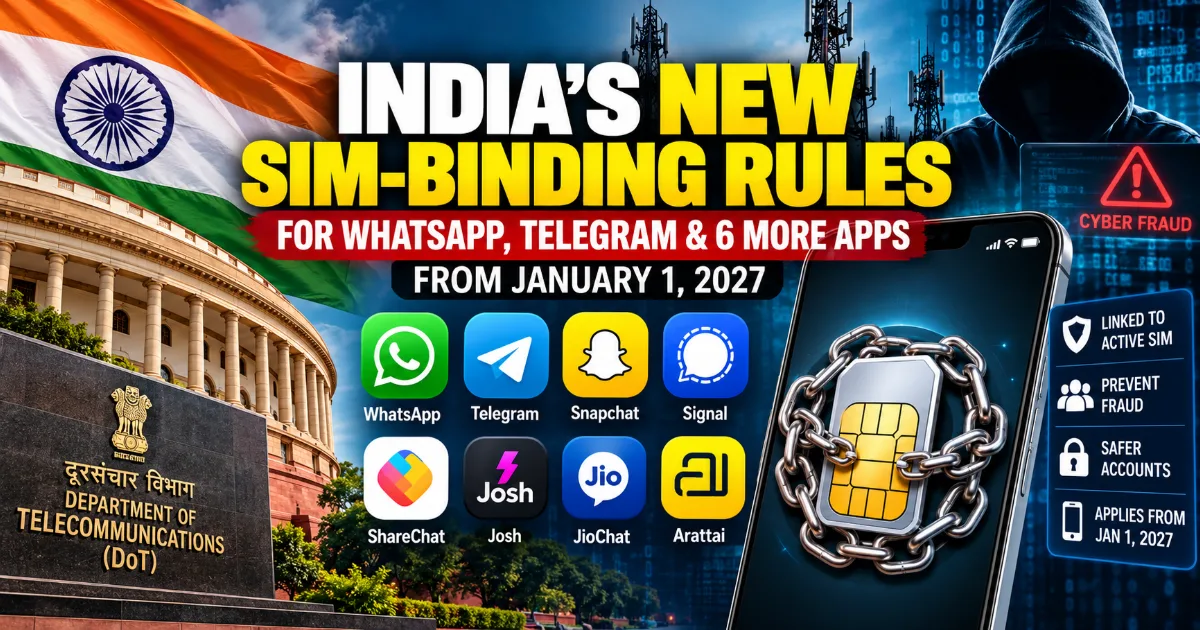
India is preparing for a significant change in how messaging and internet-based communication applications connect users to their registered mobile numbers. From January 1, 2027, covered services are expected to enforce SIM-binding requirements under directions issued by the Department of Telecommunications (DoT). The original list names WhatsApp, Telegram, Signal, Snapchat, ShareChat, Josh, JioChat and Arattai, bringing some of India's most widely used communication platforms into a new regulatory framework designed to reduce the misuse of mobile numbers in cybercrime.
The policy addresses a specific security concern. Once a person verifies a mobile number during account registration, some messaging services can continue working even if the SIM card associated with that number is removed from the device. According to the government, this can be exploited by fraudsters who use Indian mobile numbers to operate accounts remotely, impersonate officials, conduct phishing campaigns or target victims with sophisticated scams.
Under SIM binding, a covered application must remain linked to the active SIM associated with the registered Indian mobile number. The aim is to make it more difficult to use an account on a device that does not contain the relevant SIM. This represents a shift from treating the phone number mainly as an initial identity-verification mechanism to requiring an ongoing relationship between the registered number, the SIM and the device running the application.
However, the change is not simply a new login screen. It could affect people who use messaging services on multiple devices, travel internationally, change phones frequently or depend on tablets and computers for work. The practical consequences will depend on how individual platforms implement the requirements and how the rules are applied to different types of devices and accounts.
Continue Reading
The original directions were issued on November 28, 2025, under India's telecom cybersecurity framework. The government subsequently made the requirements public through an official announcement on December 1, 2025. The original implementation period was later extended, with recent reporting indicating that covered platforms have until December 31, 2026, to comply, making January 1, 2027, the expected operational start date. Press Information Bureau
The government says the objective is to strengthen telecom cybersecurity, improve traceability and prevent the misuse of Indian mobile numbers. The policy also raises questions about privacy, convenience, digital access and the responsibilities of technology companies operating in India. As the deadline approaches, users and businesses will need to understand what the rules mean, which services are covered and what changes may be necessary in their everyday digital routines.
What Exactly Is SIM Binding?
SIM binding is a process that continuously connects a digital service to the active SIM card associated with a registered mobile number. It differs from the familiar one-time password verification that most users encounter when creating an account or signing in to a messaging application for the first time.
Under the traditional model, a user enters a mobile number and receives a verification code through SMS or a phone call. Once verification is complete, the application generally treats the number as an account identifier. Depending on the platform, the user may continue using the account even if the original SIM card is removed, provided the application remains installed and the account remains authenticated.
This arrangement offers flexibility. Someone can verify an account on a smartphone and subsequently use it on a computer, tablet or another compatible device. A person travelling abroad may continue using a messaging application over Wi-Fi even after replacing their Indian SIM with a local SIM, although platform-specific policies and verification requirements can affect access.
SIM binding introduces an additional condition. The application must remain linked to the specific active SIM associated with the registered Indian number. If the SIM is removed, deactivated or no longer available in the device running the application, access may be restricted under the new requirements.
The distinction is important because a verified phone number does not necessarily prove that the original subscriber continues to control the account. A criminal who obtains access to an already authenticated account may potentially continue operating it even after the original SIM is no longer present in the device. The government wants to close this gap by strengthening the connection between the subscriber's mobile identity and the communication service.
The measure does not eliminate the need for other security protections. Account passwords, two-step verification, device security, fraud detection, identity checks and suspicious-activity monitoring remain important. SIM binding is intended to make certain forms of account misuse more difficult, rather than guarantee that every account is controlled by its legitimate owner.
The precise user experience will depend on the technical implementation adopted by each platform. Applications may need to verify the presence of the registered SIM, handle temporary connectivity problems and provide processes for users who legitimately replace or upgrade their SIM cards.
Which Eight Apps Are Named in the Government's Directions?
The original directions specifically named eight app-based communication services. These include major international platforms as well as Indian services.
WhatsApp is one of the most significant services affected because of its widespread use for personal conversations, family groups, workplace coordination, customer support and business communication. Many small businesses also use WhatsApp to interact with customers, receive orders and coordinate deliveries.
Telegram is widely used for group communication, large channels, community discussions, file sharing and information distribution. Its users include individuals, businesses, educational groups and organisations that depend on large online communities.
Signal is known for its focus on privacy and encrypted communication. Its inclusion raises important questions about how SIM verification requirements will be implemented alongside its existing privacy-oriented design.
Snapchat is another service named in the original directions. It combines messaging with multimedia sharing and social features, particularly among younger users.
ShareChat serves users across Indian languages and includes social communication features. It is part of a broader domestic digital ecosystem designed for audiences beyond English-speaking internet users.
Josh is an Indian short-video platform with social and communication-related features. Its inclusion reflects the broad scope of the original list of services covered by the government.
JioChat is a communication service associated with India's telecom and digital services market. Its inclusion demonstrates that the requirements are not limited to international technology companies.
Arattai, developed by Zoho, is an Indian messaging service that has attracted attention as a domestic alternative in the communication-app market.
The government has stated that its directions apply to app-based communication services that use Indian mobile numbers to identify users or provide their services. This means the policy should not be interpreted as a permanently closed list limited to eight brand names in every possible circumstance. The exact application of the rules depends on whether a service falls within the relevant regulatory definition.
For users, the practical lesson is to watch for official notices and in-app instructions from the services they use. Different applications may introduce changes at different times as they prepare their systems for compliance.
Why Is the Government Introducing These Rules?
The government's main argument is that criminals have exploited the separation between a mobile number and the device on which a messaging account operates.
Mobile numbers are widely used to register accounts and establish initial contact with users. They can help services distinguish between accounts, deliver verification codes and support account recovery. However, the number itself is not a complete guarantee of identity.
Once an account has been authenticated, the application may remain active without repeatedly checking whether the original SIM is still present. The government believes this can create opportunities for fraudsters who use Indian numbers to maintain accounts while operating from other devices or locations.
In its December 2025 announcement, the Department of Telecommunications said the directions were intended to prevent the misuse of telecommunication identifiers and strengthen the security of India's telecom ecosystem. It specifically highlighted concerns about cyber fraud, impersonation and scams operated from outside the country.
The wider problem is significant. Digital fraud can involve criminals pretending to be bank officials, police officers, government representatives, investment advisers or trusted contacts. Victims may receive messages and calls designed to create panic, encourage urgent payments or persuade them to disclose confidential information.
A messaging account linked to a mobile number can become a tool for building credibility. Fraudsters may use it to contact potential victims, distribute malicious links, impersonate legitimate organisations or continue conversations with people who believe they are dealing with someone trustworthy.
SIM binding is intended to reduce the ability to operate certain accounts without the associated active SIM. By making continued access dependent on the registered SIM being present, the government hopes to make some forms of remote account misuse more difficult.
However, the relationship between SIM binding and fraud prevention is not absolute. Criminals can use SIM cards obtained through fraudulent means, take over legitimate accounts, deceive victims into sharing verification codes or exploit weaknesses in devices and applications. A SIM may be physically present in a device even when the person operating the account is not its legitimate owner.
The effectiveness of the policy will therefore depend on how it is implemented and combined with other safeguards. Its success should ultimately be measured by whether it reduces fraud and improves accountability without creating unnecessary disruption for legitimate users.
What Changes for Everyday WhatsApp Users?
For people who keep their registered SIM in their main smartphone, the transition may be relatively straightforward. If the application can verify that the correct active SIM is present, many users may continue using the service with little visible change.
The impact could be greater for people who have separated their messaging activity from the phone containing their registered SIM.
Consider someone who initially registers WhatsApp on a smartphone but later moves the SIM card to another device. If the original phone continues running the application without the registered SIM, the new requirement could affect that setup.
Similarly, someone might keep a dedicated smartphone at home for calls and use a separate Wi-Fi-only device for messaging. If the messaging device does not contain the registered SIM, the application may not be able to operate in the same way under the new rules.
People who use spare phones, secondary devices or Wi-Fi-only tablets should pay attention to instructions from the platforms they rely on. They may need to reconsider which device contains their registered SIM or how they access the service.
This does not mean that every user will automatically lose access on January 1, 2027. The date represents the expected operational start following the compliance period. The actual experience will depend on platform implementation, the account's configuration and whether the required SIM checks are satisfied.
Users should also avoid assuming that a SIM-binding requirement means they must purchase a new phone. In many cases, the relevant question will be whether the existing device and account configuration can meet the platform's implementation of the rules.
The safest approach is to wait for clear instructions from the relevant application rather than make unnecessary changes based on social media posts or unverified claims.
Will WhatsApp Web and Other Linked Devices Be Affected?
One of the most important questions concerns the use of messaging applications on computers and other companion devices.
Many people rely on WhatsApp Web and desktop applications to manage work conversations, respond to customers, send files and coordinate with colleagues. Similar multi-device arrangements are useful for people who prefer typing on a physical keyboard or need to keep communications accessible while working on a computer.
The original SIM-binding directions also addressed web access and companion sessions. Initially, the rules included a requirement for periodic logout of web instances, with a maximum interval of six hours, followed by a facility for users to reconnect through QR-code linking.
However, subsequent reporting in 2026 indicated that the government revised the six-hour requirement and moved towards a risk-based approach to logging out companion sessions. This means users should not assume that the original six-hour logout rule remains unchanged.
The broader requirement to maintain an appropriate relationship between the account and the registered SIM remains central to the policy. The exact way this will work on a computer, tablet or other linked device will depend on the final requirements and each platform's technical implementation.
For businesses, the details matter. An employee who uses a desktop application throughout the working day needs reliable access. If sessions are interrupted or relinking becomes more frequent in certain circumstances, companies may need to adjust their workflows.
Customer support teams could be particularly affected because they often manage large volumes of conversations through desktop interfaces. Even brief interruptions can delay responses or complicate coordination when several employees share responsibility for customer enquiries.
Businesses should therefore monitor official platform communications and test their own workflows as updates become available. They should also establish backup communication channels for critical operations rather than relying entirely on a single messaging service.
The objective should be to preserve legitimate multi-device functionality wherever the rules permit it, while ensuring that the required security checks are satisfied.
What About People Travelling Abroad?
International travel is one of the areas where SIM binding could create practical questions.
Many Indian travellers use their Indian mobile numbers to register messaging accounts. When travelling overseas, they may insert a local SIM to avoid expensive roaming charges while continuing to use their existing messaging accounts through Wi-Fi or mobile data.
Under a SIM-binding system, a traveller whose messaging application is running on a device without the registered Indian SIM may encounter access restrictions, depending on how the platform enforces the rules.
For example, an Indian professional travelling to Singapore might use a local SIM for data while keeping the Indian number active in another phone. If the messaging application is on the travel phone but the registered SIM is in a different device, the arrangement could conflict with a strict device-level SIM requirement.
This could affect business travellers, international students, tourists and people who frequently move between countries. They may need to plan which device contains their registered SIM and how they intend to maintain access to messaging services.
However, users should not conclude that all international travel will make WhatsApp or Telegram unusable. The impact will depend on the applicable requirements, the platform's implementation and the user's device configuration.
Travellers should look for guidance from the application before departure, particularly if they depend on messaging for banking alerts, accommodation arrangements, work communication or contact with family.
People who frequently change SIM cards should also ensure that they understand account recovery procedures. A replacement SIM, number change or device upgrade can create account-access complications if handled incorrectly.
The government and technology companies will need to communicate these situations clearly. Security requirements are easier to follow when legitimate users can understand how to comply without losing access unexpectedly.
What Happens When Someone Changes Phones or Replaces a SIM?
Changing a smartphone is a routine part of modern digital life. Users upgrade devices, repair damaged phones, replace lost handsets and move their accounts between operating systems.
SIM binding adds another consideration to these transitions. If an application needs to verify that the registered SIM is present in the device, users may need to ensure that the SIM and account move together in a compatible way.
A person purchasing a new phone may need to transfer the SIM and complete the application's account migration process. A user whose phone is damaged may need to install the registered SIM in a replacement device and follow the platform's verification steps.
Replacing a damaged SIM with a new SIM associated with the same mobile number is also different from changing to an entirely new number. Mobile operators typically have processes for replacement and number management, but applications may have their own account-verification procedures.
Users should avoid deleting their old account or removing the application from a working device before understanding the migration process. Maintaining access to the registered number and ensuring that recovery options are up to date can reduce the risk of being locked out.
The government has not suggested that ordinary users should stop replacing their phones or changing SIM cards. The challenge is to make legitimate transitions compatible with the security requirements.
Technology companies will need to handle common situations carefully. If the system incorrectly identifies a legitimate SIM replacement as suspicious activity, users could face unnecessary disruption. Clear error messages, reliable verification and effective customer support will be important.
The success of SIM binding will depend partly on how well platforms manage these everyday situations, not just how effectively they block suspicious account activity.
Will the Rules Improve Cybersecurity?
SIM binding could close a gap in account security, but its effectiveness will depend on the threats it is designed to address.
The measure may make it more difficult to operate certain messaging accounts on devices that do not contain the associated SIM. That could reduce some opportunities for fraudsters who rely on maintaining authenticated accounts after separating them from the original mobile connection.
However, cybercrime is not based on a single technique. Criminals may acquire SIM cards through illegal means, deceive victims into installing malicious applications, steal authentication codes or take control of devices. Some scams rely on legitimate accounts that have been compromised rather than accounts operating without a registered SIM.
A fraudster who possesses a SIM obtained through identity fraud may still be able to satisfy a basic SIM-presence check. Likewise, a victim may be persuaded to make a payment even when the message comes from a properly registered account.
This means SIM binding cannot replace broader cybersecurity measures. Applications still need effective detection systems, protection against account takeovers, secure recovery processes and ways for users to report impersonation.
Telecom operators also have a role to play. Accurate subscriber records, effective controls against fraudulent SIM issuance and timely action on suspicious connections can strengthen the system around which SIM binding operates.
Users must remain alert as well. They should be cautious about urgent requests for money, unexpected links, requests for verification codes and callers claiming to represent government agencies or financial institutions.
The policy may improve traceability and raise the cost of some forms of misuse, but the real test will be measurable outcomes. If fraud rates decline and legitimate users experience minimal disruption, the policy may demonstrate value. If criminals adapt quickly while users face widespread access problems, the government may need to reconsider how the requirements are applied.
Privacy Concerns and the Debate Over Government Oversight
The SIM-binding policy has also raised concerns about privacy and the relationship between telecom regulation and digital communication.
A mobile number is a form of personal identifier. Requiring messaging services to maintain an ongoing relationship between an account and an active SIM could strengthen accountability, but it also increases the importance of how identity-related information is processed and protected.
Privacy advocates and industry participants have questioned whether the requirements could create unnecessary barriers for legitimate users and whether the approach is proportionate to the security risks. Industry concerns have included the technical burden of implementation, the effect on multi-device access and the potential difficulties faced by people who travel or change devices.
There is a distinction between verifying the presence of a SIM and requiring a platform to collect more personal information about the contents of private conversations. SIM binding, by itself, does not mean that the government automatically gains access to the content of encrypted messages.
Nevertheless, any system that links user access more closely to telecom identity needs clear safeguards. Users should understand what data an application checks, how verification occurs and what information is retained.
The implementation should also be designed to minimise unnecessary data collection. A security requirement does not automatically justify gathering unrelated personal information or retaining sensitive data for longer than necessary.
Another concern is the potential impact on people who rely on privacy-sensitive communication. Journalists, researchers, activists, lawyers and other professionals may have legitimate reasons to consider how their identities are linked to digital services. The rules must be assessed in the context of applicable privacy protections and the rights of users.
The government argues that the policy addresses a concrete cybersecurity problem. The broader debate is about ensuring that the response remains proportionate, effective and transparent.
What Could the New Rules Mean for Businesses?
Messaging applications have become essential business tools in India. Small retailers use them to receive orders, service providers use them to coordinate appointments, and larger organisations use them for internal communication and customer support.
For many small businesses, WhatsApp is more than a personal messaging application. It can function as a lightweight customer relationship tool, a sales channel and a way to share invoices, delivery updates and product information.
SIM binding could affect businesses that use dedicated messaging phones, shared devices or computer-based workflows. If an account depends on a registered SIM being present in a specific device, organisations may need to reconsider how they distribute access among employees.
A company using one phone number for customer enquiries may need to ensure that the primary device and SIM remain configured in a way that satisfies the platform's requirements. Teams that rely on linked devices should test their workflows and prepare for any changes to session management.
Businesses should also review account ownership. If a company account is registered using an employee's personal number, a change in employment or ownership could create complications. Where possible, organisations should establish clear internal procedures for managing business numbers, device access and account recovery.
The transition offers an opportunity to improve security more generally. Businesses can enable available account protections, restrict access to authorised staff, train employees to recognise impersonation attempts and maintain records of critical customer communications.
They should also avoid depending entirely on a single messaging platform for essential operations. Email, telephone support, official websites and other communication channels can provide alternatives when an application is unavailable or an account requires verification.
The government and platforms should provide clear implementation guidance for business users, particularly smaller companies that may not have dedicated IT teams. Predictable rules and adequate preparation time can help reduce disruption while preserving the intended security benefits.
What Should Users Do Before January 1, 2027?
Users do not need to panic or immediately stop using their messaging applications. The most sensible response is to understand the requirements and prepare for possible changes.
First, identify which mobile number is registered with each communication service. People who have multiple SIM cards or have changed numbers over the years should make sure they know which number is associated with their accounts.
Second, consider which device normally runs the application. If the registered SIM is kept in one phone while the messaging account is used on a different device, the user should watch for official instructions about compatibility.
Third, keep the registered mobile number active and accessible. If the number has been deactivated or transferred, the user may need to complete account-recovery or number-change procedures.
Fourth, review account security settings. Enable two-step verification or other available protections, keep recovery information up to date and use a secure screen lock on devices that contain messaging accounts.
Fifth, monitor announcements from the relevant applications. Platform-specific instructions are likely to be more useful than general claims circulating on social media because technical implementation may vary between services.
Finally, avoid sharing verification codes with anyone who contacts you unexpectedly. A genuine security process should not require you to disclose a one-time password to an unknown caller or message sender.
These steps are useful even for people who are not directly affected by SIM binding. Maintaining control over a registered number and securing an account can reduce the risk of account loss and impersonation.
Will All Messaging Apps Stop Working on January 1, 2027?
No. The announced date should not be interpreted as a blanket shutdown of WhatsApp, Telegram or the other named services.
The date follows the extension of the compliance period for covered platforms. The policy requires services to implement the relevant SIM-binding requirements, but the actual impact on an individual user will depend on the service's implementation and whether the user's account and device meet the required conditions.
Users whose registered SIM remains active in the device running the application may experience little disruption. Others may need to adjust their device setup or follow new verification instructions.
It is also important to distinguish the obligation placed on service providers from the experience of individual users. The government has directed covered companies to comply. That does not mean every account will suddenly be deleted or every user will be unable to send messages when the date arrives.
The best approach is to rely on official announcements and in-app guidance rather than viral images or exaggerated headlines.
Conclusion: A Major Security Change That Must Balance Protection With Convenience
India's SIM-binding requirements mark a significant development in the regulation of app-based communication services. By requiring covered platforms to maintain a stronger link between accounts and active registered SIM cards, the government aims to reduce opportunities for cybercriminals to misuse Indian mobile numbers.
The policy could make certain forms of account misuse more difficult, improve traceability and strengthen the security framework around digital communications. Those objectives are important in a country where messaging applications play a central role in personal communication, business activity and access to services.
However, the policy also presents practical challenges. People who use multiple devices, travel abroad, change phones or rely on computer-based messaging may need to adjust their routines. Businesses will need to ensure that their communication workflows remain compatible with the new requirements.
Privacy and proportionality will also matter. Stronger verification should be accompanied by clear rules about data handling, effective safeguards and transparent explanations of how the requirements work.
The government must demonstrate that SIM binding provides meaningful security benefits without creating unnecessary barriers for legitimate users. Technology companies must implement the rules in ways that are reliable, accessible and easy to understand. Users, meanwhile, should keep their accounts secure and follow official instructions as the implementation date approaches.
January 1, 2027, is an important milestone, but it is not a reason to assume that messaging services will suddenly disappear. The real change is the move towards a stronger connection between mobile identity and digital communication. Whether that change improves security while preserving convenience will depend on how carefully the rules are implemented in the months ahead.