US Intelligence Allegedly Identified a Chinese Technology Executive as an Intelligence Asset With Access to Nvidia's Leadership, Raising Questions About Beijing's AI Ambitions, Semiconductor Security and the Growing Technology Rivalry Between Washington and Beijing
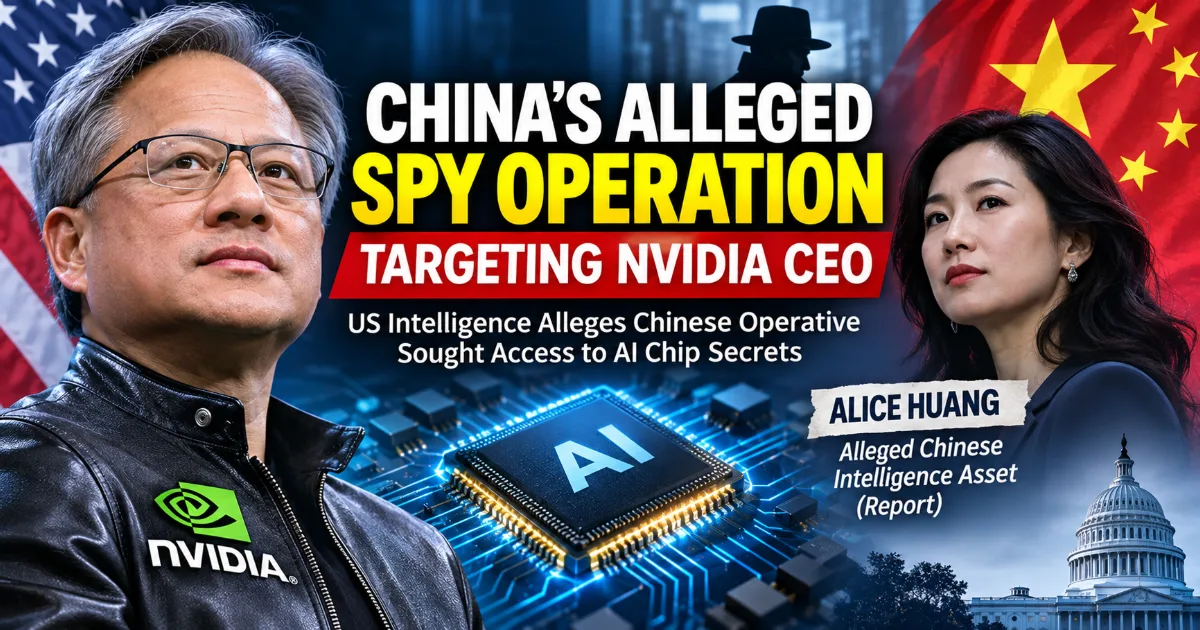
A major espionage controversy involving one of the world's most influential technology executives has placed Nvidia, the global artificial intelligence chip industry and the wider US-China technology rivalry under renewed scrutiny. US intelligence assessments reportedly identified a business executive with connections to Nvidia CEO Jensen Huang as a suspected Chinese intelligence asset, allegedly recruited to gather information about him and potentially influence the availability of advanced American AI chips to China.
The woman at the centre of the reports is Alice Huang, a former executive at Megaspeed International, a Singapore-based technology company that buys Nvidia computing equipment. According to reporting by The New York Times, US intelligence officials believed she had been recruited by China's Ministry of State Security (MSS), Beijing's principal civilian intelligence agency. The alleged objective was to obtain information about Nvidia's leadership and the American AI semiconductor industry, and potentially encourage the company to support greater access to advanced chips for Chinese customers.
The allegations became more consequential after reports described a close relationship between Alice Huang and Jensen Huang, including a reported romantic relationship. Jensen Huang subsequently acknowledged in a message to Nvidia employees that he had been unfaithful to his wife, although the public message did not identify the person involved. Nvidia's board has now initiated an independent investigation into whether its chief executive was targeted by a foreign intelligence effort.
Continue Reading
The controversy is not simply about the personal relationships of a powerful technology executive. Nvidia's processors are central to the development and deployment of advanced artificial intelligence systems. The company has become a strategic asset in the global technology economy, while Washington has imposed export restrictions intended to limit China's access to the most powerful American AI chips.
If the reported intelligence operation is substantiated, it would highlight how foreign intelligence services may seek access to strategic technology not only through cyberattacks or industrial espionage, but also through commercial relationships, professional networks and personal connections.
At the same time, the allegations remain allegations. The public has not been shown the underlying intelligence material, and the claims have not been established through a publicly disclosed court finding. China has rejected the accusations, while Singapore has separately clarified that its government did not investigate Alice Huang over the alleged intelligence links described in earlier reporting. The distinction between intelligence assessments, corporate investigations and proven misconduct is essential to understanding the story.
Who Is Alice Huang and Why Is She at the Centre of the Allegations?
Alice Huang has been identified in media reports as a technology executive associated with Megaspeed International, a Singapore-based company involved in purchasing Nvidia computing equipment and providing access to computing infrastructure. Megaspeed operates in a sector that has become increasingly important as businesses and developers seek access to powerful processors for artificial intelligence workloads.
The company reportedly became significant because of its commercial relationship with Nvidia. Businesses that purchase large quantities of AI computing hardware can develop relationships with senior executives, technology partners and suppliers. Such relationships are normal in the semiconductor industry, where major customers may negotiate equipment purchases, infrastructure arrangements and technical support.
US intelligence officials reportedly became concerned that Alice Huang's relationship with Jensen Huang went beyond an ordinary commercial connection. According to the reporting, American intelligence assessments described her as an individual recruited by China's Ministry of State Security to gather information about Nvidia's chief executive and potentially influence the company's position on advanced chip exports.
The reports also raised questions about Megaspeed's business activities and its access to Nvidia's technology. The company has reportedly attracted scrutiny over concerns that advanced AI chips could be obtained through commercial arrangements and eventually reach Chinese customers despite US export restrictions.
It is important, however, not to treat the company's commercial relationship with Nvidia as evidence of espionage. Purchasing computing hardware, operating data centres and providing cloud services are legitimate business activities. Any allegation that a company or executive acted as an intermediary for intelligence collection or prohibited technology transfers requires independent verification.
The public reporting has not established that Alice Huang successfully obtained confidential Nvidia information, nor has it demonstrated that she influenced the company's commercial or export-policy decisions. The central question is whether the intelligence assessment can be substantiated and whether any sensitive information was actually accessed.
What Was the Alleged Chinese Intelligence Operation Trying to Achieve?
The reported operation was allegedly connected to China's wider interest in advanced artificial intelligence semiconductors.
Modern AI systems require enormous computing resources. Training large models involves processing vast quantities of data through specialised chips capable of performing complex mathematical operations at high speed. Nvidia's graphics processing units and associated computing systems have become essential infrastructure for many of the world's leading AI developers.
China wants access to advanced AI computing because these technologies have implications for economic competitiveness, scientific research, industrial automation, military applications and national security. The ability to train and deploy powerful AI models can influence everything from semiconductor design and drug discovery to autonomous systems and intelligence analysis.
According to the intelligence reporting, the alleged objective was not necessarily limited to obtaining technical secrets from Nvidia. It may also have involved learning more about the company's internal thinking and encouraging a commercial or political environment in which more advanced chips could be made available to Chinese customers.
This distinction matters. Intelligence collection does not always involve stealing a technical blueprint or copying a processor design. Information about executive priorities, corporate strategy, supply-chain relationships, customer requirements and political influence can also be valuable.
A foreign intelligence service might seek to understand how a company makes decisions, which executives influence its direction, what commercial pressures it faces and how it approaches government restrictions. Such information can help a state identify opportunities to influence policy or anticipate business decisions.
However, the alleged purpose of an operation must be distinguished from its proven outcome. The reports describe what US intelligence officials reportedly believed the operation was intended to achieve. They do not establish that Beijing successfully obtained Nvidia trade secrets or changed the company's export policy through the alleged relationship.
Why Nvidia's AI Chips Have Become a National Security Issue
Nvidia's importance has grown dramatically with the expansion of generative AI. Its processors are used in data centres that train large language models, develop advanced image-generation systems, run scientific simulations and power enterprise AI applications.
The company's hardware has become particularly important because modern AI computing depends on more than the performance of an individual processor. It requires high-speed connections between thousands of chips, specialised networking equipment, memory systems, software libraries and data-centre infrastructure.
Nvidia has developed a broad ecosystem around its processors. Its CUDA software platform, networking technologies and integrated computing systems have helped establish the company as a central supplier for AI development.
This position has transformed Nvidia from a major graphics-chip manufacturer into one of the most strategically important companies in the global technology industry.
For the United States, advanced AI processors are no longer viewed only as commercial products. They are also considered technologies with potential national security implications. Powerful computing systems can support military research, intelligence analysis, cyber operations, advanced weapons development and other sensitive applications.
Washington has therefore introduced restrictions on exports of certain advanced semiconductors and related technologies to China. The objective is to limit China's ability to acquire computing capabilities that could accelerate its development of advanced AI and military systems.
These restrictions have created a difficult environment for American chip companies. They must balance commercial opportunities in a large market with compliance obligations and national security concerns.
Nvidia has argued that maintaining access to international markets is important for the competitiveness of American technology companies. The company has also had to adapt products and sales arrangements in response to changing export rules.
The alleged espionage operation, if confirmed, would demonstrate why US policymakers are concerned about the possibility that access to advanced computing technology could be pursued through indirect commercial and personal channels rather than through straightforward purchases.
The Role of China's Ministry of State Security
China's Ministry of State Security is the country's principal civilian intelligence and counterintelligence agency. It is responsible for gathering intelligence abroad, protecting state security and addressing perceived threats to the Chinese political and security system.
The agency has frequently appeared in Western government assessments and cybersecurity investigations concerning alleged foreign intelligence activities. US officials have previously accused Chinese state-linked actors of attempting to obtain sensitive information from government agencies, technology companies, research institutions and private organisations.
The allegations involving Alice Huang would represent a different kind of reported intelligence approach if the account is accurate. Instead of relying exclusively on hacking, technical surveillance or direct recruitment within a company, the alleged operation would have used a commercial executive's access to a powerful business leader.
Personal relationships can create intelligence opportunities because they may provide access to private conversations, professional networks and information that is not available through formal corporate channels. Intelligence services around the world have historically attempted to exploit human relationships as part of their operations.
But the existence of such historical methods does not prove that they were used in this particular case. The public has not been given the underlying intelligence assessment, surveillance records or independently verifiable evidence necessary to establish the alleged recruitment.
The US claims should therefore be understood as serious intelligence allegations that require further examination, rather than as a complete public account of a proven espionage operation.
The Reported Relationship With Jensen Huang
The controversy gained international attention when media reports described a close relationship between Alice Huang and Jensen Huang, Nvidia's co-founder and chief executive.
The Financial Times reported that US officials believed the relationship was romantic. The reports suggested that the relationship had become part of the intelligence concerns communicated to senior officials in Washington.
Jensen Huang later sent a message to Nvidia employees acknowledging that he had been unfaithful to his wife. In the message, he apologised to his family, colleagues, board members, partners and shareholders, accepted responsibility for his actions and said he would cooperate with the company's investigation.
His admission confirmed that there was a personal matter serious enough for him to address internally, but it did not independently prove the intelligence allegations concerning Alice Huang. Acknowledging infidelity is not the same as confirming that a relationship was part of a foreign intelligence operation.
The distinction is particularly important because the public discussion involves both personal conduct and national security. The first concerns an individual's private choices and the responsibilities that come with leading a major corporation. The second concerns whether a foreign government attempted to exploit access to a strategically important technology company.
The two issues may overlap, but they require separate standards of evidence.
Nvidia has said that Jensen Huang's interactions with customers are part of his normal responsibilities. The company has also argued that its customer relationships do not provide access to classified information or sensitive US national security material. Earlier company comments described the interactions with Alice Huang as not unusual or unexpected in the context of the chief executive's work.
The board's independent investigation will need to determine whether the relationship created any risk to the company, whether corporate policies were followed and whether any confidential information was exposed.
Nvidia Launches an Independent Investigation
On November 8, 2026, Nvidia's board announced that it was initiating an independent investigation following reports that Jensen Huang had been the target of a foreign intelligence effort.
The company said a committee of independent directors, assisted by outside independent legal counsel, would oversee the inquiry. The board also stated that it had no reason to believe that either US national security or Nvidia's secrets had been compromised, while emphasising that the investigation would examine all available information.
This statement is significant because it separates the existence of an alleged intelligence effort from the question of whether the effort succeeded.
A person can be targeted by an intelligence operation without the operation obtaining confidential information. A company can also face a security threat without suffering a confirmed breach.
The investigation will need to examine the nature of the relationship, the information that may have been discussed, any relevant communications and whether corporate security procedures were followed.
It may also need to review the company's interactions with Megaspeed and determine whether any transactions raised concerns under US export-control rules.
The board's statement expressed confidence in Jensen Huang and his leadership team. The company also confirmed that Huang supports the investigation and will cooperate with it.
For Nvidia, the inquiry is important not only because of the national security questions but also because investor confidence depends on the company's ability to protect intellectual property and maintain strong corporate governance.
Nvidia's business is built around highly valuable technology, research, software and relationships with major customers. Any suggestion that its leadership was exposed to foreign intelligence collection could raise questions about the company's internal controls, even if no compromise is ultimately established.
US Congress Wants Jensen Huang to Explain His Interactions
The allegations have also reached the US Congress. On November 5, 2026, the chairmen of three influential House committees requested a closed-door briefing with Jensen Huang.
The request came from Brian Mast, chairman of the House Foreign Affairs Committee, John Moolenaar, chairman of the House Select Committee on China, and Rick Crawford, chairman of the House Permanent Select Committee on Intelligence. Their letter asked Huang to brief lawmakers about his interactions with Alice Huang and Nvidia's security protocols against foreign intelligence activities.
The committees requested a briefing for November 18 and asked Huang to accept the proposed date or provide an alternative by November 11.
The lawmakers said the allegations raised national security concerns about China's potential access to sensitive American technology and information. Their interest reflects a broader concern in Washington that advanced AI computing has become a strategic resource and that commercial relationships could potentially be exploited to bypass traditional security barriers.
A congressional briefing would allow lawmakers to question Huang about his interactions with Megaspeed, the company's customer-screening processes and the safeguards used to protect confidential information.
It could also help establish whether Nvidia had received earlier government warnings about individuals or organisations connected to the matter.
However, a request for a briefing is not a finding of wrongdoing. Congressional committees routinely seek information when reports raise questions about national security, corporate conduct or foreign influence. The purpose of the proposed session is to establish what happened and whether further action is required.
The timing is also important. The controversy has emerged during a period of intense political debate about how much advanced AI technology American companies should be permitted to sell to China.
Megaspeed International and the Wider Chip-Supply Chain Question
Megaspeed International has attracted attention because of its position in the AI computing market.
Companies operating data centres and cloud-computing services purchase large numbers of high-performance processors. They may then rent computing capacity to AI developers, research organisations and businesses that do not have the resources to build their own infrastructure.
This business model is legitimate and has become increasingly important as demand for AI computing has expanded.
However, it can create challenges for export-control enforcement. A processor sold to an approved customer may be installed in a data centre and used by multiple clients. Regulators must therefore understand not only who purchased the hardware but also who ultimately uses the computing capacity.
The US has imposed restrictions on the export of certain advanced Nvidia processors to China. These restrictions are intended to prevent prohibited end users from gaining access to computing systems that could support sensitive military or strategic applications.
The concern surrounding Megaspeed is connected to questions about whether companies in third countries could provide indirect access to restricted AI computing resources.
Reuters reported that US authorities had scrutinised Megaspeed over suspicions that it may have helped Beijing obtain access to advanced AI chips that were restricted from shipment to China. Nvidia has said it checks customers and acts on information it receives from the US government about entities of concern.
These are separate but related questions. One concerns alleged intelligence collection through a relationship with Nvidia's chief executive. The other concerns whether the supply chain for advanced computing equipment has been used to circumvent export restrictions.
A company can be investigated over export-control concerns without its executives being involved in espionage. Likewise, an alleged intelligence relationship does not automatically establish that a company illegally transferred restricted hardware.
The investigation must establish whether these issues are connected and whether any laws or corporate policies were violated.
Why the United States Is Worried About Indirect Access to AI Chips
Export controls are designed to restrict the transfer of sensitive technology to specific countries, organisations or end users. But enforcing them in a global technology market is difficult.
AI computing hardware can move through several layers of suppliers, distributors, data-centre operators and cloud-service providers. A processor may be manufactured in one country, assembled in another, sold through a commercial partner and ultimately used by a customer somewhere else.
The physical movement of a chip is only one part of the issue. Access to computing power can also be provided remotely. A company that owns advanced processors can potentially rent computing capacity to customers who never physically possess the hardware.
This creates a distinction between controlling the export of a physical product and controlling access to the computing capability that product provides.
US policymakers are increasingly concerned that restrictions could be undermined if prohibited users gain access through third-party infrastructure.
The concern is not limited to China. Any country with advanced computing restrictions must consider the possibility of intermediaries, shell companies, indirect ownership and cloud-based access arrangements.
For Nvidia, this creates a difficult compliance environment. It must sell to legitimate international customers while ensuring that its products are not diverted to prohibited users.
The company also needs to protect its relationships with cloud providers and technology partners. A customer may be commercially legitimate, but the ultimate users of its infrastructure may be more difficult to identify.
The Megaspeed allegations have therefore become part of a wider debate about whether existing export-control systems are sufficiently equipped to deal with the cloud-computing economy.
China Rejects the Allegations
Beijing has rejected the accusations that Alice Huang was recruited by Chinese intelligence to target Jensen Huang.
A spokesperson for China's Foreign Ministry described the reports as baseless and as an attempt to smear China. The response reflects Beijing's broader position that accusations of Chinese espionage are frequently used by Washington to justify restrictions on Chinese technology companies and limit China's access to advanced technology.
China's response is an important part of the story, but it does not independently resolve the allegations. Equally, US intelligence assessments cannot be treated as conclusive simply because they have been described by multiple media outlets.
The public has not been provided with the complete intelligence material, and the claims have not been tested in a publicly disclosed legal proceeding.
The controversy therefore remains a dispute involving intelligence assessments, media reporting, corporate statements and government denials.
A credible conclusion will require evidence that can establish whether Alice Huang was recruited, what information she allegedly sought, whether any information was obtained and whether any company or government official acted improperly.
Until then, the allegation that China conducted an operation targeting Nvidia's chief executive should remain clearly labelled as an allegation.
Singapore's Government Rejects Claims That It Investigated Alice Huang
An important development in the controversy came from Singapore.
On October 31, 2026, Singapore's Ministry of Home Affairs issued a clarification concerning a Wall Street Journal report about Alice Huang's alleged links to Chinese intelligence and her relationship with Jensen Huang.
The ministry said the report had suggested that Singapore officials were concerned about Alice Huang's relationship with the Nvidia chief executive or had investigated her alleged connections to China. Singapore's government stated that neither it nor its officials had made those claims and that no such investigations had been conducted in respect of Alice Huang.
This clarification matters because Singapore is a major international technology and financial centre. It hosts regional headquarters, data centres, semiconductor-related businesses and multinational technology companies.
The country also has a strong interest in maintaining its reputation as a reliable location for international business. Claims involving intelligence activity, technology transfers and corporate executives can have implications for its commercial environment.
Singapore's statement does not prove or disprove the US intelligence allegations. It addresses a specific claim about whether Singaporean authorities had conducted an investigation or expressed concerns to the publication.
The distinction is important. A report based on US intelligence assessments should not be expanded into an assertion that Singapore's government independently confirmed the alleged intelligence activity.
The clarification also demonstrates why international reporting on intelligence matters requires careful attribution. Statements by US officials, intelligence assessments, corporate responses and statements from Singaporean authorities represent different sources of information. They should not be merged into one supposedly confirmed account.
Jensen Huang's Position and the Future of Nvidia's Leadership
Jensen Huang is one of the most influential executives in the technology industry. He co-founded Nvidia in 1993 and has led the company through its transformation from a graphics processor manufacturer into a central supplier of AI computing infrastructure.
His influence extends beyond Nvidia's internal operations. Governments, technology companies, research institutions and AI developers closely follow his views on semiconductor supply, artificial intelligence and the future of computing.
That makes the allegations particularly sensitive for the company.
The Nvidia board has expressed confidence in Huang and said he will cooperate with the independent investigation. The company has not announced that he will step aside from his role.
Huang's message to employees acknowledged personal conduct that he said had hurt his family and fallen short of his responsibilities to colleagues, the board, partners and shareholders. He also stated that he would cooperate fully with the national security review.
The board's investigation will need to consider whether his personal relationship created any corporate risk, whether he followed company policies and whether confidential information was discussed or exposed.
The outcome could have implications for corporate governance even if no espionage-related information was compromised.
Large companies increasingly expect senior executives to follow strict standards around conflicts of interest, information security and relationships with business partners. A chief executive's personal connections can become a corporate concern when they involve customers, suppliers, government officials or individuals who may present security risks.
The investigation will also be watched by investors because Nvidia's valuation and strategic importance are closely connected to confidence in its leadership.
However, it would be premature to assume that the controversy will result in a leadership change. The company has publicly backed Huang while the investigation proceeds.
The Political Dimension: AI Competition Between Washington and Beijing
The allegations have emerged at a time when artificial intelligence is central to the strategic competition between the United States and China.
Both countries are investing heavily in AI research, semiconductor development, data centres and advanced computing infrastructure. Their competition extends beyond commercial products into military planning, scientific research, cybersecurity and economic influence.
The United States has sought to preserve its advantage in advanced semiconductor design and manufacturing while restricting China's access to certain technologies.
China, meanwhile, has invested in domestic chip development, AI models, data-centre infrastructure and alternative technology supply chains. Its companies are working to reduce dependence on American hardware and software, although access to the most advanced semiconductor manufacturing capabilities remains a significant challenge.
Nvidia sits at the centre of this rivalry because its products are widely used in AI development. The company's commercial decisions can influence the availability of computing power across different markets.
The question of whether Nvidia should sell advanced processors to China has therefore become politically sensitive.
American technology companies argue that international sales support research, investment and the competitiveness of US firms. Security officials and some lawmakers warn that advanced computing systems could strengthen China's strategic capabilities.
This tension creates a difficult policy environment. If restrictions are too broad, they may encourage customers to shift towards domestic alternatives and reduce the global influence of American technology. If restrictions are too narrow, they may allow strategically sensitive computing capabilities to reach prohibited users.
The alleged intelligence operation adds another layer to this debate. If foreign intelligence services are attempting to influence technology executives or gain access to their networks, policymakers may argue that commercial relationships require stronger security oversight.
But the controversy could also intensify political pressure on technology companies and their executives before the facts are fully established.
Could Personal Relationships Become a New Front in Corporate Espionage?
The allegations have renewed attention on an aspect of intelligence operations that is sometimes overshadowed by cyberattacks and technical surveillance: human intelligence.
Companies often protect their systems through firewalls, access controls, encryption, cybersecurity monitoring and employee training. These safeguards are essential, but they cannot eliminate every risk created by personal relationships and professional networks.
Senior executives routinely interact with customers, suppliers, investors, consultants, government officials and business partners. Their work requires access to people and information across several countries. These relationships are necessary for international business, but they can also create opportunities for individuals seeking sensitive information.
An intelligence operation that attempts to exploit a personal relationship may not need to penetrate a company's computer network. It could instead seek commercially sensitive information through conversations, introductions or access to influential decision-makers.
That does not mean every personal relationship involving an international business executive should be viewed with suspicion. Such an approach would damage legitimate commercial relationships and create an atmosphere of distrust.
The challenge is to establish clear boundaries between personal interactions, professional responsibilities and confidential corporate information.
Companies can reduce risks through conflict-of-interest policies, security awareness programmes, access controls and procedures for reporting suspicious approaches. They can also ensure that sensitive information is not concentrated in the hands of a single executive.
The Nvidia controversy may encourage other technology companies to review how they assess risks involving senior leadership and international commercial relationships.
What Has Actually Been Established and What Remains Unverified?
The story has attracted attention because it combines intelligence allegations, a personal relationship, semiconductor export controls and the leadership of one of the world's most valuable technology companies. But these elements need to be separated carefully.
Several developments are established through public statements and reporting. Nvidia's board has announced an independent investigation. Jensen Huang has acknowledged being unfaithful to his wife in a message to employees. US lawmakers have requested a closed-door briefing. China has rejected the espionage allegations, and Singapore has clarified that its government did not conduct the investigation attributed to it in an earlier report.
Other claims remain based on intelligence reporting. These include the allegation that Alice Huang was recruited by China's Ministry of State Security, the precise objectives of the alleged operation and the extent of her access to Jensen Huang.
The public record has not established that Nvidia's trade secrets were stolen, that classified US information was obtained or that the company's export decisions were influenced by the alleged relationship.
It has also not established that Megaspeed International knowingly participated in an intelligence operation or illegally transferred restricted Nvidia processors to China.
These distinctions are not technical details. They determine whether the controversy represents an attempted intelligence operation, a successful espionage breach, a corporate governance failure or a combination of separate issues.
The independent investigation and any subsequent congressional review may provide further information. Until then, reporting should avoid presenting intelligence allegations as proven criminal conduct.
What the Investigation Could Mean for the Global AI Industry
The consequences of the case could extend well beyond Nvidia.
AI companies increasingly operate through international partnerships. Their customers include cloud providers, research institutions, universities, governments, startups and multinational corporations. These relationships create complex networks through which computing resources and technical information move.
If the allegations lead to stronger security controls, technology companies may introduce more extensive screening of customers, partners and executives' interactions with high-risk entities.
Cloud providers may also face greater scrutiny over the identity of customers using advanced AI processors. Regulators could demand more detailed records of computing access, hardware location and ultimate beneficiaries.
The semiconductor industry may experience additional pressure to demonstrate that export restrictions are being enforced effectively. Companies could be expected to provide greater transparency about distribution channels and the use of advanced processors by international customers.
However, stricter controls may also create commercial challenges. International data-centre operators depend on access to global hardware and customers. Excessively complicated compliance requirements could increase costs and slow infrastructure investment.
The industry therefore faces a difficult balance between national security and the open commercial relationships that have helped technology companies grow.
The Nvidia investigation could become an important example of how that balance is managed when allegations involve a company's most senior executive.
The Bigger Question: Is AI the New Strategic Target of Global Espionage?
Artificial intelligence has become one of the most strategically important technologies of the modern era. Countries are competing to develop more capable models, faster processors, larger computing facilities and applications that can transform industry and national security.
The technology is valuable because it can improve productivity, accelerate scientific discovery and automate complex tasks. It can also be applied to military planning, surveillance, intelligence analysis and cybersecurity.
As a result, governments have strong incentives to understand the capabilities, research priorities and commercial strategies of their competitors.
The most valuable information may not always be a secret processor design. It could be knowledge about future product launches, supply-chain vulnerabilities, export-control decisions, customer relationships or the strategic thinking of senior executives.
This makes technology leaders important figures in international competition. Their decisions can influence where computing resources are sold, which markets receive access to new products and how quickly advanced technologies spread.
The allegations involving Nvidia highlight the possibility that intelligence agencies may seek access to this strategic information through both technical and human channels.
But they also demonstrate why companies and governments must be careful when responding to suspected espionage. Intelligence assessments can be important early warnings, but they must be examined through credible investigations before conclusions are presented as established facts.
Conclusion: An Alleged Chinese Spy Operation Puts Nvidia and the AI Chip Race Under Scrutiny
The allegations surrounding Alice Huang and Nvidia CEO Jensen Huang have opened a new chapter in the growing technology rivalry between the United States and China.
US intelligence assessments reportedly identified Alice Huang, a former Megaspeed International executive, as a suspected Chinese intelligence asset who was allegedly recruited to gather information about Nvidia's leadership and the American AI semiconductor industry.
The reports have raised questions about whether personal and commercial relationships could be exploited to gain access to influential executives and potentially influence the availability of advanced computing technology.
Nvidia has responded by launching an independent investigation led by a committee of independent directors and outside counsel. The board says it has no reason to believe that national security or company secrets were compromised, but it intends to examine all available information. Jensen Huang has expressed support for the review and committed to cooperating.
The controversy has also attracted congressional attention, with three House committee chairmen requesting a closed-door briefing. China has rejected the espionage accusations, while Singapore has clarified that it did not investigate Alice Huang as suggested in earlier reporting.
For now, the central allegations remain unproven publicly. There is no established public finding that Nvidia's trade secrets were stolen or that American national security information was compromised. The investigation must determine whether the alleged operation existed, what it sought to obtain and whether any sensitive information was actually exposed.
The broader implications are nevertheless significant. AI processors have become strategic assets, and companies developing them operate at the intersection of global commerce, national security and geopolitical competition.
The case also highlights a difficult reality for the technology industry. Protecting intellectual property is no longer only about securing servers, networks and research laboratories. It increasingly involves understanding the risks associated with commercial partnerships, international customers and the people who have access to senior decision-makers.
If the allegations are substantiated, the case could become a major example of how human intelligence and commercial networks intersect in the global AI race. If they are not, it will still raise important questions about how intelligence claims should be verified before they affect companies, individuals and international relations.
For Nvidia, the immediate priority is to establish whether any information was compromised and reassure employees, customers, investors and regulators that its security controls remain effective. For Washington and Beijing, the controversy is another reminder that the competition over artificial intelligence is not simply about building faster chips. It is also about controlling access to the technology, protecting strategic information and maintaining influence over the infrastructure that will shape the next generation of global computing.
#ChinaSpyAllegations #Nvidia #JensenHuang #AliceHuang #ChineseIntelligence