A Festival That Inspires New Beginnings
Vijayadashami, also known as Dussehra, is one of India's most meaningful festivals. Celebrated at the end of Navratri, it symbolizes the victory of good over evil, truth over falsehood, and courage over fear. Beyond its religious significance, Vijayadashami holds a special place in Indian culture because many people consider it an auspicious occasion to begin something new.
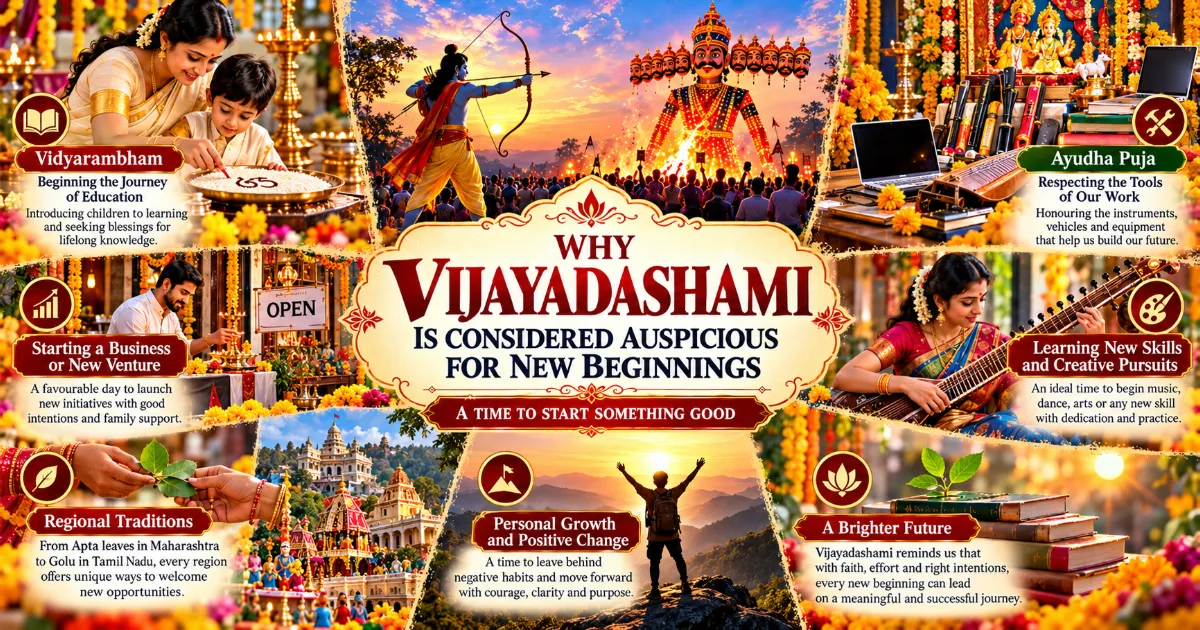
Across India, families may choose this day to start a business, purchase tools, begin learning a skill, initiate a new project, or take the first step toward a long-held dream. Parents introduce children to education, artists worship their instruments, and professionals seek blessings for their work. These customs reflect a shared belief that new beginnings should be accompanied by good intentions, dedication, and gratitude.
But why is Vijayadashami associated with fresh starts? The answer lies in its spiritual symbolism, regional traditions, and the timeless lessons that Indian culture has preserved through generations.
Continue Reading
1. The Meaning of Vijayadashami: Victory That Opens New Doors
The word Vijayadashami combines the ideas of vijaya, meaning victory, and dashami, referring to the tenth day of the lunar fortnight. The festival marks an important conclusion to the nine days of Navratri and celebrates divine victory in different traditions.
In the Ramayana tradition, Vijayadashami commemorates Lord Rama's victory over Ravana. In the tradition associated with Goddess Durga, the festival celebrates her victory over Mahishasura, the buffalo demon who represented destructive and oppressive forces.
Both stories communicate a powerful message: challenges can be overcome when courage, wisdom, righteousness, and determination guide our actions.
This symbolism makes Vijayadashami a meaningful occasion to leave behind habits that hold us back and begin a better chapter. Someone might decide to pursue education after years of hesitation, establish a business after careful preparation, or commit to healthier personal habits. The festival encourages people to approach such decisions with confidence and responsibility.
The idea is not that success arrives automatically because a task begins on a particular date. Rather, Vijayadashami offers a culturally meaningful opportunity to begin with a positive mindset and a clear purpose.
2. Vidyarambham: Beginning the Journey of Education
One of the most beautiful Vijayadashami traditions is Vidyarambham, the ceremonial introduction of young children to learning. The practice is particularly associated with Kerala and is also observed in other parts of southern India.
During the ceremony, children are introduced to letters and the basics of writing. A parent, teacher, or spiritual guide may help the child write their first letters, sometimes on a plate of rice or another traditional surface. The ceremony represents the beginning of a lifelong relationship with knowledge.
Vidyarambham reflects the high value placed on education in Indian culture. Learning is understood not merely as a way to earn a living but also as a means of developing judgment, understanding the world, and becoming a responsible member of society.
Although the ceremony is often associated with young children, its message applies to learners of every age. Vijayadashami can be an opportunity for anyone to begin studying a new subject, learn a language, develop professional skills, or return to an educational goal that was previously postponed.
Every meaningful learning journey begins with a first step. Vidyarambham celebrates that moment and reminds families that curiosity and knowledge deserve encouragement.
3. Ayudha Puja: Respecting the Tools That Help Us Work
Another important tradition connected with Navratri and Vijayadashami is Ayudha Puja, commonly observed in several southern and western Indian communities. The word ayudha means weapon, but the observance has broadened to include the tools and instruments people depend on for their work.
Farmers may worship agricultural implements, artisans may honour their tools, musicians may offer prayers for their instruments, and businesses may clean and worship equipment used in daily operations. In contemporary settings, some people also include computers, vehicles, machinery, and other professional tools.
The deeper message is one of gratitude. Our work depends not only on personal effort but also on the resources, instruments, knowledge, and support that make our efforts possible.
Ayudha Puja encourages people to treat their work with respect and to care for the tools that support it. It also offers an opportunity to reflect on professional goals and improve the way we work.
For someone starting a business, opening a workshop, beginning a creative project, or entering a new profession, the tradition can serve as a reminder to prepare carefully, use resources responsibly, and approach work with sincerity.
4. Starting a Business or New Venture
In many Indian families and business communities, Vijayadashami is regarded as a favourable day to begin a new venture. Some people may open a shop, launch a business initiative, start a new project, or perform a small puja before beginning operations.
This association reflects the festival's central theme of victory and progress. Starting something new often involves uncertainty, financial responsibility, hard work, and the possibility of failure. An auspicious occasion can provide emotional encouragement and bring family members or colleagues together in support of a shared goal.
For entrepreneurs, Vijayadashami can be a meaningful date to define a business vision, begin serving customers, introduce a product, or make a commitment to ethical practices.
However, choosing an auspicious date should complement practical preparation rather than replace it. A successful business still needs research, financial planning, an understanding of customers, reliable operations, and the willingness to learn from mistakes.
The cultural value of the occasion lies in combining hope with responsibility. A new venture can begin with a prayer or a family blessing, but its future depends on the decisions and efforts made every day afterward.
5. Learning New Skills and Beginning Creative Work
Vijayadashami is also a meaningful occasion for people who wish to begin learning music, dance, painting, writing, crafts, or other creative disciplines.
Indian traditions often connect knowledge and artistic expression with divine inspiration. Goddess Saraswati, who is widely associated with learning, wisdom, music, and the arts, is honoured in several regional traditions and observances connected with education and creative pursuits.
Beginning a new skill on Vijayadashami can therefore represent more than a calendar choice. It can be a personal promise to make time for learning and practice.
A person who has always wanted to learn an instrument might attend their first lesson. Someone interested in writing could begin a journal or work on a book. A young artist might enrol in a class, while an experienced professional could start exploring a new area of expertise.
Creative growth rarely happens overnight. It requires patience, repetition, and the willingness to make mistakes. The spirit of Vijayadashami can encourage people to move beyond hesitation and take that first step.
The most important part is not achieving immediate perfection. It is developing the discipline to continue after the excitement of beginning has passed.
6. The Tradition of Shastra Puja and Honouring Strength
In some traditions, Vijayadashami is associated with the worship of weapons and instruments of protection, sometimes described as Shastra Puja. Historically, the occasion held particular significance for warriors and rulers preparing for campaigns or honouring their responsibilities.
Today, the symbolism can be understood more broadly as a reminder that strength must be guided by wisdom and ethical responsibility. Courage is valuable when it protects people, supports justice, and helps individuals stand against wrongdoing.
The festival's stories also suggest that the struggle against evil is not limited to the outside world. People can reflect on anger, dishonesty, jealousy, arrogance, and fear as personal challenges that require awareness and effort.
Beginning anew may therefore mean deciding to communicate more honestly, become more patient, fulfil responsibilities more consistently, or repair a relationship that has suffered.
Such changes may not attract public attention, but they can be among the most meaningful victories in a person's life.
7. Regional Traditions That Give New Beginnings Different Meanings
India's cultural diversity gives Vijayadashami several regional expressions. Although the customs differ, many connect the festival with learning, gratitude, prosperity, spiritual reflection, or the beginning of a new phase.
Kerala: Vidyarambham
In Kerala, Vijayadashami is especially associated with Vidyarambham, when children are ceremonially introduced to writing and learning. Temples and other venues may host ceremonies where teachers and families guide children through their first letters.
The custom celebrates the beginning of education and the role of teachers in nurturing knowledge.
Karnataka: Mysuru Dasara
Mysuru Dasara is known for its royal heritage, elaborate celebrations, processions, cultural programmes, and the worship of Goddess Chamundeshwari. The festival brings together devotion, history, music, art, and community participation.
Its grandeur illustrates how a religious festival can also preserve regional identity and cultural traditions across generations.
Tamil Nadu: Golu and the Celebration of Knowledge
During Navratri, many households in Tamil Nadu arrange Golu displays featuring dolls and figurines on stepped platforms. The displays may represent deities, scenes from epics, social life, and aspects of Indian culture.
The concluding days of Navratri and Vijayadashami can be associated with the beginning of learning and artistic pursuits. The tradition highlights the connection between devotion, creativity, family participation, and knowledge.
Maharashtra: Seemollanghan and Apta Leaves
In parts of Maharashtra, Vijayadashami includes the tradition of Seemollanghan, historically associated with crossing boundaries, and the exchange of apta leaves as symbolic gold.
These customs carry ideas of prosperity, friendship, courage, and moving beyond familiar limits. They can be interpreted as encouragement to explore new possibilities while maintaining meaningful social bonds.
North India: The Victory of Lord Rama
In many parts of northern India, Vijayadashami is marked by Ram Lila performances and the burning of effigies representing Ravana and other figures from the Ramayana.
The story reminds people that arrogance and injustice cannot ultimately overcome righteousness. It offers a fitting moment to reflect on personal values and begin a new chapter with greater honesty and self-control.
These examples are not identical expressions of a single ritual. They show how different communities have developed distinct ways of giving the festival meaning.
8. Why People Choose Auspicious Days for Important Decisions
The tradition of choosing auspicious dates is deeply rooted in many Indian communities. People may consult family customs, a religious calendar, or a priest when selecting a date for a ceremony, opening, or major life event.
Such practices can provide continuity with family heritage and make important milestones feel special. They can also bring relatives and friends together to offer encouragement and support.
At the same time, an auspicious date should not become a source of unnecessary anxiety. Important decisions sometimes need to be made according to practical circumstances, professional requirements, health, safety, or financial realities.
A meaningful beginning depends on more than the date. It also depends on the purpose behind the decision, the quality of preparation, and the effort that follows.
Vijayadashami can be a day for setting intentions, but those intentions become meaningful when they are translated into action.
9. Personal Lessons for Modern Life
The values associated with Vijayadashami remain relevant even for people who observe the festival primarily as a cultural occasion.
Overcome hesitation: Beginning something unfamiliar can be uncomfortable. The festival's message of victory encourages people to take thoughtful action rather than remain trapped by fear.
Replace negative habits: Just as the festival symbolises the defeat of destructive forces, individuals can use the occasion to recognise habits that interfere with their goals and work to change them.
Respect knowledge and skill: Traditions such as Vidyarambham and Ayudha Puja highlight the importance of learning, practice, and caring for the resources that support our work.
Combine faith with effort: Hope can strengthen motivation, but consistent effort is necessary to turn a goal into reality.
Value community support: Family blessings, teachers, friends, and colleagues can help people remain committed to their goals. A new beginning becomes more meaningful when it is supported by encouragement and shared responsibility.
These lessons allow the festival to remain relevant beyond its ceremonial observances.
10. How to Make Vijayadashami a Meaningful New Beginning
Anyone can use Vijayadashami as an opportunity for reflection and positive action, regardless of whether they are beginning a major venture or making a small personal change.
Start by identifying one meaningful goal. It could be completing a course, developing a professional skill, improving a daily routine, starting a creative project, or spending more time with family.
Next, turn the goal into a practical plan. Decide what needs to be done first, what resources are required, and how much time can realistically be devoted to it.
If you follow the festival's religious traditions, you may begin with a prayer, visit a temple, or seek blessings from elders and teachers. Others may prefer a quiet moment of reflection or a written commitment to their goal.
Most importantly, continue after the festival ends. Set small milestones, review your progress, and adjust your approach when necessary. A single day can inspire a beginning, but meaningful change grows through repeated effort.
Families can also use the occasion to encourage children to read, explore a new subject, learn a traditional art, or develop a habit that supports their growth.
Conclusion: Let Every New Beginning Carry a Purpose
Vijayadashami is much more than the final day of Navratri or a celebration of legendary victories. For many people, it represents the possibility of beginning again with courage, knowledge, gratitude, and hope.
Through traditions such as Vidyarambham, Ayudha Puja, and regional celebrations across India, the festival reminds us to respect learning, honour our work, value our cultural heritage, and approach the future with a positive outlook.
Whether you are beginning a new business, learning a skill, pursuing education, or working to improve yourself, Vijayadashami offers a meaningful occasion to set your intentions.
The true significance of an auspicious beginning lies not only in choosing a special day but also in the values and actions that follow it.
May this Vijayadashami inspire you to leave behind what holds you back, strengthen what is good within you, and move forward with confidence and purpose.
Happy Vijayadashami! Shubh Dussehra! May every new beginning bring wisdom, courage, and meaningful progress.