
A Serious Cybersecurity Warning for Millions of Banking Customers
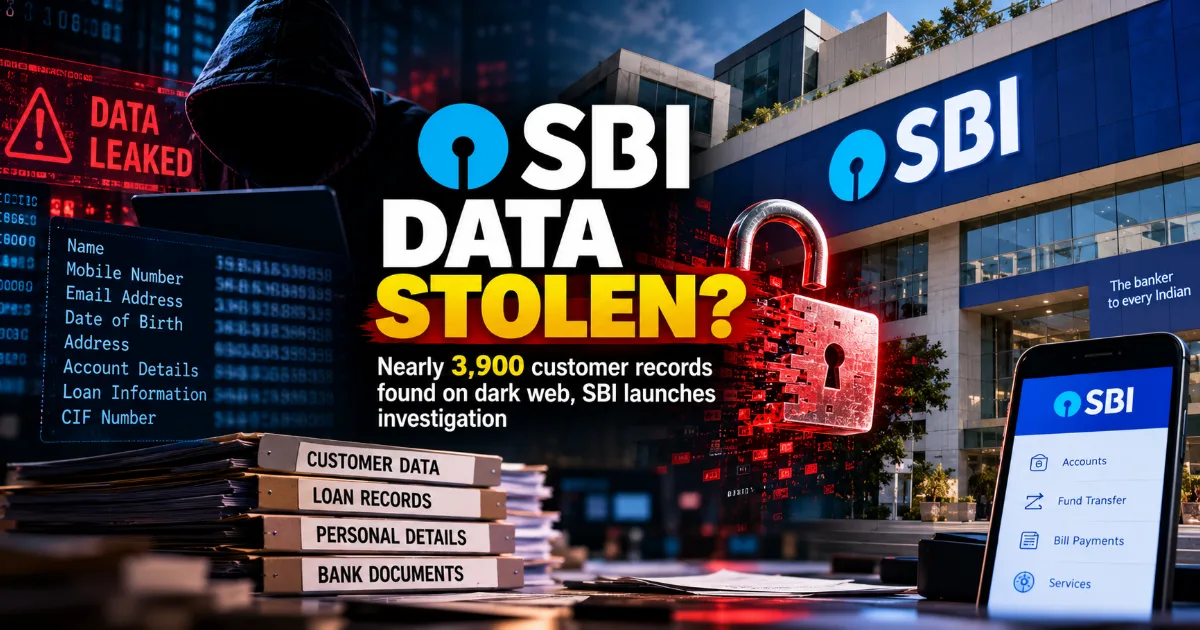
India's banking sector is facing renewed scrutiny over the protection of customer information after the State Bank of India reported a suspected data-loss incident involving personal information associated with thousands of customers. The country's largest public sector bank disclosed on October 21, 2026, that a preliminary examination of approximately 3.75 lakh records found on the dark web had identified 3,897 customer records containing personally identifiable information. The bank has launched a detailed investigation to determine the authenticity of the exposed material, identify its possible source and assess the risks to customers.
The incident has drawn attention because SBI serves more than 50 crore customers across India and operates an extensive network of branches, digital banking platforms, ATMs and financial services. A bank of this scale holds enormous quantities of sensitive information, ranging from basic contact details to records associated with loans and customer applications. Protecting that information is a central responsibility, particularly as banking increasingly depends on digital systems and interconnected service providers.
According to the bank's disclosure, it received alerts on October 16 from its threat intelligence service provider, the Defence Cyber Agency and the Indian Computer Emergency Response Team, commonly known as CERT-In. SBI said it activated its cyber incident response and containment protocols and engaged an independent cybersecurity agency empanelled by CERT-In to examine the incident.
The bank has stated that the incident has not had a material impact on its core business operations, financial performance or business continuity. However, the absence of a reported disruption to banking services does not mean that the potential privacy consequences can be ignored. A data exposure can create risks for customers even when their accounts remain operational and no immediate financial loss has been reported.
Continue Reading
The distinction between operational disruption and information security is important. A bank may continue processing transactions normally while investigators work to establish whether personal records were exposed, how they became accessible and whether anyone has attempted to misuse them. The financial and reputational consequences may become clearer only after the investigation progresses.
At this stage, the full scope of the SBI incident remains uncertain. The bank's preliminary findings identify 3,897 customer records containing personal information within a much larger collection of records found online. Investigators still need to establish the authenticity and completeness of the material, determine how it became available and assess whether additional customers or categories of information may be affected.
What Exactly Happened in the SBI Data Incident?
The incident came to wider public attention after a group identifying itself as Siriusim claimed to possess a large dataset associated with SBI. Reports about the claim described approximately 3.75 lakh to 3.8 lakh records and thousands of PDF documents allegedly containing information linked to banking customers, loan applications and account-opening processes.
The appearance of such claims on the dark web does not automatically establish that every record is authentic or that every item originated directly from the bank's central systems. Criminal groups sometimes exaggerate the size or significance of datasets to attract attention, demand payment or increase their perceived credibility. Records can also be duplicated, outdated, incomplete or combined from different sources.
That is why SBI's preliminary review matters. The bank examined approximately 3.75 lakh records available on the dark web and identified 3,897 customer records containing personally identifiable information. This is a specific preliminary finding, not a final determination of the total number of people affected or the complete volume of information that may have been exposed.
The bank has not publicly established how the information left its systems. It has also not provided a complete public account of whether the incident involved a direct compromise of its core banking infrastructure, a third-party service provider, a document-processing system or another part of the wider operational environment.
These distinctions are critical in cybersecurity investigations. A data exposure can occur through several routes, including compromised credentials, misconfigured storage, unauthorised access to an application, a third-party vendor's systems or the misuse of information collected during a legitimate business process. Investigators need evidence before identifying the cause.
The available disclosure indicates that SBI is treating the matter as a serious incident requiring technical assessment and remedial action. Until the investigation establishes the source and scope, it would be premature to claim that the bank's entire customer database has been stolen or that its central banking systems have been compromised.
The incident nevertheless raises legitimate questions about the security of customer information, the monitoring of external threats and the speed with which affected people are informed. Those questions deserve attention even before every technical detail becomes public.
What Customer Information May Have Been Exposed?
The categories of information identified in reports about the incident include registered mobile numbers, dates of birth, names, gender, email addresses and residential addresses. The material reportedly also included branch details, Customer Information File identifiers, lead IDs and metadata associated with loan and lead records, along with other related files.
A Customer Information File, or CIF, identifier is used by banks to maintain a customer's information across relevant banking relationships and services. The presence of customer identifiers in an exposed dataset can make the information more useful to someone attempting to connect records or impersonate a customer. However, the existence of an identifier in a dataset does not, by itself, prove that the person who obtains it can access an account.
The same caution applies to loan-related metadata. Information connected with a loan application may reveal that a person has applied for credit, interacted with a bank representative or submitted documentation for a financial product. Depending on the records involved, it may also provide clues about a person's financial circumstances or current application status.
The precise meaning of each field depends on the underlying dataset. Metadata can describe a record or document without necessarily containing the full contents of that document. For example, a record may identify a loan application or its processing stage without providing every financial detail associated with the application. Investigators must establish what the files contain before making definitive statements about the sensitivity of each item.
The distinction matters because reports about data breaches can sometimes combine confirmed findings with allegations made by the party claiming to possess the information. The bank has identified a subset of records containing personally identifiable information, while the broader claims about the dataset and associated documents still require verification.
Even limited personal information can be valuable to fraudsters. A criminal does not necessarily need a bank password to make a scam convincing. A caller who knows a customer's name, phone number, branch and a few details about a loan application may be able to construct a believable story about a pending payment, a documentation problem or a suspicious transaction.
That possibility makes the incident important for customers, even as the bank continues to investigate whether the exposed records have been used for fraud.
Why a Data Leak Can Be Dangerous Even if Bank Balances Remain Safe
When a bank reports a cybersecurity incident, customers naturally want to know whether their money is safe. SBI has said the incident has not materially affected its core operations or business continuity. This is reassuring regarding service disruption, but it should not be interpreted as proof that every customer record is unaffected or that no individual could face a fraud attempt.
A person's bank balance and personal information are different categories of assets. Transaction systems may continue functioning normally while a separate dataset containing names, contact details or application records is exposed. A breach of personal information can therefore create a privacy and fraud risk without necessarily enabling an attacker to transfer money directly.
The most immediate concern is often targeted social engineering. Criminals may use leaked details to impersonate bank employees, customer support representatives, loan officers or government officials. They may tell a customer that a loan application requires urgent verification, that a bank account is about to be blocked or that an unusual transaction must be reversed.
Such messages can be persuasive because they include details that the recipient recognises. A person who receives a call mentioning their bank branch, full name or recent financial application may assume the caller has been verified by the bank. In reality, personal information can be used to create a convincing but fraudulent interaction.
Attackers may also combine exposed information with data obtained from other breaches. One dataset might provide a phone number, another might contain an email address, and a third might reveal an individual's employment or shopping history. Together, these fragments can help criminals build a more complete profile of a potential victim.
This does not mean that every person whose record appears in a suspected leak will experience fraud. The risk depends on the nature of the information, whether it is accurate, whether it is used by criminals and what additional security protections are in place. Nevertheless, exposed personal details can remain useful to fraudsters long after the original incident has been contained.
Customers should therefore remain alert without assuming that their accounts have automatically been compromised. A sensible response is to review account activity, use official banking channels and treat unexpected requests for confidential information with caution.
What Is the Dark Web, and Why Does Stolen Data Appear There?
The dark web refers to online services that are not accessed through ordinary public browsing in the same way as conventional websites. Some services use specialised software and network arrangements designed to provide greater anonymity. These technologies have legitimate uses, including protecting privacy and enabling communication under restrictive conditions, but they are also exploited by criminal groups.
Dark-web marketplaces and forums have become channels through which some cybercriminals advertise stolen databases, exchange credentials, sell access to compromised systems or distribute personal information. A dataset may be offered for sale, released publicly to demonstrate a group's claimed capabilities or circulated among other criminals.
The presence of a dataset on the dark web does not necessarily reveal how it was obtained. A group may claim to have hacked a bank even when the information came from a vendor, an exposed application or a previously stolen collection. It may also claim responsibility for data that was already circulating elsewhere.
For that reason, cybersecurity teams must examine more than the public claim. They may compare sample records against internal data, examine timestamps and file structures, investigate access logs and assess whether the information could have come from another source. They may also work with external security specialists and government agencies to determine whether the exposure is genuine and whether an active threat remains.
The SBI investigation is expected to examine the authenticity and completeness of the material, the potential source of the exposure and the associated risks. Until that process produces findings, claims made by the group should be treated as allegations rather than as a complete technical explanation.
The dark web also creates a challenge for organisations responding to incidents. Even if an exposed dataset is removed from one location, copies may already have been downloaded and redistributed. Removing a public listing does not guarantee that every copy has disappeared.
This is why incident response must focus on the underlying cause, access controls, affected records and measures that reduce the risk of further misuse. Simply attempting to remove a dataset from public view is rarely sufficient on its own.
How SBI Responded to the Suspected Exposure
SBI has said it promptly activated its cyber incident response and containment protocols after receiving alerts about the suspected exposure. The bank also engaged an independent cybersecurity agency empanelled by CERT-In to conduct a comprehensive assessment.
The involvement of an external specialist can help provide an independent technical examination of the incident. Such an assessment may investigate how the records became available, whether they match the bank's internal information, which systems or processes may have been involved and what corrective measures are required.
A detailed investigation typically involves several stages. First, the organisation needs to understand what information may have been exposed and whether the incident is continuing. It then needs to preserve relevant evidence, investigate the route through which access occurred and identify weaknesses that may have contributed to the problem.
The next stage is remediation. Depending on the findings, this can involve restricting access, changing credentials, correcting system configurations, strengthening monitoring, reviewing vendor permissions or modifying processes that handle sensitive records. The appropriate response depends on the cause, so it is important not to assume that one particular technical fix will resolve every possible scenario.
SBI has stated that it is monitoring the situation and implementing appropriate corrective and preventive measures as required. The bank has also said that its core operations continue normally and that the incident has not had a material impact on financial performance or business continuity.
Those statements address the immediate operational position, but customers and cybersecurity observers will also want to understand the longer-term findings. Important questions include how the information was exposed, whether additional records are affected, whether any fraudulent activity has been linked to the incident and what safeguards will be strengthened.
A final assessment can take time because investigators must distinguish between confirmed facts, incomplete records and unsupported claims. Rushing to announce a cause before the evidence is available can lead to incorrect conclusions and may complicate the investigation.
The appropriate expectation is a clear explanation of the confirmed scope and the measures taken once the investigation reaches a stage at which the bank can responsibly disclose those details.
The Role of CERT-In and India's Cybersecurity Framework
CERT-In is India's national agency responsible for responding to cybersecurity incidents and coordinating relevant technical guidance and alerts. Its work includes issuing advisories, collecting information about incidents and supporting organisations in responding to cyber threats.
In the SBI case, the bank said it received an alert from CERT-In alongside information from its threat intelligence provider and the Defence Cyber Agency. The inclusion of multiple alert sources highlights how organisations may learn about a potential breach through external monitoring rather than solely through their own internal systems.
Cybersecurity monitoring services can identify suspicious activity, leaked credentials or datasets that appear to be associated with a particular organisation. Such alerts are valuable because an organisation may not immediately recognise that information has appeared outside its controlled environment. However, alerts must be investigated before the organisation can establish what happened.
India's financial sector is subject to cybersecurity requirements and regulatory oversight intended to protect the stability of financial services and the information they hold. Banks must manage a broad range of risks, including unauthorised access, fraud, service disruption and weaknesses in the systems used by their suppliers.
The challenge is that cyber threats evolve quickly. Organisations need to protect not only their main banking platforms but also the wider network of applications, document repositories, service providers and operational tools that support their work. A weakness in one part of that environment can create a route through which information is exposed.
The SBI incident is therefore relevant beyond one bank. It illustrates the importance of effective information-sharing, threat monitoring and coordinated response across the financial sector. The discovery of a suspected dataset should trigger a structured investigation, while lessons from confirmed incidents should inform future security measures.
It is also important to distinguish a suspected data exposure from a confirmed attack on a bank's core transaction systems. These events can have different causes and consequences. Precise descriptions help customers understand the risk without creating unnecessary alarm.
Could the Data Have Come From a Third-Party Service Provider?
One of the important unanswered questions is where the exposed information originated. Large financial institutions do not handle every process through a single central platform. They may rely on a network of technology providers, document-processing services, customer acquisition partners, loan-related intermediaries and other vendors.
These relationships can improve efficiency and allow banks to offer a wider range of services. However, they also create additional points at which personal information must be stored, transmitted or accessed. Each connection introduces security responsibilities that need to be clearly defined and monitored.
A third-party breach is one possible route for data exposure, but there is no confirmed public finding establishing that this is what happened in the SBI case. The source could be elsewhere, and investigators need to establish the facts before assigning responsibility.
The question is nevertheless important because vendor security can be difficult to manage at scale. A bank may maintain strong controls over its own systems while a supplier uses weaker authentication, retains records longer than necessary or grants employees more access than their roles require. If sensitive information is shared with that supplier, a weakness in the supplier's environment may create risks for the bank and its customers.
Organisations can reduce such risks by evaluating vendors before sharing data, limiting access to the information needed for a specific task, requiring appropriate security controls and monitoring compliance throughout the relationship. Contracts should clearly establish responsibilities for protecting information and reporting incidents.
Data minimisation is also important. A third party should not automatically receive every detail available about a customer if the service can be delivered using a smaller set of information. Limiting the amount of information shared reduces the potential impact if a system is compromised.
The SBI investigation may provide more clarity about the source of the suspected exposure. Until then, the possibility of a vendor-related issue should remain a question for investigators rather than a conclusion presented as fact.
Why Customers Should Watch for Phishing and Impersonation Scams
One of the most practical risks following a personal-data exposure is an increase in convincing impersonation attempts. Criminals can use names, contact information and financial context to make messages appear as though they come from a bank or another trusted organisation.
A fraudster might call a customer and claim that a loan application is incomplete. Another might send a message saying that a bank account requires immediate verification. The message may contain a familiar name, branch or application reference, making it appear more credible than a generic scam.
Customers should remember that possession of personal information does not establish that a caller is legitimate. A criminal may know several accurate details and still be attempting to steal money or gain access to an account.
No one should disclose an OTP, ATM PIN, internet banking password or other authentication secret to someone who contacts them unexpectedly. Customers should also avoid installing remote-access applications at the request of an unknown caller or following links that claim to provide urgent account protection.
If a message creates pressure to act immediately, the safest approach is to stop and verify it through an official channel. Customers can contact the bank using contact information obtained independently from its official website, banking application or card documentation. They should not rely on a phone number or link supplied in a suspicious message.
Customers should also review their recent transactions and report any unfamiliar activity promptly. If they believe they have suffered financial cyber fraud in India, they should contact their bank immediately and use the official national cybercrime reporting channels, including the cybercrime helpline at 1930 where applicable.
These precautions are useful regardless of whether an individual record was included in the SBI dataset. Fraudsters use many sources of information, and good security habits reduce risk across a wide range of scams.
Does the Incident Mean SBI Customers Should Withdraw Their Money?
A suspected exposure of personal records does not automatically mean that customers need to withdraw their money or close their accounts. SBI has stated that the incident has not materially affected its core operations, financial performance or business continuity.
The bank's preliminary disclosure concerns personal information identified in a dataset on the dark web. It does not establish that every customer's account credentials were exposed, that account balances were altered or that unauthorised transfers occurred as a result of this incident.
Customers should respond proportionately to the information available. They should monitor their accounts, remain alert to suspicious communications and contact the bank if they notice unusual activity. If the bank later identifies specific customers who require additional action, those customers should receive clear guidance through reliable channels.
Panic can create its own risks. Fraudsters may exploit public concern by sending fake security alerts, claiming that accounts must be moved to a different bank or persuading customers to disclose authentication information to protect their money. Such instructions should be treated with suspicion.
The most useful response is informed caution rather than fear. Customers should follow verified information from the bank and relevant authorities, avoid sharing confidential details and report suspicious transactions promptly.
A Wider Warning for India's Digital Banking Economy
India's digital banking ecosystem has expanded rapidly. Customers increasingly use mobile applications, internet banking, instant payment systems, digital lending platforms and online account services. These services have improved convenience and expanded access, but they also mean that financial institutions manage more digital interactions and larger volumes of information.
The security challenge extends beyond preventing unauthorised transfers. Banks must also protect personal details, identity information, application records and other data that may be used in fraud or identity-related crime. An organisation can maintain transaction availability while still facing a serious privacy issue if information is exposed elsewhere.
The SBI incident comes at a time when financial institutions are dealing with increasingly sophisticated cyber threats. Attackers may exploit compromised credentials, weak access controls, vulnerable applications or mistakes in the configuration of cloud and other technology systems. Some use automation to identify potential weaknesses more quickly, while others rely on social engineering to persuade people to disclose information.
Technology alone cannot eliminate these risks. Strong security requires clear ownership, regular testing, access restrictions, staff training, effective monitoring and a process for responding when something goes wrong. Organisations must also consider how data moves between internal departments and external partners.
The scale of India's banking sector makes this work particularly important. A major institution may have millions of customer relationships and a large network of systems supporting different services. Even a limited exposure can affect real people, while an incident involving a supplier or shared platform may have implications beyond one organisation.
The goal should be to reduce both the likelihood of a breach and the consequences if one occurs. This includes limiting the amount of information stored, making sure access is necessary and authorised, detecting suspicious activity quickly and communicating clearly with affected customers.
The SBI case is a reminder that cybersecurity is not solely an IT issue. It is a core part of consumer protection and financial trust.
Transparency and Customer Notification Matter
When personal information may have been exposed, customers need to know what happened, what information may be involved and what steps they should take. Clear communication helps people assess their own risk and recognise attempts to exploit the incident.
The bank's public disclosure explains the preliminary findings and says an investigation is underway. However, the public information reviewed so far does not establish whether every potentially affected customer has been individually notified or whether a facility is available for customers to check whether their records were included.
Those questions may be addressed as the investigation develops. The priority should be to provide accurate information without prematurely identifying affected individuals or disclosing details that could interfere with the investigation.
Effective notification should be understandable and practical. Customers should not have to interpret technical terminology to determine whether they need to take action. Communication should explain the categories of information involved, identify any confirmed risks and provide reliable instructions for reporting suspicious activity.
It should also avoid creating additional opportunities for fraud. Following a widely reported data incident, scammers may impersonate the bank and offer to check whether a person's information was exposed. Customers should be encouraged to verify any notification independently and never provide authentication secrets to someone who contacts them unexpectedly.
Transparency is important not only for the customers directly affected but also for maintaining confidence in the banking system. People need to believe that institutions will investigate incidents honestly, take corrective action and explain the findings when it is appropriate to do so.
A clear final report, once the facts are established, could help answer the most important questions about the incident. It could also provide useful lessons for other financial institutions facing similar threats.
Conclusion: The Real Test Is What the Investigation Reveals
The suspected SBI data exposure is a significant reminder of the responsibilities that come with managing personal information at national scale. The bank has identified 3,897 customer records containing personally identifiable information in a preliminary examination of approximately 3.75 lakh records found on the dark web. It has activated its response procedures, engaged an independent cybersecurity agency and stated that its core operations have not been materially affected.
The incident is serious, but the available evidence does not justify claiming that every SBI customer has been affected or that the bank's entire customer database has been stolen. The authenticity, completeness and origin of the broader dataset remain matters for investigation. The bank has not yet publicly established how the information became available online.
For customers, the immediate priority is to remain alert to phishing attempts, impersonation calls and suspicious messages. They should monitor account activity, protect authentication information and contact the bank promptly if they notice anything unusual. Personal information can help criminals make scams more convincing, even when the information alone does not provide direct access to a bank account.
For SBI, the priority is to establish the source and scope of the exposure, strengthen any weaknesses identified and communicate confirmed findings clearly. For the wider banking industry, the case reinforces the need to secure not only transaction systems but also the broader network of applications, records and third parties involved in delivering financial services.
Digital banking depends on trust. Customers must be confident that their information is handled carefully and that institutions will respond responsibly when a security incident occurs. That confidence is built through strong preventive controls, rapid investigation, proportionate corrective action and transparent communication.
The most important question now is not simply how many records appeared on the dark web. It is how the information became exposed, what further risks exist and what changes will prevent a similar incident from happening again. Those answers will determine the lasting significance of the SBI data leak.
#BeyondHeadlines #StateBankOfIndia #DataBreach #CyberSecurity #DataLeak #DarkWeb